Copyright (c) Marc Dacey/Dark Star Media 2006-2026. Above photo (c) Marc Dacey. Powered by Blogger.
Showing posts with label Anchor and tackle. Show all posts

2020-05-31

And we're back....

One of the pleasures of living aboard is the proximity to the great outdoors, which are greater now that air and land traffic are truncated.
Well, it's been some time since my last post. And yet it's been an eventful month here on the good ship Alchemy, now tied to the seawall at National Yacht Club.  We moved back aboard her on April 30th, having left our winter digs, amid the pandemic stop and start. Our club gave us and two other liveaboard boats permission a good 12 days before any members were allowed on the grounds to tie up and, for lack of much else on offer, bob in place. Even though May was a somewhat unseasonably cool month, appropriate bedding allowed a modicum of comfort and we've done a lot of boat jobs whilst waiting for an improvement in conditions that might allow us to get to the East Coast this season.
 
This is now full of dishes and other galley gear. It's been a valuable addition.
So far, there's been a slight loosening of the "go nowhere, do nothing" restrictions to retard viral spread. Our club, after a lot of debate, is skedded to launch those who wish to be launched (and a minority do not), in mid-June, and various Lake Ontario marinas may be open by then, although the policies on "visitors" are as yet unclear; the Murray Canal opens tomorrow, however, on June 1.

Alchemy at her temporary dock; the power's off on the main finger at the moment, so we are on the wall with a glorious 1.5 bars of wifi!
Our first two weeks here were, unsurprisingly, quiet, with only two other boats, both occupied by single men, and the spectral forms of the club manager and yard man making the odd appearance. But there have been repairs and upgrades done (at a proper distance) most days we've been here, and our son has been completing on online computer science course. Most of the time, or so he says.

Pick a slip, any slip.
 Several jobs have been completed; one was the installation of a chain stopper on the foredeck.
Ah, yes, steel boat skippers just love putting holes in the deck. Not.
 Because of the comparative heights of deck, windlass and anchor roller, I had to fabricate HDPE "risers" for the chain stopper, as well as calculate the most accommodating angle of offset from windlass to roller. The idea is that the stopper keeps the "yank" of the anchor off the windlass gypsy and instead transfers those loads to the deck. So this has to be well-mounted, to say the least. While we have a similar chain hook, and the usual bridle gear, this inline stopper seems to us to be a tidy solution.
Tightening the mounting bolts.
 The job went smoothly.
Missing here is the lever and plate used to trap chain links in the groove just visible. Chain can come up, but can't be lowered or payed out without lifting the plate.
 As did the interior work.

Backing plates and plenty of sealant, as was the case for the windlass, finish the job. No leaks detected since installation
 Getting all that chain out of the well and down the hawsepipe was an improvement.
Doing what it's supposed to.
Meanwhile, Mrs. Alchemy decided that the more tender herbs needed a warmer spot in order to thrive. We didn't really see frost in May, however. Well, just a bit.
OK, snow.
The weather was generally a bit discouraging, which probably reconciled a few sailor to a multi-week delay in getting launched.
Yes, snow. In May.
The harbour is behind that squall.
Meanwhile, fabricator extraordinaire Andrew Barlow made me a beautiful SS wind generator mast and matching base. Well, beautiful to me, anyway. I had to modify it to take a 3/4" hole for the wind generators leads to exit the pole. And that meant cutting a hole on a curved piece of stainless steel.

Start with a pilot hole. Actually, start with clamps. The more, the merrier...
Cutting stainless is a bit of a trial at the best of times. It takes slow drill bit speeds, and plenty of lubrication in the form of cutting oil or water to avoid the dreaded "work hardening".  But I must be improving.
The geared-down shop drill press helped here.
As did plenty of oil. No smoking allowed.

Done. I cleaned up the edges until reasonably smooth and we are ready to pole.
Living in semi-isolation in a mostly closed yacht club means no waiting for the showers, but it also means encounters with various fauna. This is either a Peking duck escapee or some sort of partial albinism...friendly little fellow, either way.
I will call you "Quackers".
Aside from the expected sparrows, terns, grackles, starlings, mallards, red-winged blackbirds and gulls, we've also have had visits from trumpeter swans, cottontail rabbits and one fearless mink, who runs past our boat every morning, usually with an improbably large fish in her face.
The little flange turns sideways and the hawsepipe is sealed.
Still on the topic of ground tackle and fabrications, it's customary offshore to bring the anchor belowdecks and to stow the chain low. This leaves a rather obvious hole in the deck, however, capable of letting in undesirable volumes of ocean. The solution is another Barlow-executed gasketed cap for the windlass's hawsepipe. The anchor end of the chain is attached to the wire lead and, if needed as land is approaching, the flange is turned sideways and the chain is hauled onto the deck for reshackling to the anchor. Neat, isn't it?

Us moved to the wall for that sweet 30 amp fix needed to run space heaters.
 A couple of recommissioning issues have surfaced. The March pump used to run water to the Marine Air heat pump/AC unit has blown a seal, which is leaking prodigiously. I have a spare, but it's a rather big effort to take apart the saloon stairs to access the relevant area, so I've been putting it off. While cycling about 10 days ago, I hit a curb cut badly and pulled a few muscles in my back going over the handlebars in a rather undignified, if strictly Newtonian, fashion. Every job on the boat seems to involve wrenching at arms' length, which, to be honest, isn't the sort of physio called for. But I am recovering even with daily doses of boat yoga.
A sign of better days was seen in the club parking lot.
A more serious issue (we rarely use the AC in either hot or cold modes) arose when the fridge ceased working. The compressor is new last year, and I didn't think it was the problem, so I redid the power leads and remounted the 20 amp circuit breaker (less boat yoga now). Then I checked the power leads going to the module. All good and the customary 13.2 VDC was found.
The dreaded module.
I thought that the thermostat might be involved, so I took the old one I saved from The Time of the Flood and hooked it up. Oh, ho, the fridge happily ran. So I pulled out the leads from the control module and found on the ground lead very little bare wire in the spade connector. I stripped it better, folded it over and crimped on a new spade connector. It's been running fine again for four days, and I deem "crisis averted".
It's the little black wire at the bottom. The outages were intermittent, and therefore frustrating, but we worked it out.
Meanwhile, the club is awaking from its slumber. Dinghy docks are back and the various workboats are launched. Even the old and cranky Blue Barge started immediately. I can't recall the last time that happened in spring, actually. May it be a portent of things to come.
Not sure about Junior Sailing activities this summer, though.
I will also note that this May has featured a tremendous amount of strong easterly winds...I believe we had a five-day stretch of 20 to 30 knot E last week. And some pretty vivid weather along with it.

But southerly this time.
 This has cramped our style regarding certain jobs, such as The Great Reflooring. Yes, we are actually getting to more "make the boat prettier" jobs, as opposed to the "don't sink" and "be capable of sailing" jobs. This has consisted of removing old flooring, prepping the surfaces and remediating them as needed, dealing with found rust, grinding, "converting" and repainting with rustproofing. After that laying down ruinously expensive, if very nice, vinyl flooring held down with two-part epoxy seems the easy part.
The silver part is rustproof-painted; the grubby part is rust-converter painted. It's technical.
The saloon is fully done thanks to Mrs. Alchemy's steady hand and art. The pilothouse will be completed on Tuesday and the helm seat and pedestal restored by then. The boat's looking good. Let's go sailing!
Apply glue and Lonseal Teak and Holly as needed.

2020-04-13

An outbreak of boat jobs

Can't. About to move aboard!
The above request is courtesy of Marina Quay West, which has several dozen liveaboards in residence and where the good ship Alchemy is being readied to being a floating home once again, and, it is most devoted to be wished, a sailing home by April 30th, which is when our apartment lease and our marina dock lease expire.

There have been many, many changes since the last post. A major one was the offer of our boat club, National YC, to offer us a dock (good thing we never "cashed in" that dock right, right?) for the summer, which means going "up" the membership status ladder from "crew" to "senior"...which will cost us money. Given the extremely tentative nature of our plans to leave Lake Ontario this season, even to get just to Nova Scotia and get our hull recoated and our standing rigging redone, leading to the possibility that not only might we cruise in circles this summer, but might also have to haul out (because the antifoul paint will be rather tired at that stage) in Toronto, our plans scuttled for another years, we decided to rejoin the club and get a dock, a course both providential in terms of timing, but a little bitter in terms of dreams deferred.
The underside of the wind generator "body" has a compressing collar and Allen bolts. I believe it is happiest with a 1.875 OD pipe.
Nonetheless, while there remains even a glimmer of hope of leaving on May 8th (the first day of what was the "suspended until further notice"  aspect of locking down the Seaway for boats such as ours), we press on with the refit just because we should. One long-postponed project is the installation of an Air-X wind generator on the stern to supplement the solar panel portion of the shore-independent power regime. This 12 VDC model is not necessarily the best or the quietest, but I traded it for a 24VDC acquired at a yard sale from the people who sold us our solar panels, and it seems reasonably robust, although it needs a paint job. Andrew Barlow, fabricator extraordinaire, is going to make up a pole for it and a footplate on which said pole will be mounted, which in turn will be bolted onto the flange off the stern of Alchemy fit for the purpose. Its role is supplemental to the solar panels, and we'll see if it earns its keep in that regard on, for instance, night passages when we'll presumably want radar and AIS chewing amps on the night watch.
Because it wouldn't be a passagemaker without a load of gear off the arse.
Other improvements include the resurrection of Alchemy's original 20 amp charger, which I found was made not only for Westmarine, but in versions labelled by StatPower and Xantrex (as the Truecharge model). Manuals are available still, and this is a pretty straightforward unit suitable for keeping two Group 27 deep cycle batteries of about 210 Ah capacity and wired in parallel topped up.


Does the job and so did the 5200 in sticking the board to which it's screwed to the collision bulkhead.
The idea here, which I consider not overly crazy, is that if the main house bank fails or otherwise requires service (or simply needs to be moved out of the way for access or repair of the tankage and plumbing beneath it), I can have two Group 27s at the ready to "become the house bank" or the start batteries as needed. After all, the windlass can also be worked manually, if onerously. Belt and suspenders thinking at work!
The energized windlass breaker and solenoid box: This is tidier than it looks.
Part of the prep of moving aboard is sending things into storage. To that end occassioned a socially distanced visit from my nephew Ryan Dacey and his still-under-warranty missus, Alex. The two of them brought some of my late parents' records, old photos and other "treasures from the basement" of their mother, my late sister. Off to Trenton it shall go.
Try not to cough.
Onward to the construction of the bed platform, which, being 90° rotated from the original, needed accessorizing to serve as an athwartship double berth. First up was constructing a crosspiece on which the hinged "bed flap" could land smoothly and capable of supporting the weight of two dozing admirals. This required an aluminum backing plate for the inside of the hanging lockers.

Why, yes, the vacuum cleaner got a workout in this process.
The flap itself is 1/2" marine ply, reinforced by stiffeners underneath and hinged with a stainless steel piano hinge and two SS strap hinges at either end. It will be held just past vertical when not in sleep mode by a peg set into the bookshelf surround, backed up by an eye-and-hook.
The underside is shimmed 1/4" to make the whole thing level. There will be a strip of gasketing material to keep those bolts and screws from chewing at the wood and metal. Stowage is below.
The upper side will have, at first, thick closed-cell foam as a Velcro'd on base, with memory foam as a mattress. We will have to improvise to get the hinge covered for comfort, but expect to get fitted mattresses and a Froli-type substrate sometime down the road. Mrs. Alchemy is already planning out lee cloths.
Prior to strap hinges and, you know, the bedding.
Imagine, if you will, that we are on either starboard or port tack, at night, with Cabin Boy on watch. We can shift our head or feet to either end, and our weight is farther forward than it would have been. A simple movement gets us into the pilothouse (there's a new handrail just out of shot) and there's also new stowage (the rectangle cut out of the former port berth) for light items, such as fenders. We hope it serves us well. 
Moved logbook rack, restored 24-hour ship's clock and freshly repainted port-side helm area suitable for chartwork.
John Cangardel was kind enough to give us some anti-chafe gear that wraps itself around line, such as our "cross-channel" bow spring to the docks opposite. Handy, this.

Yes, our son finally cleaned the deck. Well, somewhat.
Lastly, I spent a couple of hours yesterday tracing some wiring glitches and restored the radar's power circuit and that of the AIS. This involves taking down the pilothouse wire loom secured on the forward part of the pilothouse just below its roof and getting busy with the heat shrink. When I deselect the B&G plotter's internal GPS for that of the Vesper XB-8000 AIS unit, which has its own GPS receiver above the radome some seven metres up the mast, the positional accuracy was improved...the big scribble in the second slip was "before" and the boat running its forward-looking sonar was "after": we are in fact in the first slip of this pier.
But not travelling at 0.1 knots.
A few fuses blown last year (perhaps during the October "thrashings" we administered while racking up sailing hours) were replaced; some legacy circuits at 2 amps or under have glass inline fuses, which is a better solution in some ways for small draws than endless five amp circuit breakers. So back on came the helm reading lamp.
Maybe too many pens, pencils and loose cable ties? Can confirm.
Mrs. Alchemy is prepping the saloon floor with a vigorous belt sanding so that our freshly purposed roll of Lonseal Marine teak and holly flooring can spruce the joint up a bit. It had better: it was impressively expensive, even for something with the word "marine" in it.
Wiring to be confined better before we actually leave, which could be in either May or 2021...sigh. The boxes are full of watermaker parts.
More to do, of course, but we are clipping along nicely, despite the dour circumstances. More to come soon as the seacocks are opened for business...after it snows this week.
That Chelsea clock is keeping near-perfect time now, thanks to Mr. Del Rosario's ministrations.

2020-03-22

Refitting in the year of the plague

The windlass battery bank is in place, and so are the new Honda 2200 gensets, which are making us look prescient in some respects, despite the fact that I've wanted a new pair for several years so we can fully charge at anchor...or weld things.
A realistic review of our situation has to allow that we may not be able to leave Lake Ontario this summer. This is because the situation at the American locks (and indeed, the Canadian locks on the St. Lawrence in regard to "non-essential travel") is at present unknown, and if I even bothered to ask some official, events unrelated to the toxicity of our boat's crew could overtake and alter policy quicker than we can whip out valid passports. I know we have to identify ourselves to the operators of American locks as Canadian boaters, but is chucking a line to a lock staffer crossing a border? If we never leave the boat? Can't say right now, but it's waking me up at night.
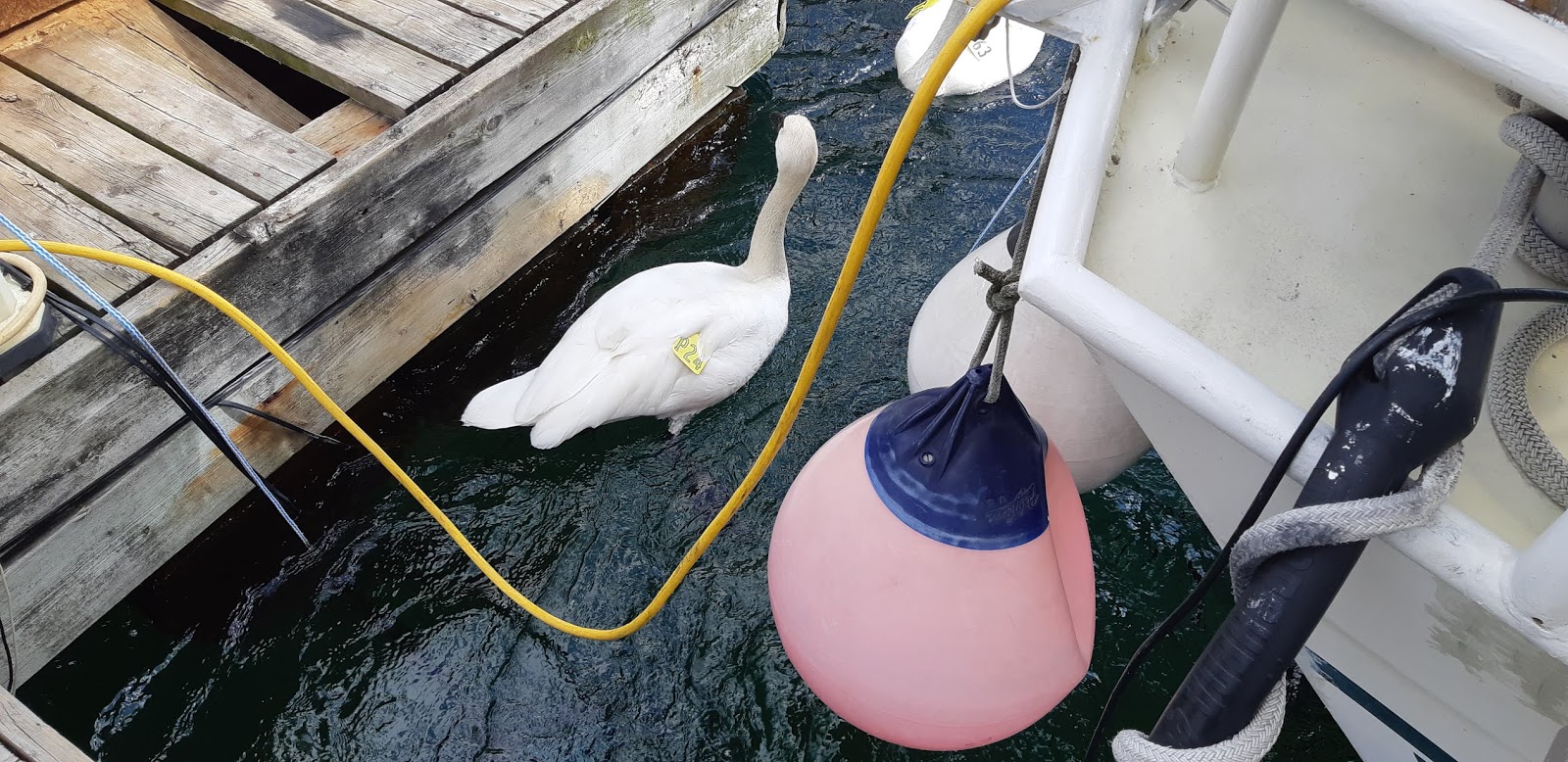
Mrs. Alchemy, who stopped being a wildlife rehabber last week, thinks she recognized the trumpeter swan in the foreground. We were measuring the templates for the chain plates for the drogue bridle when these two rolled up.
We are in our apartment until April 15, at which point we expect to be out of the marina and on the wall at National Yacht Club for a few days to finish up some jobs at the club workshop and generally prep for imminent passagemaking. There's a few personal matters to attend to, but we may be out of luck when it comes to any services or docks available on the trip down, which could make things...well, not impossible, but difficult in some respects, particularly given that it's still very early in the season to live aboard.
Found the prop puller! Now I want to stow it, greased up, in the Ghost Tank just because I hope not to need it for some time.

For instance,  our club, due to the "social distancing" aspect of the current pandemic, is considering delaying the club's boat launching, scheduled for April 25-26, until...who knows? The club is already largely closed for business, although the washrooms and the workshop is open and people are roaming about doing the usual commissioning jobs, but with no sure outcome that the crowds and the cranes will arrive at the end of April.
Another U-bolt firmly placed through the pilothouse roof...it will also serve as a tie-down for items such as the whisker pole.
Of course, we hope to be in Kingston or so by the end of April. We have to continue to work as if that's going to happen, if for no other reason than we will be living aboard, come viral hell or Lake Ontario high water, which, naturally in this year of the plague, is totally also a thing.
The keen-eyed will note that the current water levels  of March 18, 2020, are at the same height as those of April 21, 2019, meaning "high, indeed" and potentially record-breaking.
This adds several considerations to our departure plans: 1) High water levels may threaten yacht club and marina operations severely: fuel docks may be shut and electricity turned off to docks still clear enough of the water to use. Our early start may get us past (if we can clear the locks to more or less sea-level past Montreal), but we can't count on even marinas being open for business if the pandemic is cancelling boat launching plans; 2) The high water is increasing currents in much of the St. Lawrence river and estuary. While this is not necessarily dangerous, it is a consideration that may make getting in and out of marina and YC facilities tricky.
Took a trip by train out to our chandlery of record last week. Had no problem getting a seat as I am The Last Sailor on Earth.
Meanwhile, things are getting altered, improved or fixed. The "outside" throttle shifter was very balky and eventually seized in the shifter part for reasons that remained unknown even after a forensic review with the manufacturer's service tech via phone in Florida. So, not wanting to plate over and redrill fresh holes for something different, I invoked the warranty and got a replacement. So far, so good, but I won't actually hook up the Morse cables of the outside throttle shifter until we "dewinterize" circa the end of March and move the boat to a finger-end for coming and going, which will be after we remove the gradually failing boat cover this coming week. As will most boat things, creating an orderly action plan is part of the deal.

New shifter is identical to the old, save that this, you know, shifts.
Another job of some import is to fabricate and install chainplates for the series drogue. As discussed earlier, this involves cutting and shaping stainless steel bar stock and through-bolting the resultant plates to the hull at the stern.
Crosby G-209A 3/4" shackles with 7/8" pins and a seven-ton working load. I was told that a pair of 5-ton shackles would serve, but the size of these goes nicely with the closed thimble of the Dyneema bridle.
Because the five-inch wide, 1/2-inch thick SS plates are awkward to hold against the sternquarters on a windy day, I hit upon using some much lighter alu stock at 2 1/2" wide, which is what the SS will be cut down to, to measure out where the various holes should go. The idea is to actually make four 2 1/2" wide chainplates out of the two five-inch pieces and to drill all of them with matching bolt holes. Inside the boat, the "spares" will be rotated 180° and will serve as backing plates. The two will sandwich the hull and will be bolted together with six 1/2" SS bolts and locknuts per side.
Apparently, I was holding my phone upside down. The shackle end will be rounded off smoothly to lessen the slight chance of damaging the bridle. The dotted line represents the angle of the stern just below the pipe gunwales.
Meanwhile, back in the boat, I've started to saw this and reinforce that to swing the bed platform in the aft cabin athwartships, as described before, but I also did a small job to aid and abet the new shifter. That was to cut the compartment top for the hydraulic ram area so that the Morse cables for the outside throttle shifter, which also wend their way through there to get back to the engine, could have as few curves and therefore as little opportunity for friction or related hang-ups, as possible.

This involved some fun measurements and a hole saw to make a decent-looking slot. I've saved the cut-out and may tidy this job by restoring it so the cables just emerge from the hole and go straight to the shifter body.
The bed platform will feature a hinged portion that will "go up in the daytime" and will give us about four extra inches of width. More to come on that project as I do some more reinforcements.
The swans persisted. They were curious and unafraid, suggesting the dreaded bread supplement to their diets.
Every day is busy now, and last week saw the arrival, courtesy of a friend driving down from Barrie, of a replacement solar panel for our solar arch, which I will install once the plastic's off and I have easier access to the aft deck.
Now with five extra watts than its predecessor!