|
| It's the most wonderful time of the year! Docklines at the ready. |
|
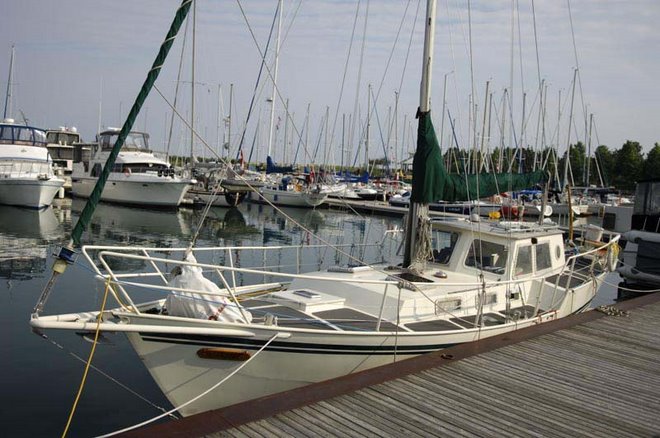
The pins were barely in the steel before I was walking along the reassembled dock to put on my docklines. I've been told that, instead of every previous year when ours was one of the last boat in the water at launch (this year on April 28th), we would be one of the first, thanks to a change in the crane deployments. That means an extra emphasis on being ready to rock off the slings. Or at least, to motor sedately.
 |
| The angle is intentional: the waterlift muffler is not on the centreline. Blurriness unintentional. |
|
Behold the stainless steel exhaust circuit shut-off. It's the culmination of
a long-planned alteration to
Alchemy's diesel exhaust setup, one that (after an appropriate real-life test period) will allow me to get rid of the dreaded anti-siphon loop, which I consider a weak spot in getting water out of the boat, having had them fail on me on two different vessels.
 |
| Yes, skipper, there is something called a "flash". Seen on the right: the anti-siphon valve. Mine's a Vetus. |
I got the idea from Dave Gerr's excellent
Boat Mechanical Systems Handbook, which I endorse wholeheartedly as Damned Useful. In the picture above can be seen the fibreglass "T-fitting", a short run of exhaust house down to a SS ball valve, and a further length of hose down to the waterlift muffler. Also visible is the anti-siphon circuit, the purpose of which is
to keep cooling sea water from backing into the engine once it ceases to use its exhaust to "push" it uphill and out of the boat. Well and good: my diesel is at or below sea level, and is more so on a heel. Water sucked in for cooling purpose via a seacock off the standpipe is perhaps one metre below sea level: anyone who has attempted to hold an inverted bowl full of air in a swimming pool can get a sense of the pressure involved. So the anti-siphon valve, by dissipating this pressure, allows the impeller to send seawater (and the heat it draws from the engine via the heat exchange) out of the boat, combined with the diesel's exhaust. It's why one's boat squirt out the stern, or, in our case, out the side.
 |
| Yes, I like to label. This shows the distance of the valve above the waterlift muffler. The top of the valve ball is just about at the waterline level of the boat at zero degree, or "no heel". This means that very little water can accumulate above it without draining to either side of the transverse exhaust. |
Problems can occur with this anti-siphon valve, however, and
I wanted to avoid complexity. Even though we sail in fresh water, I have had the "plunger and spring" part of the valve corrode and or stick shut and have had exhaust water back into the exhaust manifold,
occasioning the dreaded "hydrolock" and extensive repairs and remediation. That's why I wanted to avoid the issue entirely: that's why, noting I already had an unusual starboard side exhaust, decided to go for a two-fer.
 |
| The new, port-side exhaust outlet being welded into place. |
 |
| It got warm. |
This involved some fabrication: Stainless steel "nipples", Sch. 80 and grooved to better accept hose-clamped exhaust hose, were welded in port and starboard. All credit to A. Barlow, my welder/fabricator of choice.
As mentioned previously, he also did the new galley and head drain nipples in the same, robust form factor.
 |
| Back to the bare metal. It won't be the only time: we're having the entire bottom redone in Nova Scotia. |
The idea was to dispense with the need for an anti-siphon loop at all. This installation means, in essence, t
hat the area of the exhausts is effectively doubled (there's now
two exhaust hoses, not one). This leads to less "back pressure"; the exhaust gases that propel themselves and the cooling water do not have to work as hard to get the mixture off the boat. The absence or negation of the anti-siphon circuit is compensated by the fact that the boat is nearly always heeled to some degree; the downward slope of one exhaust hose leaves the "windward" or "high side" hose open to the atmosphere, which allows the exhaust to exit properly.
 |
| That "T" is as high as it can go at present, but if it needs to be higher, I can make a box for it to increase the slope of the exhaust hoses out of the boat via that removable plate. As I've mentioned, I've been thinking of this for some time. |
Now, this arrangement is neither common nor written about much, which accounts in part for the delay in implementation. Most sailboats have long hose runs to the stern and while that's fine in terms of function, unless the engine's in the saloon, an anti-siphon loop is essential, but the run is long and the possibility of having following waves flood the exhaust is real. That's why I took this route and, let's face it, I was already, with a starboard exhaust out one side, conceptually halfway there.
 |
| About as neat a "bead" as I can manage in tight quarters. |
Tests will follow once launched next week. In the meantime, I've finished the new bilge outlet. This is an above the waterline hole in the boat that takes a plastic fitting. It's bedded outside and in with 5200 Fast Cure sealant, which is the nuclear option for boat glues. But, as Mrs.
Alchemy pointed out, one doesn't want the bilge outlet to leak, and so the big gun was brought out.
 |
| Recycled copper strapping. I suspect the hot water heater will go in the 'blank space'. |
|
While I was down there, I gave extra support to the bilge pump hose, which is rather cheap and may be replaced before we skitter off the edge of the world.
 |
| The PSS "burp line" is better secured now. |
In the process of strapping down the exhaust hose and ball valve, I secured the
shaft seal's vent line high in the engine bay. It is not, in fact, the recommended two feet above the waterline, but coiled as it is, the water would have to be "extreme" indeed to crawl up that line. I have never seen it more than a few centimetres above the seal itself, in fact. Should this become an issue, however, I can easily raise it significantly higher...and drier.
Just because I often get asked about costs, the four nipples (two drain, two exhaust) cost about C$400; the run of corrugated exhaust hose (about 3.5 metres) was about $180; the AWAB SS 44-51 size hose clamps were about $60 and the stainless steel ball valve and tailpieces were about $230. We will soon learn if this was a wise investment.