Copyright (c) Marc Dacey/Dark Star Media 2006-2026. Above photo (c) Marc Dacey. Powered by Blogger.
Showing posts with label Sea peoples. Show all posts

2014-11-13

The myths we share

King Neptune: May require occasional appeasement; sacrifices, perhaps some episodes of transvestism.

The fine author over at Boat Bits had last spring a small note on cruiser conformity. I've had reason to reflect upon the topic of late. I believe it's a truism that even self-proclaimed non-conformists like cruisers actually prefer company...particularly company backed by the bland, Taco Bell-like strains of Jimmy Buffett, although this affliction is not universal.

You can guess my feelings on the faux-piratical works of Mr. Buffett.
Rule of thumb: the more elaborate the hat, the more suspect the religion.

But it's true, insofar as myths go: Cruisers often feel they have broken free of the pack by their choice to cruise. Some even crow about it. It's part of the self-mythologizing of the modern cruiser. It's self-mythologizing in the sense that if you go to sea with all mod cons and are in constant touch via nine kinds of gadget to loved ones and other lubbers. It's self-mythologizing if your boat is on Spot, Marine Tracker and cruises in convoys like ARC. If, to mangle Vera Lynn, you'll never sail alone, are you really blazing a path of individuality through the pitiless waves at the ends of the oceans?

Not that one must, of course. After all, others went before all of us, when it was a lot harder.

Please note there's nothing wrong with this self-image of ruggedness: there's no reasons whatsoever that those who've worked hard to actually get onto a well-found boat (if today's production cruisers can be judged as well-found) should not enjoy their time as they see fit. And, arguably, it's a lot of work to live full-time on a boat, and for most sailors, the amenities are all the sweeter because they often involve more labour than is customary in, say, a new condo. It's just somewhat cognitively dissonant to some, and I am among them, that "cruisers in clusters" should wish to trade one commute (to work and back) for another (to the beach bar and back). The "cruiser lifestyle" so prominent in Mr. Buffett's oeuvre can devolve into a clubby boozefest with lashings of infidelity...or so some tales told have suggested.

For some, it's a sundowner, for others, a way of life.

Of course, it hasn't escaped my attention that this aspect of "cruiser culture" is just a sunnier, sandier version of some local YCs of which I've darkened the doors. The boat, and the sailing, often seem secondary to the activity within the communal tree fort of Permatan Bay. Like attracts like. No mystery there. But being too long among a bunch of self-declared non-conformists (cruisers who've "stuck it to the man" by sailing away from the ol' nine-to-five) can itself grow conformist. It may be something to keep in mind: a sort of "I didn't come 9,000 NM to hang out with the cast of a Freedom 55 commercial" refrain to ward off complacency.

Stock figures: Fifty-five and white is no way to go through life, son.

Now, unless you have been given a free boat and possess a marketable skill (and most skilled people tend to overestimate the "marketable" part), you have to be at least affluent to go cruising in the first place (or that is the general perception), and so former wage slaves with three pensions tend to rule the waves. The same well-serviced demographic can be frequently found spouting off libertarian and/or hippie sentiments while smuggling a disassembled Mossberg in the headliner "just in case". It's funny how a realistic evaluation of how others should act is often the first casualty of material success. Not exclusively, mind you: I've known of a few sailors who have integrated charitable works and educational endeavors into their cruising life, and have "good works" scribbled on their boat's "to do" list, and more power to them for it. But if poor people are annoying, why go to poor countries? Why go to poor countries just to cluster among people just like oneself? One answer is that, with not many exceptions, the reality is that most people who can afford to cruise in the first place are from generally pasty countries where there is a tradition of doing so. Yachting, after all, didn't really exist until aristocrats invented it, and it's trickled down to the upper middle class in the intervening centuries. There are exceptions, of course: people can get cheap or free cast-offs or can made boats out of rubbish and salvage with little but skill and time...but they tend not to sport parrot-themed headgear. Thankfully, I think.


Clearly, the sailing life, whether one is a Napoleonic Era naval re-enactor or the purchaser of a new Beneteau Sense 46, is at heart a conservative one, if not necessarily in the political sense. Techniques and materials are tested and discarded over decades and even centuries in the harsh light of the verdict of the sea: if a way of doing things is inappropriate or ill-suited for its purpose, the very waters and winds will make short work of them, and possibly make shorter work of the venturesome sailor that precipitously employed them.

What may have been lost is the sense is just how selective that conservatism can be, and how for many a sailor such selectivity may be, sometimes, a dead end. We sailors took to Dacron in the 1960s over "traditional" canvas sail material and manila lines because Dacron was superior in nearly every respect: it didn't predictably rot in sunlight and was predictably stronger. We are beginning to shift from steel wire shrouds and stays to PBO rigging and "soft shackles" for the same reason: greater strength, more resistance to "rot" and less weight aloft.

One could say similar things about modern anchor designs, daggerboards, electric auxiliaries and even the sort of things I have been known to make light of, like steering via iPhone or a wristwatch. All new techniques have, in the conservative sailorly mind, not only a battle to establish their intrinsic worth, but a fight against the stolid inertia of sailors when it comes to adapting new techniques, technologies and materials...given that the older techniques, technologies and materials work quite well enough, thank you very much. Dad's CQR is barely rusty!

This is not in itself to be derided: sailors are thrifty by nature and necessity and like to think of themselves as self-reliant and, returning to the realm of myth, perhaps tied to the mast gazing steely-eyed into the face of the tempest. This sort of self-mythologizing goes back to Odysseus, and maybe further, of course. But sometimes the "good enough for Cap'n Grandad" mindset can be a set of blinders to the opportunities of improving one's seamanship or expanding the contents of John Vigor's black box of prudent preparedness.
Don't leave shore without it.

Even the most rugged of invididualists, and sailors tend to think of themselves as pretty independent, boot-strappy types, can forget that we've spent 99.9% of our evolution in small, mobile groups in which innovation was, at best, incremental, and princely solitude usually turned one into dinner. So the myth of the lonely skipper (or the tiny brave crew on the tiny stout vessel) alone against the raging sea with fids in teeth and lengths of jute stuffed into belts is only so if you really work hard to ignore the last 100 years or so of technology.

One needn't be alone today at sea. One can be, of course, and more power to the truly self-sufficient sailor out of easy contact with land and all its snares, but now it's a choice.

This does not obviate or lessen the reality that skipper decisions must still be made, should crises intrude on the voyage. Decisive and prompt actions (and the consequences of same) will likely remain a big part of cruising until such time as crew (and boat?) can be beamed out of the tempest, Star Trek-style.

So perhaps it's time for some new myths to which the sailor can aspire.


2014-07-18

When friends go offshore


S/V Giulietta in Cascais marina a few days ago.
The first saltwater delivery I crewed on was on the then-new Giulietta off the course of Portugal in 2007, as related here. Giulietta is a custom-built Delmar Conde 1200 (in other words, a 40-footer), and she is not only a strong and well-conceived design, but is still impressively competitive, as her proud owner, who goes by Alex Gman on Facebook, will tell you.
A hot boat, and well-crewed.
He's right to do so. His well-crewed (mostly with youthful, fearless dinghy sailors) boat is very competitive in ORC class sailing in Portugal and in fact took first place in 2013, as in "best ORC boat in Portugal" and may do so again this season. This is pretty impressive given that 40 feet is not a huge race boat and that Giulietta's competitors are a bunch of larger Swans and other big ocean-rated vessels between 50-60 feet LOA. He's sponsored by a number of firms, including our mutual friends at Fortress Anchors, who I daresay are getting their money's worth out of the deal, given the steady improvement and persistant podium appearances of their logos.
Alex with old-man sailor beard and silverware, with his more appealing and charming wife Julieta beside him.
Alex and his crew have a new challenge at the moment: getting the light (12,000 lbs.) and generously canvased Giulietta to the Azores for some more racing. As far as I know, Giulietta has not been on an actual ocean crossing, although the Portuguese coastal waters can be brutal enough, as well as sporting a near-continuous line of cliffs and pointy, hard parts.
Alex doesn't believe in reefing...he says it just slows the boat down.
Giulietta is going to the Azores to participate in the Atlantis Cup Regatta in Horta, also known as "the Autonomy Regatta", perhaps because you have to sail across a quarter of the Atlantic to get there. Regardless, I thought it might be interesting to note that Alex, who was once self-described as "not a computer guy" (which is strange as he's a very successful engineer working worldwide) has gone over to the tech-savvy side of sailing, and is using a DeLorme InReach device (think "Spot Messenger" with Twitter-like text capabilities), and is also visible via AIS when within VHF range from the Marinetraffic.com site and also via Vesselfinder.com here.

A fairly typical outcome: Giulietta is in the lead.
Of course, a lot of this fine tracking technology will be turned off (and probably unplugged) during any actual racing, as Alex's hesitations about using AIS and these fairly recent tracking technologies was, as he said to me, "not wanting to give the competition any clues". Which, if sail racing is your sport, is very understandable.

As of July 18, 2014.
Now, Alex is currently reporting (it's around sunset on July 18th as I post this in the eastern Atlantic) strong winds on the bow, i.e. westerly winds. As he has a fine crew, a strong, well-equipped vessel, and is himself an excellent sailor, I have few worries for his five- to eight-day passage, but I do find it intriguing how easy it has become to actually see, more or less in real time, where a little boat on a great big ocean is...and to have them say something to the world from their deck.
Evidently, closehauled on starboard
Would that I could be there...I was graciously invited, but the timing is wrong for work and airplanes and boat fixing. But I find it encouraging that I can follow along, even from the pilothouse of my own docked boat.  Boa viagem e bons ventos, amigo!

UPDATE 14.07.21:  They've arrived in one piece.


2013-08-07

My creator and his destroyer

HMCS Haida, the last extant Tribal-class destroyer, leaving its berth next to National Yacht Club in 2002 and heading for Hamilton Harbour.

Some things are unlikely to be known with certainty, but I do know that my father's World War II service as a seaman on British Merchant Navy ships took him on the dreaded "Murmansk run" in order to to supply Russian allies with needed goods and war materiel, and that the Canadian destroyer HMCS Haida was on the same run. At the same time as my father's runs? I can't say, but for the sake of literary licence, I'll believe it.
A bridge not yet far enough up.
Now, having posited the not easily verifiable, but easily possible, conjunction, I'll move to the factual and note how it's funny how the Venn diagrams of personal history and History with a capital "H" cross. We sailed a couple of weeks ago to Hamilton, ON, a largish city I had never visited by sailboat, despite its proximity to our home port, or perhaps because of that. We were attending a very nice backyard party/jam session thrown by some transplanted-from-Toronto friends. It was also my birthday weekend, and, like a good co-captain, my wife gave me a new chart of Hamilton Harbour.

If yours is the only boat requiring passage under the bridge, the operators waste no time lowering back to the road level.

Hamilton has a large, protected and deep natural harbour; it's no surprise that it became a centre of heavy industry. The protected aspect comes from the harbour being almost completely bounded by artificial moles under elevated highways and roads, the whole pierced by a short but turbulent ship canal spanned by a large lift bridge.

Now, aside from a stellar and much-appreciated chance to steer downwind both there and back (we set a new SOG record of 9.2 knots (!) surfing on the return leg), we got to see a few Hamilton sights of note, such as Brewers Marine Supply, a rather old-school chandlery where I left my PLB for battery replacement,  and we walked from the very pleasant Royal Hamilton Yacht Club to visit HMCS Haida, now a museum ship and the last extant Tribal-class destroyer from World War II.

As said above, my connection to this particular ship is tenuous, but real, or at least plausible. My late father, of whom I've spoken in this blog before, participated in World War II as a teenaged British merchant navy sailor; he was just 20 in 1945, and so had what can only be described as a highly eventful youth. Despite the fact that many of his comrades and friends met unpleasant ends thanks to U-boats and horrible weather, while serving on rapidly and perhaps insufficiently built ships, and the real possibility of death-by-torpedo, he generally had a fairly happy war, centered, as he often said, on the absence of food rationing aboard Merchant Navy ships.
Still in the top 10 list of "unpleasant yet essential" as far as I can tell

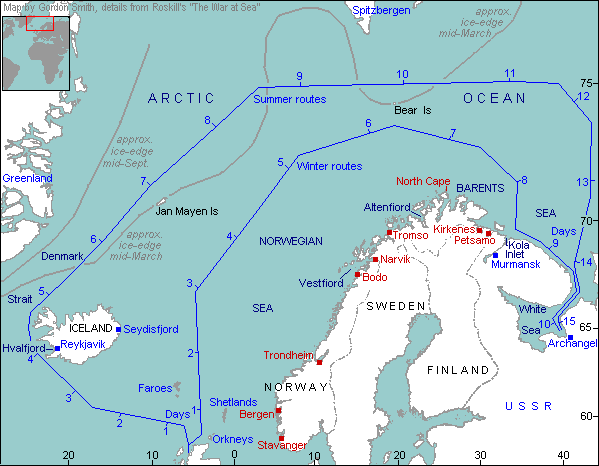
One thing he did not enjoy recalling, however, was the exceedingly dangerous convoy duty he served making the so-called "Murmansk run". With the USSR as an ally during World War II, Britain, Canada and the U.S. strove mightily to supply the Russians with food, fuel and the precious war materiel needed to beat the vast German land forces on the Eastern front. This meant reaching Russia's most northerly port, one acceptably distant from the front lines, and yet one also ice-free and served by rail.
A colourized example of the sort of constant effort to remove the heavy frozen ice from the ship's decks.

The attrition in men and ships was appalling on this particular frosty convoy route. German long-range spotter aircraft were easily able to patrol the route based as they were out of Norway, and weather bad enough to ground them was also liable to sink the freighters in convoy due to heavy ice accumulation and the resultant sudden, devastating capsize. My father commented he was rarely more motivated to labour aboard than when he and the rest of the crew had to knock...with hammers and axes...frozen sea water off the decks and superstructure of his ship in order to avoid a fatal top-heaviness.

The right side matches the description of what I heard from my father.

Enter HMCS Haida. Built to a British design, this jack-of-all-trades destroyer class served in various navies, including the Royal Navy, the Royal Canadian Navy and the Australian Navy. They proved to be tough (Haida was particularly bellicose in her service) and reliable, and provided some measure of protection to the merchant shipping under their care.

HMCS Haida in 2002 being towed from next door to our club to its currrent berth in Hamilton, Ontario. I recall seeing this.

Although I do not have current access to my father's MN paybook to confirm this, it is very likely that he would have been in one of those ships protected by Haida and its sister-ship, Huron. Thus, my father's survival to breed me, some 16 years after the end of World War II, made a visit to see Haida more personal than most touristic days out.
As HMCS Haida would have appeared during World War II.

The strange thing is that Haida was berthed for most of my life (she was decommissioned in the early '60s) not only in Toronto, but opposite our present boat club. She sat immobile, tied up and quietly rusting and barely avoiding the scrapyard, a short walk away, and neither I nor my father saw fit to visit her. Towed to become a permanent museum ship to Hamilton some 10 years ago, I deemed it a "must-see", and a very interesting visit it proved to be.
Mrs. Alchemy and Cabin Boy Extraordinaire, shown to scale
Without spoiling it for those readers inclined to visit (which we would suggest is a very good idea), it does bring home how large and complex a vintage destroyer can be, and at the same time how basic were the wartime facilities aboard.
I'm guessing that the low steel wall here is to divert breaking seas and to keep snapped anchor chain from taking off the legs of crew further aft.

Haida is not entirely at present as she would have appeared if my father had viewed her from a convoy ship's bridge un 1943. She served well into the Cold War, and still sports radar and guns from that time. But enough of her is pure World War II to get a sense of how life aboard her must have been.
Your correspondent's toes contemplating the sheer at the bow.

My hairy little son seemed to get into the spirit of the thing, shouting various warlike invective in his unbroken voice.

I'm not sure destroyers ever called for "RAMMING SPEED" from the aft bridgedeck. Perhaps.

"Captain requests shellfire to be deposited just over there."
ICOM Model 1 VHF, circa 1956

Some mortal coils.

The Captain's quarters were Spartan at best, although I liked the look of the instruments.

Acceptably firm, as per regulation. No lee boards seen.
What? No Zulu time?

The highlight for me, being of a mechanical bent, if one acquired late in life, was a visit below. Yes, I should have used more flash.

This is how the analog world worked, kid.

One of the volunteers in the engine room was a woman who believed herself to be the first female stoker in the Canadian navy. She was exceptionally well-versed on the equipment, and when I enquired whether the steam turbines were the Parsons type, she got quite animated and allowed me to peer into...and touch...the enormous blades of the turbines.
I can only imagine this woman's backstory. She knew every inch of this vast and complex space.
The idea of any of the surrounding piping or engine parts, filled with high-pressure, superhot steam, bursting during wartime, was sobering indeed. 
Note the cotter pins on the mounting stud nuts. Cheap insurance!

I enjoyed the visit to Haida very much, as did the family, and even if you lack a tenuous connection to its history, who wouldn't want to sit on a deactivated torpedo?

Well, they said it was deactivated.

2012-09-03

Tracing one warm line

An uncharted hazard to navigation, but keeps the rum cool
New interest in my country's northernmost waters has been sparked by the news that three sailors in a venerable 31-foot fibreglass full keeler have transited a northerly arm of the Northwest Passage.

http://www.cbc.ca/news/canada/story/2012/08/29/north-northwest-passage-sailors.html

http://www.ctvnews.ca/canada/sailors-take-northernmost-trek-through-arctic-to-highlight-record-thaw-1.937299

While it's not quite the first it's suggested to be, St. Roch and Gjøa having done it before and over a protraced (years!) period...

Gjøa: Norwegian for "damn, it's chilly on this deck"
St. Roch: Were the Mounties not particularly busy during WWII?

...along with a number of powered vessels since, the achievement, in the context of the High Arctic route and the smallness of the vessel, is singular.

Consider that in the '70s the seemingly forgotten Willy de Roos did it in a nearly 50-foot steel sailboat  especially constructed for the trip, for instance. This makes taking even a modified production boat of some age more unusual.

Note the ice-chopper welded to the bow. Now I want one.

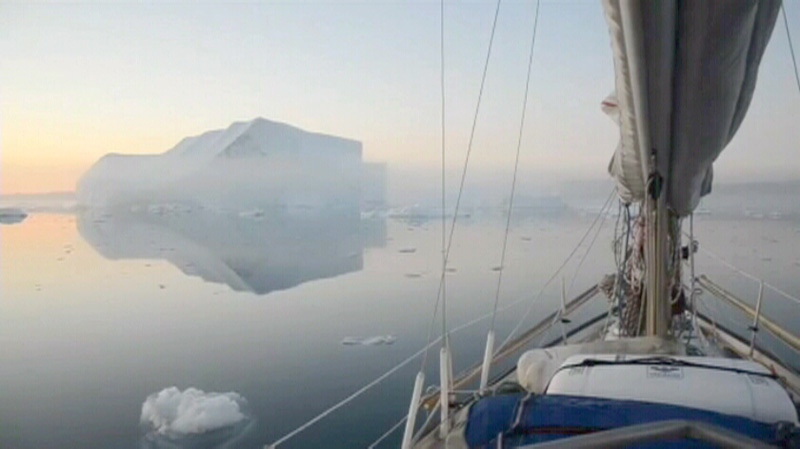
The 31-foot boat and the owner are Swedish, and the two crew Canadian. No sailboat has evidently been farther north. It was not generally considered possible before the hotter, more lightly iced Arctic summers of late.  The voyage was proposed as a way to raise awareness of climate change, and I suppose it's done that, all right. There's plenty of interesting, both to me as a Canadian with knowledge of high-latitude exploration and as the fitter-out of an "expedition"-grade steel sailboat, at the voyage's website here.

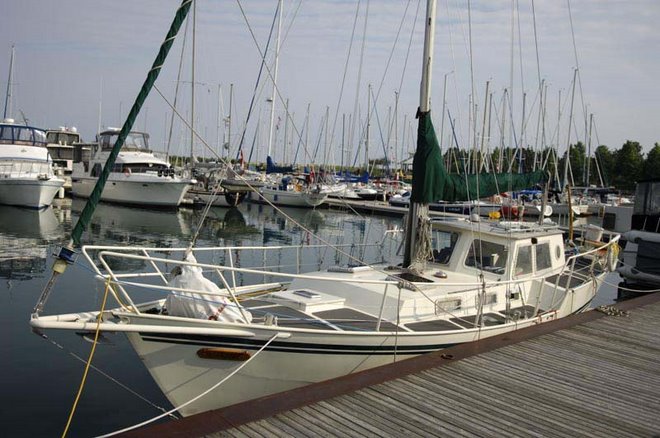
Full keeled like the steel Alchemy, but shorter than, almost as old as, and plastic like, Valiente

It's undeniably stirring stuff, as opposed to deniable climate science. I have to wonder, however, given my generally dubious take on man and his works, if eyes aren't lighting up in the financial capitals of the world with fresh avarice, thinking "well, if a crappy little sailboat can do this trip...". One of the conceptual barriers to the usual attitude of "go forth and suck" in the Canadian Arctic is that the history is very discouraging.

Holy frozen crap.


In a case of interesting timing, the same week a little Swedish civilian pleasure vessel did what killed literally hundreds of the best-equipped Europeans of the last century, Canada's fearless leader announced a drive to find Franklin's sunken and presumably crushed ships. More cheap sentiment with a varnish of science, perhaps, but it is a rationale for sounding the frosty and probably clathrate-littered Arctic depths to bolster our territorial claims to the vastness. Bannock bread and Arctic circuses aside, it's going to lead to better charts. I support, broadly, better charts. Whether I personally visit the place or not, when a deep-draft oil tanker chugs through those particular dark waters, I would desire an outcome that doesn't involve the extremely limited Canadian SAR resources in the Arctic.


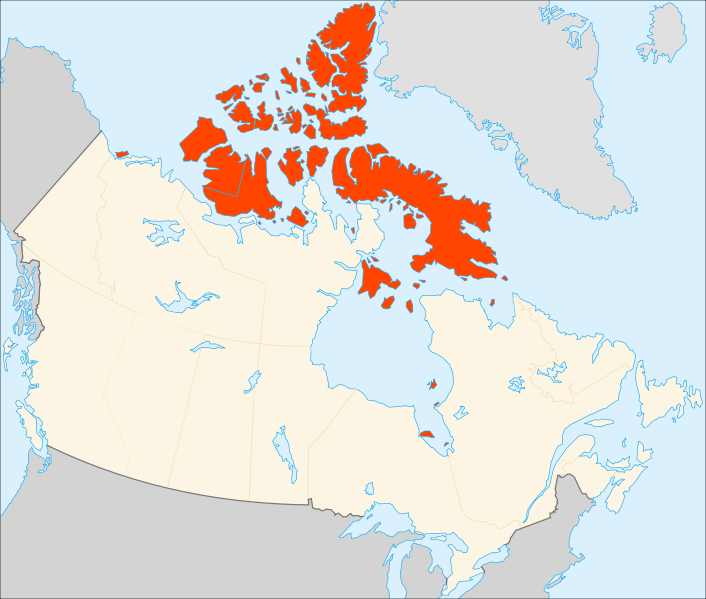
Canada considers the convoluted and incompletely charted seas of its Arctic Archipelago to be essentially domestic/coastal waters, like the waters between Vancouver Island and the mainland of British Columbia. Other countries, including the United States, China and Russia, all of whom have tankers capable of ice-breaking, think the waters "international". In effect, if a tanker breaks up off King William Island and befouls thousands of square miles of fragile Arctic coastline, too bad for Canada: it's nobody's fault. Bad stuff happens at sea, right?

Not actually Canada for the purposes of shipping/resource extraction


So while I can appreciate the planning, seamanship, raw energy and sheer bravado of the crew of Belzebub II, I cannot help but see the achievement as another nail in the coffin of Canada's Arctic territorial sovereignty, of which I am not particularly concerned, but also as a start flag waved in the cause of the industrialization of the Arctic, of which I am mightly concerned.

Pack ice freeing up for slightly longer each late summer is not necessarily an opportunity. The Arctic should remain a daunting and hostile environment for industrial endeavour for the foreseeable future, and because we can do it (see "moon landings"), it doesn't follow that we should do it (no "moon colonies and factories 40 years on").

Who farted?

I find it interesting that some of the same governments that are denying a human role in climate change (China, Russia, the U.S.) are chomping at the bit to extract resources from an area, such as the Canadian Arctic, that has been historically unavailable due to it being too damn cold and icy. And dark. And without nav aids, or, on occasion, reliable compass readings.

Naturally, the paradox of a warming Arctic caused by (possibly and/or in part) human-driven climate change leading to fossil-fuel and mineral extraction that will lead to more cars and gas and coal and smelting, which in turn will...

Well, gentle reader, I sincerely hope the point is taken: The world is run on partial perceptions best appreciated through one eye. The eyelid is lubricated with grease.


Denialism in climate terms is, I believe, multi-part: Denialists have found (and a good thing, too) examples of climate science that is either inconclusive or actually rigged. This leads to ideas that the whole topic is a way to garner grants and to drive social change and "socialist" schemes like carbon taxes.

The climate scientist community has not been well-served here. Fiddling with the numbers or stating that a consensus exists when such is not the case does make the neurons of conspiracy theory light up. Egregious tampering has been uncovered. This does not render the AGW thesis incorrect, but the degree, timing and mix of causes leading to AGW, along with a predictable timeline worth pondering, is rendered, once again, foggy. Planetary climate trends rest on so many variable that it is extremely hazardous, in my view, to make blanket, or smog blanket, predictions of future trends.

The other aspect of denialism, however, is harder to challenge, but perhaps easier to understand, and that is the problem of scale. Understanding how one's driving of a SUV or one's dark grey shingles or gas-heated corn-to-ethanol conversion plants can add up to climate tipping points (shaped or not shaped like hockey sticks as required) is very difficult for individual humans to understand, like accepting that our bodies are composed of ten times as many bacteria as body cells. To consider this is firstly difficult for the generally innumerate citizenry of most of the planet, but also because it is disturbing to do so.

Having a direct understanding of what one's car, furnace, international road transport system, international bunker-diesel shipping fleets, and tens of thousands of dirty coal plants is hard for most people to conceive. Understanding that such sources are cumulative in their output of certain gases and particulates is less difficult to understand, so we are fighting about matters of degree.

The weather is always changing. The climate is the cumulation of the weather. To sail an old, plastic 31 footer through the top end of the Northwest Passage would have seemed inconceivable within my own lifetime. Now it has been done. Something is changing. Whether it represents whether something is amiss or whether we have a large or small part in it is still not fully understood. I have even heard that without the Industrial Revolution, the timing of various orbital cycles might have seen by this point the start of a fresh Ice Age, but even those take centuries to boot up.

Frankly, I suspect that our numbers will kill us collectively before the climate does. Insects moving north and south with drought in food producing areas, and habitat decline on the coasts may revive old diseases or invent new ones. History is replete with examples where humans, even rich, savvy ones, have been quite easily killed off by the most common of climatic events. A less-populated Earth would buy more time, I think, to try and figure out exactly what is happening, our part in it, and whether we have any options in the matter.

The most fascinating part of this latest Nortwest Passage is that they went in a fibreglass boat and not a steel one. That to me says more about the conditions they encountered...and anticipated encountering... then multiple shots of them tanning at 70 degrees north to the sound of melting ice pans, like it was some kind of fortuitous miracle of surprising warmth.

These guys did it in the '80s a lot farther south and it was no picnic. Before them: Hudson.
If you can find this, it's a very good read, and I have been on this boat and knew the voyagers


Even though with only minimal changes in our refitting plans, I could equip Alchemy for high-altitude work, I'm not sure if I want to be part of that problem. I'm not sure I'm part of the solution, however, by not transiting the Northwest Passage, even if it is now, unlike in the time of Franklin, less an impossible dream.

Lastly, this post is an excuse to play one of my favourite Canadian songs.


2011-12-10

Nothing if not practical


This is Ken of the good ship Silverheels III, three or four years now out of Toronto. Astute readers may recognize the boat name appended to many comments posted to this blog, most of them helpful and constructive when they aren't hectoring me to hurry up and get sailing.

Ken and his lovely and talented wife Lynn are currently anchored somewhere in the "insurance applies" part of the Southern Caribbean, and have, as this photo illustrates, fully embraced the tropical lifestyle. In fact, their biggest challenge recently is digging out of the dim recesses of their sturdy Niagara 35 enough musty trousers and long-sleeved shirts to make the trip back to Canada for the holidays without freezing to death on the trip from the plane to the parking lot.

Ken and Lynn are, like most cruisers, nothing if not practical. You fix your own gear (Ken was for many years responsible for resusitating busted electronics gear abused by students of Ryerson University's Radio and Television Arts course, and was in fact there doing it when I was there as a student 30 years ago...only I didn't know him then.) You source and prepare your own food. You hump your own laundry into the tender, and, if necessary, beat it on your own rock, although it rarely comes to that, I suspect.

But the not-so-dirty and not-so-secret of life aboard? You don't wear many clothes at all. When the air below is the temperature of blood, it's practical to save on sweating through clothing by not wearing it at all. You'll only have to wash it later. If you postpone donning a T-shirt and shorts until the cooler evening hours, you might get two evenings' wear out of it. This economy of  treating clothing as a special event means far less expense on sometimes extortionate shoreside laundries, along with a reduction in the chances that an errant wave will douse your carefully packed laundry just as you are coming alongside. If you don't wear it, you don't need to wash it.

Offshore, many folk doff trou upon leaving sight of land or in international waters. Sure, you might have boat sandals, a big, floppy hat and strategic applications of sun block, but there lay undiscovered countries of once-hidden flesh that, in time, take on the all-over golden hue of the once-pallid (if in fact Caucasian) cruiser.

Not that photos of this reality ever make the sailing mags. Everyone there seems to be in shirts they rolled Jimmy Buffett to get, and usually a salt and oil-stained Tilley hat. Little do the lubbers know that the brown, it goes all the way down. I have heard of night watches conducted with T-shirt, harness and tether and not much else, and the T-shirt's only on to reduce the chafing of the harness. Barely sailing? Indeed.

Concerns about moles going funny aside, not only is nudity aboard practical from a clean-clothes conservation viewpoint, but it's arguably healthier than bothering to get dressed in many conditions that the active cruiser is likely to encounter. The damp of sea air, even assuming you don't actually catch salt spray on some part of your clothing, can affect skin to the point of peeling. Salt blisters can form in unlikely places. Nothing ever feels quite dry. So allowing sweat to evaporate directly from one's skin...all of one's skin...means ablutions can be performed with a freshwater swipe of the sponge (conserving water and effort). The breeze, if present, cools and comforts the sailor, although if you notice that a body part is doing a reasonable impression of the arrow of the Windex, it may be time to consider donning foulies.

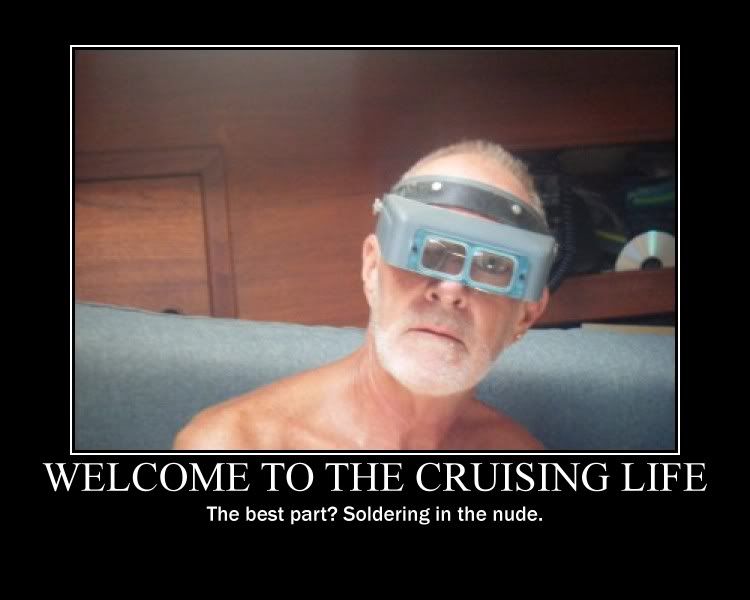
So let's hoist a glass of the finest rum to Ken, Lynn and all other clothing-optional cruisers. It's a rarely discussed aspect of the liveaboard life, and it takes a brave fellow with steady hands to solder in the buff, but it's a healthy and practical response to feeling hot, hot, hot. Boaters with air conditioning don't know what they're missing.

Seeks cruising kitty (Obscure TPB reference).