The process of boat refitting is rewarding and frustrating in equal measure. The reward is in gaining skills and experience that will undoubtedly be required once the voyaging begins. The frustration is realizing that sufficient skills to do some jobs cannot be learned in a timely or effective fashion and that outside help will be required. Such was the case with our desire to replace Alchemy's flimsy and awkward dropboard-style companionway hatch.
That hatch, which mated with the oceanic-grade sliding hatch in the pilothouse roof, was flimsy because it was just a quarter-inch-thick sheet of smoked Lexan glued to a cherrywood lip, which slid into two grooved pieces of wood screwed into the steel sides of the pilothouse formed into a supporting flange. A single kick...or even a modest pooping wave, would have stove it in. Adding to this impression of insufficiency was that the dropboard, relying on mere gravity to keep it in place, was ungasketed: a driving rain or a snow-covered deck would cause water to seep down the companionway steps, ticking off the skipper. The dropboard was awkward because it was either all out or all in, a 16 x 26 inch flat wind-catching rectangle of bother that had no proper home when out and would constantly fall over if not secured strongly. The redesign came early, as did the frustration, because while I could draw what I wanted, as I did with the engine bay hatch (which turned out differently once I confabbed with the fabricator), I did not possess the skill nor the tools to do it myself.
Both frame and door hatch materials were made from stainless steel plate and bar stock bought locally
So Andrew Barlow, fellow NYC club member and welder/millwright/fabricator extraordinaire, was put on the job. He is approximately the fifth or the sixth person with his skill set to have seen and commented on my design, and it is the bane of my existence that I can't despite my best efforts persuade tradespeople to come to work on the boat. Part of that reason is that the work is on a boat: many fabricators are unfamiliar with them and prefer to stay in their fully equipped, predictably immobile workshops and I can understand that. Andrew, by contrast, lives on a vintage wooden power boat during the week, and goes to work in a 24-foot Shark. He gets boats and consequently, grasps (and can creatively critique) my ideas, such as they are. And, from my point of view, he actually executes the work, which is the hardest stage to overcome. I sent the above design to some professional marine fabrication places and was basically told "your job is too small for us to bother with."
SS hinges! The bar across the top was just for support and to keep the pre-welded-in frame from twisting.
As it turned out, there were a few onsite mods required, and the full-on custom approach paid off. Also, seeing a heavy chunk of stainless steel fabrication emerging from the small cabin of a Shark sailboat rafted off my starboard midship bollard proved amusingly nautical.
This piece was "dry-fitted" more than once to ensure as snug a pre-weld fit as could be managed. The only thing I really changed was to nix the fixed port in the upper hinged part of the door, which was dubbed "the cat flap".
The new door was meant to a) take a pooping (over the stern) sea, although that is pretty rare due to the height of the "stern castle" of Alchemy, My job was to take off the painted plywood outer surface of the aft steel plate of the pilothouse; it was held on but simple galvanized studs and plastic battens and was construction-grade exterior plywood sheathing. It wasn't going to be missed. I also sourced after much searching the beefy "hatch dogs" that would act both as handles to the upper and lower parts of the companionway door, but would also secure it, thanks to the magic of compression, against seas and, with the addition of a locking mechanism, potential intruders. I am a big believer in deterrence in the sense that if you make your already clearly metallic and industrial boat more metallic-and industrial-looking, thieves will move on to the airy and bright Beneteau with the beautiful paint job three moorings over. Nobody wants to steal a dirty hammer.
This relatively minor sub-plywood rust has already been "Ospho'd" and painted. A decision about insulation and further covering this will come later when some other decisions, like where to put the propane supply, are made.
As is customary with jobs like these, I want the welder to do welding. Cleaning up the surfaces, removing the flammable stuff and making sure the beer is cold are my jobs, as was running a "clean" 15 amp 12 ga. line to the power post as the compact Miller welding machine kept tripping my onboard breaker.
Amazing to watch, if indirectly, Andrew was the perfect combo of fast and fastidious.
I'm only part-way through educating myself about welding, so welding chat with Andrew was confusingly technical but illuminating, as was the combination of stick tack-welding, as in the above shot, and MIG welding with stainless steel wire to "fill in the gaps" later on. I was impressed by the quality of both Andrew's gear and his technique. I don't have the shop nor the experience to have made this job a reality.
An early fit: We learned that the massive dogs would interfere with the flap lying flat enough to open the whole hatch enough. They would themselves get ground down a bit.
A note on the design: As can be seen, Alchemy's pilothouse roof is not flat. Like its deck and its solar panel arch, it is curved to shed water more effectively. This means, however, that a single-plate companionway hatch door hinged on one side cannot open beyond 90 degrees to the roof. To do so, a second hinge must allow a "flap" (dubbed "the cat flap") to fall forward so the whole door can nestle under the overhang of the pilothouse roof. Such a door is known as "a Dutch door" and was inspired by one used by long-time cruisers and writers Evans Starzinger and Beth Leonard. Besides solving the opening issue, the cat flap allows a nice 25 cm. opening for ventilation and communication between sailing helm and pilothouse in all but severe conditions.
Some discussion about cutting down these handles was necessary.
That was the theory, anyway. Much of my refit journey has involved making virtues out of necessities.
More lining up revealed a gap in the plate that Andrew would fix.
A couple of fitting and modification sessions later (during which I had to take apart and reinstall the old crappy dropboard pieces so I didn't leave the boat wide open), we were largely done.
This flange on the cat flap comes just inside the overhang of the sliding hatch.
In the photo above is the flange that mates with the underside of the sliding hatch when closed. Gasketing may be required here, but it will be hard to do permanently until I physically bolt the pilothouse back down later in the summer after installing several necessary wire runs and after using HDPE plastic, butyl stripping and Tef-Gel-isolated bolts to dog it in place.
The stainless steel part: Filling the gaps between frame and bulkhead with molten wire.
That visible rust is what happens when you grind SS with a non-SS wire wheel: residue.
After Andrew's part was finished, I had a door that would open, close and flap down, but nothing particularly tightly. That part was on me. I cut, fitted and glued rubber stripping and an HDPE strip of thin stuff (1/32nd of a inch thick) to make the door have a compression fitting to block water ingress, and then I fabricated out of UHMWPE triangular wedges against which the dogs could further compress the door at four points.
Needs a daub of paint and probably a layer of insulation, but I got what I wanted.
The wedges are secured by bolts drilled through the SS frame and the mild steel pilothouse plate
The remaining to-do jobs in this respect are mainly cosmetic.We can paint this or insulate it and paint it, and I need to pack the handles with some sort of grease to keep them limber in their nylon bushings. In addition, we have to decide if we want some sort of peephole or small fixed glass porthole to let in light when the boat is sealed up here. Also needed is some sort of means to hook or otherwise capture or restrain the entire door when it is fully open at sea ("fair-weather mode"). Still, it's been a big advance and clearly, a long time coming. Yay us!
Roger Pratt, whose cruising ended abruptly in St. Lucia.
I hesitated to complete this post, although it's been six weeks since I started it. But it would be Pollyannaish of us to fail to acknowledge that, in addition to the hazards of nature, there's the potential for trouble when one anchors in Paradise. The fact is that many tropical locales are not safe for foreigners and that in some cases the more active sort of resistance to unwelcome boarders can get you killed. I'm not talking about pirates off Somalia, however: I'm talking about being boarded underway or at anchor in some of the most cruiser-dense waters of the world. And, for the record, I won't get into a gun debate here: that's rarely an option for non-Americans out of their own waters. Nor will I specify whether I use Captain Slocum's alarm.
Pictured above is Roger Pratt, murdered by vicious thieves in January off the Caribbean island of St. Lucia. The more I read about him and his wife, the more typical a cruising couple they seemed: retired professionals in their early 60s, mucking about at no great rate in the Caribbean. Before the blog of their boat Magnetic Attraction was removed, the Pratts' entries were benign, the record of an engaged couple enjoying the various islands and people they'd visited, and exhibiting a capable degree of seamanship.
Could've been anyone. It's not common to get killed on one's boat, but it's hard to determine if it's getting more common to have that boat robbed. Data is incomplete, or hard to collate, or is stale or anecdotal. I sense that many cruisers are fatalistic on this score, however. Others seem to feel that the onus is on the cruiser to keep alert and to appear, if not poor, than not visibly rich. Don't venture too far. Don't carry money. Dress down, et cetera. And, most importantly, stay informed and keep current about "bad areas" and avoid them. Of course, this doesn't help if a previously good area turns bad because some locals decide to rob your boat, with a little machete work if the owners are aboard and raise objections.
Frequently seen in groups.
Of course, nowhere is truly safe and everything is relative. I've been burgled here in Toronto. I've also got into some fairly serious physical altercations, although those are now far in the past. I consider myself reasonably prepared to throw a punch or worse, particularly if my family is also threatened. But I'm no spring chicken anymore, and on passage we would not be, despite bringing our "home" with us, really on home turf.
You can see the cruise ships from here. Photo (c) Giles Ashford
Be aware that you are guests and are intrinsically privileged
A sometimes unconsidered fact of life is that when a Westerner affluent enough to have the
time and gear necessary to cruise a sailboat shows up in a place where
poverty is general; or even a place where the employees of luxury hotels on
the beachfront live in shantytowns out of sight behind the property line, it's a sort of taunting. Sometimes, when I am experiencing frustrations with the pace of renovation aboard our yacht, I have to think "if your biggest worry is a unco-operative yacht, you may be approaching one per center territory, Chuckles". Upon such sober reflection, my day tends to improve and the clean drinking water becomes extra-tasty.
Nonetheless, I can never excuse the violence, or the
sheer opportunism of seeing a boat as a floating target of looting, but I
can sometimes understand how knocking off a cruiser would seem like a good career move to a person with no prospects. And just as clearly, a lot of cash-flush tourists from the rich part of the planet don't appear to comprehend the nature of poverty, to the point where they don't grasp how staying in a fake slum is grossly insulting. Such folk probably see the planet as one big service industry and there's little else to say except they'd better hope that Soylent Green isn't a documentary.
Take the same precautions as you would at home, because you are at home
We can only make our own
choices based on recent information: it's clear that in some cases there's often a spate of robberies done in a semi-organized fashion;
other times, a fisherman sees a hatch carelessly left open and decides to improve
his material circumstances. In still other cases, boats are robbed while
the crew sleeps, and if you've ever slept on a sailboat, that is a
pretty amazing level of stealthiness!
We can make our own precautions by sturdy locks, lights and radios left on to suggest
occupancy, the retrieving of tenders/dinghies on deck so they can't just
be cut free of the boat, and the lifting up and locking of all boarding
ladders. This is pretty basic stuff, I think, but you have to go to the people actually living aboard, in this case seasoned co-skippers Ken and Lynn of Silverheels III, to get the real scoop. Others have said much the same thing, but perhaps more holistically: it's been a long time since 'a party line' described a telephone installation, but what is a non-DSC VHF call except an all-points broadcast that is easily overheard? The low acceptance of MMSIs and digital selective calling among cruisers is a mystery to me: if you know you are going to hear from a fellow boater, the VHF will, in effect, "ring" and you can move to a working channel without announcing it on Channel 16. Sure, you can still be heard, but you are harder to find right away...and you're not supposed to babble on VHF anyway. Keep it brief and keep your plans to leave the boat unattended to yourself.
Possessing a certain charm, but she'll never be mistaken for a new Jeanneau Sun Odyssey DS...thank Poseidon
Being a less compliant or obvious target is part of the safety regime;
another is being less attractive. I subscribe to the theory that "magpie mind" is an actual attribute of the average thief's thought processes. By this, I mean a compulsion toward shiny objects. I may have mentioned in the past an old bike courier's trick I called "courier grime": cover the expensive frame in filthy band decals or leftie sentiments, and pat baby oil on whatever's still visible. Grind a little brown chalk and blow it randomly on the frame: voila: fake rust! Getting drunk and wielding house paint works, too.
At the recent Toronto boat show, I tried to explain to a marine paint salesdrone how any hull paint I wanted to purchase and apply must
be 100% about durability...not only did I not care whether it looked
particularly good in a strong light, I actively did not want the typical high-gloss look
of the typical fibreglass yacht. In fact, I want Alchemy to appear to be coated in flat and industrial paints, suggesting, we hope, that there is nothing of shiny value is or could possibly be aboard.
Protective colouration, so to speak.
An idea of dubious merit?
It may become necessary in certain popular cruiser locales to go old-school and to keep an anchor watch. Now, I've only overnighted one night in the Caribbean, and that as crew, so no expert, I. But I would certainly consider it for reasons of both security and for the more usual reasons of sheer
unfamiliarity with holding of the ground, oncoming weather, shifting winds and so on.
But it seems logical to me, even in the context of dealing with perhaps young, drunk and/or desperate boat thieves, that approaching a boat with a clearly awake watchstander would be not a first choice.
Let's
make it even simpler: An anchor watch in a fairly full anchorage could be
organized via a cruisers' net to cover only every fourth or fifth boat,
assuming the boats anchored are in some sort of rough array. One boat
with one alert pair of eyes and ears and a handheld VHF on a
pre-arranged channel can realistically "patrol" a number of surrounding vessel. You see a panga coming in at 2 AM and slowingdown? Hit
them with the spotlight. You see a boarding? Light up your boat, hit the
PA and key the hailer and radio.
Every night, the "watch boat" switches based on a schedule not broadcast over the cruiser net. If
the cost of avoiding a possibly violent break-in was having to stay up four hours a night once a
week, I would be happy to be of service.
A few nights (there's no sense that these crimes happen often in broad daylight) of that would really discourage all but the most desperate of thieves, I would think. Others may consider it impractical or insufficient a discouragement. I think if it is insufficient, I wouldn't want to be in that portion of Paradise. Too many serpents.
Apparently, I have readers who worry when the pace of my blog posting slackens somewhat. Often, that's either because I have little to say, or it isn't particularly interesting (or is even less interesting than the usual not-very-interesting boat blagging), or I have to down boat tools and apply myself to money-making for the boat habit. Such has been the case recently.
It's also been the hottest part of the summer, making the interior of the steel beast intolerable even for those, like me, used to panting in its torrid, insufficiently ventilated bowels. Now, if that description hasn't been off-putting enough, I'll recount a recent repair gig on the old plastic fantastic, Valiente.
A boarding ladder bought last year to replace a previously busted ladder itself improvidentally folded the wrong way while I was descending for a swim. I'm considerably lighter than I was this time last year, so I blame shoddy construction. Irrespective of that, getting back aboard was a trial and I bear the bruises and cuts to prove it. So I determined to do better, meaning sturdier and stronger.
In our part of the world, ladders are required for the purposes of rescues, for which having at least one aboard is a mandatory safety equipment item, like flares, and of course for swimming and reboarding a boat at anchor. There are many ways to mount and deploy the many types of boarding ladder, which range from simple rope ladders...
Uh, no.
...to heavy duty welded jobs that would suit the stern of Alchemy...
Novel is also expensive, although I think firemen use something like this.
All of which got filed for when the time comes to address this on Alchemy, probably at the same time I address the conceptually linked issue of "what mast step can possibly fit my giant feet". In the meantime, Valiente needed a new, unbusted and stronger ladder for the preferred amidships location (the stern is too narrow in my view and too hard to access for backing plates to bolt a ladder there).
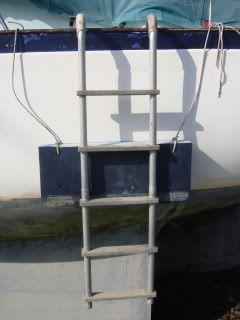
Due to a chance perusal at the chandlery where my wife works, I picked up a ladder not only of a type I had yet to see: a gunwale-mounted aluminum ladder that was light, of a good width and which folded vertically.
Nice and long, too, meaning a couple of steps are below WL
This ladder, the maker of which is not on the label, was the right price by virtue of looking pretty industrial and having hung, neglected, on the wall of more stainless, hot 'n' happening models. Maybe it's for a dock. I am indifferent. I want its functional length and its stowage compactness.
Ignore the general grubbiness. This was prior to a Big Summer Scrub/Debirding
Looks like a real house ladder, doesn't it? For me, this is a Good Thing, given how lame and plasticky swim/boarding ladders have seemed to me.
See previous repairs and former mount points. Also 40-year-old chrome on bronze. Sigh.
Installation was straightforward, if longish, as I decided on a proper "drill 'n' fill" process of oversizing the mounting holes, isolating the balsa core with thickened epoxy (West System) and then drilling the proper-sized bolt holes (3/8") through the resultant "hard core".
Slightly blurry...or was that the epoxy kicking?
The mounting plates were sealed around their edges with 4200, as were the bolts themselves. As the bolts are snugged down, the "bead" of sealant climbs up the threads, making a further gasket of sorts under the bolt head and in the drilled hole itself, without mucking up the part the nuts and washers go on. This greatly lessens, for the years I've been doing it, the chances of rain or seawater migrating below, which can really ruin your Little Library of Boat Repair, in my unfortunate and pre-smartening-up experience.
Evidence of my previous labours
After letting the epoxy fill cure, the holes were drilled and "backing plates" in the form of largish fender washers were installed; my son held the bolts still while I used a 1/4" ratchet driver to dog down the nuts to an acceptable degree (Note to self: must get a "clicky torque wrench" in order to quantify "acceptable degrees"). The line of larger bolts running aft is the port genoa track, fixed after it tore straight out of the deck at 28 knots. Has not budged since the recore and remounting!
Might have to consider repainting the interior at some point as this is getting old.
A closer look: The tape was there to keep the epoxy from dripping, but leaving this piece in place is a tell-tale. As it is paper painters' tape, if it feels damp, you've got a leak and a sealing job ahead. Not damp so far after several drenchings of mid-summer intensity.
Will swim shortly, applying the ultimate field (stream?) test
The finished project looks good to me and packs down even better into the starboard cockpit locker than did its crappy forebear. I saw on a sailing forum an idea to get the ladder more vertical vis-a-vis the turn (in) of the hull by lashing crosswise a foam pad or a small fender under the ladder. This sounds like a smart (and cheap!) idea I will employ.
Cleverness courtesy of Cruisers' Forum's "David Old Jersey"
Once again, needful work on Valiente leads to applicable solutions (or at least, bad ideas probably avoided) on Alchemy.
Despite the oft-repeated goals of cruisers to laze in hammocks drinking out of pineapple mugs, the cruising boats used to get to hammock-positive locales are increasingly complex machines.
One could easily neglect to check certain dials, digital displays or indicator lights on the modern boat, and thus fail to note (or have the watchkeeper fail to note) engine overheating, low oil pressure, water ingress or some other potentially fatal condition, like a propane leak or CO build-up, requiring immediate skipperly attention.
A personal favourite
Having had low oil pressure and cooling water overheating issues on our boats in the past, I am a fan of early warnings. There's a gas/propane sniffer on Valiente, along with a CO detector. I typically check for "output" of cooling water at the stern and eyeball the temperature and oil pressure dials of the very basic Atomic 4 control panel, and so haven't bothered with buzzers. On Alchemy, I will install more alarm setups because more of the critical systems could self-destruct without immediately noticing the process, and also because, frankly, there is a lot more at stake than aboard a Lake Ontario day sailer.
Voice recognition, as fans of "Siri" know, is a thing of the present. So why should a host of boat alarms buzz with essentially the same range of tones?
It should not be massively
difficult to replace that growing host of various buzzers with the sort of circuitry
that is found in “talking/singing birthday cards”, or “talking seatbelt
alarms” in cars and the like. Or to rig just the chips capable of holding a two
or three word message, along with a small amplifier, to make a personalized alarm.
Imagine hearing instead of
some random buzzer in D sharp, you heard your own voice saying “Fuel
pump overpressure!” or “Bilge past six inches!” or the very useful
“Exhaust temperature past 100C!”
If one did not wish to actually record specific messages, one could
simply throw in random…but distinct…noises on pre-recorded chips, like "birdsong means bilges", or "fly buzzing means fuel", and so on.
It’s the
distinctiveness of the alarm noise that is desirable. Buzzers tend to sound alike, because
they all come from the same factory in China, I would imagine. Voices...now, the human mind zeroes in on those in terms of direction and content far more easily. Of course, if you find the idea of a verbal alarm a little creepy, there are some less buzzy options.
Picture combining the “talking alarm” with “The Clapper” for a shut-off, and
you’ve got the basis for a marine products empire where the average
customer’s age is already well past “I should’ve worn earplugs during
that Alice Cooper tour in '72”.
Personally, I am not quite that age, myself, and due to plenty of deafness in my family, I have both nursed my hearing and had it regularly tested; it appears I'm in good nick. Spend time at an average boat club, however, and it's clear a large percentage of Boomers have listened to a few too many booms to hear their pants ringing in anything but a dead-quiet environment...which the sea is rarely.
Like my idea for dim, five-second red LEDs that would be triggered by
movement across the sill of companionways at night, or a 9V
battery-powered, reed switch-activated, under-lid LED locker light, I do not see a
strong objection in cost or complexity of a “talking alarm” to easily
distinguish what part of the boat’s systems is complaining.
It only sounds like Star Trek. The actual electronics involved would
not be beyond the average electronics hobbyist, which most cruisers
already are, because they can't afford not to be. I built kit shortwave radios and repaired my guitar amps as a teen and still do various electrical bench work (I'm trying to reboot an old Furuno radar I found, for instance); I don't think any of this at the level of "home-brewed" is very difficult to rig. If someone's already invented these sort of gadgets, I would enjoy hearing about it. Just not in the form of a buzzer.
"I'm sorry, Skipper, I can't unlock the rum cabinet."
About two and a half years ago, I posted my thoughts, immature as they were, on what I suspected was the reality of self-rescue on a sailboat in the middle of the ocean. By "self-rescue", I mean a way in which the solo sailor, having fallen off, can reboard his/her vessel, or how a single and perhaps smaller member of a couple can retrieve the big dope that's slid overboard in the night.
It starts with understanding the difference between EPIRBs (a beacon
for the boat) and PLB (a beacon for the body that has fallen off the
boat). This video explains it succinctly:
It
is quite conceivable that if you came up on deck 200 NM offshore to
find your PLB-equipped crew missing, you would a) call a MAYDAY on your
SSB and VHF, b) hit the EPIRB to get a plane in your general vicinity,
and they would c) attempt to zero in on the PLB signal, which is
normally weaker and of lesser range than a boat's EPIRB.
I was of two minds then, and I remain so today, with a couple of caveats and an evolving suite of MOB devices to blame for the rethink. My original position was, and remains, to stay aboard the boat. Sounds easy, right? Obvious, even. And yet people fall off boats all the time. On the Atlantic delivery I crewed after I wrote the original post on self-rescue and problems I saw with getting someone back aboard in bad conditions, the boat came off an odd and higher wave while the AP was on during my middle of the night watch. I had been watching the stars, so brilliant at sea and had been lying on my back. The boat slid, the cushion I was on slid, and suddenly my feet were under the lifelines and my backside was on the toerail.
Then the tether went twang. I stopped my slide with my feet washed by the waves of the sudden, clear-air gusts or rogue waves or whatever the hell it was that threw us over without warning.
I was able to quickly haul myself (and the cushion) back, switch off the AP, and actively steer back to our course. By the time the skipper appeared, all was well and I had re-engaged the AP.
But it was a lesson or a warning. I never failed to tether on in the Atlantic when on solo watch, because intellectually I understood that the likelihood of finding someone on a moonless night with 10-12 foot waves was pretty low. I could be pretty far astern, and injured, before anyone found me. The PLB might...might...have helped, but we were between Bermuda and the USVIs at about 63° West, and likely beyond SAR aid. Past Bermuda, I saw two ships, at a great distance. Maybe. Could've been a UFO.
So stay aboard. Don't cause your friends, or SAR personnel, or even your crewmates to play what I grimly termed "spot the corpse". Believe in your saviours: the tether, one hand for the ship, the PFD and the Personal Locator Beacon...wait, what about that PLB?
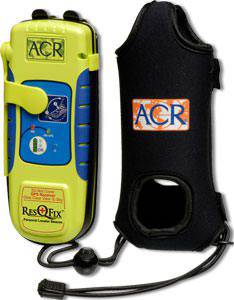
I still have that ACR "Res-Q-Fix" PLB. It lives on Valiente during the season, because while it's not an EPIRB, it's better than nothing. I wear it when I sail solo, again because it's better than nothing. But it's five years old now, and it's due for a battery replacement. I have to wonder, in light of PLB technology's "cheaper and more features", if it's worth bothering. (Since writing this, I found a place in Hamilton which will swap out the battery, so that and visiting HMCS Haida are reasons to go to The Hammer.)
The manual operation aspect is an issue, as well: If you are knocked out or have broken fingers (not a crazy assumption if you were knocked off the boat), you are going to have issues activating some of these units once in the water. It's a two-hander job.
So are the new style of near-range "life tags" the way forward? That depends, I think, on comparing features.
I don't know if devices like these are practical, but as we creep closer to our own ocean adventure, I do consider them in the context of overall crew safety at sea.
While I agree that the majority of sailing done is coastal and within
reach of such SAR resources as may exist, I am thinking specifically of offshore use,
where the distance exceeds the range of SAR personnel, and the odds of a
person being alone at the helm in the middle of the night is greatest,
and it is this possibility of having to be the only possible rescue
vessel in the area that I am thinking of.
The short form is that these beacons incorporate AIS and DSC signals to aid boats in turning around and locating people in the water. They can sound an alarm if the wearer gets more than, say, a boat length away from the AIS.
It's interesting, even if the two-mile range seems short to me. Obviously, it's only for multi-person crews able to physically retrieve people from the water, which means that a) there's a ladder or Lifesling or other means of getting them aboard, and b) they aren't so injured that they are unable to aid in their own climb back on deck, and c) conditions allow coming alongside a person in the water without slamming them further or chopping them to bits with the prop.
Point goes to staying aboard. On the other hand, with a "proximity beacon tied to the AIS, you know if somebody is off the deck very quickly. Even if they are passed out and have a broken arm, guaranteeing a hard recovery, the search aspect would be the smallest part of the operation.
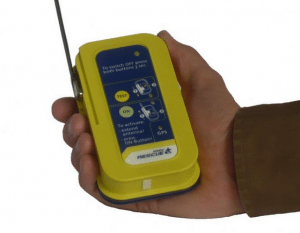
Different AIS-SART, same hand?
That aspect is better this than waving a sputtering penlight, I suppose. Yelling is right out. Anyone who's tried to shout from an aft cockpit to the bow where the anchor handler is knows this is true.
On the other hand, in a heavily trafficked area such as Lake Ontario, I actually would prefer what I already have: a submersible VHF with which I can directly shout MAYDAY on Ch. 16. My Standard Horizon 850 gives me not only a radio that can float/take a dunking, but can also give me a lat/lon thanks to an integrated GPS. The likelihood on a summer's afternoon near Toronto is that I would be hauled out by another boater monitoring Ch. 16 and halfway back to my own boat before I saw the yellow helicopter.
But that's not really the scenarios for these gadgets. They are more-or-less designed for offshore. More presumptions include that:
a) all crew on deck are wearing these devices at all times.
b) the devices themselves are always charged and functional, meaning they are
"always on" in a sort of "guard mode" until lack of proximity to the AIS
transceiver sets them to "active mode".
c) that you keep your AIS on continuously in order to hear the alarm.
It may be the case that the ideal solution is for a PLB/GPS combined with a
two-mile COB beacon, allowimg the greatest number of options for
"self-rescue" or thanks to the more typical guys with the slings in orange helicopters. I wonder
if a simple clamp and extending, brightly coloured pole (like the sort
on bicycle carts) on the PFD would increase the visibility of the COB
and, if the beacon was on the top of a two-meter pole, would the range of the beacon then be much greater than two miles? I understand also that some PFDs inflate a "soft danbuoy", a sort of inflatable, brightly coloured plastic pole that deploys off one shoulder. That seems like a good idea, but would be only marginally better at night.
That "laser flare" is looking good at this stage. Certainly, what I currently have is enough for Lake Ontario (mostly) fair-weather sailing. But I follow developments with interest, as do I check up on the international standards.
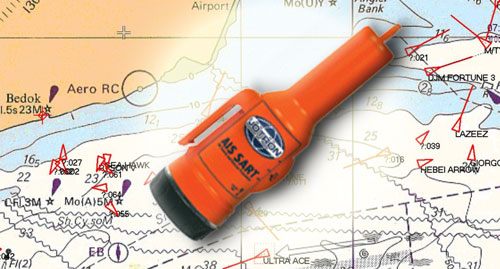
It only looks like a bottle of rum
This AIS-SART technology looks promising, but is it translatable to the self-rescue set-up we are discussing? Dunno. Must learn. Maybe this would serve. It calls your VHF using Channels 16 and 70 via DSC, providing a set of GPS lat/lons. It also has a strobe and can be water-activated.
The "old school" trailing floating rope is an old trick from the days of cork-filled
"life belts". I have read of a couple of cases where it worked (for
obvious reasons, you don't hear about when it doesn't work). A refinement
of this idea is attaching this trailing line via shock cord and a sort
of pin and block to the control lines of a wind vane. The weight of the
line is not sufficient to pull the pin, but the weight of a body on that
line, being dragged at several knots, is. You pull the pin, the wind
vane is disengaged, and the boat (hopefully!) rounds up. You haul
yourself forward and hope you were clever enough to buy the sort of
folding ladder you can deploy from the water's surface.
Again, you have to be fit and largely uninjured and conscious to accomplish this. If you've ever been towed behind even a dawdling sailboat, you know you'd have to possess considerable arm strength to pull yourself forward. Adrenaline might help, but if the water's not tropical, not for long.
You could rig this "release and round-up" to a jib sheet, too, but I
would have to look up how that works in the old 'single-hander' books I
have. It might be only suitable for dinghies.
Needless to say, these methods are in no way guaranteed, but if I was
single-handing on the open ocean in relatively easy conditions, I would
consider trailing a floating line aft. It wouldn't induce that much
drag, and it's cheap, if "last chance" insurance.
It's an interesting topic, to say the least of it. People who
"self-rescue" get to tell their stories. Rarely is a single-handed boat found adrift and uncrewed
in which it's clear how the skipper departed, or why.
UPDATE, 2013.04.13: Of course, all these gadgets are predicated on being hauled back aboard in a timely manner, and from water that will slow the onset of hypothermia. Given the time of year from where I'm writing (early, fitful and sleety Spring), a reality check on falling into cold water is relevant. A couple of article by the excellent Mario Vittone on the equally compelling gCaptain website are worth linking here for the reality of hypothermia's role in complicating self-rescues, or indeed any rescue.
The Truth About Cold Water: A grim but honest examination about some of the myths concerning what a person can and cannot hope to do once off the deck and into the cold sea/lake. In my recent Marine First Aid course, we learned a bit about cold shock and cold incapacitation, and a little bit about post-rescue collapse. But I haven't been trained as a paramedic, just as a first responder of the most basic (and perhaps only) kind available. All I can do is be aware of these factors if a person I can retrieve is appearing hypothermic.
Drowning Doesn't Look Like Drowning: Just as movie heroes seem to have infinite bullets, and Batman's sustained more concussions than a thousand Sidney Crosbys, so many of us have a rather fixed idea of what drowning looks like. This idea is completely wrong, according to Vittone, and you do learn the truth in a proper marine first aid course.
UPDATE, 2013.05.06: Thanks to sailor and long-time reader John Cangardel for sending me this, which I suspect is based in part on a prop from a James Bond movie.
Interesting how at 1:43 the helo spotted him on the infrared...in the daytime. But I cavil. This is, like, the Garmin Quantix I mentioned earlier this year, a bit of a paradigm shift in PLB form factors. Interestingly, it's orientated to calling in rescue resources from afar, not the "self-rescue" discussed above. Is this therefore of most use to solo sailors?
No, Mr. Bond, I expect you to drown.
The Breitling Emergency II model is interesting to me as it shows the convergence of certain types of wearable beacons with pricy, if more quotidian items like watches or brooches, et cetera. Clearly, the day when we have a combination radio and beacon of the Star Trek "communicator" type cannot be very distant. Certainly the widespread popularity of the far, far cheaper SPOT Messengers is a harbinger, and while the SPOT beacons have some shortcomings, they are a terrific and low-priced adjunct to proper emergency beacons; even the daily "I'm OK and here's my lat/lon" message from vessels on delivery is useful to loved ones while one is offshore.
If you sink this close to shore, skip the beacon and just get out and walk.
To my knowledge, there isn't (yet) an AIS-SART in a watch that would alert people that you've fallen off the boat and are bobbing on a bearing of 271 T. Why would there be? Increasingly small devices, now down to not much bigger than a couple of packs of gum, do that already. And yet a watch has the cultural heft of a customarily worn item of "clothing", and doesn't look like a conspicuously bright piece of plastic rescue tech. It looks like a very expensive watch, which, if one is relieved of it through robbery, might reveal the location of the thieves, if only by them fiddling with it!
According to this,
the Emergency II will transmit for 18 to 24 hours. I am guessing it is both
121.5 and 406 Mhz because neither transmission contains a GPS string. I
think an EPIRB with GPS wins in this regard, plus a SART for the last
few miles.
I am also a little suspect at the length of time it
will broadcast. Hit a container in the South Pacific and you could be in
that raft for a few days, even with a working EPIRB and your location
tracked via COSPAS. Interestingly, COSPAS-SARSAT frequency issues are discussed by Breitling, who maintain that the analog 121.5 Mhz signal is still valid for final "homing in".
I also question the need to secure the watch
to the top of the raft (bring a C-clamp in the ditch bag, perhaps?), although clearly one cannot
deploy the antennas and continue to wear the thing. I can see this being
of some use to hikers, mountaineers and back-country skiers,
perhaps...the sort of people unlikely to carry an EPIRB or even a
standard PLB (although that is a good thing to consider if it's the 406
Mhz GPS transmitting kind).
Nonetheless, even a fifteen-grand, short-lived beacon you can wear will appeal to some. Not me, however: I wear a worn Suunto Vector with a cracked crystal, said crystal getting cracked in the first place because the Vector is somewhat chunky; the Emergency II is even larger and heavier. I like my old watch's barometer feature, however. but am considering switching up to a Suunto Core, which has a "storm watch" alarm feature some sailors have reported useful to them in getting sail off before bad weather hits.
Dorky, yes, but I don't have to lash it to the top of the raft to use it.
I can acquire one of these for $250. Of course, many sailors say you can get a perfectly fine Casio for under $50 and not worry. Others go completely "island time" and lose the watch entirely. That's fine, too: I didn't wear a watch except for suit gigs until I got the Vector for sailing use. I use the barometer function a great deal and that feature alone is attractive to me.
For fifteen grand, however, the Breitling Emergency II would just make me more nervous than the possibility of stepping off into the raft. I also can't help but reflect that I could spend the same amount and could ballast the liferaft with EPIRBs that would last a month.
Note that I would not in fact spend that amount. That's also about four very nice liferafts.
This German-made AIS beacon starts transmitting when the PFD inflates, which is handy if you are unconscious, but alive, when you fall off the boat at 0300h.
UPDATE 2015.09.12: As predicted, it seems that the utility of adding AIS to a wearable device attached to a PFD (along with laser flares and other "here I am" devices, is proceeding apace.
While it's logical and indeed expected to note that the majority of my readers are American, some of them might not instantly recognize that I, my family and our boat are not. After all, we appear to speak a common language, and over large parts of the land mass that we share, after stealing it from the natives, it's often difficult to distinguish in a physical or geologic sense where one country ends and the other begins. Indeed, a bone of contention among some of the previously mentioned aborginals of North America is that they don't much care to flash passports at the Canada-U.S. border as in many cases their traditional tribal lands are on both sides of the imaginary line, much of which remains unfenced, and despite various security initiatives, unwatched.
Living in Canada and writing in English on the internet means a lot of contact with Americans, who, when they think of Canada at all, do not see us as a particularly belligerent bunch, as a sort of self-deprecating politeness seems to be our collective sociological trait, where we can be distinguished from Minnesotans or Vermonters at all (save for les Quebecoises, I suppose, whom Americans sometimes think are found everywhere in Canada in large numbers).
And yet like many other Commonwealth countries like Australian, New Zealand and even the Gurkhas of Nepal, we have been and continue to be quite a feisty bunch. The current debate about fighting in hockey in Canada would be unlikely to happen elsewhere, as apart from MMA and boxing, there are very few sports in which out-and-out brawling is considered part of the game. Even rugby is arguably less violent.
Which brings us to Canada's often-derided armed forces. We possess a vast country and a diffuse population, which, while wealthy on the scale of nations, is not really numerous or threatened enough to justify the sort of army, navy and air force that would impress a middle-rank dictator. Indeed, more than one American has alleged that Canada gets a "free ride" in terms of our own military defence, although one might say "a free ride from the enemies of America, perhaps", but that wouldn't be true, either.
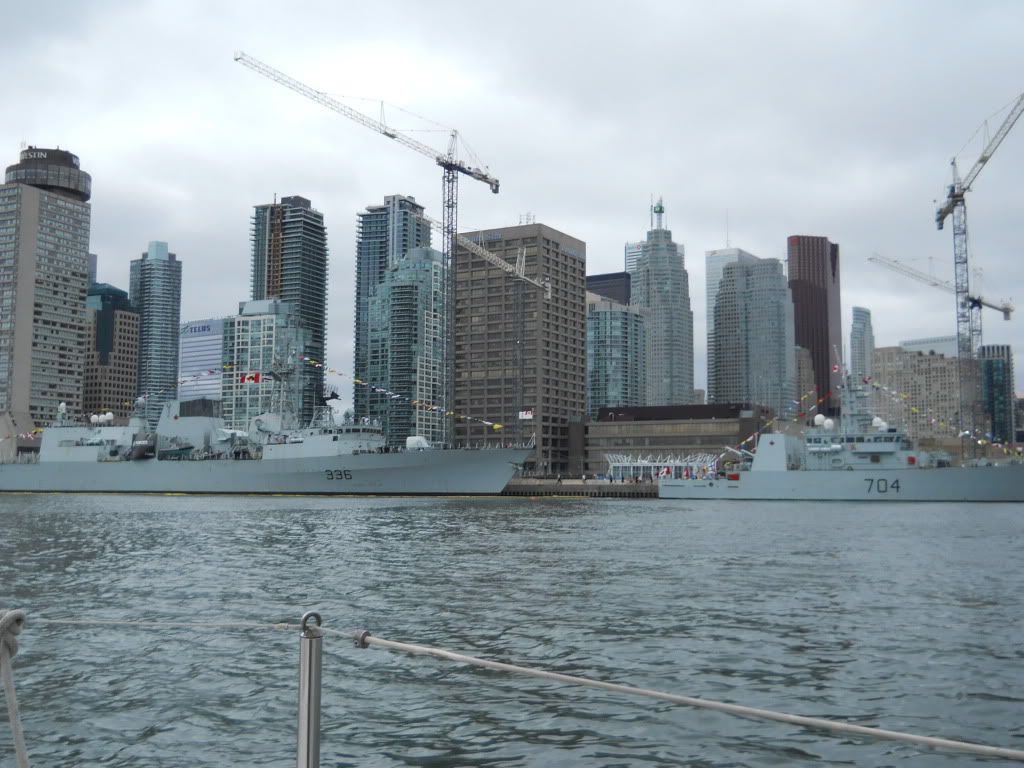
The truth is that our compact military has been at it for years at the a large human and financial cost since the Second World War, during which Canada fielded disproportionately large navies and armies. We once had an aircraft carrier, for instance, but it has since made more sense to have frigates. Recently, as a "last day of summer holidays treat", we saw one of our own, HMCS Montreal. (The other treat was a honking fast sail in Valiente.)
Montreal and two smaller minesweepers are currently patrolling the Great Lakes...for what is not precisely clear, but I'm sure the crews appreciate not being in their usual Atlantic patrol areas in September.
Our son, Mr. Cabin Boy, appreciated the opportunity to see large red buttons reading "ARMED" and "FIRE" and to field-test the rigidity of the deck gun. For a non-taxpayer, he has some firmly held ideas on what constitutes value.
Dad, meanwhile, appreciated those aspects of a 480 foot frigate that have application in his own steel hulk of approximately 1/12 the length...and it's more than one might think. Their liferafts look bigger, but are still recognizably liferafts.
The ground tackle, while impressively sized, was also not radically different in design, although the forces involved in holding something this massive and lofty exceed my imagination.
The "devil's claw", used to secure the chain and relieve strain on the windlass (I guess "capstan" is more appropriate).
It's adjusted with this hulking turnbuckle thingie.
Which is in turn "adjusted" with a Navy-issue sledgehammer.
And the chain goes out via this suspiciously well-polished hawse pipe. Modern warships seem to favour a centerline chain deployment and anchor stowage.
Possibly the only compass I've seen that's nicer than our Ritchie Globemaster, but mine still has the hilariously named "compensator balls". The balls on this one must reside below decks, one assumes.
And clearly, one would prefer to "operate" this part of the ship. Alas, no.
As for navigation, I was gratified to see that they are no better equipped than ourselves in the paper chart department:
...although their RADAR is a bit more elaborate.
...and so is their plotter...
My favourite bit was spotted as we were leaving...HMCS Montreal has an interesting approach to deploying fenders:
No doubt effective!
While not personally particularly militaristic, I come from a family in which active military service has played a role, and I respect the work of our armed forces who are frequently given tasks at home and overseas for which our federal government seem unwilling to finance. The sailors aboard were courteous and well-informed, and seemed to welcome the opportunity to mingle with the public that pays for the ships. Given a world in which future conflict is likely to persist, I hope "big city visits" like that of the Montreal and her sister ships inculcates a willingness to maintain an effective armed force for Canada.
The online log of S/V Alchemy, her restoration, her crew and their voyage
“You never enjoy the world aright till the sea itself floweth in your veins, till you are clothed with the heavens, and crowned with the stars: and perceive yourself to be the sole heir of the whole world.”-Thomas Traherne
"He that has patience may compass anything."-François Rabelais
"The Great Lakes sailor is wild-ocean nurtured; as much of an audacious mariner as any. "-Herman Melville
"[The sea is] neither cruel nor kind ... Any apparent virtues it may have, and all its vices, are seen only in relation to the spirit of man who pits himself, in ships of his own building, against its insensate power." -Denys Rayner
“For those who believe in God, most of the big questions are answered. But for those of us who can't readily accept the God formula, the big answers don't remain stone-written. We adjust to new conditions and discoveries. We are pliable. Love need not be a command nor faith a dictum. I am my own god. We are here to unlearn the teachings of the church, state, and our educational system. We are here to drink beer. We are here to kill war. We are here to laugh at the odds and live our lives so well that Death will tremble to take us.” -Charles Bukowski
"A dream you dream alone is only a dream. A dream you dream together is reality." -Yoko Ono
My wife, my teenaged son and I plan to start voyaging in spring of 2020, plagues notwithstanding, for an estimated five to six years. I hope to move us aboard before that point to work out the kinks of living on a boat.
The careful reader will note the URL of this blog has "alchemy 2009" in it, a reference not only to our boat's name, but also to the original, anticipated departure date.
This is called "tempting the gods of the sea and life in general" and will not be modified. You have to know when to fight, and when to appease. Frankly, it matters that we go, not when we go. This is a good lesson for all aspiring voyagers, I think: the hubris of long-range planning lurks like an evil watermark on every "to-do" list.
Here you will find various notes on our preparations, labours and education as we try to become better sailors in a good old boat. I hope to continue to discuss in this blog the realities of preparing for a marine-focused extended sabbatical, the issues both mundane and philosophical confronting the potential cruiser, and the efforts required by everyone involved to make it happen.
Please note that all text and images on this site are copyrighted and may not be used without permission of their respective authors and creators.
Please note that I have not bothered to resize photos and they may be seen at full size and aspect ratio simply by clicking on them. Some photos formally hosted on third-party servers are not at present appearing; I will locally host these photos as I can afford the time to relink them.
Please also note that anonymous comments are usually spam and will typically be deleted without reading.
Author's text and most images other than product shots specifically created by product manufacturers are copyright 2006-2026 M. Dacey/Dark Star Productions. Photos sources linked from online news and related organizations are copyrighted to their creators.
Middle-aged, bookish Canadian with compact family in process of exploding career and prospects in favour of lengthy, low-rent sabbatical has boat, seeks ocean. Must have non-smoking bilges.
All contents (C) 2007-2021 M. Dacey/Dark Star Productions













One could easily neglect to check certain dials, digital displays or indicator lights on the modern boat, and thus fail to note (or have the watchkeeper fail to note) engine overheating, low oil pressure, water ingress or some other potentially fatal condition, like a propane leak or CO build-up, requiring immediate skipperly attention.
Having had low oil pressure and cooling water overheating issues on our boats in the past, I am a fan of early warnings. There's a gas/propane sniffer on Valiente, along with a CO detector. I typically check for "output" of cooling water at the stern and eyeball the temperature and oil pressure dials of the very basic Atomic 4 control panel, and so haven't bothered with buzzers. On Alchemy, I will install more alarm setups because more of the critical systems could self-destruct without immediately noticing the process, and also because, frankly, there is a lot more at stake than aboard a Lake Ontario day sailer.
Plenty of alarm widgets or alarm systems exist for the cautious/paranoid/typical cruiser, and some are very clever indeed, and cross over into the solenoid or automatic actuator realms.
But I wonder: why don't boat system alarms talk? Cars talk, GPSes talk, even cheap alarm clocks murmur instead of buzz. Even smoke detectors can shout at one. Even personalized smoke detectors exist.
Voice recognition, as fans of "Siri" know, is a thing of the present. So why should a host of boat alarms buzz with essentially the same range of tones?
It should not be massively difficult to replace that growing host of various buzzers with the sort of circuitry that is found in “talking/singing birthday cards”, or “talking seatbelt alarms” in cars and the like. Or to rig just the chips capable of holding a two or three word message, along with a small amplifier, to make a personalized alarm.
Imagine hearing instead of some random buzzer in D sharp, you heard your own voice saying “Fuel pump overpressure!” or “Bilge past six inches!” or the very useful “Exhaust temperature past 100C!”
If one did not wish to actually record specific messages, one could simply throw in random…but distinct…noises on pre-recorded chips, like "birdsong means bilges", or "fly buzzing means fuel", and so on.
It’s the distinctiveness of the alarm noise that is desirable. Buzzers tend to sound alike, because they all come from the same factory in China, I would imagine. Voices...now, the human mind zeroes in on those in terms of direction and content far more easily. Of course, if you find the idea of a verbal alarm a little creepy, there are some less buzzy options.
Picture combining the “talking alarm” with “The Clapper” for a shut-off, and you’ve got the basis for a marine products empire where the average customer’s age is already well past “I should’ve worn earplugs during that Alice Cooper tour in '72”.
Personally, I am not quite that age, myself, and due to plenty of deafness in my family, I have both nursed my hearing and had it regularly tested; it appears I'm in good nick. Spend time at an average boat club, however, and it's clear a large percentage of Boomers have listened to a few too many booms to hear their pants ringing in anything but a dead-quiet environment...which the sea is rarely.
Like my idea for dim, five-second red LEDs that would be triggered by movement across the sill of companionways at night, or a 9V battery-powered, reed switch-activated, under-lid LED locker light, I do not see a strong objection in cost or complexity of a “talking alarm” to easily distinguish what part of the boat’s systems is complaining.
It only sounds like Star Trek. The actual electronics involved would not be beyond the average electronics hobbyist, which most cruisers already are, because they can't afford not to be. I built kit shortwave radios and repaired my guitar amps as a teen and still do various electrical bench work (I'm trying to reboot an old Furuno radar I found, for instance); I don't think any of this at the level of "home-brewed" is very difficult to rig. If someone's already invented these sort of gadgets, I would enjoy hearing about it. Just not in the form of a buzzer.