Copyright (c) Marc Dacey/Dark Star Media 2006-2026. Above photo (c) Marc Dacey. Powered by Blogger.
Showing posts with label Launch/haulout. Show all posts

2020-01-09

The winter of our content rent

 
He's got a fine head of hair, my nephew. And a very nice wife, too.
Time certainly flies when one is having boat. It's been a rather busy time aboard, abroad and ashore, with blogging updates deferred...but no longer! First up was nephew Ryan's wedding to Alex. Despite a bit of drizzle, a very good time was had. Logistics were tricky for us, however, what with retrieving dress shoes from Trenton and me needing a smaller suit thanks to The Boat Diet Plan: Eat less, move more, preferably on a 32C vessel.
A rare shot of Alchemy's two skippers, not giving conflicting orders.
After that pleasant duty came a scramble to secure a winter berth; to secure insurance for said berthing; to secure shoreside accommodation; and to feel more secure about some neglected sailing skills. So we buggered off to Niagara-on-the-Lake, as one does.
Foofy wind, however.
 ...and to Port Darlington for dinner with sailing pals Matt and D-L...
Sunset and rum, a good combination.
 On a rainy day, I even fit in another trip to see HMCS Haida, of loving memory...
In case one wishes to construct a WWII destroyer.
But other needful things beckoned. Our friend and agent for our now-sold house Suzanne Manvell found us a boat-club-proximate flat in late 2018 in which we stayed for 11 months until we moved aboard in June, 2019. Faced with an unexpected winter stay-over here in Toronto, and not Halifax, we asked her again if she knew of a downtown apartment in which we could stay short-term (we expect to move back aboard Alchemy at the end of March, 2020 with the goal of [finally] leaving Toronto circa April 15).

Unexpectedly, she said "how about my house?" Suzanne had a tenant leaving a first-floor flat and we could start renting October 1, which suited us perfectly. Her house is only slightly farther away from our winter berth than was the last place, and there's a corner of the garage suitable for sailbags, bicycles and dinghy sail rigs.
From stair to door is sufficient for clearing out most of the forepeak, plus bikes.
 The place is spacious and bright. We'd best enjoy it as it's likely to be our last "house" for some time.
Available spring 2020!
 Even the Cabin Boy got his dungeon, suiting his slightly Gothic bent.
He eventually got a bed, firm not cruel.
Meanwhile, we had to wangle insurance. Our carrier insisted that "floating, non-liveaboards" needed a canopy, tent or other covering to cast off snow and ice and discourage top-heavy turtling. Now, we have never done this for Alchemy: we've just shovelled off the decks when needed. But I knew where to go: the good crew of the steel ketch Goshawk, Jay and Rob, who live on Frenchman's Bay and who know their business as they are winter liveaboards.
This is from where I took my design cues, but, as will be seen, I didn't go to quite these sturdy lengths.
Jay and Rob do an impressive, generally bulletproof job because they would know right away were it to fail and because a proper covering makes for a warmer boat.
They run PVC tubing to the decks and packing tape as transverse supports. Then they shrink the cover on with a propane torch both impressive and, if not wielded carefully, destructive. See next post...
The bow of the boat need not be covered.

Everyone has the approach that works for themselves.
This "boom attachment point" I pretty well copied directly.
Having received the collective boat-cover wisdom while we were still at National YC (we moved gradually into the apartment during October as we wanted to sail as long as we could)...
Cobourg looking like a mill pond after a fairly gusty passage and a decision to bail out of a straight shot to Waupoos.
...we learned we weren't going to get approval to stay in the water at our club (it was a longshot) and so confirmed our berth at a nearby marina. 
The weather held until late October, save for some weirdness.
 Our slip was wide, but short. Good thing we had plenty of lines.
This was actually helpful when constructing the boat cover. I put together the Portabote and worked around the perimeter.
We also had an unusual 50-foot powerboat in steel from the 1960s opposite, cutting the breeze somewhat.
I don't see many steel boats on Lake Ontario larger than ours that aren't on the job.
 After some exotic maneuvering, we were ensconced.
Note the sails, bagged, tagged and garaged for the winter.
 This was Hallowe'en. The next post reveals what came next.
Have you never seen a horny teenager?

.And it was scary!

2019-05-13

Lurch, launch and all before lunch

Amid frankly appalling (see wind-driven sleet in the tiny clip above) conditions and a case of skipper's jitters regarding the soundness of the standpipe thread sealing...

When access was straightforward, no problem...

...but with this much lead in front of it, a concern.
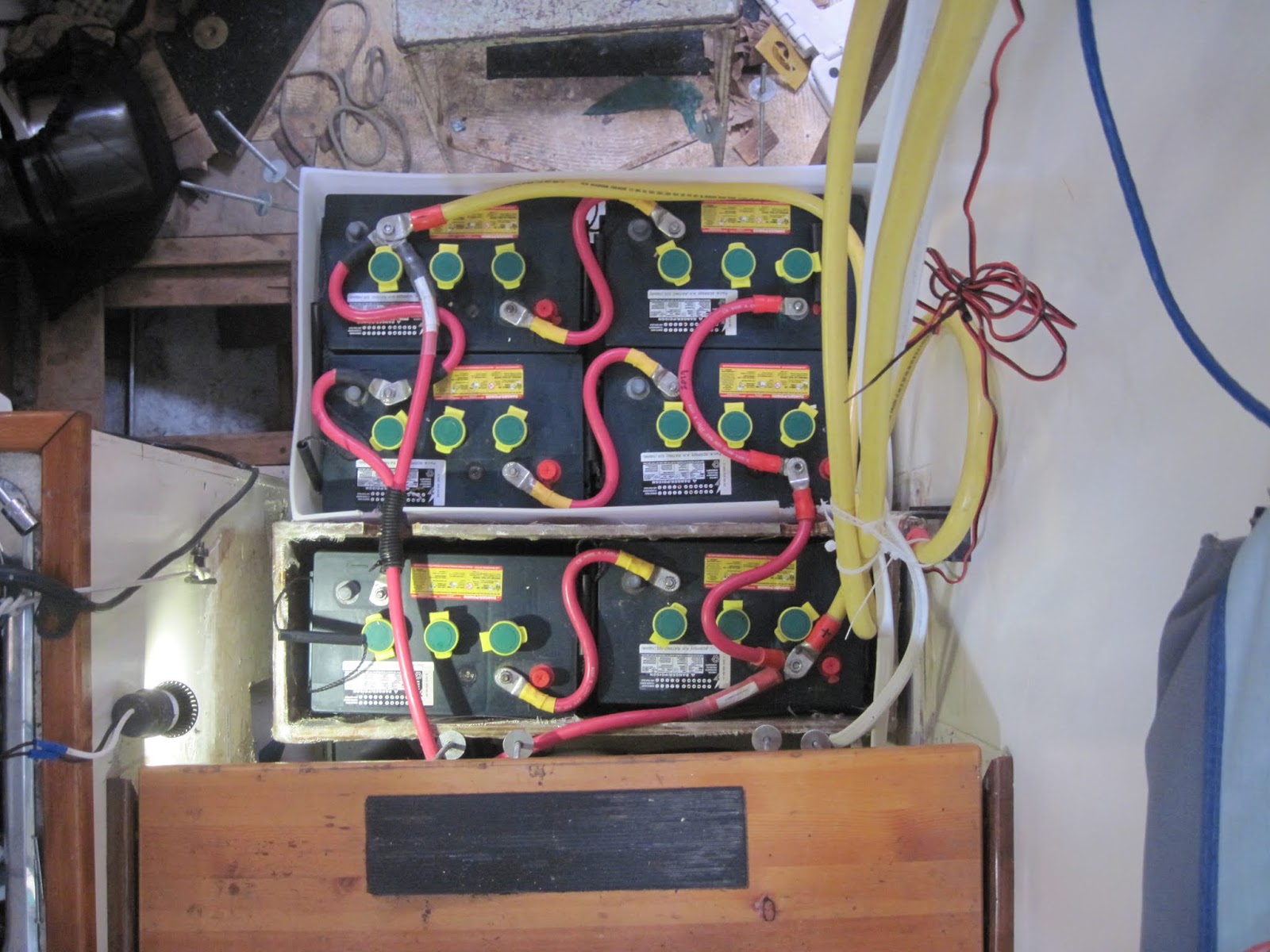
...thanks to the restoration of the house battery bank, seen above minus tie-downs and lids, we launched on April 27. Second boat in, in fact, in the East Yard, winter lodgings of the behemoths of the first row.
Always be cinch-belting!

There's often a touch of ambiguity about our sling marks, as the movement of internal ballast over the winter can be significant.
So we requested, and grudgingly (because launch waits for no one) received "a minute hanging in the slings" to check the integrity of our multiple valvings, tapings and pastings. Luck and, I certainly hope by this stage, skill prevailed and we had no ingress at the many threads in play. That meant I could leave the engine cooling water valve open, fire up the iron jenny (already tested in the cradle as being good to go, the harness and battery connections fully restored) and proceed to our dockline-festooned slip.
Back where she belongs...until July.
As I was on towboat duty, and, inexcusably in my view, a lot of boats this year needed tows (the ones with dead engines/no engine get a pass, of course), I couldn't linger and admire our handiwork, or tapework: Mrs. Alchemy and myself resumed "helping out at Launch".
Shot from mid-morning, this gives an idea of the scale of the cranes employed at launch. Ours is not, in fact, the heaviest boat in the club, an alarming stat for a steel boat owner.
The wind, at times gusting past 25 knots (borderline for crane operations and enough to make Alchemy "shiver" in the slings a few centimetres off her cradle), gave us in the club workboat Storm King plenty to consider. I lost count past 20 tows, but it was near-continuous and increasingly cranky duty. Why can't people ensure their motors work (and have batteries and tillers) on the day? It's not a surprise if you can work a calendar!
Alas, my logo was rejected in favour of cheaper Mac-Tac
After my shift concluded, I got a picture of the effect of Alchemy's winter on the substrate...

No wonder I felt pitched a little for'ard.
This subsidence was, perhaps, aided and abetted by the rising levels of the lake, which led to a group decision to get the mast in as soon as possible.
Two weeks ago. Today, the bricks are partially awash. The lake is 1.6 metres above chart datum.
I had to sort all the wires, cables, strings, stays, shrouds, halyards, etc. and bolt on the spreaders. I'm getting about as fast at this as I think I can. Kudos to the club members who helped with my notoriously massive mast.
It's only confusing if you think about it.
Some chafe-type repairs were needed and the usual "keeper wire" sorting, but it went well and the masting, while heavy work, went without blood sacrifice.

Looks good even boomless, we think.
So, for a multitude of reasons, launch came and went to our satisfaction, even though we needed every minute in the run-up to it and many minutes since.
Postcard-grade, really.
The boom is on, and the new lazyjacks can be seen. More to come shortly as the Drive to be Live in July continues.
I rigged the lazyjacks by copying a picture I saw online. Ah, modern sailing theory!
As a postscript, our former boat Valiente is now sporting a new, stainless steel rudder. We are vicariously anticipating great things of it for the new owner!

Anode goes where? As she's on a mooring, not such a big deal...


2018-10-15

Falling into winter

It was the jib's time, actually.
For Canadian sailors on the Great Lakes, October can be a sad time. The same weather that brings exciting sailing in the form of cool, windy days great for long trips also heralds the five months of the year (here inland at Toronto at least; it's different on the east and west coasts) that our boats are, generally, cradled on land. Decommissioning, which involves at our club demasting, is a fair bit of work and preparation to avoid damage or even injury (our mast may be 200 kilos to judge by the grunting five adults make to get it off the dolly and into a rack).
The naked foretriangle is shocking!
This year, however, is (I certainly hope) the last year we'll be in Toronto for some time, and we are crowding the boat with all sorts of spares and tools we've previously kept in a garage or a related storage space. Making room for every sail we intend to bring has involved a fair bit of planning. And there will be more to come.

I was able on a relatively light air day to take off the yankee-cut jib by myself and to bag it and the staysail in the forepeak. The mainsail removal required Mrs. Alchemy, as the day selected was very breezy (20-28 knots) and only the favourable WNW wind direction that made "head to wind" at dock over the deck, more or less, allowed a reasonably crisis-free stripping and folding away. No pictures, alas...I'm sure it was dramatic from shore!
The pensive Mrs. Alchemy did not, evidently, fancy being in this shot.
Because I need to prep the inward-turning pilothouse flange to restore its roof, I needed to have a look-see. I want to clean up this flange and put a wide strip of HDPE plus butyl tape for sealing purposes all the way around to separate the steel from the aluminum prior to bolting it down; the bolts will have coatings and nylon bushings to keep them from reacting electrically with roof or hull. The roof, although it's aluminum, is a well-built, heavy thing, so I rigged the boom to work with the topping lift to hoist it up.
Needs a clean, but the two-part's intact.
Unfortunately, the imminence of the haulout this coming weekend means I may have to wait until the spring in order to finish this job (paint not kicking well in mid-winter), as without the boom, I would either have to rig a gantry to lift the roof or, as has been the case in the past, find four men willing to lift the thing gently to one side or to find a Polecat crane.
That "polished" part is where the old fluxgate compass sat, and where the new heading sensor will go.
One outstanding task is to regasket the pilothouse roof's opening hatches. Both drip a bit in the rain, and as a stop-gap, I've taped them up.
The sharp-eyed will note I went from the straps to the line. More secure.
Lastly, I brought down the Honda 2 to sit on its designated workshop mount. One-armed lifting and shifting is a beautiful thing. Tomorrow, the mast comes out.
There's a newer 2.3 HP Honda, but I'm not tempted. An air-cooled, 15 kg. 3.5 HP? Perhaps.

2018-05-17

Sticking around

That big radome doesn't look so big up there and seems like it won't interfere with the sails when tacking. That rescue hook is not part of our rig, but of our dock.
When I last posted, it was about an unexpected day-long power outage during which our frozen and refrigerated food was saved by a portable generator. Today's post is about the extensive modification of the mast prior to putting it in, or, in the case of our deck-stepped mast in its tabernacle, on Alchemy. Said extensive modification involved the running of four lengths of wire (two 1/2" thick LMR-400-UF cables for AIS and VHF antennas, one 18 mm Furuno radar cable and one 1/4" UHF-style GPS cable). This proved to be...tricksy.
In order to get a greater bearing surface for the AIS antenna mount, I added a bit of scrap teak to an existing teak pad on the spreader. Saved drilling fresh holes in said spreader.
The prior RG-58 VHF cable was inside a cable-tied length of nasty foam pipe insulation, along with several 14 ga. wires for the various mast-mounted (and now LED) lights. So while I could clip the PL-259 connector from one end and pull the cable out of that half-assed loom (presumably to reduce mast noise and halyard abrasion/fouling, but a pain in the ass for us), I could not use it to "fish" new cable. In addition, the new cables, save for the wee GPS run (which is part of the Vesper XB-8000 package) were considerably bulkier than is customary on Lake Ontario, because they transmit more power to the antenna with less signal loss, a worthy ambition for the prospective offshore sailboat. So that meant cutting holes in the mast large enough to get them in.

Five screws, tidy heat shrinking and no sharp radius. Should work well.
So I had to get inventive. In my garage of Too Many Boat Things, I found the 1/4"(6 mm) forestay to Valiente I had removed in 2013 when I rerigged. I cut off the terminals and I had abour 40 feet/12 metres of reasonably stiff wire. I drilled the VHF hole in the top plate of the mast between the sheaves and, with the coax taped to one end of the forestay wire, carefully pushed it down the mast. Carefully, indeed, because it's a busy area in there and I did not wish to foul halyards or that grubby, if still functional, foam loom of 14 ga. wire.
This is the Scanstrut LMM-2 gimballing radome mount. It's pretty slick, but I had to be careful to get it centered and rivited correctly.
After I learned I could spin the stay to get it past obstacles, the work went slowly, if productively. Together with Mrs. Alchemy, we fished the four wires to the appropriate mast-base exits. After that, it was time to do the radar mount.
A total of 12 3/8" pop rivets are holding this on. Feels pretty permanent to me.
This was mostly just careful work and following the IKEA-like instructions from Scanstrut. Then the usual routine of inking the right spots, using a  nail punch and hammer, followed by the use of a small drill bit and then a larger drill bit, and then the riveting. It took about three hours.
The Vesper AIS's GPS receiver is mounted on the same gimbal as the radome, nice and high.
May we never heel or pitch-pole this much! But I'm ready if we do.
Loads of crimping, chafe-guarding and tidying up later, we moved the mast to the Place of Hoisting.
Two of the delays in getting the mast in were the realization that Alchemy was pointing in the wrong direction and that the mast had to be craned on its "back"
Because I have so many stays and shrouds and must mount rather exactly into the tabernacle, the crane activity can take longer than the allotted 30 minutes per boat, and it's to the credit of my friends who helped me that certain slowdowns (like the inability to retrieve the hoisting line) were dealt with in such a patient way. I need to tell the crane operator I'm going to need an hour next time.
Alchemy unbound: waiting for my turn.
Some frustration, followed by a round of beverages purchased to mitigate frustration, later, Alchemy was back at her dock with shrouds and stays provisionally tensioned....which reminds me, I need one of these.
Nice! Got the full-length battens in unassisted this year, which is always a little tricky.
So the jib and staysail are now in place, as well as the rather good-looking mainsail pictured above. I declare the season underway.  The next steps will be drilling fresh holes in the pilothouse in order to route all those cables to their new devices.