Copyright (c) Marc Dacey/Dark Star Media 2006-2026. Above photo (c) Marc Dacey. Powered by Blogger.
Showing posts with label Testing. Show all posts

2019-08-31

A slight change of plans...

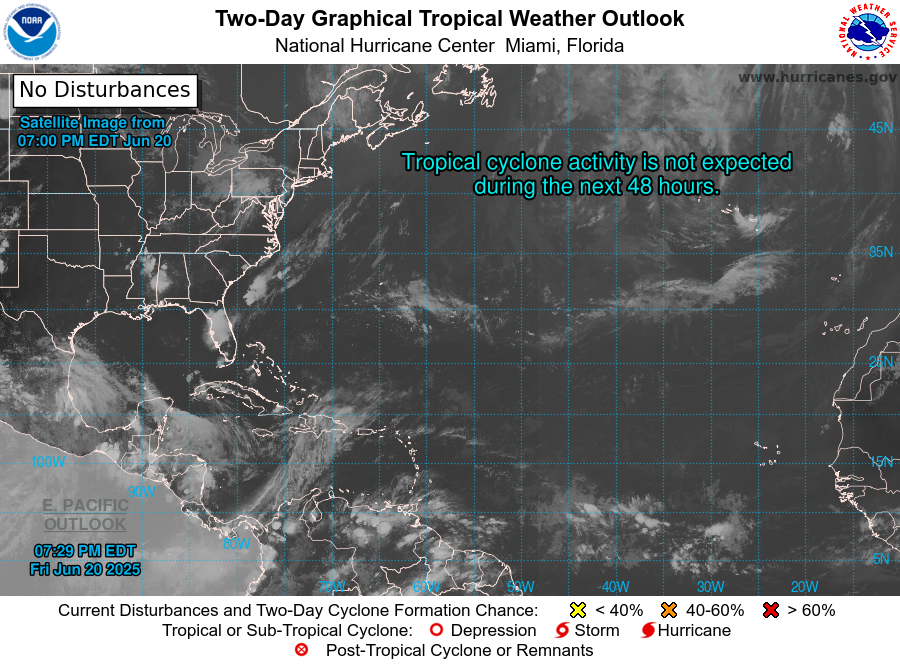
Apparently it's a popular place these days.
This is Halifax. At this point, the last day of August, we had expected to be near or nearish to it and booking interesting activities like apartments and hull treatments. But we've had a very busy last six weeks or so, and while frustrating and sweary in parts, it's also been productive. Two weeks ago, circa August 15th, we decided to overwinter here in Toronto, leave the boat in "layup afloat" (mast in, at a slip, covered over with a frame and plastic and with agitators breaking up the ice) so we can go down the St. Lawrence in spring 2020 without rushing and having honed some rather rusty sailing skills.

Also, there was this factor:

We didn't want to rush to the Maritimes chased by fall gales and not lingering in nice places because we were racing bad weather.

Nonetheless, we've now sailed some and repaired or installed a great deal more. The boat's in good, serviceable shape and we have a good game plan for doing here in Toronto what we would have done in Halifax in less familiar surroundings. We've even got a land-based apartment as I do not propose to sleep aboard the "job site".

Some refitting highlights follow. Amazing what living aboard does for one's productivity!

 It's been a hot summer and we tend to skip lunch. Dinner, however, makes up for it. My belt's needed five new holes since May. Hmm.
So many parameters!
 After a rather steep learning curve with the hydraulic steering, we got the autopilot sorted and properly installed. And attractively mounted, if you ignore the previous generation of gear's mounting and conduit holes.
The rudder feedback sensor took a day to mount correctly.
We are at the point now where the AP steers better than we can, so we let it. Basically, we input a true compass heading and correct to conditions. We derive that bearing by putting a cursor with generous offing near our desired destination and just keeping a watch on events. It's clear that a lot of local sailors are going to some waypoint very close to, say, a buoy or other nav aid. That's not so prudent when two or three of 'em do it at once, we feel.
Lazyjacks took effort: the irony did not escape me.
 Lazyjacks and two separate Dyneema-core reefing lines are now on the main. That's a safety improvement, as are the preventers we can now rig for downwind sailing in blows.
 Fact is, prior to actually leaving, we haven't needed reefing lines. Alchemy can carry a full main well past 20 knots apparent wind, and if we encounter more, we've just gone to the staysail. But all is different now.
The secondary fuel filter: Not, evidently, guilty.
 We had a big delay around August 1, when, while on a test sail in light air, our engine basically sputtered and died and only started again reluctantly and at very low RPMs. We made it back to our dock with difficulty and an odyssey of troubleshooting commenced.
And goat sacrifice to the Dark Diesel Lords.
 Basically, we were:
  • 1) starved of fuel, and
  • 2) the fuel was old and grotty, and
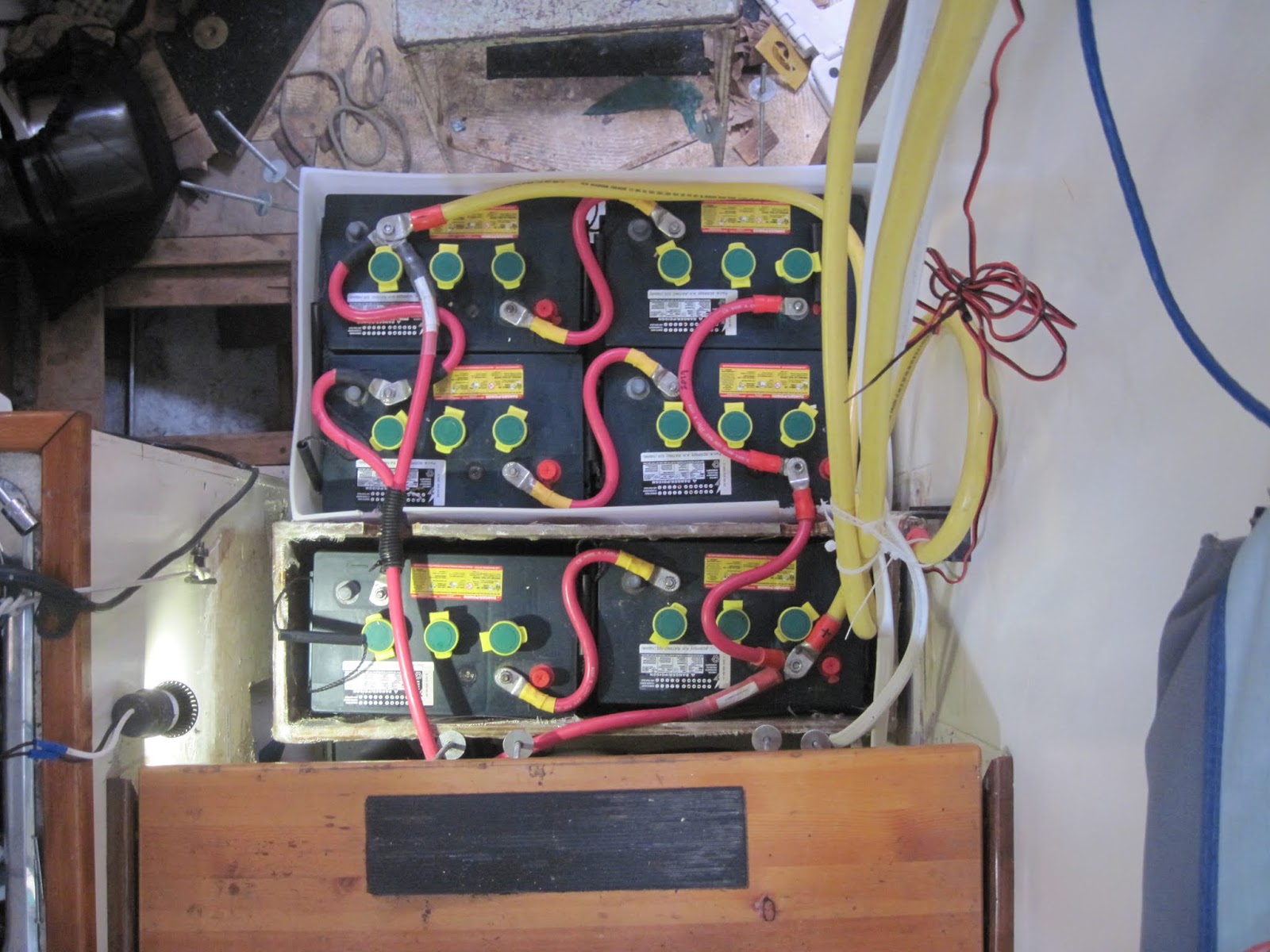
  • 3) we needed to change it all, which involved moving all the batteries to access the tank tops to vacuum out crud, and
  • 4) we changed all the supply side fuel lines in case of said crud, and
  • 5) we installed an inline fuel pump (a Walbro FRA-1, for the intrigued), and
  • 6) we changed out all the filter elements, primary and secondary.

And don't forget the goat.
 Very long, laborious story short, the problems seem solved. We've done about 50 hours of rocky and calm motoring without issue, but it took a very long process and a lot of questions strewn about to the helpful people at the club (and elsewhere, thank you!) to solve Why Won't Beta Purr? I feel we were fortunate not to bugger the injectors and we will be cycling thrugh the fuel...and the biocide for the fuel...moe quickly in the future.
Ahctual crap sailing!
 Meanwhile, there's life aboard. Frankly, it's pretty nice.
My sleep schedule's changed.
 There's a lot of sky watching...
Nothing's ripped!
 ...and practising sailing in various modes...
Scored an end dock. Sweet.
 ...and travel to exotic places. OK, this is Trenton, jewel of the Bay of Quinte and where we keep stuff.
An actual exotic beverage, this was. The brewery was micro, indeed.
 We plan to sail as deep into the fall as weather and insurance allow, to see what breaks or falls off. Best to know here than 1000 NM eastbound, I think.
Cobourg, a harbinger of Trenton.
 A happy side effect of deferring our departure is that we get to attend my nephew Ryan's wedding. That required some collective sprucing up ashore and the acquisition of more formal duds.
Cabin Boy, soon to be Cabin Man.
 Lastly, I put the AP controller on a "helm extender", because just having the thing sticking out of a hole on a NMEA 2000 cable wasn't a long-term game plan. It looks about as nice as I can do with a piece of scrap teak.
The answer was "more helm".
More to come and sooner next time!

2019-05-13

Lurch, launch and all before lunch

Amid frankly appalling (see wind-driven sleet in the tiny clip above) conditions and a case of skipper's jitters regarding the soundness of the standpipe thread sealing...

When access was straightforward, no problem...

...but with this much lead in front of it, a concern.
...thanks to the restoration of the house battery bank, seen above minus tie-downs and lids, we launched on April 27. Second boat in, in fact, in the East Yard, winter lodgings of the behemoths of the first row.
Always be cinch-belting!

There's often a touch of ambiguity about our sling marks, as the movement of internal ballast over the winter can be significant.
So we requested, and grudgingly (because launch waits for no one) received "a minute hanging in the slings" to check the integrity of our multiple valvings, tapings and pastings. Luck and, I certainly hope by this stage, skill prevailed and we had no ingress at the many threads in play. That meant I could leave the engine cooling water valve open, fire up the iron jenny (already tested in the cradle as being good to go, the harness and battery connections fully restored) and proceed to our dockline-festooned slip.
Back where she belongs...until July.
As I was on towboat duty, and, inexcusably in my view, a lot of boats this year needed tows (the ones with dead engines/no engine get a pass, of course), I couldn't linger and admire our handiwork, or tapework: Mrs. Alchemy and myself resumed "helping out at Launch".
Shot from mid-morning, this gives an idea of the scale of the cranes employed at launch. Ours is not, in fact, the heaviest boat in the club, an alarming stat for a steel boat owner.
The wind, at times gusting past 25 knots (borderline for crane operations and enough to make Alchemy "shiver" in the slings a few centimetres off her cradle), gave us in the club workboat Storm King plenty to consider. I lost count past 20 tows, but it was near-continuous and increasingly cranky duty. Why can't people ensure their motors work (and have batteries and tillers) on the day? It's not a surprise if you can work a calendar!
Alas, my logo was rejected in favour of cheaper Mac-Tac
After my shift concluded, I got a picture of the effect of Alchemy's winter on the substrate...

No wonder I felt pitched a little for'ard.
This subsidence was, perhaps, aided and abetted by the rising levels of the lake, which led to a group decision to get the mast in as soon as possible.
Two weeks ago. Today, the bricks are partially awash. The lake is 1.6 metres above chart datum.
I had to sort all the wires, cables, strings, stays, shrouds, halyards, etc. and bolt on the spreaders. I'm getting about as fast at this as I think I can. Kudos to the club members who helped with my notoriously massive mast.
It's only confusing if you think about it.
Some chafe-type repairs were needed and the usual "keeper wire" sorting, but it went well and the masting, while heavy work, went without blood sacrifice.

Looks good even boomless, we think.
So, for a multitude of reasons, launch came and went to our satisfaction, even though we needed every minute in the run-up to it and many minutes since.
Postcard-grade, really.
The boom is on, and the new lazyjacks can be seen. More to come shortly as the Drive to be Live in July continues.
I rigged the lazyjacks by copying a picture I saw online. Ah, modern sailing theory!
As a postscript, our former boat Valiente is now sporting a new, stainless steel rudder. We are vicariously anticipating great things of it for the new owner!

Anode goes where? As she's on a mooring, not such a big deal...


2018-09-18

The rare instance of actually enjoying the vessel

We are coming around to the "no instruments on deck" idea...maybe a compass and maybe a tablet holder to show course, but not "the bridge of the Enterprise" as that distracts from keeping watch. Ignore the not-to-code propane tank...it's empty.
The day started with legal stuff, and then semi-related banking stuff. Then cleaning stuff (the never-ending aspect). But there was still enough hours and (more or less) enough wind to attempt a "let's get reacquainted with the boat" two-hour tour. Because we haven't sailed in weeks. We've done a bit of boat work, and we've been down to check bilges and clean away sad cobwebs, but there's been little time to actually get off the dock and move about on the water. So, despite a lingering cold and impressively hacking cough, off we went.

I'm still giddy at how accurately Marinetraffic.com can report our movements, and aware that I will want to turn the AIS off sometimes.
The wind was SSW 9-11, fitful at best, so we didn't crack much more than 4 knots and more often dawdled in the mid-three range. But that was undemanding and there were few other boats out, despite the weather being very warm and sunny for mid-September.
Outrunning a Hunter 24 was not difficult, even for a barge such as ours.
Save for the occasional plane landing nearby, it was quiet and cool. What a difference to the sorted chaos of the last couple of months. Regretfully, we have only a few weeks to enjoy this, as haulout is early this October, on the 19th/20th weekend, meaning I'll have to haul the mast a week or more before that. We may try to squeeze in a trip to Trenton, where our new house is, in the first week of October, but that's about that for the season.
Mrs. Alchemy's head, diesel jerrycan and Toronto skyline: a fairly representative prospect.
Gratifyingly, we still know how to sail. Nothing failed, no leaks, no engine blips and I laid the boat right on the dock upon our return well enough to see the missus step off with two lines and no waiting.
A bit loose as the wind merited it. The little grey blotch was a wasp starter kit.
I've started a somewhat frightening to-do list for the winter that will be the subject of another post soon. I recently heard an Andy Schell podcast with sailor Paul Exner, who has had to rehab his damaged boat after Hurricane Irma and sail it to a new phase of life in Hawaii, in which Exner defines seamanship not only in terms of knowing your knots and your splices, but in terms of time and labour management, as both are finite resources. I found it a rather compelling proposition.
Could we have gotten a pointless 0.8 of an extra knot with the staysail up? Guess so.
All in all, a beautiful, relaxing break and a mild injection of peaceful fun to remind us why the hell we've been subjecting ourselves to such levels of disruption on the home(s) front. It's for the greater good.

Yelling out "STARBOARD" not necessary in this case.
Now, I also reacquainted myself with an issue that is fixable, but remains a touch ambiguous in terms of "best fix". I have reason to believe our engine is significantly over-propped, which I can fix at haulout easily enough, but I would like to get my pitch numbers right. With a low-hours Beta 60 and a clean, if heavy-displacement, steel full keeler, I hit cruising speeds at too low (1800 RPM) a throttle settingand can't get above 2,050 RPM in relatively flat seas when I hit hull speed under motor. I do not have evidence of overheat or overpressure, however, which is good.


I've input my numbers into this worthy app, but the fact is, I have a 19-inch four-blade feathering prop (a Variprop D-107) on a steel full keeler and that isn't going to change. What can change is the pitch of said prop in forward (overpitched in reverse means I can stop and back down "with authority" and I don't care if I'm lugging for 30 seconds). But I do care I can't get the engine revving at hull speed a full 600 RPM short of its rated max, meaning unneeded strain and poorer fuel economy at cruise speeds (75-80% WOT).
The prop in, and with, question. Works like a charm otherwise.
This adjustment of pitch is probably a drop from the present 15 inch pitch to 11 or 12, but I'd rather do the math before I tinker with the stops in the hub. As a side note, everyone unhappy with their fuel burn or their RPM at WOT should understand this topic as it really makes a large difference in terms of efficiency and wear. There's even books on it, but I really just need to experiment at a slightly coarser pitch than the app (a very flat 10 inches!) suggests.