Copyright (c) Marc Dacey/Dark Star Media 2006-2026. Above photo (c) Marc Dacey. Powered by Blogger.
Showing posts with label Sea traffic. Show all posts

2017-07-03

Flat, but out

A pleasure cruise in Hamilton Harbour was vetoed by the skipper due to inclement weather conditions.
As it was both a holiday weekend and a rare three days off in a row for the hard-labouring Mrs. Alchemy, we took the boat to Hamilton to visit friends. Hamilton's about 30 NM WSW from Toronto, which means "head to wind" most of the time. So about a five-hour motor.

The day was near dead calm, with occasional fog and mist, anyway, and I had a reason to want to motor. Alchemy has two keel tanks of about 50 gallons (200 litres) capacity. Both were filled to their respective brims in 2009 before I went into a cradle for a few years to replace the engine, the entire drive train and other needful things. The diesel at that point was primarily intended to keep the tanks of black iron from corroding. I got it from a marina that I knew didn't sell diesel with ethanol in it. I had yet to spec out the new engine, but I had already heard of the ethanol additive effect on deleterious gaskets and seals and its tendency to absorb moisture from the air.

The interesting part came after I had installed the fuel filter system and had stopped (basically) using a siphon from a jerry can, which even in my mind was asking for it. The diesel from the aft tank looked good. It seemed to work. After cleaning the pickup tube (a tiny bit of gunk was found), all seemed to be well. The diesel purred. The boat moved. All was well. I regularly mixed in new diesel and kept that aft tank full.

But I didn't address the forward tank. That was filled with nearly nine-year-old, pure diesel. I topped up that vintage fuel with fresh diesel (if ultra low sulphur, which is another issue). Then I ran the fuel  from that tank for an hour at dock (at about 1,300 RPM; I'm not a monster) Again, no issues.

So it was with some trepidation that we departed circa 0800h yesterday. While I knew I had a "good tank", I was keen, frankly, to burn off as much old fuel as I could. As it turned out, the Burlington Bridge, a lift bridge that allows the only access to Hamilton's large harbour (and which we've seen before on our now-sold first boat), only opens on demand and every 30 minutes. My new plotter told me if I could steer tightly, we would get to the piers in front of the lift bridge at 1228h. Yikes. Apply throttle!

So, flat out through flat water it was. I like my hydraulic steering just fine, but under motor and plenty of it, the rudder tends to drift slightly and corrections applied are not subtle. While I don't think this is a problem, particularly, I will be inspecting the fluid levels and the state of the seal. And the purchase of an autopilot, because steering by hand in calm conditions is actually a bit of a drag.

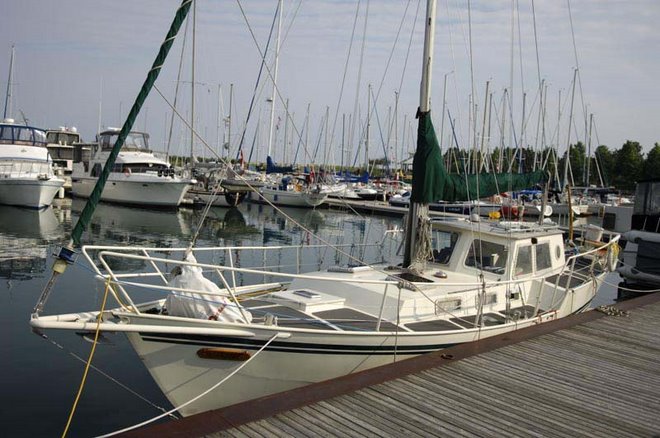
The photo at the top indicates why I didn't take our hosts out for a boat ride. It poured and blowed a fair bit, but the evening and our dinner and convo were great. The next morning, we left the literally brand new and mightily impressive docks of the Royal Hamilton Yacht Club with a lesson learned: the prop walk I use to slip Alchemy's stern to port side with a quickness isn't such a benefit when leaving from a starboard docking. I had to do some awkward spinning between rows of boats to get out. The solution(s) were: to have gone in stern first and docked to port; to have walked the boat back nearly to the bow of the boat in the next row, and then steered to port in forward; or to have done the previous move warping off against a line. Ultimately, no harm, no fouls, no buffer required, but I dislike giving a show before my coffee's settled, and the need to make a bridge opening (it's about a 30 minute motor from the YC to the bridge) by a specific minute (we did) makes for unseemly concern.
Mrs. Alchemy mulling over autopilot brands.

Sea state: Stateless
As can be seen, it was another windless day (although it improved at the last stretch and we motorsailed with a more or less effective jib adding a couple of knots).
How to Avoid Huge Ships: Lake Ontario Edition.
Both legs of this otherwise minor journey, I took an interest in the doings of the little AIS targets on my VHF. The CPA calculation is the one I find most useful in AIS monitoring. When we sailed yesterday in moderate fog, we of course noted that plenty of boats did not have AIS and therefore required careful watchstanding (we have as yet not installed a radar). But there were quite a few that had it going, and even the scant data delivered by our AIS-equipped radio gave us a heightened awareness. Not to mention notifying us when the large lake freighter had started to move off its pier at 90 degrees to our course. Handy, that. 
Water scene with duck.
We were just missed by another line of thunderstorms and made it home tired but happy. The Canada Day Weekend involved an enormous rubber duck (see photo). Patriotism continues to baffle me.
My god...the harbour...it's full of duck!

2017-06-30

Fitzstakes

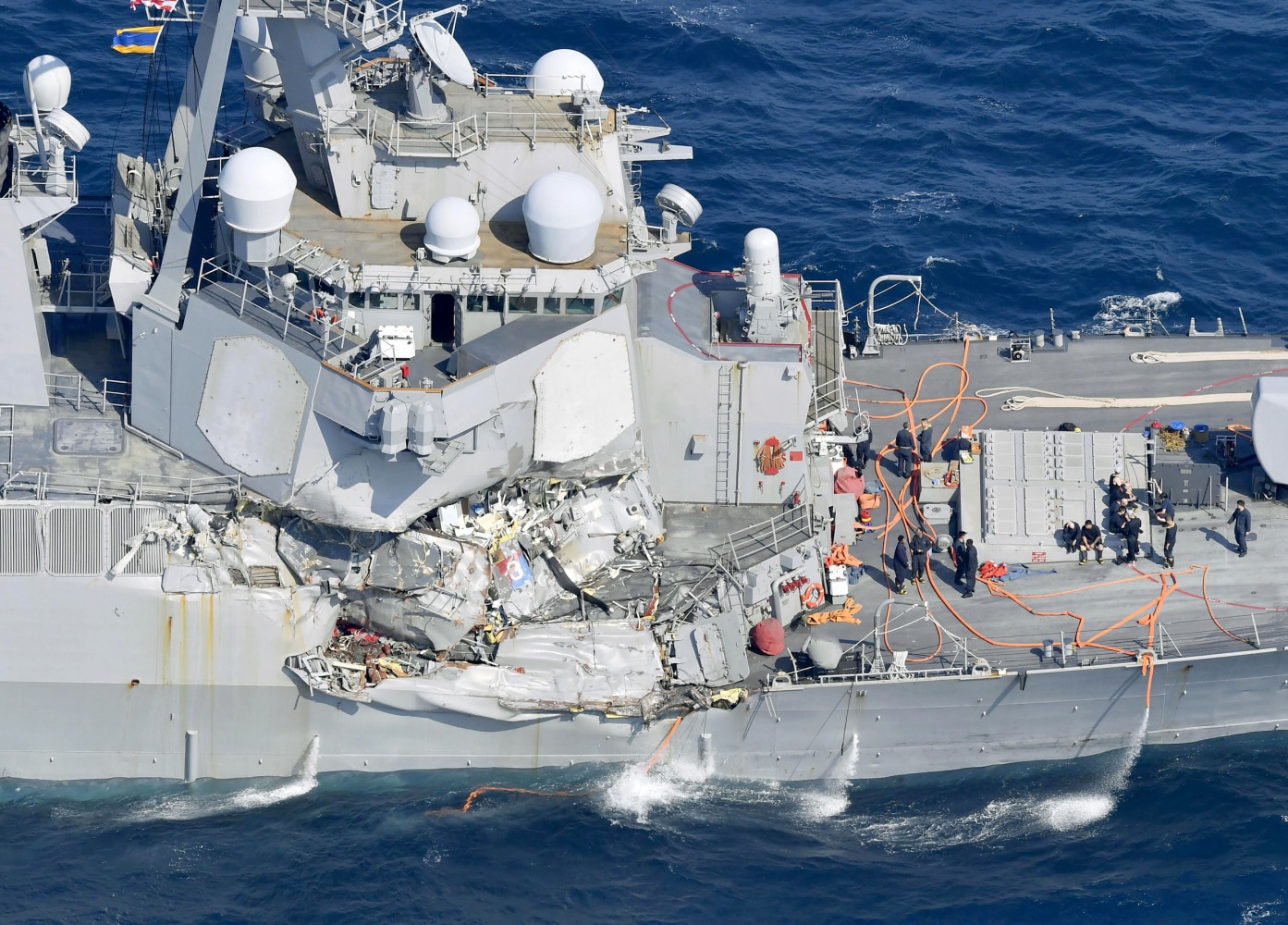
Apparently, the interior of the Fitzgerrald skipper's stateroom is visible in this shot. Good grief.

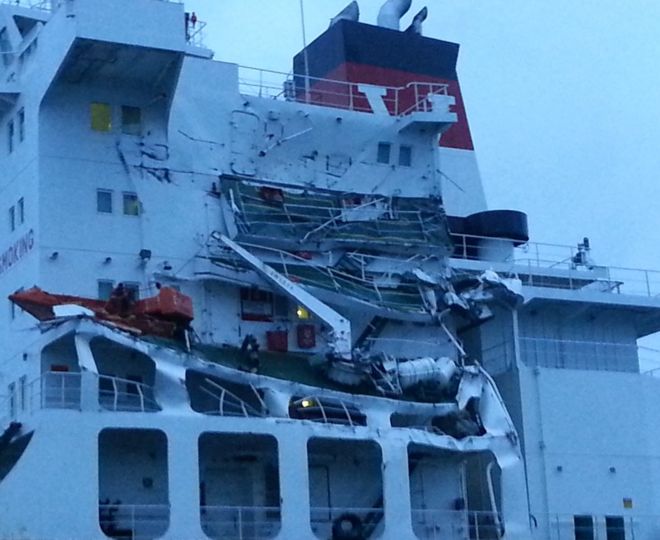
Risk assessment is more than reading a forecast or watching a radar's guard zone. It's a holistic, ongoing appreciation of what all sorts of inputs are saying while one is in command (or crewing) on a boat, including the harder ones to quantify, like gut checks or the smell of the air. It's too early to speculate on the precise chain of events that led to the recent incident involving a container ship that killed seven sailors on the U.S. destroyer Fitzgerald, depicted above, but even the already-known facts are reminiscent of the way another U.S. Navy ship, Guardian, managed to ground itself in 2013 on a charted reef (even if the charts were known to be predictably inaccurate), which led to a total loss. Ironically, considering the ecological damage done, the last biggish vessel to ground on this reef belonged to Greenpeace in 2005. Incorrectly, in my view, they also blamed the chart.
Minesweepers are made of wood, so a few weeks on coral...
...precludes a buffing-out.
It's a poor seaman, I think, who blames his tools. Charts feature dates of surveys, after all, and if you are heading into a remote or poorly surveyed area, it's best to know the quality of the data on which the plotter or paper positions are based, and to not try to shave time and distance down when there is any kind of ambiguity.

Our tools, in this case, our navigational tools, are not ourselves, or, to put it another way, they are not extensions of ourselves. While it is not always possible (think of a submarine at depth) to lay physical eyes and ears on our surroundings, to put more emphasis on representations of said surroundings, rather than going outside of the glass bridge to have a look-see, would seem imprudent.

Despite the as-yet absence of a full investigation (which, like the one that dissected the USS Guardian incident, may be redacted or opaque with naval jargon), a lot of mariners have discussed this incident as it features some fairly clear-cut premises on which modern civilian and military ships operate. Particularly hard-to-turn, unhandy and comparatively slow cargo vessels and agile, fast naval ships bristling with detection gear. As this article sums up, avoiding collisions is a shared responsibility, but U.S. warships are not supposed to be crept up on by 750-foot container ships.
 
How agile? This agile. This is the same class of destroyer as USS Fitzgerald.

If, as is customary, both ships were on autopilot, that doesn't get anyone off the hook, of course, as this more in-depth article suggests. The consequences are real and are, of course, tragic. While we think of warships as intrinsically strong, they are merely strong enough; if you want speed, you can't build a ship with 30 cm. thick sides. Most modern naval warfare involves missiles at a distance and countermeasures to missiles at a distance, not ramming. I cannot imagine what went through the skipper's mind as he was (apparently) nearly ejected from his ship. What is known is that it was a new gig for him.
Physics has the final word, again.

Even in the seaways with the most heavy use and the arguably most closely monitored traffic separation schemes (TSSs), the scourge of under-crewing and lax watch standards can cause ships to collide.  Again, this is a recent (July 1, 2017) event, but I will wager that someone who should have been looking around wasn't, or was beguiled by a screen. Makes sense in such circumstances to avoid ships entirely if they exhibit zombie-like behaviour, doesn't it?
Yes, the struggle is real.

Back in the small-boat realm, I just read a rather good article (in which the writer, rarely in my experience, seemed to have sailed and knows what a sailor would care to know when reading about a bad day on the water) on a heavy squall that hit a post-race group on Mobile Bay, Alabama in the spring of 2015. The description in the article make it clear that a host of factors led to tragic outcomes, but a few people chose not to race that day. The technology didn't fail those who did choose to race, but perhaps their instincts faltered. I can't make that judgment, frankly, and it would be hubristic to try. But I have noticed that a) people rely a great deal on technological inputs while sailing (readers may recall we ourselves recently updated our plotter) and b) the traditional skill sets of the sailor are beginning, I would argue, to wilt. Who sails today with just a handheld VHF and maybe a bulkhead compass? Perhaps the lack of screens might sharpen some skills that may be shown, once again and sadly, to be absent on some of the largest and most-crewed vessels on the oceans.

UPDATE, 17.07.15: Receent shots from the drydocking of the USS Fitzgerald suggest why crew died and how it was very fortunate that this ship did not go to the bottom: https://news.usni.org/2017/07/12/new-dry-dock-photos-show-extent-hidden-uss-fitzgerald-damage