Small boat or large driver? Hardly matters in a pool.
WARNING: Graphics-heavy supersized post follows! The annual Toronto boat show is an odd event for me. It's been years since I went solely to check out new boats, and the kind I prefer (sailboats) have become increasingly rare over the years as the nature of the boating community has, as we shall shortly learn, shifted away from wind-powered fun to one predicated on fossil fuels.
A HobiePhat? Inflatable, portable pontoon thingie.
But as we own a diesel-driven motorsailer, I risk hypocrisy here, even though we try to motor very selectively and have kept the hours low. But it's a definite trend at the boat show: I have never seen a greater variety of powered fishing boats, runabouts, outboards and cabin cruisers in one place. So...much...chrome...And so much for carbon taxes, eh?
On the other hand, this is the Canadian-approved Honda eu2200i and "companion" pair of gensets, a way to get about 3600 watts of 120 VAC, or 30 amps (continuous) in two approximately 20 kilo "luggables". Now, for us, this is an attractive alternative to having a small diesel genset aboard as it is portable (as either one or both in operation) and needs little gas to run for several hours (which we would carry for the small outboard we're bringing) and allows us to run pretty serious standard power tools without engaging the inverter off the battery bank, which is generally considered "lossy". In addition, a pair of these can themselves charge the house bank or to power the watermaker, should the renewables and the alternator be out of commission. Another option is to bring them ashore if we need to do work (or help locals) on distant beaches. Lastly, they can be fit in existing compartments and lashed in place for safe stowage. I've had the predecessor model, the eu2000i, for some 10 years and the Hondas are reliable and well-built. And yes, I know not to run them at the bow when anchored.
I will point out that the speed limit in Toronto Harbour is six knots.
Overcompensating, Skip?
The Honda 2.3 HP aircooled outboards now out are not to my mind worth the upgrade from my simple, 12 kilo Honda 2, and while propane-powered outboards abound (which I don't entirely understand, given the energy density of propane versus gasoline or diesel, although I'm willing to stand corrected), there is seemingly no other air-cooled outboard option.
Because I would go for a 3 or a 3.5 HP one of those, thanks to the weight savings and mechanical simplicity of an air-cooled four-stroke outboard...and yes, they are noisy little buggers, but you can refill them from a water bottle if you want. Well, a water bottle capable of holding gas safely.
There's a 2.5 HP Yamaha, but it's water-cooled and about four kilos heavier than the one we own.
So...many...fishing boats.
...but enough fish?
Now, powered boats of all kinds have always dominated the Toronto boat show, and given the thousands of small lakes and rivers within 500 km. of here, that's not surprising. But the floor space devoted to sailboats has declined precipitiously in recent years and appeared to be at a new low, to judge by the shoved-off-into-one-corner appearance of the few Hanses, Dufours and Beneteaus present.
So, maybe 10 sailboats?
A new approach to making bow thrusters accessible?
Rectangular portlights...ugh. The grey hull is nice, however.
I usually prefer the Dufours, but they've gotten as "samey-samey" as most other production boats at these price points.
More on Boat Show sailboats (and powerboats) a little later, but the changes at the show arguably reflect more than reinforce changes in the marketplace demographics of boating, its costs and indeed, its likely future form. I had the good opportunity to sit down and talk boats with Wallace and Sharon Gouk, the survey/yacht delivery team responsible for Port Credit Marine Surveys.
Fits the driveway, doesn't need the dock.
Veterans of the local boating scene and long-time liveaboards, neither is short of opinions on the changes in boating in southern Ontario and elsewhere over the years; indeed, Gouk posts on the popular Cruisers' Forum website. I asked him to speak as a surveyor to note some of the major changes he and his wife have seen in recreational boating over the last few decades. Wallace replied that, in terms of the demographics of the sort of boats with which he is involved, mainly "cruiser-type boats, whether power or sail", boating mirrors society. "People are getting older," Gouk says. "The demographics of [boaters] are getting older, too." He adds that "boating is becoming more complex, extremely expensive and it's hard for younger people to get into in until they collect the inheritance from the boomers."
The companionway is a little shallower, meaning there's extra stowage in front of the engine here. Clever? Depends how hot it gets, but that's decent access to critical stuff for a production boat.
But Gouk does not see money as the only obstacle to the continuance of a thriving recreational marine scene. "I don't think the interest is there among the young people" he says. "There's a bit of a different attitude that goes way beyond boating. Kids are coming out of school with [significant] debt. That changes their attitudes about everything. The ones that have an interest are looking at smaller, trailerable boats, or at chartering, but for a young family to lay out $200,000 for a good used cruising boat, that's not going to happen."
One pair of winches on a 41 footer? Huh. I'm going to three this spring.
Gouk sees a decline in sailboats of the cruising type, but also sees a fallback in sales of the larger cabin cruisers and powerboats. "Nobody's doing very well [on new boats]." But the outlook is perhaps even worse for used boats. The surveying couple, who also do the appraisals on seized boats for Port Credit Harbour Marina, part of which is a "graveyard" for abandoned boats, sees more 'classic plastic' as unsellable at any price and destined to be cut up for scrap.
"That particular problem I see as mushrooming over the next five to 10 years," says Gouk. "The shell of the boat, the part that's going to last forever, that's the cheapest part of the boat. It's the systems inside of the boat that are really expensive. People buy a 32-foot sailboat? I can take you to 50 of them right now you can get for $500. People go into this with the dream of 'I can fix that up' ...well, maybe, but it's going to cost you $3,500 per year to store the boat while you're fixing it up."
Hmm. Why boating's in decline is no mystery.
Gouk does not see, in his work as a surveyor, the level of competence he would hope to see in restored boats, noting that "marine electrical work is different from that done on land". Your correspondent can agree with the assertion. Nonetheless, the skilled amateur wanting a cheap boat has not got long to wait. "In the used boat market, the prices are dropping simply because boomers are dying off," says Gouk. "The biggest tip-off is in the demographic make-up of the yacht clubs. The younger kids have an entirely different outlook on life. They're not coming in at the bottom of the market to pick up an old boat."
The man I sold Valiente too is in his (quite fit) 70s...I have to concur.
This realistic assessment may extend to even the more popular brands of "good old boat". Gouk, who has been inside hundreds of them in a near-forensic assessment of their qualities, is emphatic: "There are no 'good old boats'" he says. "You get into those older boats, and there's gate valves, solid-core household-grade AC systems, and sloppy construction techniques. And yet some of them are still very expensive on the used boat market."
Having had a '70s boat, which, besides its fine sailing qualities, was more or less a ready-to-sink firetrap when I bought it, I can only concur. A special thank you to the Gouks for spending time with me and I encourage a visit to their interesting and comprehensive website for some great resources (and some horror stories!) from deep inside the world of boats.
These lads were doing fine work for an underappreciated cause that could render a lot of fishing, save for carp, unlikely.
But back to the show. The numbers support Gouk's assertion of a
shrinking market for boat owners of all types. According to show
management,
"the 2019 Show attendance totalled
73,464, down 5% from 2018, having experienced 8
out of the 10 days with major snowfall, ice and extreme cold across the
province effecting travel for show-goers. The closing weekend had over
1,800 e-tickets unredeemed, likely due to
weather conditions."
Likely, sure, but a lot of clubs in the Toronto area also have empty docks, and as noted, the demographics of people who might enjoy boating of any type are getting longer in the tooth...how are you going to get a 24-year-old into a Shark when Netflix is streaming?
This looked to be popular, but as we sail pantless offshore, it would be rather inappropriate for our lifestyle choices.
That said, sales were apparently reasonable enough to keep vendors happy; Mrs. Alchemy worked a few shifts for Genco Marine, which we have personally enriched this winter with multiple purchases I'll outline in a later blog post. Anyway, my co-skipper reports that sales appeared to be strong this year (the incentivizing discounts no doubt played a role), and other vendors with whom I spoke gave the impression that the trade was "fewer, but better". May this continue. The boat show is a big regional draw, and irrespective of my attendance, or indeed our presence in Canada, a lot of people would still clearly miss it.
More square windows? Have they never heard of the Comet jetliner?
I often go not to see the boats...I mean, we have a boat...but to see the innovation. With a steel pilothouse cutter that will plow more than glide through the waves, "slick" isn't a priority. Advances in control gear, safety gear and the "working the boat" elements are, and I like to quiz various vendors, especially at the less-frequented booths, about lingering, obscure questions I might have. Pro-tip? Go on a Monday or Tuesday of the show, because the mornings are sparsely attended and you'll have the marine industry pro's attention more easily than on a weekend.
This pro must have been on break.
For instance, I had a particular issue in that want to weld on studs for hull anodes this year. Without going into detail at this stage, I have to change over from freshwater-sutiable magnesium anodes to ones capable of providing protection to our steel boat in brackish and salt water, at least until we get our hull recoated. We are going out to the sea via the St. Lawrence this summer, and it had been recommended to me that I switch to aluminum anodes for the hull, rudder (aluminum, too, but of a different grade) and prop. I could source them, but I could only find zinc anodes to fit my DF-107 model VariProp. Well, they exist and I found that out at the show. Fizzing averted.
Found out some details about EPIRB registration here, as well.
Along with the multitude of free and paid educational seminars available (although Paul and Sheryl Shard and Andy Schell and Mia Karlsson were not present this year, both of whom I count as friendly acquaintances and at whom I enjoy throwing impertinent questions, the show remains a great place to pick up knowledge without actually getting wet in the process. I think in the rush to promote big, shiny things, this aspect of the show is somewhat underplayed, but as we are about a thousand miles from the ocean...and it's winter...time spent learning from sailors on break from full-time lives aboard (or people like forecasters or delivery skippers) is of great utility and interest.
This firm makes a Travelift not made by Travelift, which tends to monopolize locally the boat picking-up business.
A couple of last points: The commercial marine business is not well-represented at the boat show, and perhaps it should be. It is very difficult to convince Canadian youth to take trades-type jobs these days, but perhaps if they knew more about them, there'd been some attraction, interest and uptake. This booth, for Georgian College's marine trades courses, saw very little action and was tucked away in a presumably cheaper corner.
Didn't help that I couldn't attract this guy's attention to speak with him, so absorbed was he in his screens.
Perhaps that's the wrong approach for a labour-starved field to take.
I also noticed that some popular booths were not in attendance, particularly Garhauer Marine and Ontario Battery, both of whom from which I've bought significant amounts of gear in the past. I also noticed that Ray of Ray's Marine didn't have his usual double booth, or indeed any booth, another surprise and another vendor I've spent money with. While I can still find multiple outlets for pepperoni, hammocks, miracle waxes and Sperry shoes, it's the more "hardware" places I miss.
Holland Marine Products: I patronize them and will again.
Knowing our plans to depart this summer, I spent more time at the show than I had in years, and appreciated, I think, its rhythms and emphases. It's a circus, sure, and it's not necessarily even a place to score bargains (although I did pretty well in that regard this year, probably because I was keen to "finish" certain necessary areas on the boat). But it remains a great place to window-shop, to pick up well-priced "sundries" (every third person seemed to have a fender, foulie jacket or boat hook to hand) and to think of the warmer months to come.
I am surprised, but perhaps shouldn't be, at how many people I know, or run into, at the boat show.
Got a fresh 2019 almanac and confirmed we can order the charts for our big trek to Nova Scotia at The Nautical Mind.
Finally, like all boat clubs these days, our strong racing and junior sailing programs protect my own National Yacht Club from the march of time and division of attention that so strongly suggests boating 20 years hence will be even more niche an activity than it is now. However, it's not all gloom: the NYC booth attracted a lot of favourable attention, and the cadre of over 30 friendly and informative club members acting as "ambassadors" garnered around 150 serious enquiries from people contemplating a club from which to enjoy life on the water.
Good. I'm rather fond of the place myself.
Sure, the location's great, but the people are pleasant, too.
Thank the Canadian Economic Action Plan, I suppose, for the low-res graphic above. For those sailors and casual readers who may wonder if they need to up their kale intake, it's the cover of the latest "Chart 1", the Canadian Hydrographic Service's glossary of terms and graphics that is the key to understanding and decoding (at least until it become second nature to do so) the paper charts mariners, including recreational sailors, are legally required to carry aboard under the Carriage of Charts provisions of the Canada Shipping Act, and which are available at the better sort of nautically minded shop. In some cases (but not all), electronic representations of these charts will suffice, but you need to have Chart 1 at hand as a navigational Rosetta Stone to read the hieroglyphs chart makers customarily use. Contrary to popular belief, the closer one sails to shore, the more crowded the water gets from the view of the nav table (another rapidly outmoding term) or the helm plotter.
The U.S. cover is also a litttle hard to read, almost as if it's trickling down.
Of the several countries' waters in which I've sailed (Canada, the U.S., Antigua, the USVIs, the U.K., France and Portugal), most seem to follow similar conventions regarding their nautical charts, and, as world shipping grew, this was reinforced in the last century by adherence to the standards of the International Maritime Organization (IMO). Looking back, the science of hydrography as a practice evolved in Europe during the Age of Exploration, although the Arabs and Chinese certainly made excellent maps and navigational tools. While the actual charts of coasts and little sugar-producing islands were guarded with the same strategically prompted ferocity as are nuclear missile blueprints are today, the conventions of hydrographical measurement tended to standardize on the British, and, to a lesser extent, the French, model. This was particularly true after the fixing of longitude became accurate and mechanically aided, and with the introduction of superior cartographic techniques. Yes, the books linked are strongly recommended for those sailors capable of prising themselves away from the latest romantic peregrinations of The Bachelorette.
The result is that, with any relatively modern country's equivalent of Chart 1, the sailor can use their local hydrographic services and charts. Bias does play a role here, however, as a few countries have charted most of the world for their own national reasons: the U.K.'s Admiralty charts are generally considered the most thorough, whereas the U.S. NOAA charts are both free in electronic form and are in easy-to-download formats amenable to printing. My own choice would be dependent on destination (former British possessions tend to be better charted by the British) and (this is critical) the last update of the chart in question. If the surveyor was Captain Cook, admirable, innovative and careful as that particular hydrographer/explorer was, take the observation as, at best, provisional, and charts based on inaccurate information, irrespective of the media of paper or pixels, is why you keep a watch. Even the chart printed yesterday unrolled aboard still whiffing of ink (or the plastic and brass of an SD card) is only a snapshot in time of what is really in front of one's bow.
One of these things is not like the other.
As such, the debate between which is better, paper or pixels, is, I find, rather sterile. As this brief but excellent paper examines, it is the evolving human tendency to "trust" machines that is causing to fall into abeyance the simple acts of direct observation that would keep electronically navigated vessels safer by simply looking out and around in order to provide a real-world context for what the Playstation Plotter is insisting is real. Any trip to a restaurant in the last five to 10 year will reveal several beautiful couples facing each other with their eyes locked on their smartphones, which, contrary to the name, do not make you smart. And yet I am far from a Luddite; along with Ben Ellison of Panbo.com, I believe the fault is not in our plotters, but in ourselves.
Get the picture, sailor?
This longing for mitigated and interpolated reality is curious to me in the same manner as gazing at a hammer before pounding a nail is. On the other hand, I started sailing in 1999, and, perhaps more importantly, started navigating in 1999 via formal instruction...and I have yet to stop. While plotters existed in somewhat more basic forms in 1999 and were even acknowledged as the coming thing, I was trained to use paper charts in order to grasp the essentials of navigation, such as taking bearings off land marks, the difference between magnetic and true compass readings, and using every bit of information available to me, such as "running the depth contour" to give me a greater confidence that me and my boat were where we should be...or to suggest and confirm that we were not, a situation that can evidently affect even the most well-equipped vessels. Plotters are great and are inarguably convenient, naturally, but I am starting to conclude that they only make you a better navigator if you were a pretty good navigator to begin with. If you are not, on what basis are you going to find errors that could kill you? Faith-based navigation works about as well as anything else faith-based: while there are aphoristically no atheists in foxholes, there are no fundamentalists wielding dividers.
The British example of eyestrain.
For those who suspect that their plotters, if not actively leading them astray, are not teaching them the situational awareness critical to safe and thorough navigation, there's hope in the form of formal instruction, or even in the purchase of dead-simple flash cards and books with which the sensible sailor can grasp the related fields of chart mastery, buoyage, pilotage and who exactly gives way to whom in a crowded (or not) seaway.
Don't leave dock without them.
While British (and while you have to grasp the IALA buoyage system differences), these are of enormous help in relating what the charts says to what you are rapidly approaching and what that might mean to earning a sundowner.
Particularly helpful, and thanks to John C. for the review.
Clearly, if one wishes to spend enough money, there are electronic plotter setups, particularly the newer (and priced accordingly) ones that provide a 3D view, that can allow easy navigation, especially at night or in fog when, short of creeping right up to a numbered buoy (which I have done more than once) to confirm one's location, you have little other options short of stopping, heaving to, or anchoring, if possible.
A compromise, rather than the multiplicity of proprietary formats of the various plotter manufacturers is to use a means to rendr paper charts in electronic form, as is the case with the free OpenCPN and other raster-based displays. For some, the familiarity of the paper chart (which have the advantage of the standardized symbols as well as the typically faster updating of a national hydrographical authority) makes the use of raster or vector (know the difference!) charts in electronic form easy, and in some cases, intuitive.
Warning: May not be intuitive.
So if you have paper charts, as is still required, you might as well use them, or at least be able to read them. Gleaning through your local charts with the relevant pages of Chart 1, perhaps with a suitable beverage, is still a good place to start. I daresay that you'll get more out of the fleeting squiggles on your nav app-equipped iPad if you choose to use one. I opt for a mix because sailing for me is more engaging when I have puzzles of trim, helm and, yes, navigation to solve. I have a GPS, several in fact, but I like to take bearings and make little cocked hats and whip out the sextant and even to swing the lead to determine that it's right. It nearly always is, of course. It's the electronic chart that may be wrong: Paper charts, too, can be, or at least you can be the first poor bugger to confirm that by means other than mere charts.
Not all zincs are created equally, and not all zincs are even zinc
There is clearly
always more to learn about how even strong materials react to stress imposed under laboratory conditions versus in the real world, just as there is much to learn about galvanic action on metals when they are used in a boat hull in the weak battery fluid that is salt water. I have decided that I will take a little chance with deformation with the more pliable grades of mild steel, for instance, in
order to avoid a catastrophic failure with stainless steel (SS) or other comparatively
brittle grades of steel. It's among the things I'm learning as I'm teaching myself to weld.
Even a simpleton such as I am should come out of this with an even number of digits
I will also mix metals with proper isolation if
the potential for galvanic interplay is low or can be mitigated. An example would be my
aluminum pilothouse roof, which sits on an inward flange of the mild steel sides of
the pilothouse. It was originally through-bolted in 40 spots and sealed with a bead
of the dreaded 5200, which I think is great stuff for gluing on
fibreglass keels, but should come otherwise with dire warnings. particularly for those end-user who tend to idly scratch themselves.. It took
many hours and many reciprocating blades to pry off the roof of Alchemy in 2011 in order to
swap out the old engine via a Polecat crane. Now that the engine installation is more or less completed, and, short of installing a series of water tanks that will fit through the companionway, the reinstallation goes thusly: Grind the
mild steel flange back to bare metal. Coat with a couple of layers of high-zinc galvanizing primer. Top with Endura
two-part epoxy to keep it unexposed to the various elements for the foreseeable future.
Not necessarily a brand endorsement, but among a group of similar products required.
Here comes the science: I want to put nylon bushings in every steel flange
hole (40 of ‘em, remember?). Then I want to lay down 1/16th strips of Delrin or HDPE atop the flange with appropriate holes for the bolts. Beside this plastic strip, which performs, along with the bushing, the role of electrically isolating the aluminum roof from the steel hull structure, I want to also lay down a line of
butyl tape. This can be a fairly narrow line of tape, as it will be compressed in place as a barrier to water ingress, on the outside of the HDPE strip,
which itself can be bedded with something that will given without severe
difficulty in the future. Fit the 40
SS bolts and 40 new nylon washers and Nylock nuts to fit through the
bushings, and put dielectric goo on the threads. Dog down as is
sufficient to squish out the butyl, and trim to desired neatness.
This method (SS bolts, “other metal deck” and “other metal backing
plate”) also applies for any deck gear, as making backing plates from SS
is a royal pain, whereas power tools shape 1/4″ aluminum plate easily. In practice, this means attention to paint service is critical, as "rust" is a lesser worry than voltages, in some senses. EPDM rubber strips, able to withstand compression and UV exposure, seem like a good bet here when (for instance) bolting the typical sort of SS clamps to support awnings or biminis to the extant, painted pipe rails. The likelihood of paint plus rubber failure is low. And, of course, when one is making electricity, the need for effective insulation/isolation is commensurately greater.
"What do you mean, 'you forgot the gasketing'"?
Even on a plastic boat, I’ve sometimes chosen encapsulated ply over
aluminum as a backing plate choice because of the number of SS bolts involved and the unlikelihood
of keeping everything both isolated, in strong compression, and yet
fully dry.
My impression is that in materials such as chain, plate or in gear such as failed stays and bolts,
it is the prep and awareness of the role electricity plays in the weak electrolyte we call the ocean that defers or at least delays the majority of unpleasant
surprises. Certainly the process of “ground tackle” is not commonly
thought of in an electrical sense, but dissimilar metals in anchoring,
even in a galvanically benign (presumably) open roadstead can have a
negative effect on top of the differing material characteristics, such
as ductility, of their respective parts.
Two very helpful volumes that are destined for the onboard library.
I have found Bruce Roberts’ “Metal Boats” and Nigel Warren’s “Metal Corrosion in Boats” excellent resources in understanding, at least for
starters, a complex subject with many possible reactions and solutions. But even if you think you know this topic, and have taken all necessary measures, one should never neglect to actually examine your vessel, metal or not, for signs of wastage or corrosion due to galvanic issues. Part of dealing acceptably with this involves a little gadget called an isolator,and is a topic I will return to in the future.
King Neptune: May require occasional appeasement; sacrifices, perhaps some episodes of transvestism.
The fine author over at Boat Bits had last spring a small note on cruiser conformity. I've had reason to reflect upon the topic of late. I believe it's a
truism that even self-proclaimed non-conformists like cruisers actually prefer company...particularly company backed by the bland, Taco Bell-like
strains of Jimmy Buffett, although this affliction is not universal.
You can guess my feelings on the faux-piratical works of Mr.
Buffett.
Rule of thumb: the more elaborate the hat, the more suspect the religion.
But it's true, insofar as myths go: Cruisers often feel they have broken free of the pack by their choice to cruise. Some even crow about it. It's part of the self-mythologizing
of the modern cruiser. It's self-mythologizing in the sense that if you go to sea with all mod cons and are in constant touch via nine kinds of gadget to loved ones and other lubbers. It's self-mythologizing if your boat is on Spot, Marine Tracker and cruises in convoys like ARC. If, to mangle Vera Lynn, you'll never sail alone, are you really blazing a path of individuality through the pitiless waves at the ends of the oceans?
Not that one must, of course. After all, others went before all of us, when it was a lot harder.
Please note there's nothing wrong with this self-image of ruggedness: there's no reasons whatsoever that those who've worked hard to actually get onto a well-found boat (if today's production cruisers can be judged as well-found) should not enjoy their time as they see fit. And, arguably, it's a lot of work to live full-time on a boat, and for most sailors, the amenities are all the sweeter because they often involve more labour than is customary in, say, a new condo. It's just somewhat cognitively dissonant to some, and I am among them, that "cruisers in clusters" should wish to trade one commute (to work and back) for another (to the beach bar and back). The "cruiser lifestyle" so prominent in Mr. Buffett's oeuvre can devolve into a clubby boozefest with lashings of infidelity...or so some tales told have suggested.
For some, it's a sundowner, for others, a way of life.
Of course, it hasn't escaped my attention that this aspect of "cruiser culture" is just a sunnier, sandier version of some local YCs of which I've darkened the doors. The boat, and the sailing, often seem secondary to the activity within the communal tree fort of Permatan Bay. Like attracts like. No mystery there. But being too long among a bunch of self-declared non-conformists (cruisers who've "stuck it to the man" by sailing away from the ol' nine-to-five) can itself grow conformist. It may be something to keep in mind: a sort of "I didn't come 9,000 NM to hang out with the cast of a Freedom 55 commercial" refrain to ward off complacency.
Stock figures: Fifty-five and white is no way to go through life, son.
Now, unless you have been given a free boat and possess a marketable skill (and most skilled people tend to overestimate the "marketable" part), you have to be at least affluent to go cruising
in the first place (or that is the general perception), and so former
wage slaves with three pensions tend to rule the waves. The same well-serviced demographic can be frequently found spouting off libertarian
and/or hippie sentiments while smuggling a disassembled Mossberg in the headliner "just in case". It's funny how a realistic evaluation of how others should act is often the first casualty of material success. Not exclusively, mind you: I've known of a few sailors who have integrated charitable works and educational endeavors into their cruising life, and have "good works" scribbled on their boat's "to do" list, and more power to them for it. But if poor people are annoying, why go to poor countries? Why go to poor countries just to cluster among people just like oneself? One answer is that, with not many exceptions, the reality is that most people who can afford to cruise in the first place are from generally pasty countries where there is a tradition of doing so. Yachting, after all, didn't really exist until aristocrats invented it, and it's trickled down to the upper middle class in the intervening centuries. There are exceptions, of course: people can get cheap or free cast-offs or can made boats out of rubbish and salvage with little but skill and time...but they tend not to sport parrot-themed headgear. Thankfully, I think.
Clearly, the sailing life, whether one is a Napoleonic Era naval re-enactor or the purchaser of a new Beneteau Sense 46, is at heart a conservative one, if not necessarily in the political sense. Techniques and materials are tested and discarded over decades and even centuries in the harsh light of the verdict of the sea: if a way of doing things is inappropriate or ill-suited for its purpose, the very waters and winds will make short work of them, and possibly make shorter work of the venturesome sailor that precipitously employed them.
What may have been lost is the sense is just how selective that conservatism can be, and how for many a sailor such selectivity may be, sometimes, a dead end. We sailors took to Dacron in the 1960s over "traditional" canvas sail material and manila lines because Dacron was superior in nearly every respect: it didn't predictably rot in sunlight and was predictably stronger. We are beginning to shift from steel wire shrouds and stays to PBO rigging and "soft shackles" for the same reason: greater strength, more resistance to "rot" and less weight aloft.
This is not in itself to be derided: sailors are thrifty by nature and necessity and like to think of themselves as self-reliant and, returning to the realm of myth, perhaps tied to the mast gazing steely-eyed into the face of the tempest. This sort of self-mythologizing goes back to Odysseus, and maybe further, of course. But sometimes the "good enough for Cap'n Grandad" mindset can be a set of blinders to the opportunities of improving one's seamanship or expanding the contents of John Vigor's black box of prudent preparedness.
Don't leave shore without it.
Even the most rugged of invididualists, and sailors tend to think of themselves as pretty independent, boot-strappy types, can forget
that we've spent 99.9% of our evolution in small, mobile groups in which
innovation was, at best, incremental, and princely solitude usually turned one into
dinner. So the myth of the lonely skipper (or the tiny brave crew on the tiny stout vessel) alone against the raging sea with fids in teeth and lengths of jute stuffed into belts is only so if you really work hard to ignore the last 100 years or so of technology.
One needn't be alone today at sea. One can be, of course, and more power to the truly self-sufficient sailor out of easy contact with land and all its snares, but now it's a choice.
This does not obviate or lessen the reality that skipper decisions must still be made, should crises intrude on the voyage. Decisive and prompt actions (and the consequences of same) will likely remain a big part of cruising until such time as crew (and boat?) can be beamed out of the tempest, Star Trek-style.
So perhaps it's time for some new myths to which the sailor can aspire.
My last, feeble muttering in public was about...sad to relate...keeping the boat clean. I suppose a
corollary to keeping things clean is to keep them accessible. One of the
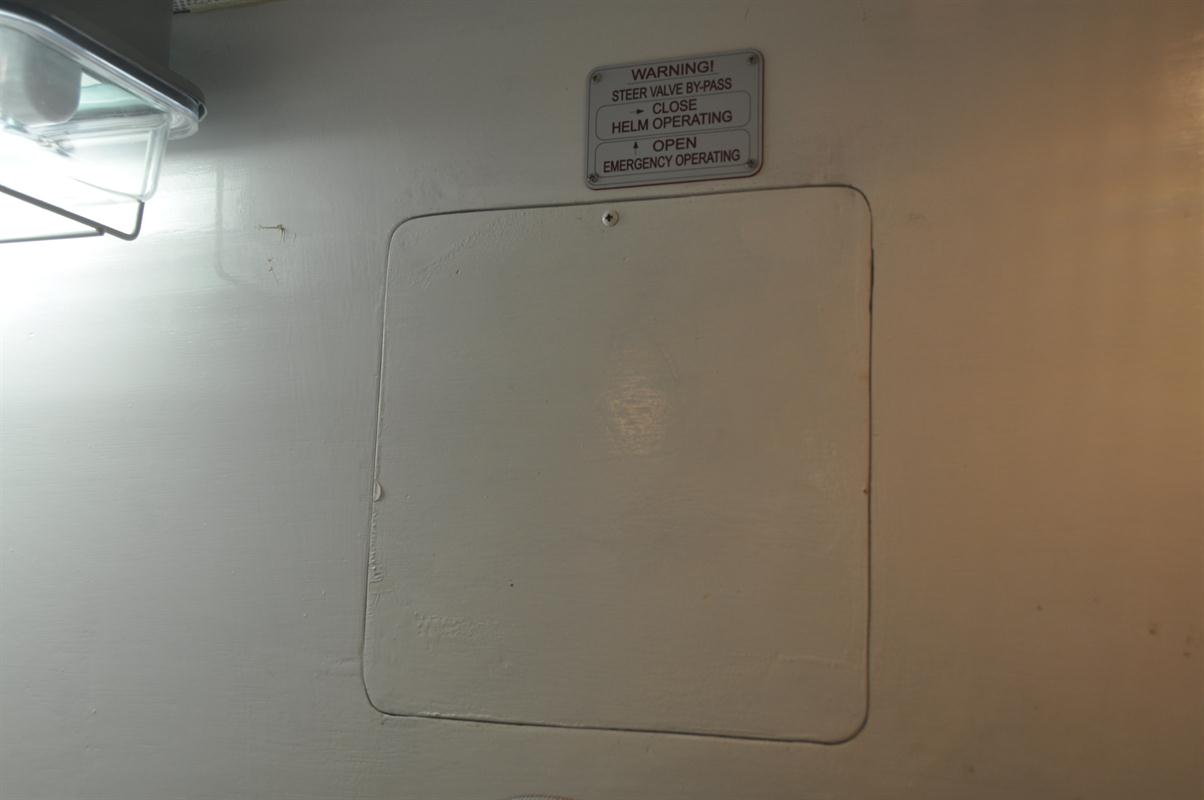
upsides of owning a custom boat is having no compunctions about sawing or drilling through a non-structural part of the interior to make an access hatch or
other “points of egress” to a particular potential trouble spot, like
the lowest part of the head hoses, or to making the aft cockpit sole
removable to get at the transmission or the stuffing box.
Handy if you'd thought of it. Photo (c) Regina Sailing.
Of course, this demands all sorts of planning and a deep knowledge...and a good record...of
what is behind the trim. As fewer cars owners can do minor repairs in
their driveways, I would suggest that fewer boat owners know where some
of the wire runs, hoses and vent lines actually go in their boats.
This used to be standard practice, even on "cheaper" cruisers. It's easier to do your own.
My experience of proposing such modifications of access is that
owners of production boats are quite resistant to cutting holes in their
“highly designed” vessels, even though it is newer, often “modular”
designs that the most egregious cases of “burying” critical gear occurs.
Clearly labelled and next to a light source. (c) M/V Sea Spirit
A friend of mine thinking of buying a boat a while back had a 2011 Hanse 355
surveyed. The very good surveyor, Wallace Gouk, acting on my friend's
tip, found a flexing part of the hull that was unsupported by an
untabbed bulkhead. Not a failed tab...a spot never tabbed. A big
freaking void I could have put my clown shoe through. Helpfully, it was adjacent about three holes cut for wire and hose runs, further compromising the strength of the bulkhead at that point. And with the Hanse's typically modern production cruiser-style of modular design, it would have been nearly
impossible to rectify this issue without cutting out half the cockpit.
This boat was lovely to look at and has the clean lines of a good
sailer....even as I said at the time (grumpily, because I dislike the majority of
production boats I've seen since about 2000) "it annoys me less than
most". I got annoyed afresh after seeing some of the pictures from the survey...eek.
Expectedly, this issue of "tabbing absence" was a deal-breaker for my friend, who moved on to a much better-built 2002 Dufour 36 Classic. Of course, the guy
selling the otherwise reputable Hanse had no clue what a piece of compromised junk the boat he was flogging was, I would have wagered. My friend, on the other hand, worked for CS in the '80s and
is the sort of guy who goes out in 30 knots on Lake Ontario because it used to be common knowledge that wind makes the boat go, and more wind is better, until stuff breaks, and that's probably the skipper's fault for an incomplete knowledge of physics. The baseline assumption is "I am sailing a well-found boat". Or was, once. Our materials science, when it comes to boat construction, seems to be far ahead in certain respects of the actual execution on the factory floor.
I am, with allowances made for crew and conditions, similar in spirit, and not out of some antediluvian machismo, but because it's exhilarating to sail in a stiff breeze and to feel the spray and to play the waves and run through one's hypotheticals should something go wrong.
Condofied to the max. I am unwilling to board such a boat to see what the access situation is.
My friend who probed the Hanse hadn't sailed for about 25
years when I first took him out in my Viking 33 a few years ago, and when he saw
the high boom of a modern Hunter and asked "should we help them? They've
broken the gooseneck and jerry-rigged one higher!", I realized that such is the impression modern boat design can make with a sailor who's been out of the game for some years.
Funny, sad or true? All three, I think. (c) Bill Bishop/The Marine Installer's Rant
Modern boats can appear to be crippled. They can also seem underdocumented, largely inaccessible (who has seen the rudder post?), and products of committees of introverts. Clearly, this is not universal, but it's common enough to make me happy that with a wide-open (in terms of access) custom boat, I can make my own fixes...and even my own mistakes...without too much in the way of hidden and potentially nasty surprises.
The online log of S/V Alchemy, her restoration, her crew and their voyage
“You never enjoy the world aright till the sea itself floweth in your veins, till you are clothed with the heavens, and crowned with the stars: and perceive yourself to be the sole heir of the whole world.”-Thomas Traherne
"He that has patience may compass anything."-François Rabelais
"The Great Lakes sailor is wild-ocean nurtured; as much of an audacious mariner as any. "-Herman Melville
"[The sea is] neither cruel nor kind ... Any apparent virtues it may have, and all its vices, are seen only in relation to the spirit of man who pits himself, in ships of his own building, against its insensate power." -Denys Rayner
“For those who believe in God, most of the big questions are answered. But for those of us who can't readily accept the God formula, the big answers don't remain stone-written. We adjust to new conditions and discoveries. We are pliable. Love need not be a command nor faith a dictum. I am my own god. We are here to unlearn the teachings of the church, state, and our educational system. We are here to drink beer. We are here to kill war. We are here to laugh at the odds and live our lives so well that Death will tremble to take us.” -Charles Bukowski
"A dream you dream alone is only a dream. A dream you dream together is reality." -Yoko Ono
My wife, my teenaged son and I plan to start voyaging in spring of 2020, plagues notwithstanding, for an estimated five to six years. I hope to move us aboard before that point to work out the kinks of living on a boat.
The careful reader will note the URL of this blog has "alchemy 2009" in it, a reference not only to our boat's name, but also to the original, anticipated departure date.
This is called "tempting the gods of the sea and life in general" and will not be modified. You have to know when to fight, and when to appease. Frankly, it matters that we go, not when we go. This is a good lesson for all aspiring voyagers, I think: the hubris of long-range planning lurks like an evil watermark on every "to-do" list.
Here you will find various notes on our preparations, labours and education as we try to become better sailors in a good old boat. I hope to continue to discuss in this blog the realities of preparing for a marine-focused extended sabbatical, the issues both mundane and philosophical confronting the potential cruiser, and the efforts required by everyone involved to make it happen.
Please note that all text and images on this site are copyrighted and may not be used without permission of their respective authors and creators.
Please note that I have not bothered to resize photos and they may be seen at full size and aspect ratio simply by clicking on them. Some photos formally hosted on third-party servers are not at present appearing; I will locally host these photos as I can afford the time to relink them.
Please also note that anonymous comments are usually spam and will typically be deleted without reading.
Author's text and most images other than product shots specifically created by product manufacturers are copyright 2006-2026 M. Dacey/Dark Star Productions. Photos sources linked from online news and related organizations are copyrighted to their creators.
Middle-aged, bookish Canadian with compact family in process of exploding career and prospects in favour of lengthy, low-rent sabbatical has boat, seeks ocean. Must have non-smoking bilges.
All contents (C) 2007-2021 M. Dacey/Dark Star Productions







Here comes the science: I want to put nylon bushings in every steel flange hole (40 of ‘em, remember?). Then I want to lay down 1/16th strips of Delrin or HDPE atop the flange with appropriate holes for the bolts. Beside this plastic strip, which performs, along with the bushing, the role of electrically isolating the aluminum roof from the steel hull structure, I want to also lay down a line of butyl tape. This can be a fairly narrow line of tape, as it will be compressed in place as a barrier to water ingress, on the outside of the HDPE strip, which itself can be bedded with something that will given without severe difficulty in the future. Fit the 40 SS bolts and 40 new nylon washers and Nylock nuts to fit through the bushings, and put dielectric goo on the threads. Dog down as is sufficient to squish out the butyl, and trim to desired neatness.
This method (SS bolts, “other metal deck” and “other metal backing plate”) also applies for any deck gear, as making backing plates from SS is a royal pain, whereas power tools shape 1/4″ aluminum plate easily. In practice, this means attention to paint service is critical, as "rust" is a lesser worry than voltages, in some senses. EPDM rubber strips, able to withstand compression and UV exposure, seem like a good bet here when (for instance) bolting the typical sort of SS clamps to support awnings or biminis to the extant, painted pipe rails. The likelihood of paint plus rubber failure is low. And, of course, when one is making electricity, the need for effective insulation/isolation is commensurately greater.
Even on a plastic boat, I’ve sometimes chosen encapsulated ply over aluminum as a backing plate choice because of the number of SS bolts involved and the unlikelihood of keeping everything both isolated, in strong compression, and yet fully dry.
My impression is that in materials such as chain, plate or in gear such as failed stays and bolts, it is the prep and awareness of the role electricity plays in the weak electrolyte we call the ocean that defers or at least delays the majority of unpleasant surprises. Certainly the process of “ground tackle” is not commonly thought of in an electrical sense, but dissimilar metals in anchoring, even in a galvanically benign (presumably) open roadstead can have a negative effect on top of the differing material characteristics, such as ductility, of their respective parts.
I have found Bruce Roberts’ “Metal Boats” and Nigel Warren’s “Metal Corrosion in Boats” excellent resources in understanding, at least for starters, a complex subject with many possible reactions and solutions. But even if you think you know this topic, and have taken all necessary measures, one should never neglect to actually examine your vessel, metal or not, for signs of wastage or corrosion due to galvanic issues. Part of dealing acceptably with this involves a little gadget called an isolator,and is a topic I will return to in the future.