Copyright (c) Marc Dacey/Dark Star Media 2006-2026. Above photo (c) Marc Dacey. Powered by Blogger.
Showing posts with label Rant. Show all posts

2020-03-22

Refitting in the year of the plague

The windlass battery bank is in place, and so are the new Honda 2200 gensets, which are making us look prescient in some respects, despite the fact that I've wanted a new pair for several years so we can fully charge at anchor...or weld things.
A realistic review of our situation has to allow that we may not be able to leave Lake Ontario this summer. This is because the situation at the American locks (and indeed, the Canadian locks on the St. Lawrence in regard to "non-essential travel") is at present unknown, and if I even bothered to ask some official, events unrelated to the toxicity of our boat's crew could overtake and alter policy quicker than we can whip out valid passports. I know we have to identify ourselves to the operators of American locks as Canadian boaters, but is chucking a line to a lock staffer crossing a border? If we never leave the boat? Can't say right now, but it's waking me up at night.
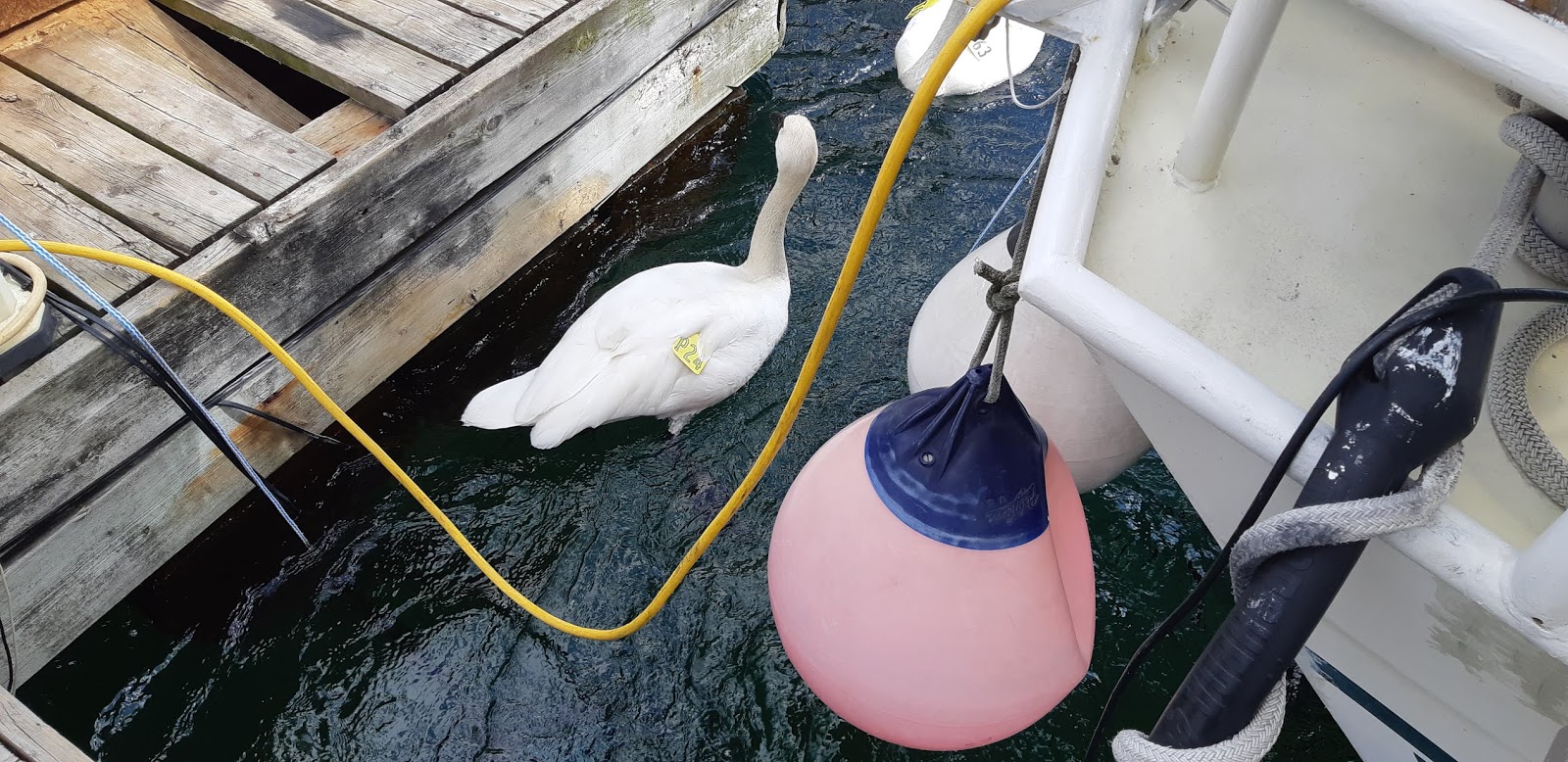
Mrs. Alchemy, who stopped being a wildlife rehabber last week, thinks she recognized the trumpeter swan in the foreground. We were measuring the templates for the chain plates for the drogue bridle when these two rolled up.
We are in our apartment until April 15, at which point we expect to be out of the marina and on the wall at National Yacht Club for a few days to finish up some jobs at the club workshop and generally prep for imminent passagemaking. There's a few personal matters to attend to, but we may be out of luck when it comes to any services or docks available on the trip down, which could make things...well, not impossible, but difficult in some respects, particularly given that it's still very early in the season to live aboard.
Found the prop puller! Now I want to stow it, greased up, in the Ghost Tank just because I hope not to need it for some time.

For instance,  our club, due to the "social distancing" aspect of the current pandemic, is considering delaying the club's boat launching, scheduled for April 25-26, until...who knows? The club is already largely closed for business, although the washrooms and the workshop is open and people are roaming about doing the usual commissioning jobs, but with no sure outcome that the crowds and the cranes will arrive at the end of April.
Another U-bolt firmly placed through the pilothouse roof...it will also serve as a tie-down for items such as the whisker pole.
Of course, we hope to be in Kingston or so by the end of April. We have to continue to work as if that's going to happen, if for no other reason than we will be living aboard, come viral hell or Lake Ontario high water, which, naturally in this year of the plague, is totally also a thing.
The keen-eyed will note that the current water levels  of March 18, 2020, are at the same height as those of April 21, 2019, meaning "high, indeed" and potentially record-breaking.
This adds several considerations to our departure plans: 1) High water levels may threaten yacht club and marina operations severely: fuel docks may be shut and electricity turned off to docks still clear enough of the water to use. Our early start may get us past (if we can clear the locks to more or less sea-level past Montreal), but we can't count on even marinas being open for business if the pandemic is cancelling boat launching plans; 2) The high water is increasing currents in much of the St. Lawrence river and estuary. While this is not necessarily dangerous, it is a consideration that may make getting in and out of marina and YC facilities tricky.
Took a trip by train out to our chandlery of record last week. Had no problem getting a seat as I am The Last Sailor on Earth.
Meanwhile, things are getting altered, improved or fixed. The "outside" throttle shifter was very balky and eventually seized in the shifter part for reasons that remained unknown even after a forensic review with the manufacturer's service tech via phone in Florida. So, not wanting to plate over and redrill fresh holes for something different, I invoked the warranty and got a replacement. So far, so good, but I won't actually hook up the Morse cables of the outside throttle shifter until we "dewinterize" circa the end of March and move the boat to a finger-end for coming and going, which will be after we remove the gradually failing boat cover this coming week. As will most boat things, creating an orderly action plan is part of the deal.

New shifter is identical to the old, save that this, you know, shifts.
Another job of some import is to fabricate and install chainplates for the series drogue. As discussed earlier, this involves cutting and shaping stainless steel bar stock and through-bolting the resultant plates to the hull at the stern.
Crosby G-209A 3/4" shackles with 7/8" pins and a seven-ton working load. I was told that a pair of 5-ton shackles would serve, but the size of these goes nicely with the closed thimble of the Dyneema bridle.
Because the five-inch wide, 1/2-inch thick SS plates are awkward to hold against the sternquarters on a windy day, I hit upon using some much lighter alu stock at 2 1/2" wide, which is what the SS will be cut down to, to measure out where the various holes should go. The idea is to actually make four 2 1/2" wide chainplates out of the two five-inch pieces and to drill all of them with matching bolt holes. Inside the boat, the "spares" will be rotated 180° and will serve as backing plates. The two will sandwich the hull and will be bolted together with six 1/2" SS bolts and locknuts per side.
Apparently, I was holding my phone upside down. The shackle end will be rounded off smoothly to lessen the slight chance of damaging the bridle. The dotted line represents the angle of the stern just below the pipe gunwales.
Meanwhile, back in the boat, I've started to saw this and reinforce that to swing the bed platform in the aft cabin athwartships, as described before, but I also did a small job to aid and abet the new shifter. That was to cut the compartment top for the hydraulic ram area so that the Morse cables for the outside throttle shifter, which also wend their way through there to get back to the engine, could have as few curves and therefore as little opportunity for friction or related hang-ups, as possible.

This involved some fun measurements and a hole saw to make a decent-looking slot. I've saved the cut-out and may tidy this job by restoring it so the cables just emerge from the hole and go straight to the shifter body.
The bed platform will feature a hinged portion that will "go up in the daytime" and will give us about four extra inches of width. More to come on that project as I do some more reinforcements.
The swans persisted. They were curious and unafraid, suggesting the dreaded bread supplement to their diets.
Every day is busy now, and last week saw the arrival, courtesy of a friend driving down from Barrie, of a replacement solar panel for our solar arch, which I will install once the plastic's off and I have easier access to the aft deck.
Now with five extra watts than its predecessor!

2018-11-29

Strangely compelling, but no one knows why

Yeah, there's a bit of spam in that total, but I prefer to be a light unto the nations.
I have been scribbling about refitting a boat since 2006, more or less a dozen years a slave to a dream of casting off, if I hope not this mortal coil, but that which ties me to land, with what I have laboured to make a well-found vessel. We are closing in, and fast, to the manifestation of that dream in the form of heading for salt water in 2019. My son is now 17 and he'll finish high school in seven months. You can imagine the to-do list is ample and the time, like the daylight, is short.

I've been eyeing the blog's odometer for some time. It ticked over the quarter-million mark today, which might be peanuts for the average bloviation about politics or similar outrage, but is what I consider respectable for the random blatherings of a half-wit with a wrench. The fascination of reading about a man learn how to do simple tasks he would've known how to perform mere decades earlier must touch a masochistic nerve, is all I can say. Nonetheless, this humble scribbling, replete with half-assery, bad ideas and compromises of both material and spiritual kinds, has brought me into the lower ranks of Those Who Sail.

This is generally not the same ranks as Those Who Drown.

I have received a great deal of advice over the years and have particularly benefitted from contacting...and learning from...active sailors and refitters...some significantly younger than myself (not that that is so hard to be these days) who have inspired me. Veterans and beginners all, I have learned from them and from my readers.

Thank you.

2018-04-07

Surveying the risks


"Non-compliant": yes, we know. We haven't used it since shortly after getting the boat. Probably is empty. Photo (c) Peter McGuire, Fastnet Yacht Surveys.

Had a survey for insurance purposes last Sunday, something our insurers haven't asked us to obtain  A couple of things we knew (Mrs. Alchemy was present as a learning opportunity), such as the superannuated propane tank and the propane hose that needs replacement after 10 years, and that the inline filter for the air condition seawater circuit was not ABYC-approved. Both are easily fixed, and the last one can find a use for a salvaged little Perko-type strainer I already have stowed.

It's an Octopus, but not the breaded kind.

We also know we need an isolation transformer. It's on the list. What I didn't know or noticed was that the hydraulic hose going to the pilothouse helm pump is starting to "sweat", meaning Its Time Has Come. As I am planning on installing a hydraulic autopilot this summer, I think I'll buy the replacement and the "new" hose and fittings at the same time. Still unsure of which autopilot brain box I'll install, but I'm leaning toward this. And this display. While we intend as a matter of course (nav pun) to steer to a heading, rather than to a waypoint, so as to reveal set, drift and leeway, etc., we are going to preserve the option of interfacing with the existing plotter. But mainly, it's about robustness.

So is risk assessment. A lot of decisions on the boat are driven less by what we think we can "get away with" and more by "if we do these things and follow these practices, we will lower our chances of catastrophe". That's more than wishful or magical thinking, it's prudent seamanship, which is something even a land lubber can practise. We try to follow the precepts of "renovate, repair, and, if possible, improve". It's why the failed Schedule 40 galvanized steel pipe nipples topped with bronze ball valves have been replaced with Schedule 80 (beefier) stainless steel pipe nipples with Marelon ball valves.
Before...
And after...still to do, the reconnection to the respective drains.
Was I always this cautious? No, but near-sinkings and hanging from tethers over a wild sea will sharpen one's sense of the transitory nature of life and boats, and suddenly backflow preventers and gas sniffers seem like sound investments. This was brought home to me, again, just 12 hours ago.
You'd be melancholy, too.

This fine old fellow is "Doba". How he ended up on our ratty couch at 0300h is a cautionary tale. Doba is an elderly Dogo Argentino, a large breed of hunting dog, allegedly, but he is possibly the mildest-mannered beast I've ever encountered..."big suck" only approaches his degree of stolid amiability. Last night, circa 2 AM, I was fighting with a reinstallation of Google Earth when I heard barking and shouting from the street. Now, as we live way downtown; sonic shenanigans of this sort are not unusual of a Friday evening. I would have ignored it and turned in had I not heard the loud arrival of a police car, followed by that of the first of many fire engines.

One of the rowhouses across the street was on fire. Which one was not immediately clear, but I could see loads of smoke from my second-floor window and, briefly, flames curling up above the roofline. I woke the missus and went outside. Sure enough, Doba's owner, Paul, one of the two tenants in the building, and Franco, the building's owner, were on the street, with Franco clearly in shock. The speed with which the place had burnt was alarming: the second, top floor was effectively burnt out, but the four fire trucks on scene had knocked it down rapidly.

Turns out Franco on the top floor had left a cigarette burning on an ashtray that may or may not have been on the bed while he went to the bathroom. The bed caught fire and then the room caught fire. Everyone got out, save one of two cats (we've just learned that Cat Two was found) but I suspect the building is effectively condemned. Or so it looks.

We learned from Paul that Franco has had a loose relationship with risk management: while he owned the property outright, he carried no home insurance (unmortgaged houses are not, in fact, obliged to do this, which was news to me...and to our real-estate agent). He also had, as is required by law in our province and presumably in others, no smoke/fire detectors on each floor. Whether this would have helped is unclear, but it might have been possible to put out a smouldering bedding fire before it really took off had an alarm sounded. The house was from 1890 and that dry hemlock wrapped in horsehair was like an oil-lamp wick, unfortunately.

We loaned Paul and the basement tenant a couple of coats and had them in for tea and brandy. When the "warming bus" arrived, we offered to take Doba overnight. He did whine a bit, understandably, but he settled on the couch to sleep and was otherwise the perfect guest. Around 10:30 AM this morning, Paul came by to pick him up to shed elsewhere. I wish them good luck. They'll need it.


I relate this tale not to point blame at Franco or at any home or boat owner with a non-rigorous approach, but to illustrate that three people now homeless (plus three pets, including the vast Doba) and, probably, with a few hundred items destroyed or damaged possessions, might have avoided this outcome with some pretty basic forethought. What the surveyor pointed out by way of needing attention needs attention (although my insurance company took this year's cheque without complaint), but a shortage of alarms and extinguishers aboard weren't among the remedial aspects covered. Same with the house: we had tenants for years and there's smoke detectors on every floor with a CO detector next to the furnace, plus more fire extinguishers than are required in various potential problem spots. We have full house insurance, including coverage should I be unable to work from home, as it's my usual spot. These things are stated not to seem smug, but to indicate habits of mind. I have commented in the past (and recent events in the sailing world have kept it top-of-mind) how viewing the universe as more or less indifferent to one's well-being seems realistic, as do clear-eyed assessments of risk in one's environment, particularly that of the sea on small boats. There are parallels to small houses on land. You may think because you've never screwed up, you are an expert at something. This may be the wrong approach.

Prudence only looks like paranoia to the unprepared.

2018-03-24

Regrets and boat sales

One way to get it done. Photo (c) Yachtworld

"That's simply ridiculous when man with minimum education tells me that he's market expert (for example). Rip-off expert - I would believe so."
The above quote is from a recent Cruiser's Forum post in which an individual objected to being "pestered" by a broker with high-ball offers he judged, possessing the infinite wisdom of these sort of internet forum participants, unrealistic. There is a case to be made that apple polishing exists at the offshore end of the boat-selling spectrum, the potential passagemaking boat buyer needs to exercise some common sense about how worn boats at sea for years obviously can get.

You'd have to have been confined to a brig or live under a bridge not to realize how collapsed the market is for used boats, save at the nosebleed altitude of mega-yachts, and even those aren't commanding "oligarch" prices these days. Why would they? They are too numerous and it's cheaper to impress the people you want to have sex with on land.

I did find the obtuseness of the poster, however, interesting. He was simultaneously complaining that a broker he had approached for advice was pitching him boats, because he knew the prices were too high and resented the pitches. His contempt for the brokerage trade was not confined.

Brokers have a legitimate job in the ecosystem of the acquisition of boats, and, like used car sales folk, they are widely despised for it. But I'm not sure why the hate exists. The onus is on the buyer to ask for recent surveys, or, if the money involved or the lack of expertise on the buyer's side suggest it, to hire a purchase survey. The opportunities for getting ripped off are limited when reasonable boats in reasonable condition outnumber potential buyers. The broker, however, can be a useful filter in this process, but, in the era of Craigslist, Kijiji and other DIY operations, not a necessary one. But that is not their fault nor their concern.

The potential buyer can be correct about not needing a broker but can also be indifferent to their existence. And there is more than one way to sell or buy a boat, with variable levels of formality and agency. As an example, we just sold our house. I worked in concert with the realtor to show the place to ONLY developers, renovators, investment property buyers, and people who already owned houses in the area: in other words, to people who saw the place in context, didn't care that the paint was old and the floors needed sanding and that some of the improvements were visible through holes cut in the ceiling. That doesn't matter when you already know you are going to gut the place. It would be like putting on full makeup prior to having plastic surgery. So we didn't. I kept my old boat clean and gave it a cursory topsides buff, but I didn't, by a similar logic, pretend it wasn't 43 years old.

We avoided a general listing with the house. We showed it about a dozen times over five months. No "fluffing", no $25K "staging" or "white boxing": just a sign out front with the "Exclusive" label on it.

We named a fair price. We got that fair price. We paid a fraction of the usual commission. The tactic and the price was based on my extensive research of the 20 nearby houses that had changed hands in the last 36 months.

I mention these aspects because houses and boats sell according to similar agent/broker models, but those models are variable...if you, the buyer or seller, so request. If you don't like the game, change the rules. If you don't like the game with changed rules, don't play the game. I see non-garbage boats on Kijiji I would jump on, if I didn't already have a boat and if I knew anyone who wanted a boat...but, of course, I don't. If you're not paying a broker's cut because you resent broker's cuts, you can keep a surveyor on speed dial. Apart from the price used boats command, selling and buying one outside of the former paradigm is, like so many other fiscal activities in our brave new world, largely frictionless. That said, I can't blame a hungry and probably depressed broker for trolling any name they have. Neither should any buyer or potential buyer. After all, you may want to sell your boat someday, and, unlike an algorithm, a broker may not be interested in your custom at any price.

I had my first boat with a broker for 18 months. We showed it about 25 times. Not a single offer. A guy in my club offered me half of what I'd listed it for, no survey, all cash. I see my good old boat sailing off the mooring regularly. I have no regrets, save I'll never get those 25 showings' worth of time back. And that includes the hard and generally (in my experience) honest work brokers supply.

2016-08-02

Splendid isolation


Behold the Yandina Galvanic Isolator: It's like a check valve for stray currents.
Take a deep breath, sailors: This may get technical.

Boat electrics are a complex and an even nuanced subject. Not only are knowing the basics of wiring out AC and DC circuits necessary if you want to run your own liveaboard show, but the special situations of a) boats sitting in weak electrolyte and b) metal boats sitting in weak electrolyte must be appreciated. Some terms are inexact or differ among the English-speaking peoples, such as "line or hot, neutral, ground or earth", while others, such as "floating ground", give rise to unintended images of hovering turf.

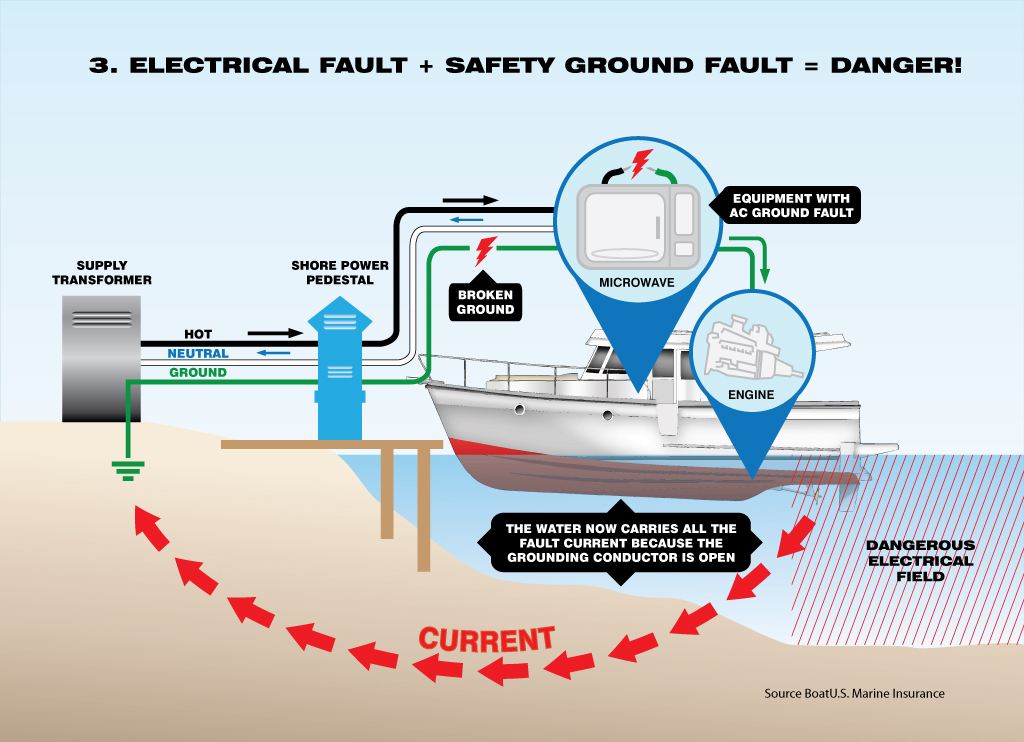
Part of the battery rehab has been, of course, the installation of the inverter, the device that creates AC power from DC power stored in the house battery bank. Learning about how that circuit is tied into the existing AC ground (see "floating") suggested that I should improve the shore power situation with galvanic isolation, which, in basic terms, stops stray currents in the water, a fluid highly conductive of voltage, from dodgy dock electrical supply, people dropping live extension cords in the water, or people whose boat wiring is not up to spec and who may consequently be leaking volts into nearby water.

Diagram (c) Boat U.S. http://www.boatus.com/

This is a problem with many solutions, all of which make great bedtime reading for people like me, and which can be exacerbated on metal boats. Not to mention that in severe cases, which may nonetheless be insufficient to trip the breakers designed to protect the circuit, the waters can become sufficiently electrified to injure or kill swimmers, the gravity-prone or kids messing about in nearby boats, who fall in all the time. It's not just the zinc anodes that suffer.

I can note and complain about flaws in my own club's wiring, and, as you'll read below, there are problems. But I can't actually fix them myself. I can, however, protect my boat. The Yandina gadget is one step in that direction.
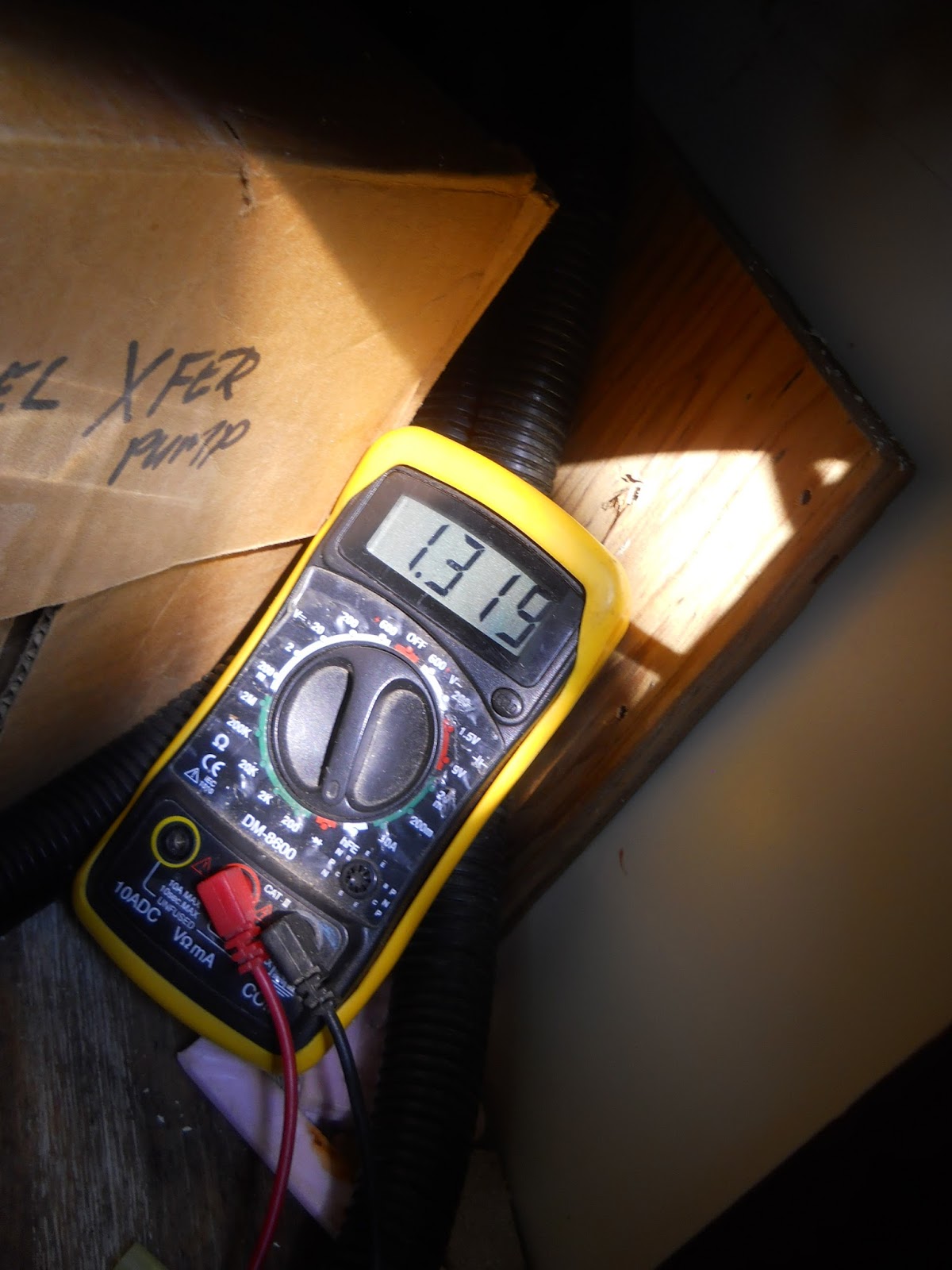
Measuring the diodes in one direction...
...and then the other. Both were within spec, according to the manufacturer's instructions.
Acting with the guidance of a trusted source, I determined the galvanic isolator was functioning and then found a logical, shady place to mount it (it's not a large thing).  Then out came the shore power plug and I broke out the Holy Trinity of electrical hand tools: my Klein cable cutters (obtained in a junk store for five bucks), my Ideal Stripmaster and my Ancor double crimper.
Of course, even though I replace this typical cord when it shows signs of wear, there are better options these days.
Firstly, I had to cut into the 30 amp line. Keen eyes will spot a second 30 amp line and yes, we can run them combined for 60 amps, but I've never bothered. The throw switch seen to the left of the shot here is the "30A/off/60A" option, but it's never been an issue. If it becomes one, I can alter this installation.

The scribble refers to which outlet on the pilothouse exterior this cable is attached.
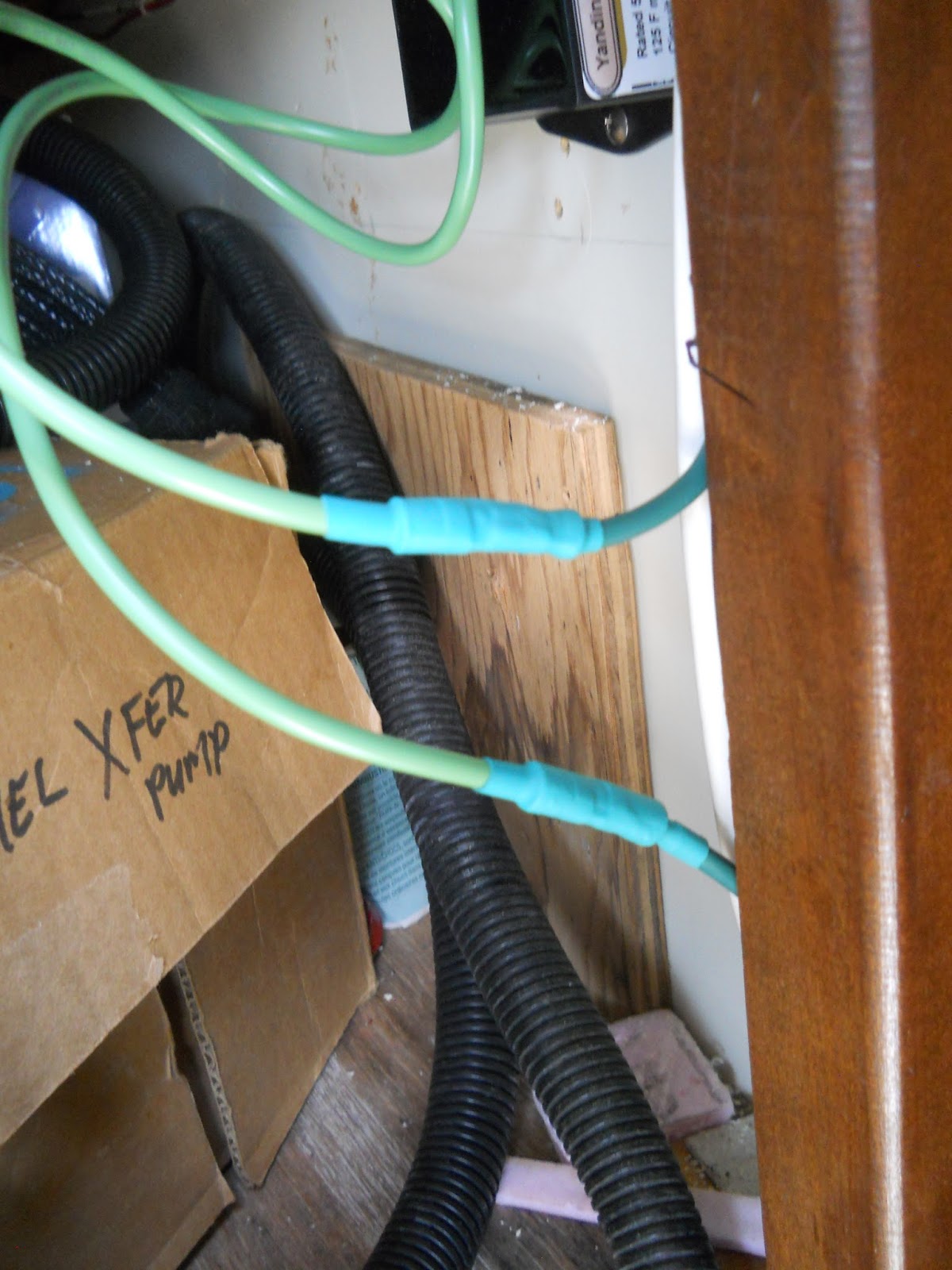
Carefully scoring the outside cover to reveal the green ground wire, I opened up about 15 cm. There was no need for any more to be exposed.
Stripping. I live for it.

My old friends, the heat-shrinkable butt crimp connector. That doesn't even sound rude anymore.
Crimping the isolator into the ground circuit was straightforward. Still haven't quite figured out the +/- adjustment on the crimper, however.
After applying the heat gun, it looks reasonably weatherproof. Given that it's in the companionway to the aft cabin, opportunities to experience weather should be quite limited.
A few cable ties to neaten up my work and I was done. Plugged back in, there was no evidence I had done a thing, and yet I had protected my boat from current events.
Squared away, yet still accessible should that be necessary.
Now, while the rationale for this installation is clear to me,  the world is full of crappy shore power circuit connections and dodgy boats. I may not be entirely done. There's an argument (particularly on metal vessels) for installing a larger, bulkier and more expensive item known as an isolation transformer. It's the electrical equivalent of wearing a wellie in a whorehouse should one wish to avoid the clap of galloping corrosion. The arguments in favour of it are strong, but I would need to see more benefits in the form of a longer record of anode wastage on Alchemy. Certain factors are currently (no pun intended) influencing the lack of enthusiasm for installation of an isolation transformer. Firstly, we will be on the hook (and therefore not on the shore power) in most places we visit. Not being on shore power, and not being near other boats on shore power is more than half the battle in reducing galvanic corrosion issues. Secondly, we don't have a generator built into the boat...and tied into its AC circuitry. It's all DC, from panels to wind genny to battery bank. Unless we are inverting DC to AC, there's no AC. We will have AC also in the form of Honda 2000 portable generators, definitely one and possibly two, but they aren't attached to the boat directly.
Not to code, hell, no
That judgment rendered, there's some squirrelly stuff on the docks at my club. Spend a few weeks in blistering heat wiring out things and one starts to dwell on it. A guy three slips down has been running two domestic-grade (think 16 gauge garden variety you'd use to power a weed whacker) from his wee charger on his '70s-era boat (wired probably identically to Valiente) across his decks, off his bow, over the water and down a bow dock line. From there it goes to the power post I share with a cabin cruiser that is constantly drawing 60 amps to keep the beer cold. When I asked why, the owner said the "power post closest to him doesn't have a working 15 amp plug". Well, that's really a club issue the boat owner has. Letting a live extension cord dip into the water next to my steel boat is my problem. He's since pledged to get a 30 amp cord. Hell, he's paying for the dock.
See that white fuzzy thing in the middle of the shot? That's the outer cover and inner fuzz exposed because the cord's nearly cut through.
Yet this stuff is distressingly common on the docks. Either through a perception that "well, I only need enough power for the clock radio/Koolatron/little 10 amp battery charger" means only an extension cord is necessary, or because the club is negligent or ignorant on how poorly crappy cords and water mix one sees this far too often.
Black electrical tape does not, in fact, keep the electricity in.

I use "pro-grade" 12 ga. extension cords on occasion to run tools while I've got the AC circuitry in pieces on the deck. I secure it to the dock and wrap it up when I'm done. I don't leave the boat plugged in generally, because of what I've learned. The battery bank will shortly be on solar and wind...I won't have to plug it at all if I'm not running power tools. These concepts aren't hard, but remain, in my view, poorly understood. Since I started sailing in 1999, there have been three serious firest at nearby facilities: a fire at RCYC caused by a battery charger left plugged it via an extension cord that burned several boats; a fire at QCYC caused by leaving a fridge plugged into an extension cord (that one nearly burned the club down, if I recall correctly); and a fire at Outer Harbour Marina from an extension cord plugged into a heater in the on-site toilets. I saw the results of that one personally: 
It did not buff out.
The commonality, of course, is the lowly, unattended, probably hot and overamped extension cord. They are, unless really expensive and made for mud-caked construction sites (I have 150 feet of those and use them as needed over the winter) made for temporary, light duty. They aren't waterproof and the longer they are, the more likely they are to melt. The 30 amp shore power cord, with the right adapter, is the only acceptable power cord that should be seen at a marina or yacht club unless it's in active, supervised use. 
Yikes. An argument for hauling out if I've ever seen one. Photo (c) QualityMarineServices.com
I realize that extension cords are easy and that shore power cords are unwieldly, heavy and expensive. I don't care. Your negligence doesn't get to burn (or corrode) our boat. Send your hate mail care of this blog.