Copyright (c) Marc Dacey/Dark Star Media 2006-2026. Above photo (c) Marc Dacey. Powered by Blogger.
Showing posts with label Comms. Show all posts

2020-10-08

Catching up and not coughing

Not a bad moon rising across from the National Yacht Club back in June.
Well, that was a rather significant pause in new posts. It's October 8, 2020 at time of writing and we started sailing on our voyage of discovery, COVID-19 and repair around July 15. The prep for leaving was retarded by the sense that, once the St. Lawrence Seaway had opened in late June, that we should prudently stand by for a couple of  weeks to see if the dreaded "second wave" manifested. Alas, that didn't happen until we were in the Atlantic Bubble, but I digress. Digression will follow, trust me.
The end of June saw our boat club launch, finally, and our return to our dock instead of the convenient seawall
The weather improved sufficiently to get multiple small jobs done and to plan out where I wanted to take this "repair and refit" blog in light of plans to debut a new, more voyage-focused blog. Now, given the axiom of cruising as "boat repair in exotic places", this does not mean the retirement of this elder blog, but I will be posting more rarely and with a goal of showing what actually living aboard takes out of a boat and how to order the necessary labour effectively to continue moving and remaining functional...and what you can safely leave for winter.
Rooms with views and a mission attic probably aren't great for restoration purposes
Speaking of living aboard, the vagaries of Toronto real estate were revealed, and I mean revealed, in our former house and its mate on the other side of the firewall. The person who bought first our side and then the other obviously has plans, likely of the "fashionable restaurant" variety, but leaving the roof off and the back exposed to the weather for months at a stretch seems counter-intuitive. Luckily, I am more utilitarian than sentimental on subjects like real estate, but it seems a little wasteful. But then I lack the nous of developers.
 
Two Honda 2200s, for when you really need 27 amps of AC and there's no shore power.
 
Back at the lived-aboard, we were testing various systems for soundness. The Honda gensets worked like champs, and, now in our Nova Scotia winter digs, we've got one ashore in case of a power outage over the winter (a distinct possibility, we've been told, as is the need to bring in rum and storm chips).The other Honda is staying with the boat so we can have power at the boatyard to which we are going tomorrow morning...in case power goes out there...
And it was moving steadily to the SE. GOOD JOB, BOYS!
Meanwhile, back in June/July before we left, we had time to observe the state of marine expertise far from the ocean. This is a warning buoy to delineate the crumbling end of the seawall. Note that it isn't actually at the crumbling end. We saw the City of Toronto workboat (or a subcontractor) screw around more than once getting this nav aid in place correctly and watched them leave bow paint on another part of the seawall on a dead calm morning. The further east we've subsequently gone, the greater the level of seamanship we've observed.
Yeesh.
Solstice 2020, observed with a measure of social isolation, and a measure of rum.
Huzzah! Sumer is icumen in!
Meanwhile, living aboard at a COVID-affected boat club meant we were left largely to our own devices until the launch process happened. Mrs. Alchemy and myself have enjoyed for many years "kicking off summer" by watching the sun rise after the shortest night of the year. This year, despite daunting circumstances and no guarantee we would dare to leave, was no exception.

In the meantime, boat life continued. We got to see a lot of these sights...

A cliche need not be ugly.

...and a mother canvasback and her brood of curious offspring were a feature of morning coffee on the aft deck...
Once there were eight, but my biologist wife suggested five was fine parenting.
The watermaker can't be really started in fresh water. This is no longer a problem.

Boat jobs accomplished included a partial installation of the watermaker, mainly to get it out of the portside seaberth. These RO tubes went over the port water tanks and the rest of the pieces, which are modular, will go starboard side.
Brown feet are inevitable in this lifestyle.

The liftraft, which I didn't like on the starboard aft deck rail for reasons of scraping while docking and the weight of the thing, went snugly on the cabin top a little in front of the mast and between the saloon hatches. This I greatly preferred.

The drogue was repacked and stowed at the aft end of the sailing helm footwell, bagged against UV. It could work on the aft bollards, but the goal is to install chainplates on the stern this winter and then never use it!
Nephew No. 2 Ryan Dacey

Goodbyes were made and signals hoisted...
Thank you, everyone who helped us begin the voyage
...and we were off! And I finally got the solar panels tied into the batteries. Behold, free amps!


2019-08-31

A slight change of plans...

Apparently it's a popular place these days.
This is Halifax. At this point, the last day of August, we had expected to be near or nearish to it and booking interesting activities like apartments and hull treatments. But we've had a very busy last six weeks or so, and while frustrating and sweary in parts, it's also been productive. Two weeks ago, circa August 15th, we decided to overwinter here in Toronto, leave the boat in "layup afloat" (mast in, at a slip, covered over with a frame and plastic and with agitators breaking up the ice) so we can go down the St. Lawrence in spring 2020 without rushing and having honed some rather rusty sailing skills.

Also, there was this factor:

We didn't want to rush to the Maritimes chased by fall gales and not lingering in nice places because we were racing bad weather.

Nonetheless, we've now sailed some and repaired or installed a great deal more. The boat's in good, serviceable shape and we have a good game plan for doing here in Toronto what we would have done in Halifax in less familiar surroundings. We've even got a land-based apartment as I do not propose to sleep aboard the "job site".

Some refitting highlights follow. Amazing what living aboard does for one's productivity!

 It's been a hot summer and we tend to skip lunch. Dinner, however, makes up for it. My belt's needed five new holes since May. Hmm.
So many parameters!
 After a rather steep learning curve with the hydraulic steering, we got the autopilot sorted and properly installed. And attractively mounted, if you ignore the previous generation of gear's mounting and conduit holes.
The rudder feedback sensor took a day to mount correctly.
We are at the point now where the AP steers better than we can, so we let it. Basically, we input a true compass heading and correct to conditions. We derive that bearing by putting a cursor with generous offing near our desired destination and just keeping a watch on events. It's clear that a lot of local sailors are going to some waypoint very close to, say, a buoy or other nav aid. That's not so prudent when two or three of 'em do it at once, we feel.
Lazyjacks took effort: the irony did not escape me.
 Lazyjacks and two separate Dyneema-core reefing lines are now on the main. That's a safety improvement, as are the preventers we can now rig for downwind sailing in blows.
 Fact is, prior to actually leaving, we haven't needed reefing lines. Alchemy can carry a full main well past 20 knots apparent wind, and if we encounter more, we've just gone to the staysail. But all is different now.
The secondary fuel filter: Not, evidently, guilty.
 We had a big delay around August 1, when, while on a test sail in light air, our engine basically sputtered and died and only started again reluctantly and at very low RPMs. We made it back to our dock with difficulty and an odyssey of troubleshooting commenced.
And goat sacrifice to the Dark Diesel Lords.
 Basically, we were:
  • 1) starved of fuel, and
  • 2) the fuel was old and grotty, and
  • 3) we needed to change it all, which involved moving all the batteries to access the tank tops to vacuum out crud, and
  • 4) we changed all the supply side fuel lines in case of said crud, and
  • 5) we installed an inline fuel pump (a Walbro FRA-1, for the intrigued), and
  • 6) we changed out all the filter elements, primary and secondary.

And don't forget the goat.
 Very long, laborious story short, the problems seem solved. We've done about 50 hours of rocky and calm motoring without issue, but it took a very long process and a lot of questions strewn about to the helpful people at the club (and elsewhere, thank you!) to solve Why Won't Beta Purr? I feel we were fortunate not to bugger the injectors and we will be cycling thrugh the fuel...and the biocide for the fuel...moe quickly in the future.
Ahctual crap sailing!
 Meanwhile, there's life aboard. Frankly, it's pretty nice.
My sleep schedule's changed.
 There's a lot of sky watching...
Nothing's ripped!
 ...and practising sailing in various modes...
Scored an end dock. Sweet.
 ...and travel to exotic places. OK, this is Trenton, jewel of the Bay of Quinte and where we keep stuff.
An actual exotic beverage, this was. The brewery was micro, indeed.
 We plan to sail as deep into the fall as weather and insurance allow, to see what breaks or falls off. Best to know here than 1000 NM eastbound, I think.
Cobourg, a harbinger of Trenton.
 A happy side effect of deferring our departure is that we get to attend my nephew Ryan's wedding. That required some collective sprucing up ashore and the acquisition of more formal duds.
Cabin Boy, soon to be Cabin Man.
 Lastly, I put the AP controller on a "helm extender", because just having the thing sticking out of a hole on a NMEA 2000 cable wasn't a long-term game plan. It looks about as nice as I can do with a piece of scrap teak.
The answer was "more helm".
More to come and sooner next time!

2019-02-03

Going somewhere?

It's odd to hope you never see this deployed in earnest, or in the absence of the main vessel, really.
Having a freer hand with the boat gear purchases made the recently visited Toronto Boat Show reviewed last time a lot more fun than usual. But I've spent a lot of time in research/review mode, as well, trying to make the best choices in gear for our vessel's voyaging. First up of the "big buys", if just about the last to arrive, is the Viking RescYou six-person liferaft. Last to arrive, because the clock starts ticking on the service schedule from when the raft arrives, and we don't need to mount this until after we launch in late April. We also got the rail-mounted cradle and the "hard" container, as this isn't something I want to muscle out the companionway if things go pear-shaped. We already have a ditch bag and are debating its contents, but a handheld watermaker is already in there.
Now, to rig jacklines and bolt padeyes in all the right places.

Continuing on the safety front, we now have a pair of Wichard ProLineR 2m/1m safety tethers. I picked this version for flexibility as I plan on installing Kong Tango carbiners on jackline webbing as needed and snapping onto that. This allows the smaller shackle to be used on "static" clip-ons, such as padeyes on the mast tabernacle or wire. A shout-out to Attainable Adventure Cruising, which has been, as in so many other areas of offshore sailing, a source of great value.
Self-rescue the better way.
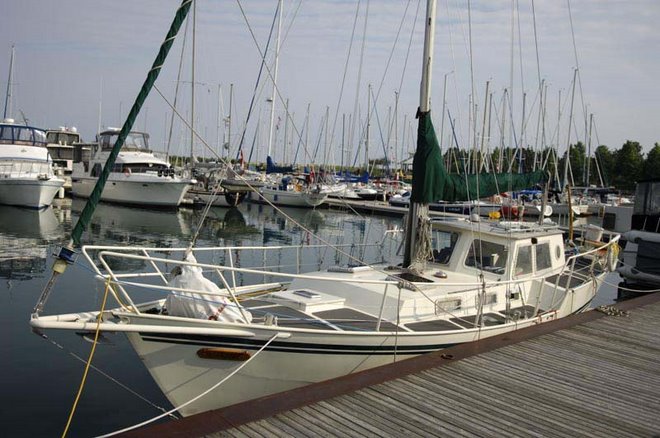
Now, tethers keep crew on the boat, when used effectively and without exception. But you'll see the problem inherent in the system: human behaviour, plus simple misfortune of, say, tripping off the boat. There are a number of ways to address this, starting with "always wear your PFB on deck. Always." Now, after that, the options multiply. We've had PLBs (pictured is the successor to ours), and we have liferings and throwing line slings and danbuoys and assorted means to retrieve a COB (crew overboard). But the device pictured above is a step beyond.

Arguably, the most dangerous time for a crew is watchstanding at night; smaller crews, as ours will largely be unless we pick up crew, will have the nightwatch hours split into two or three shifts, at least one of which will have only a single crew, tethered on deck, awake. Should a crew fall off the boat, this AIS MOB1 will not only transmit to the AIS receiver on board, it will also send a DSC alarm to the VHF, which is going to wake up everyone on board. Lastly, it's got a strobe. Save for survival conditions (stay aboard, kids), in which case the crew would almost certainly be awake and tethered and ready for anything, this seems like a game-changer for self-rescue, a topic that has interested me for some time. Fact is, in most cases, save relatively near to shore, the boat from which the crew has unexpectly departed is best placed to get their crew back alive. Search and rescue not only take time, they are generally not available more than a couple of hundred NM offshore. So this is a helpful advance.
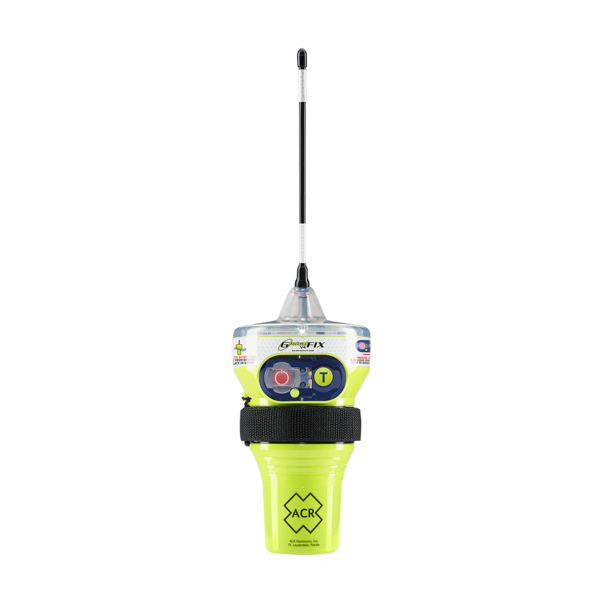
Hello, hello? Dinner is ruined!


Now, what about the boat? We could have a medical emergency, a dismasting or a small fire that cripples our ability to make passage. We needn't be sinking. We needn't be taking to the liferaft. But we may have to call in outside help. That when you trigger the EPIRB. I selected this model for its balance of features, and because we also have a functioning PLB and will also have a satellite phone and handheld VHFs with GPSes (as does my watch). We are making it hard to get lost, frankly.

Slightly less capacity, greatly less corrosion, much easier to haul to shore.
Speaking, more or less, about cooking up solutions, we have now a fibreglass propane tank to replace the steel one that came with the boat, which is at least 13 years old and probably uncertifiable. This one will be easier to haul ashore empty or filled.
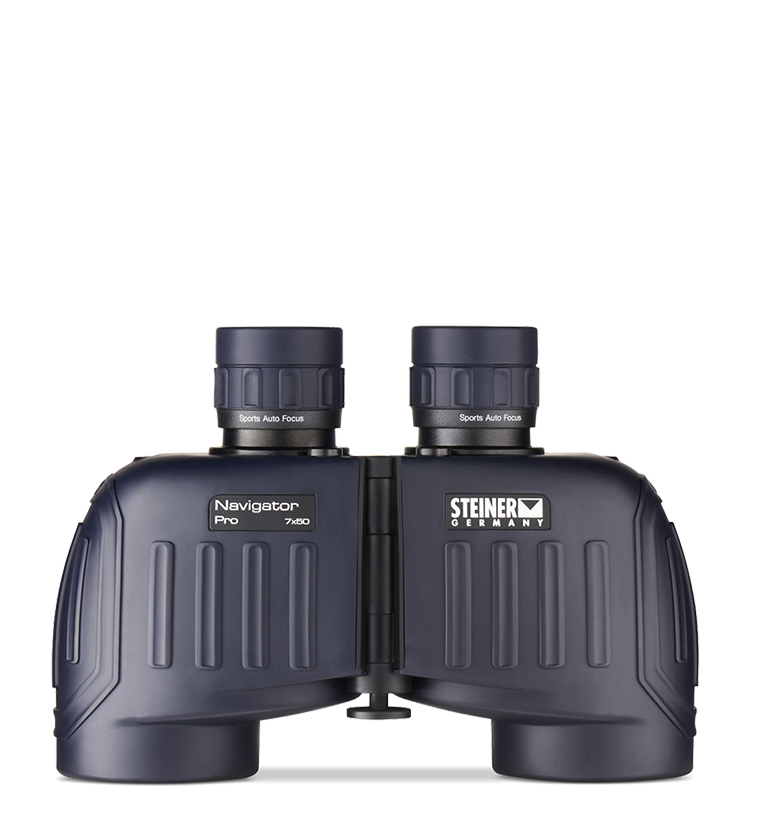
I can see clearer now and can correct for variation.
These were not strictly necessary as I possess fairly good, if vintage, Kurt Muller circa 1940s 7 x 50 binoculars. But these Steiner Navigator ProC binoculars have a built-in compass and very impressive optics, making buoy spotting or bearings to landmarks very simple, once I figure out how the steel deck affects them. Experience suggests "a lot" for my compact wife and "not at all" for my loftier son and myself...the steel seems to bother compasses to about the 165 cm. mark above deck and then hardly at all.

If you're going to pump with enthusiasm, go hydraulic.

The quest to install the autopilot has taken a great leap with the ordering of an Octopus reversing piston hydraulic pump and a Navico NAC-3 "core pack" and some associated gear that will make helming, we hope, a doddle. More on this as the pieces arrive.
I don't favour Gill particularly, but we've ended up with Gill gear because we've had very few issues with it and it's good value for our money, particular if you buy last year's wonderfoulie. But then we have a dry boat.

Lastly, Mrs. Alchemy is off to Brittany this week to take an RYA course in (very) tidal waters. So in our traditional mode of seeking bargains in discounted foulie gear, she picked up a rather nice set of Gill OS23 jacket and offshore pants at a good price. I didn't make a sound when she got some long-sought-after duBarry sea boots (not pictured as they were closeouts). I remain stuck with Canadian Tire wellies, as nothing else fits me.

And that's enough for now about how we spent our Christmas money!


2018-05-17

Sticking around

That big radome doesn't look so big up there and seems like it won't interfere with the sails when tacking. That rescue hook is not part of our rig, but of our dock.
When I last posted, it was about an unexpected day-long power outage during which our frozen and refrigerated food was saved by a portable generator. Today's post is about the extensive modification of the mast prior to putting it in, or, in the case of our deck-stepped mast in its tabernacle, on Alchemy. Said extensive modification involved the running of four lengths of wire (two 1/2" thick LMR-400-UF cables for AIS and VHF antennas, one 18 mm Furuno radar cable and one 1/4" UHF-style GPS cable). This proved to be...tricksy.
In order to get a greater bearing surface for the AIS antenna mount, I added a bit of scrap teak to an existing teak pad on the spreader. Saved drilling fresh holes in said spreader.
The prior RG-58 VHF cable was inside a cable-tied length of nasty foam pipe insulation, along with several 14 ga. wires for the various mast-mounted (and now LED) lights. So while I could clip the PL-259 connector from one end and pull the cable out of that half-assed loom (presumably to reduce mast noise and halyard abrasion/fouling, but a pain in the ass for us), I could not use it to "fish" new cable. In addition, the new cables, save for the wee GPS run (which is part of the Vesper XB-8000 package) were considerably bulkier than is customary on Lake Ontario, because they transmit more power to the antenna with less signal loss, a worthy ambition for the prospective offshore sailboat. So that meant cutting holes in the mast large enough to get them in.

Five screws, tidy heat shrinking and no sharp radius. Should work well.
So I had to get inventive. In my garage of Too Many Boat Things, I found the 1/4"(6 mm) forestay to Valiente I had removed in 2013 when I rerigged. I cut off the terminals and I had abour 40 feet/12 metres of reasonably stiff wire. I drilled the VHF hole in the top plate of the mast between the sheaves and, with the coax taped to one end of the forestay wire, carefully pushed it down the mast. Carefully, indeed, because it's a busy area in there and I did not wish to foul halyards or that grubby, if still functional, foam loom of 14 ga. wire.
This is the Scanstrut LMM-2 gimballing radome mount. It's pretty slick, but I had to be careful to get it centered and rivited correctly.
After I learned I could spin the stay to get it past obstacles, the work went slowly, if productively. Together with Mrs. Alchemy, we fished the four wires to the appropriate mast-base exits. After that, it was time to do the radar mount.
A total of 12 3/8" pop rivets are holding this on. Feels pretty permanent to me.
This was mostly just careful work and following the IKEA-like instructions from Scanstrut. Then the usual routine of inking the right spots, using a  nail punch and hammer, followed by the use of a small drill bit and then a larger drill bit, and then the riveting. It took about three hours.
The Vesper AIS's GPS receiver is mounted on the same gimbal as the radome, nice and high.
May we never heel or pitch-pole this much! But I'm ready if we do.
Loads of crimping, chafe-guarding and tidying up later, we moved the mast to the Place of Hoisting.
Two of the delays in getting the mast in were the realization that Alchemy was pointing in the wrong direction and that the mast had to be craned on its "back"
Because I have so many stays and shrouds and must mount rather exactly into the tabernacle, the crane activity can take longer than the allotted 30 minutes per boat, and it's to the credit of my friends who helped me that certain slowdowns (like the inability to retrieve the hoisting line) were dealt with in such a patient way. I need to tell the crane operator I'm going to need an hour next time.
Alchemy unbound: waiting for my turn.
Some frustration, followed by a round of beverages purchased to mitigate frustration, later, Alchemy was back at her dock with shrouds and stays provisionally tensioned....which reminds me, I need one of these.
Nice! Got the full-length battens in unassisted this year, which is always a little tricky.
So the jib and staysail are now in place, as well as the rather good-looking mainsail pictured above. I declare the season underway.  The next steps will be drilling fresh holes in the pilothouse in order to route all those cables to their new devices.