Copyright (c) Marc Dacey/Dark Star Media 2006-2026. Above photo (c) Marc Dacey. Powered by Blogger.
Showing posts with label Illuminations. Show all posts

2020-02-16

Cabinet shuffle

Behold! Custom cabinetry. That microwave is actually a dead version of the one we currently use and which is "right-sized", at a mere 700W of draw, for occasional use aboard.
What is stowage? More than just a mispronunciation of "storage", stowage is specifically securing items on a boat so that they can't fly free on a seaway, which would be comical were a rubber spatula involved, and fatal with a large, full can of paint or "Big Bertha", your favourite motor mount persuader.
Yes, this is the sort of tedious detail with which I plague craftspeople who know their business.
The stowage lacking on the good ship Alchemy is has been centered in the forepeak workshop (more to come soon on that topic) and in the galley. As discussed in the latter half of this post, there was a big empty space above the sinks just crying out to be filled with useful stowage, and to do so in a way that was functional and didn't look like treefort-grade crap was beyond my skill set.

Enter Fred Blair. Fred is a pal of my father-in-law, Dave McMurray, who designed boats and ran a Pickering, Ontario-based chandlery in the 1980s. Fred and Dave connected via that work and presumably found common cause as Fred is a "Shipwright, Cabinet Maker, Custom Woodworking" person held in high esteem by Dave. So we met in January and he took the job, which was good for us as we had had poor luck to that point getting this particular task fulfilled.
Photo (c) Fred Blair: Shipwright, Cabinet Maker, Custom Woodworking
As can be seen, the cabinet we wanted was, design-wise, pretty basic, but had to be of undisputed strength, given the motion of the ocean and the prospect of jamming it with not-entirely light cookware.
Photo (c) Fred Blair: Shipwright, Cabinet Maker, Custom Woodworking
Early on, we decided against the five-inch-tall "mug rack" below the microwave "nook" in favour of taller cupboards on top. This allows a more logical arrangement of wide, short things, such as barbeque tools and our electric grill, up top, and pots and/or bulk food supplies below.

Routering the right way.. Photo (c) Fred Blair: Shipwright, Cabinet Maker, Custom Woodworking

Fit and finish with the hinges of wonderment. Photo (c) Fred Blair: Shipwright, Cabinet Maker, Custom Woodworking
The interiors are beautifully finished; the only alterations I've made, save for the mounting holes drilled earlier today, are to put a series of vent holes on the underside of the dish storage area. If dishes are stowed still a little damp, they can drain over the sink closer to the centerline.
Varnishing. Photo (c) Fred Blair: Shipwright, Cabinet Maker, Custom Woodworking

In addition, the internal shelves and separators can be moved about and independently secured as needed, and the rear of the microwave compartment is well-vented to lessen the chance of overheating.
The finished product at the shop. Photo (c) Fred Blair: Shipwright, Cabinet Maker, Custom Woodworking
The hinges are something else. They close almost hydraulically and once I install the magnets Fred provided, I suspect they'll need a fair bit of force to open, which is desirable on an ocean-bound vessel as we hope to sail.
Even the back is pretty.
Installation of a cabinet made of 3/4" marine plywood means some tricky maneuvering. I'm not sure what this cabinet weighs, but it feels similar to our 30 kilo SPADE anchor, Naturally, one item is made for dropping and the other isn't. After measuring out and drilling some mounting holes (note the big and torquey Makita drill I trot out for whipping through steel bulkheads), I had to fab up a sort of strut to keep the cabinet, which at one point had all three of us positioning it freehand over the sinks, supported while I drew drill marks on its future home.
The leftovers from the boat cover construction find a use.
A quick blast of epoxy paint on the bare metal, which still took, Makita enthusiasm notwithstanding, three drill bit changes to get up to the desired 1/2 inch bolt hole sizing, and we were ready to dog down.
This will be recovered by the fitted cherry strips that were there before. I don't think the bolts I've used will be too proud.
 And here's the result. The internal partitions were removed for reasons of access.
Fits like a charm. Picture a spice rack in that space above.
The mounting bolts have washers either side of the bulkhead and the cabinet, and are secured by heavy Nylok nuts. Picture also some sort of 12 VDC pointing directly down into the sinks.
There is not a huge amount of clearance here, but I can see to wash, and Mrs. Alchemy, at a foot shorter, likes the ease of access to the cabinet contents.
This cabinet solves a lot of problems for us. That open area on the side-mounted cabinet held the microwave before, and is now freed up to hold food or bottles. The cabinet is strong enough and well-bolted enough to have on its side a handhold to make the transit to and from the pilothouse safer. All in all, we are well-pleased, and will be even more so once it's filled with our kitchen stuff. Thanks, Fred! And thanks to FiL Dave for connecting us with such a talented craftsman.

2018-05-05

Powerless (almost)

This is the heavy-gauge extension cord not on the boat. It's powering the fridge...
A short digression on preparing for life aboard was prompted yesterday by a rather strong wind storm (gusts of 60 knots were reported at the lake, and there were perhaps some local downbursts of greater intensity. Intense enough to down large trees across the city, anyway, which led to a large number of discrete power outages.
...which is powered by the dependable Honda 2000, now easily over a decade old and showing the wear and tear of being bicycled for many winters to an otherwise electricity-free boatyard some distance away. Why? To charge batteries on Valiente I enjoyed transporting even less.
Ours started between five and six o'clock Friday; I don't know for sure as I was having a mast-moving-inspired nap, which was broken by Mrs. Alchemy's return from errands shouting "HAVE YOU SEEN THIS WIND?" (I suspect she thought she was still outside). Thinking better of my CanLit-inspired answer of "no, who has seen the wind?", I arose to relative silence: a house without electricity in it is, even to my comparatively aged ears, a quieter place. Save for the honking of the cars negotiating an intersection with dead traffic lights outside, of course. Plus that howling wind.

Wood that it had stood.
Sailorly habits mean we have candles and flashlights to hand and the outage was only the south side, our side, of the street; we had no particular reason to assume it would be long, so we picked up a pizza for dinner and played Settlers of Catan by candlelight. The game's vaguely medieval, so it made sense. But as the hours went by with no restoration, I started to be concerned that the food in the fridge and the chest freezer would defrost or otherwise perish. Other sailorly habits include shopping the grocery flyers, meaning we have food items bought on sale to last a few weeks, and some of which are frozen. So it was time to invoke the generator.
As seen on Kindle.
The Honda 2000 I bought many years ago has yielded stalwart service when I've needed to charge batteries or run a power tool too far from an outlet for even the ridiculous lengths of extension cord we own. This was such a time. Its output is approximately 10 amps on the AC side, with a brief allowance for surges, meaning I could safely alternate fridge and freezer (and charge my son's computer which holds his textbooks) to keep their contents sufficiently cool (the furnace, too, was off, but the house was about 19C).
Wires were gnarled, but that house was missed, luckily.
It worked a charm. I ran it about two hours last night and three hours this morning before going off to do mast work, and when I got home, power had been restored. We did something similar a few years ago after a summer thunderstorm-related outage, and it's been a good reminder that life restricted to 10 amps is more or less daily boat life in some ways, and that being conscious of what life without mains power is like is salutary to a future when sun and wind will keep the batteries, for the most part, topped up. I'd write more, but there's a hot shower to take.

2016-09-04

Little bright spots

Snowbirds of two types.
I've been doing "big jobs" this summer, despite roaring heat and needed, if ambition-thwarting, spells of paying work. Part of the issue is time management: if I know I have four hours free, that's worth setting up for drilling, big crimping, meter work, etc. That's a nice stretch, although in the typical heat aboard the boat under in my as-yet unrestored-with-insulation pilothouse roof, it's also about the limit of what I can do without passing out. I mean, the A/C works fine in the saloon and the aft cabin, but a) I can't always have it running when I am doing electrical work and b) the lack of insulation on the lid largely defeats it.

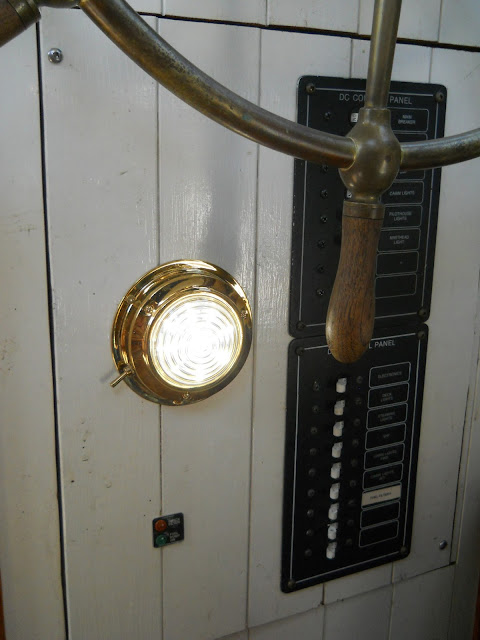
Today, I had about two hours to spare for boaty things. There's always a myriad of small improvements I've wished to make and many of which I've long since acquired the requisite bits and pieces. One such was a small LED light, picked up for a liquidation price a couple of years back, which I wanted to use for direct, more or less, light on the breaker panels and indirect, dim light for the pilothouse. I'm not talking about a red light for night watches or map-reading, but a low-draw general illumination light. I saw it digging around for some monster switches, and thought...well, it's one more box ticked, isn't it?
Light fantastic.
Unfortunately, I can't do half-assed anymore. Unseen arethe carefully crimped connectors and terminals, lovingly sealed under heat shrink and made with 100% marine-grade tinned wire. I tied this LED fixture in to the cabin light 10 amp breaker, as most of those lights are already low-draw and it would be overkill, even for me, to put this on a breaker. At first, I tied it onto the fuel pump breaker (the white-labelled switch last on the lower panel), but unsurprisingly, the fuel pump induced a rather disco rhythm to the light, which would have been obvious had I not been stunned slightly from the racket of low passing jets during the Air Show (see top photo). 

It was a simple job, but it's satisfying to do simple jobs that don't involve unplugging the shore power to avoid welding.