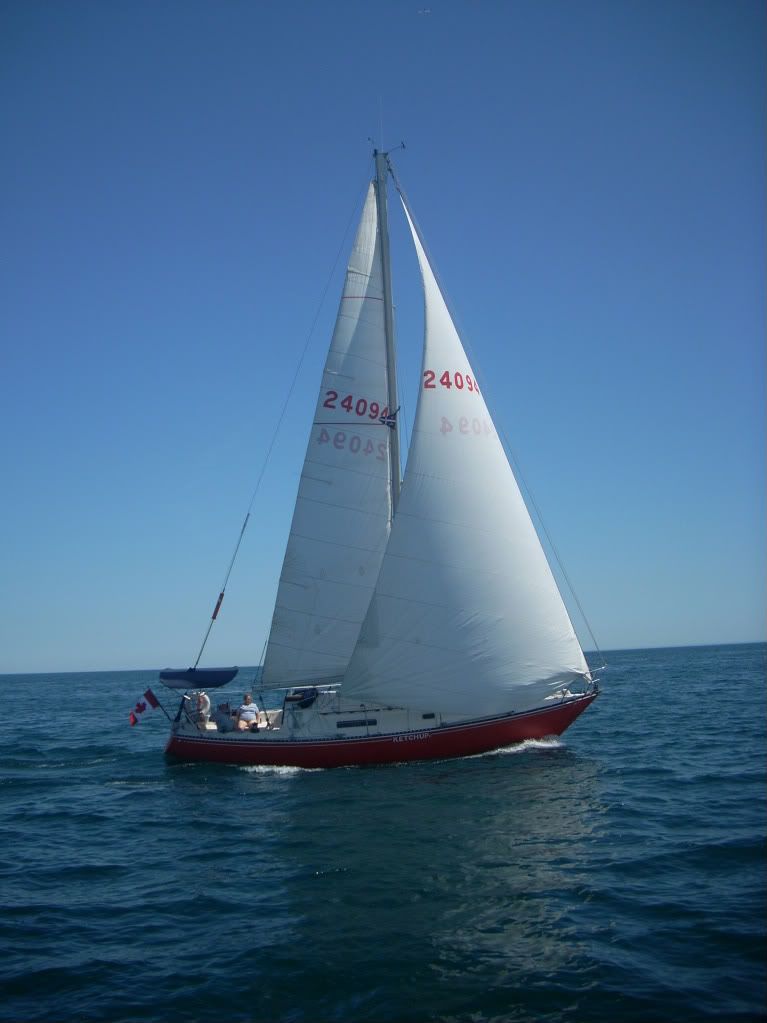
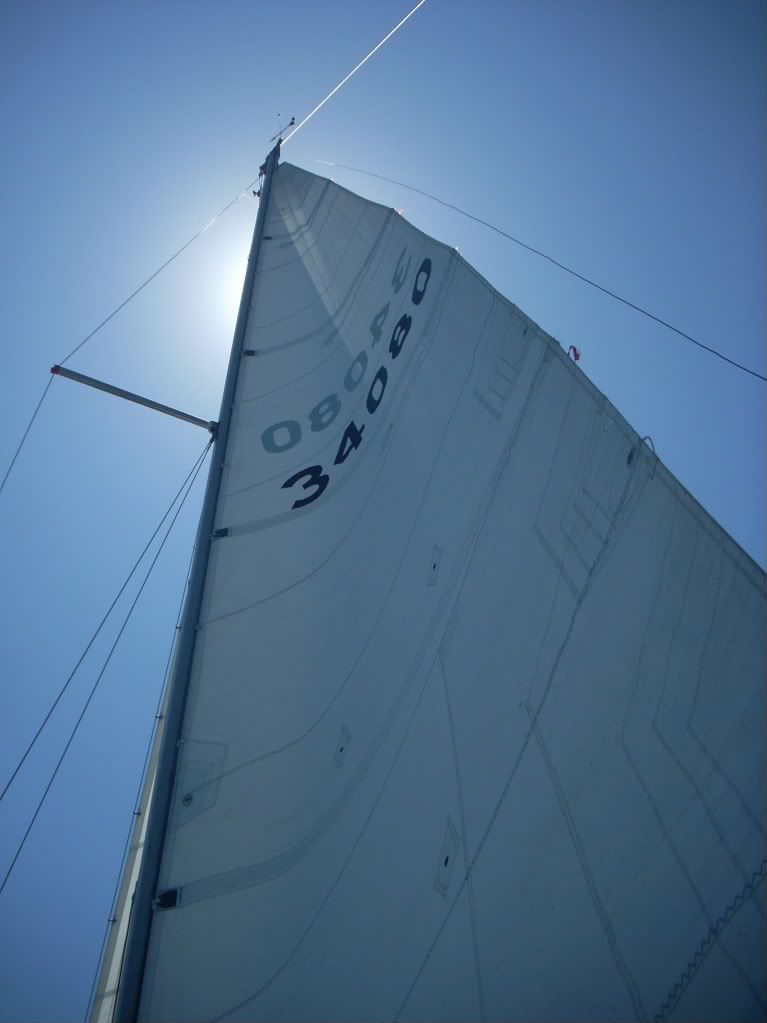
Copyright (c) Marc Dacey/Dark Star Media 2006-2026. Above photo (c) Marc Dacey. Powered by Blogger.

2010-08-14

A wee summer getaway on the Low Seas


Last Monday, we decided to take a quick trip to Cobourg from Toronto. This is a mere 100 km. NNE, hardly an expedition, but we like the little town, and we like the well-serviced marina, and the boat was running well, if in "Spartan" mode. I'll leave what that means to your collective imaginations; however, no lake was harmed in the making of this voyage.

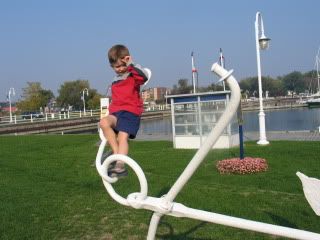
So here are a few pictures. This is my son in 2005 at said compact destination:


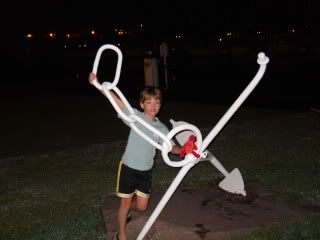
And here he was last week.


He'll be nine in a couple of weeks and has been sailing since he was five days old. Yes, that means the photographic proof predates digital!

As is so often the case on Lake Ontario in the summer, decent wind was NOT a feature of this trip.


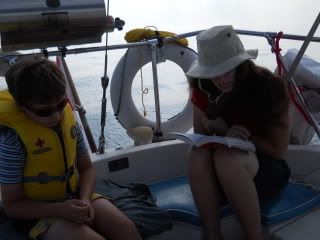
Consequently, the Harry Potter Book Club held several meetings.


Yes, my kid can read, but he still likes being read to.

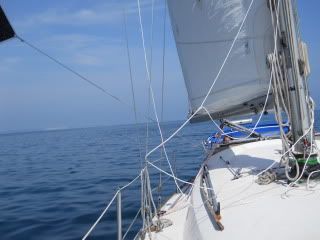
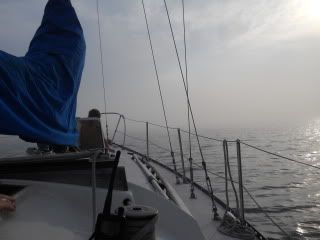
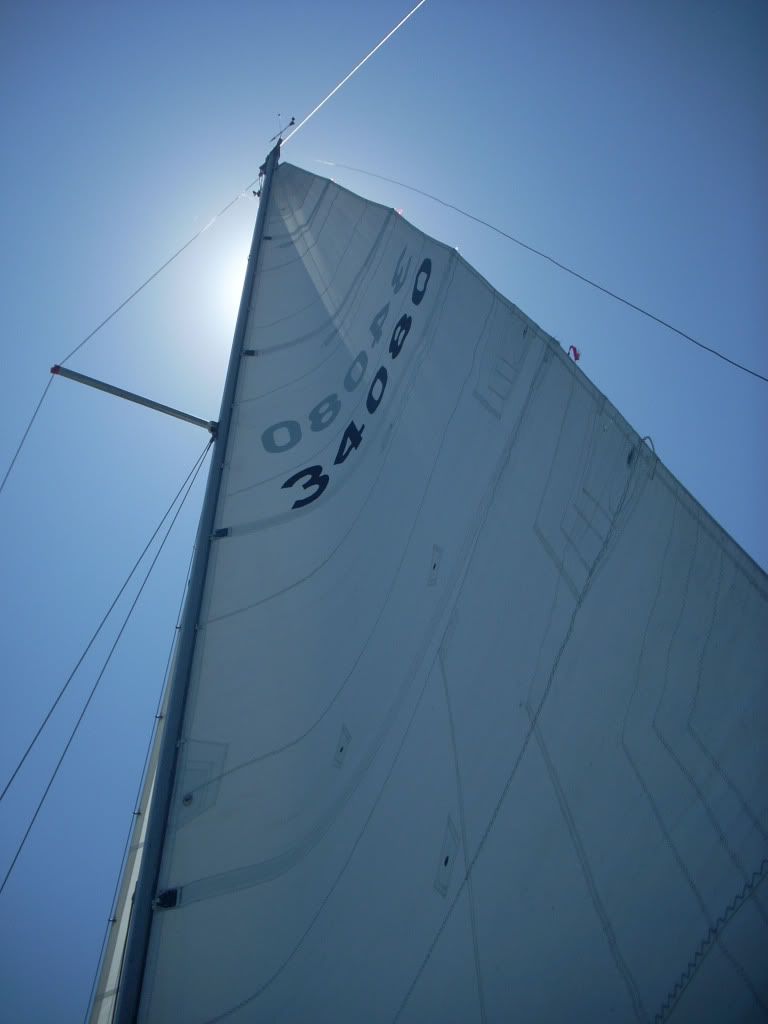
We did get a chance to throw up some sail...


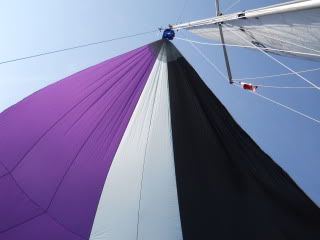
...but even with my cruising spi, we could only make about 4 knots in 6 knots of wind. At least it was from the south east, a rare direction here. Getting "up lake", meaning to the south west, is usually a chore of beating long tacks.


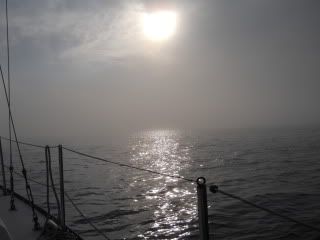
Eventually we just motored...straight into fog. Also note why boats with worn gelcoat and child passengers need frequent cleaning...oh, the footprints...


About 30 seconds after I requested my wife to hand me the can of compressed air, I had to blow it at a drifting fishing boat that came out of the fog directly in my path...five miles offshore...(sailorly invective omitted).


Anyway, that was our mid-week getaway: 75% motoring in next to no wind with about five hours of actual sailing...sigh. Now, back to boat reno ashore.

2010-08-02

Well, that only took 18 years


After years of having other sailor types express shock and horror that I hadn't seen this fairly mild comedy about a dubious yacht delivery skipper and an uptight family who inherit a vintage ketch, I located it on DVD and myself, my wife and our eight-year-old son watched it tonight. It was indeed mild, but had a few laughs and not too many errors on the seamanship side. Kurt Russell's "casual sail0r" character reminded me of a few guys at my club, actually, who know a bowline, a long splice and the rest is instinct. And beer.

Sometimes that's not a bad thing.

Vintage winches feature pinches


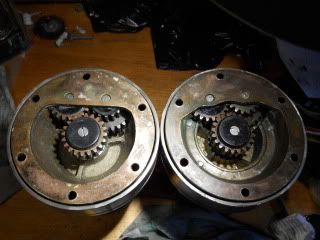
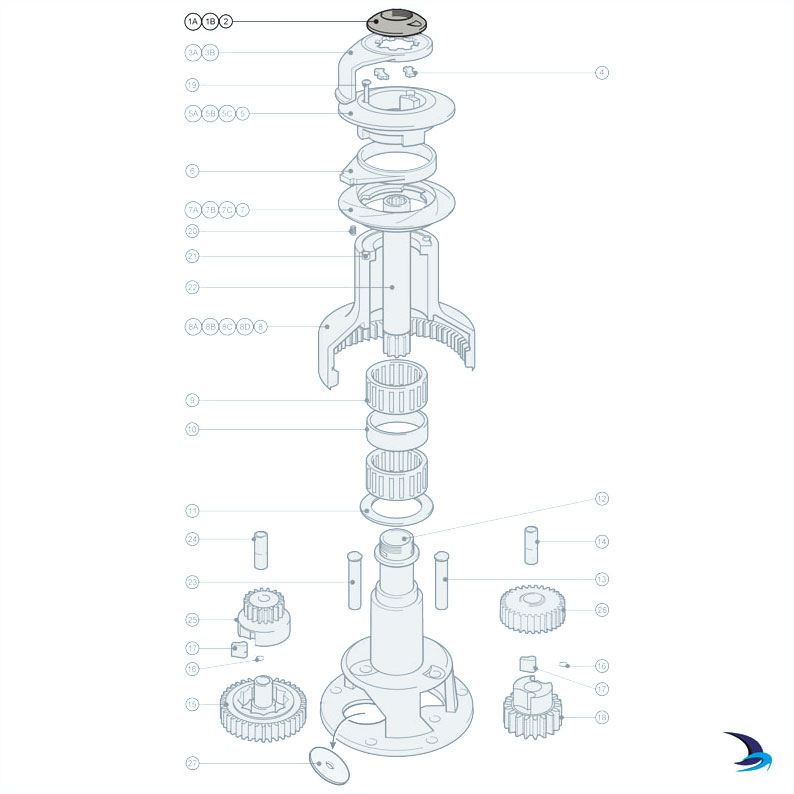
I recently received a pair of vintage winches, Lewmar 44 ST (self-tailing) Ocean Wave models from the '90s. I purchased them for $200 each from a fellow sailor on anything-sailing.com on the assumption that they had never seen salt water, and having now stripped, serviced and getting them going clackity-clack in a proper fashion (I have to earn the rum around here), I believe that they haven't been soaked in brine and will find a nice home as "backups".
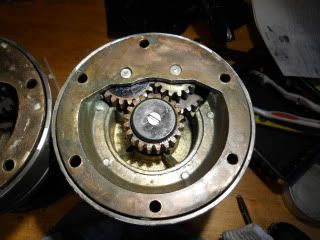
Helpful when pulling to pieces.

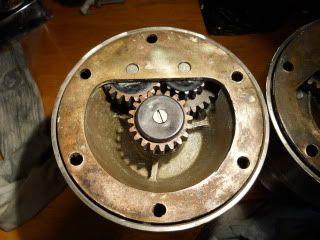
Curiously, they have slightly different guts, although they are identical on the outside. The one on the right has some sort of two-part base with a kind of internal sleeve for the central post...


...whereas the one on the left has a solid casting.


Anyway, they are built like tanks and show wear only in some superficial scratches and dings in the chrome. They will probably go on Alchemy as secondaries for drogue or warp use, towing or "big air" downwind stuff like running twins and will be mounted behind the current Anderson 40 primaries and Anderson 28 secondaries. The Andersen 40s are sized the same as these 44s...winch sizing is an arcane and arbitrary thing. Spares are still available, and I received, happily, full documentation.

I think this deal is almost as good as the $200 80-pound used CQR anchor my fellow sailor Maria P. scored down in Mexico last week:

Likely off for a short cruise next week. Frankly, we need the practice.

2010-07-21

Squall aboard at the Lake Ontario 300 race


Leaving from Port Credit, all looked fabulous forward...
...but in order to get a hint of what was to come, you had to look aft.

Ahoy, maties, 'tis the Ancient Mariner back from t' voyage...a voyage that will pay for many a sailmaker's kids to go to college...

Short version is that everyone on my crew is safe and we came second in our fleet on both finish and corrected times, which was very gratifying. That was after a very frustrating, if typical, early Tuesday morning that saw us ghost past the finish line at one knot of boat speed.
The calms after the storms.

Saturday's start was fast and very crowded and which saw a boat not in our start fouling us over the line. We had two violent squalls in the first two hours, one south of Scarborough lasting about five minutes at what I estimate was 40-45 knots and one about 25 minutes later south of Oshawa/Whitby that took about ten long minutes to blow out and which clocked 50 knots on our vessel before we really were too busy to look anymore. We have reason to believe it went to 60 knots because a boat near us took a shot of their WSI registering 59.8 knots which we saw after we had finished. I felt a little funny seeing that, I can tell you. Certainly, I recognized the sound of the 45 knot squall, but the heavier one flattened the seas, had marble-sized hail and roared like several freight trains. The first squall saw two of our crew on deck trying to wrestle the sock onto our assy spin while enduring a fearsome heel and pelting hail. They were safe, however, if strained. The assy spin was torn and stowed, but it can be repaired.

The archetype of a parade of Lake Ontario squalls. It barely rained and didn't blow back in the city.

About four miles further on, I was watching aft and saw a spinnaker explode on a boat about a quarter of a mile back before it disappeared in mist, which gave us about ten seconds to partially furl the jib and to release fully the main as we turned partially to the wind. This probably saved us more damage, as the boat was pinned at 40-45 degrees over for some very noisy minutes as we watched several hundred grand in composite sails disintegrate on several boats we could see around us. The radio buzzed with abandonments and reports of damage and injury and a trimaran having flipped its four crew into the lake. They were all retrieved safely. The best analysis of what actually happened from a meteorological standpoint can be found here, while the skipper's take on the entire race is found here.

Our damage was a torn leech line cover that meant we had to partially furl for every subsequent tack, a ripped up assy spin, a Code Zero with a hole chafed in it that we repaired with duct tape (how Canadian!), a damaged stanchion, a lost Dyneema spin sheet and some underwear, although I can't confirm the last bit. Later on, in the 25-30 knot following winds that propelled us the rest of the day, the barbeque on the rail simply sheared off, no doubt amusing some fish. We had a surplus light air spin of vintage years that we used pole-forward as a fake Code Zero in the middle of the next night, but it was only good to 10 knots and we had to douse it when faced with further, if only a measly sub-30 knot, squalls on Sunday night on the American side of the lake.

Proof we dipped the boom (!):
Weed heeled a bit.


It was the biggest squall any of us had seen, and I was sailing with some experienced sailors. If the 60 knots of wind speed is true, and I believe it's credible that it blew that hard, that's bettering what I had in the Atlantic delivery I did last November by 15 knots. Here's what 60 knots does to sails on a racer:
Painful to see, unless you run a sail loft. Then it's porn.

Out of 198 boats, 59 "did not finish", 33 of those due to too much damage, injuries, dismastings or capsize, and the rest because they were frightened/exhausted and wanted to stop their suffering. I think that maybe 30 feet should be the lower limit for this race, because of the sort of exhausting wave motion I saw on the sub-30 foot boats. The exception was the 20-foot Mini Transat boats, which faired well, but are arguably made for such conditions.

Also, beating up the U.S. side is tedious work. I much preferred the downwind legs.
Red skies at night was nice, however.

All in all a great trip, a great crew and a great experience in getting a fairly large cruiser to race effectively. Had we had a second A-sail, we might have won on corrected time.

2010-06-19

A suit and spi affair


My wife is working part-time at a local chandlery (yay, employee discount!), partially to make the money I don't make when I'm gutting the boat, and partially because if she has to have a job in retail, at least this one is educational for our future boaty endeavours.

So I was down there pawing through the sales racks and found something very much like this:


They are a set (bib pants and hooded jacket) of cheap (well, cheap enough) coastal-grade, non-miracle fabric foul weather gear. I went on delivery last November with only a pair of bib foulies; I just used my usual rain jacket by Banff that I use for cycling and on Lake Ontario. I knew that the center cockpit position was well-protected, and that I was unlikely to get continuously soaked by waves like I would in a race.

Still, I thought that with a smaller, wetter boat in the water, I should have something basic around here, so I picked up these for a hundred bucks, mainly because the jacket fit. My body-type is Lowland Gorilla, and when the chest fits and my arms are bare halfway to the elbow, I tend to buy whatever it is, knowing that opportunities for properly simian clothing don't come every day. Also, the foulies I intend to get before we leave are more, uh, technical, and run for four to five times as much. For sailing in the summer and fall rain on Lake Ontario, this'll do.

I was staring at the lurid colour of the things one night last week when I got a call from a fellow club member, asking me if I wanted to crew on his 47 foot Catalina during the Lake Ontario 300.

http://www.lo300.org/

Easily flattered, I said yes, not thinking how rusty is my spinnaker setting work and how, in a race, you don't really hove to for clever cocktails. Understand that I have raced, at the club level, and pretty successfully, too. In fact, I recommend club racing between rated boats to anyone who wishes to accelerate and/or consolidate their sailing knowledge...despite the yelling from the Cap'n Bligh A-type who frequently sail little boats against each other. You can learn as much from a horrible warning as from an avatar of civilized competition.

Anyway, looks like I'll be "going to sail the low seas" in mid-July. Y'arr, redux.

2010-05-31

A Brace of Vikings


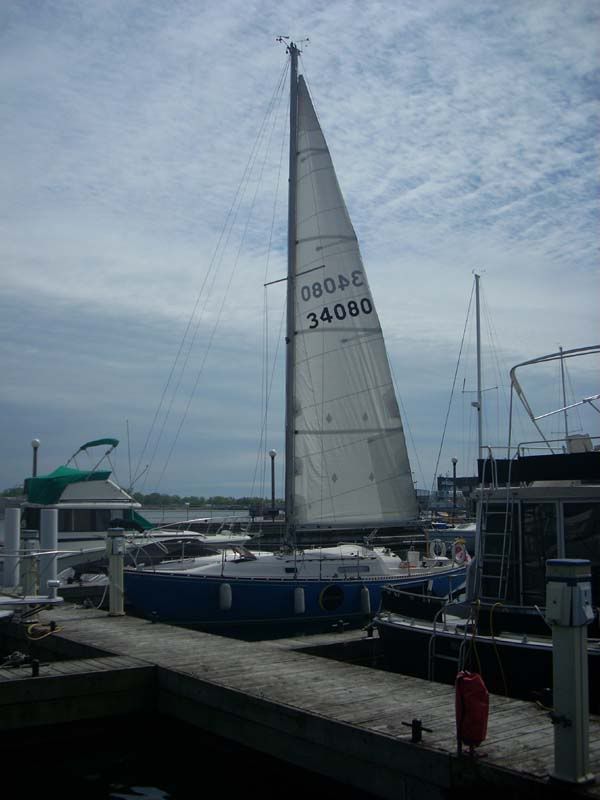
Nice, isn't it? This is the lightly used main from a C&C 33 recut for use on the Viking 33, the elder boat in my half-landbound "navy". Really, it should have full and not half-battens, but we'll start slowly this year, shall we? Really...I should be working on the other boat, not sailing at all, but it was so nice yesterday!

We got the plastic boat underway yesterday in somewhat marginal light air that actually improved even as the temperature rose past 30C. For a first push-off of the season with the wife and kid, it was blessedly free of complications, skipper foul-ups and error, and we got in about four hours of decent sailing on a gratifyingly beautiful Sunday afternoon.

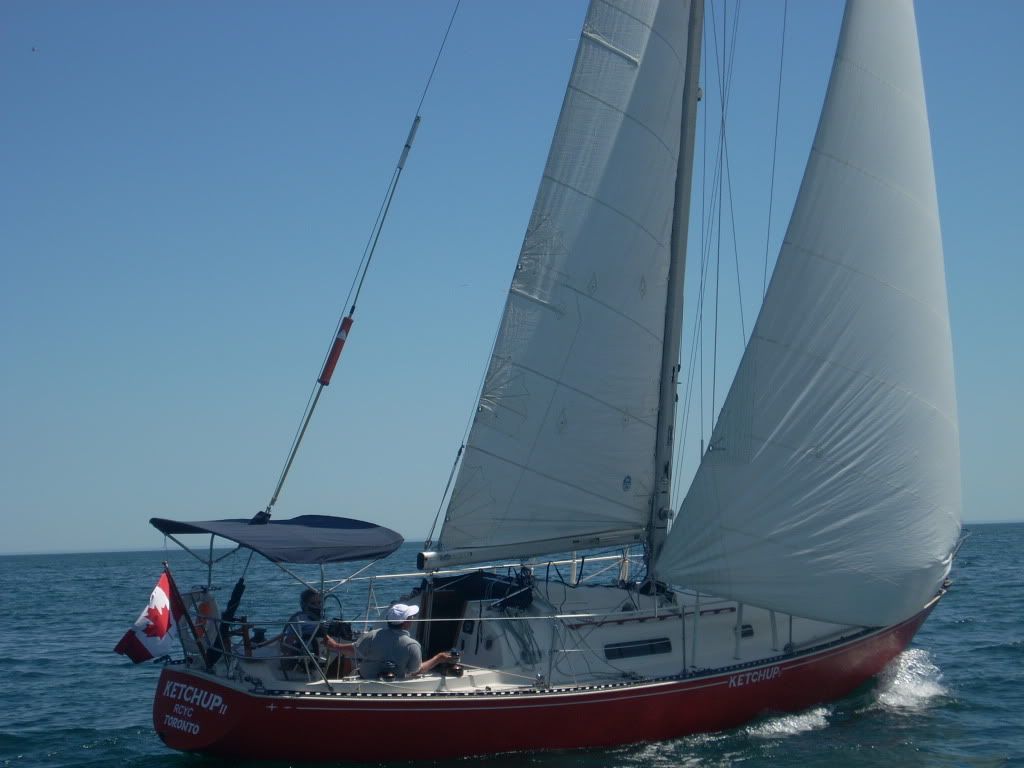
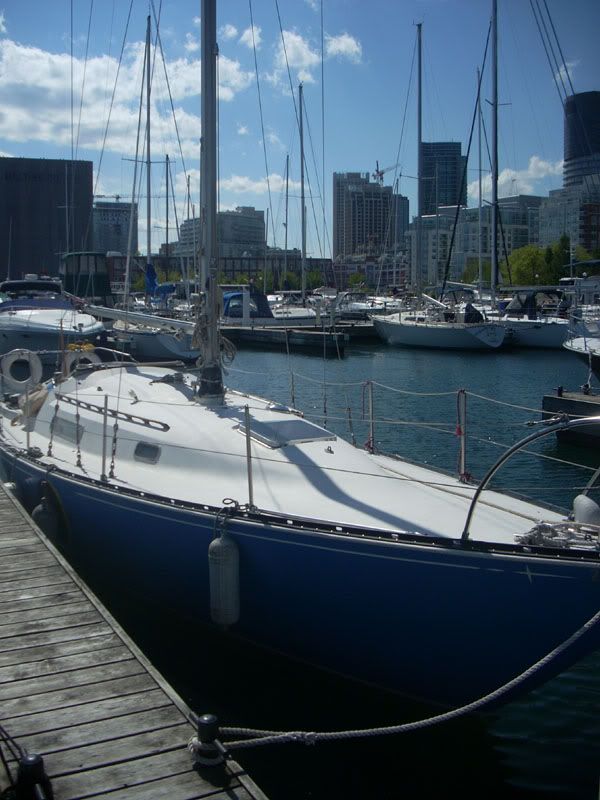
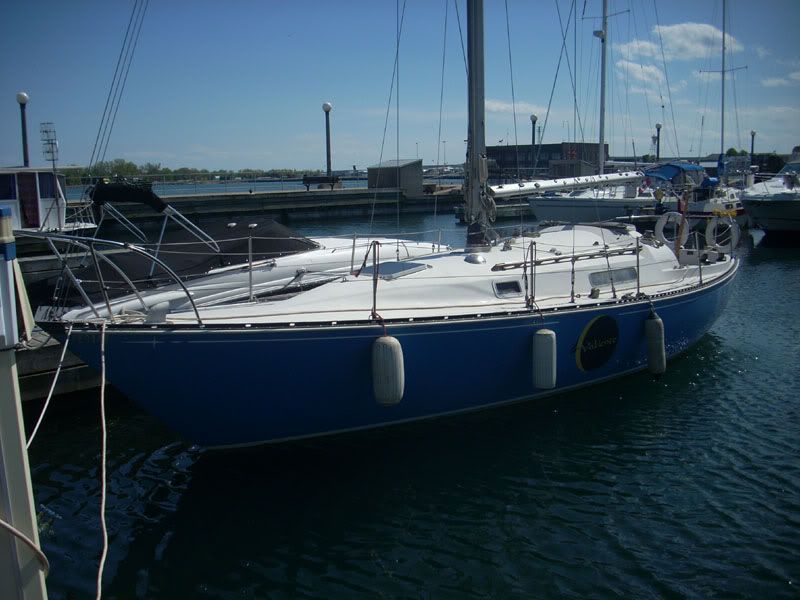
I've written about the old boat before, but to reiterate, it's called a Viking 33, a 33' 7" "racer-cruiser" drawn in the very late '60s by the C&C firm of yacht designers and builders. Bearing the distinctive (at least on the Great Lakes) C&C "star and stripe" cove line, the Viking 33 was built by Ontario Yachts (responsible for the Ontario 32 pocket cruiser and a few other well-regarded boats) for about eight years. Mine (Valiente) is hull #32 of approximately 150 constructed, and was built in 1973. I know of about five or six still sailing in my immediate area, including one, Sveeta, a 1974 model at my home club, and Ketchup, another 1974 at RCYC.


The owner of Ketchup is Mr. Dan Erlich, a fine fellow I got to know via an e-mail list about 10 years ago on the subject of care and feeding of the Atomic 4 gasoline auxiliary engine, a simple and reliable beast that, despite its more or less 1940s design, is the right size and type for short-haul movement of recreational sailboats.

Today, small sailboats tend to have either outboards off the stern (not great looking, too much weight aft and too exposed for my liking), or small diesels inboard (heavy, expensive and not suited to short operational intervals). A low-compression, gasoline inboard no more complex than a riding lawnmower engine makes sense for a sailboat that isn't going to need hundreds of miles of range, but engines like the Atomic 4, once the Number One auxiliary engine choice in sailboats under 40 feet, has fallen to the mighty, and mightily inappropriate for most sailors' needs, auxiliary diesel, which I find a pity, as to re-engine our classic plastics with diesels in 2010 makes no economic sense; a pair of sculling oars would be the more logical course, or perhaps putting a shaft on a sole-bolted exercise bike.

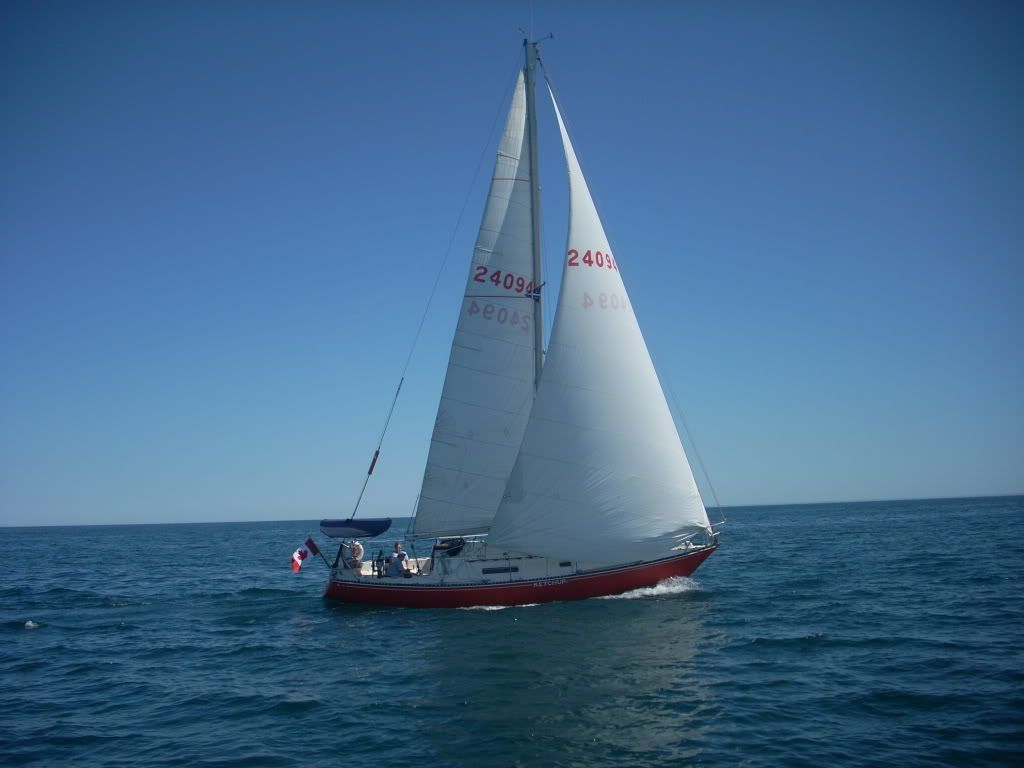
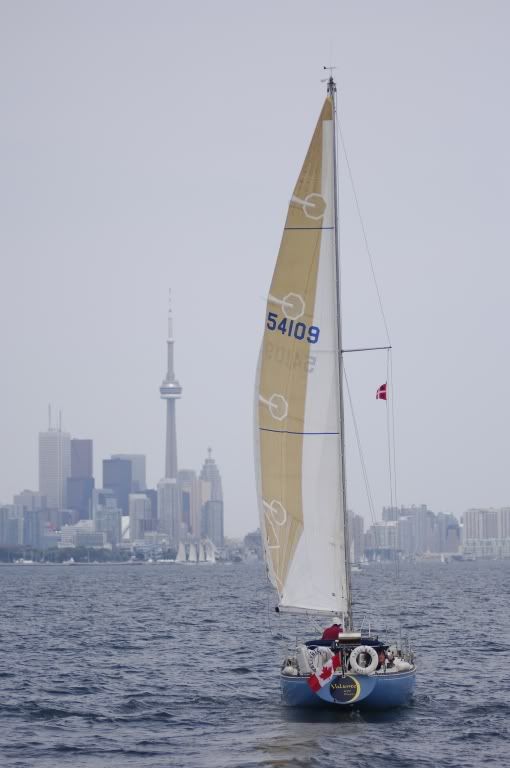
Needless to say, any engine that sits idle for six months of the year and which ceased production a quarter-century ago requires some sort of support system, and Dan is pretty clever at both obtaining increasingly rare spares and making them come to life again. Despite having near-identical boats (although I've opted for "stripped out" and Dan's got a comfort- and cruising-oriented family and hot-and-cold-running everything), we've never...until yesterday...run our respective darlings side-by-side. Dan was out yesterday with his mother for a nice cooling ride and so we "gammed" and ran parallel for about four miles to the west-south-west, "in front of the Island" as we say in Toronto.


What a great trip. We had near-identical sail sets and it was very interesting to see how closely the boats performed in "level" conditions. It was also a little odd to see what one's boat looked like from a distance! I rarely meet another Viking 33 actually sailing, and having both boats tracking within a boatlength on the beam was a great opportunity to check out variables, that while only of interest to the owners, were fun to observe.

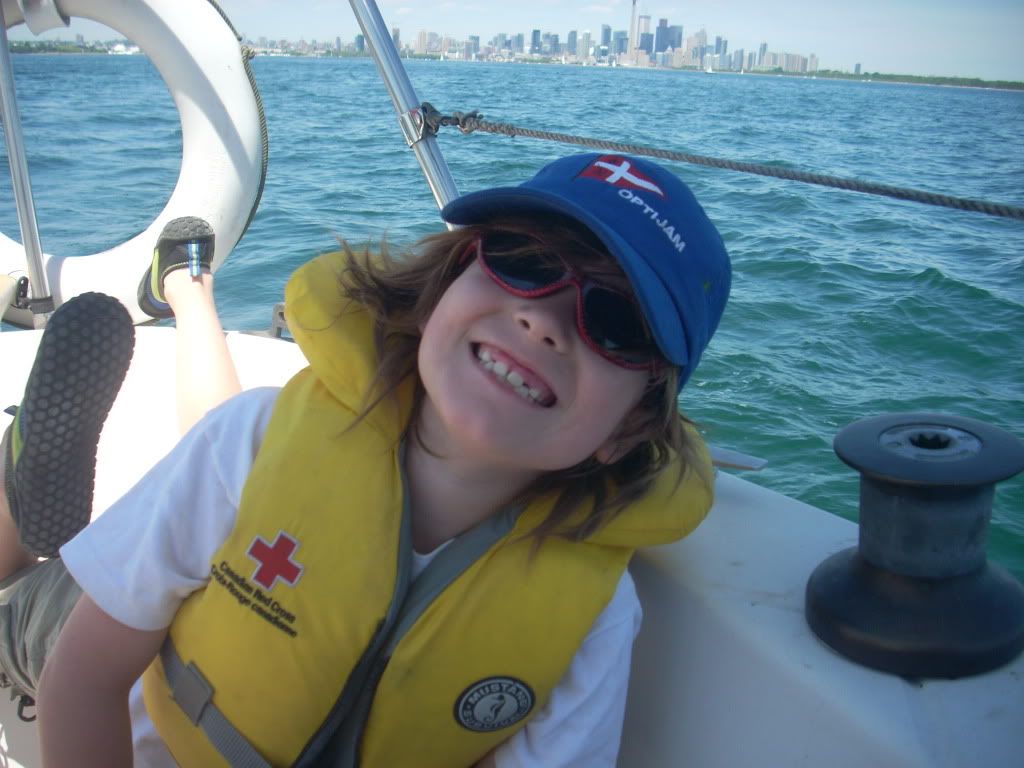
The cheerful second helmsboy was also fun to observe:


Also, quite frankly, they are "hot", responsive boats, and I like tweaking the controls to get that extra 1/10th knot in close quarters...it's about as near as I get to racing these days.

2010-05-15

New slip for an old boat


Why, yes, I should be slaving away in Alchemy, engineless, with a pilothouse roof held on with bungees and a couple of bolts, and with a "to do" list stretching into 2011. But all work, etc., even if the "play" portion of that particular proverb is actually "more work on a different boat". When the result is this, however...


...I can forgive myself my quasi-dereliction. As related earlier, the "old boat" was launched (as opposed to languished in a parking lot) this year due to the serendipitous coming together of factors, plus a lot of elbow grease to ameliorate a few years of semi-benign neglect. Anyway, the boat was launched (into a 25-knot headwind) and after some tension surrounding the motor start (it chose eventually to burp into life), and a few days later an extremely rushed "masting" and more angst, the boat is ready for the application of sails and the true commencement of recreational operations.


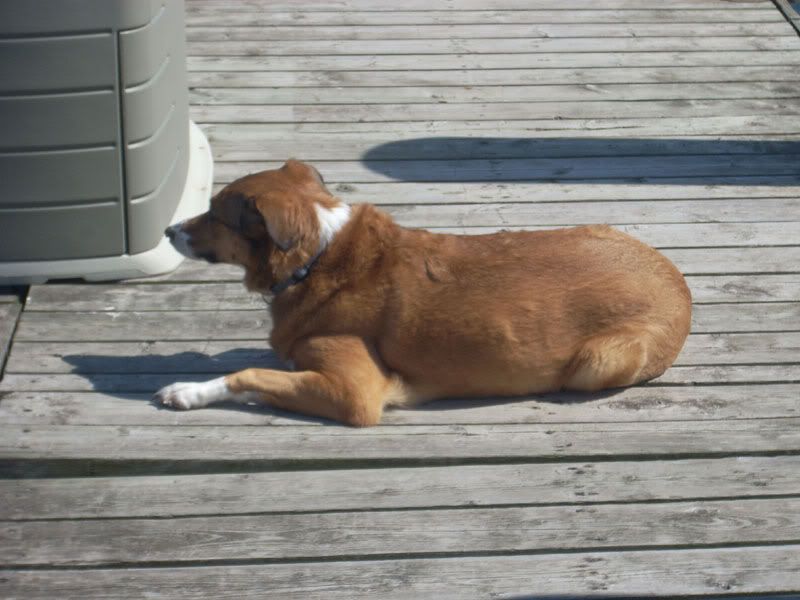
Even Casey the dock dog was impressed, and, after a hot day inside our landbound "project" boat, I suspect I'll be, too, even if it's only to lay about the plastic boat's cockpit swilling semi-frozen ciders. A cooling evening sail will be a bonus, as my fellow skipper "Overboard" has rediscovered on her concrete canoe down in Mexico (www.againstallcods.blogspot.com).

2010-04-30

Launching Sideways and the Skipper's Nerve Medicine

I spent yesterday literally clearing the decks on Alchemy in preparation for our boat club's Saturday launch. We (meaning myself, my wife and the boat...ever notice that solo sailors say "we" when referring to themselves...and their boat?) are not launching this year as there is no engine aboard and extensive welding and tank replacements and prop pulling, etc. are to be done...definitely not water-work.

We will, however, be moving about 10 metres south and west in order to facilitate cradle storage. Owners have to be present during crane moves, and I have an "away" job on Launch Day, so my wife will be present to "supervise". Having had some unfortunate experiences during boat moves (see May 8, 2007 entry), there's always a little bit of nervous tension about seeing the boat out of its natural element (water) flying through one unnatural element (air) and flying over another (earth).

The deck clearing was prompted by the move. All tenders were attached to the perimeter fence to leave a clear field for the "sling guys" to position the crane slings at marked points on the hull.

I have attended Launch and Haulout some 20 times at this point, and I still am not entirely comfortable with seeing the boats most of us devote a lot of time, money and sweat to maintaining rotating at the end of a husky hoist some 30 feet in the air, to be "splashed" into sometimes rough waters. But it's a simple fact of life in Canadian waters (with the exception of mild British Columbia) that boats tend to spend half the year in cradles, and that means transfers via cranes or TraveLifts are a fact of the boating life here.

Most of the time, it's quick, safe and expertly done by practised volunteers and hired crane/yard operators. Most of the time.

Perhaps it's timely to list a couple of the skipper's tipple recipes. Owning a boat has actually restricted my recreational boozing significantly, because, unlike many local sailors, I rarely imbibe at any point in the day during which I can be expected to operate my vessel. I don't have a car, but I wouldn't drink operating one then, either, and not just because of the laws, but because it's easier to be stone-cold sober (rather than scraping "just under the legal limit") than to court the disaster of impairment. Boats are slow-moving, sure, but carry vast amounts of inertia once in motion, and the water can be a weird combination of monotonous sameness and infinitely distracting. Mowing down a kayaker or hitting a log would be easy, and even easier with one's drink on.

Nonetheless, when one and one's crew are tied to the dock, and the boat's "put away" and the dinner is served and the lanterns are guttering in the cool breeze, there are few finer moments than relaxing with a sociable beverage on deck. Wine aboard (a topic I will deal with in the future) with meals is customary, but beer or cider taste better if the sun's still up. After dark, however, I like gin or rum-based drinks, and these two have proven popular at home and aboard. One's a classic, and the other I think I may have invented.

The Bark and Stormy

Not quite Bermuda's national drink, but a reasonable facsimile we enjoy.

4 oz. Gosling's Black Seal Rum (Havana Club 7 year old may be substituted, but not amber or "spiced" rums)

12 oz. Canada Dry or Vernor's ginger ale (ginger beer is not always available).

Healthy dash of Angoustura Bitters.

Pour into a pint tankard over ice. Grate fresh nutmeg and/or cinnamon bark into drink to taste. Briefly stir and garnish with lime wedge. Serves one.

The more abstemious among you will note that this is essentially a "double", or rather two cocktails at once. This is because a) it is good enough that you'll want two, b) one wants to minimize the transfer of beverages from the galley to the deck, and c) England expects every man to do his duty, and this is far less damaging than the old grog ration that won Trafalgar.


The Corolla


Named so because it's an accelerator subject to recall.

2 oz. London Dry Gin (I like Tanqueray and Gordon's here, but you can use Bombay Sapphire to good effect if you prefer)

1/2 oz. Limoncello

Assertive dash of bitters

4 oz. of ginger ale or fizzy lemonade, or lemon juice and soda.

Mix in tall glass over ice and garnish with lime wedge.

This is more a "sundowner" and is very nice during hot weather. One can also pretend it discourages scurvy. I like the "gin and ginger" mix personally, but frankly it's the Limoncello that makes this drink work. Just remember that Limoncello is quite sweet and a little goes a long way.

Fleeting marine instrument industry note: Garmin, the well-regarded U.S. makers of plotters, GPSes and, more recently, radars, have announced a bid to acquire Raymarine, the venerable, if not always well-managed, British instrument makers. While I am aware of Raymarine and Garmin's respective reputations and market share in North America, I don't know how Garmin does in Europe, where I saw and continue to hear of a lot of Raymarine products on recreational yachts. I would say that Raymarine and Furuno were about evenly split in Europe, to judge from dock-walking and peering into various well-equipped cockpits, with the relatively unknown in N.A. Navman brand in third. I also saw a few NASA logos. NASA (http://www.nasamarine.com/) is the unfortunately named British firm that makes affordable AIS units and other instruments. I think they are aligned or owned by Si-Tex.

Anyway, we live in interesting times. I've seen too many balky or unintuitive Raymarine units to mourn much (I even own a Raymarine 420 plotter that came with the boat), but I'm not sure that Garmin, a newer firm lacking (perhaps undeservedly) a reputation for "oceanic grade" components, can capture Raymarine's loyal following. There are pluses and minuses for boat owners as the instrument industry consolidates down to three or so major players, but it remains to be seen whether more reliable gear at a less onerous price point will be the result.

2010-04-25

Best practices for worst cases


-->Photos: Guy Perrin.
Where we live on Lake Ontario, what inclement weather that exists in the six-moth saling season is typically brief, although it can be as intense, particularly during summer squalls, as all but the most brutal offshore weather. This can come as a surprise to saltwater sailors, but I think it’s generally acknowledged as true that sailing a well-found vessel on the Great Lakes in the heavy airs of spring or fall, or in the 50- to 60-knot storm fronts that can fall onto the Lakes like meteorological sledgehammers is good practice for oceanic passage making.

Having now spent time in salt and fresh squalls, I can see this point, even if I need ski goggles. Exercising safety tactics in bad weather is an easy one, but given that one can sink in a calm sea, preparedness should always be on the yachtie’s mind…that and a really good rum drink recipe.
By way of cultivating the sailorly version of what the police, rescue and military folk call “situational awareness”, I and about 300 other attendees spent a crisp Saturday recently in an auditorium near to Royal Canadian Yacht Club’s shore-side clubhouse.
RCYC was sponsoring a full-day “Safety at Sea” seminar in conjunction with US Sailing. Attending it would provide a Safety Certificate necessary to enter selected offshore races, and certainly wouldn’t hurt for the Lake Ontario 300 and other long Great Lakes races, but for myself and others, it would consolidate and fill in the gaps in gradually acquired sailing safety knowledge. Eventually, my goal is to take the RYA Yachtmaster Offshore (http://www.rya.org.uk/coursestraining/exams/Pages/Yachtmasteroffshore.aspx) certification course in the UK, and I'm about three-quarters of the way in terms of "sea miles crewed" for that. This one-day seminar is like crib notes for the more demanding RYA qualification.

A show of hands testified that the crowd was about 50/50 racers and cruisers, and although the presentations were probably more oriented to large race crews, the knowledge of gear, techniques, equipment and “best practices” was very applicable to single-handers and cruising couples alike. The co-hosts and keynote speakers were John Rousmaniere, famous for his books on seamanship and on the lessons of the deadly 1979 Fastnet race, and Capt. John Bonds, an avuncular and retired U.S Navy skipper with an engaging style, and a seemingly endless well of illustrative anecdotes to support his deep knowledge of safety skills.
While Rousmaniere and Bonds did the majority of the presenting, attendees also heard from speakers such as Herb Hilgenberg (who was of great help to S/V Ainia when I was crewing on her during a delivery last November, as told below) on weather patterns for the Great Lakes sailor, a speaker from the Canadian Coast Guard on the organization of search and rescue facilities and operations, a shipping company executive on why it’s not a great idea to “buzz” lake freighters, and Toronto surgeon and J-Boat racer Michael Chapman outlined the best ways to render first aid at sea. Certainly Chapman’s fairly graphic slides impressed the audience that it’s better to clip on than to injure oneself at sea. It was also made clear that there are real limits to the medical aid one can give aboard a small sailboat, and that evacuation may be necessary (if even possible), so the “how to bring aboard a harness from a helicopter” video came in handy, too.
Both Bonds and Rousmaniere were practised and humorous you wouldn’t mind having in a lift raft, if it came to that, but the emphasis was definitely on avoiding things coming to that. Speaking of lift rafts, one model was inflated on stage, and the various attributes were pointed out. This was the first time I had seen this, and it was much louder than the diagram, and made a deeper impression.
Another deep impression was made by the comparison of USCG-approved flares, PFDs and signalling gear (which more or less applies for Canadian safety gear) versus SOLAS-grade equipment. No, it’s not cheap and yes, I am convinced it’s the way to go when going offshore. Given the utility of the EPIRB and GMDSS systems, I find it bordering on foolhardy that sailors make passages without them. No matter what gear one chooses to carry aboard, the seas (even little Lake Ontario) are still very large, and the boats (even the newest one at our docks) are still very small: it makes sense to make use of every advantage one can to attract help should things go badly out there.
Did I learn a lot of new things? Not as much as direct experience has taught me, no, but attending a pretty comprehensive and multi-pronged seminar such as this was did consolidate a lot of safety knowledge I'd picked up in a fairly haphazard fashion, and it certainly reinforced a few opinions (like the worth of SOLAS-approved gear, the essential nature of EPIRBs, PLBs and similar devices at sea, and the need to take a higher grade of first aid course) I already had. Mostly, though, it helped to better sort my mental sock-drawer, so to speak, of partial and random safety factoids into a better and, I hope, never tested base of knowledge. Forehanded, as the seminar speakers might say, is forearmed.

2010-04-21

Restoration era sailing


Something a little different today: This post is not another product evaluation or status update about the big steel cutter, but something about deciding to share a boat with fellow enthusiast, and putting in a few hours in order to do that right. Yes, it takes away from the hours devoted to "The Big Project", but all work and no sailing makes Jack and myself a dull sailor, and I'm pretty dull already. This post is about shiny, or at least much less chalky, things.

A recap: Faced with an market for used boats so soft as to be vaporous, I decided to keep Valiente, my first and fibreglass boat, one more year until I could find either a buyer or a way to store it (in a shed? in a field?) for several years until we returned from the five-year trip we are two years from starting.

Having a "spare" yacht does not, in my experience, inspire sympathy, but just as the currently largely dissembled Alchemy is near-ideal in my mind for long-range voyaging, the 1973 vintage, 33 1/2 foot Valiente is ideal for Great Lakes cruising and even club racing. Its design by the venerable C&C firm is narrow, fast and light, with a notable "stiffness" conducive to cutting through the short, square chop of our freshwater seas, and while amenities are few on this pushing 40 vessel, the ride is indeed sweet. Life after a circ may be distant, but I can still see wanting to head out with beer and sandwiches on a nice, responsive tiller-steered boat like the one I fell in love with in 1999. So I am motivated, within reason and fiscal sense, to keep this old girl in some form and fashion. People with big boats say I will never go back to a smaller one, but if I do, I could do much worse than this.

Nonetheless, I can't afford to keep two boats in either dollars or time, and so I was resolved to pay good money to leave her moldering in a nasty waterside parking lot while I figured out what to do. A series of fortunate events put a former sailor in my life who wanted to ease back into sailing. This individual, who shall remain nameless (hence Ni, or "nameless individual") because I get the sense he's a private kind of guy, has brought a lot of practical experience and a strong desire to work to the partnership, and is interested in doing the kind of stuff that, while I like the results, have never found very compelling, like making the hull look nice or rationalizing the wiring.

Long story short, we decided to split costs on a downtown marina slip and get Valiente in running order again. Part of this isn't the usual hoses and gaskets work on which I tend to focus, but a more comprehensive restoration. What follows are a visual record of how an old, oxidized gelcoat topsides can be "brought back" via a few steps, the right product, and elbow grease. All credit to Ni here, as this was his "thing"while I was replacing valves and batteries and losing tools on the "inside".

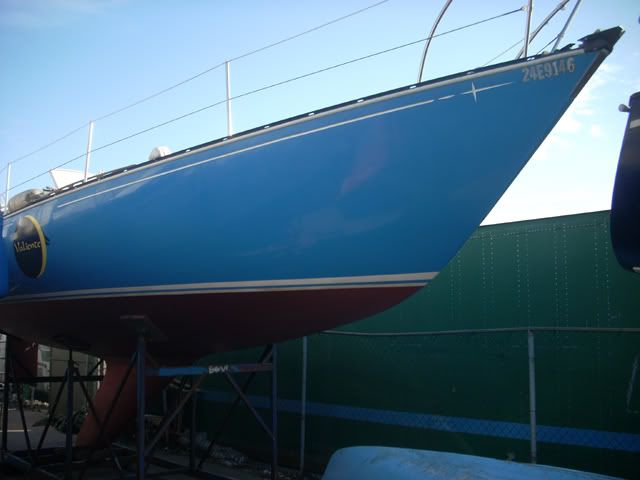
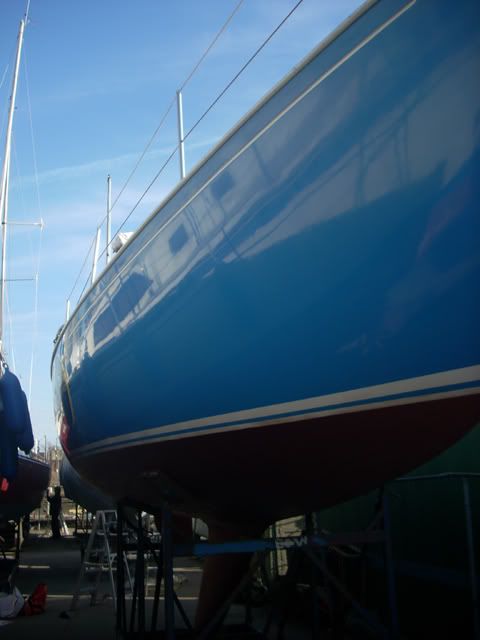
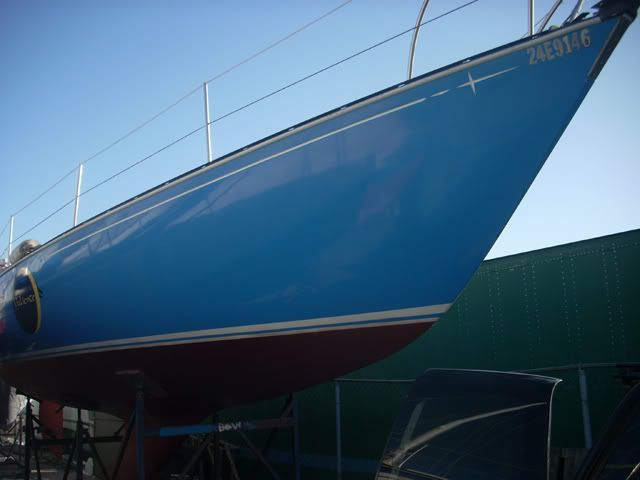
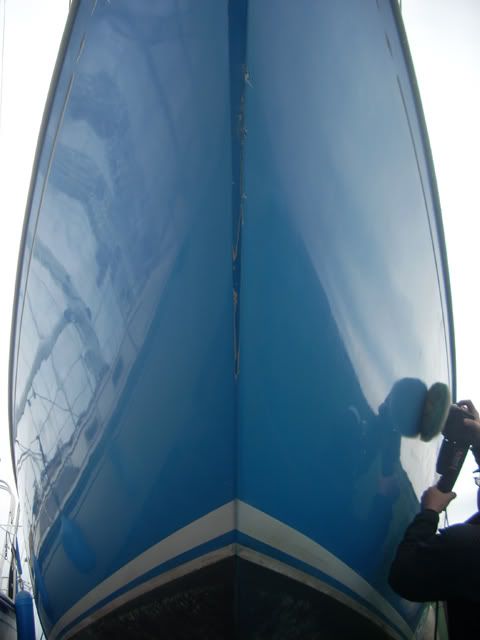
Here's the hull after one polisher-assisted application of "Meguiar's No. 1", a semi-coarse rubbing compound in liquid form. It's already taken off much of the "age" of the 37-year-old gelcoat.


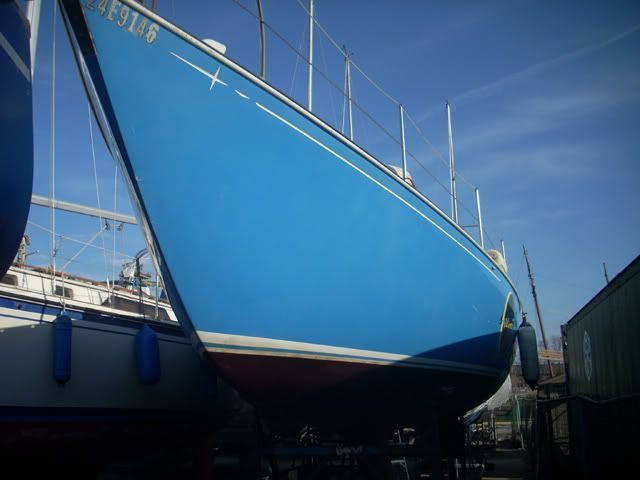
The view from the front. This was April 6th. We've had with few exceptions very good weather this spring in Toronto, allowing early starts on the boat readying front. As Alchemy isn't launching, the decision was made to "do it right" on Valiente, the sailing component of my cheap-ass navy. Oh, and those little chunks out of the stem will be fixed, and a bow roller I had made years back attached.


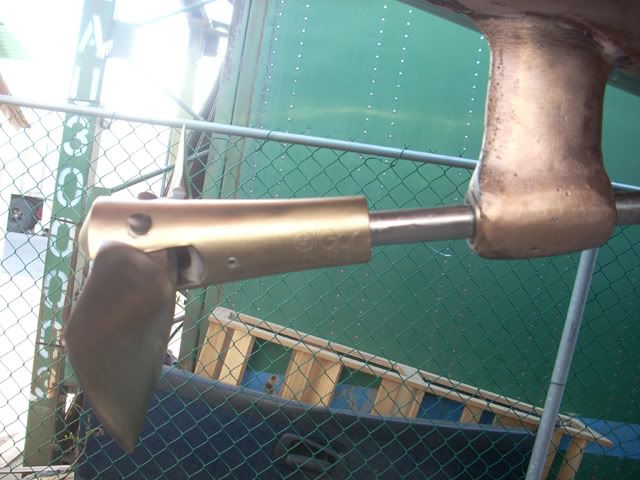
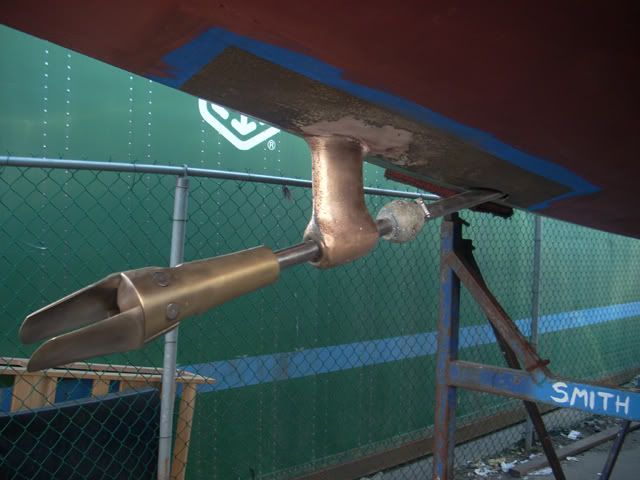
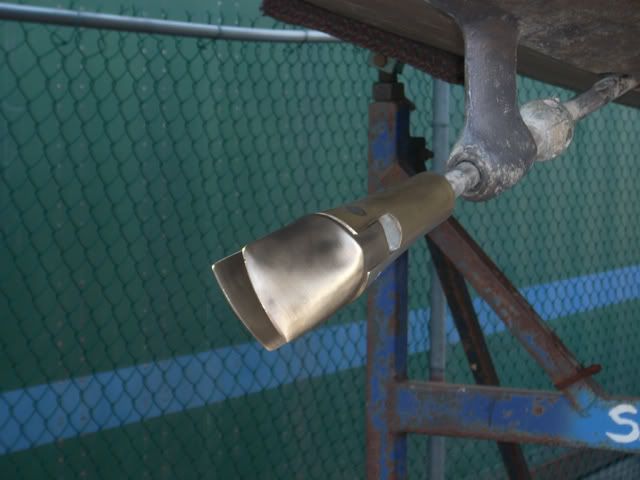
The folding prop, in need of servicing (lubrication and tightening of the Allen bolts), and a nice polish.


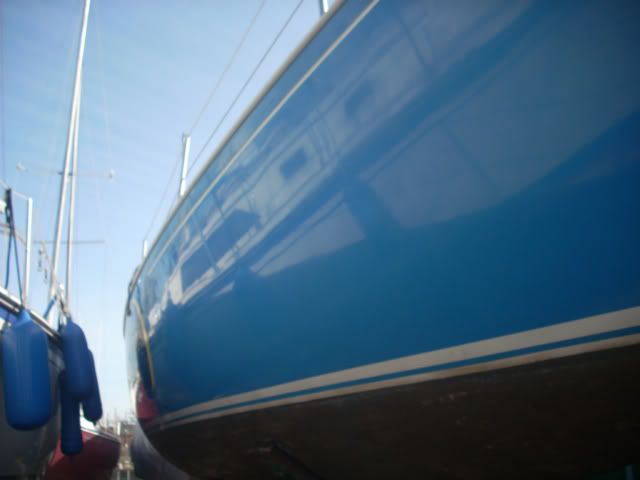
The finished initial polish on April 12th. Nice, no? But wait, there's more!


The finished second polish, with Meguiar's "No. 2", on April 14th. By this stage, Ni was getting excited. I think it's clear that he likes shiny things and finds polishing meditative in a way I obviously do not. This is actually a good thing in a boat partner...to have different priorities and experiences.


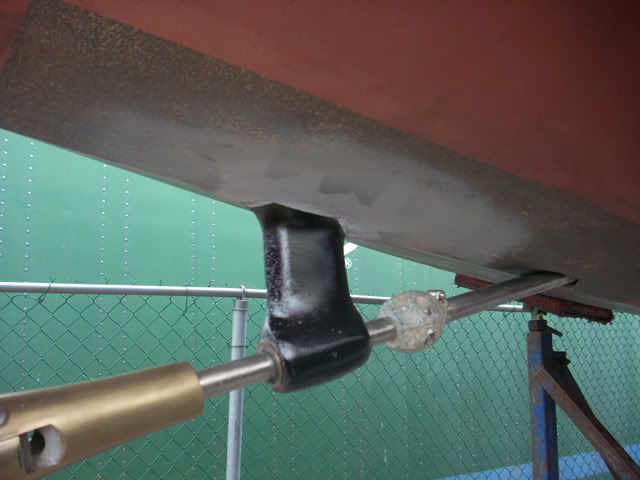
Ni "took the initiative" and cleaned out the shaft strut back to the bronze of several coats of filler, bottom paint and related goo. An area that looked like a pacifier for senile lampreys became free and ready for fairing.

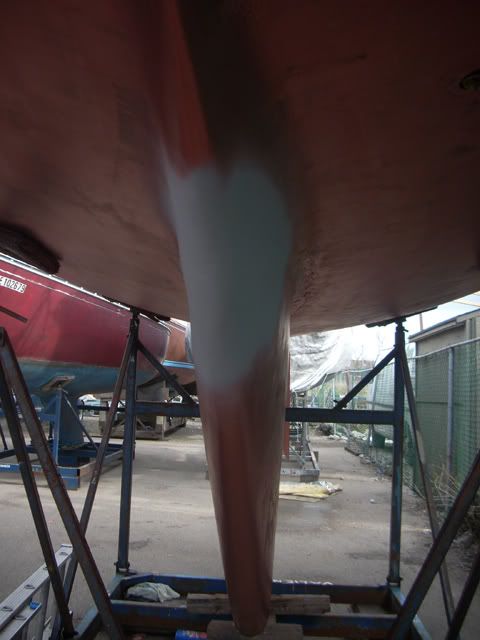
April 17: While I started on what would be two cans and three coats of VC-17M bottom paint, Ni continued with the fairing and tidying up of the strut and keel root areas.


Now, the proper way to do all this below-the-waterline fairing and filling stuff involves Tyvek suits, wet sandpaper and excruciating attention to detail. If one is a racer, that is. We "just cruise fast" types resolve to see how a test of a concept works before getting into that time-pit. Not to mention expensive respirator filter elements.

Seriously, this is the most TLC the boat's had during my entire watch in the cosmetics department.

April 19th: Priming the strut prior to applying the last of the bottom paint. Nice work, Ni!


April 19: The final application and hand-polishing of "Starbrite" marine sealant/topcoat/whatever. Ni remarked that the gelcoat was "drinking" this stuff as its "pores closed", which I understand from a chemical point of view but still sounds like one of those dodgy make-up for forty-something commercials to me.


While there are some mechanical and maintenance issues to get at, we "achieved ignition" yesterday on the 20th and are more or less ready to splash the boat and make our way to the pricey but centrally located slip we've procured for this season. A pair of new batteries, a new seacock and various sealants, paints and compounds have been applied, and after a very well needed deck wash (did I mention that the canvas cover under which I usually store the boat was shredded by gales this winter, exposing the deck to the diesel soot and dirt of the adjacent recycling facility? No, I believe I did not), we'll have a boat that not only sails very well, but looks great doing it.

After a hot day down in the bowels of Alchemy, that will make for a very nice break, as well as keeping our infrequently tested sailing skills up.

Coming soon: The Safety at Sea seminar I attended recently, recommended rudder removal, and U.S/Canadian dollar parity and its affects on the self-equipper's budget.
More tender moments

The default setting for many cruisers, but worthy perhaps of a rethink

It's interesting the divergence in taste cruisers have regarding tenders...although I'm prepared to be "schooled" by our own reality on this, once we get into continuous mooring/anchoring mode. Perhaps I hadn't mentioned, but the only way the voyages of Alchemy are going to be economically viable is via the near-exclusive avoidance of marinas and docks. It's a free night at a reciprocating yacht club's visitors' dock, and reciprocity will likely lessen greatly the farther away from Canada that we sail, or it's going to be the old (new) anchor dropped into the briny to hold us close to foreign shores.

That means rowing, putt-putting, or even sailing to said shores in some manner of small, open boat, commonly known as a "tender" in the parlance of yachting.

As some may recall, we originally had a Zodiac 310 RIB (now in disrepair and needing a retube to something not PVC), and a Honda BF100 9.9HP longshaft outboard, a pretty robust combo that got us "on the plane", more yachtie lingo that refers to exceeding the usual six knot or so limit of plowing through the water and instead skimming at close to 20 knots over its surface, like a squashed Jet-Ski. We both motored about in this relatively stable and commonly found style of tender and when taking it in tow on the classic plastic Valiente (see the next post above).

When we acquired Alchemy, however, because of issues getting the 100-pound engine on and off in a seaway, and of getting the RIB aboard and stowed (even given our generous deck and robust boom/topping lift combo), we opted for a Portabote and nesting dinghy tender pair, with a single Honda 2 HP outboard that my strong but height-challenged wife can easily single-arm up out of the forepeak workshop, for both tenders. Both have oars, and the nesting dinghy has a generous Marconi rig for zooming about.

Not shown: the handy "notched stick" to keep this open while the seats are snapped in.

We chose this set-up for compactness, lightness, mechanical simplicity (the Honda is air-cooled, meaning that while it buzzes somewhat loudly, it doesn't require freshwater flushes to get the corrosive cooling seawater from its innards). I capacity, as the two tenders can hold more together than even our retired RIB. I personally also like the fact that a lashed Portabote on the rail and a lashed and stowed nesting dinghy keep my foredeck quite clear and preserves my forward view from the pilothouse. This was not the case with the Zodiac, which, no matter how it was secured on deck, presented plenty of pontoon in all views forward.
This stowed is not much larger than our forward deck hatch.

We expect the two-tender solution to be slow(er), wetter, somewhat more tricky in terms of boarding and exiting, but also more flexible and freeing, particularly as our kid gets more skilled with sailing (he's starting White Sail 2 this year), and having two tenders means we can all leave the boat and go to different places for different reasons. Within reason, I can even bring the Honda engine with me if the locale looks dodgy. Speaking of dodgy, something that looks like a plastic rowboat is, it seems to me, inherently less attractive to a thief than the expensive and desirable inflatable.

Needless to say, having a 15hp and an inflatable obviously suits the majority of cruisers for separate and different reasons, and I realize I am definitely in the semi-Luddite, Pardeyesque minority in fancying a rowing option. But it's interesting nonetheless, and it hurts no one to experiment. Inflatables and larger engines are so common that a switch-up would not be difficult.

A "PS" here: I've seen some intriguing use of those ski stowage boxes adapted to boats. It might be an idea for cruisers wishing to lock deck gear away without chucking it below.

http://www.sailboatrack.com/Rack_Accessories.html

2010-03-29

Not dead...just attending to the necessaries

Sorry to any remaining readers, but I've had a glitch in the working life that caused me to focus on getting jobs (I'm a freelancer) and doing other things than blog posting.

Normal patterns of blather, however, will soon be resumed. Plus, I'm going to a potentially interesting seminar on Safety at Sea on the 10th of April, which might merit some comment.

It looks also as if I'm keeping the "surplus" boat this year, which at the very least will give me a bit of respite from what I suspect will be a hot, grimy, sweaty and dusty summer doing organ replacement on the currently gutted Alchemy.

Lastly, I'll fix these missing pictures. Soon. Argh.

2010-01-20

The Roadstead Less Travelled: A visit to the Boat Show


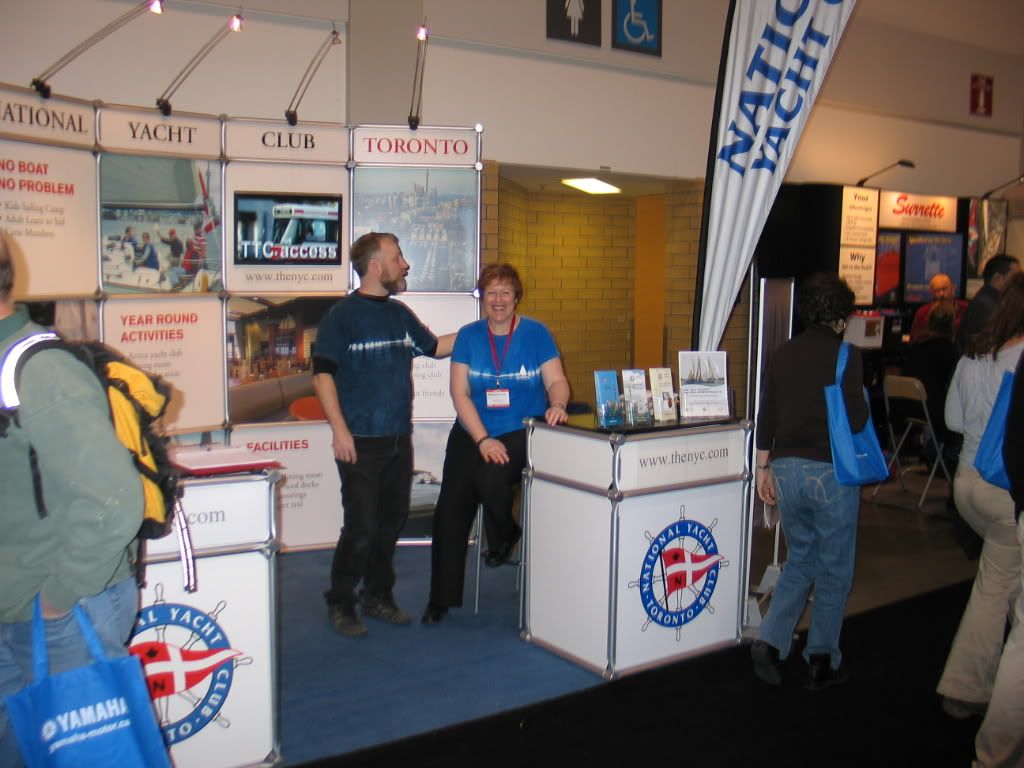
I write for and am the editor of my boat club's monthly newsletter, though for how much longer remains to be seen as I must focus on boat repair as A Way of Life. In this capacity, I attend the a large annual boat show to gather pictures and to write up the event. Our club, with its typically aging and sometimes, sadly, dying membership, has a booth to inform and persuade new members in order to keep our docks and coffers full. No surprise there; most clubs are doing this as the boomer bulge passes the 60 to 70 year old mark and decides mucking about with boats may be not as much fun as it was back in the '70s. At least, that's the impression one gets from the older crowd.

Me, I am shopping for an engine and various, lesser items to fit out our boat. Growing experience and differing goals are taking me farther away from the purchasing ambitions of someone wanting a folding chair with the words "Skipper" emblazoned on it, or one of the larger sorts of Catalinas, for that matter. More power to those recreational sailors, but we are after different things and are on different roads, watery or not, and beyond the advances in electronics, such as the new VHF radios I saw with integral GPS and/or AIS functions, there wasn’t a lot of new stuff this year, nor reasons for me to attend. Prices seemed to be static or somewhat lower, with AIS units, handheld VHFs and LED fixtures and nav lights particularly cheaper. I ended up buying my SSB rig (show special!) plus a PYI packless shaft seal and yet another floating handheld VHF, this one with GPS. Now, I need to secure a couple of MMSI numbers.

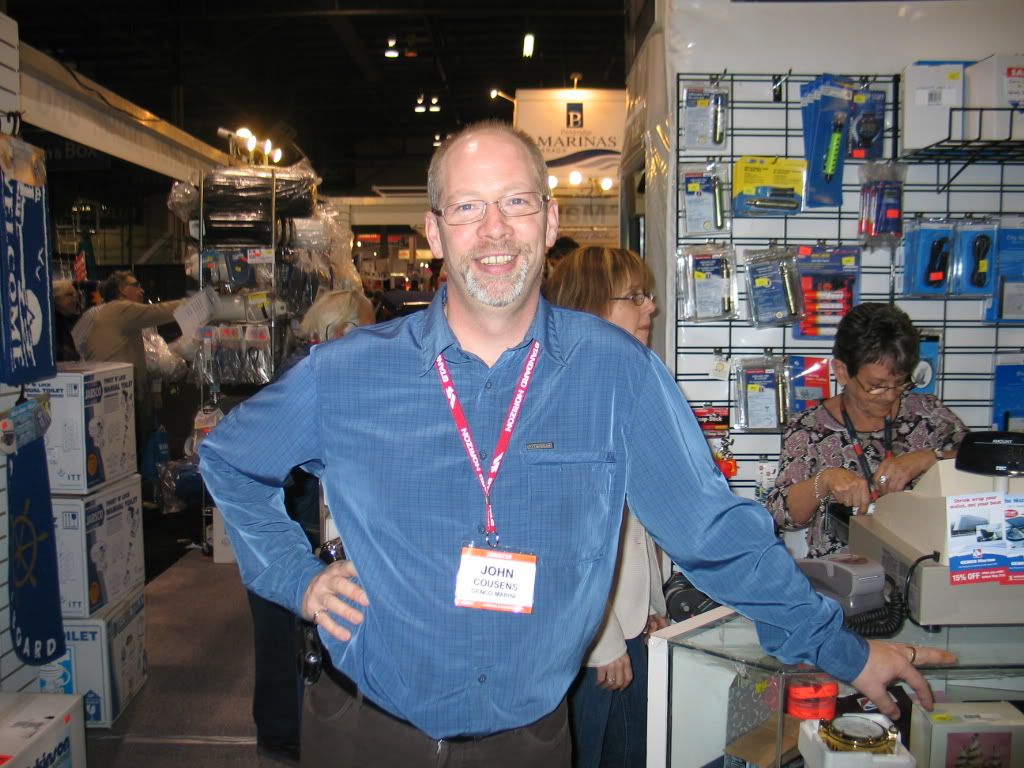
Look, a moonlighting boat club member!

I did see, however, a “thrust-bearing-less” universal joint coupler that might be of great interest to fiberglass boat owners interested in dampening vibration and saying goodbye to misalignments. Reminiscent of the AquaDrive system, the Powertrain Marine Coupling was devised in Norway and is worth investigating if you've thought "gosh, that AquaDrive looks great, but I'd have to pull the engine and have heaps of money to glass in a thrust bearing the size of J. Lo's backside". Well, as I said, it's worth investigating.

I also had an interesting discussion with a "battery builder" about having semi-custom banks assembled for me in 2-volt modules (like the Surrettes, only more "industrial"). I'm having him aboard shortly to see if it makes sense to go this route...it's a decision I have to make soon.

As for the sailboats, I stepped aboard a few, including the massive Hunter 50, a new offering that I’m not sure would even fit the 45 foot docks at our club in the most literal sense. The trend to apartment-sized saloons is particularly obvious here, as was the absence of handholds and positive lock-downs on the dozen or so floor panels.I’m sure it’s a fine, if not bluewater, cruiser, but I guarantee it's a fabulous floating bar.

I spoke briefly with perennial ocean racer Derek Hatfield down among the Catalinas and Tartans. He was soliciting support for his campaign in the next Velux 5 Oceans race. He explained briefly the rather intriguing concept of the “Eco Open 60” class, which, contrary to trends, proposes to have “older” 2003 or earlier Open 60s enter the race as a means to recycle the boats and keep them out of landfills. It was remarked upon that given the toll the sea has exacted on some more recent models of Open 60 and America’s Cup racers, maybe a slightly heavier-built “good old boat” will last the entire race.

I accompanied sailing buddy Cap'n Matt to the unadorned Garhauer booth (there’s never even a sign…just tables full of shiny blocks, beckets and stainless steel) and once again had the pleasure of watching a fellow sailor order an elaborate, semi-custom traveler, and then look slightly guilty when told the unexpectedly reasonable price. Time and again, raised eyebrows and furtive glances signal “this price must be a mistake”, but no, it’s just Garhauer’s way of selling solid, basic gear for the non-racing sailor.


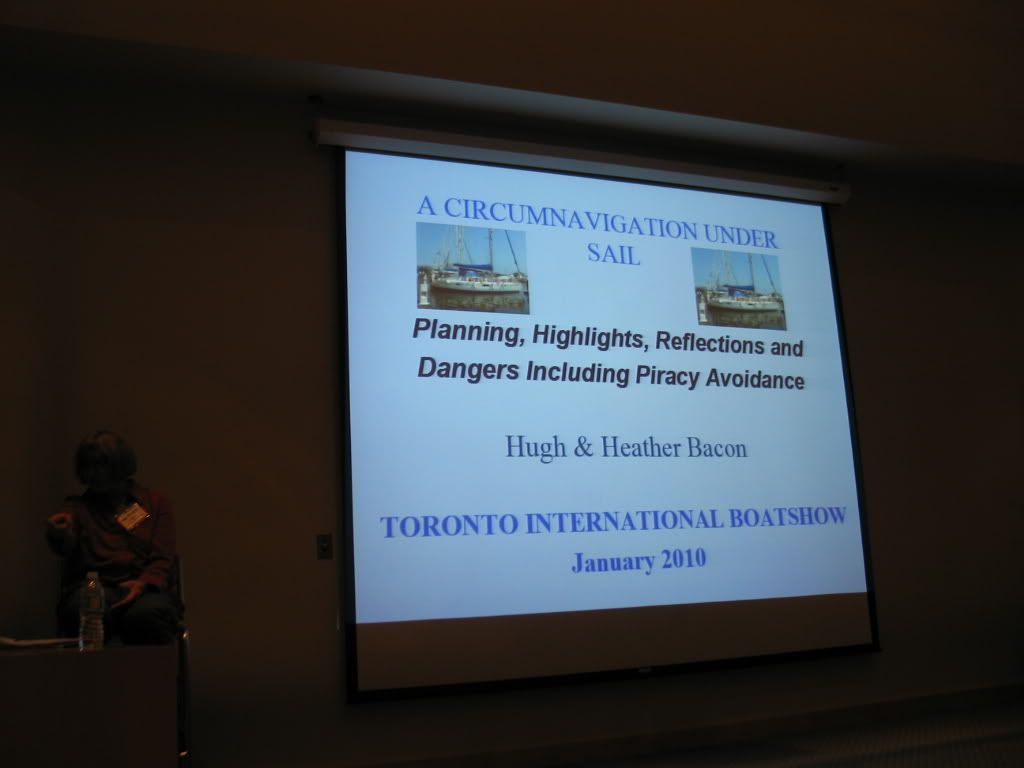
I also attended a compact lecture and picture show by circumnavigators Hugh and Heather Bacon (http://www.noonsite.com/Members/doina/R2004-11-08-1), who provided a nice reality check for the dreamers (I am apparently not one, resigned as I am to "boat maintenance in exotic locales") and a reinforcement of the notion that I'm not crackers and that a circ is doable at reasonable cost and without getting dead due to stupidity. I had a nice chat as well about the usual: ground tackle, engines, and "what didn't you find useful?" A nice couple and they gave off the air of calm, confidence and competence I am finding is the common denominator of successful passagemakers. As Hugh writes entries for the esteemed noonsite.com, I'm not surprised.

I’d write more, but the 10 kilos of catalogues, brochures and spec sheets aren’t going to read themselves, nor is all that gear I bought self-installing…

2010-01-04

Cruising and the nature of work


A new year brings new musings, and a chance encounter with a rather good radio show gave me occasion to think of the very different skills I am acquiring as an aspirant cruiser, versus the sort of skills that I have acquired in order to pay for our sailing enterprise in the first place.

Sailors do a lot of work, first to ready the boat and then to keep it in good order underway. It is home, castle, saferoom and transport, and the sea is a harsh mistress indifferent to the fate of even the stoutest vessels. So we sailors work and toil in conditions of frequent shortages of money, parts, the proper tools or easy access points. We contort, squirm and sweat, and often we have to jury-rig (a nautical term) a solution that must endure until we tie off to some distant dock. We must be resourceful, creative or rich. Sometimes and rich.

And yet it doesn't seem like work to most sailors of my fellowship. Part of that, I think, is that even more than on land, the relation of cause and effect, problem and solution, the fault and its repair, is quite immediate on the sea. You fix the thing, if you have the will, the skill and the spare, and you resume operations, with perhaps an extra ounce of rum in the evening's sundowner...assuming you're not on watch.

I have earned my living as a writer, publication designer of the desktop variety and, at various times, a marketer, a publisher, a media producer and so on. The last job I had that could be described as "working class" was as a bicycle courier at the end of the 1980s, and while that kept me fit and certainly honed my navigation skills, it was a stop-gap, a rent-payer, a commission job, and not a career, although I know of people, very lean people, who've done it for decades.

Everything in my social milieu suggested that white-collar, or at least "creative", was the way to go. Nothing in my experience, even having an ex-Merchant Marine sailor for a father, suggested that I should learn a trade or master at least one hands-on craft.

Getting a century house in 1997 and an aging sailboat in 1999 changed all that, primarily because economy and a lingering sense of unfounded pride led me to the "do it yourself" ethos. Now, this is easier for people who've inherited most of their furniture...I can't yet dovetail together more than the most feeble of carpentry projects...but I have had to learn plumbing, wiring, framing, drywall and insulating for the house, and winch maintenance, rigging, sail repair, engine rebuilding, more plumbing, wiring, soldering and fibreglassing for the boat. Throw in the various things steel boat owners need to know, including the somewhat occult topics of galvanic corrosion and isolation, and I am becoming, almost via osmosis, "handy".

I wasn't handy growing up. My late father wasn't particularly handy, or I would've noticed inheriting a less modest set of tools, or would've possessed memories of less haphazard maintenance in my childhood home beyond putting in the occasional light fixture or fuse. But I have to be handy, now and into the future, if that future includes going offshore. Pots of money for "marine labour" won't help me in the middle of the sea. Cruising sailors beyond the reach of a mobile phone have to understand and in many cases be able to repair (or work without) most parts of their boat's systems. And yet the gradual acquisition of whatever modest repair, diagnostic and related "trades" skills has not been onerous in the least, despite its dread necessity. It's been..engaging. Stimulating. Fun. I seem to have a knack, or at least, the ability not to lose fingers or eyes. Yet. The beer at the end of the day isn't for "stress relief"...it's because I earned it, and I am thirsty, and it is time to rest.
Coming to a necessary mechanical aptitude post-youth does evoke a certain pride and sense of accomplishment less common in my experience as part of a corporate or otherwise digitally-mediated process. Perhaps I sense the presence of the ghosts of my ironmonging, mining and otherwise callused ancestors, but hauling out engines, grinding steel and not often injuring myself in the process is both new and exciting in the way that a really bang-on InDesign layout job just...isn't.
So a philosopher-mechanic's ponderings on the joys of work-smeared hands found in me a great resonance.

Thank you, sailing lifestyle, for the pleasure of random labour. It is not, and will never be, without its frustrations, but I have discovered a tinkering, improving and repairing instinct I barely knew I possessed, the need to do much more than keep a bicycle greased hardly existing in my life before my late 30s.

I'm passing on the links should readers wish to hear them and to understand the above ramblings.

http://www.cbc.ca/spark/

http://feeds.feedburner.com/cbcradiosparklite

And here's a transcript of a book made free by the first interviewee, a fairly impressive fellow named Seth Godin.

http://sethgodin.typepad.com/files/what-matters-now-1.pdf

I found the second interview, about the longing for work involving the hands and the value that our increasingly "digital" and, some might say, decreasingly physically competent, society puts on mechanical skills and how this can affect our personal sense of volitional "agency". This is not airy-fairy speculation, but rather the ideas of a fellow who left a Washington thinktank directorship to run a one-man motorcycle restoration shop...and then wrote a book about work and personal satisfaction

http://www.cbc.ca/spark/#matthewtranscript

http://www.amazon.ca/gp/product/1594202230?ie=UTF8&tag=sparkblog-20&linkCode=as2&camp=15121&creative=390961&creativeASIN=1594202230