Copyright (c) Marc Dacey/Dark Star Media 2006-2026. Above photo (c) Marc Dacey. Powered by Blogger.

2011-03-18

Light reading


So last week I met with Tim Mackinlay and his wife Bice down at my club for a coffee and a chat about the wonderful world of LEDs. Tim builds and sells LEDs of the "warm white" variety; they aren't your Dad's (elder sister's, maybe?) "bluey" LEDs, but are easy on the eyes and have the ideal (for boating) quality of directionality and low-amperage draws.

Tim was kind enough to give me a couple of "bayonet mount" lights and a foot-long strip of ganged LEDs to play with as an incentive to buy. Frankly, his prices are very good, so if the quality matches the ding, he'll be receiving my custom.

I've spoken about the logic of using LEDs before (or at least I think I have). For sailboaters, who are not making electricity when actually sailing, unless they have a wind generator or solar panels (and it's full daylight), lights are among the biggest users of the usually limited power that the boat's battery banks can store.

We are so used to more or less unlimited access in this country to cheap...but steadily getting more expensive...electricity that my constant shout of "turn off the lights when you leave a room" is frequently ignored and our cities at night are ablaze with clearly illuminated, empty rooms.
With the incandescent 12 VDC "auto lamps" in use aboard most boats until the last five to ten years, you simply cannot leave them on for hours on end without running the engine, and its amp-producing alternator to recharge the batteries any more than you can leave a car's headlights on all day and expect the engine to crank. They convert 90% of their draw to heat to make that little tungsten wire glow, and heat up the boat (desirably, in some situations) in the process. Rare is the boater who hasn't overdrawn his or her batteries through miscalculation or mistake, and it can make for a sick feeling when the engine won't start...or starts in a dodgy fashion...because you've left the lights on too long.

The heat issue was solved in part years back via the use of 12VDC flourescent tubes and "C-shaped bulbs" that provided either a cold or warmer light, but without the heat output. I think they drew a little less, as well. Good as area lights, like for under-counter fixtures in the galley or the head or even the engine room, the flourescents, if not well-made, sometimes had the habit of emitting RF interference, leading to crackling static on certain VHF or SSB frequencies. Some alternators do this, too. It's sometimes due to shielding or proximity issues, but can be annoying. Also, some people just don't like the "office lighting" effect aboard. Maybe it's the atavistic impulse that sailboats below deck should be bathed in the cheery yellow glow of stinking oil lamps or even candle-powered "lanthorns". Or maybe it's because the last place you want to be reminded of "the office" is "the sailboat". Whatever...flourescents have never taken off, except as work lights where the shadowless "throw" of the light is great for finding critical little pieces you've dropped under the engine.
Alchemy has a real mix of lighting: incandescent nav lights of the "honking" type, which in this case means 25 W Aquasignals. These are oversized from a legal standpoint, and draw down the batteries, but if I'm motorsailing at night, I love the fact that they make us the brightest thing for miles. LEDs here, at 1/10th of the draw, if equivalent in brightness, would represent a huge savings in amps, because I would sail with the trilight on all night without thinking I was going to have to turn off the fridge for three hours.

I also have two 10 w lightbulbs in the saloon bulkhead fixtures, tube and C-type flourescents in the galley, head and pilot berths, a typical brass and faceted glass incandescent in the aft cabin, 10W halogens for aft cabin berth reading lamps and an Alpenglow red and white flourescent in the pilot house. There's even a blue LED with a switch for the fridge! Throw in the various LED flashlights, head lamps and work lights I own, the oil lamp I bought from that poor girl who died on the S/V Picton Castle, and short of an arc lamp, it's all there: the history of boat lighting in one hull! It's quite representative of the changes since Alchemy was built and I'm sure many a boat in the harbour contains the same mongrel mix.

I would keep a halogen for close work in the galley, like dish washing and cutting board work, and maybe for the "workshop" forward, for when I have to do soldering with a magnifying glass or clean out burrs from tapping aluminum. I also will keep the Alpenglow, which by some design magic is the flourescent fixture that looks the least flourescent of any I've ever seen, and has "dim" settings in white and red suitable for the nerve center of the boat. The rest? Swap meet.

Going forward, the goal of "independence from the marina and its Satanic shore power" is intimately tied to the concept of installing and keeping topped up a substantial house battery bank (the batteries used to power everything but the engine starting, by far the biggest, if short in duration, use of electricity aboard and customarily delegated to a dedicated "start" battery). Then, once you've got this quarter-to-half ton of sparky lead at 100% capacity, the idea is to use it as little as possible! One pulls this particular rabbit from the confines of its top hat by monitoring and reducing draws where possible. The fridge gets insulated with tranches of blue or pink closed-cell foam, sealed with gooey, waterproof, condensation-blocking industrial goo, and strict rules about opening the lid are posted. The idea is that the compressor should cycle as little as possible, because in the tropics, the difference between keeping things frozen and the temperature on deck can be awesome to contemplate and expensive from an amps-consumed viewpoint to achieve.

Lights are also amp-eaters. LEDs, not so much. Leaving an LED on for 10 days tends to equal the equivalent of leaving a lightbulb of equivalent output on for one day, and even drunken sailors are likely to notice a lamp left burning that long. So the advent of more "warm" and "less directional" LEDs is welcome. I have "first gen" blueish LEDs I bought some seven years ago on Valiente already, and they aren't nice, but I can't measure their draw with a one decimal amp meter, so they'll stay because they make great night lights.

Where LEDs have real potential, I think, is not in the "bright, warm reading and area light" market, where I think the corner has been turned on everything but price (still too expensive!), but in specialized, boat-particular applications where the LEDs are dim, directional and not even attached to the boat's DC power supply.

Years back, I got from one of my favourite surplus stores a single dim, red "blinking" LED, a 9V battery and a 9V battery connector. Some electrical tape and two crimps later, I had a weird-looking black Pez dispenser-like thingie that blinked steadily like it knew something. I clamped it to Valiente's nav station and sure enough, through the smoked Lexan of the dropboards, it looked like some sort of burglar alarm or other security device. It worked for about 14 months straight before needing a fresh 9V, which set me back two bucks. Did it keep the boat safe? Dunno. Did I get two bucks' worth of "peace of mind"? Yes, I did.

So I started to think: What if you wired an IR sensor, some sort of auto-off circuitry and the same 9V battery and the same dim red LED to the companionway stairs? On the blackest night, a light would illuminate the companionway steps...poorly, so as to preserve precious night vision...and then would shut off after three seconds? You could have the whole boat done this way, although you'd want to have a "daylight shutdown" to save power. A heaving boat at night can be tricky, and yet turning on proper lights can disturb sleepers. How much better would it be to have invisible beams turn on dim "here's where the cabin sole is" lights that self-extinguished as you moved through the boat?

Another use, already implemented in part on Alchemy, are magnetically switched little LEDs that click on when a locker lid is raised or when a cabinet door is opened, throwing lights on the contents. I would like to implement this idea pretty well everywhere not only because it logically shortens the time spent rummaging around in the dark (there's that "do not disturb" aspect again), but is also a safety element, because on a rocking boat, you don't want to have one hand in the locker, the other holding a flashlight, and no hand left "for the boat". I've worn headlamps on watch and they are the next best thing, but paradoxically are sometimes too bright. "Dedicated" locker LEDs down in the bilge stowage and inside cabinets and lockers could save time and be safer when all about is dark...and at night at sea can be like the inside of a cow.

Another aspect of LED and safety concern is what happens when the normal lights go completely out. Electrical failures of the catastrophic sort are rare, true, but lighting happens, corrosion never sleeps and fuses inevitably blow, any of which could find you searching in the dark, on a lee shore, with heavy air all about, trying to connect batteries you know were good three hours ago to nav lights that may or may not be still functional. If you were the Pardeys, you'd already have the oil lamps out, but we aren't them, and maybe you aren't, either. You want perhaps, some form of lighting that is self-contained and independent of the boats "mains", as our British friends call it.

The "self-contained" part is critical. Any situation bad enough to need self-contained lights is probably going to involve a breakdown of the boat's electrics, either via water ingress or flooding. I know I'd want the bilge pumps to work then, not the lights. I don't need a light to notice my feet are wet.

There's a little kids' toy you can buy at any dollar store that is a tiny coloured LED worn on a little piece of elastic on one's finger. Like so:

I don't like single-use items, but these are cheaper than the batteries inside them and are great for dark corners.


Well, you could either mod them for a white LED, or simply use them as is on your little finger to bring light RIGHT UP to the work in your boat! Clip 'em to a hat and you've got a map reading light. At a buck a piece, you could buy quite a few to brighten various areas up to see if the concept of "many points of light" works for your boat.

That's what I mean is a bit of a paradigm shift with LEDs. They are so cheap and plentiful that you start thinking less of "what light" and more of "where would I want light?"

Of course, all these little gadgets can be coated or siliconed to make them more water resistant, if not water-proof.

That's enough for now. Good grief, I do prattle on.

2011-03-05

And to the bottom bind them!


Sometimes, the difference between thinking you know nothing and knowing you know something is marketing.

In a previous employment iteration, I worked as a marketer. Chomsky's notion of the manufacturing of desire and consent was in full effect. The key to selling most of the unnecessary crap in our society is based on the accessing of that nagging feeling of self-doubt in the prospective customer...the idea that they have a knowledge deficit.

When it comes to something as relatively faddish in boating as "what's the best anchor?", this feeling is rampant and tied to the fear of making a faulty choice, leading directly to a fatal mistake.

Anchors hold boats to the sea floor, but actually, they enact the same sort of physics as a spring. Energy of the wind and waves on the available areas of the boat load the spring (the rode, made of chain or rope or a combination) which pulls irregularly at the anchor, buried in the best case in the (hopefully) firm bottom material and resistant (again, hopefully) to various angles jerks, pulls and strains.

A lot of variables there, aren't there? One constant is the length of the rode. More rode equals a greater length along which the sharp tugs at the bow (modified of course via the use of bridles and snubbers) can be distributed and modified before they manifest as a wrenching yank at the shaft of the anchor. Recall that a wrenching yank is how the thing's going to be pulled off the bottom during retrieval (yet again, in hope), and it's clear how much of anchoring is about the selective balancing of forces.

That nagging feeling can come about when years of successful anchoring with some "traditional" anchor, like the Bruce or the CQR, seem to fade into a cruel joke when the new, lighter, flukier (in a good way), roll-bar-equipped, lead-tipped Wonder Anchors of the Rocna, Manson, Bulwagga, Fortress or Spade types manifest. (There are others, of course...every tenth sailor seems to forge a new type of world's best anchor).

These new anchors offer better holding, at shorter scope, in harsher conditions, on a greater variety of bottoms (not weeds, though...keep an old fisherman's/Yachtsman's disassembled in the forepeak for that) than all their venerable predecessors.

It has led, in my experience, to hearing sailors with long and unblemished years of successful anchoring (as in "we didn't drag the anchor and we always got it back and we didn't swing into a more expensive boat, either) feel like they were anchoring know-nothings; that they were missing the boat, so to speak, by not relegating the "old hook" to the bilges in favour of some orchid-shaped, two-grand chunk of Big Scientific Anchoring, yo.

If you have successfully anchored without dragging in a variety of conditions, then I submit it to you that you do in fact know something. Possibly more than is justified for the outlay of The Holy Hook.


A lot of these arguments about "which anchor" seem to me to dead-end at a couple of points. The first is the marketing-driven contention or, less dogmatically, the suggestion, that there is, or could be, a single "do it all" anchor. Car drivers have (at least where I live) the habit of switching from "summer" to "winter" tires, and benefit thereby, even given the greater friction and lower gas mileage when running on winter tires. That's the price we pay for greater stopping power on slick, icy or slushy roads.

All drivers (except those who work for tire manufacturers) appear to largely agree that "all-weather radials" are a compromise best left to people who get two weeks of cold weather a year. The Quixotic quest for "the one anchor to hold them all/And to the bottom bind them" is equally a compromise. Even our colleagues and fellow-sailors from Fortress, Spade and Rocna will admit, grudgingly, that their products won't do any better (and perhaps a lot worse) in weeds and rocks and certain other sub-surfaces.

The second point is that some old salts (or just new salts who've been paying attention to old salts) seemingly "get by" with feeble, discredited older anchor designs, such as the Bruce, popular on the Great Lakes still, because they a) never anchor in bottoms where the Bruce's deficiencies will manifest, or b) possess proper anchoring technique of knowing correct rode length, the use of chain, the use of kellets, snubbers and bridles and even diving on the anchor to ensure it has set firmly.

In other words, how much of the vaunted superiority of the new style of anchors can be attributed to the fact that they are forgiving of inadequate scope, inadequate chain, generally lax technique and so on?

Could it be that sailors who know how to anchor properly and to the conditions can make any well-made and time-tested anchor work? Could it be that those who regularly drag, break free, fail to reset or drift down on their fellow sailors lack the experience or the initiative to lay out sufficient scope, to rig bridles or even to know that the anchorage is not safe and that they should run to sea?

Speaking of which: How often does "running to sea" get listed under "anchor strategies of known success". And yet it is an important part of seamanship, knowing when to bug out in the face of gear-destroying conditions. It's very much in the same realm of seamanship as "reefing early and often", as it is focused on reducing forces destructive to the boat or unsafe to the crew.


I do in fact think that the newer, lighter, broader, roll-bar-equipped designs have merit, and probably enough to persuade me to whip out the wallet when the time comes to equip the steel boat with a "dedicated primary". But I also contend that it is not always the inadequacies of previous long-standing (and long-holding) designs that is to blame, but the sometimes considerable lack of experience of the person standing over the anchor locker.

As for me, I'm going to transfer a couple of anchors back to Valiente this year and do some more experiments. You can never have too much anchoring practice, and my back needs a work-out!

Addendum, March 19, 2011: Looks like I'm getting a Fortress to play with this season. This will allow me to put the 'venerable' CQR (very common here, as are the Danforth for "lunch hook" and even the old Bruce (every second boat) to the test, or rather, just to see if I can duplicate the results I've seen elsewhere that shows the CQR failing to set quickly. They are going to look at me funny off Hanlan's Point, where the phrase "sandy bottom" refers to the nudist sunbathers rather than what the snorkeller reports.

Meanwhile, in the blogosphere, the bars and the bull sessions, the debate rages on and the slagging is public and intense....and not particularly illuminating.

The line between anchor and wanchor is about 4 mm of Dyneema, it seems.

I would, for my own purposes, simply like to establish baselines which have largely (but not completely) eluded my notice in this nearly decade long (has it really been 10 years?) bunfight over "who has the better anchor?"

Baseline 1: That the various "newer style anchors", such as Manson, Rocna, Sarca, Bulwagga, Spade, XYZ and any I've missed, are, due to advances in design and metallurgy, better qualitatively than the "old school" CQRs, Bruces, Danforth styles.

Baseline 2: If Baseline 1 is accepted (a big but arguably provable "if"), then I want to know if the new style anchors merely allow for worse technique (short scope, no kellets, bridles, insufficient backing down), or work as well when all anchors are judged with the same accepted 7 to 1 scope, bridles, snubbers, kellets, etc. My impression is that the newer style reset quicker and this obscures the fact that proper scope would not have required a reset in most bottoms.

Baseline 3: I want to know which anchors fail or perform worse in what bottoms. The quest for "one anchor" for all situations is false, I think, otherwise who would still carry a Yachtsman/fisherman's...but people still find it's superior in heavy weed and sometimes rock bottoms. The fact that it largely sucks everywhere else doesn't apply. Me, I want an all-purpose primary. Then I want a stern/bower/secondary for insurance/flexibility (like Bahamian mooring in tidal streams, or to counter expected wind shifts). So I want the second anchor to do OK everywhere, but particularly in conditions where it is known the first anchor is sub-optimal or merely "average".

It is difficult to test for such conditions, and it appears to be even more challenging to find anchor makers willing to talk honestly about their products that allows that it might not be perfect in loose silt during a Cat 5 hurricane.

Me, I don't need perfect. That's unreasonable. But if a CQR is as good as a Rocna at 10:1 scope on all-chain, with waterline snubbers and a bridle off the deck and a kellet on a messenger line suspended five feet off the sea floor, then why would I buy a Rocna?

Isn't it cheaper just to learn how to anchor properly? Why buy a product that merely compensates for one's ignorance of the physics of a catenary? People who regularly anchor, such as my esteemed commentator below, have the habit of actually diving on the hook, looking at the state of the set, the composition of the bottom, the proximity of other debris nearby and so on. The biggest problem doesn't seem to be the type of hook, but other boaters who drag because they seem unclear (or indifferent) to some anchoring basics.
2011-03-02

Relativity and your house bank


This is a cut and paste of an article recently posted in the Economist that some might find interesting. I don't usually do wholesale c 'n' p as a blog post, but I found this information new and thought-provoking. So much of our technology is prosaic in the extreme (the simple lead-acid battery would be an example of this) but often we "end-user" are ignorant of what fundamental physical laws and processess are being levered for our convenience.

Summary: The lead-acid battery is an old and well-understood technology, but you can't understand its basics without invoking Einstein...something I had not heard before.

From the article:

"ALBERT EINSTEIN never learned to drive. He thought it too complicated and in any case he preferred walking. What he did not know—indeed, what no one knew until now—is that most cars would not work without the intervention of one of his most famous discoveries, the special theory of relativity.

Special relativity deals with physical extremes. It governs the behaviour of subatomic particles zipping around powerful accelerators at close to the speed of light and its equations foresaw the conversion of mass into energy in nuclear bombs. A paper in Physical Review Letters, however, reports a more prosaic application. According to the calculations of Pekka Pyykko of the University of Helsinki and his colleagues, the familiar lead-acid battery that sits under a car’s bonnet and provides the oomph to get the engine turning owes its ability to do so to special relativity.
The lead-acid battery is one of the triumphs of 19th-century technology. It was invented in 1860 and is still going strong. Superficially, its mechanism is well understood. Indeed, it is the stuff of high-school chemistry books. But Dr Pyykko realised that there was a problem. In his view, when you dug deeply enough into the battery’s physical chemistry, that chemistry did not explain how it worked.

A lead-acid battery is a collection of cells, each of which contains two electrodes immersed in a strong solution of sulphuric acid. One of the electrodes is composed of metallic lead, the other of porous lead dioxide. In the parlance of chemists, metallic lead is electropositive. This means that when it reacts with the acid, it tends to lose some of its electrons. Lead dioxide, on the other hand, is highly electronegative, preferring to absorb electrons in chemical reactions. If a conductive wire is run between the two, electrons released by the lead will run through it towards the lead dioxide, generating an electrical current as they do so. The bigger the difference in the electropositivity and electronegativity of the materials that make up a battery’s electrodes, the bigger the voltage it can deliver. In the case of lead and lead dioxide, this potential difference is just over two volts per cell.

That much has been known since the lead-acid battery was invented. However, although the properties of these basic chemical reactions have been measured and understood to the nth degree, no one has been able to show from first principles exactly why lead and lead dioxide tend to be so electropositive and electronegative. This is a particular mystery because tin, which shares many of the features of lead, makes lousy batteries.

Metallic tin is not electropositive enough compared with the electronegativity of its oxide to deliver a useful potential difference.

This is partly explained because the bigger an atom is, the more weakly its outer electrons are bound to it (and hence the further those electrons are from the nucleus). In all groups of chemically similar elements the heaviest are the most electropositive. However, this is not enough to account for the difference between lead and tin. To put it bluntly, classical chemical theory predicts that cars should not start in the morning.
Which is where Einstein comes in. For, according to Dr Pyykko’s calculations, relativity explains why tin batteries do not work, but lead ones do.

His chain of reasoning goes like this. Lead, being heavier than tin, has more protons in its nucleus (82, against tin’s 50). That means its nucleus has a stronger positive charge and that, in turn, means the electrons orbiting the nucleus are more attracted to it and travel faster, at roughly 60% of the speed of light, compared with 35% for the electrons orbiting a tin atom. As the one Einsteinian equation everybody can quote, E=mc2, predicts, the kinetic energy of this extra velocity (ie, a higher E) makes lead’s electrons more massive than tin’s (increasing m)—and heavy electrons tend to fall in and circle the nucleus in more tightly bound orbitals.

That has the effect of making metallic lead less electropositive (ie, more electronegative) than classical theory indicates it should be—which would tend to make the battery worse. But this tendency is more than counterbalanced by an increase in the electronegativity of lead dioxide. In this compound, the tightly bound orbitals act like wells into which free electrons can fall, allowing the material to capture them more easily. That makes lead dioxide much more electronegative than classical theory would predict.

And so it turned out. Dr Pyykko and his colleagues made two versions of a computer model of how lead-acid batteries work. One incorporated their newly hypothesised relativistic effects while the other did not. The relativistic simulations predicted the voltages measured in real lead-acid batteries with great precision. When relativity was excluded, roughly 80% of that voltage disappeared.

That is an extraordinary finding, and it prompts the question of whether previously unsuspected battery materials might be lurking at the heavier end of the periodic table. Ironically, today’s most fashionable battery material, lithium, is the third-lightest element in that table—and therefore one for which no such relativistic effects can be expected. And lead is about as heavy as it gets before elements become routinely radioactive and thus inappropriate for all but specialised applications. Still, the search for better batteries is an endless one, and Dr Pyykko’s discovery might prompt some new thinking about what is possible in this and other areas of heavy-element chemistry."


Here's a bonus link for those readers who, like me, have found how refitting a boat has been an exercise in the history of technology, i.e. no matter where you are aboard, some fluid needs pushing uphill for some reason. As a result, one learns about hydraulics and physics, AND one gets wet. Thought I might say "or" there? Wrong. The skipper get wet even when he doesn't screw up once. It's "Neptune's fee", I suspect.

Anyway, behold The Toaster Project: one man's quest to smelt a humble chunk of technology.


2011-02-15

Main concerns


I believe we have had automatic transmissions in cars since at least 1939 (GM's Hydra-matic...although there were many precursors). Until quite recently, received wisdom was that manuals were better for reasons of a) speed, b) economy, c) performance and d) the way you could start a battery-dead manual car by pushing it down a hill.

In the last 10 years or so, however, advances in sports car transmissions have given the edge in these areas to automatics. In small economy cars, the CVT is taking hold. The paradigm has shifted, to make a pun: It's now getting as hard to buy a manual shifting car as it is to get manually lowering windows.

Whether this is all a good thing or not remains to be seen. As a Canadian who has "push-started" more than one frozen car back to life down various rural roads in winter, I prefer systems I can repair or work-around. In the context of this discussion, slab-reefing, horizontally battened mainsails are "manual", and the various types of in-mast are "automatic".

I won't include boom-reefing, because, despite its seemingly ideal midpoint of utility, it hasn't claimed a large part of the mainsail-handling market, whereas many of the "name" boatbuilders have gone with in-mast, perhaps due to marketing rationales based on aging customers for bigger boats, or just out of "follow the leader" behaviour.
Whatever the tenuousness of the analogy, I do not at this stage believe that in-mast can, in most cases, match the performance of traditional, "roachy" mainsails. I do believe there are ways (stackpacks, jacklines, certain batten car designs) to make "manual" main handling more efficient. I also believe that, having sailed in-mast reefing boats in the heaviest winds I've experienced at sea, that they are viable, durable and dependable...not to mention very quick...methods of reducing sail.

While some focus on "not having to leave the cockpit" as a bonus of in-mast reefing, I discount this because everything but the reef lashing can be accomplished on a traditionally rigged boat from the cockpit, and also because I feel that if you can't work on the deck safely, you might have either the wrong techniques of harm reduction or may be not fit to sail in the sort of conditions requiring significant sail reduction. It has to be said: there are some sailors reluctant to swallow the anchor who may be taking on very large cruisers five years beyond their abilities. It's a bit reminiscent of 80-year-olds and driving: Some won't pass those mandatory retests, but the argument that getting half-blind, slow-reacting seniors off the road shouldn't apply because "it will restrict their freedom" doesn't cut it for me. So while the in-mast furling solution may extend the years in which an aging couple may sail, I'm not sure it's a lifetime pass for people who should really consider a trawler...or an RV.


Certainly, in the case of Alchemy, we are set up for slab/jiffy reefing, and the standing rigging is robust and heavily stayed. Our crew is young in the context of the general cruising community, and the purchase of a boat of this size was predicted on the realistic ability of my compact, if strong, sub-40 year old wife to handle all sails as they were rigged on the boat. As we sail conservatively, and as we have an arguably safer deck layout for handling halyards, etc., we see no advantage to changing, and many advantages to making a deeply reefable main, to installing jacklines, and perhaps even a "Dutchman" flaking system. Lastly, as a heavy displacement boat, we need all the drive and sail shape we can get, and that isn't currently found with either alternative main furling design.

Maybe one day we will see smaller boats all go in-mast. Maybe one day slab reefing will follow the hank-on foresail and the gaff rig into niche categories. But I don't see that we are quite at that point yet, and I don't see it's something I want to introduce into our upcoming voyaging plans.

2011-02-09

Variations on a theme


Now I realize how out of fashion the lowly and ancient magnetic compass is in light of the New Dispensation of GPS, but I still like to call myself Hornblower, crow out "helm's a-lee!" and refer to the little Plastimo compass in the cockpit with seamanlike purpose. In fact, I use it to, you know, navigate. I have bearings to my favourite destinations more or less memorized, which is what happens when you play with charts. The Ritchie Globemaster with the amusingly named Soft Iron Compensator Balls in the steel boat is, contrastly, almost too grand to consult...I feel like I'm taking penicillin to the Norwegian Resistance when I look at its sober, monastic dome. It's about the most professional gear aboard and it says This is the Vessel in Question.

Anyway, geomagnetism and its role in navigation continue to attract my attention, even more than "do you know how to rewire an alternator?". Which to be honest, is probably something I should pick up.

Nonetheless, on my local chart, the compass rose says, as they do, something along the lines of "10 degree W deviation (1994)". That means if I read 90 degrees on the compass, it's actually 80 degrees T. It also suggests that the last time someone was around here with a Great Big Azimuth Compass was pushing 20 years ago.

Unfortunately, the stately and predictable movements of our Magnetic North Pole are becoming...well, skittish, and the rate of deviation (also marked on most charts) is probably undervalued.

Does this affect the average sailor? No. When it hits 11 deg. W in my home waters is unlikely to affect my helming or pilotage as I can't steer better than a 5 deg. wobble most of the time. Nor would I want to.

But I have found it interesting that there are starting to be real-world effects due to the Wandering Pole:

http://www.physorg.com/news/2011-01-tampa-airport-runways-renumbered-due.html


"The primary runway at the is designated 18R/36L, which means the runway is aligned along 180 degrees from north (that is, due south) when approached from the north and 360 degrees from north when approached from the south. Now the (FAA) has requested the designation be changed to 19R/1L to account for the movement of the magnetic ."

My government has something to say about it, as well. "During the last century the Pole has moved a remarkable 1100 km. What is more, since about 1970 the NMP has accelerated and is now moving at more than 40 km per year. If the NMP maintains its present speed and direction it will reach Siberia in about 50 years." Oh, Canada, we've already given up on Hans Island...must we have our little lodestones pointing to a kleptocracy, now?

I point this out as a navigational curiosity and as a small token that the Earth doesn't really care what is printed on our charts.

It's very cold, windy and bleak here at the moment and it's hard to do much aboard. I pushed off a great deal of snow from the deck yesterday, but even with the anti-skid, it's hard to stay upright. The weather is forecast to go above zero C. next week, so I will try to resume refitting operations. The good news is that I believe I've found a way to "deroof" the pilot house without leaving the boat entirely open, and this method will allow welding on deck in dry circumstances.

2011-01-09

The sound of truth....

Who's heard a story that went like this?

http://www.youtube.com/watch?v=41QWZK9RBCo&feature=player_embedded


Funniest thing since sending a newbie powerboater to the chandlery in quest of "pushrope", and a good warm-up for the 2011 boat show. I'm going tomorrow, and will issue forth my inevitable spleen thereafter.

2011-01-02

A product plug for a plug product? Or a future Dremel experiment?


Now, isn't this a bit of cleverness?

You don't really have to explain it, really. You just look at it, and then you look at the collection of assorted power adapters stuck into a six-outlet thingie stuck into the two plug outlet stuck in your pilothouse...OK, my pilothouse, and you say "Oh...how obvious". Thanks to The Incredible Hull blog, by the way, for this one.

I bet I can make one at home that's way more resistant to rust for use at sea...particularly in the pilothouse where if stuff isn't getting recharged, it's connected via USB to something else.

http://store.fastmac.com/product_info.php?products_id=458

That's the bit that interests me: a tidy way to have a "hub" that could be routed through an existing outlet so I didn't have to leave it flopping on the helm. In fact, I could see using a standard outlet that had maybe two 12 volt "cigarette lighter" DC sockets and two or three USB slots. Hell, throw in an SD card reader.

There are "helm" versions of a lot of charging/power sockets, but they are pricey and I don't actually want them. Steel boat and all...let's keep the electrics "inside", dry and out of the weather as much as possible. I don't even like the idea of outside speakers, really. Inside speakers with an IR remote to mute the stereo...sure. I love my music, but I love the music of the sea more, so I don't feel the need to "patio-ize" my aft deck. To each, his own.

But back to the AC plug box as a form factor for a variety of little connectors: Substitute "nav station" for "pilothouse"...the idea is taming the beast of a load of wires and low-draw chargers haphazardly connected every time you have the inverter running. "Sun's shining, wind's blowing, and we're motoring offshore to pump the tanks, kids! CHARGE UP!"

Let's not ignore the utility of having a sequestered laptop or little ITX box somewhere dry and out of sight, and being able to plug in a thumb drive from the helm to bring up different charts on a small monitor, or photos of what the reef looks like at different points in the day, or docs that are pre-loaded (Port captain goes off work at 1600h!). I can see plenty of plug and play reasons to have a hub, audio jacks (ship's intercom? SSB speaker relay?) or even a VGA socket permanently installed to some other networked resource or device that is perhaps already running and just awaiting a signal to access a flash drive or a webcam.

"Blank plates" cost about a buck, and a heavy gauge steel surround (suitably rust-proofed) might be worth experimenting with. That is, if somebody's hasn't already thought of it.

2010-12-31

Another nautical milestone passed...or is that "mile buoy"?

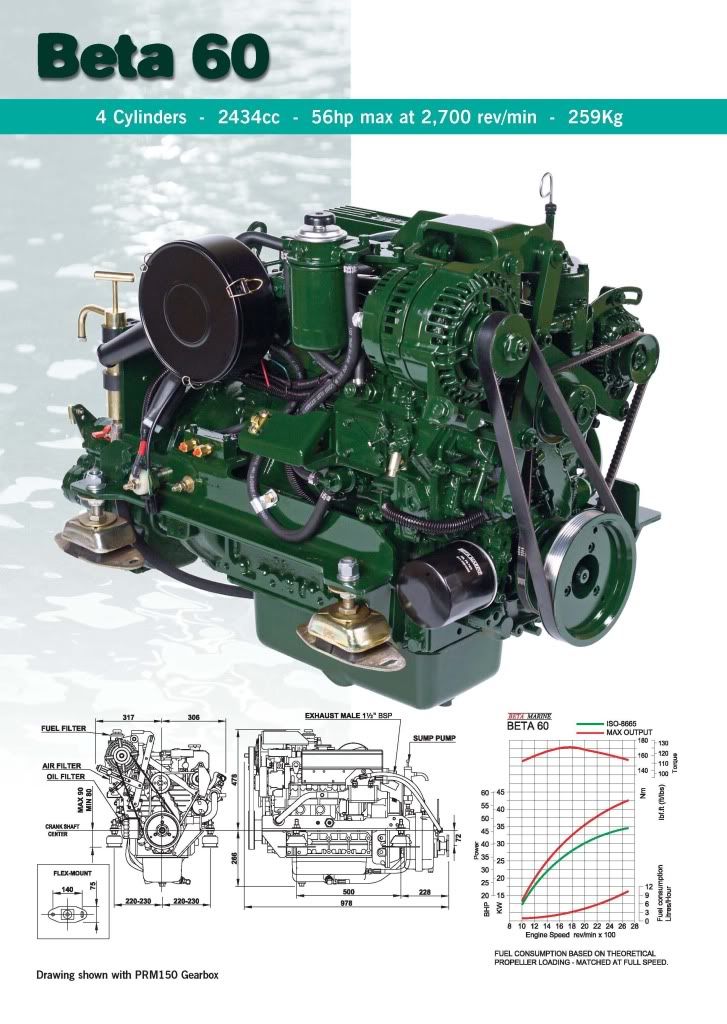
After considerable consultation and debate, I've purchased this engine for Alchemy. A fellow in my club announced himself not only as the Nanni diesel rep for Toronto (a French marinized Kubota), but as the Beta Marine rep (an English marinized Kubota).

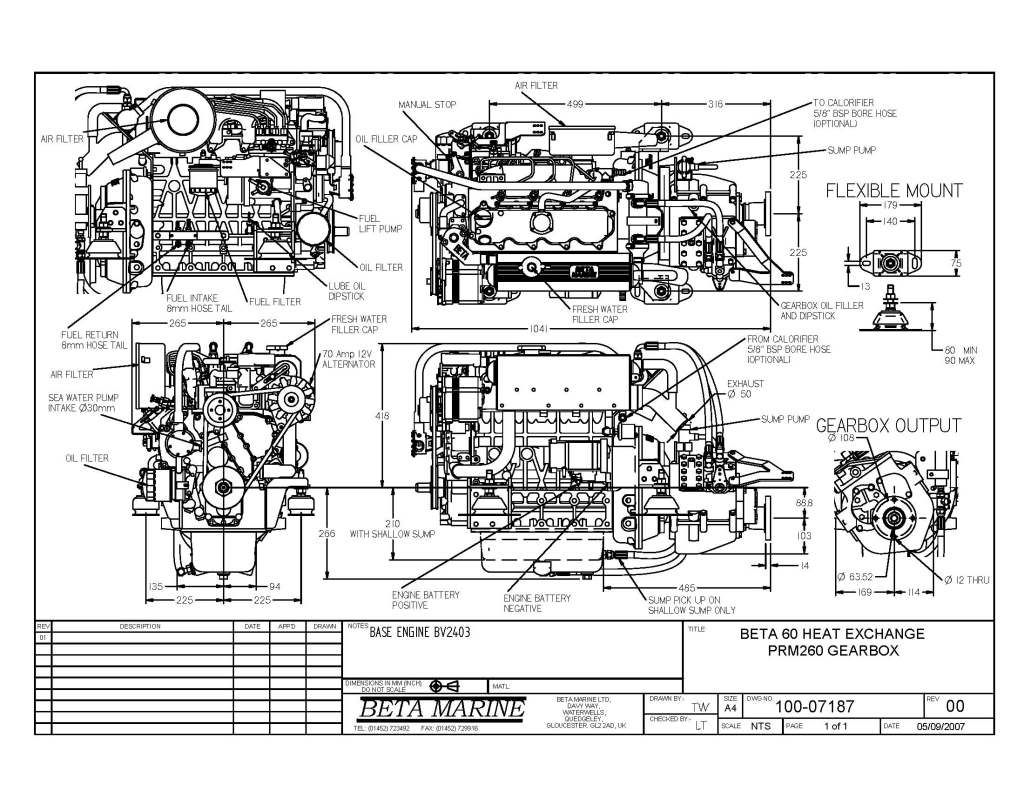
This is the "keel-cooled" version used in barges and whatnot, but I'll have the usual heat-exchanger on it, but with two alternators, a ZF25 hydraulic transmission, the raw water pump relocated (perhaps) to the top of the engine, and the oil filter relocated off the block, rotated to the vertical and put on the bulkhead for ease of filter changing. This last "option" makes sense also because you can fill a vertically oriented filter with fresh oil and spin it on, leaving very little oil-free space in the circuit when you fire up the engine again. Also, you don't spill much, if at all. Makes sense to me.

The basic layout and measurement of the 60 HP block are here:


I will have to fab up a cardboard mock up to play with to determine motor mount positions, "risers", if needed and distance from the forward bulkhead. I have to include the space needed for the thrust bearing, the stern tube, the PSS (shaft seal) and the Aquadrive unit, all of which are aft of the transmission plate.

So there's a lot to figure out and no doubt a lot to measure, measure, cut. I'll keep my miniscule, if surprisingly international, readers apprised of our progress in the New Year.

2010-12-28

Peru-sing South American Cruising


This might be the first time I link directly to another blog's post instead of writing it myself, but Michael and Edi on Sequitur, a Canadian Hunter 49, have posted a reminder that it's not all barbeques and sundowners for the ocean cruiser; a large part of it can involve bribery, bureaucracy and extortionate fees.

What's Spanish for "I voted with my keel"?

http://www.sailblogs.com/member/sequitur/?xjMsgID=156150

A very good post from cruising grounds less familiar than most for many Northern Hemisphere sailors.

2010-12-17

Climate change skepticism and the contemplative cruiser


Ask sailors about global warming/climate change and count the number of sailors you've asked and add one. That's about the number of contrasting viewpoints you'll get.

I have never owned a car and choose to live downtown as a consequence. Or, perhaps because I get to see the tense, often angry faces of car drivers from my perch atop my bicycle, maybe I should say "as a benefit". I've made no secret that not owning a car has freed up what I figure is $6,000-$8,000/year for activities such as sailing. I'm not rich (in the First World, anyway); I couldn't have a sailboat in the water and one a-building on land if I also drove.

But I don't feel particularly virtuous about it. As a teen, I owned and drove with pleasure smoky little two-stroke mopeds as close to the 60 km/h speed limit for them as I could get away with. I in fact got a ticket once...for speeding...downhill.

I also don't hesitate to fire up either my woodchipper or my chainsaw in twice-yearly tamings of the abandoned woodlot I call my backyard.

I certainly wouldn't mind a car on those days when I'm moving vast sailbags or batteries to and from the boats. If they made a diesel/electric hybrid Honda Element or Nissan Cube, I would be sorely tempted, because basically I need a wheeled box to carry heavy and bulky "stuff" short distances. I essentially have two sets of tools (Boat and Garage) just to dodge towing 40 kilo tool chests in one of the several wheeled carts I have for my bicycle.

Still, with a waistline at least as old as my head, I derive physical benefit in the form of exercise via towing metal lumps hither and sometimes yon. I also get to experience what the heated garage types often do not: plenty of time in the open and frequently windy, damp and/or scorching air. Combine that with even the local sailing (not exactly a trackless vista, but still decent enough to see weather advancing rapidly), and I would say I get to look at the weather more than most, but less than, say, the average forest ranger or mountain guide.

I accept that in my lifetime, the climate is showing signs of change. I would say that the predictability of the climate, in terms of historical trends, is lessening and "unseasonable" weather (whether colder or hotter or wetter or drier than in, say, the midddle part of the 20th century) is increasing.

I don't know the reasons. I do know that we live in a country (Canada) where we are quite profligate in our use of fossil energy and also in which some of the more notable climate change events occur (such as permafrost thawing and the opening of the Northwest Passage). I also accept that "change" in this sense could include this sense of a widening of such historical norms and a lessening of the predictability of seasonal weather trends.

I am also a sailor planning a world cruise starting in a couple of years. It would be injudicious, to say the least, to disregard the role of climate change in our planned journey. My pilot books are established on these principles: that over some 200 years of data recording (mostly by the U.S. and U.K navies), it has been possible to discern patterns that exceed raw chance in terms of what sort of sailing weather one might expect in given areas in given months.

So while I encourage a healthy and indeed scientific skepticism over the causes (and by inference, the range of possible solutions) of climate change, I don't reject the premise that burning fossil fuels created over millions of years in a handful of decades, or widespread deforestation in favour of farting cattle has had a measurable effect on the planetary climate.

It would be surprising if it hadn't, given that we are pretty clear on what a single large volcano can do as a matter of historical record: Bugger up the summers for a few years.

I have been visiting a very popular blog of late that is critical of a lot of the current climate change science....and rightly so, I think. There's a lot of alarmism and conclusions drawn from too little data on what are, after all, extremely complex systems in which the effect of human activity is only a part, and to an as-yet unknown ratio. But while I do not accept nor encourage the sort of evangelical self-hatred of all man's works that some "greens" espouse, neither do I believe that the viewpoint of those who posit that "all climate change science is bunk; let's all hop in the SUV and drive slowly!" is particularly helpful, either. It's clear that at least some "deniers" have an interest in continuing to live carbon-profligate lives, and the consequences be damned as long as there's gas for the monster truck and propane for the hot tub. Some of the posters have a bullying tone I don't find helpful. Others are clearly still upset that The X-Files was cancelled.

And yet one of the reasons to go cruising in this decade is the rather disturbing notion that the next decade will see some potential locations either turned into sandbars, or the site of climate-change-fuelled civil unrest, or both. Last chance to see, and so on.

I welcome future illumination. Preferably with a warm, white LED, of course.

2010-11-15

Wind makes the boat go


There was a recent thread on a sailing forum I frequent soliciting advice on "heavy weather strategies". Now my experience of big air is both limited and local, although I've spent about two weeks on the Atlantic in the last three years in rather different situations. Anyway, I gave the following account of what I've learned since 1999.

"My strategies, such as they are, are different depending on my proximity to shore, the boat I'm on, whether I'm alone, with crew, or AM crew. Way back when I was an appallingly green sailor, I saw 40 knots solo on Valiente, my 33 footer, and got into trouble when a gust..a predictable gust coming out of a river mouth and clearly visible valley... laid me over on the lee side with no harness and no PFD on. I lost some finger meat releasing the main sheet and learned to be more careful and less caring if a fender rolls off the deck in half-gales. Repeat the mantra: It doesn't matter if it looks sloppy...do NOT retrieve the fender when the boat's on autopilot above 28 knots. Bad things will happen when you are on that sidedeck...particularly if you are concentrating on appearances and not on sailing the boat actively.

I have seen 30-35 knots with my wife and kid aboard on Alchemy, the pilothouse cutter, which has pipe-sized rails instead of lifelines, and which features cambered, dry decks, and, of course, a way to steer in relative comfort. I found in this case that having just a staysail up (hank on for simplicity) drove the boat near hull speed and yet gave plenty of control and balance...if little in the way of pointing ability. So "reduce sail toward the center of effort" is a good one in increasing winds.

Another one not in many books is the idea of preparing hot drinks and soups in thermoses, sandwiches, energy bars, anything you can stuff into your face with one hand quickly. You use up a lot of energy running a boat in big seas and wind, and you will stave off fatigue if you are properly nourished. These days, it is rare to get surprised by bad weather: even local squalls are preceded by signs in the sky that they MAY occur, so it's easy to get together food and drink at the dock if you think you are in for a stretch of heavy weather.

I have seen 30-45 knots as a delivery crew for protracted periods (meaning what they call "fully developed seas" of six metres/20 feet) in the Atlantic out south of Bermuda, and the logic was to keep a bit of jib out and a little bit more main (it was in-mast furling, which was new to me, but which worked well) to continue to drive the boat near hull speed in order to maintain control and to avoid pooping, broaching or the dreaded pitchpoling. This worked very well, generally, except when squall lines would pass with 40-plus knots and confused seas. This is when knowing where the handholds are is essential, because if you break an arm offshore getting thrown into the cabinetry, it might stay broken for a week...so there's no harm in crawling if it gets you to your station. Also, take care with normal life: getting pants on while keeping one hand for the boat in a squall is difficult and like playing blind rugby.

I saw 60-knot squalls in my home waters this last summer as race crew. At some point, most boats will have to suspend racing in dangerous conditions, if only to preserve their sails and rig. How that is to be accomplished is quite individual, as is the decision to slow down or press on. We tore our jib, a Code Zero and an assy. spin in the space of about 90 minutes in three separate squalls. The last time, we furled in most of the jib (we had about 20 seconds warning thanks to the sight of exploding spinnakers in the mist aft of us) and let the mainsheet go as we turned to face the wind. Then we more or less got pinned 30 degrees over in a sort of half-assed heaving to attitude that nonetheless was easier on the gear. This allowed us to resume racing when approximately one-third of the fleet of nearly 200 boats had to retire, many with extensive damage. So that heavy weather strategy was "know when to pause and take stock". Running ahead of wind can work, I am thinking, to a certain point, but that point will vary with one's confidence, the qualities of the boat, and the abilities (and strength) of the crew. A fully crewed race boat can push the issue a lot farther than a cruising couple.

For truly appalling, long-term heavy weather, like getting out of the way of a cyclone or a deep trough of heavy, cold wind, I would carry the Jordan Series Drogue over a sea anchor. My particular boat is better suited to running off at an angle, I think, although deliberate "testing" of this by seeking out loads of wind and trying to heave to or run off in an area where I'm not far from help if I screw up is advisable. Practice whatever techniques you choose before you need them: an example many people do yearly is getting under full sail and then suddenly chucking a hat or a life ring over the side and shouting "Crew overboard!" Whether the boat comes about and to a stop in an orderly fashion or not is instructive, to say the least.

Knowing one's boat seems to me to be key: The method that works on one might not work on the next, but generally, having the proper sails and the bulletproof means not only to reduce but to secure your sails, deck gear and all lines (because if it's sheeting down hail, you can't keep track of where that 100 feet of Spectra furling line went...over the side and into the prop, maybe?) are key tactics. Keep the decks clean and the gear lashed, because then if you have to go forward to deal with something, you won't get smashed or tripped while you're dealing with jacklines and flashlights. Because you secure jacklines at sea and you clip on whenever you leave the cockpit in heavy weather, and whenever you are on watch alone, which will be frequently.

I have much still to learn, but I do notice myself making fewer gross errors than before, which is progress of a sort.

2010-11-07

What a difference a year makes


I find it interesting to note that a year ago today, I was crewing on a Bristol 45.5 approximately where the "s" is in the current position of decaying ex-hurricane Tomas. I can only imagine the sea state at that position is much more severe than the conditions we experienced, and they were no daysail on a pond.

A year ago, we were being squeezed between a vast low-pressure trough and a decaying Hurricane Ida. Worse weather, according to nearby boats racing in the Caribbean 1500, was all around us (except in front of us!). Nonetheless, we were getting plenty of wind in the 20-35 knot ranges, with squalls better than 40 knots at times, and large, rolling seas in the 12-18 foot range (I'm guessing, because I sure haven't seen more than 10 feet on Lake Ontario). We made excellent speed in an inverted "L" shaped course from Virginia to USVIs skirting Bermuda, and while it was a fast passage, it was also rough enough to be "instructional". Cheers to skippers Bruce and June for giving me the opportunity...and I'm sort of glad we had weather, but not this much weather.

2010-09-30

Grinding my gear

I'm starting to address some functional and structural shortcomings on Alchemy as I progress on the boat preparation path. I've avoided to this point much in the way of cutting, grinding and otherwise irrevocably altering the metal fabric of our boat, partly out of fear of making a mistake and partly because slicing bits off the hull imposes certain time and action restraints when it comes to launching again in the spring of 2011.

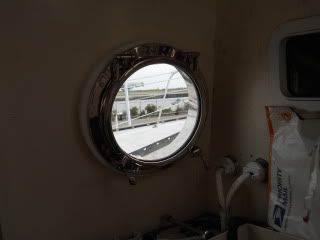
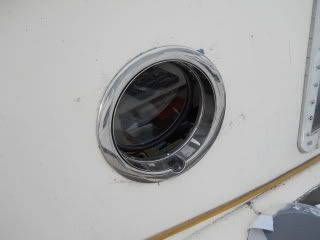
One of the more minor, if finicky, job has been the removal of the fixed (Lexan) portlights in the pilot house and their replacement with portlights capable of opening.


The pilothouse is the nerve center of Alchemy and is where the crew will be spending a lot of time, either in staying out of heavy weather, taking a break from the sun, or making use of the navigational instruments, course plotting, radios or other gear. While there's a separate helm on deck (and when the new engine goes in, a second set of engine controls), the pilothouse is where the nominal "driver's seat" is, and yet it's like sitting in a steel and plastic greenhouse. Rigid insulation will lessen the heat transferred via a big flat aluminum roof, but the two rooftop hatches (about 7 x 12 inches) and the single opening forward window simply aren't enough to keep the air moving. At the same time, the wind or weather might argue against having the companionway hatch open. So a semi-sheltered way to get air through the boat was as much a necessity as a choice.

This is the "dry-fit" result:

"Dry fit" in this context means that all the pieces are bolted together tightly to conform to their permanent positions. Absent, however, are the final priming and painting of the metal made bare via drill bits, angle grinder (grinders, really, as I wore one out) and Dremel. Also missing is the butyl tape and bedding/caulking necessary to make all this as waterproof as possible, considering that at some point a few tonnes of seawater could whack it with intent.

If it looks nice (this is the view from the side deck, thank the firm New Found Metals. I had heard through the cruiser/boat repairer grapevine that this American firm did semi-custom castings and had a bevy of stock parts with the reputation for simplicity, accuracy and sturdiness that an ocean traveller seeks. After a chat with the firm's president at the Toronto Boat Show, I learned these portlights weren't, as these things go, particularly expensive.

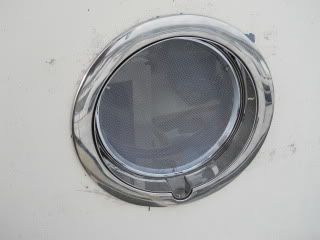
Here's the SS screen installed. Bugs, I snort at your feeble attempts at ingress!

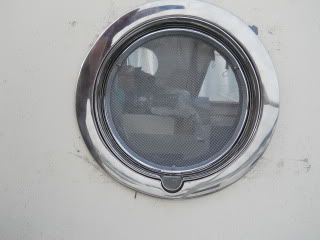
I won't go into the tedious details of making a circle X inches across X plus 3/4 of an inch bigger, except to note that I should really invest in ear protection and stop wearing sandals when I'm turning steel into splinters. That white surrounding 1 1/2" ring is HDPE plastic, a necessary "spacer" to make the "spigot" more or less flush with the "trim ring". My god, this blog is educational, I should provide diagrams. A fibreglass boat will tend to have thicker sides; my pilothouse's sides are by contrast, about an eighth of a inch (3 mm) thick. The "yachtie" turn would be to carve up a small section of teak trunk, and to use a coping saw to make a wonderfully boaty teak Life Saver. Well, apart from the fact that a chunk of teak that width and thickness (13 x 1.5 inches) would be more expensive and certainly more ecologically heinous than the portlights themselves, I just don't like wood much on steel boats. Odds are good that all this will be buried behind insulation anyway, and HDPE is cheaper and more rot-resistant than wood, and besides, we are talking about what is chiefly a great big plastic washer.

Perpendicular view, now with transparency!

Anyway, I've learned some shortcuts, and, just in time for winter, I can now have fresh air even when it's pissing down outside.

2010-09-18

Thoughts on efficient sailing

IN a recent discussion from a sailing forum in which I participate, the usual question of "what cruising boat should I get?" came up, and is usual with these sort of discussions, the merits and flaws of the more traditional, heavy displacement, cubic metres of tankage-style of cruisers came up, specifically the Island Packet line. Bob Perry, noted naval architect and writer (and designer of boats both heavy and light), noted:

"Listen, my pal with the IP 38 races it! He enters single handed events on the great lakes and he does quite well. He loves to tell me ( ad nauseum) about how he can beat a Valiant 40.
" Ok, so once you beat a Valiant 40 now shut up."

Making a boat go or not go is usually far more about the sailor than it is about the boat. Many IP owners are non racers and less than skilled sail trimmers. They could make the latest IRC racer go slow, very slow.
Sure the IP will not be as close winded as some boats but you can foot off a bit, sail the boat on the fat side and just let her roll along and you'll do just fine."--Bob Perry from anything-sailing.com

To which I replied: This is true. If I can make this thing sail at 4.5 in 9 knots apparent, anybody can trim any boat to its maximum potential, which may prove surprising not only to the guys on the race course, but to the skipper!


I consider it a truism that while not every boat is a racer, but any boat can be raced.

Most people, with the exception of racers, don't realize their boat's full sailing potential (and I don't just mean speed, but rather efficiency of the boat slipping through the water, making the minimum of lee, and having the ballast organized to provide the smoothest ride, among other considerations). Yes, some boats are inherently slower than others, measurably so. But technique and familiarity are key, and this is why I tend to cruise as if I am racing in the sense that I took all I learned in five years of flag-winning club racing (which is not all there is to learn, by a long shot) and transferred that to cruising.

Why? Because a boat sailed efficiently is a happy boat, with a happy skipper. It is fulfilling its reason to be.

Sometimes, the key to learning where to start is from crewing on the boats of others, or reading books or mucking around in dinghies or even looking at your own boat in a new light. About six years ago, I switched to a Gori folder and took about 300 pounds of gear out of my 9,000 lb. '70s racer-cruiser. The difference was noticeable and I found further tuning and sail trimming "fixes" that made the boat even more of a pleasure to sail than it already was. I transferred this knowledge to our newer steel "old shoe", and found similar "gains", although obviously to a different scale and degree. Still, it surprised more than one observer, crew or passenger to see such a big, heavy boat move in light air and manoeuver with something approaching grace.

Playfulness leavened with science will tell anyone more about their boats, even if it's generally thought to be a slowpoke. An example: My steel cutter [I]Alchemy [/I]is getting its batteries increased in weight by about three times, but they are moving forward to the CG under the mast. The new engine will be about 150 pounds lighter and about 1,200 pounds of lead ingots in the bow will be replaced by chain and tools, which are coming out of the pilothouse lockers. The water tankage remains the same at 200 gallons, but is moving down onto the stringers and frames instead of mounting beneath the side decks (this was a poor choice by the P.O.). Lastly, I'm putting on a feathering prop. My experience with both a folder and my friend "Cap'n Matt's" experience on his steel ketch with an Autoprop convinced me that a fixed prop, while mechanically simpler and much cheaper, created unacceptable drag.

I expect all these efforts to have a salutary effect on the boat's sailing characteristics and to increase both stability and "sea kindliness". Yet it is sometimes assumed that given that it's a 15-16 tonne boat, there is very little I can do that will have much of an effect.

That is not my experience. Any boat and any skipper can be improved. Sometimes it's about learning or relearning many of the basics of sail power; other times it's about removing heavy crap out of the boat or to a better spot. Skippers in the age of sail knew this about "ballast" intimately, because poorly stowed ballast could kill you if it degraded the handling of the boat or caused unacceptable losses of stability.

2010-08-30

Two against the sea!


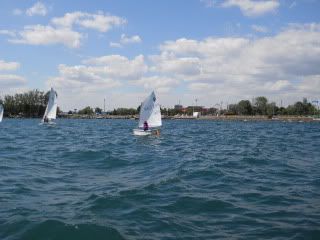
After my kid spent a couple of weeks in "sailing camp" (see hot Opti beam reaching action above), I decided in my skipperish wisdom that it was time to test the Incredible Nesting Dinghy, Optimist Pram.

I make no apologies for the vile pun, as it was geared to amuse a (then) seven-year-old boy.

Anyway, I spent a portion of an unseasonably hot afternoon assembling and rigging the dinghy, not really aided by my son's queries along the lines of "do you know who Captain America married?" and my own lack of memory as to how I did it the last time. Eventually, sweat and lucky guesses mostly prevailed.

Sorry to say, but I was, until yesterday, a dinghy virgin. I cannot tell a lie: instead of messing about in boats for a tender age (pun intended) in Optis, 420s, Lasers and finally something really tippy and squirrelly, I in fact never drove a boat until the age of 38 and my purchase of Valiente, a 33 footer of the mostly non-tippy kind.

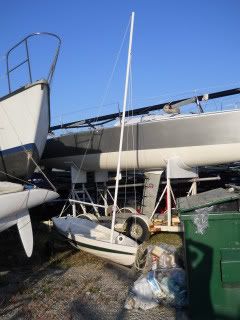
As I didn't dare take cameras or cell phones aboard (dinghies are indeed tippy, something my son decided to talk about ceaselessly while we were out, I don't have "action" photos. Instead, this is the little boat, sails stripped and charmlessly parked aft of a garbage bin.

Yes, that's a lot of rig.
Dinghies are, well, sensitive. I haven't had this much trouble with the concept of feel since teenaged dating. Eventually, with my son on the helm and me pulling various ridiculously undersized strings (or so it seemed to Burly Sailing Dude), we tacked and gybed with reasonable efficacy.

Mostly reasonable.

More study and practice is needed. As this is supposed to be the "sports car" (with the Portabote as the "van") of the tender pair to the good ship Alchemy, we will need it. But yesterday was a good start: We didn't tumble in and we sailed back to the dinghy ramp unaided. The thing's still a heavy bastard to yank around a parking lot, though (note to self: Inflate cart tires!)

2010-08-14

A wee summer getaway on the Low Seas


Last Monday, we decided to take a quick trip to Cobourg from Toronto. This is a mere 100 km. NNE, hardly an expedition, but we like the little town, and we like the well-serviced marina, and the boat was running well, if in "Spartan" mode. I'll leave what that means to your collective imaginations; however, no lake was harmed in the making of this voyage.

So here are a few pictures. This is my son in 2005 at said compact destination:


And here he was last week.


He'll be nine in a couple of weeks and has been sailing since he was five days old. Yes, that means the photographic proof predates digital!

As is so often the case on Lake Ontario in the summer, decent wind was NOT a feature of this trip.


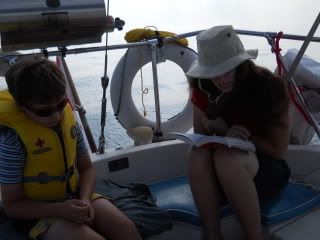
Consequently, the Harry Potter Book Club held several meetings.


Yes, my kid can read, but he still likes being read to.

We did get a chance to throw up some sail...


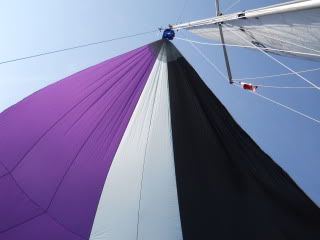
...but even with my cruising spi, we could only make about 4 knots in 6 knots of wind. At least it was from the south east, a rare direction here. Getting "up lake", meaning to the south west, is usually a chore of beating long tacks.


Eventually we just motored...straight into fog. Also note why boats with worn gelcoat and child passengers need frequent cleaning...oh, the footprints...


About 30 seconds after I requested my wife to hand me the can of compressed air, I had to blow it at a drifting fishing boat that came out of the fog directly in my path...five miles offshore...(sailorly invective omitted).


Anyway, that was our mid-week getaway: 75% motoring in next to no wind with about five hours of actual sailing...sigh. Now, back to boat reno ashore.

2010-08-02

Well, that only took 18 years


After years of having other sailor types express shock and horror that I hadn't seen this fairly mild comedy about a dubious yacht delivery skipper and an uptight family who inherit a vintage ketch, I located it on DVD and myself, my wife and our eight-year-old son watched it tonight. It was indeed mild, but had a few laughs and not too many errors on the seamanship side. Kurt Russell's "casual sail0r" character reminded me of a few guys at my club, actually, who know a bowline, a long splice and the rest is instinct. And beer.

Sometimes that's not a bad thing.

Vintage winches feature pinches


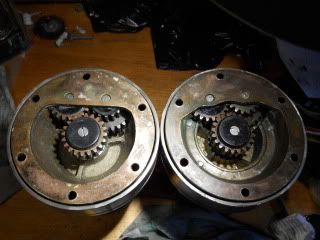
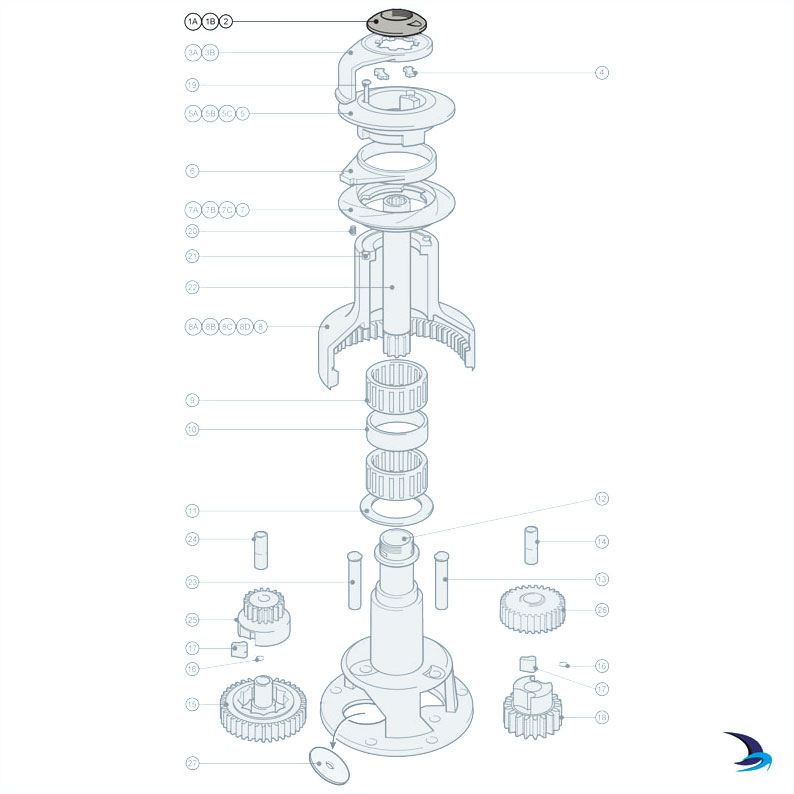
I recently received a pair of vintage winches, Lewmar 44 ST (self-tailing) Ocean Wave models from the '90s. I purchased them for $200 each from a fellow sailor on anything-sailing.com on the assumption that they had never seen salt water, and having now stripped, serviced and getting them going clackity-clack in a proper fashion (I have to earn the rum around here), I believe that they haven't been soaked in brine and will find a nice home as "backups".
Helpful when pulling to pieces.

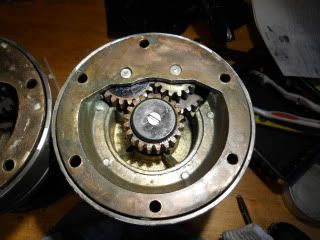
Curiously, they have slightly different guts, although they are identical on the outside. The one on the right has some sort of two-part base with a kind of internal sleeve for the central post...


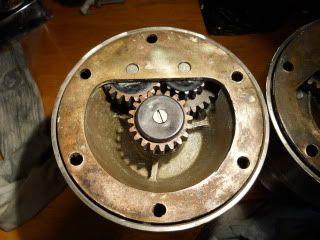
...whereas the one on the left has a solid casting.


Anyway, they are built like tanks and show wear only in some superficial scratches and dings in the chrome. They will probably go on Alchemy as secondaries for drogue or warp use, towing or "big air" downwind stuff like running twins and will be mounted behind the current Anderson 40 primaries and Anderson 28 secondaries. The Andersen 40s are sized the same as these 44s...winch sizing is an arcane and arbitrary thing. Spares are still available, and I received, happily, full documentation.

I think this deal is almost as good as the $200 80-pound used CQR anchor my fellow sailor Maria P. scored down in Mexico last week:

Likely off for a short cruise next week. Frankly, we need the practice.

2010-07-21

Squall aboard at the Lake Ontario 300 race


Leaving from Port Credit, all looked fabulous forward...
...but in order to get a hint of what was to come, you had to look aft.

Ahoy, maties, 'tis the Ancient Mariner back from t' voyage...a voyage that will pay for many a sailmaker's kids to go to college...

Short version is that everyone on my crew is safe and we came second in our fleet on both finish and corrected times, which was very gratifying. That was after a very frustrating, if typical, early Tuesday morning that saw us ghost past the finish line at one knot of boat speed.
The calms after the storms.

Saturday's start was fast and very crowded and which saw a boat not in our start fouling us over the line. We had two violent squalls in the first two hours, one south of Scarborough lasting about five minutes at what I estimate was 40-45 knots and one about 25 minutes later south of Oshawa/Whitby that took about ten long minutes to blow out and which clocked 50 knots on our vessel before we really were too busy to look anymore. We have reason to believe it went to 60 knots because a boat near us took a shot of their WSI registering 59.8 knots which we saw after we had finished. I felt a little funny seeing that, I can tell you. Certainly, I recognized the sound of the 45 knot squall, but the heavier one flattened the seas, had marble-sized hail and roared like several freight trains. The first squall saw two of our crew on deck trying to wrestle the sock onto our assy spin while enduring a fearsome heel and pelting hail. They were safe, however, if strained. The assy spin was torn and stowed, but it can be repaired.

The archetype of a parade of Lake Ontario squalls. It barely rained and didn't blow back in the city.

About four miles further on, I was watching aft and saw a spinnaker explode on a boat about a quarter of a mile back before it disappeared in mist, which gave us about ten seconds to partially furl the jib and to release fully the main as we turned partially to the wind. This probably saved us more damage, as the boat was pinned at 40-45 degrees over for some very noisy minutes as we watched several hundred grand in composite sails disintegrate on several boats we could see around us. The radio buzzed with abandonments and reports of damage and injury and a trimaran having flipped its four crew into the lake. They were all retrieved safely. The best analysis of what actually happened from a meteorological standpoint can be found here, while the skipper's take on the entire race is found here.

Our damage was a torn leech line cover that meant we had to partially furl for every subsequent tack, a ripped up assy spin, a Code Zero with a hole chafed in it that we repaired with duct tape (how Canadian!), a damaged stanchion, a lost Dyneema spin sheet and some underwear, although I can't confirm the last bit. Later on, in the 25-30 knot following winds that propelled us the rest of the day, the barbeque on the rail simply sheared off, no doubt amusing some fish. We had a surplus light air spin of vintage years that we used pole-forward as a fake Code Zero in the middle of the next night, but it was only good to 10 knots and we had to douse it when faced with further, if only a measly sub-30 knot, squalls on Sunday night on the American side of the lake.

Proof we dipped the boom (!):
Weed heeled a bit.


It was the biggest squall any of us had seen, and I was sailing with some experienced sailors. If the 60 knots of wind speed is true, and I believe it's credible that it blew that hard, that's bettering what I had in the Atlantic delivery I did last November by 15 knots. Here's what 60 knots does to sails on a racer:
Painful to see, unless you run a sail loft. Then it's porn.

Out of 198 boats, 59 "did not finish", 33 of those due to too much damage, injuries, dismastings or capsize, and the rest because they were frightened/exhausted and wanted to stop their suffering. I think that maybe 30 feet should be the lower limit for this race, because of the sort of exhausting wave motion I saw on the sub-30 foot boats. The exception was the 20-foot Mini Transat boats, which faired well, but are arguably made for such conditions.

Also, beating up the U.S. side is tedious work. I much preferred the downwind legs.
Red skies at night was nice, however.

All in all a great trip, a great crew and a great experience in getting a fairly large cruiser to race effectively. Had we had a second A-sail, we might have won on corrected time.