Copyright (c) Marc Dacey/Dark Star Media 2006-2026. Above photo (c) Marc Dacey. Powered by Blogger.

2012-03-13

Arise, O diesel! Alignment awaits!


The greatest hoist ever executed.
This post describes, in graphic-heavy detail, how I've built what I hope will be a durable engine gantry for the new diesel mounting, coupling and alignment procedure. It turned out to be yet another in a long line of "boat learning experiences". I'm posting this with loads of photos as I was asked to relate my experience with this project, so please bear with the load time.

Getting the diesel into the boat recently was comparatively easy...about an hour's work with a guy on the Polecat crane, me and a friend shifting and using radios and whatnot.

The typical marine diesel engine, for the uninitiated, must sit on four "motor mounts" bolted to engine stringers, fore-and-aft steel girders (in Alchemy's case; f/g boats have either solid or wooden-cored engine stringers covered in a thick, reinforcing layer of fibreglass), and aligned between the engine coupling (the heavily built spinning disc at the back of the engine), and the propellor shaft coupler, a similar metal disc about 12-15 cm wide at the inside end of the propellor shaft.
Typical marine diesel mounts. Photo (c) "Dual-Flex"


Typical "drive-saver" coupler insert designed to reduce vibration.

In most boats, this has meant a quite exact alignment, as the flat surfaces of the shaft and engine coupler must "mate" as close to exactly as possible.

The reasons are twofold: The couplers' surfaces are very smooth and are secured by three or four or even more bolts; a more close-to-perfect fit means a tighter fit, meaning the bolts are evenly stressed. The second reason is that misalignment, even below the level of casual observation, can induce both vibration and destructive wear on the engine's drivetrain and the "stern tube", the glass or metal pipe that encloses the prop shaft on the way out of the boat.

Misalignment can wear all the parts of the drive train, from the crankshaft and bearing inside the engine, to the prop at the far end. The engine prematurely wears, the stuffing box can overheat and fail, the expensive shaft can become scored and worn, and the prop' s blade can wear. The cutlass bearing can fail. Worse case could be an engine seizing or the shaft failing: Boom, you can have a nice chew out of your rudder as water comes hosing into your engine compartment. You do have tapered wooden plugs and a prayer shawl back there, right?

So the so-called "solid" coupler requires careful alignment using an interesting little device called a "feeler gauge". Essentially a little jacknife with several little slips of metal of differing thicknesses, this gauge tells you how close to ideal the coupler surfaces are. Considerable dinking around with the engine mounts can be involved, little 1/8th turns of the heavy, and by that stage, load-bearing bolts in the motor mounts, to raise or lower the engine fractions of a degree to obtain as close to "completely aligned" as is possible.

While it is quite possible to do all this with wedges, crowbars, foul language and a small quantity of blood sacrificed to the sea gods, my particular situation called for some inventiveness. In short, I needed an engine gantry, something to allow me to haul the engine up and down over its stringers (the longitundinal beams to which the motor mounts are bolted) and forward and aft until I found the exact spot needed.

Ideal, but expensive and way, way too big to fit in the pilothouse.

Great for a car, not for a boat with a "diesel pit": you can't lower the engine past the legs.


I was not sure I wanted to drill holes in the pilot house deck, bolt, back and brace this underneath. Cool gadget, however.

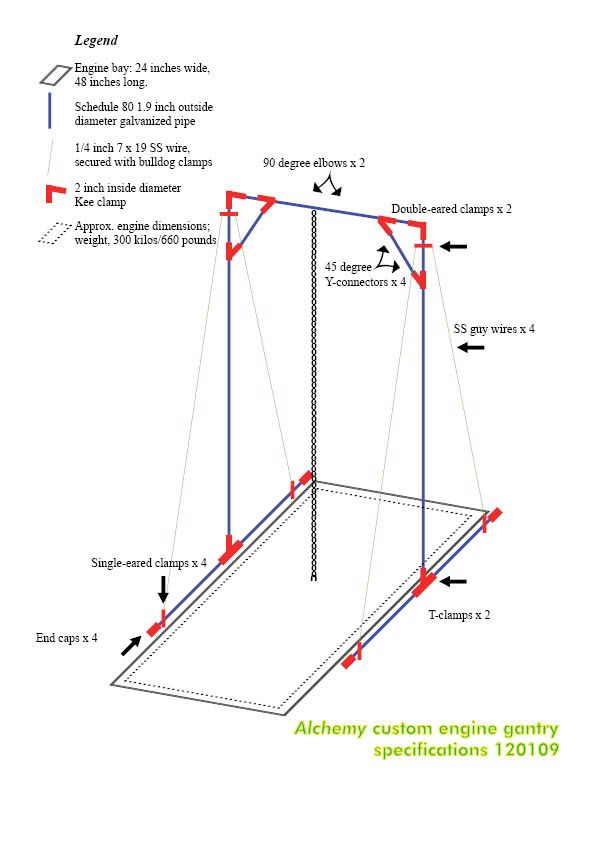
I solicited advice from my fellow sailors, and seriously considered making something out of steel pipe and Kee Klamps, with which I am familiar from work in the film industry...
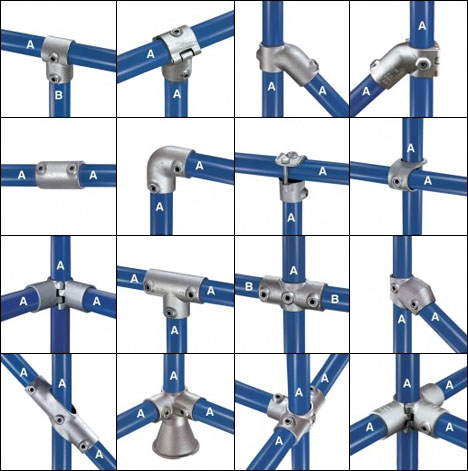
Not cheap, but reusable and essentially man-sized Meccano. It was hard to resist.

The Kee Klamps would have been used as pictured. Their use seemed so practical, if pricy, that I started to design in earnest:
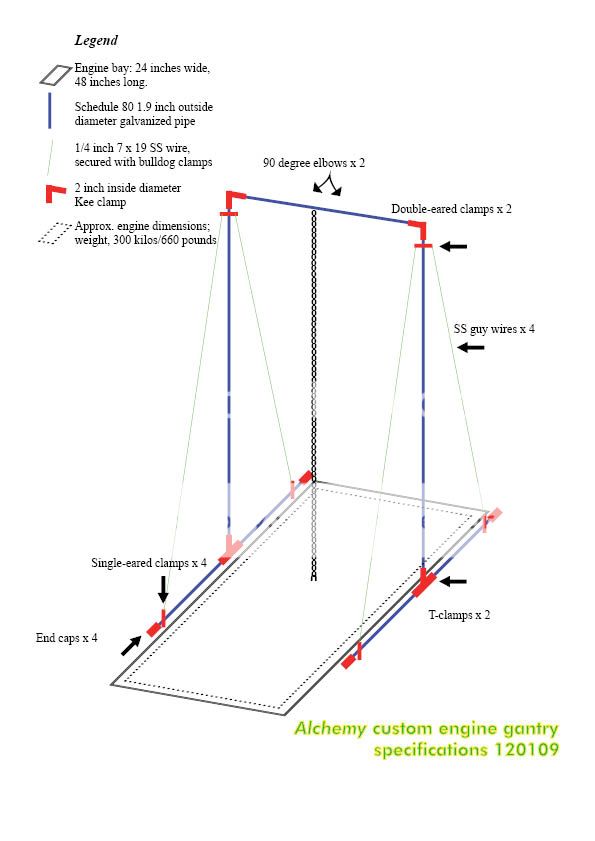
Oh, Kee Klamps, we would have been good together...but you cost top dollar.


I even did Version 2, beefed up at the corners
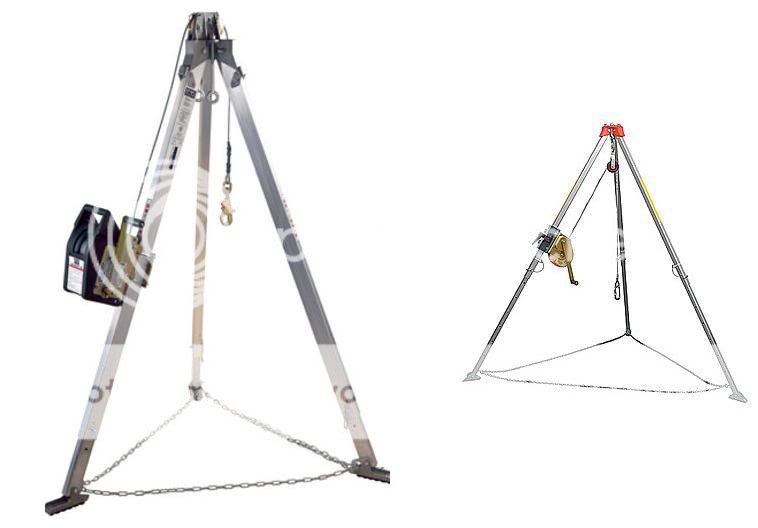
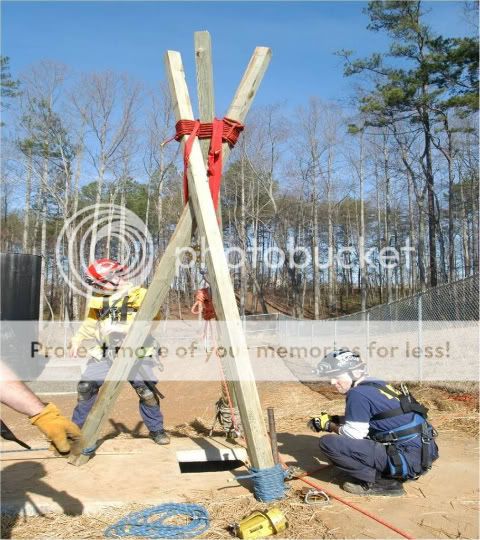
But the Kee Klamp Solution, beautiful and skinny as it was, was several dollars too far. I even had some "thinking out of the box" suggestions, like a tripod affair:

Not enough spread on the load bearing surface, and the engine would snag the chains.

I'd have to take the roof off.

So in the end, decided to build in dimensional lumber: Two triangles, cross-braced and bolted, should have done it. I got "designing", a dignified term for engineering of the level usually found on the back of a napkin.
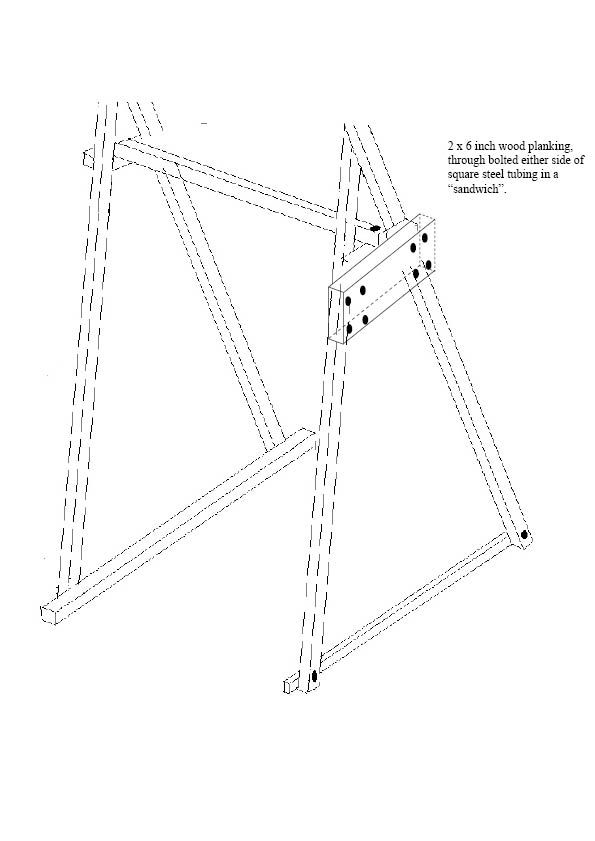
I started by modifying my engineer friend's basic design.

Then I actually took measurements and made modifications.
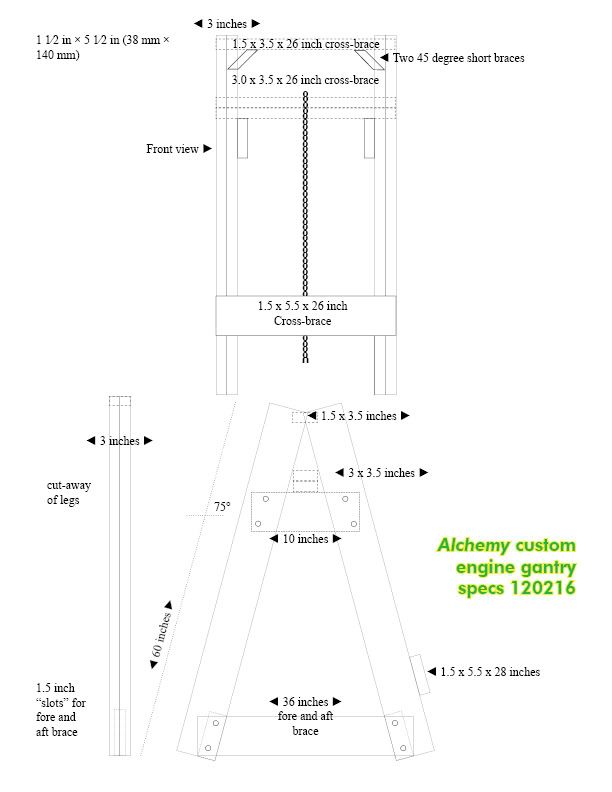
Then I smoked crack. Things got a little out of hand.


The opportunity to learn through building and the chance to save a bit of money (I estimate I spent $80 on all the bolts, screws and lumber) meant I could live with inelegant and heavy if it was strong enough to persuade me to get under the suspended engine. No joke...I could get killed in a fairly vivid fashion (arrgh, pump the bilges...) if I failed to cobble together something sufficiently strong.

I went with KD-grade construction spruce 2 x 6s, about five 12 foot lengths.
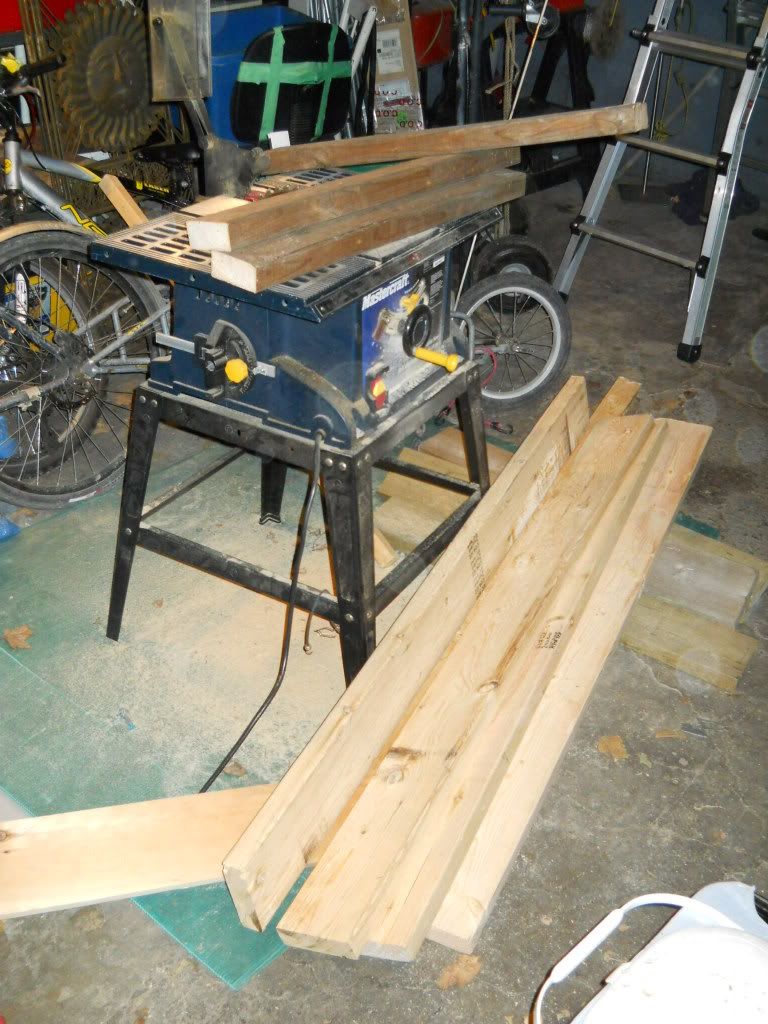
Reminder: Sweep garage
Using my table saw top as a work area, I first cut the cross-beam, which would end up "floating" and held only by the engine weight, on braces. 

One of my oldest and best-performing power tools, plus a very manly drill bit.

This was to enable me to easily reposition the beam, and thus the hoist's vertical drop, some short distance fore and aft.

That very long racheting wrench thingie was a deal. The radius means you can crank fast enough to warm up the nuts, and what man wouldn't like that?
The beam itself was made from hemlock 2 x 4s I salvaged from the rebuilding of our breakfast nook off the kitchen (it used to be a drafty, sinking "mud room"). Unlike modern lumber, these were a lot closer to being 2 x 4 inches, and hemlock is strong. Thinking I'd double the thickness, I eventually decided to triple it. I did not wish to here a single creak. Through-bolted with six inch long, half-inch thick SS bolts, washers and nuts, it seemed pretty well tied together.

I liked using a template, to a degree
I decided I wanted a pair of 2x6s for each of the four "legs", and that the base 2 x 6 should be mortised in between them, and then double-bolted for strength. This required a bit of geometry to compensate for the angled legs, so I made a rough template.
Not as inaccurate as it looks.

I saw things above plastic because beneath is the drain for the horse piss: my garage was built as a stable. Not that I intend piss of any kind to happen in the garage. That's what the garden is for.
Dicking about with these cuts took some time. Knowing what you want and having the experience to take a shortcut, or to see that one might exist, are different things. 

Fortunately, years of low-grade, faffing-about house repairs mean I generally can lay hands on the right tool.

It's Black and Decker, a crap brand. However, it was on sale for $29 and the tippy plate thing comes in quite handy when the alternative is a plastic mitre box and calories.

Or, rather, the "right now" tool.

Eventually, I had four more or less equal-length gantry legs with mostly similar trapezoids cut out of their insides.

Like your prom date, it's even worse up close.
I had a slight change of plan when it came to making the "triangles". 

I needed good light and level concrete for this bit. I got good light.

I decided I wanted ones with brushcuts.

Apparently, I was on the level
Things were coming together. The keen eye will note my Honda 2000 genset. I run a crappy line to the garage, just for lights, pending the rental of a backhoe to dig the requisite legally deep trench, and I don't like to run power tools AND lights in there as it could trip a house breaker 100 feet away. So I use the Honda. Handy little bugger.

Based on an abandoned IKEA bookshelf for frost giants.
So I had a brace for the forward face, a brace over the top, and two "keeper" planks to center the hemlock triple-width beam.

So clean! (Not the garage, the gantry)

That was basically that. The "open" side would allow the transmission to clear the gantry, or so I thought.

This is the reality of two boats, no car, folks. And yet if I had a car, I probably couldn't swing even one boat.
The problem now was to disassemble the thing and get it down to the boat.

Nice lashings, at least.
My customary mode was, to put it bluntly, overtaxed. Riding this over a little bump might, I thought, either kill me or snap my frame, bike or trailer.

Cockles, and mussels, and lumber, ei-oh.
The gantry weights over 100 pounds/45 kilos, after all. So a hand truck or dolly that can convert to a four-wheeler and can take 800 pounds of weight was needed. After the Makita drill, I use this thing all the time. A great deal I got for about forty bucks.

It only *looks* like a DIY trebuchet.
After much personal heroism and unappealing grunting, I humped this Frankenwood assemblage down to the boat, and used the handy deck crane.to haul these chunks aboard. Inevitably, they required even further deconstruction just to fit down the companionway.

Much unrecorded swearing, bolting, noting the base was one-half-inch too narrow for optimum, recutting, rebolting, drilling and screwing, the "wide stance" frame was in place:


Pit, but I hope no pendulum.
This length of line was fine for deposit via the Polecat crane, but I replaced it with a short piece of chain to lessen the gap between the beam and the engine.

Not much point if I can only get it partway up, said the actress to the bishop.

I cut some chain to fit the beam and...

Suitable for hoisting diesels or torturing heretics.

...making sure I was more or less centered over the engine's mass, so as to avoid a nasty swing when I cranked it free...

It shifted a bit because I'm not quite zeroed on with the hoist and chain positions. Easy enough to fix, however.
 ,,,hoisted away. The chain hoist is a one-tonne model I got from Fastenal on sale for $69. Needless to say it will come in extremely handy for a) installing water tanks, b) installing half a tonne of batteries and c) removing 600 kilos of lead ingots from the forepeak put there for trim purposes. Which infers the amount of tools, chain and anchor our boat is meant to sport.

WHEE!

DIESEL GOES UP, DIESEL GOES DOWN...yay...
The chain hoist is one of those devices (much like the similar winch) that you think you can anticipate how it works, and then you use it, and it is actually far easier. I can lift this engine with one hand on the chain, and lower it precisely. It's a fine thing, this hoist. Particularly on a steel boat. Looks the part, this part.

Ok, stop already. You can play with it tomorrow.
And the rather elaborate and painstakingly constructed (because I am clumsy, hence pain) engine gantry thingie? 

Fabulous. Nary a creak, not a shift, groan or wobble. The floor of the pilothouse is similarly unprotesting. I am well-pleased.

Four feet to the shaft seal? Where's my measuring tape?
As for the ultimate reason for all this levity, or rather levitation? To get the new engine on these flexible feet, to bolt the coupler to the Aquadrive unit, to bolt the Aquadrive unit to the shaft, gird as it will be with that PSS Shaft Seal thingie, and to clap on a four-bladed feathering propellor fit to power us off lee shores of exceeding remoteness.
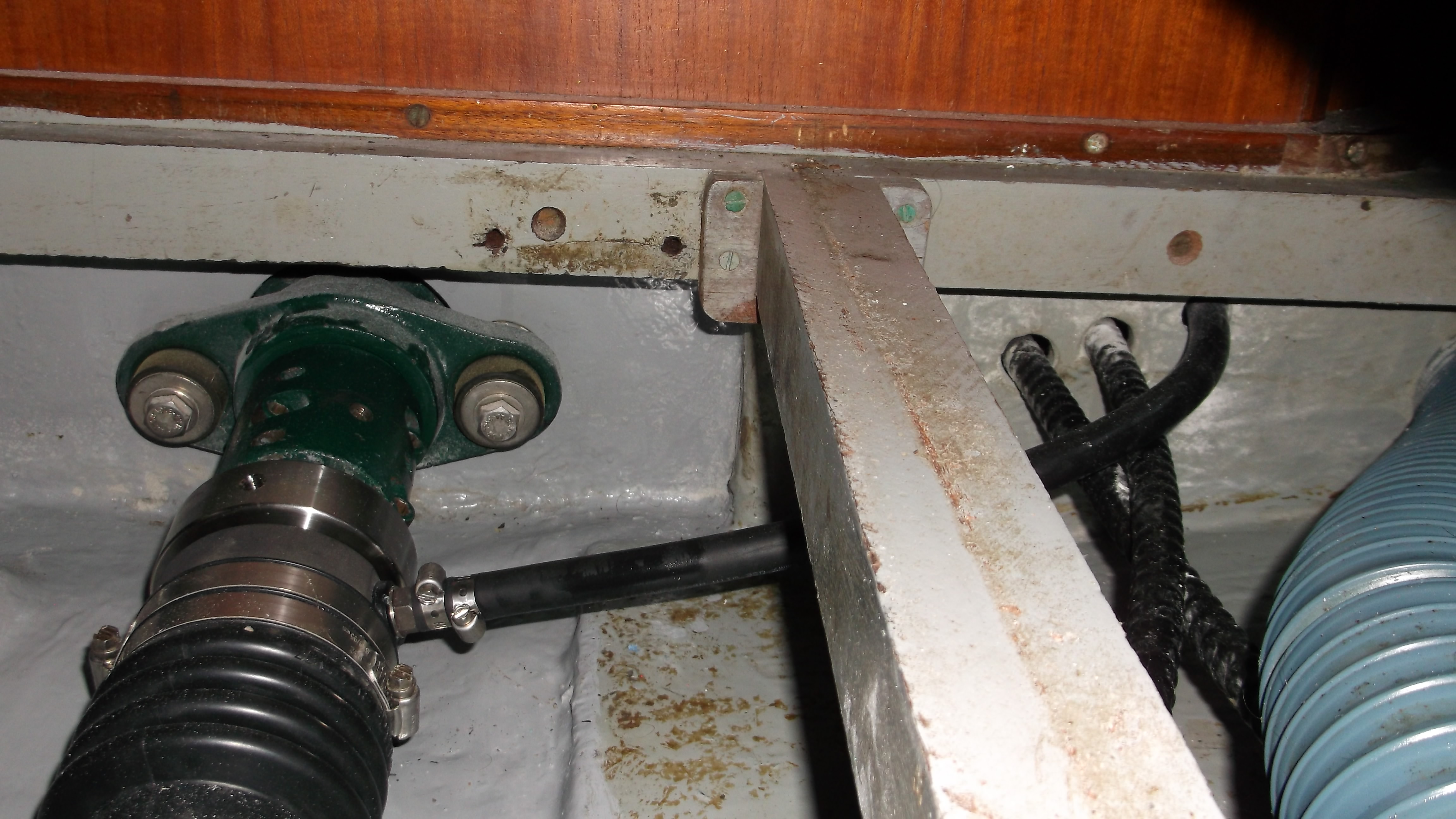
Eventually, it should resemble this. This is very cool, if you understand the issues with motoring a small boat in a seaway. Saves vibration, wear on the drivetrain and shaft misalignment issues. Photo (c) http://www.botanybay.org
And that's the boat that Jack built, or is building. Further reports shortly.


2012-02-23

Self-rescue: More reality checking


About two and a half years ago, I posted my thoughts, immature as they were, on what I suspected was the reality of self-rescue on a sailboat in the middle of the ocean. By "self-rescue", I mean a way in which the solo sailor, having fallen off, can reboard his/her vessel, or how a single and perhaps smaller member of a couple can retrieve the big dope that's slid overboard in the night.

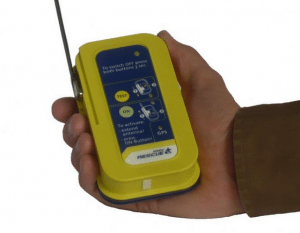
It starts with understanding the difference between EPIRBs (a beacon for the boat) and PLB (a beacon for the body that has fallen off the boat). This video explains it succinctly:

It is quite conceivable that if you came up on deck 200 NM offshore to find your PLB-equipped crew missing, you would a) call a MAYDAY on your SSB and VHF, b) hit the EPIRB to get a plane in your general vicinity, and they would c) attempt to zero in on the PLB signal, which is normally weaker and of lesser range than a boat's EPIRB.

I was of two minds then, and I remain so today, with a couple of caveats and an evolving suite of MOB devices to blame for the rethink. My original position was, and remains, to stay aboard the boat. Sounds easy, right? Obvious, even. And yet people fall off boats all the time. On the Atlantic delivery I crewed after I wrote the original post on self-rescue and problems I saw with getting someone back aboard in bad conditions, the boat came off an odd and higher wave while the AP was on during my middle of the night watch. I had been watching the stars, so brilliant at sea and had been lying on my back. The boat slid, the cushion I was on slid, and suddenly my feet were under the lifelines and my backside was on the toerail.

Then the tether went twang. I stopped my slide with my feet washed by the waves of the sudden, clear-air gusts or rogue waves or whatever the hell it was that threw us over without warning.

I was able to quickly haul myself (and the cushion) back, switch off the AP, and actively steer back to our course. By the time the skipper appeared, all was well and I had re-engaged the AP.

But it was a lesson or a warning. I never failed to tether on in the Atlantic when on solo watch, because intellectually I understood that the likelihood of finding someone on a moonless night with 10-12 foot waves was pretty low. I could be pretty far astern, and injured, before anyone found me. The PLB might...might...have helped, but we were between Bermuda and the USVIs at about 63° West, and likely beyond SAR aid. Past Bermuda, I saw two ships, at a great distance. Maybe. Could've been a UFO.

So stay aboard. Don't cause your friends, or SAR personnel, or even your crewmates to play what I grimly termed "spot the corpse". Believe in your saviours: the tether, one hand for the ship, the PFD and the Personal Locator Beacon...wait, what about that PLB?

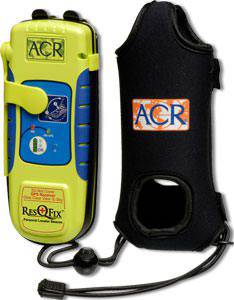
I still have that ACR "Res-Q-Fix" PLB. It lives on Valiente during the season, because while it's not an EPIRB, it's better than nothing. I wear it when I sail solo, again because it's better than nothing. But it's five years old now, and it's due for a battery replacement. I have to wonder, in light of PLB technology's "cheaper and more features", if it's worth bothering. (Since writing this, I found a place in Hamilton which will swap out the battery, so that and visiting HMCS Haida are reasons to go to The Hammer.)

The manual operation aspect is an issue, as well: If you are knocked out or have broken fingers (not a crazy assumption if you were knocked off the boat), you are going to have issues activating some of these units once in the water. It's a two-hander job.

So are the new style of near-range "life tags" the way forward? That depends, I think, on comparing features.

This link from Practical Sailor tells us


I don't know if devices like these are practical, but as we creep closer to our own ocean adventure, I do consider them in the context of overall crew safety at sea.

While I agree that the majority of sailing done is coastal and within reach of such SAR resources as may exist, I am thinking specifically of offshore use, where the distance exceeds the range of SAR personnel, and the odds of a person being alone at the helm in the middle of the night is greatest, and it is this possibility of having to be the only possible rescue vessel in the area that I am thinking of.

The short form is that these beacons incorporate AIS and DSC signals to aid boats in turning around and locating people in the water. They can sound an alarm if the wearer gets more than, say, a boat length away from the AIS.

It's interesting, even if the two-mile range seems short to me. Obviously, it's only for multi-person crews able to physically retrieve people from the water, which means that a) there's a ladder or Lifesling or other means of getting them aboard, and b) they aren't so injured that they are unable to aid in their own climb back on deck, and c) conditions allow coming alongside a person in the water without slamming them further or chopping them to bits with the prop.

Point goes to staying aboard. On the other hand, with a "proximity beacon tied to the AIS, you know if somebody is off the deck very quickly. Even if they are passed out and have a broken arm, guaranteeing a hard recovery, the search aspect would be the smallest part of the operation.

Different AIS-SART, same hand?


That aspect is better this than waving a sputtering penlight, I suppose. Yelling is right out. Anyone who's tried to shout from an aft cockpit to the bow where the anchor handler is knows this is true.

On the other hand, in a heavily trafficked area such as Lake Ontario, I actually would prefer what I already have: a submersible VHF with which I can directly shout MAYDAY on Ch. 16. My Standard Horizon 850 gives me not only a radio that can float/take a dunking, but can also give me a lat/lon thanks to an integrated GPS. The likelihood on a summer's afternoon near Toronto is that I would be hauled out by another boater monitoring Ch. 16 and halfway back to my own boat before I saw the yellow helicopter.

But that's not really the scenarios for these gadgets. They are more-or-less designed for offshore. More presumptions include that:

a) all crew on deck are wearing these devices at all times.
b) the devices themselves are always charged and functional, meaning they are "always on" in a sort of "guard mode" until lack of proximity to the AIS transceiver sets them to "active mode".
c) that you keep your AIS on continuously in order to hear the alarm.

It may be the case that the ideal solution is for a PLB/GPS combined with a two-mile COB beacon, allowimg the greatest number of options for "self-rescue" or thanks to the more typical guys with the slings in orange helicopters. I wonder if a simple clamp and extending, brightly coloured pole (like the sort on bicycle carts) on the PFD would increase the visibility of the COB and, if the beacon was on the top of a two-meter pole, would the range of the beacon then be much greater than two miles? I understand also that some PFDs inflate a "soft danbuoy", a sort of inflatable, brightly coloured plastic pole that deploys off one shoulder. That seems like a good idea, but would be only marginally better at night.

That "laser flare" is looking good at this stage. Certainly, what I currently have is enough for Lake Ontario (mostly) fair-weather sailing. But I follow developments with interest, as do I check up on the international standards.

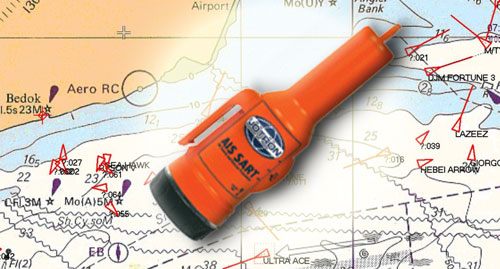
It only looks like a bottle of rum

This AIS-SART technology looks promising, but is it translatable to the self-rescue set-up we are discussing? Dunno. Must learn. Maybe this would serve. It calls your VHF using Channels 16 and 70 via DSC, providing a set of GPS lat/lons. It also has a strobe and can be water-activated.


The "old school" trailing floating rope is an old trick from the days of cork-filled "life belts". I have read of a couple of cases where it worked (for obvious reasons, you don't hear about when it doesn't work). A refinement of this idea is attaching this trailing line via shock cord and a sort of pin and block to the control lines of a wind vane. The weight of the line is not sufficient to pull the pin, but the weight of a body on that line, being dragged at several knots, is. You pull the pin, the wind vane is disengaged, and the boat (hopefully!) rounds up. You haul yourself forward and hope you were clever enough to buy the sort of folding ladder you can deploy from the water's surface.

Again, you have to be fit and largely uninjured and conscious to accomplish this. If you've ever been towed behind even a dawdling sailboat, you know you'd have to possess considerable arm strength to pull yourself forward. Adrenaline might help, but if the water's not tropical, not for long.

You could rig this "release and round-up" to a jib sheet, too, but I would have to look up how that works in the old 'single-hander' books I have. It might be only suitable for dinghies.

Needless to say, these methods are in no way guaranteed, but if I was single-handing on the open ocean in relatively easy conditions, I would consider trailing a floating line aft. It wouldn't induce that much drag, and it's cheap, if "last chance" insurance.

It's an interesting topic, to say the least of it. People who "self-rescue" get to tell their stories. Rarely is a single-handed boat found adrift and uncrewed in which it's clear how the skipper departed, or why.

UPDATE, 2013.04.13:  Of course, all these gadgets are predicated on being hauled back aboard in a timely manner, and from water that will slow the onset of hypothermia. Given the time of year from where I'm writing (early, fitful and sleety Spring), a reality check on falling into cold water is relevant. A couple of article by the excellent Mario Vittone on the equally compelling gCaptain website are worth linking here for the reality of hypothermia's role in complicating self-rescues, or indeed any rescue.


The Truth About Cold Water: A grim but honest examination about some of the myths concerning what a person can and cannot hope to do once off the deck and into the cold sea/lake. In my recent Marine First Aid course, we learned a bit about cold shock and cold incapacitation, and a little bit about post-rescue collapse. But I haven't been trained as a paramedic, just as a first responder of the most basic (and perhaps only) kind available. All I can do is be aware of these factors if a person I can retrieve is appearing hypothermic.

Drowning Doesn't Look Like Drowning: Just as movie heroes seem to have infinite bullets, and Batman's sustained more concussions than a thousand Sidney Crosbys, so many of us have a rather fixed idea of what drowning looks like. This idea is completely wrong, according to Vittone, and you do learn the truth in a proper marine first aid course.

UPDATE, 2013.05.06: Thanks to sailor and long-time reader John Cangardel for sending me this, which I suspect is based in part on a prop from a James Bond movie.


Interesting how at 1:43 the helo spotted him on the infrared...in the daytime. But I cavil. This is, like, the Garmin Quantix I mentioned earlier this year, a bit of a paradigm shift in PLB form factors. Interestingly, it's orientated to calling in rescue resources from afar, not the "self-rescue" discussed above. Is this therefore of most use to solo sailors?


No, Mr. Bond, I expect you to drown.
The Breitling Emergency II model is interesting to me as it shows the convergence of certain types of wearable beacons with pricy, if more quotidian items like watches or brooches, et cetera. Clearly, the day when we have a combination radio and beacon of the Star Trek "communicator" type cannot be very distant. Certainly the widespread popularity of the far, far cheaper SPOT Messengers is a harbinger, and while the SPOT beacons have some shortcomings, they are a terrific and low-priced adjunct to proper emergency beacons; even the daily "I'm OK and here's my lat/lon" message from vessels on delivery is useful to loved ones while one is offshore.

If you sink this close to shore, skip the beacon and just get out and walk.
To my knowledge, there isn't (yet) an AIS-SART in a watch that would alert people that you've fallen off the boat and are bobbing on a bearing of 271 T. Why would there be? Increasingly small devices, now down to not much bigger than a couple of packs of gum, do that already. And yet a watch has the cultural heft of a customarily worn item of "clothing", and doesn't look like a conspicuously bright piece of plastic rescue tech. It looks like a very expensive watch, which, if one is relieved of it through robbery, might reveal the location of the thieves, if only by them fiddling with it!

According to this, the Emergency II will transmit for 18 to 24 hours. I am guessing it is both 121.5 and 406 Mhz because neither transmission contains a GPS string. I think an EPIRB with GPS wins in this regard, plus a SART for the last few miles.

I am also a little suspect at the length of time it will broadcast. Hit a container in the South Pacific and you could be in that raft for a few days, even with a working EPIRB and your location tracked via COSPAS. Interestingly, COSPAS-SARSAT frequency issues are discussed by Breitling, who maintain that the analog 121.5 Mhz signal is still valid for final "homing in".

I also question the need to secure the watch to the top of the raft (bring a C-clamp in the ditch bag, perhaps?), although clearly one cannot deploy the antennas and continue to wear the thing. I can see this being of some use to hikers, mountaineers and back-country skiers, perhaps...the sort of people unlikely to carry an EPIRB or even a standard PLB (although that is a good thing to consider if it's the 406 Mhz GPS transmitting kind).

Nonetheless, even a fifteen-grand, short-lived beacon you can wear will appeal to some. Not me, however: I wear a worn Suunto Vector with a cracked crystal, said crystal getting cracked in the first place because the Vector is somewhat chunky; the Emergency II is even larger and heavier. I like my old watch's barometer feature, however. but am considering switching up to a Suunto Core, which has a "storm watch" alarm feature some sailors have reported useful to them in getting sail off before bad weather hits.


Dorky, yes, but I don't have to lash it to the top of the raft to use it.
I can acquire one of these for $250. Of course, many sailors say you can get a perfectly fine Casio for under $50 and not worry. Others go completely "island time" and lose the watch entirely. That's fine, too: I didn't wear a watch except for suit gigs until I got the Vector for sailing use. I use the barometer function a great deal and that feature alone is attractive to me.

For fifteen grand, however, the Breitling Emergency II would just make me more nervous than the possibility of stepping off into the raft. I also can't help but reflect that I could spend the same amount and could ballast the liferaft with EPIRBs that would last a month.

Note that I would not in fact spend that amount. That's also about four very nice liferafts.

This German-made AIS beacon starts transmitting when the PFD inflates, which is handy if you are unconscious, but alive, when you fall off the boat at 0300h.
UPDATE 2015.09.12:  As predicted, it seems that the utility of adding AIS to a wearable device attached to a PFD (along with laser flares and other "here I am" devices, is proceeding apace.

2012-02-19

The most convincing anchor test ever!


I own a Fortress, and frankly, I'm shocked! Although one might point out "needs all-chain rode", "not enough scope" and "cats", I think I need to rush out and buy the New Coke Rocna, made from pressed cans of New Coke.

If you don't find this amusing, congratulate yourself on never having wasted precious minutes observing "anchor tests" done on dry beaches using farming gear.

Thanks for making this, Brad, aka "Bene505" from anything-sailing.com.

2012-02-17

Keeping 'em in stitches

Bob, bob, bobbin along


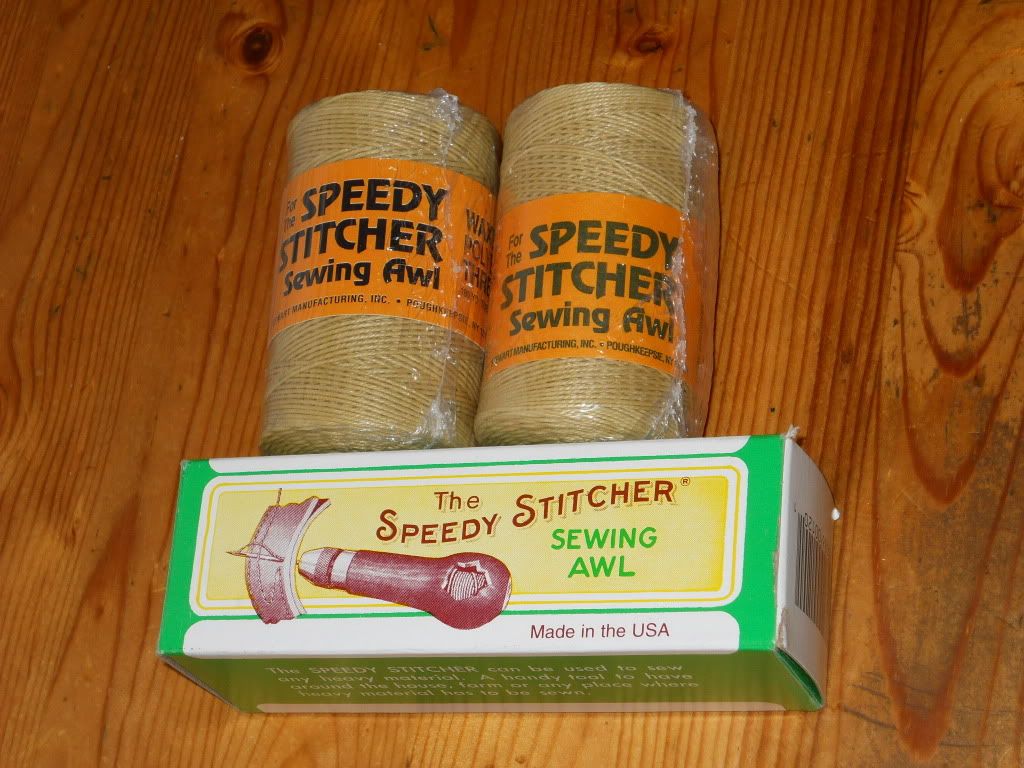
Perhaps not the most momentous post I've ever made, but to illustrate the sort of headspace I'm in, this little device was my Christmas present from my wife. The Speedy Stitcher may look like something acquired by using a time machine to mug a cobbler, but it's actually a handy little device that would have made my rode-driven Adventures in Whipping more effective than using a simple sailmaker's needle, as one does.

I just realized that last sentence will be somewhat confusing to my foreign readers. Twenty years ago, it would have been confusing to me. But I had to learn nautical English, which seems to have little to do with standard English, so you will have to, too.

I learned about this handy device on Anything-sailing.com, a useful and somewhat less bombastic and more practical sailing forum I frequent. Available at the esteemed Lee Valley Tools for a far more reasonable price than had I bought it from, say, West Marine, the Speedy Stitcher seems, on first use (on otherwise good jeans worn through due to winter bike riding), to be a practical addition to the sailmaker's tackle box I've always carried. I actually like fabric repair and will occasionally make simple clothing. I find it calming, and, as a sailor, very useful going forward in the sense of applying chafe gear, patches and sail repairs. There's always make and mend aboard: you might as well have the right tools.


Mukluks? Maybe with built-in flotation.

2012-02-11

Pilot error reduction

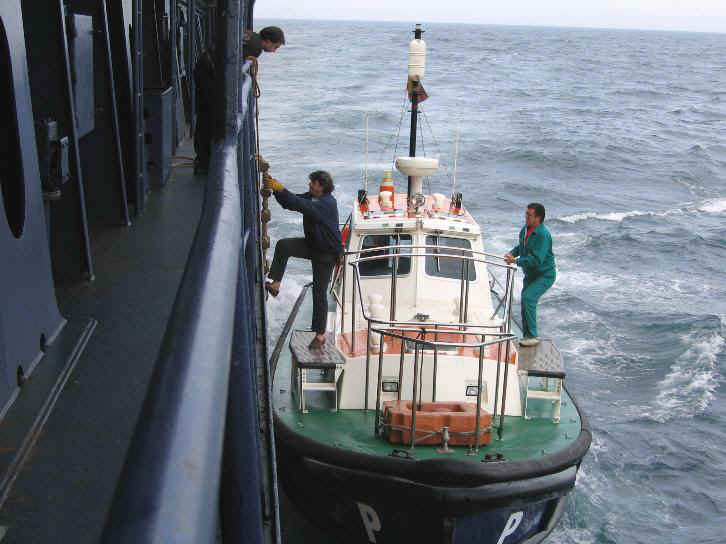
Would it kill you to get a better boarding ladder?
 
"Pilot" is a word with several nautical meetings. A maritime pilot, and by extension piloting or pilotage, is a professional mariner assigned (usually) by a governmental authority to board and guide merchant vessels and occasionally private yachts through tricky or congested harbours, passes or canals. Customarily, a pilot will advise the captain of the vessel, who remains in overall command (and takes overall responsibility for the safety of the vessel should he or she overrule the pilot's advice). Despite the impressive array of navigational sensors and displays available on modern merchant vessels (and quite a few private boats), many harbours and approaches remain dynamic and potentially dangerous environments, and "local knowledge" and even intuition are brought by the pilot to increase the chances of a successful, non-crunchy landing, mooring, through-passage or docking.

The left side of this graphic is white, and is not in any sense the flag of Poland. It's the "H" signal flag, and indicates to all nearby that a pilot is aboard the ship in question. That is not your cue to sail right in front of their bow.


Pilots are not universal. They are required on the Panama Canal, for instance, where they actually supersede the captain in terms of guiding the ship, making that canal one of the few places in the world where the skipper legally must surrender control of the ship. By contrast, hired-by-the-hour "line handlers" suffice for private boats for Ontario's Welland Canal, which lifts both commercial (up to 750 feet in length) and recreational vessels (anything that won't fit on a boat trailer) between Lakes Erie and Ontario. But the fact is that while they are an essential service in many places too dangerous to approach for the unfamiliar, other places they are a mandatory method of scooping fees from every passing vessel. In still other places, pilots might be a good idea, but the absence of sufficient traffic capable of generating revenue, such in the reef-bound islands of the tropical Pacific, means "you're on your own, son!"


Of course, no human pilot is infalliable, and even the best of them can be crossed...literally in some cases (see above) by a reckless sailor with poor timing or impulse-control issues. So when the human pilot can't be present, sailors can resort to written "pilots", such as Sailing Directions for Area Insert Name Here. Locally, I use Sailing Directions for Lake Ontario, which comprises small photos, "chartlets", particularlities of the various ports, marinas, bridge heights and underwater dumps, along with descriptions of various land features, nav aids and the like.


Think of these types of pilots (in other contexts they are referred to as "pilots") as companion volumes to the paper charts used as the foundation of navigation. 


The U.S. government has free Sailing Directions downloads of impressive volume (better not get the laptop wet) in both planning and "en route" forms, as well as offering regularly updated (and free as PDF downloads) Coast Pilots. Very comprehensive sailing directions, a.k.a. pilots, are also available from the expensive, if usually reliable United Kingdom Hydrological Office.

Another kind of pilot relates not to how you approach the land, but how you approach the weather. Getting the balance right means playing the laws of averages: you may decide to cross the Atlantic from Canada to Britain in early June rather than early July because you may get colder temperatutes, but also lighter winds, whereas July could bring early-season hurricane remnants chugging up the otherwise helpful Gulf Stream. Comprised of observations taken by personnel of the Royal and U.S. Navies from the late 1700s to the present, and averaged out for five by five degrees squares of ocean for each month of the year, "wind pilots", for lack of a better term, allow the sailor to improve her odds of picking a favourable time to make a passage through most of the waters of the world, and to sketch in a game plan in the south Pacific, for instance, that offers the least chance of either typhoons or dead calms, neither of which are desirable weather for most sailboats.


Admiralty Ocean Passages for the World, a venerable publication name-checked regularly in cruising narratives,  is not cheap or lighter than an e-reader, but it offers in a pleasing and useful form a great mass of data of huge utility to the crew in planning mode. While the free U.S. pilot charts of the same type contain much of the same information, manipulating them in either PDF or in chart form is a little tiresome compared to a book. Nonetheless, the point is not the ease of use so much as the ease of understanding how historical weather trends can...or in certain years cannot...tilt the odds of having a steady passage with a minimum of nasty, wind-borne surprises.


This brings me to what might be considered the latest, Web-based version of the pilot chart: The Climatology of Global Ocean Winds (COGOW) project's website has collated ten or so years of data culled from satellites able to detect wind and wave movements across the oceans...from orbit. This is stunningly useful, as is quickly apparent when one trolls through the site in order to obtain "wind roses" for some tiny spot on the ocean, averaged not to the month but to a two-week span, and...here's the relevant bit...averaged over a nine-year span starting 12 years ago.

If you pick up on the nuances of this diagram, it could sway your decision to sail East South East.


Is that a small sample? Yes, compared to the 200-year-plus range of observations of the U.S. and UK pilots. But it is arguably finer grained, in the sense that because the data was collected consistently by one machine functioning 24 hours a day for years on end, the data is not based on perhaps fuzzy methodology employed by subjective observers operating outside of proper instrumentation or indeed, prior to the adoption of Beaufort's scale, agreed-upon terms of reference. The "drill-down" brings us observations from areas a mere 0.5 x 0.5 degrees in size.


Close to where my friends on Silverheels III are, next week's forecast shows a continuing likelihood of northeasteries


In sailing terms, that's miniscule. It's certainly a tiny fraction...I'll let you do the math...of the five by five degree areas covered by the "book" Pilots. And while the sample size over time is not great, a mere ten years or so, it does cover the period of "weird weather" of the last 15 years or so. Comparing these graphs to what the various "long-view" pilots show might be instructive, confusing and/or helpful, much like this blog. And yet I feel better for having found this intriguing addition to the passagemaker's store of knowledge.


2012-02-06

Visual aids for sailing from a very good sailor


Damn right I built this! (translated from the Portuguese)

In 2007, I crewed on a short delivery in Portugal. It was my first saltwater experience beyond being on Irish and English ferries, and I was on the impressive Giulietta, a custom-built Delmar Conde 1200 racer built by my friend Alex, who lives outside of Lisbon. The boat is currently stripped out and is racing ORC around Portugal, and is doing quite well. It certainly has the most comprehensive and well-organized method of handling control lines I've ever seen.

Alex, tired of the repetition and general level of nonsense at certain sailing forums that shall go unmentioned, started a sailing forum of his own, Anything-sailing.com,  whose membership he finds more congenial. Although Alex's biases in favour of fast, modern designs are known, he genuinely wants to be helpful to sailors who want to learn, and pretty well anything that gets him sailing on his marvellous boat is a decent excuse.

Alex made a comprehensive series of "how-to" short instructional videos for YouTube that I would like to see more widely viewed. Not that I think I get the numbers of YouTube...I am under no illusions, particularly as I can see my stats...but these particular videos are well done for a fellow who doesn't have English as a first language, and who frequently makes fun of his own troubles working computers.

While you could browse his YouTube channel,  I thought to list some of my favourites here. Even veterans can, I believe, learn from a sailor who is also a pilot and has an extensive engineering background. His explanations of how various parts of the rig work...and how to get the most out of them...are of interest even to experienced sailors. How long, after all, could you talk about the use of the Cunningham?


Obrigado, meu amigo!


2012-02-01

Rabbit at rest, and the dartboard weather report


CLEAN ME.


Because my two sailboats (made possible not by Midas-grade wealth, but by forgoing a car and being thrifty/cheap and not having vacations and cable TV) are quite different in terms of design, materials and intended usage, it's only natural to me that I reach for a metaphor or perhaps a simile to distinguish them in my mind.

Rabbit and tortoise will do.

Without belabouring the old fable, the smaller boat, the "rabbit", is generally the faster, although in a real blow, the "tortoise's" longer waterline would allow a faster top speed, and under generally more comfortable and specifically drier working conditions. Still, the tortoise is built and sailed in as undramatic a fashion as possible, because it's a house and a little world on the seas...or will be. The rabbit, by contrast, is all about the fun, "laying her down" and getting, if it seems like it might help, green water over the winches in quest of that perfect, howling ride.


Feelin' hot, hot, hot

That howling ride might come early this year. Environment Canada, a government agency of which could be said they are "no worse than most" and "occasionally useful", have taken to issuing three-month temperature and precipitation forecasts. The one above indicates their view that we are going to continue to have an unusually balmy winter, straight onto spring.

I have foulies and thermals and sea boots. No biggie.
The second chart indicate normal precipitation. We've had very little snow this winter here in Toronto. I think I've shovelled, in a fairly disinterested way, about three times, and that could've been done with an angry broom. There's been plenty of rain, however, and the lake retains its brimming aspect, which is welcome to fin keelers everywhere.

That said, this "forecast" is barely above random chance in terms of accuracy. The last three months were supposed to see us buried under Eastern Front levels of snow and ice, signalling for the army that never comes, but in fact I've been riding my bicycle nearly every day. It's been windy as hell, on the other hand. If snow had been in it, we would have had several severe blizzards. But that hasn't been the case. I've had to replace a few cheap tarps, and I spent today pumping out the rainwater from Valiente's icy bilges, but that's a small price to pay for keeping the mast in. So far, I like that decision. So far, the inch of ice that formed in the harbour during a brief cold snap would not have even caused me to worry about failing to haul at all. I could have sailed all winter, had there been facilities (and insurance) to do so. I can't recall a winter in which that was predictable or even possible. La Nina, you're a sexy beast.

If this not-cold winter weather persists, it will not only argue for an early April launch for Valiente (assuming the marina will let me in early), but easier work aboard a less-frosty Alchemy, the tortoise will a new heart, awaiting a load of suturing and a decent cardiac massage.
Obviously, today was windy. Less obviously, the boat to the left has slapping halyards and a bad case of the tinks.


Ionosphere, beware!

I now possess the tools to conquer you!


Yes, I will at some point actually open these boxes. Soon, my precioussss...


Not really, but after some delay and misunderstanding, my SSB gear arrived this morning.

Now all I need is a functional boat, with upright mast and working antenna included, in which to put it. Further purchases, labour and tweaking will be involved.

I may attempt "listening only" from home just to get used to the rhythms of amateur radio coverage and fiddling. I can't transmit (legally) from land (I think) or physically (lack of proper antenna, counterpoise or dummy load), but I think I can LISTEN without breaking the warranty, and I have an existing length of copper I can rig as an antenna. Unlike some devices, RTFM is the operating principle here. I don't know what I don't know about putting together a functional amateur radio aboard a boat, but at least I know I don't know. Much study lies ahead.

The role of SSB radio in modern cruising is quite similar to the role of the sextant or even the windvane (see "GPS and autopilot good; old mechanical things bad"). Why, goes the logic, in the days of  satellite phones, widespread wireless and phones of smartness do you need a RADIO? Isn't that a touch retrograde?

Well, no. I did run the numbers on this, and, more trenchantly I think, saw an SSB rig in full functional use on my Atlantic delivery in 2009, and the ability to send and receive voice and e-mails and receive GRIB files offshore is very, very comforting and useful. So are cruisers' nets. A phone call, even via satellite, is point-to-point. If no one answers, or if "the system's down", you are, to use the sailor's term, S.O.L. A radio might be considerably more finicky and subject to vagaries of tuning, sunspots, the state of the ionosphere and so on, but it's essentially broadcast, meaning any number of people can hear you and in the case of the emergency frequencies, will be actively listening. And you've got a very wide spectrum of frequencies from which to choose. And, for the moment, there is still a worldwide community of shortwave radio broadcasts, so the SSB/shortwave set can be a source of information and even entertainment. And education: I will to some extent rely upon the SSB-mediated SailMail service to communicate my son's high school subjects to and from the Toronto school in which he will have a truly virtual presence.

And Herb H. Let's not forget the extremely useful service rendered to the distance cruising community of Herb and his forecasting kin in giving us the "turn left to avoid cyclone" information that keeps us, for the most part, from being the snack bar at the new artificial reef.

Besides, I have expert friends who look out for me and want to save me money (the crew of Silverheels III in Grenada). I have been told that I can install this myself (I built a CB radio system when I was a teenager, so I'm not completely at sea, so to speak, with most of the concepts and avoid licking the contacts, generally). I have also been told that a boat with a nice, cambered steel deck and a nice, tuned antenna suspended between my twin backstays will likely make me an excellent transceiver.

So, ionosphere, you've been warned. Radio Alchemy will at some point in what I hope is the near future be on the air.


2012-01-31

From flipping lids to downing hatches

Today, as they say, was a good day. Beset by the need to make money to support my boat addiction, plus the fact that I have customarily shared the parenting duties with a formerly working and currently school-attending spouse, I have not always worked to a schedule when it comes to the boat, and have certainly not advanced as rapidly as I would have wished.

The fact that the URL of this blog starts with "alchemy2009" is mute testament to my molasses-like progress.

Part of this slowness is due to my own ignorance on how best to do boat jobs, or even how to do them at all. I find that it pains me to admit it now, but my high school years might have profited me more with less chasing skirt and more taking shop. I'm handy, or handier than I thought I was, but I simply lack the experience of doing jobs in an efficient manner. I don't have a "manner" to contrast it against.

Still, I learn and absorb and carry a stupid amount of information in my head. Bursts of activity occur (followed or preceded at times by bursting wallet contents). Today I finally got the new engine down the hole.

Said hole
Said hole required temporary clamping of 2 x 4s over the now-bare engine stringer mounting bits (the "motor mounts" will go in later). Easy peasy, this bit. Note freshly galvanized paint areas. More will be done in warmer weather.

 
You can see your face in it, but it's not that great a mirror

The engine, tarped, tarped and tarped again against the elements on the foredeck for too long, is still shiny. Ooh, shiny.

I am a jealous god.

Revealed, it's practically modern art. It exudes raw industrial-grade purposefulness. It squats like a barbaric deity, or a sort of mechanical toad, the sort capable of taking you on a memorable trip. Mmm, toad.

That pallet has a lot of salvageable wood it in, include long carriage bolts as mounts.And thus the noted cheapness of the prospective cruiser manifests in the same picture as a five-figure diesel toad god.


Jeff practising the oblong discus throw. Note the author's crappy bike trailer and feeble "don't kill me, SUV lady!" flag

An example of doing things the hard way is how I used to lift off the pilothouse roof only to stash it on the deck, "in case it rained". A better solution is to put it on the flippin' ground while you futz around with the load to be placed oh-so-gently below.

Whither a sawhorse, or lengths of lumber?


This is my friend and fellow boater Jeff Cooper doing his Superman routine. Actually, thanks to the expert manipulation of Henry Piersig, who is not only surgeon-like in his ability to work a crane, but is also my club's Commodore three years running, we clipped along quite efficiently. Everything was done in about one hour, and the weather, while usually warm for right after a snowfall, was calm in wind and bright in sun. Bit slippery on deck, is all. Thanks very much to Jeff and Henry for their skills, speed and helpful suggestions.

Something quite similar to my club's "Polecat Crane Truck", a Very Useful Piece of Equipment

My one bright idea of the day was to bring handheld radios so we could advise Henry on "one inch, one inch down...one more...STOP!" Very handy, that was. Even given that if Henry can play darts like he can place a crane hook at full boom extension, and out of visible range, I'm going to owe him more pints than I already do.

Welcome to the Melanoma Deck, S/V Box o' Tools
As I said, not raining and 8C on January 31st. The sounds were "up, up", accompanied by the constant sluicing of meltwater, and the grumbling of a truck diesel that probably thought it was going to be recycled into Chinese cookware by now. Oh, blown ring, rust-speckled Polecat, I still think you're great!

Victory!

The actual set-down was a little iffy as it looks as if that honking ZF25 hydraulic transmission wants to crunch a transverse support. So Jeff, who dove down the hole voluntarily, blocked up the engine to keep it from being damaged until I can raise it and get measuring. Which I will do anyway as there is welding to get down back there for the thrust bearing/Aquadrive/PSS/shorted shaft assembly.

Nonetheless, in general dimension, if not exact final Place of Great Functioning, the new diesel fits quite well. I think it's smaller than Ye Olde Westerbroke that it has replaced. It's certainly lighter, while being "eight horses" more lusty. I think I will call it "The Red Lusttoad". No, wait. That's an anagram for "The Led Rusttoad", and that sounds unchancy. Sailors and their superstitions!

I will be leaving these shackles on for the moment, Mr. Bond.
The engine will require a gantry of sorts to be built so that it can be raised and lowered easily in order to position the mounts, move it fore and aft as needed and to get a fellow and his welding gear down there, not to mention the new tanks.

The perhaps-overthought gantry started looking like this:


...and currently looks like this:


I need more stability or a second beam to keep those triangles from wobble or shift. I wanted something collapsable that I could stow and bring with me, but I may just have something welded. I judge that there is insufficient strength to run a beam across the pilothouse roof without possibly flexing the structure, which could break the windows, so I prefer to work entirely inside. More on this to come.

The restoration was straightforward. I updated the tarps (lots of rain is coming), cleaned up, disposed of disposables and admired the (fractionally) new view forward.

The engineless foredeck is a nice change, no?


Yes, a good day, indeed. Thanks for everything, Henry and Jeff, and to Mr. M. Bird for getting me the proper lifting eye, which, aye, lifted.

2012-01-24

Invention is only a finger away


Yes, that title struck me as slightly off-putting, as well. But docking, as seen in the video above, is all about on-putting, or at least putting the boat safely on the dock. Step one is stopping, or slowing enough to get a line around a bollard. Luc Cote, who with his wife Tina has the slip at my marina that is kitty-corner to mine, has done exactly that. He's invented a simple device to make docking safer (you stay aboard instead of jumping off with a line) and more certain (you can give yourself plenty of slack to secure the line).

The low blue boat in the top center of the establishing shot is Valiente.  Such is fame.

Luc and Tina live aboard an Irwin 37 (which is for sale if you are interested). Luc runs a water taxi service from the marina and has had a lot of time and muscle memory to dedicate to the issue of better, safer docking. The "Dock Wand" is made to accomplish that. I saw them at the recent Toronto Boat Show and they had made a hundred to sell, but had in fact sold 500. The Dock Wand would appear to be a hit.


Not much more than a length of line, a plastic pole and a brightly coloured ball, the Dock Wand is, like most good ideas, so simple and straightforward, one feels slightly moronic even contemplating the long list of reasons one didn't invent it years back. In my own defence, Valiente has quite a low freeboard and my wife usually jumps off with a hook in one hand and a breast line in the other. Alchemy, by contrast, is both four times or better the mass and even at midships calls for a bit of a hop to reach the level of the dock.


So I might have to wander over to get one myself. The videos are pretty self-explanatory. One spliced end of a longish line goes to a cleat (ideally centered or forward). The other end goes to a ball used to lasso the aft cleat on a dock. That accomplished, you can drop the thing in the water: You are "on" enough to either stop in calm weather, or to give you time enough to jump off with more lines to finish securing.

I can see this as being a big help for big sail boats, power boats and single-handers of all types. I wish them well and I hope my readers find it a clever and useful tool.

Sometimes a picture says three words

Vada a bordo, cazzo, indeed
UPDATE: An interesting couple of recent videos about Costa Concordia from the fine folks at the news programs 60 Minutes:

http://www.cbsnews.com/8301-504803_162-57559461-10391709/a-world-askew-on-board-the-costa-concordia/

http://www.cbsnews.com/video/watch/?id=50137223n

And current (mid-January 2013) news:

http://www.cbsnews.com/video/watch/?id=50138881n

FURTHER UPDATE (September 2013): Preparations are nearly complete for the one-shot parbuckling attempt to refloat this casualty of poor life choices: http://www.businessinsider.com/costa-concordia-removal-hits-key-phase-2013-9?op=1


2012-01-17

A question even wartime propaganda cannot answer


Heh. I've found that the orange bitters I've taken to using in my somewhat modded Dark 'n' Stormies sparks an urge to design T-shirts that only amuse nostalgic British drunken sailors.

Or pirates.

Or Johnny Depp fans.

Heh.