Copyright (c) Marc Dacey/Dark Star Media 2006-2026. Above photo (c) Marc Dacey. Powered by Blogger.

2013-02-03

Make and mend: Spares, DIY and overthinking self-sufficiency


A self-made man.
In the Royal Navy of centuries past, "leisure" was a fluid concept. Seamen of various grades, unlike officers, did not have set uniforms, although a certain uniformity of dress prevailed. Like officers, they were expected to provide their own clothing: officers would have tailors create uniforms from approved patterns and colours, while seamen would literally tailor their own clothing from issued "slops", basic items of clothing that could be altered to suit fashion, function or form.

To these ends, crews on Royal Navy warships would get one "afternoon off" each week for such "make and mend" work: the construction of new items of clothing, often from spare bits of canvas cribbed or purchased from the sailmaker or his mate, or the repair of existing clothing. All save the newest, perhaps impressed, crew would have the cutting and sewing skills necessary to create reasonably tidy clothing, and which would, while remaining individualized, hew to the general look of "seaman's rig".
Such skills as might be required after these sort of fun and games.
Perhaps contrary to the preconceptions of what "life before plumbing" was like, Royal Navy crews were generally cleaner, healthier, and, barring death or injury in battle, longer-lived than their shoreside relations. Many, although certainly not all, captains sought to maximize the lives of their crews, skilled and trained examples of which were in short supply, through food supplements (hence "limey") and basic hygienic practices. such as regular bathing, basic laundry, the airing of bedding and hammocks, and cleaning of the otherwise filthy bilges. Rudimentary as these methods may have been, they were generally far in advance of terrestrial habits, where "apply more gallons of perfume" still held sway.
Improved the grog, too.
"Make and mend days" were comparatively restful occasions for the working Jack Tar. They were a time to socialize, to perfect certain aspects of seamanlike skills of needle and knife, and to relax in a more or less sanctioned fashion, secure in the knowledge that most things were in good order in the wooden world of His Majesty's Ship.

Which brings us to the ideal of self-sufficiency and the reality of "only so much boat". The Royal Navy, tasked with the defense (or often the acquisition) of a vast, disjointed empire, had at its disposal ships constantly in a state of rot, cannon and musket-fire damage, and the material weakenings of sea, sun and wind. Depots of trained craftsmen, shipwrights and labourers, along with hard-to-transport materials such as masts, planks and cannon, had to exist in remote areas. Ships on dreaded blockade duty spent months and even years on station without "refit", getting occasional resupply at sea even as planks were sprung and sails were shredded. Other ships would cruise thousands of miles from the closest naval bases, and had to bring many tons of canvas, lines of every description, metal plate and ingots and the means to forge them, along with food and drink sufficient to keep large crews alive, if not particularly well-fed.
"Out of Madeira? The deuce you say, sir!"

The limit of wooden warship construction was some 200 feet/60 metres LOA. Larger ships would "hog" or sag under their own weight. Taller ships might and did capsize due to the weight of cannons carried too high. Nonetheless, given relatively strict limitations, it was not unusual for a medium-sized warship, such as a frigate or a third-rate "74", to be on patrol for a year or more without more than going ashore to fill water casks or to obtain a few animals for on-deck slaughter.

Royal Navy warships were thus functionally autonomous. Only the more severe sort of damage, such as a holing below the waterline, or losing the mainmast, would necessitate an unplanned trip to a naval base. It was this sort of logistical support that underpinned the ability of a warship to not "touch shore" for extended periods, and we as aspiring long-distance cruisers can learn from it.

Not as rare an event as one might wish, and sometimes absurdly difficult to get fixed/replaced.

It's good to know, if somewhat discouraging, that it's hard to get your boat fixed in many places around the world, as cruisers Bruce and June on Ainia have recently learned. The old rueful saying that cruising is "boat repair in exotic places" is simply a function of the fact that the sea is a harsh environment that wears out gear faster and in more unusual ways than are typical ashore. That's why the Royal Navy helped to kick-start the Industrial Revolution by setting up block-making, rope-making, and shot-making (cannonball) factories, because every ship had to carry three or four "sets" of rigging, ground tackle, sails, shot, gunpowder and so on. Hemp rope and canvas sails rotted rapidly compared to modern materials, and while those materials are objectively more durable, even a modestly equipped 40 foot cruiser is arguably more complex in terms of systems than was HMS Victory at the battle of Trafalgar. Shown to even the captain of an 1805 warship, the average boat show floor model of today is akin to showing the cockpit of an Airbus to a World War 1 pilot. The general principles of operation under sail would be grasped, but little else.
A tribute to ruinously expensive maintenance and a willingness to carry spares meant "six months on blockade duty"

Strangely, some cruisers stow six months' worth of food and, via the miracle of desalination, water, giving themselves the same "mission runtime" as HMS Victory. I think that it is possible to get away with not carrying quite so much food and even water as was common in the '60s and '70s, or to carefully plan to incorporate fishing and dehydrated/dry foodstuffs so as not to carry a half tonne of tins.

In other words, keep Antarctica off your route and there's few places you won't find some sort of grocery store. Spares, however, are a different story. We are spoilt for choice in the Western world, but more to the point, we are spoilt for access. I discovered on Friday that I had the wrong flange adapter for my Aquadrive universal coupler to mate with my Hurth ZF 25 2.0 hydraulic transmission. Yes, the preceding sentence was not intended for the casual reader. Nonetheless, I can phone the people who sold it to me, e-mail them pictures of what I'm talking about, and have the right part couriered to me in days, depending on how much I wish to pay for speed. There's no question it will happen.

Go to Random Tropical Paradise, however, or even Slightly Less First-world Democracy, and it's a different story. Dealers in obscure marine gear...or any marine gear...may not exist, or may have part-time hours, may be run as a sideline with little or no on-site stock, may  be far from the port you have struggled to reach, or simply not exist in your charmingly underserved locale. The same trouble can involve sourcing machinists, fabricators, riggers, mechanics or those qualified to glass over the hole in the bow caused by hitting SOMETHING offshore.

So the question of "how many spares" is answered by "how much do you wish to spend" and "do you want to live in the middle of a boat gear shop?" You will never get "total coverage", and so must have Plan Bs as options: lost your pressure water? Fetch the foot pump or manual pump. Bent a fluke in a blow? Carry a backup primary anchor. Burnt out your windings or zapped a solenoid? Get a windup engine starter. 

(Although after a "water event" in the boat in the summer of 2017, I ended up getting a spare typical starter.)

Worth bringing? That depends how far off the cluster points you intend to drift

Fabrication can be considered a subset of spares, it seems to me. One would usually carry extra raw water pumps, even at $500 per, just as one would carry the many filter elements, clamps, belts, and lengths of hose and gasketing needed for the modern diesel. One is less likely to carry obscure tools, like prop pullers, or things like bar and plate in steel and aluminum, lengths of threaded SS rod, spools of tinned wire, reels (as opposed to just coils) of Dacron and Spectra line, wooden planks and boards, tap sets, vises, drill presses and light welding capacity. In other words, not just the spares anyone doing more than a weekender would do, but the means to make items that will serve as the spare, or will replace items for which no spare exists aboard, or perhaps, within reasonable space and time.
Welding? In my boat? It's more likely than you think.


Now we're talking 18th century self-sufficiency with 21st-century gear! Ar, matey, indeed, she be floatin' below her lines, y'arr.

Along with all the other stuff I'm doing aboard to get launched in late April, I am designing the layout the forepeak workshop. As can be seen, we have a triangular space about seven feet long and eight feet across at the base (the collision bulkhead) to play with, and I have standing headroom. Due to a reader request, I've updated the design to that of 2016, which is about 75% completed at present, save for the anchor chain fall.
Enough to scale for planning purposes.
While this space greatly exceeds in volume the "workbench area" of most 40-footers, it obviously reduces the living space left in the rest of the boat, although the stowage available in a full-keeler is very generous compared to that of a fin keeler. In a pilothouse setup, however, that is not so noticeable as the boat seems broken up into three self-contained "rooms" of galley-saloon, pilothouse (where much time is typically spent), and aft cabin, which can be made as private as is desired. Weight forward is mitigated somewhat by having the batteries and tankage low and close to the center of effort (CE) of the boat. Whether trimming will be required (or repositioning of gear) won't be known until the last calm day before departure, I suppose. There should be ample room to stow enough food and spares and safety gear, oh my, without repainting the waterline or loading the saloon with projectiles if we hit rough weather.
So, in pursuit of the "fix it yourself while underway" goal, which I freely admit might be illusory, I am weighing the pros and cons of bringing 120 VAC contractor-grade power tools, the very tools I've been using in the refitting process. As mentioned before, the plan is to use one of two portable gensets to power them, and not to lean on the handy but somewhat wasteful DC-AC inverter. That item will run some computer gear, a small microwave and, when necessary, a little Shop-Vac action.
OK, this may represent overkill.


Considering bringing small drill presses and stick/wire-feed welding equipment kicks things up a notch. It's a steel boat, after all, not something two-part epoxy can mend, and because I can see making brackets, mounts and other relatively simple pieces while aboard, I don't consider it unreasonable to have this capability. I already carry a selection of bar and plate stock, and can see, if a tang, for instance, went kablooey, making up a couple of straps to serve until I could obtain a proper casting would be a Good Thing.

It only seems pie-in-the-sky until one considers the alternative of being stuck in an under-serviced locale. I do agree that while it is impractical to carry a full range of spares, it may be possible to carry the means to fabricate simple items as temporary fixes. I must learn to weld, if only crudely, irrespective of bringing the means of production along with us; I have the room and the cost is not prohibitive, particularly when compared with the cost of staying tied up to a dock for weeks on end waiting for boat gear made of Pure Unobtainium to wend its merry way through customs, the bribery filter and dodgy postal services.
Available near your anchorage...maybe.
The last consideration here is also that one could perhaps have a plausible "trade-in-kind" proposition to make among other cruisers if one could repair failed welds or fab up brackets aboard. While unlikely to be a money-maker, "will fabricate for diesel" is a compelling reason to bring along a $300 stick welder if I already have the amps to run it.

I'm prepared to consider that I am overthinking this whole "floating machine shop" idea, but I've gotten quite used to having a number of tools, taps and whirring, grinding objects at hand and have difficulty contemplating not having that ability in some distant lagoon. The challenge will be finding the sweet spot between rational preparedness, capacity and realism about how much I actually will want to cover my repair needs (and maybe the repair needs of others) while on passage.

2013-01-18

40 Maintenance Rules and some commentary

Pretty spiffy...and another metal boat!
Over at the excellent and well-written Attainable Adventure Cruising blog (although it's pretty complex for a blog), author, voyager and photographer John Harries of S/V Morgan's Cloud lists 40 rules of boat maintenance I found not just inspiring, but accurate even at this early, still outfitting stage of our own voyaging. I also found it applicable even to those contemplating a week on the hook in the Thousand Islands, which is fairly typical for here.

The 40 Rules are listed here, and I won't swipe content to such an extent as to cut and paste them all. You may read them and evaluate/apply them as you see fit. But I will, in the interests of better cruising, comment on a few of John's lucid points, which are drawn from many years and over 100,000 NM of voyaging. I will also encourage readers, at the risk of leaving off this blog, to explore that of Mr. Harries. It's very large, but amenable to browsing. It's safe to say that any "rule" I don't comment upon represents a near-total endorsement of the philosophy espoused.

Thanks to John Cangardel for sending me the link.

Rule 3: Don’t install anything new for 12 months before a long voyage. 
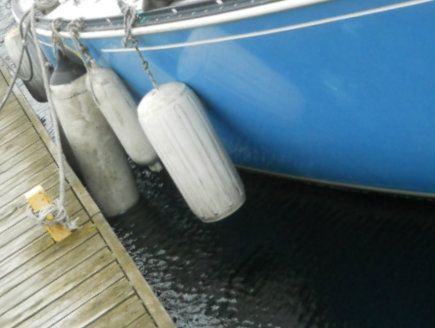
  • This is not always possible, but if you follow Rule 4's injunction to do a "real shake down", but in home waters, you can break stuff and then get it shipped and serviced in your own language, and if necessary, currency.
Rule 6: In the quest for reliability, time spent varnishing and polishing stainless is wasted.

  • I would say this particularly applies for exterior wood, which I like to keep down to, say, the drinks tray. My friend Alex applies the special "Nothing" treatment to his silvery grey teak decks on his 40-foot racer and likes the result. I have to concur. 

Rule 8: Never ignore a strange noise.

  • Perhaps it's because I've been near-sighted since I was a child, and (so far) retain good hearing (I get tested as I've had a few deaf relatives), but I sail with eyes AND ears. Even a small sound will alert me to potential trouble and I have enough of what I call "sailor's OCD" to want to track it down. Your ears stand watch when your eyes are closing, or so I've found. 
Rule 14: You need a work bench, no matter how small, with a vice.

  • I would add "a nav table" as well, but that might lead to a rant involving the absence of positive floor hatch locking on modern production boats and I dislike late-night mouth foaming.. The rule of thumb is "cruising is boat repair in exotic places", and for that, you need a few square feet of sturdy bench top, a strong light and secure tools, preferably sprayed with anti-rust stuff of your choice. See my previous post on stowage, tools and The Conquest of Stuff. Let's just say with the first seven feet of the boat being a well-equipped workshop, I feel good about the concept of Where the Skipper Goes to Bash Things.
Parts no longer made, but can be made from parts
 Rule 22: Replace anything for which parts are no longer made.

  • I have to debate this just a touch. I've hauled out and replaced/repaired/rebuilt three Atomic 4 gas inboards. They stopped making them in my early 20s, 15 years before I even got my first boat. Parts are no longer made explicitly, but there is a thriving aftermarket in equivalent gear (mainly NAPA stuff, old Chevy parts and stock accessories for elderly tractors) and I can cut gaskets and fashion shims. I also have a sideline in reconditioned Atomic 4 parts (I've made $300 over the years for alts, oil pans and other obscurities). I prefer to carry a newer spare and/or duplicate a part or (these days) device. For instance, I have a functioning fluxgate compass, a venerable KVH AC 103. It works. I'm not going to chuck it unless it breaks. Because I dislike the Star Trek approach to MFDs, integration and proprietary linkages, and because I have a dry pilothouse, I will see if I can use it until it dies. I approve of spares and drop-ins and will carry loads of 'em, but I don't feel the need to update old, functional equipment if it performs well and I can fix it.

Rule 26: Do routine maintenance yourself. You will see problems developing before they get critical. Rule 27: Delegate the grunt work—bottom painting comes to mind—so you can focus on the important stuff.
Rule 28: Delegate highly skilled tasks you don’t do often.

  • These three are interlinked and I couldn't agree more. I would add, however, that sometimes if you are hiring someone to do the highly skilled tasks, that it's a great opportunity to do the grunt work, because "grunt" doesn't mean "indifferently accomplished". Also, "grunt" and "routine" overlap, so you will spot things if you do jobs that cycle slowly.
  • I have saved money when hiring general contracting, which I would half-ass due to ignorance, by being the guy hauling the tools, the ladder and the lumber/shingles/bags of cement. You can see the job the pro is doing without "supervising". They are pros, ostensibly, and you hovering is a waste of two persons' time. Go paint the boat, polish the binnacle or coil rope. Make the area clean and easy for the pro, and ask a few questions. Be a good, humble client, and learn as he/she earns.

Rule 34: For couples: Split up the skills that you need to be good at between you. Aspiring to both be equally good at everything (like the magazines tell you to) is BS, a waste of time, impossible, and sets you up for acrimony.

  • True, but it is also a reality that if the "expert" goes down, the "survivor" must make port regardless. An example is coming up: I am in the middle of installing a new diesel. I have a fair bit of experience by now with boat engines and plenty of thumb-printed Big Books of Diesel Fixin'. A diesel course is coming up at the club. My wife has a biology and a teaching degree, and years of quasi-vet animal care and first aid experience. A Red Cross certificate course is coming up at the club. The solution: I'm taking the medical course and she's taking the diesel course. She is ignorant of engine mechanics and I got a badge in Cubs decades ago on how to rig a sling. We need to go 30/70 on our opposing skills sets, not 10/90. So we are going to shoot for the basics of each others' "designated areas of responsibility as engineer and ship's doctor. It'll be a Good Thing.
Rum won't fit in there!


Rule 39: Two things that should never be connected to the battery are the sails and the crapper.

  • I've been on and admired boats with electric heads and electric winch assist, pressure water, etc. But I've chosen a vacuum head (Lavac) operated with a medieval=looking pump, and my solution to the problem of halyard and sheet handling was to buy a smaller boat with bigger winches. It's a steel boat going into salt water. Our reliance on electricity will be "somewhat", but visibly less than most modern boats. That's a choice I don't expect to regret, and I can always change it later on...there's the old Flojet pump around in a box somewhere. Fine for the dock, I'm sure. But much of the time, it'll be foot pumps, hand pumps and bog pumps. Even the "last resort bulge pump", a massive and apparently never used Patay underdeck pump, is hand-operated. I have found that the assumption that something will happen at sea when a switch is flipped to be, if not false, not to be relied upon exclusively, and Plan Bs should rate higher than a bucket plus fear.

If a pump can possess beauty, this one is Scarlett Johansson's backside.
Check out the entire list: It's a great entry to the rest of the very good blog entries.

2013-01-17

One off the wrist: Garmin's new autopilot watch

Ben Ellison at Panbo.com reports on the new Garmin Quatix, a watch you can steer by, among (many) other things::

If you oversteered, would you cling to the strap?
 
Hmm. Just as I prefer APs to steer to a course and not to a waypoint, which encourages a process of observation and corrections for set, drift and other variables, I'm not sure this is a great idea. I like the concept of some kind of COB integration with a watch: imagine the "traditional" lookout pointing at a COB who is periodically vanishing behind a swell. The lookout could point with some kind of verification of bearing based on some sort of Lifetag PLB  My wife and I were discussing this in the context of losing dinghies on flat seas, never mind crew: Objects behind the boat vanish with amazing rapidity even in good conditions. Local (10 NM or less) beacons make sense in the same way as GPS-based anti-theft devices make sense for burglars dumb enough not to stash a car in an underground parking lot.

But AP through a wristtop thingie, plus GPS, plus baro, plus anchor watch function, plus tide calculator, plus time? Too many eggs, not enough basket, I think. The COG/SOG functions are nice, but not really necessary for the cruiser. Maybe for a small boat racer, sure. I just find the idea of so many functions packed into something that gets banged around so easily to be problematic, along with the fact that any transceiver, such as a GPS, is going to eat battery power rapidly (see GPS-equipped VHFs left on with the GPS working versus "just a radio"...big difference in working life off the charger). Also, this is one more gadget that demands eyeball time perhaps better spent observing the water and things in it, rather than digits representative of reality.

A helm station redesign for Alchemy? Not bloody likely. Well, maybe the comfy chair.


Maybe I'm wrong on this, however. I'm no Luddite: I have a venerable Suunto Vector that I consult regularly for its compass and particularly baro features, but its battery lasts 9-12 months, not days to mere hours. I also think it would be a special kind of connector to charge every day at sea and not turn into green slush.

I would, however, like to hear more when more is known. Price, obviously, is a factor (I'm guessing "not cheap, plus add in all the black boxes, etc.), but so are the degree and limits of both integration and functionality (it's probably not going to work as well on a steel boat, for instance).

Why, yes, according to these apps, I am enjoying my sail.
Yes, I know we are entering a world where tricked-out iPads can act as plotters, APs, and places from which you can update your blog whilst tacking, but I think the jury's still out on whether this is a better world. There's some question in my mind as to whether the average sailing human may be the weakest link in the fabulous possibilities of integrated, multi-function gadgets pumping streams of data at baffled brains.

Amazing what you can get done on a sunny winter's day

Yesterday, I took advantage of some sunny, slightly above-freezing weather yesterday to make some progress. Boat fixing really does consist of long stretches of tiny changes, elaborate planning and contemplative thumb-sucking before bursts of visible activity. We are in the visible activity phase, it seems.

Helping to manifest said activity was the presence, aid and abetting of Matt Phillips, a very knowledgeable steel boat skipper and the person most responsible for me getting into sailing back in the late '90s. Matt has done his own repower on his handsome Bob Wallstrom-designed 1979 ketch Creeation and suggests that mine will be easier and less reliant on non-Euclidian geometry, lasers and lube. He is giving me a much-needed boost of confidence in the "not crazy" portion of Alchemy's refit. Of course, I own two boats in the first place, so "overall crazy" is still in effect.

Very nice, and this was before the paint job.
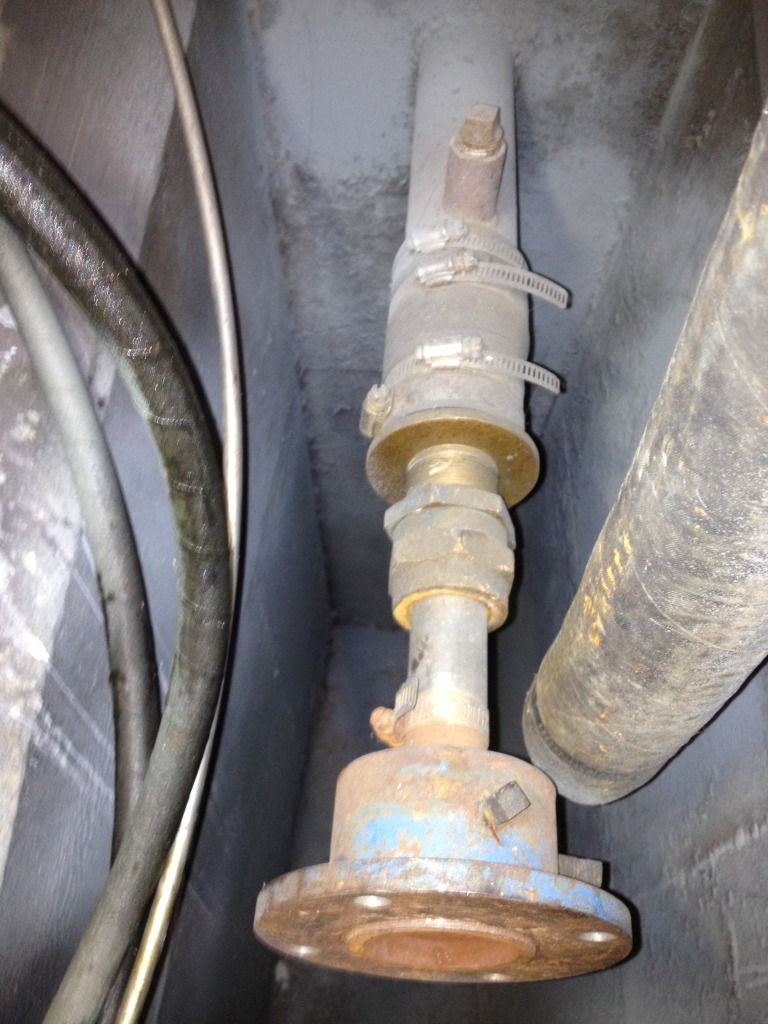
 Part of the struggle in refitting is getting the order right. This is why Matt's help was invaluable. In order to make the template for the thrust bearing that will carry the AquaDrive that will mate with the coupler that will spin off the engine...you have to pull the shaft.

So you have to remove the coupler:

Coupler jobs down here.
Not shown: the removed coupler and stuffing box. According to Matt, who actually folded himself in place to do this bit while I attacked the hydraulic end, everything came off pretty easily. I actually had a crack at this part previously, which may have helped. The "bilge pit" paintjob is holding up, I see.

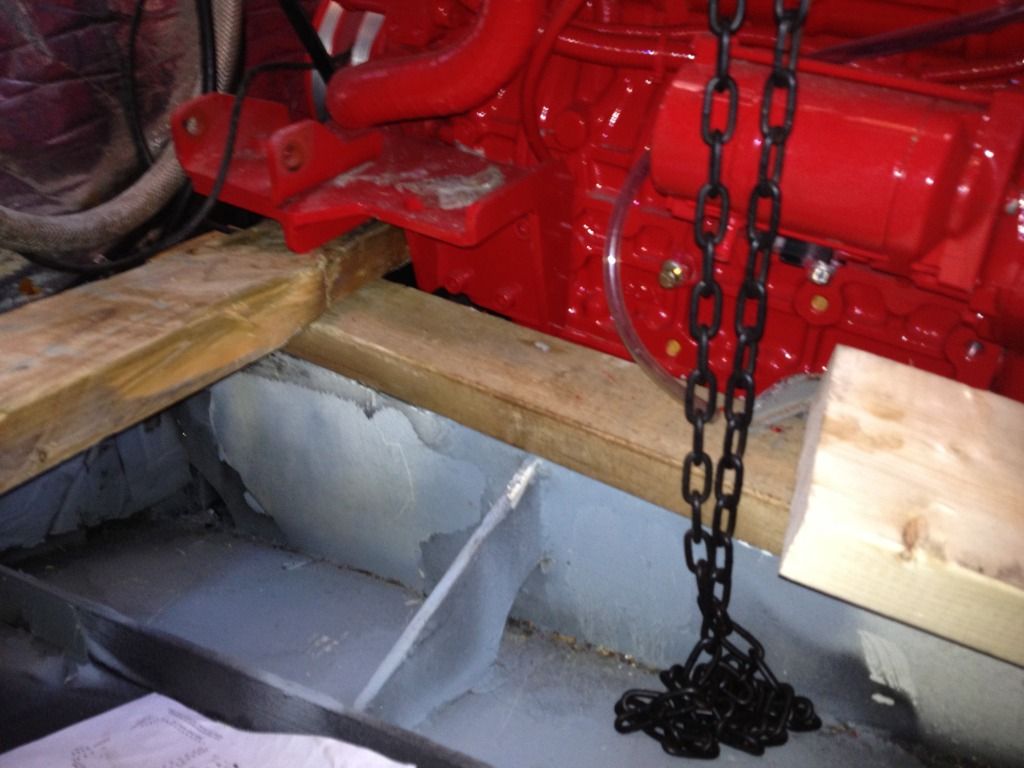
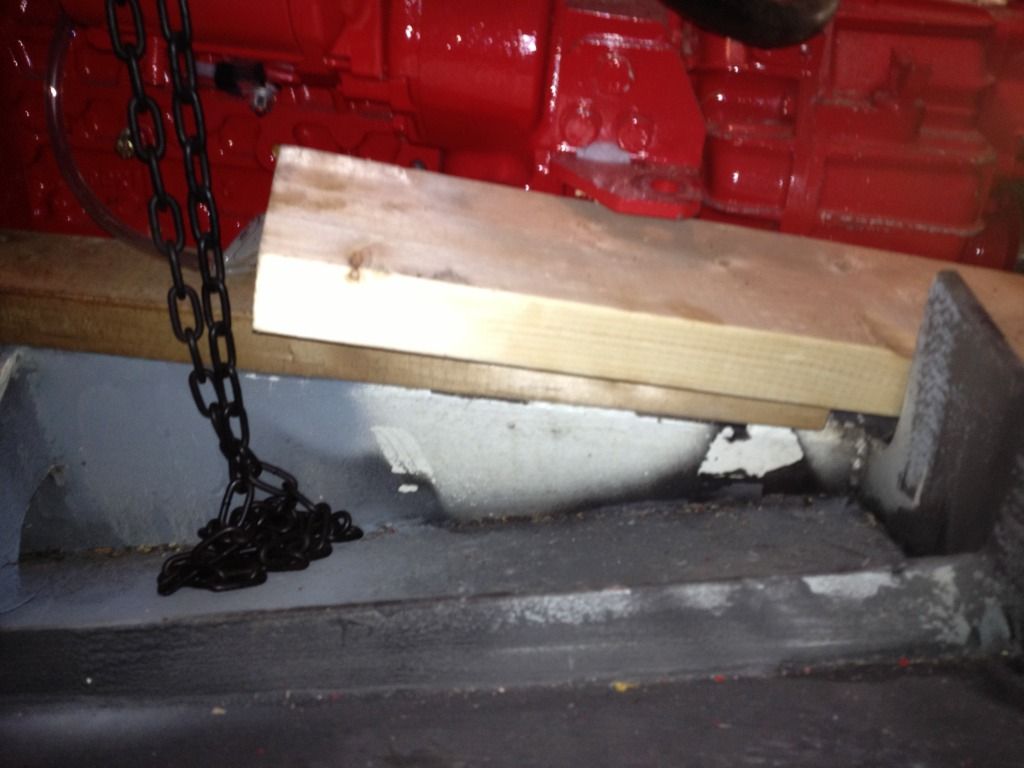
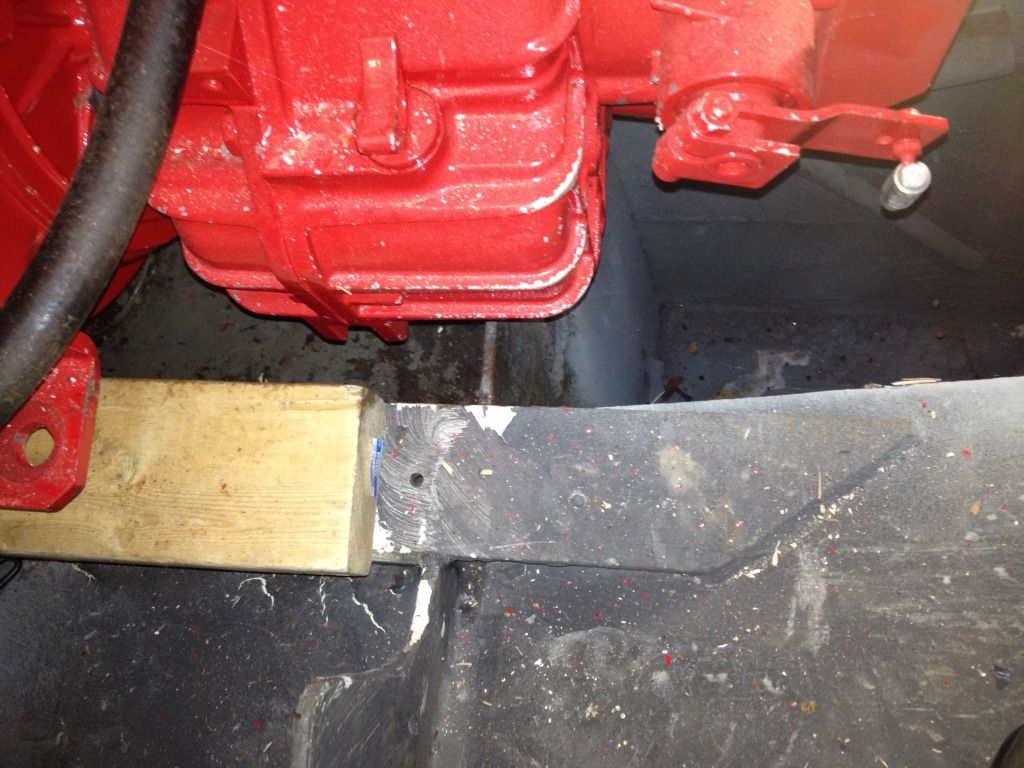
A fresh eye on the engine stringers, currently topped by lumber as standoffs representative of the height of the "soft" engine mounts that will support the engine, confirmed that the engine is more or less "in the zone". A future post will document the process of measurement, thrust bearing template making, and subsequent welding/fabrication.

I think I should have another crack at painting this area as it is a little thin.
Still shiny, but could use a dusting.

Discussion has centered on making an oak riser topped with sheet metal, or simple HDPE blocks to get the necessary height for the motor mounts. These will be through-bolted to the steel plate stringers.


Some grinding remediation might be necessary here, but we won't know until templates are made
When the engine's in place, I need to order a water lift muffler, which I would prefer, if possible, to keep outside of that deep bilge. It's been suggested I could fill that with lead, but I'm thinking "wine cellar". We'll see. Under the engine is another tank I wish to make my 40 gallon third fuel tank.

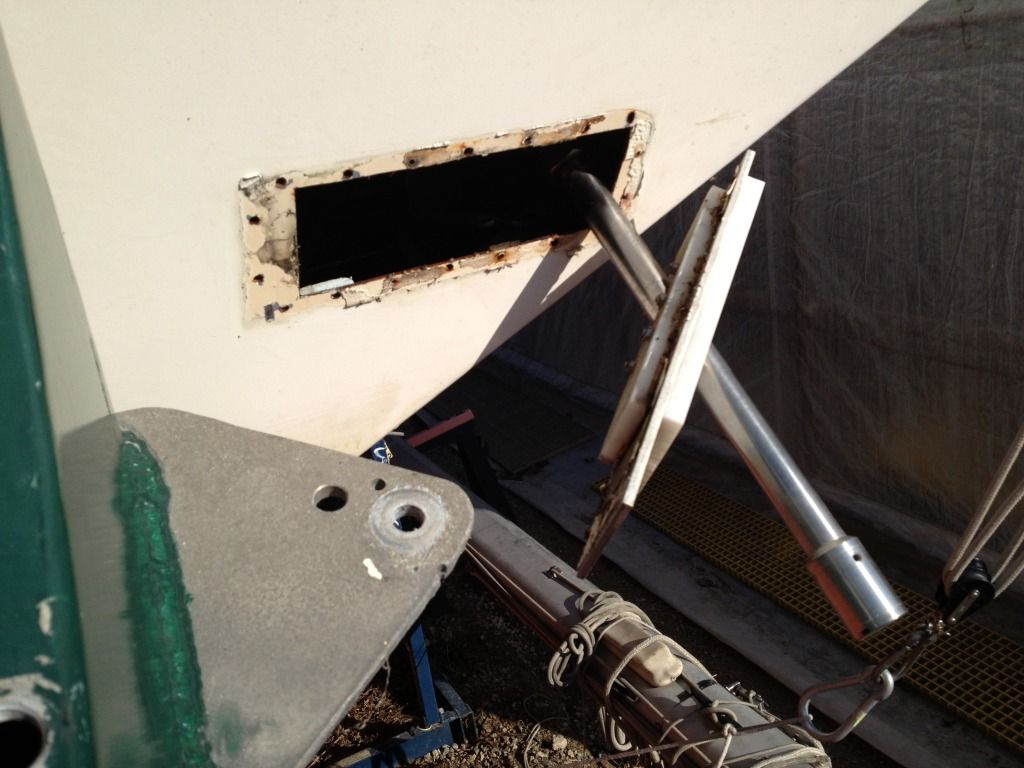
Next came the hydraulic steering arm or ram, which is more than just a anagram of "arm". As this device is fairly carefully positioned in order to work at the correct angles without rubbing a bigger hole in the stern than is necessary, it became clear that the best method was to unbolt the entire plate. Thirty 4 mm Allen key operations later, some grunting and a frank admiration that the job was done with dressed threads and mere gasketing and NOT the 5200 that glued the roof down and gave me so much grief in the past, the plate was off.

There are robust pins and "cuffs" already stashed away here, but it's a pretty strong method of steering.

This area will be cleaned up, as will the slightly corroded threads, and the HDPE plastic "sandwich" will be replaced with Starboard, which is more UV-resistant. Care will be taken to replicate the snug, angled passage through which the ram (or arm) passes. I will also use 4200 and butyl tape or some similar combination of sealants/gasketing to keep as much sea water as I can.

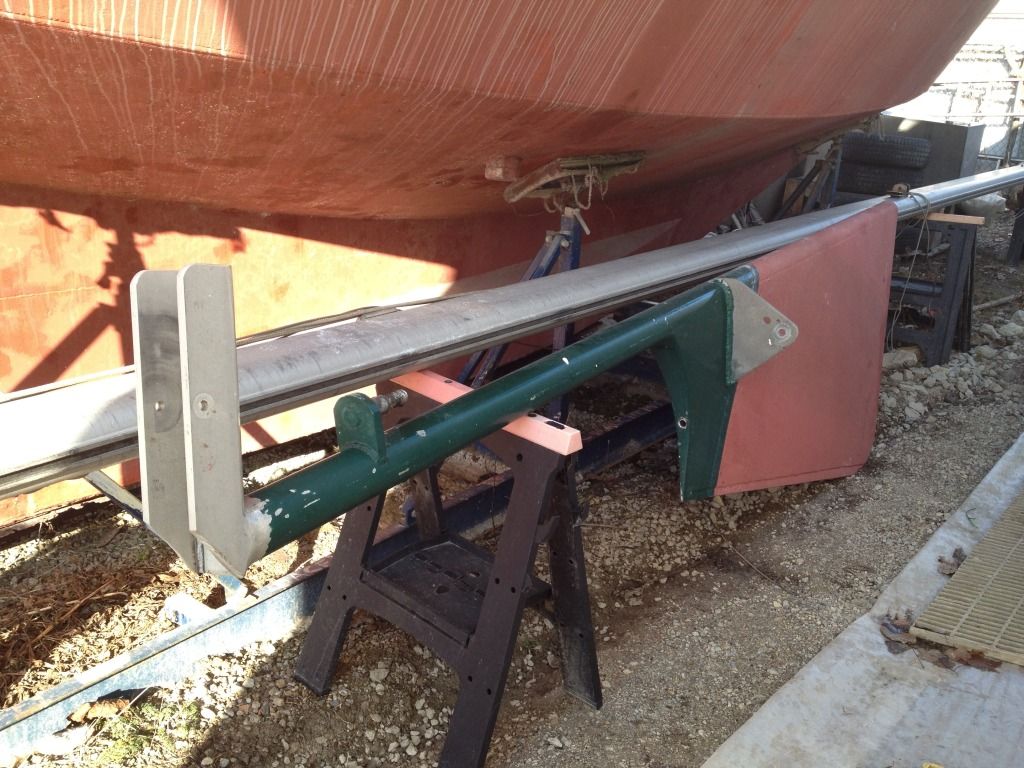
It turned out to be a two-person job using a two-foot breaker bar and a 1.5 inch deep socket and using the entire rudder as a lever. The upside was that the rudder is lighter than it looks and we lifted it pretty easily off its mounts.

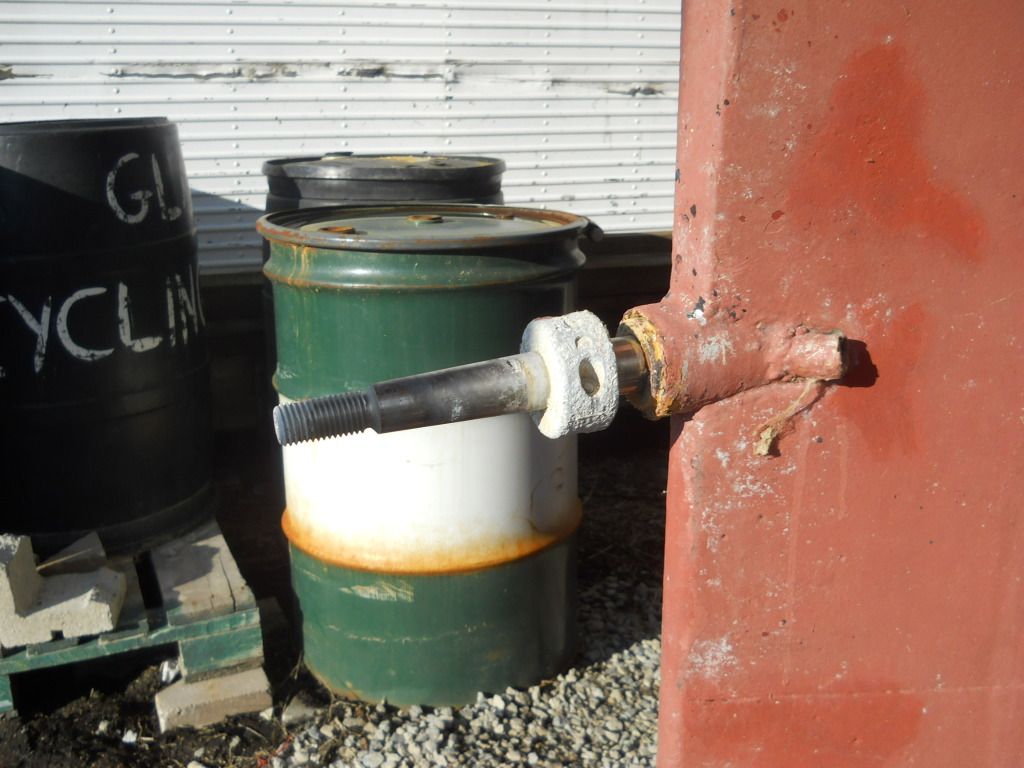
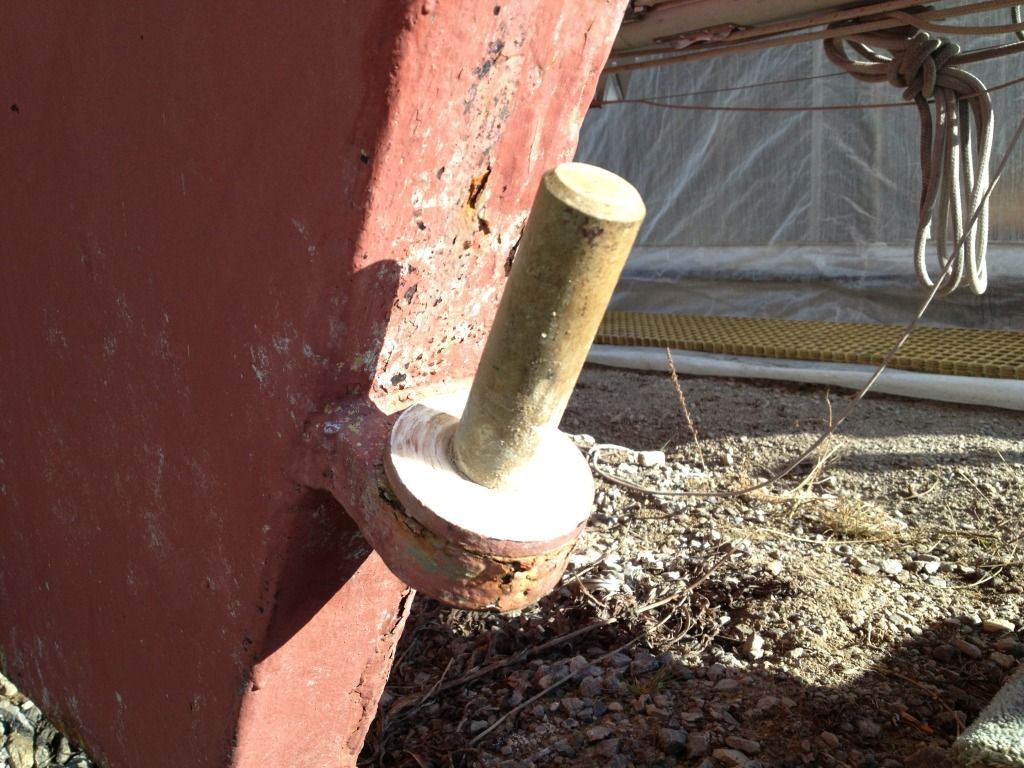
The rudder was next. Freed from the ram, it made a handy lever: the breaker bar and socket were held against the stern, and the stubborn, fairly corroded nut was turned by clocking the rudder itself. That threaded pin will be cleaned up, and a new nut will be through-drilled (as will the pin) to take some sort of cotter pin to keep the nut in place. It's a notable miss on a generally well-built boat that this simple sort of "keeper" was not present in the first place.

Will be cleaned up, clearly. I'm going to do the entire hull before launch.
Think it's robust enough? I do.
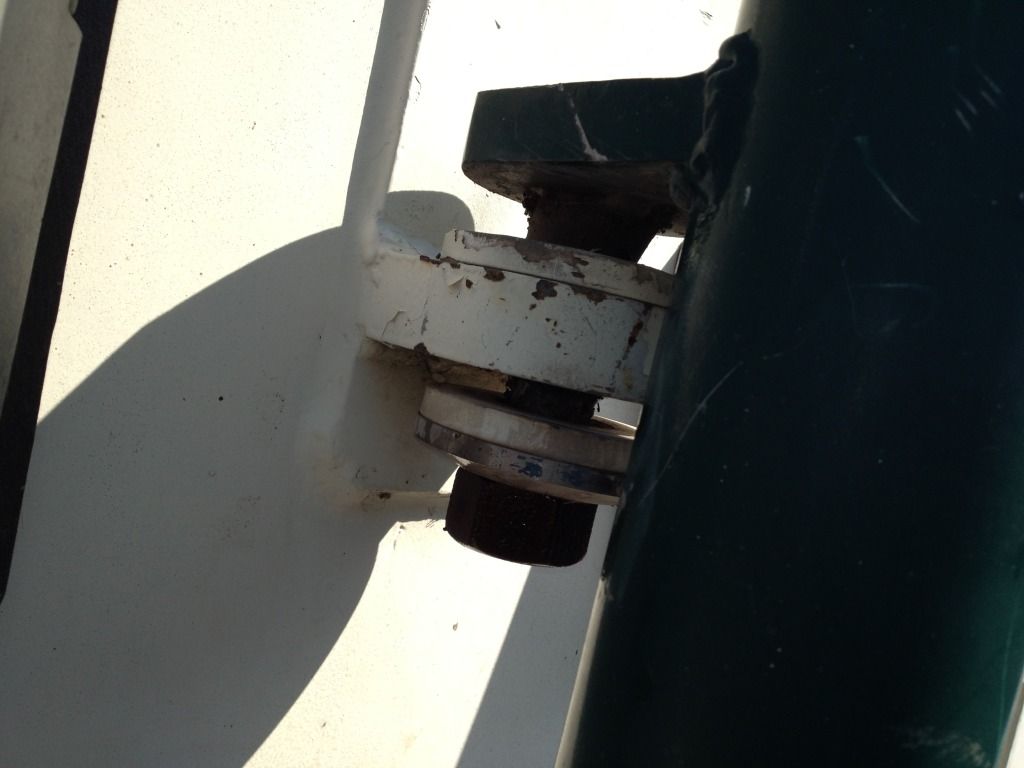
The bottom pintle features more Delrin washers that act as bearings. The top pintle/gudgeon seems to be short a 1-inch spacer, so these will be made.
Also an opportunity to paint otherwise inaccesible areas
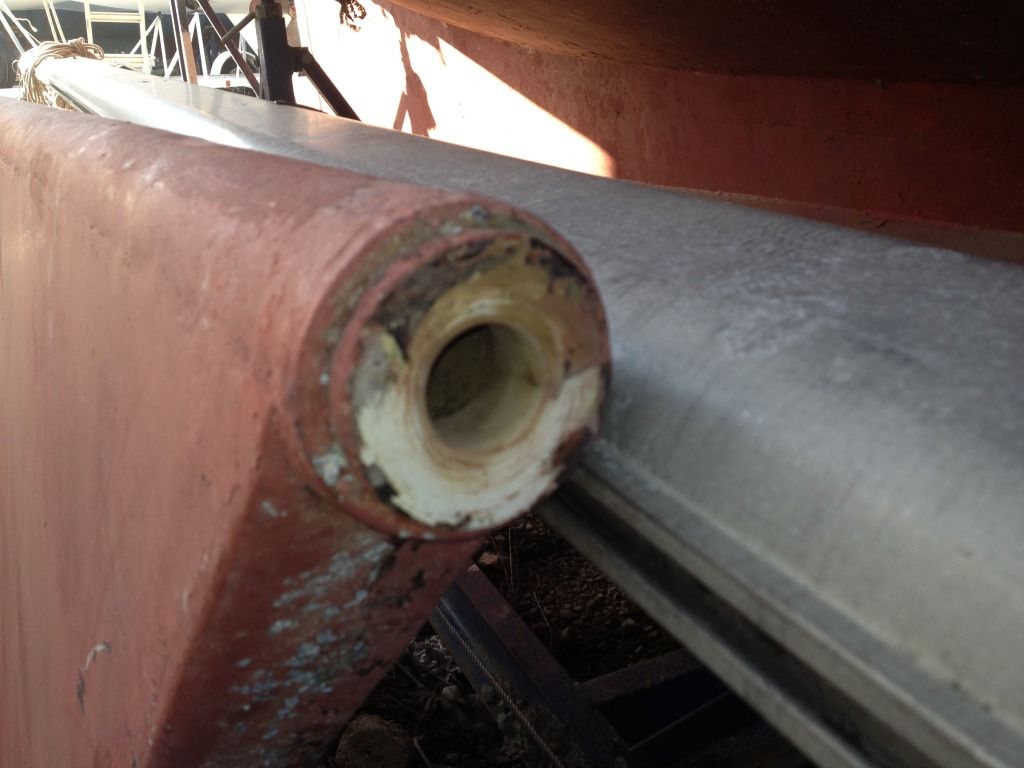
I like this bit: a massive Delrin insert in the bottom of the rudder. As it sits on another Delrin ring, everything goes smoothly, something I noticed hand-steering via tiller with the hydraulics bypassed.
Together for the first time: important parts of Valiente (mast) and Alchemy (rudder).
The small hole in the top of the rudder blade is to let in water; there is a similar threaded hole in the bottom. This is in part for draining water that would enter through just being in the water most of the time, but also can be used to deliberately flood the rudder. I'm going to make plugs in order to see how a nominally "empty" rudder steers. I also may have to enlarge the aperature for the new prop, which would involve aluminum welding and yet more measurement.
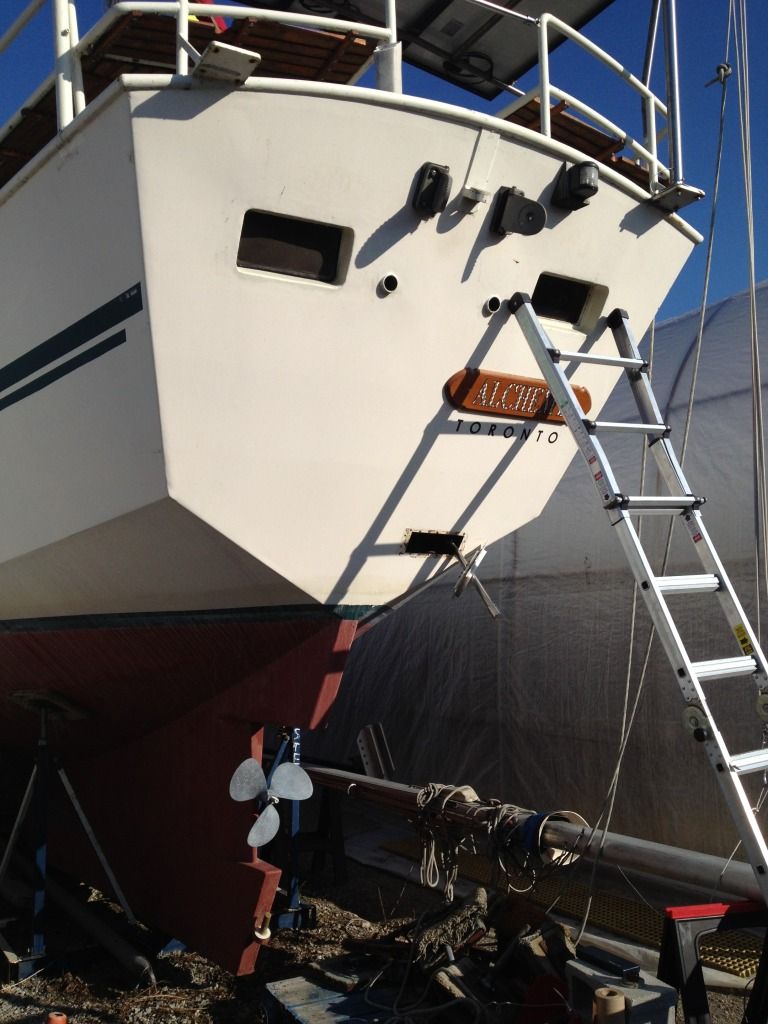
Behold the naked stern!
Lastly, the original fixed, three-bladed 18 x 13 prop came off, thanks to a bit of fiddling with a prop puller I acquired at some hazard to life and limb by cycling out to North Etobicoke by bicycle last year. Like the great big socket used to remove the pintle nut, it's a single-use tool that is worth the price for that single use. Took about a minute and two swings of my biggest crescent wrench, another rarely used...but absolutely needed...hand tools. I'll keep the old prop as a, God forbid, spare.
After the bris, the lox!
Fitting the new prop will happen in the next few days, along with confirmation that it fits when full feathered (I already know that zinc has to go!), after which I'll pull the shaft to check for length and trueness, which I believe means finding a perfectly flat really big tabletop and rolling the shaft to see if there's any sort of wobble. Finally, however, a properly productive day. Sailing is peanuts next to time management.


2012-12-21

Yule be launching soon...

...which is what I'm saying on this, the shortest day of the year and, according to the more excitable among us, the End Times. Given that we launch in the spring, the Apocalypse can piss off, thanks very much. I've far too much to get done, and if any skeletal Horseman should manifest, he can tie a line to his spectral pommel  and provide enough purchase to help me to get the rudder off.

And as I've finished the obligate Christmas shopping, I think I will lay a charge on the extracted boat batteries in the garage, do a bit of house chores, and contemplate a Terrible future.

This is Terrible:


Note: Less terrible, more delicious
I am looking forward to it, although I suppose this would be more in keeping with the day:

From the same brewery. I do like their work
Personally, I take it as a point of pride that I drink better than any Mayan ever did.
Happy Solstice to all, and to all a fine holiday. May the deity, folkloric character or rational concept of your choosing grace you with health and enough wealth to upgrade your boat next year, and may your path to a happy life on the waters be lit with the ever-increasing sunlight of approaching summer.

(Invert as required for Southern Hemispheric readers, of course!)

2012-12-13

Time for OCD? Yes

With all the rules, regulations, check-lists, acronyms, memory work, methodical stowage and general fussiness associated with good seamanship, one could be forgiven with linking successful sailoring and obsessive-compulsive disorder. Maybe even a touch of the 'Spergers.
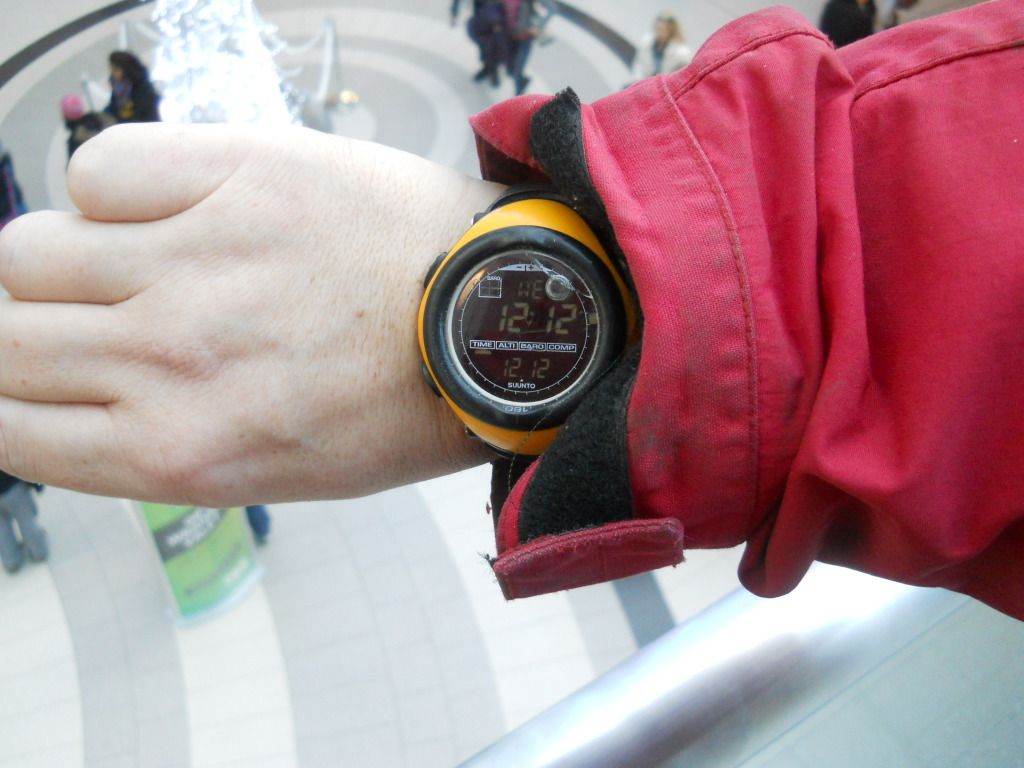
Yes, it's 12.12.12, 12:12:12 hours, EST
Being largely unconscious of why I interrupted my holiday shopping to take this picture in a busy mall I seldom otherwise patronize, I shall not argue the point too strenuously. I will note that the time on my hands is precise, indeed atomic, despite my cracked crystal.

Write your own jokes here about my mental makeup on this otherwise meaningless post. Assuming we aren't headed for the Mayan Apocalypse, in which case I'll be below decks with the rum stocks.

A brief anecdote on the subjective nature of time: In the context of hearing a joking reference to "when will the slaughter of our oldest citizens cease? A new oldest person seems to die every couple of weeks!", I recalled that some 20 years ago, I had a girlfriend whose mother was adopted in the 1940s by a middle-aged woman who couldn't have kids, hence the adoption.

When I knew her (my girlfriend's granny) in the early '90s, she was 101. Her own grandmother had lived until 98, and had been born in 1819. The two, 1819 grandma and 1890s grandma, had been close, and many "old timey" stories had been exchanged.

So, my girlfriend's grandmother's grandmother had a) been born in the same year as Queen Victoria, b) had been born before Napoleon had died, c) had children before the widespread arrival of photography, and d) at the age of 18 had personally witnessed events in Toronto that were part of the 1837 Rebellion, a minor historical event, but one that led to the formation of Canada as an independent country, which happened when grandma's grandma was already middle-aged.

Hence, old people are like time machines. Get an oldie who knew an oldie as a kid, and you can hear at one remove human experiences nudging 200 years old. If you are fortunate, you may hear them as well. I realized recently that some scary old guys in my youth, particularly one I recall with a bandaid where his nose should've been, were actually World War I veterans, who of course would have been 70-80 years old in the late '60s when I was a nipper. I suppose, being capable of math, I knew that, but I have been quite used to the idea that they were mostly dead, most of my life, and that WWII guys were "the elders". One fails to take into account that they are aging at the same rate as everyone else, and that time is a very slippery customer.

2012-11-18

Knowing when to fold 'em

Practical or flat-water toy?

About two and a half years ago, I wrote on the subject of recent developments in folding boats, a seemingly fertile ground for the inventive sailor or otherwise aquatically inclined traveller.

Fertile ground is usually seeded with money, and the website Kickstarter allows crowd-sourced funding of little inventions. One which recently caught my eye was an 11-kilo vessel touted as a revolutionary folding kayak. It's been successful in getting press, and plenty of attention from the alternative outdoorsy types.

Batteries not required, but can it stand battery in general?


But at eight hundred bucks per, it had better work. Compactness is the main draw of folding boats, but durability is very much an issue. If you lived in an apartment next to a canal system or a big pond, I can very much see this as an attractive means of kayaking for the space-challenged. The downside for the cruiser, of course, is that there's very little space for cargo. Cruisers' tenders need to haul things back and forth, although this would be ideal for exploring a mangrove swamp or a calm lagoon if you only packed a lunch

And there are few more space-challenged than aboard a sub-50 foot cruising sailboat.

Here's a video of the kayak being folded up:


Interestingly, there are several less-polished versions of the same basic "coroplast kayak/boat" concept:


and this one, which is made of wood for the traditionalists among you:


I like the idea of foam or inflatable tubes lashed to the gunwhales of a tender. It's one used by the Walker Bay tender manufacturers and it's an idea I intend to adapt for our own Portabote and nesting dinghy

Still, it seems that there are many ways to construct folding boats, and the field seems full of interesting ideas and unusual materials. Whether they would suit cruisers as real-life tenders in sometimes choppy conditions will become clear with use and anecdote.

2012-11-10

Too good...and bad...not to share

I don't often post non-original material, but this was too good a horrible warning not to.


What astounds me is the patience and willingness to help of those sailors in the Zodiacs. Could it be an acknowledgement that "they've all been there", or simply that the presence of the charter fleet and their sometimes woefully inexperienced crews is part of the price for "another day in Paradise"? I find their forbearance inspiring, anyway. Maybe while they were helping, spouses and crew were dialling 1-800-UHITMEE.

Some European sailors are critical (and rightly so, in my opinion) that North American recreational sailors, and particularly Americans from certain underregulated states, are not required to have much, if anything, in the way of licencing or boater education in order to operate a boat.

Clearly, a landlubber or daysailer handed the keys to a Sun Odyssey 42 or an equivalent large cruiser is not likely to be the smoothest operator in a crowded anchorage. Most sailors I've met in Canada and the States seem to exhibit a prudent attitude and a willingness to learn, if not in a regulated fashion, but the official qualifications absent or minimal (like Canada's PCOC) are only part of the story.

A basic grasp of physics as it pertains to objects in motion comes into play, and without that, you can get into trouble quickly. The fellow I share my 33 footer with is a long-time passenger jet co-pilot: his docking is a thing of beauty to watch because he is very used to the idea of incremental applications of power to relatively heavy moving objects. Ergo, he docks with the snooker-expert finesse that took me, a non-driver of everything but boats and bicycles, some time to acquire, and I still have to buff out the odd graze on the topsides.

By way of contrast and comparison, here's an example of great helming in extreme conditions. Note particularly that the skipper has aimed for the seawall, knowing he'll be slewed sideways by a big wave, which will allow him to pass into his basin.


The counter-argument against licensing and certification of boaters is that even in places with more onerous licensing regimes than in North America, you can get idiotic behaviour on, in this case, the roads:


The short form of this is "you can't fix stupid, but you can give it a licence." I've been informed that most of the really bad stuff here is from Eastern Europe, which may play into the stereotype of the fatalistic Slav...I'll leave that to others to determine. I don't even own a car (although I can drive) and have no current road licence.

It is true, however, that the lack of educational qualifications to drive a boat in much of the Caribbean is what makes credit-card captains (a great term, by the way) makes the charter business possible.

And the charter insurance business. Man, talk about a job for life. I hope that the rising rates that industry must have to impose doesn't kill chartering. What I do hope is that it helps to drive a higher bar for the sort of training required to leave the dock in the first place. The bleating from certain quarters about "over-regulation" and "freedom" aside, there is an element of responsibility and safety awareness in working a multi-ton boat, and I do not find it unreasonable that people doing so, particularly on the casual basis of a winter charter holiday, should be exempt.

The charter industry won't like it, though.

UPDATE: A reader writes:
 Just a few personal notes about your excellent post on credit card captains.
The video is by Rick Moore, a Torontonian who now lives in Grenada. He’s a professional videographer and charter skipper who probably helped the bungling beginners because he did not want to see more havoc wreaked in the anchorage and because of a seafarer’s duty to assist (although it could be argued that neither boat nor crew were in any real danger).
The larger chartering companies with newer boats now require their customers to have some formal training and experience. See this from Sunsail: http://www.sunsail.com/experience-required/experience-levels. Note the sentence: If we feel that you may need assistance, we reserve the right to add an instructional skipper to your charter. We are chartering two Bavarias from Horizon with my family at Christmas, they were satisfied with my credentials but they would not let my children skipper their own boat until they showed their US Sailing Bareboat Certification.
The boat in the video, Cielo de Dios, a 1996 Beneteau 505, has been shifted from top-tier TUI (Moorings-Sunsail) further down the quality line as she got older. I’ve seen her a few times in the BVI; she has a bad reputation and those in the know keep well clear of her, if at all possible. When I was anchored off Jost last year, her crew dropped anchor on top of another boat’s anchor and then she drifted within a couple of feet of our bow. Typical Cielo crew. So It’s the lower tier chartering companies that are less demanding. Old boats, not in great condition, such as the one on the video. And yes, the insurers must love them.
About qualifications, many European countries now require some proof of competence from operators, although most have not adopted the UNECE’s Resolution 40. Country regulations are confusing and even vary from port to port, particularly in the southern European countries.  Normally, a vessel that complies with her flag’s regs is accepted “as is” in other countries. But it seems it’s not always the case.
Good information! As is probably apparent, I posted that Cielo video primarily for the grim humour value of seeing what appears to be hapless charter crew out of their depth (so to speak). It's "horrible warning" stuff.. But the issue of non-standard sailing qualifications being required to get on charter boats persists, because requiring everyone to have an ICC would be seen as a drag on business. So dragging on anchor rodes and the crunching sound of low-speed collisions that may or may not "buff out" should be part of Paradise for a little while yet, unfortunately.

2012-10-29

Storm prep and mast commutation


The Perfect Squirrel?

The same attributes that make October pleasant for sailing can also provoke concern. The former hurricane known as "Sandy", which as a father is a name I absurdly associate with an aquatic squirrel from a cartoon, is sending gales our way, and has delayed my scheduled haulout.


Not relevant to my haulout plans.


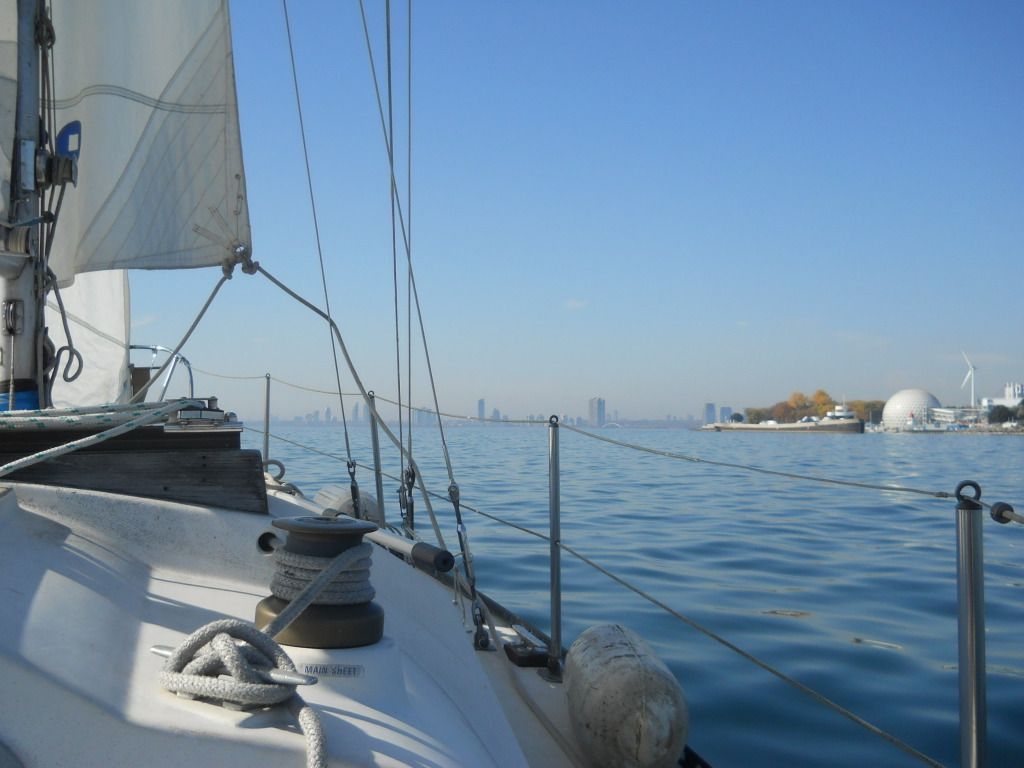
Last week...in fact precisely seven days ago, my wife, a friend, and myself bobbed in near dead calms off the shore. It was warm, well...warmish, quite sunny and windy like the tomb.

Note the gravity-driven sail
The best part was that the water was so wavelet-free, and the work of the plankton-munching mussels so thorough, that we could see the bottom of Lake Ontario some 20 feet down.

Should I break out the spinnaker or just try to find the rum?


For those of you in warmer climes, this may mean little, but Lake Ontario is where murk goes to die, usually after wrapping itself in swamp-coloured muslin.

The yearly boat retirement commenced after this pleasant if nautically underwhelming couple of hours adrift with the hauling of Valiente's mast. This was an exciting exercise conducted with the wrong crane on the wrong day, and ended up with me buying a group of resourceful fellows a round of pints.

I must have been moved near to tears.

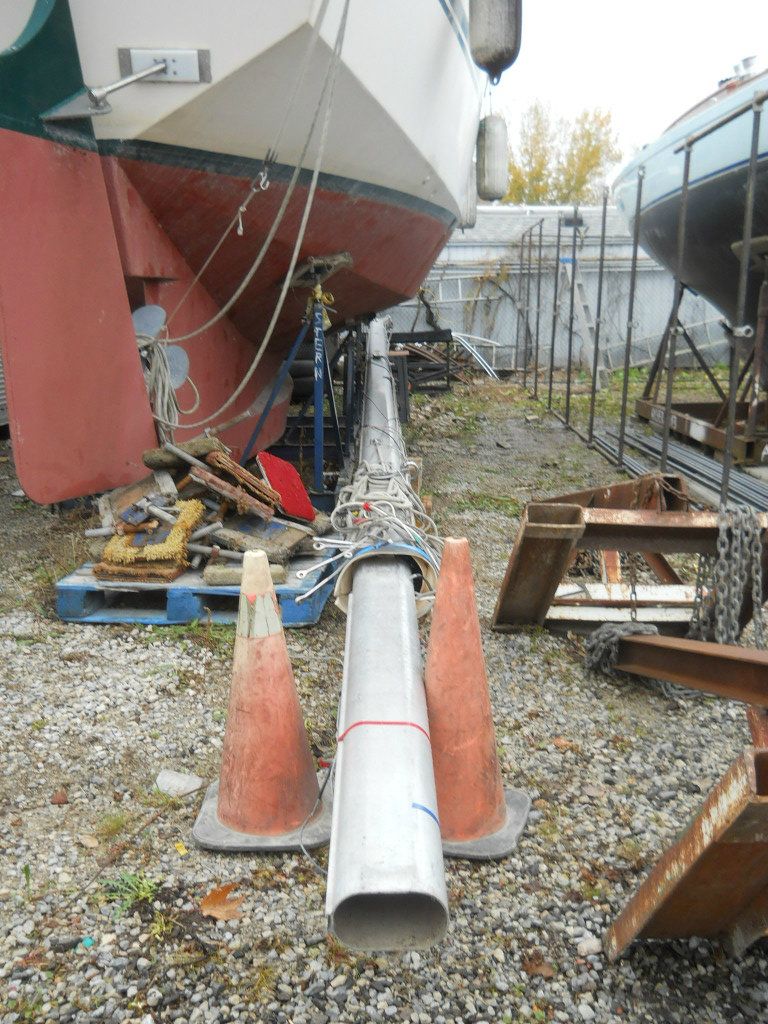
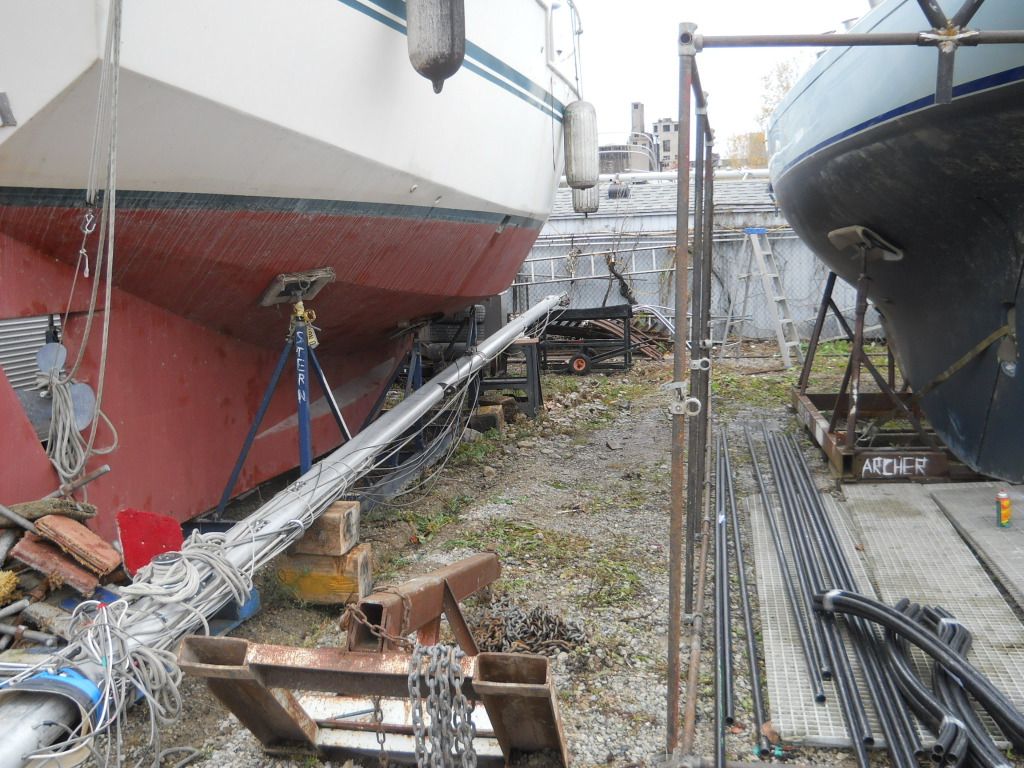
With the mast thrillingly untangled from the crane and resembling somewhat less a robot's death spear, I was free to stow it beside Project Number 1.

This game is rigged: Note the arising Temple of R-Boat Repair to starboard.
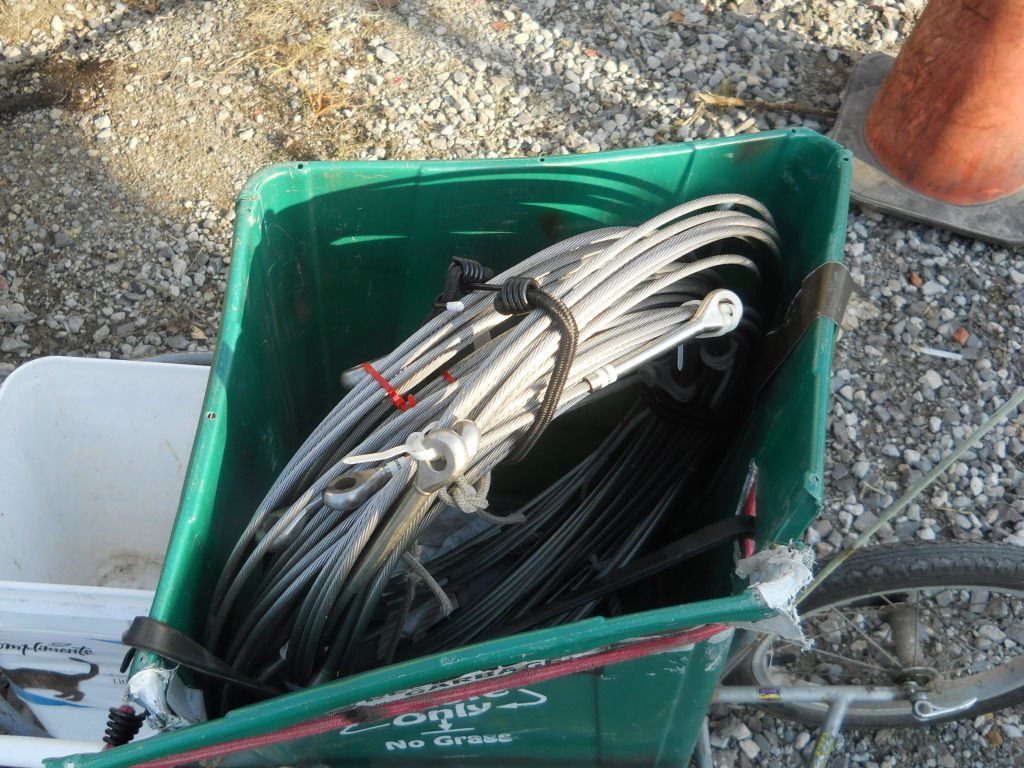
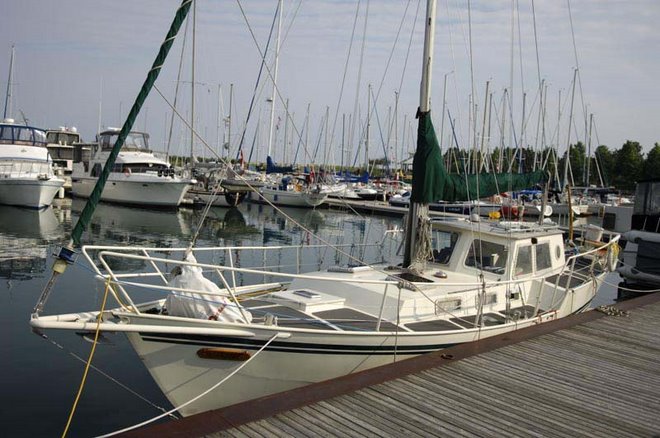
Even though Alchemy fixing is rarely far from my thoughts and increasingly chewed-up hands, I determined that if the classic plastic Valiente was to turn 40 years in 2013, it would not be with her original standing rigging. Yes, my SS wire, terminals, tangs, pins, buckles and plates are all original. I am replacing the swage terminals and the wire this winter. In order to do that, I have to remove the old stuff, which looks remarkably, if not suspiciously, still in good condition. But as the Botox and implants can defer and yet not defeat the march of time for the vain Hollywood star, so my antique rigging must be relegated to the role of "emergency spares". Also, I got a good deal on rigging. Parsimony and prudence, together again.

Ground Zero for "The World Encompassed" could use some tidying up,
I believe that most of the rest of the mast gear is still OK, but I'll know more when I disassemble the various pinned nuts and tangy bits. I will also redo the sheaves and (sigh) pop for new halyards that aren't the colour of grandpa's jock. The point being two-fold: I have to do this stuff to keep it safe for me sailing, which will be at least another season. But that said, it wouldn't hurt to make the boat more attractive and structurally "refreshed" for whoever buys or babysits her.

Besides, it's good practice for the steel boat.

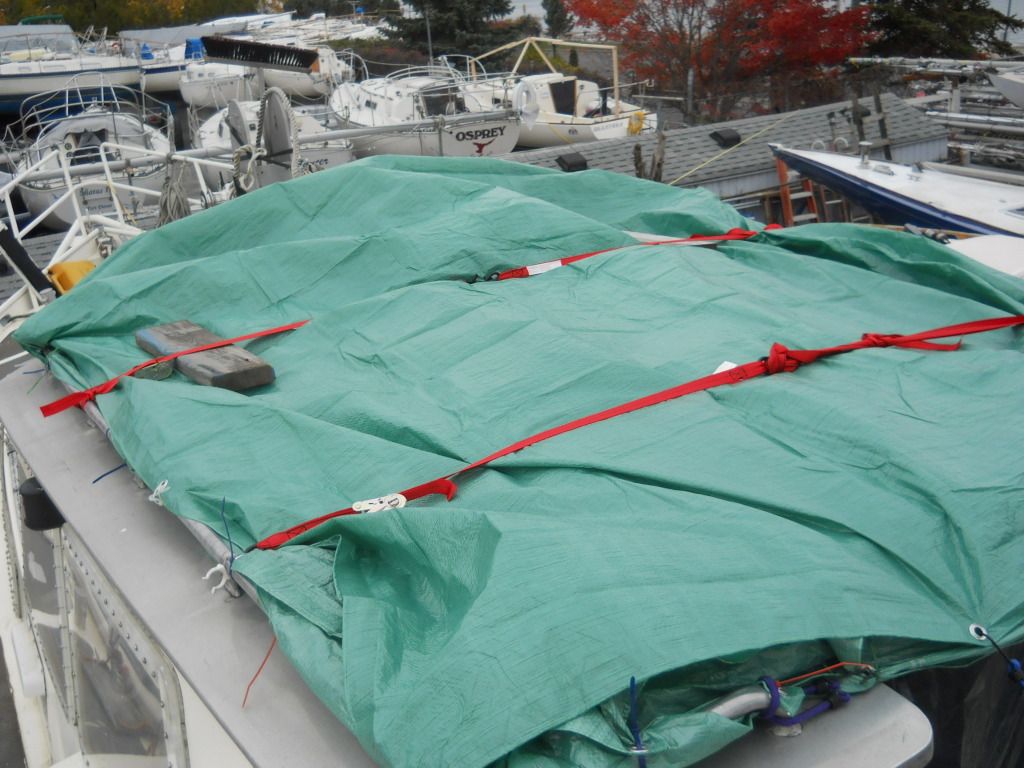
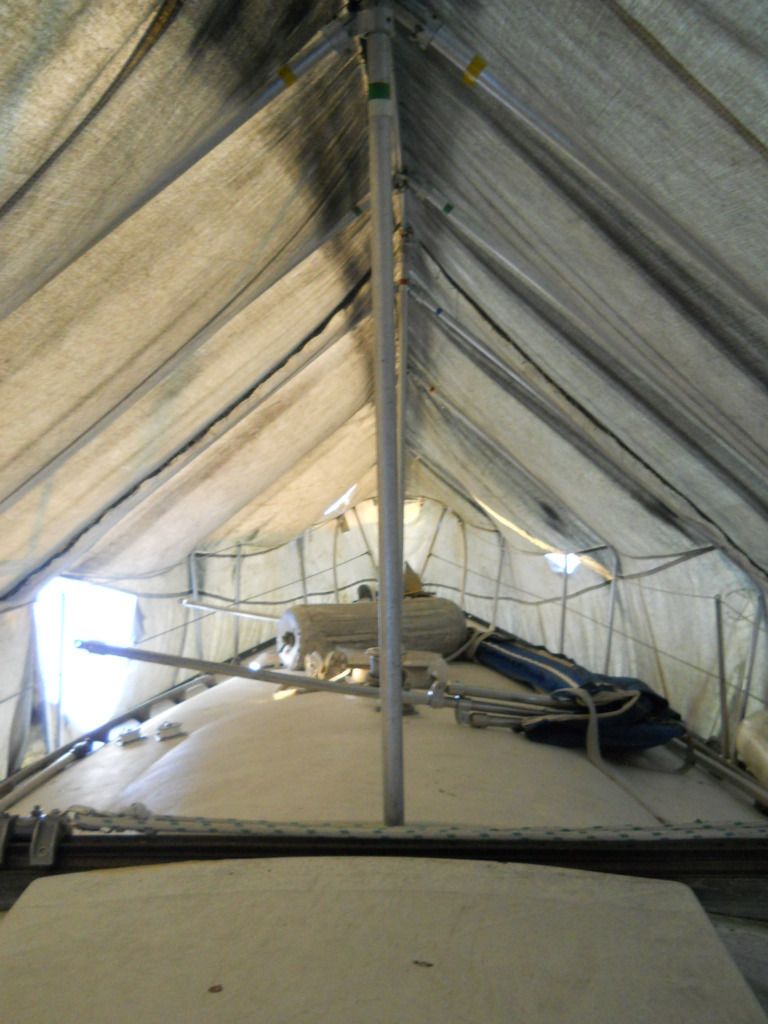
Speaking of which, the aforementioned Hurricane Sandy is producing sandy gales outside, making me happy I put on a third layer of tarp on the "lid" of Alchemy today and added some racheting tie-downs.

I'm more "function" than "form", as can be seen here.
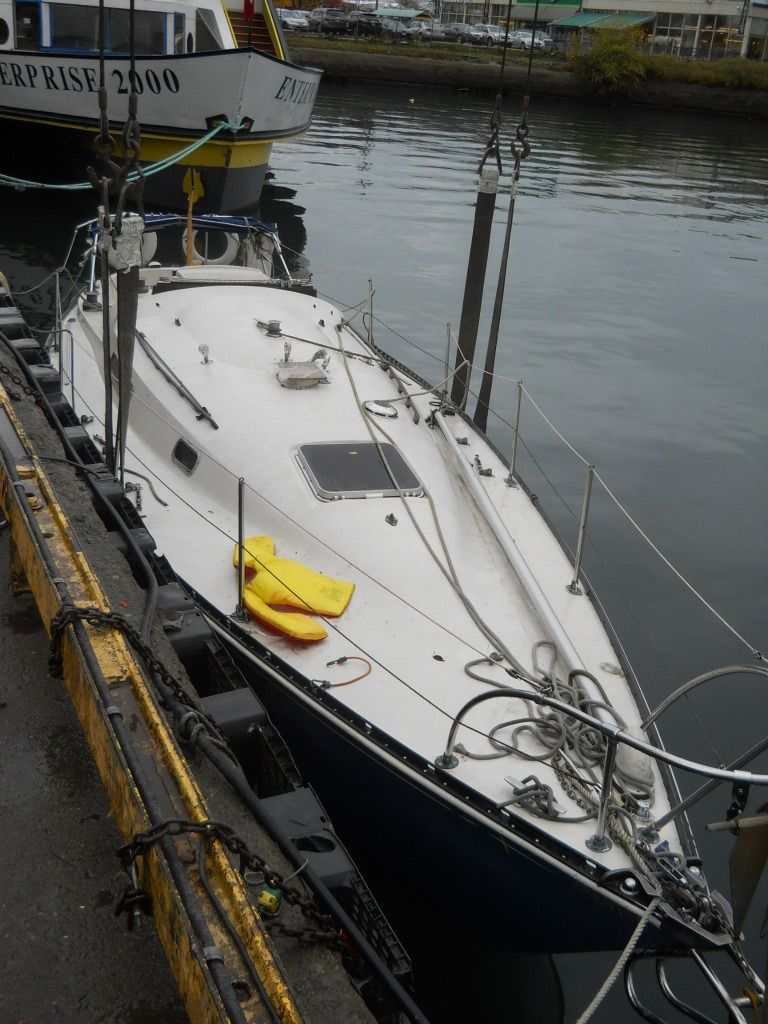
Poor Valiente was turned away from the inn, or rather boatyard, until a calmer day. This led to sudden arrangements that saw her randomly docked at my club and trussed like a sea chicken to various points that I hope are not moving very much.
Dirty, but serviceable: When the wind blows 50 knots, you can't have too many
Doubled bow lines and improvised chafe gear. My bike-riding habit produces a good supply of rags.
Spring time in the fall! This better work.
If the boat survives the night and tomorrow, the wind should drop enough to attempt to haul out on Wednesday. The gales are N to NE and there's a convenient screen of condos, etc. in that direction, plus the bow of Valiente is aimed more or less into the wind. We'll see if the low profile of That '70s Boat preserves her to sail in 2013 with the same number of dents and dings as she sported this morning.

UPDATE, October 30:  Despite some harrowing winds approaching...but not quite reaching...the forecast 50 knots last night, the boat appeared undamaged today. Tomorrow, Hallowe'en, I'm skedded to have a scary haulout in rain and light wind at Pier 35.

If mere 50 knot gusts do this, no wonder the U.S. Northeast is half-wrecked.

The wind was enough to tear down trees in the park behind my house. I feel both like I prepared and got lucky with the wind direction.

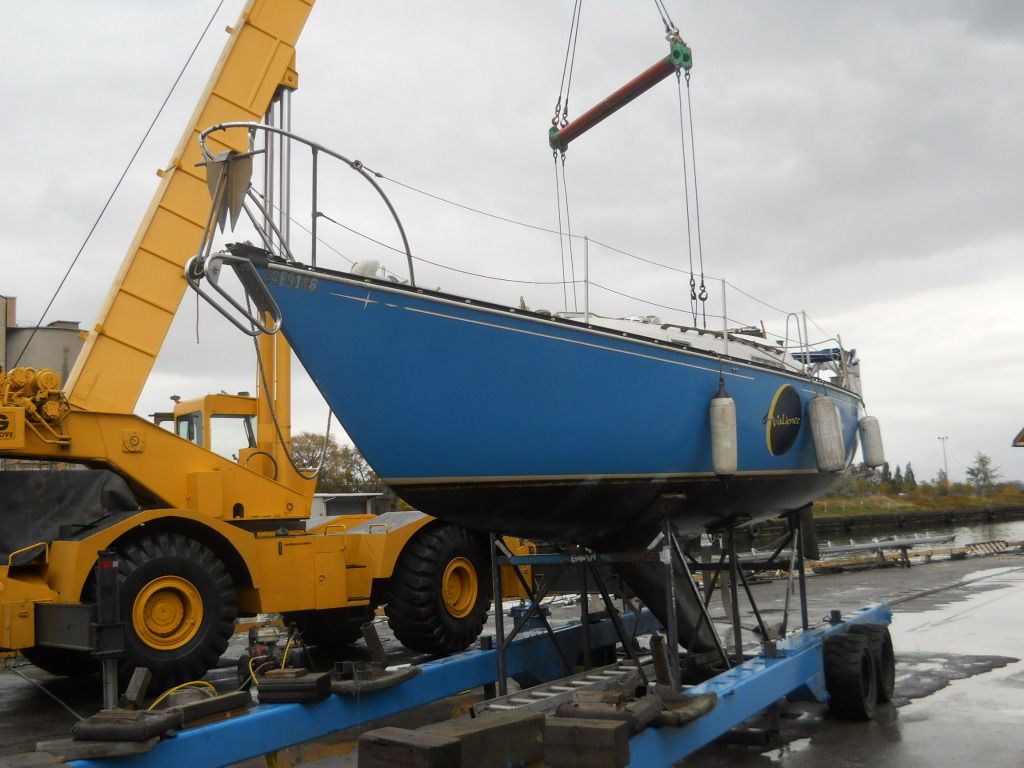
UPDATE, October 31: Got hauled without (much) incident. After the defunct hurricane's wind wrath, the waters were still and the wind wouldn't heel an Opti driven by an infant.

Old, stripped and dirty, jus the way I like 'em
This was somewhat surprising given the very Hallowe'en cast to the skies:
One does not just walk into the Bank of Mordor

Where I haul is lacking in charm, but also in high fees
Fitful dribbles of rain came and went, but no real wind, for which I was quite appreciative to Boreas and his wind god chums.

Not bad for turning 40, is she? Not her best side, however.
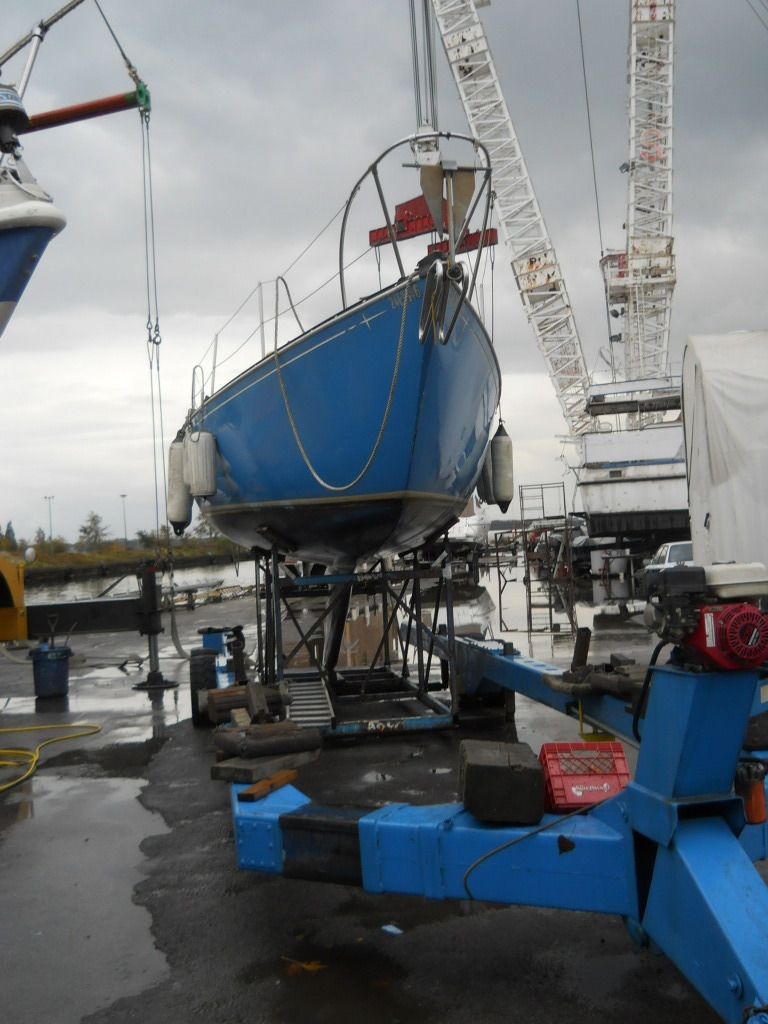
After some fiddling/manly pushing, we got the keel settled. Must remember to replace the wood pad on the cradle as it is looking worse for wear.

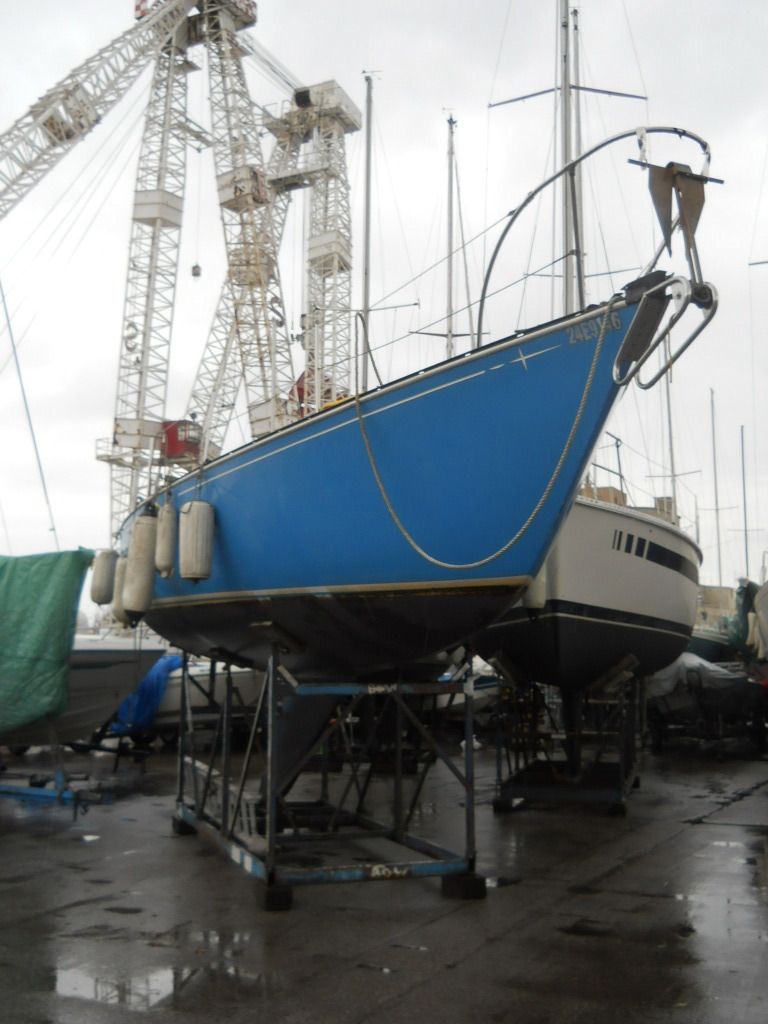
I will never get used to this sight, frankly. Seems...unnatural
And we're off to our winter berth. Toot, toot.

Like cleaning the hull and coiling down the dozen or so Sandy-inspired spring lines.


And so to bed. Time for a new tarp, maybe? Maybe.

Upside: Plenty of fresh air.


Last and not least, I finally got all the shrouds and stays off the mast and they are going to be replaced over the winter. Took some chunks off my hands, but at least the tangs and pins look good and probably OK to keep. Bless you, fresh water! You save me money!

Stays: Just a little bit longer.

The old 'uns look good enough to be spares, or perhaps bits of anchor bridle for future use.

Now it's back to Alchemy until spring. First off, the rudder!