Or can it ever, realistically, get built in the first place?
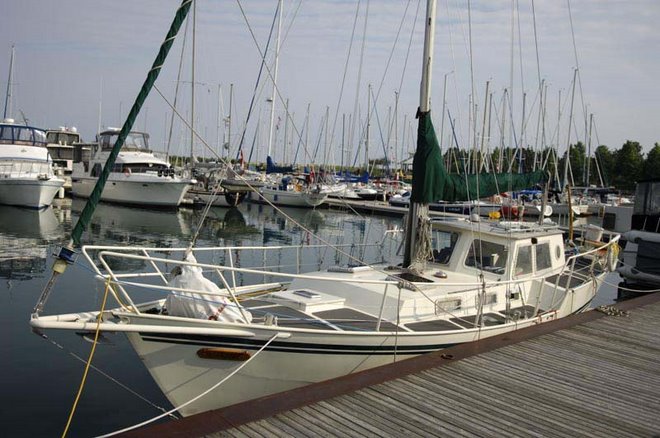
A Bob Perry-drawn Saga 43, still close to my definition of a performance cruiser that does not compromise on materials or safety
Cruiser design is a very personal thing. The number of boat owners currently sailing (or at least tied to a dock) is enormous, of course. This is in part because a great number of boats built since the mid-'60s, when design cues still were inspired by wooden full-keelers, for the most part, are still in play. I know of the middle-aged grandchildren of original Alberg 37 owners who've inherited Poppy's impulse buy...the Boat that Continues to Float.
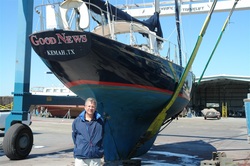
A still-going Alberg 37: Good news for the buyer, not so good for the manufacturer of newer cruisers
Of that great number of Classic Plastics, surprisingly few (when compared to, say, cars) have been stripped of metal and cut up for landfill or turned, sometimes amusingly, into sheds. Current pricing for cruising boats is therefore reflective of both a glut of supply and a dearth of buyers willing to take on the expenses of boat ownership, which, while variable, are never particularly close to zero. The days of boat-hoboing, of anchoring for free, and living on line-caught fish, a sack of rice and salad greens grown on a decktop greenhouse, would appear to be largely past. Not completely, but there's not a lot of love for the transient yachtie on the tired-looking, affordable 28 footer who wants to hang out for a week in front of gangster mansions.
This houseboat is actually called a "Hobo". It resembles a 1970-era camper trailer and looks about as seaworthy
Good riddance, some might say. Some who spend more time on the social event boards of yacht clubs than actually sailing in anything more than an angel's fart, but such folk are a significant portion of the cruiser-owning community. Even a casual inspection of boat-show offerings in the last decade or more will confirm that such vessels, while fast and exciting inshore and in light air, are not always fit or even (in my view) safe for any offshore voyaging. which is a minority pursuit of the small percentage of the population that own boats above Laser-size in the first place.
Most current offerings between 30 and 45 feet LOA seem to me to be big-arsed, wide-beamed, handhold and lockdown-deficient, flat-bottomed, over-canvassed, under-ballasted, shallow-tanked and shallow-bilged, which is great for club-racing and entertaining, but pounding away offshore? Unpleasant, unseakindly, and underbuilt come to mind. There are exceptions, thank goodness, but not at prices friendly to those who want to keep their house.
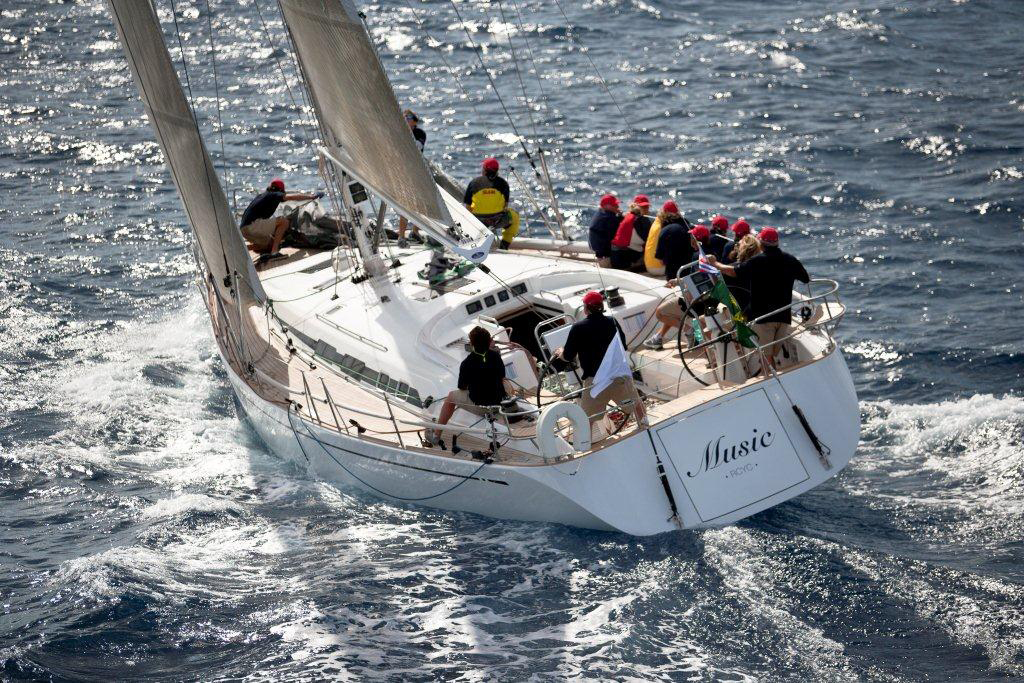
The J/160 is another performance cruiser that hits the sweet spot for me, even if it would require a lottery win to obtain
The market is ever reactive. The major builders, when they haven't been merged or driven into bankruptcy, build the most impressive boat at the most advantageous price point. Designers design with selling their designs in mind. The reason so many cars in the '50s had tail-fins is because the herd liked tail-fins and the suggestions that Space/Atomic Age design called for it, despite the fact that the fins actually created drag and sat atop the same crappy, heavy frames and indifferently machined, inefficient gas-guzzling engines.
This is the 1959 Cadillac Overcompensating for Something.
The look was all. The function was attached to the stern of form with a frayed painter of 1/4" polypropylene.
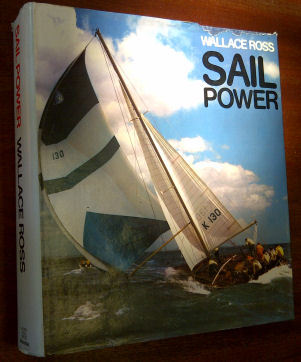
If you can find this, buy it. While technical as hell, it's a treasure trove of how to spot a boat that won't be a twitchy mess in any kind of a wind.
Now 40 years old, this book explained to me what was actually happening when I futzed with the main or eased a sheet. An invaluable resource for explaining why a boat sails as it does...and how to do it better.
All of this is known, and yet people still have an interest in inverting the marketing formula that has worked for so long, and wish to create the ideal cruiser. Over at Attainable Adventure Cruising, veteran voyager John Harries has been behind a project somewhere between a thought-experiment and a yacht-design subscription club. I haven't yet waded through all of his excellent posts made over the last year, but the thrust so far is to create a 40 footer design that would strike some as bare-bones, as the concept of a wet bar or a place to hang a flat-screen TV is not emphasized, but hull strength, ergonomics, systems simplicity, seakindliness and robustness are.
A similar, if more "crowd-sourced" design ambition was found recently on the amusingly truculent Sailing Anarchy website. The Cruising Anarchy 36 incorporates a modded-out version of an original Bob Perry design, itself "spec'd out" to avoid the sins of the Bendytoy cabal currently over-represented at boat shows.
Ideal, or idealized? I found even a taste of the process of conception intriguing as it was born out of a hatred of the deficiences perceived as being endemic to modern cruiser design.
Ah, that's better. 3D rendering is not nearly as annoying in this form as it is in the movies.
An interesting and trenchant reply, I think, as is the Navy 44, a brilliant sail-training sloop designed to last decades under the indifferent and predictably ignorant rough usage of generations of cack-handed cadets.
Read about how this is built and then bring a dental mirror and a flashlight to look at the way a new dock queen is built.
Clearly, you can favour "durable" over "convenient" when your every sail has 10 fit young people aboard to pull at your whim, but the choice of hank-ons over rhe near-ubiquitous roller-furling is interesting, to say the least, as are other apparently "old-school" choices. Some might maintain that sailing itself is superfluous to modern naval practice, so who cares in what the U.S. Navy coats its buggy whips? And yet, to those of us who cruise, such big-budget test beds that sport thinking both old and new are a powerful pointer to the design elements, materials and techniques that make for safer, more effective, and arguably more enjoyable voyaging by sail.
Like this: If I wanted a little racing with my cruising, and laid gold eggs, a Swan 53 is a very goodm tough cruiser.
When I began sailing in the late '90s, I was in my late 30s, with no real prior experience with boats. To make up my skill deficit, I did what I always do: I read up voraciously on the subject. Early on, I discovered two live-aboard tales, which confusingly had the same name: "All in the Same Boat". One was by American Tom Neale , and talks about living with kids on a tricked-out Gulfstar in the late '70s. The second is about Fiona McCall and Paul Howard, Torontonians who lived aboard a pretty Spartan, and yet closely packed, steel, junk-rigged 30 footer with two kids (!) in the '80s.
Not actually....
I loved both books and learned a great deal, particularly concerning how to live with kids aboard (I didn't have a kid at that point). I would say, however, that both books are now nearly fatally outdated in their assumptions and conclusions. Which is really no surprise, but they offered in their time a study in contrasts: Neale's self-contained, heavily equipped vessel versus the Howard/McCall "go now", functionally simple (bordering on primitive, as I recall) little boat that was capable of slowly, and safely, taking them through seas rough and benign on a penny-jar budget.
...the same books...
Alas, not only would such low-buck trips be nearly impossible to pull off today with the endless fees for permits, insurance, fuel and safety gear, not to mention the ease with which bureacrats and other pirates can find yachties and hit them up for cash,but the idea of putting a couple of school-aged kids on a home-built 30 footer might well be considered a form of child abuse. We seem to have become as a society more concerned about the preciousness of young life and its need to be preserved, and yet more stupid about evaluating risk and the need for physical challenges in order to give those same precious snowflakes some real-world baselines. My wife, the Darwinian biologist, suggests it's because upper-middle-class people (the same people who might have the money to buy boats, for instance) are deferring child-rearing until their anxiety-ridden 30s and 40s, and are tending to "bet the house" on a single kid. To put it more crudely, if an eight-child farm family of the year 1900 lost two kids to disease and one fell in the thresher playing unsupervised in the barn, it was tragic, but not an evolutionary full-stop. My son is the only child of me, the only son of an only child. He's at the pointy end of my genetic pyramid. No wonder I didn't buy a Bendytoy.
That said, I really think that we may be in the last generation of only three or so since 1960 to sail private small yachts around the world before things go completely pear-shaped. Or, and this is in my view more likely, geopolitics, income disparities and energy costs dictate that this type of private tourism, for lack of a better term, becomes financially untenable or too dangerous to achieve.
While one still hears of heavily sponsored stunt sailing exploits like single-handed teenaged circumnavigators, or the occasional "couple with kids sponging around the world on an old beater", one cannot say it's impossible to be sub-40 and go sailing for years. But I would maintain that compared to the "All in the Same Boat" days, it is definitely more prohibitively expensive to consider taking a five-year sabbatical to do this sort of voyage. I think that is part of the reason why young people (outside of racing) are generally scarce in YCs, and the average age of cruisers has crept up into the "grey pubes" range, to put it realistically. It's not just because there are fewer of them and they have so much texting and status-updating to do, although that is part of it. The unfortunate truth is that the people who were 25 in the '70s are no longer willing to live without condo-like amenities now that they have retired (with pensions younger people will likely never enjoy, or live longer enough to receive). That's what is driving current cruiser design.
Nonetheless, I encourage initiatives such as the Adventure 40 project as laudatory and a spur to rethink HOW we should sail, if we indeed sail more than at the day-sail or weekender level. Clearly, I am trying very hard to make Alchemy "strong, simple and seaworthy" and while they are very different designs, these are equally the goals in the Adventure 40, Navy 44 and CA 36 design processes. It must be remembered, however, that people who even understand and value such attributes over a second shower, A/C and a wine cooler are a subset of the subset of the people both wealthy enough, skilled enough and fit enough to consider pushing away from a dock and out of sight of land.
That said, I'll bet one could make a business case out of selling Adventure 40s or some similar "basic and bulletproof boat" and then make a second business case for a place that specialized in "hot-rodding" them for slightly less Spartan tastes. I say this claiming that I would love a J/160 set up like a J/105, but J-Boats don't even bother coming to my local boat show anymore. They aren't enough like a Jenny Bendycat with teak veneer and no fiddles on the saloon tables. Wait, you mean the sea moves?
Navigation only seems like a dark art from the land. From a young age, I was fortunate enough to possess a decent sense of direction, a damned handy thing for a sailor and which compensates a little for the near-sightedness, I suppose. I've come to realize over the years that my self-orientating ability, which is by no means "savant" level, has been refined through practice and study and is clearly linked to related skills like being a good shot, and decent at darts, archery and snooker, despite little time spent on those activities.
It's less "bear 282 degrees to reach the waypoint while I remove this blindfold" and more like "I don't often get lost, can retrace my steps and know that moss is usually on the north side of the tree...in this hemisphere". Like a significant subset of mostly, but by no means exclusively, boys, I've been fascinated by maps and geography since I was a little kid, and always had some sort of cheapo compass for turning suburban ravines into proto-Temples of Doom.
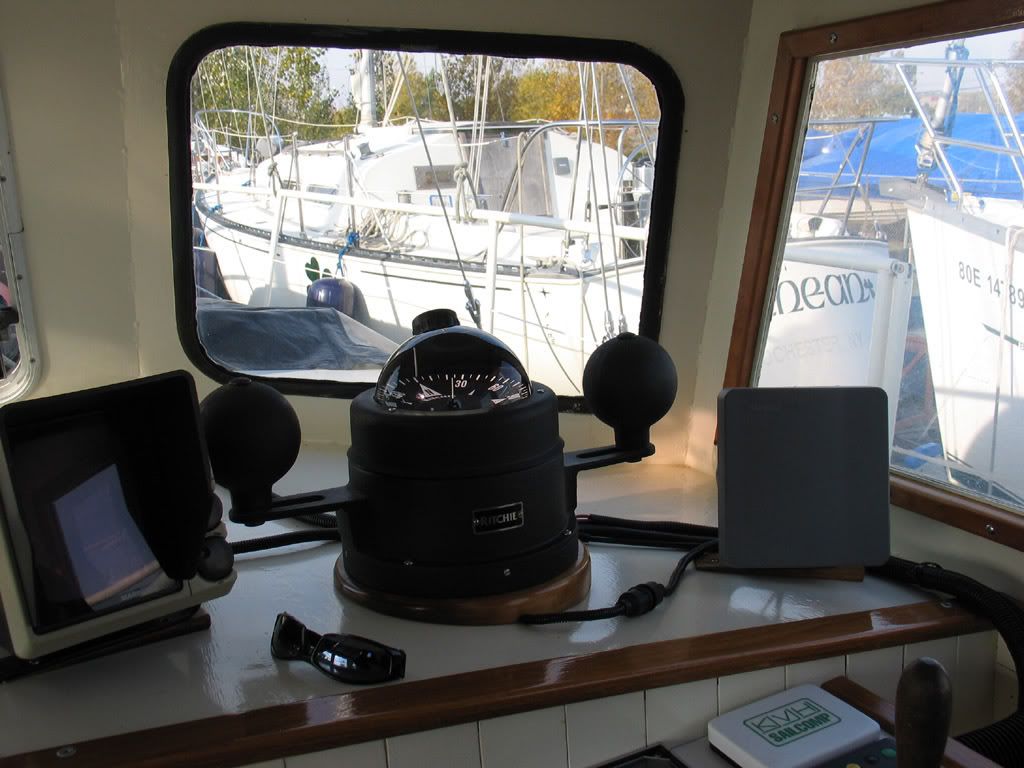
Of course, these days I fondle my Ritchie Globemaster in an unseemly fashion as much as any skipper and I like that Vion to the right, if not to the same intensity. Nice bit of gear, if pricey.
Like AC/DC sang: "I've got the biggest balls of them all!" (Note: Balls are called "compensators", probably justly)
By cartographic contrast, my late mother was so hopeless at directions that she could be seen, emerging like a narcoleptic mole every day from the subway directly in front of the office building in which she worked...and slowly turning around until she got her bearings and "saw" her destination. She, who had been ruler-slapped by embittered, demon-haunted nuns right out of her inherent left-handedness, could never again figure out her directions. Or a map. Or some stairwells. It wasn't a crippling handicap, but it kept her from driving, as "MERGE LEFT" with such a perceptual hurdle could be the last act of a short career on the road.
Navigation problem or certain death?
Quite a few people are like that inherently, including many men, some of whom feel embarrassment at not having Captain Cook-levels of positional awareness. For some of those people, even years of map study will only raise them from "hopeless" to "feeble". It's like handedness...it is very difficult to alter and attempting improvement probably screws up the brain.
I have really tried to think of how this could be no one's fault, but I can't, like the ship, arrive there
Unfortunately, while GPS, iThings, AIS, RADAR, plotters and contact lens 3DNet displays (oops, that last one is not here quite yet) provide information to the unintuitive navigator, but not necessarily context. Context, which includes looking out the window now and then, makes information/data points meaningful in a holistic sense, and seeing that big picture, even on a dark night short on photons, is critical to getting one's bearings.
People used to run aground on rocks. They frequently knew the rocks were there, they frequently knew, more-or-less, the chart co-ordinates of said sharp, point death minerals...but they couldn't do anything about it. The hawser snapped, the jib carried away, the boat wouldn't point, the current...argh! Cold, salty death in the form of gull breakfast, all charted very well indeed because lives depended upon staying away from the land almost all of the time. Keeping one's offing, or giving a wide berth to land, rocks and land with rocks, was considered prudent seamanship until quite recently. Sailing to a waypoint that wasn't a Nerf buoy? Utter folly.
Today, recreational sailors and even professionally crewed naval vessels can catastrophically run aground with comparative, even comical, ease. "The chart was wrong" is no real excuse, and yet old charts that do not feature last year's one-mile mole extension have been the basis for autopilot plots requiring extensive buffing out, at the very minimum, all the way up to Costa Concordia/USN Guardian levels of reef and habitat destruction and expense.
Are we ceding too much authority to our gadgets? Or is access to (assumed) accurate co-ordinates glossing over a lack of ability to interpret the information the gadget is supplying? Perhaps a corrolary might be "driver's lessons": When I was but a lad, driving lessons were for immigrants who'd never owned a car, people from places where cars were driven on the other side of the road, and people without dads or with dads with no gift for teaching. Mostly, dads taught you how to drive. In the intervening years, we've seen the professionalization of driving instruction, particularly aimed to first-time/young drivers. Partially, this may be a reaction to the increasing density of road traffic and the increasing density of data and external distractions. Another part may be that Dad isn't perhaps the Schmacher he fancies himself to be, and passing on his bad habits is not going to raise the collective skill set on the road. Irrespective of the reasons, the notably unsentimental insurance industry favours professionally trained new drivers with insurance discounts.
So there must be something to it.
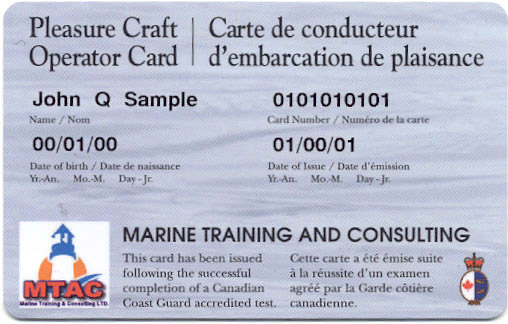
Imagine something similar with boat operator courses, or navigation courses. The PCOC is an utter joke, unless your boating life consists of recognizing a fairway buoy and making a figure-8 in an inflatable (Oh, wait, that's the Toronto Harbour Licence, another useless cash grab).
A joke that's not particularly funny.
Along with current voyagers Ken and Lynn aboard Silverheels III, I got this discreditable creditation in 1999. We three in fact met at a Canadian Power Squadron 12-week "Boating Course", which was a fairly intensive, holistic view of Most Things Boating. At the end, we got our cards, and were among the first to do so, but more importantly, we got the knowledge to more safely operate our boats in proximity to the bottom, to the hard edge, and to each other. Compared to what some European countries demand of even novice skippers, it wasn't exhaustive by any means, but it wasn't a proctored 15 minute, multiple-choice quiz you could take at the Boat Show between wake-boarding dog showtimes.
So a modest proposal, for which I have no clue concerning implementation, might be that no GPS or plotter be sold in Canada without a basic navigation course, or perhaps that you need a REAL licence, and the course time to merit it, to drive a boat beyond a bathtub. You don't need a driver's licence to buy a car in Canada, just to drive it, so this wouldn't apply to some people retired from the helm, I suppose.
I realize my proposal goes against the libertarian impulse so prevalent in North America, an impulse with which I would have more sympathy if it wasn't dominated by Ayn Rand-loving selfish pricks. But I don't see licensing requirements for boat operation as an impingement on personal freedom, which of course implies the taking of personal responsibility to learn how to take one's bearings...and how to look out over the water to see if there's an obstacle your plotter doesn't know about.
That said, there are many old-school navigational tricks to try to up one's game of Buffing Reduction. On both our boats, I use a hand-held
bearing compass (Davis, I think) from the cockpit. As I can reliably
stand in the same spot (at the end of the tiller or at the outside helm
on the steel boat), I can take "good enough" bearings (within 5 degrees)
to shore features/day marks. I have to have the bearing compass about
65 inches off the steel boat's steely deck to overcome its inherent deviational effects, but the rest is the same. This sort of "eyeball navigation" is quick and dirty, and you can work out on a chart your distance offshore, your speed, your ETA and all sorts of interesting things. So can your GPS, but not with corroded batteries or at the bottom of the sea. In addition, I find that doing the mental and the visual work gives me a picture of "how things are". Staring at a plotter, while very useful in many ways, gives me a representation of how things are. A fine distinction, perhaps, but I enjoy the brainwork of sailing as much as the line-hauling, parrot maintenance and grog-swilling.
Talk about non-standard navigation.
Yes, this is what I read for fun.
Speaking of brainwork, or rather how brains work, there is some compelling evidence that using one's hands, plus some eyeballing, plus a bit of math and muttering, integrates both hemispheres of the brain, resulting in a learning experience that is qualitatively better than just looking at a plotter's videogame-like representation of the world. Delving into the why and where of how brains acquire and use the senses to sort the world (and in the process to effectively create it) would require a very different blog that dealt with my near-lifelong, and cumulative, interest in neurology and how the physical structure of the brain has built human culture. Let's just say learning about how we learn and why this matters can, in the long term, make a better case for using navigational techniques both old and new than can any number of comical groundings caused by a child-like faith in chart plotters, a faith that may move mountains, but doesn't budge reefs and beaches one millimetre.
There's very little neurology involved, but I hope some usefulness to sailors, in my fair-weather navigation trick of placing bits of coloured tape
along the toe rail or lifelines/pipes at points 45 degrees, 60 degrees and 90 degrees to the helmsman's
eye, relative to the centerline of the boat (and on both port and
starboard sides). While on a straight compass course, preferably perpedicular to the shore, simply line up the shore feature at 45 degrees and note the time. At
90 degrees or "abaft", you note the time. Throw in the actual degree
readings for comparisons and you can figure distance off.
As this is more fun to read on a nice day in the cockpit, get the waterproof cover version
Five minutes of light math (which I well realize many people are no longer taught) and a paper chart (still made) later, you can determine
your average speed and/or distance off. It's basic pilotage, but I find I
can dispense with the bearing compass entirely and just use the watch
and get pretty impressive accuracy "by eye" using this method of
pre-chosen angles. Of course, you can take this sort of thing as far as you care to, but be warned, it can lead to hard-core sextant abuse.
Of course, you could use a GPS, could follow a depth contour or even flip a sextant on its side (far better than a bearing compass...), but where's the fun in that? (Note: there is in fact some fun in that.) Making basic navigation calls in the absence of electronics is part of seamanship, in my view, and if we had more of it, we'd have fewer avoidable accidents.
In the 21st century, questions of copyright and plagiarism are often answered by random chance.
On the very good Attainable Adventure Cruising site, which I recommend if you aren't busy actually restoring a boat, as it is impressively dense with practical information for cruisers, a recent post on companionway hatch construction bemoaned the sliding variety's inability to be properly secured against the forces of a knockdown.
So far, so good. I have an interest in the topic, dating back some time, and while the actual fabrication of a new companionway doors for Alchemy has been delayed (mainly because the firms that do this sort of work consider me small fry indeed), I'm still quite fond of my basic premise of a "drop-leaf" door.
Now with more detail. Image and design copyright 2013 Dark Star Productions, alas.
Although arrived at independently, it bears a strong resemblance to Beth Leonard and Evans Starzinger's cabin door, built by Pacific Yacht Systems back when they were willing to deal with small fry. This is no longer the case. I'll need to have whatever I decide is good enough made privately, which I did in 2017.
Proper piece of work, this. (c) 2015 Drew Frye/Practical Sailor.
Whatever gets bent and welded up in the end, it must mate properly with my Atkins & Hoyle XR 360 Cast Offshore Companionway Hatch, which can be seen in one of my earliest blog entries from 2007, and which dogs down with compression washers and sturdy handles, and slides on robust aluminum rails.
The hatch stays. The dropboard is going.
Like most A&H products, it's well-made, it doesn't leak, and while I didn't have a part in picking it, I'm happy to use it as an example of What Works, which is one of the highlights of the categorical AAC website. So when I went to link to a product shot of this heavy-duty hatch on the A&H website, something seemed a little familiar... Yep, there's my pilothouse roof shot, with no attribution, renamed (probably by the web design monkeys who may have glommed it directly or via the ubiquitous Google Image Search). Now, while I do not harbour illusions about my photographic talents (although photography courses taken in university mean I rarely take crappy shots), I do have some experience with copyright infringement and the concepts of fair use. Note the notice to the right of this post that reads "Author's text and most images other than product shots copyright 2006-2013 M. Dacey/Dark Star Productions." That's me not only covering my own backside for the images I use here, a non-commercial blog where nothing is sold, to illustrate certain sections of text, but is also me staking a claim to my own authorship. You may cut and paste my work, text and images, with proper attribution or with permission, in your own non-commercial blog. Given the nature of hyperlinks, "fair use" must extend to this premise. And I'm OK with that. I'm not the Widow Zappa, but on the other hand, A&H is making money from their site that I am not. I haven't even "monetized" this site via Google's plan to baste the place in ads. All it costs me is time, same as the nearly 35,000 visitors have spent reading this tripe.
Where it gets dodgy, from my point of view, is if you run a commercial site, selling, say, expensive boat hardware, and you poach an image I shot in 2006 to given visual oomph to the item you are selling now, in 2013. Picture opening up a typical department store catalogue of yesteryear, and instead of seeing an idiotically grinning model floating in white space wearing fabulous purple gingham flare pants, you saw a Kodak of your own eighth birthday party, and your Mum in the same lurid trousers. The (false) impression is that the pants-selling moment was staged by the department store's advertising wing, and not snapped by one's Dad to be buried in an album as a seed of future kitsch. Back before boats, in the dying days of the last century in a time called "the Nineties", I was for a couple of years the co-owner of a small, but nationally distributed, "alternative music" magazine called Chart. Still extant in the form of a website, the paper version lasted from 1991-2009, a respectable run for any Canadian specialty magazine.
One of the less-fun aspects of a minimal editorial crew dealing with unpaid or barely paid writers looking to "break into journalism" was that it was difficult to fact-check their work, a job I had done at the Globe and Mail organization prior to joining the couple who produced Chart magazine. One over-eager writer, who shall remain nameless, submitted plagiarized material from another, better-known (and more talented) writer working in the same small pond of Canadian music journalism. We printed it in good faith ("faith" being the operative word here; the plagiarist was caught, money changed hands and apologies were printed. The notable writer whose work had been poached took it in good humour, and the plagiarist vanished into well-deserved obscurity, although he has resurfaced of late online.
I relate this to give Atkins & Hoyle the benefit of the doubt: A&H should know better, but I suspect they just plugged in their numbers into templates made by their web designers, who have been perhaps Very Naughty, or perhaps just Very Lazy. Given that the designers' home page claims they "consider each project as a custom work of art", I have to consider they've been Very Ironic in incorporating my photo into their clients' website without permission or compensation.
I intend to find out. If anything of interest emerges, I will post an update. (I had a long phone exchange with Ben Atkins in 2013 that yielded squat; Mr. Atkins is no longer someone I can recommend as a principled person, nor will I do anything but discourage the purchase of his wares).
In the meantime, it is of value to consider how our current age of blogging and posting and commenting, we are all now publishers of a sort. Blogging from a boat or a distant lagoon might make it less likely one will ever discover an incident of content poaching, but that does not mean abnegation of copyright, nor should that ever be implied. Ripping off a photo from a blog isn't "creative appropriation" or "a mash-up". It's just old, familiar theft.
While the vast majority of what we collectively write is for our private amusement and may be valued at precisely zero, some put a lot of effort into their work, and, reasonably, I think, would expect compensation or at least a request should that work be deemed worthy of being used elsewhere. I've lived from my writing in some form or another since the mid-'80s and clearly have strong opinions on copyright. By contrast, I'm pretty sure if I fabricated a precise A&H hatch copy and branded it "Alchemy hatches" and sold them at a 30% discount, I would be hearing from some Napanee-based lawyers pretty damned quickly. Those who blog may think they are small fry, but small fry constitute bait, and even bait isn't free.
Goshawk in winter. I presume either Jay German or Rob Lamb shot this, so (c) to them!
Update 18.01.04: My friends Jay German and Rob Lamb aboard the steel ketch Goshawk havebeen alerted to the unauthorized use of a photo of their boat in winter garbby Coastal Climate Control in their e-mail blog to their customers. When I drowned my Nova Kool, I needed to buy a new control module from these guys. I suggested, prior to knowing Coastal Climate's reply, that the Goshawkers "be gentle and explain your objection using formal language. They sell lots of good boat stuff and perhaps can be embarrassed or threatened into some tasty contra." Despite my own negative experiences with getting ripped off for my own work or sold the work of others under false pretences, I remain hopeful that, once pointed out, those who've nicked things will pay compensation.
Warning: This could get pictorial. Heavily so. And longer-winded than even usual.
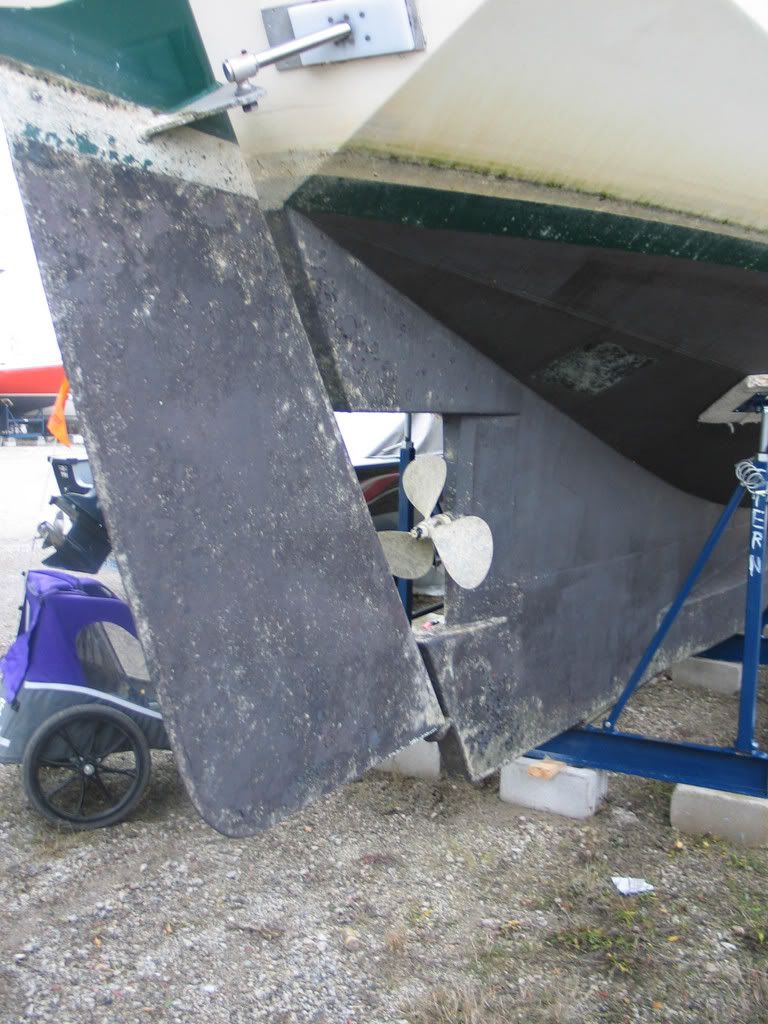
When last we visited the beached mechanic's nightmare known as S/V Alchemy, the rudder had been removed and the old three-blader rudely pulled off its somewhat grubby shaft. In order to satisfy certain concerns about El Propo Grande's blade tip clearance, the new Variprop was put on "finger-tight".
So very pretty
Plenty of clearance all around. Collar shaft zinc optional.
Cutting remarks.
Seems straightforward...nom, nom, nom.
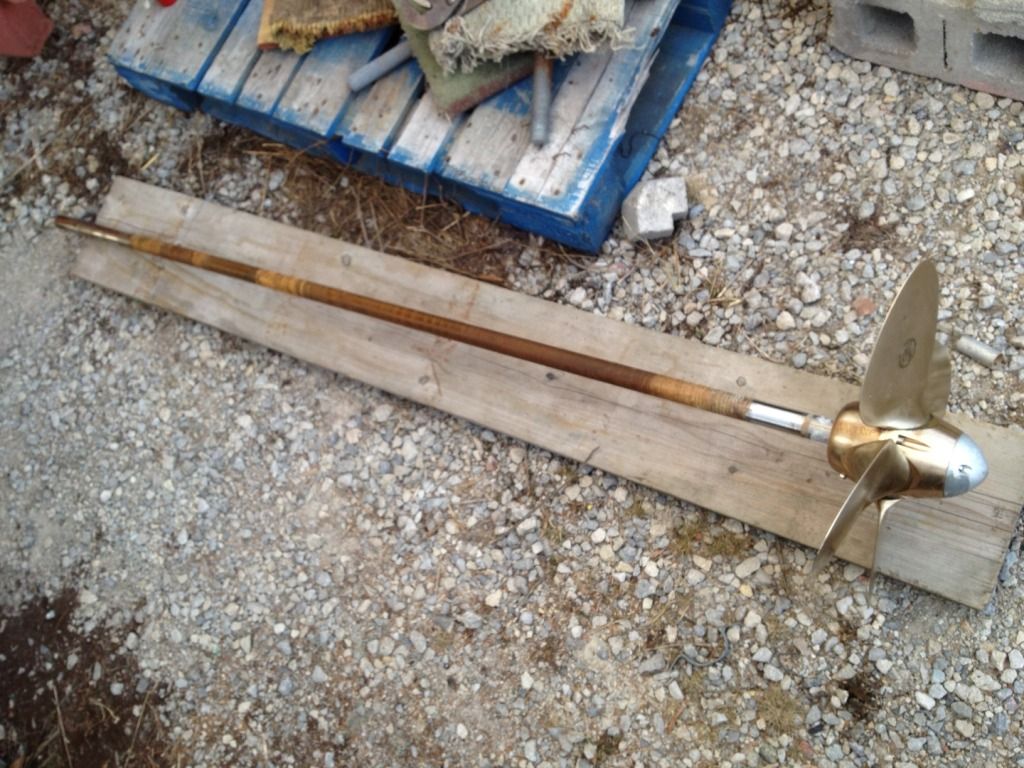
As it turned out, the clearance issue was no issue at all. What loomed next, however, was The Problem of Whip and The Question of Line Cutting. The problem of whip involves the degree to which the shaft runs unsupported beyond the bearing in the stern; even though I could extend it to include a Shaftshark or a similar line cutting device and a 1 3/8th inch thick collar zinc, this would mean unnecessary whip, which is bad for the bearing and bad for everything up to the thrust bearing, the first "hard spot" in the new drive train. See that grey cone on the end of the prop? That's a zinc, and it will suffice. In the equivalent of that zinc space on the shaft (about 1.875 inches at last measurement) will go a Shaft Shark:
The function of this is clear to anyone who has driven over fishing nets, half-sunken line, or even the sturdier sort of plastic bag: If you can chop something to bits before it fouls your precious, precious feathering blades, you should.
Practically modern art, in my view.
Regarding said bronzed masterpiece, one of the first things I purchased for purposes of refitting Alchemy was this glittering and expensive propulsive chunk of German engineering. If I bothered to mull on it overmuch, I would note that it sat in its box for nearly six years before even getting dry-fitted. Write your own rude joke here.
It does not bear too much self-criticism, however, as that time was spent acquiring skills of both land and sea varieties, restoring my original boat (Valiente) to make it more appealing as a loaner, putting my wife through teachers' college (if not, alas, employment as a teacher as of yet), seeing my son complete several courses of sail instruction and get large enough to stand watch and be more crew and less cargo; and sundry other household and family matters of varying degrees of compulsion and distress.
Did I ever mention I'm the owner of a freelance design and writing business (meaning I find work, I don't go to work) and a landlord (meaning I fix what's broken)? Yeah, boom goes most of the scheduling and good intentions. Let me be a horrible warning to all. Do not attempt without a lottery win and years in the trades.
Irrespective of my whingeing, the important part of this particular post is that I calculated, correctly as it seems, that the new "Variprop, modelle D-107, 4-Blatt, 19 x 15" would fit the space occupied by the the former 18 x 13 'fixed", meaning non-feathering or folding, three-blade. This relatively unworn prop will cleaned up and will become a spare we will bring with us.
In 2007, space was terrifying. So was the state of the bottom paint.
The Variprop installation was so widely separated from its original purpose in time by the decision to re-engine. This ultimately meant a number of other sub-projects had to happen, and are now close to happening, or are very nearly at the point of having happened.
(God help the people reading this whose first language isn't English.)
In order to obtain the promised Variprop benefits of "Ruhiger Lauf unter allen Bedingungen, super Schubkraft, keinerlei Vibrationen" (and honestly, who would not want that on a sea-going vessel?), it's going to involve a new shaft cut to the proper length.
That involved the removal of the old shaft. Oh, my aching etc.
A rare appearance by your humble correspondent working up a sweat in -9C weather.
Said shaft was, probably due to the Thordon Elastomeric bearing being out of the water for so long, surprisingly resistant to removal.
I'm thinking this shaft is 304 SS. I want to keep it for the ship's stripper pole.
But thanks to our collective extreme manliness and a surplus of clean living, we extracted the metallic devil from its lair and removed the Variprop for a brief rest. The next time that prop is going on, it'll involve LocTite and a future in Seaworld.
Age has no bearing on it: This device is hardly worn and will be staying in place.
Of course, prior to the propshaft pull, we needed it to stay in one spot for the critical thrust bearing template construction and placement. In the "Aquadrive" system I've chosen to install, the prop pushes against a thrust bearing tied (by welding and bolts) directly to the hull.
Here's what the model for the fabrication, as created by Capt. Matt, looks like:
Now with real bevel angles
Picture all this cardboard being half-inch thick welded steel and it's all significantly more butch.
It's based on what he learned doing his own Volvo 55-Aquadrive-Autoprop installation a few years back, as seen here:
Showroom quality!
It's functionally identical to what I'll have, if differing somewhat in dimensionals, as we have, of course, different Massive Boats of Steel.
Still plenty of space in that bilge, even if you can visualize the waterlift, thrust bearing and wine cellar
The little pulled-apart clothes pegs you can make out in the stern tube are exactly those. They are the right size to shim the shaft, in the absence of a supporting stuffing box, to more or less the center of the stern tube, which is necessary to align the bearing (the cardboard model), the "yoke" (the large green metal thingie) and the CV coupler (not pictured) with the transmission flange (the business end of the engine). The space between the stern tube and the yoke will contain the packless shaft seal, a clever device that can be seen in the video below. A properly installed PSS will keep ALL water out of the boat, a desirable state of affairs in a steel vessel.
After the construction of the thrust bearing fabrication model, we needed to rough in the engine's eventual position. This was a "one-hander" job, thanks to the engine gantry I built last spring.
More up and down than a spring-mounted whorehouse demands proper support for one's tackle
The engine stringers (the fore-and-aft welded girders to which the engine mounts are bolted) needed approximately four inches of height to raise the engine, mounted more or less at the halfway point on the engine mounts, to be at the proper height to couple with the Aquadrive.
Two by fours haven't been either two or four for some time. All this is "four".
It is therefore necessary, in order to gain this height and to give the engine mounts a very secure attachment to the hull, to fabricate steel "pods" or "boxes", which will be welded in place onto the stringers, primed, painted and drilled at the right places to take those mounts.
The mounts themselves are markedly larger than the ones supplied with the engine, and are an integral part of the Aquadrive system. They are called "soft mounts" and this differing type of rubber on the inside has both a vibration dampening effect and allows the engine to rumble with a touch of movement, thanks to the CV (continuously variable) joint attached to the transmission flange.
The result is a much quieter installation in boats made from metal, not generally known for silence underway. And as there is a bit of "give" in the engine's attachment to the boat (but not at the shaft), alignment issues and wear associated with misaligned, as can be the case with solid couplings, is no longer an issue. So, come for the quiet, stay for the reduced wear on the drive train.
But soft! What mount through yonder lumber pokes?
This stringer augmentation operation also gives a bit of desirable height and access to the bottom of the engine (the oil sump and various hard to reach places). I feel it's a prudent and tidy practice to slip in a roasting pan or some similarly easily bent metal container with a pad or two of oil-absorbent material. Even the best, newest, and torqued-to-spec engines can shed various fluids, and this is a cheap method of confining whatever mess may occur. And if a failure of greater proportions (a seal failure, for instance) does occur, the oil pad will reveal under what part of the engine the problem is located.
This gap matches within 2 mm the length of the CV joint and the flange adapter.
As can be seen above, even before the engine is dropped onto the mounts, which are there for final, "fine" adjustments, we are pretty close. While the Aquadrive can accommodate a fair degree of misalignment, the ideal installation as I understand it is to bolt together the entire set-up to as close to zero-degree, perfect alignment as possible. This means when you are trying to motor off a lee shore in rough chop and the boat is being thrown around, you are going to have all the "play" the Aquadrive system offers, meaning you aren't going to snap something because your hull is flexing or you are getting slapped through sixty degrees of roll.
Yes, touch up paint and a little Scotchbrite work is required.
In retrospect, one problem that has cropped up was predictable. When I bought the Aquadrive gear, I had a Westerbeke W-52 with a Borg-Warner mechanical transmission. Learning that rebuilding that engine, which had only 1,300 hours in 19 years on it...but only 100 hours and two years under my care...would cost 90% of the cash required to buy a newer, more powerful, less thirsty, less polluting, lighter and smaller diesel, it wasn't hard to decide to pop for the Beta 60.
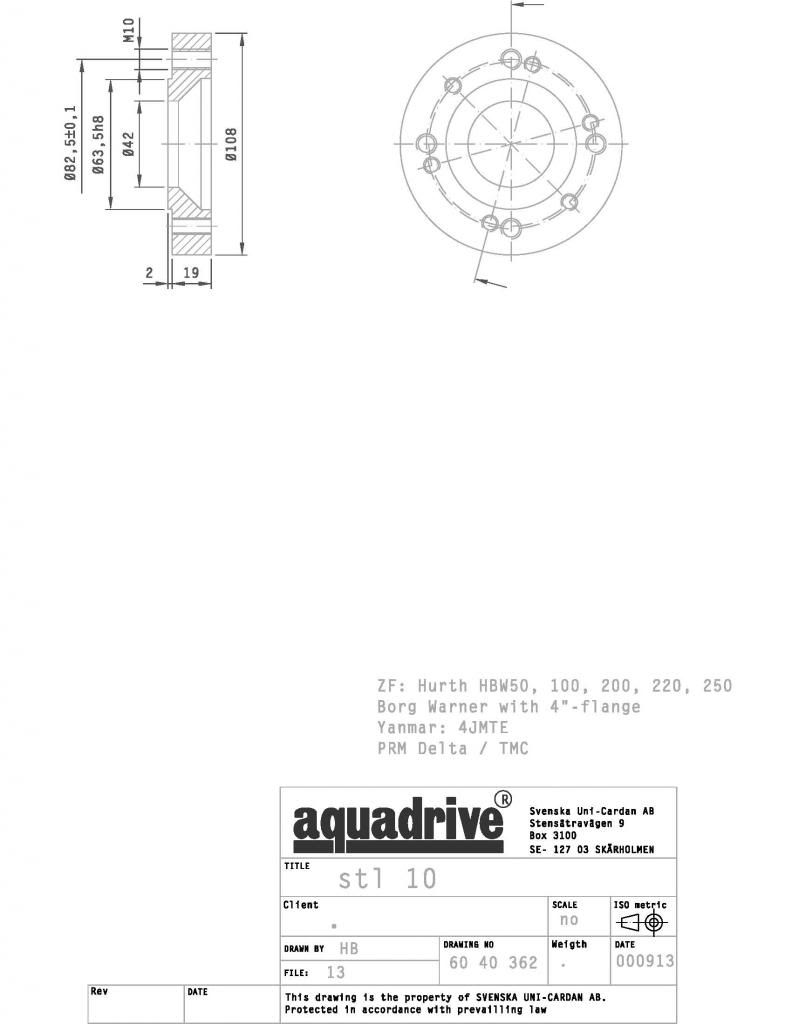
This, however, is a different transmission. It's a ZF 25 hydraulic and that flange is about 75% of the size of the adapter plate (the 3/4" thick piece of Germanic engineering that goes between the transmission and the CV joint) that I have in hand.
So I had to do some measuring. The Beta came with a shaft coupler, so I knew where the holes had to be.
Digital inches are cool. So are cheap micrometers
We'll call that "four point oh".
"Brent", the patient and helpful staffer at the fine firm that sold me the Aquadrive, suggested I could remachine the existing adapter I have to fit the CV joint and the ZF 25 flange:
That's a bingo.
In order to do that, however, the four new bolt holes have to line up just so:
The holes at 9 and 3 o'clock represent "so".
It may be clear from the above photo that putting the big holes on the outer "orbit" (the flange bolts) down by the smaller holes in the inner "orbit" (for the CV joint) would be tricky, indeed.
German engineering, natürlich, has already thought of this:
Yeah, I could've made this white space smaller, but I get paid for that sort of thing.
Note the cleverly offset big holes. So the nice man in Charlottetown is going to figure out the price of buying and shipping a couple of kilos of fine Teutonic millwork to Toronto, and if it isn't truly outrageous, I will have an answer.
If it is beyond the fiscal pale, I have a PDF to show a millwright here in Toronto from which to work on the existing adapter.
More or less how it will look when locked down.
So, after a fair bit of worthy and only slightly impeded progress, the status report for early February is as follows:
1) Engine stringer pods are ordered and are being fabricated. DONE 13.02.13
2) Thrust bearing for Aquadrive "yoke" is designed, is ordered and is being fabricated. DONE 13.02.13
3) New prop shaft has been ordered, and is the same dimensionals as the old shaft, but in higher-grade steel. ORDER CONFIRMED 13-02.07
4) Flange adapter is being priced. ORDERED 13.02.07 RECEIVED 13.02.22!
5) Shaftshark will be ordered this week. DONE 13.02.06 RECEIVED 13.02.15
To do in next week:
1) Confirm outstanding orders and find out availability of welder for thrust bearing and stringers, which should be ready in a week or so.
2) Confirm that new exhaust outlet is to be moved from starboard to port side; confirm outlet is to be 51 mm/2 in. OD. Remove old bilge outlet sea cock. Note: Replace oil we used getting the damn prop out.
3) Measure and plan out exhaust system based on Centek or Vetus waterlift. Based on now-known engine height, work out angles for proper rises, etc. and confirm whether a transverse exhaust pipe or supported hose is feasible.
This is too good an idea not to consider. A siphon break is not needed as one side is always open to the air. Long-time readers will already know my disenchantment with these devices is profound.
4) Tidy up boat and reorganize tools for better access as you use damn near everything in this sort of job and reaching around a massive wooden pyramid in the middle of the pilothouse is getting old fast. Must obtain more clamps! Must search Canadian Tire flyer!
5) The engine must be hoisted high for the welder to get all around access. This means removing or hinging the lowest companionway step to create room to move in, and to cut transverse planking to rest the engine on at pilothouse floor level. Update 130215: Still sourcing the hinges, which need this design at a lower price and not as sturdy. Engine gantry is now modified to raise the crosspiece support about one foot and the floor-level planks are cut and fitted.
A launch is late April is a certainty. A powered launch is looking more likely after the last few days of work. Propositioning, Part 2 is here.
...but I try to take care around my boat work, partly because I don't want to learn the hard way and have to do things six times, and partly because I'm always conscious that I did not receive training in my youth that would help me in any respect in my current full-bore, hands-on operations. Humilty and paranoia are my boat repair and rehab tutors.
So yesterday, my knowlegeable friend (and an award-winning cinematographer) Capt. Matt and I had just retreated from both the cold and from hauling out a very balky prop shaft.
Apparently, the secret to motivating a dirty old shaft is "more lube". It was ever thus, or rather, thrust.
This is part of the whole "tie down the engine to the boat and the new prop to the engine" exercise, more about which will follow in a later, action-filled post. Or maybe two. It's a big topic.
And we see this through his car windscreen:
This leaning tower of cinder blocks seems sub-par to me
Now, I'm no expert in how to overwinter on the hard with vintage runabouts, and I don't know if it's just a maturing sense of competence or a
basic feel for physics that made this seem a little dodgy in both
conception and execution.
The hardest working square inch of pine wood ashore. Picture the fate of the comically small fenders versus the five-ton crane.
Perhaps this is standard operating procedure for the owner. Perhaps my urge to back away on tiptoe so as not to create disrupting vibrations is related to the aforementioned refitter's paranoia. But that is one of the sketchiest things I've ever seen in a boat yard, and I've seen drunks urinating off bows in snowsqualls, boats casually dropped off cranes and trailers, and numerous drug deals.
Maybe some runabout owner will write to reassure me I'm completely off-base (like this boat very nearly is), or that it is Perfectly Safe. I wouldn't mind if the blocks were doubled up and rotated 90 degrees with each row; there's nothing inherently bad about that practice. This practice, however...
The online log of S/V Alchemy, her restoration, her crew and their voyage
“You never enjoy the world aright till the sea itself floweth in your veins, till you are clothed with the heavens, and crowned with the stars: and perceive yourself to be the sole heir of the whole world.”-Thomas Traherne
"He that has patience may compass anything."-François Rabelais
"The Great Lakes sailor is wild-ocean nurtured; as much of an audacious mariner as any. "-Herman Melville
"[The sea is] neither cruel nor kind ... Any apparent virtues it may have, and all its vices, are seen only in relation to the spirit of man who pits himself, in ships of his own building, against its insensate power." -Denys Rayner
“For those who believe in God, most of the big questions are answered. But for those of us who can't readily accept the God formula, the big answers don't remain stone-written. We adjust to new conditions and discoveries. We are pliable. Love need not be a command nor faith a dictum. I am my own god. We are here to unlearn the teachings of the church, state, and our educational system. We are here to drink beer. We are here to kill war. We are here to laugh at the odds and live our lives so well that Death will tremble to take us.” -Charles Bukowski
"A dream you dream alone is only a dream. A dream you dream together is reality." -Yoko Ono
My wife, my teenaged son and I plan to start voyaging in spring of 2020, plagues notwithstanding, for an estimated five to six years. I hope to move us aboard before that point to work out the kinks of living on a boat.
The careful reader will note the URL of this blog has "alchemy 2009" in it, a reference not only to our boat's name, but also to the original, anticipated departure date.
This is called "tempting the gods of the sea and life in general" and will not be modified. You have to know when to fight, and when to appease. Frankly, it matters that we go, not when we go. This is a good lesson for all aspiring voyagers, I think: the hubris of long-range planning lurks like an evil watermark on every "to-do" list.
Here you will find various notes on our preparations, labours and education as we try to become better sailors in a good old boat. I hope to continue to discuss in this blog the realities of preparing for a marine-focused extended sabbatical, the issues both mundane and philosophical confronting the potential cruiser, and the efforts required by everyone involved to make it happen.
Please note that all text and images on this site are copyrighted and may not be used without permission of their respective authors and creators.
Please note that I have not bothered to resize photos and they may be seen at full size and aspect ratio simply by clicking on them. Some photos formally hosted on third-party servers are not at present appearing; I will locally host these photos as I can afford the time to relink them.
Please also note that anonymous comments are usually spam and will typically be deleted without reading.
Author's text and most images other than product shots specifically created by product manufacturers are copyright 2006-2026 M. Dacey/Dark Star Productions. Photos sources linked from online news and related organizations are copyrighted to their creators.
Middle-aged, bookish Canadian with compact family in process of exploding career and prospects in favour of lengthy, low-rent sabbatical has boat, seeks ocean. Must have non-smoking bilges.
All contents (C) 2007-2021 M. Dacey/Dark Star Productions