Copyright (c) Marc Dacey/Dark Star Media 2006-2026. Above photo (c) Marc Dacey. Powered by Blogger.

2013-03-19

Propositioning, or getting a right shafting, Part 2

Machinations and fabrications, it's all getting done aboard the beached steel whale known as Alchemy. This proper update is primarily pictorial, most of this tending toward the self-explanatory.

Measure for measure, this bargain digital micrometer has been very useful
Keen-eyed followers of this record of minor achievement may recall that I needed a different Aquadrive-to-engine flange adapter plate, as I had gone and changed engines. These sort of things can happen when one buys boat gear three or four years out of sync with the actual completion of specific systems. Eh, je ne regrette rien.

The new adapter plate, obtained at a turn your head and cough price from the efficient and knowledgeable Brent of Mermaid Marine of Charlottetown, PEI, proved sufficiently Germanic in its honed exactitude to pass the penultimate fitting, of the dry kind. But a number of processes had to come to fruition before a real live welder was brought in to lay the strong seams.

For one, the engine stringer stages had to be fabricated.
A bridge over troubled bilges.
...and laid in place...

Yes, this will be cleaned, primed and painted. All of it.
Then the engine had to be flown and "blocked" with planks designed to stop (or at least slow) its descent should the chain fail fail during the welder's labours noted in a recent post.

Only apparently half-assed: This reinforcement has raised and lowered the engine a few dozen times with nary a creak.
In order to raise the engine above the level of the pilothouse floor, which itself was necessary to place planking under it and give maximum scope to anyone working in the engine bay, some modifications were made to raise the cross-beam about one foot higher than originally designed.

Not seen is how damn frosty and windy that day was. Or indeed most of days during which this work has been done. Boo-freakin' hoo. I'm Canadian. It's character building, this boat building.

The touch-up colour for Beta Marine engines is Plasti-Kote Enamel 209. Now you know.

That one-belted double wheel is the "double power take-off" custom selected for this engine. It will enable either two smaller alternators to be run (redundancy) or one alternator and an engine-driven compressor or bilge pump.

Reaming the cutlass bearing. Like most boat related activities, it sounds like nasty slang from a drama set in a particularly grim prison.
Getting the new Aquamet 22 shaft in was enough of a two-man trial that myself and the redoubtable Captain Matt have renewed confidence in the integrity of the Thordon Elastomeric cutlass bearing getting oiled up in the previous shot. There's plenty of life left in it to judge by its reassuring lack of play.
As for this shaft, it's arguably the strongest thing aboard.

Back inside, the engine mounts looked "dry-fit OK".

Thanks to the four-inch tall stringers, there's plenty of clearance below the oil pan and above the as-yet unplumbed and somewhat provisional day tank.

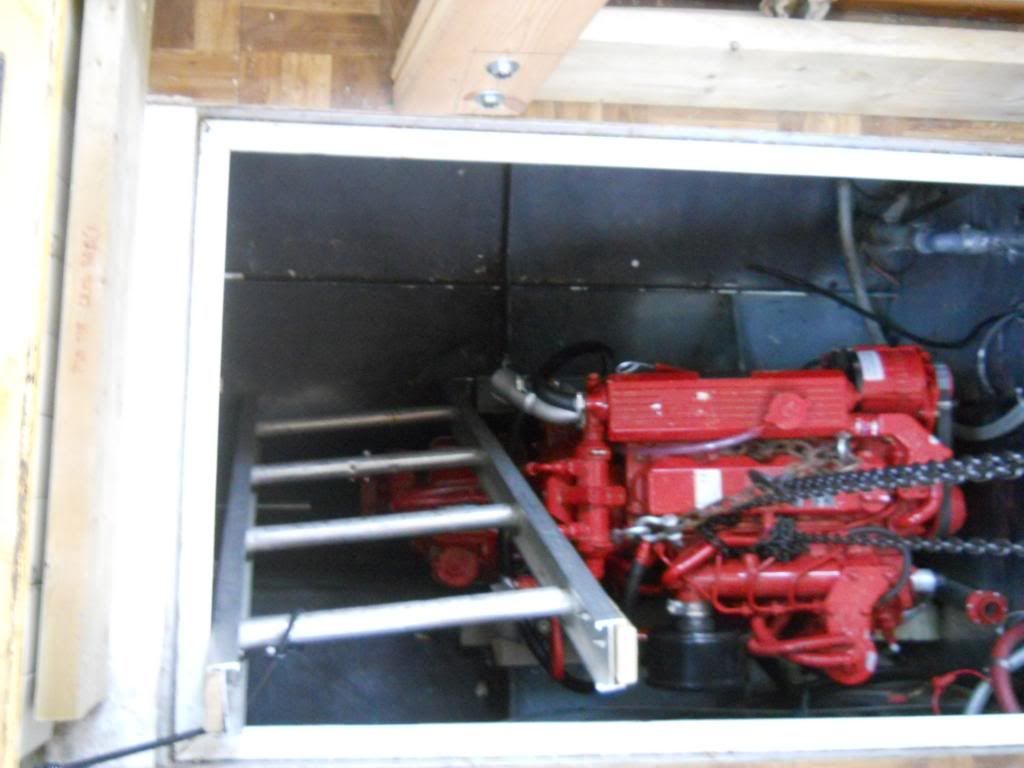
One minor difficulty was resolved by the removal of the lowest pilothouse companionway step, which will be hinged shortly in order to allow fabricated engine bay doors to open along the entire length of the engine bay opening.

Now you see it...

...now you don't. The bungees hold the tongue and groove trim over the steel bulkhead in place.

The needed adapter arrived and was found Aquaquate, so to speak.

Adaptation of the species
After that pricy little item went on, we had to slip on the Packless Sealing System, confusingly and redundantly frequently called the "PSS Shaft Seal". The principles on which this popular device operates are well known enough that I won't recount them here, but the important bit for the novice to grasp is that this replaces the traditional flax-string stuffing box, which is the only barrier between the sea and the interior of the boat via the prop shaft's "tunnel".

I could grow fond of the accordion.
Traditional stuffing boxes must drip as part of their operation. PSSes do not. On a steel boat, this is desirable and worth the cost of purchase.


Set-screws on the shiny part against which the "bellows" of the PSS presses are a touch unusual in that they are stacked one atop the other. I have to obtain spares of these little hex bolts should I ever, Neptune forbid, have to disassemble any of this stuff.

After the welding came the drilling and the fitting. If this process seems excruciating, time-intensive and laborious, it's because it is. The idea is to line up the new engine on its new mounts and stringers with the old shaft log (and the new shaft, new prop, etc.) as if it was a solid coupling. The Aquadrive is there to mitigate vibration, to isolate shock loads from shifting on the transmission, and to allow "play" in the engine's drivetrain so that wear is greatly lessened on the component parts.

This means the Aquadrive installers must "zero in" on the initial alignment just as with a more traditional boat drivetrain installation. Another parameter that has to be addressed is the proper torquing down of the bolts that connect the shaft to the "yoke hub" and the CV joint to it and the engine's flange.

The old prop serves an unaccustomed purpose.
This is done with the prop shaft held in place in a somewhat unusual fashion. The old prop and some F-clamped lengths of wood served to keep the shaft still while the bolting down of the part of the Aquadrive that grips the (non-keyed) shaft end happened.

Torquing about a revolution.
Lest it appear in these photos that I am restoring a rusted-out wreck, most of the visible rust here is actually superficial waste from previous grinding operations. There's little point in removing it until it's warm enough to paint in, I hope, April.

Thus endeth the dry-fitting.
What follows is me finalling the alignment (see Part 3...yes, really) by using a bevel and tiny, tiny movements of the heavy engine until I feel confident that I can scribe drill marks atop the stringers. Then up goes the motor again, down goes the drill and in go the engine mounting bolts.

Is this my good side?

There's no point in putting on the new prop and Shaft Shark or indeed painting all this until it's all aligned to an obsessive level of precision, or to whatever level of which I am capable. Then back goes Mister Rudder. There's a day tank to create and a new instrument panel and engine controls (and some provision for temporary fuel and batteries) to install next. Seems a lot of work to drive to a dock all summer, but such are the baby steps of Adventures in Refitting.


2013-03-15

Introducing "the one-fingered boat"

What's the current phrase? "I'll just leave this here":


Behold the brave new world of recreational sailing. This design from a very reputable firm is  conceptually divorced not only from our own experience of sailing, but in most respects (apart from the clever stowage notions I like to poach from newer designs) is very different from the direction we are going with our refit, which is notable for the complexity involved in making things simple, strong and enduring

So for us, "one-fingered" has a particular meaning in this superficially harmless product spiel, and quite another when put against the agenda of a sail voyaging family planning to be several thousands of kilometres from the nearest Swedish electrician.

And a sailing family, I might add, have come to appreciate the implacable enmity of electrical circuitry and salt water. Or even Lake Ontario's dampness, really.

I have considered Halberg-Rassy to be, along with Oyster and Swan Nautor and J-Boats, to be in the top tier of production builders. You can reasonably predict who I consider to be in the bottom tier. If they've gone this route, it must be because "the market" demands it. No builder of such an unlikely and fickle purchase as a forty-odd-foot sailboat can afford to ignore potential buyers, even if they require the largest sort of training wheels and soft-spot helmets. So the absence of a peek into the engine/machinery spaces, or a look at where the vast amount of batteries must be stored to power this push-button boat is perhaps purposefully absent. "Pay no attention to that man behind the curtain" should be on every bill of sale, perhaps.


An early meeting with the Hallberg-Rassy focus group, perhaps?

So here's a little test for readers, a little "market research" for this benighted boat blog, if you will. There are no right or wrong answers, merely opinions.

Watch the video and submit answers to the following questions:

  • 1) What is interesting about this design, and why?
  • 2) What is questionable about this design, and why?
  • 3) What is problematic about this form of new yacht review?
  • 4) Would you consider purchasing this boat, or a boat similar to it for your own use?

Answer any and all. If I get sufficient response, I'll consider sending a small, nautically themed prize to the best (meaning in this case most insightful) reply. Consider it my own form of market research, in this case to reveal biases of the readership of a sooty, overextended and cold boat refitter trying to stay a half-step ahead of his own ignorance and talent for self-injury.

Clearly, and rarely, with this video,  I am somewhat at a loss for words here, although I did find notable that the question "how does she sail?" is not asked until the final two minutes.

2013-03-14

Medium rare to weld done


Still capable of burning down the garage, but you have to start somewhere.
Having found it periodically problematic to find a welder to do many of the jobs required aboard Alchemy, I've resolved to learn how to weld myself. But the currently strained budget and my book-only knowledge makes a slow, careful and heavily protected start with the equivalent of a welding toy, in this case a discounted Lincoln MIG-Pak 140 model. This is a gasless wire-feed flux core type (or gas shielding can be used) suitable for light gauge steel and aluminum. I can get my weld on with essentially scraps, or pieces from Metal Supermarket, and make my inevitable learning-curve screw-ups cheaply. I can also compare and contrast the results of "gasless" versus "shielded" welding. I am already aware that there are definite advantages to shielded welding, but my needs are essentially low-volume, will be done in the open air, and are rarely concerned with end-product appearance, merely strength. There is very little I will make for myself that won't be immediately primed and coated in Something Two-part and Industrial.

The advantage to this particular welding unit for me is that it runs on standard 120 VAC current, although at its highest setting, suitable for 1/4-inch stock, it needs a 20 amp circuit. I figure that I can even use the relatively wee Honda 2000 to power it at half its settings, which would suffice for making brackets and the lighter sort of frames.

Anyway, the steel fabrications I had made a few weeks back for the engine stringers and the thrust bearing "yoke" have been for the last couple of weeks clamped and scribed in place:
To be primed and painted and drilled, etc.
Built to get the shaft, and to like it. Damn, sailing's rough practice.
What was proving difficult was getting hold of a welder to do the actual "melt it to the boat" bit. Greg the Welder, who fabricated our solar panel arch and welded it to Alchemy lo! so long ago, was barely contactable by phone, and despite his best efforts, admitted he was booked until April.

We launch in April. Not good.

I asked a welder at the club if he wanted the job, No, he said, but he put me on to another semi-retired other welder/club member, who already said in the past that he didn't want the job, but who might have an apprentice up for it...sometime...

Argh.

Treblex, the Mississauga-based metal fabrication firm,whose work impressed me and Capt. Matt, my "installation advisor", put me in touch with a couple of names. One called back right away, but said he'd need about a week and a half to get to me. The second guy whose name Treblex gave mecould've been by in three days, but in a mounting sense of panic at the passing days of winter, I'd already booked Welder Number One. Welder Two has some designs for various fabrications I need, and as some marine fabricators have already turned me down, albeit in a helpful manner, for being too piddly a client to work for, Welder Two might get those jobs after all.
Diamond Sea Glaze made this for Beth and Evans of S/V Hawk. I am not her, alas, and I think DSG have gone a bit higher-end. Evans was kind enough to correspond with me about how it has worked on the Big Real Ocean.

Welder One called back unexpectedly earlier this week and said "his guy, Jeff" could drop by Thursday morning. Which is how we got to here, finally:
Fire in the hole!
This is the by-now tiresomely familiar sight of the Beta 60 being kept in suspense. The process was "put welder and gear down hole; raise engine to reveal welding job; place planks as 'safeties' in case chain fall fails; reverse steps to free welder".
He was quite capable of cutting his way out, if I went for a walk or something


The misty appearance is the smoke from burning primer, for which I was lightly chided by Welder Jeff for being too witless to remove prior to his Smith God routine. Bad skipper!
Possibly not to code, but the gantry mods I made were apparently sufficient

The stringers were continuously welded at both ends and "stitch welded" periodically along their sides, Welder Jeff assuring me that this was more than sufficient to stay attached should the seas boil and the winds howl, etc.

The weld is so bright, I've got to wear shades

Here's where the thrust bearing got welded directly to the hull.
And where the Skipper figured out a better camera angle other than "straight down".


Yikes. I went to ground level to confirm my approaching date with bottom paint.

These are "heat marks". They are evidence of "successful penetration". Write your own joke here.

Yep, that's burning bottom paint. Oh, well, now I know how to relate stuff on the inside to stuff on the outside.
Boat osmosis or lava? You decide!

The other side was equally spot-fried, but not, I was assured, "all the way through". Well, I would hope not. That could impede sailing plans. Welder Jeff actually commented that the steel hull at the turn of the bilge was "surprisingly beefy, probably three-eighths of an inch thick or better". Thanks, Welder Jeff. I feel better already.

Now that this particular skills bottleneck has been cleared, I could write, and may yet write, an entirely separate post on the struggles I've had finding tradespeople (marine and otherwise) who were a) competent, b) reliable, c) not extortionate and d) in existence. A brief confab with Jeff on the state of his world underlined how busy he is, how very few young people are going into the trades, how "no one wants to get their hands dirty", and if they do, they are making craploads of money in Fort McMurray.

Short of encouraging our son to go into the trades so he can support his poor, old, by-then salt-encrusted mum and dad in our mutually pensionless dotage, I can do no more. Well, I can try to improve my own skills to lessen my reliance on others, who aren't likely to be found in tropical lagoons anyway.

That's how this post began.

On Monday, we move to the final positioning, the drilling of the stringers to take the motor mounts, and the final dry-fitting of shaft, coupler and prop with the various extras. Onward, upward, spendward.

2013-03-13

Strutting and gassing and lighting


How hard can two rectangles be? I guess we will find out.

Recently, I've had to research every type of "gas spring", which is the name of the category, by the way, for the lifting mechanism of every sort of hatch or platform that is heavier than something a simple bronze or stainless strut would hold open with confidence, which is why it's top of mind.

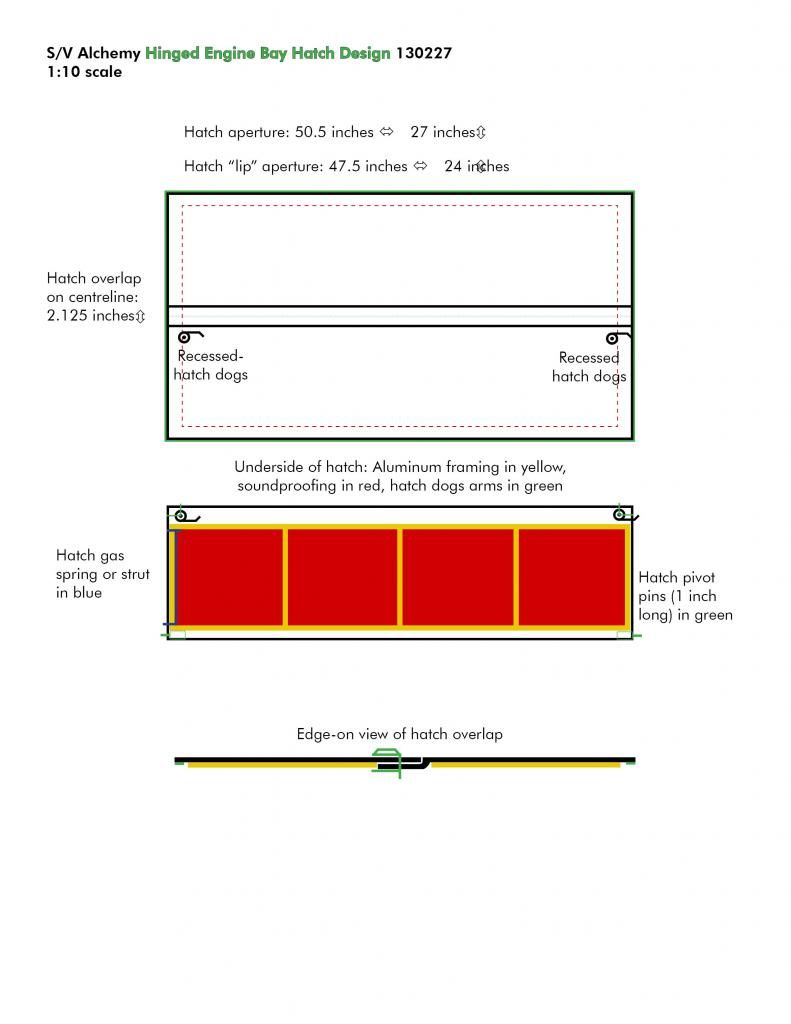
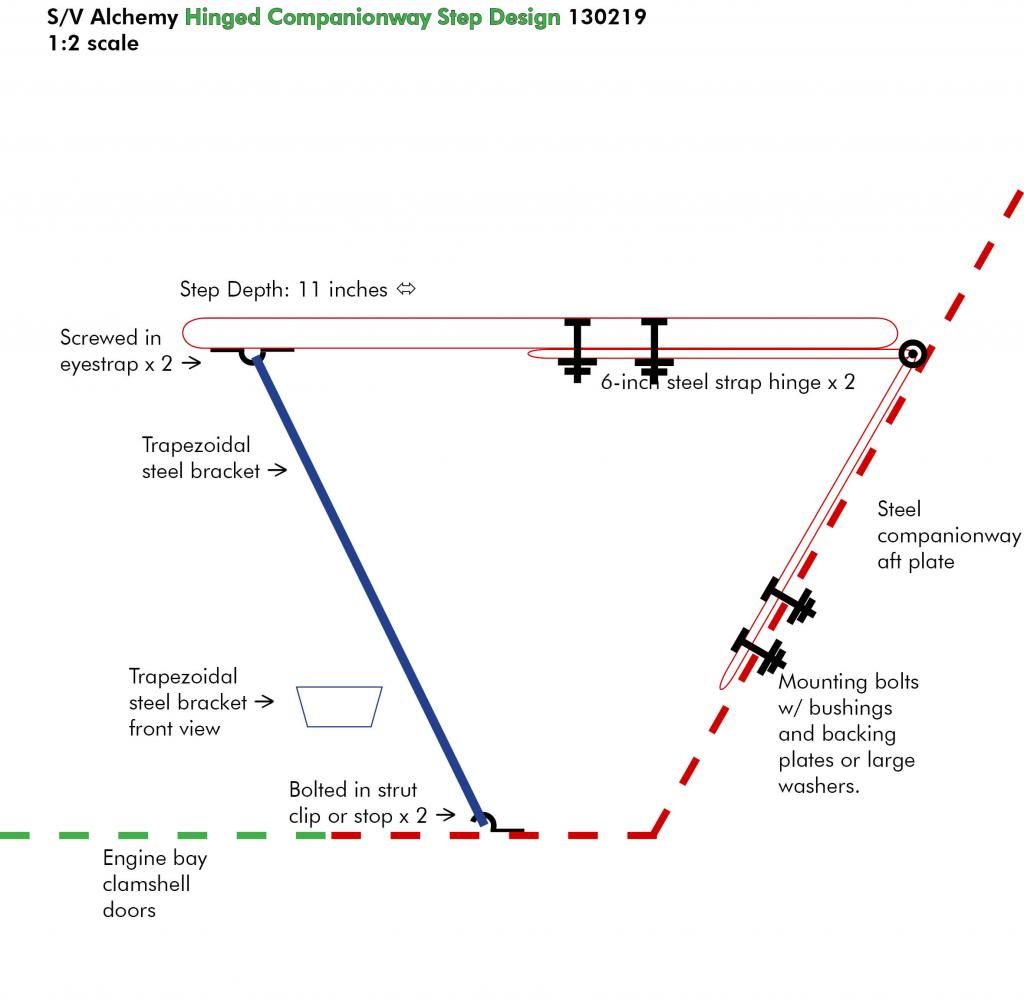
Related project to the engine bay "clamshell" hatches: For them to open, the last step into the pilothouse must raise or lower out of the way.
The ongoing engine stringer/thrust bearing project (more on this soon) was made easier by the removal of the lowest step of three going from the aft deck down into the pilothouse.

Watch that last, missing step. It's a doozy.
Removing this gives enough "air" to get a welder down and around that engine, which needs to be flown up and secured once the welder is down with all needed gear. It also would be latched in the up position when the bay hatches are upright. After a bunch of fruitless searching for a folding bracket that would fold up, and not down, and yet could support a human's weight in a seaway, all I could find was something representing overkill in several respects:

Works in the right direction, but is too big and too strong.

So my design is much simpler. An eye and hook can secure it, or even a loop of bungee, and a metal "C-strut" can support even the impact weight of a wet crew stomping on it.

Pretty representative of the genre


As for the bay hatches, this type of gas spring is nice, although I could just as easily use the very same sort of sliding hatch strut used on most deck hatches. The doors have to be kept open, and that means only their own weight has to be supported when open. When closed, the frame of the "bay hole" itself, plus the overlapping center "lip" does that job, unless my design, currently under review by a fabricator, is insufficient.

On the subject of where the backsides go, as the pedestal type of gas spring for helm seats are quite spendy, you could get everything from a bus driver's seat mount to a salvaged barbershop chair base to accomplish the same action in a compact manner.

Priced with the customary "Marine means times three" factor


We actually tried to acquire a "salon chair" for $99 last year, but we didn't get a call back. Might have been a dodged bullet, as I suspect the pedestal to seat plates and pedestal to floor connections are both robust and less prone to corrosion than barbershop specs typically are.

The reasons for this particular line of enquiry is because there is a height discrepancy between my wife (and my son for the near term) and myself. We therefore require a helm seat in the pilothouse that can move up and down and fore and aft. Ideally, a sailing helm seat would pivot side to side on some sort of friction fitting, either to make sailing on a heel comfortable (if one was, for instance, on a night watch during a cold rain from the pilothouse in the mid-Atlantic) or to shift side to side in a cross-swell. According to a recent thread I started in Cruisers' Forum, however, that particular sort of pedestal seat base doesn't seem to exist currently. So it may end up being another fabrication job, or we make do with an off-the-shelf solution.

Eh, may be overkill...the measuring tape will confirm, but the arm and foot rests are nice

Strangely, I have done exactly that with the seating solution I envision for the forward workshop. Preliminary designs, taking into account the time likely to be spent in there, the need to shift my weight and the space available, gave me a  very quick idea I might not have otherwise had if I drove a car: a bicycle seat on a post. For better or for worse, I am used to bike saddles, and I can literally salvage everything I need out of my garage. I can even make it spin...

I'm looking forward to this part of the rehab, actually. It's probably within my skill set to do it right.

Back to the "strutting", I need to investigate gas springs for my engine bay hatch and my steel forepeak deck hatch, both of which will be "unlight". Another dinette-weight project will be the new saloon companionway steps I am planning to frame up, which will cover eight Trojan L16s in a welded, stepped box, which will themselves contain battery boxes for each pair. One of the very few things I like about current showroom queens are the gas springs that allow a companionway hinged at the top to rise with a kid's grade of arm strength and stay put under pulled down, much like a well-fitted sash window.

This is bigger than I'll need...it's from a Beneteau 55... but picture something similar going up like a van's rear hatch.

The point is to take all the half-ton of batteries I intend to carry right to the CE of the entire boat, meaning I can dispose of the lead pigs acting as trim ballast forward...and replace it in part with tools and spares.

The gas springs used for truck engine hoods should be about the right size. You could use gas springs in combination with a locking strut in a number of applications around the boat in a similar fashion, including fold-away or fold-up table or nav station surfaces.

Lastly, today's hot boater tip is that Lee Valley seems to be selling moddable warm white and coloured LED strips for a price I find reasonable, and will do so for bulk discount. Many sailors have for many years been taking out the old auto-type 12VDC incadescent bulbs in favour of LEDs, particularly as the first-generation "cold and bluish" type have declined in favour of "warm white. But this Lee Valley system is more or less snap-together, looks nice (I've seen them in person) and dimmable, all attributes that are like catnip to the amp-conserving average boat fixer. I saw the RGB ones and thought "hey, go from 'blended' white to pure red in the pilothouse with the turn of a pot dial? I can get behind that!"

Part Lite-Brite, part Lego.
Naturally,  I think LEDs are the absolute bomb in any boat place that requires small amounts of light (like inside lockers soldered to a 9V battery and a contact/reed switch), or for "mood lighting" under the lips of cabinets aimed up or down.

We are pretty much at the break point between me wiring up strips off a spool obtained from an "industrial concern" and the price of retail at places like Lee Valley. I thought I'd have to make and measure my lighting, but it's going "prêt-à-porter": just buy what you need and screw it down.

2013-03-12

The buzz on boat alarms


The deluxe version?
Despite the oft-repeated goals of cruisers to laze in hammocks drinking out of pineapple mugs, the cruising boats used to get to hammock-positive locales are increasingly complex machines.

One could easily neglect to check certain dials, digital displays or indicator lights on the modern boat, and thus fail to note (or have the watchkeeper fail to note) engine overheating, low oil pressure, water ingress or some other potentially fatal condition, like a propane leak or CO build-up, requiring immediate skipperly attention.

A personal favourite

Having had low oil pressure and cooling water overheating issues on our boats in the past, I am a fan of early warnings. There's a gas/propane sniffer on Valiente, along with a CO detector. I typically check for "output" of cooling water at the stern and eyeball the temperature and oil pressure dials of the very basic Atomic 4 control panel, and so haven't bothered with buzzers. On Alchemy, I will install more alarm setups because more of the critical systems could self-destruct without immediately noticing the process, and also because, frankly, there is a lot more at stake than aboard a Lake Ontario day sailer.

And Canadian-made, by gum


Plenty of alarm widgets or alarm systems exist for the cautious/paranoid/typical cruiser, and some are very clever indeed, and cross over into the solenoid or automatic actuator realms.


But I wonder: why don't boat system alarms talk? Cars talk, GPSes talk, even cheap alarm clocks murmur instead of buzz. Even smoke detectors can shout at one. Even personalized smoke detectors exist.

"Get out of the house, ya little pyro!"

Voice recognition, as fans of "Siri" know, is a thing of the present. So why should a host of boat alarms buzz with essentially the same range of tones?


It should not be massively difficult to replace that growing host of various buzzers with the sort of circuitry that is found in “talking/singing birthday cards”, or “talking seatbelt alarms” in cars and the like. Or to rig just the chips capable of holding a two or three word message, along with a small amplifier, to make a personalized alarm.

Imagine hearing instead of some random buzzer in D sharp, you heard your own voice saying “Fuel pump overpressure!” or “Bilge past six inches!” or the very useful “Exhaust temperature past 100C!”
If one did not wish to actually record specific messages, one could simply throw in random…but distinct…noises on pre-recorded chips, like "birdsong means bilges", or "fly buzzing means fuel", and so on.
Functional, but a little HAL 9000

It’s the distinctiveness of the alarm noise that is desirable. Buzzers tend to sound alike, because they all come from the same factory in China, I would imagine. Voices...now, the human mind zeroes in on those in terms of direction and content far more easily. Of course, if you find the idea of a verbal alarm a little creepy, there are some less buzzy options.


Picture combining the “talking alarm” with “The Clapper” for a shut-off, and you’ve got the basis for a marine products empire where the average customer’s age is already well past “I should’ve worn earplugs during that Alice Cooper tour in '72”.

Personally, I am not quite that age, myself, and due to plenty of deafness in my family, I have both nursed my hearing and had it regularly tested; it appears I'm in good nick. Spend time at an average boat club, however, and it's clear a large percentage of Boomers have listened to a few too many booms to hear their pants ringing in anything but a dead-quiet environment...which the sea is rarely.

Like my idea for dim, five-second red LEDs that would be triggered by movement across the sill of companionways at night, or a 9V battery-powered, reed switch-activated, under-lid LED locker light, I do not see a strong objection in cost or complexity of a “talking alarm” to easily distinguish what part of the boat’s systems is complaining.

It only sounds like Star Trek. The actual electronics involved would not be beyond the average electronics hobbyist, which most cruisers already are, because they can't afford not to be. I built kit shortwave radios and repaired my guitar amps as a teen and still do various electrical bench work (I'm trying to reboot an old Furuno radar I found, for instance); I don't think any of this at the level of "home-brewed" is very difficult to rig. If someone's already invented these sort of gadgets, I would enjoy hearing about it. Just not in the form of a buzzer.

"I'm sorry, Skipper, I can't unlock the rum cabinet."

2013-03-09

Cargo by sail barge to New York City? It's more likely than you think.

Barging into history to bring Vermont rice to New York City
Most blog runners have the capability to see all sorts of statistics about their posts, and one of the more popular posts I've written is on the mild return of sail and sail-assisted freighters. In the context of a blog about refitting a steel sailboat, my interest in cargo is admittedly academic, but we have considered the pros and cons of schlepping stuff for money, services or "in kind" trade on Alchemy in a fairly basic manner as a viable route to managing costs and making friends in remote places.
Besides, now I have a excuse to rerun this.
In 2013, we aren't particularly distant in time from the last of the working tall ships, which I define as freight carriers of bulk cargo, as opposed to sail trainers, floating classrooms or romantic forms of tourist transport, many of which started life as the last examples of sail-powered freighters.
Behold the mighty arteries of capitalism's advance!
We are more distant in time from the regular use of sail-powered coastal and riverine water transport and that's why in my original post I hadn't considered the older sort of sailing barge or scow. These are the sort of short-haul, shallow-draft cargo vessel for which North America's canal system was built and which formed the backbone of trade in much of the world until railways and marine motors made them unfashionable, and the post-war commitment to truck transport pretty well killed them off save for hobbyists.

Said hobbyists have, however, sufficient documentation so that you can build your own barge

Truck transport, while undeniably flexible as long as the oil holds out, cannot be considered particularly efficient. Water transport, either powered solely by wind, oars and poles, or with small engine assist, is more so.
Coming soon to a river near you
Alas, "more so" is not "clean". As this report from NASA outlines, the regular routes of our (arguably) most efficient ships leaves a distinctly dirty trail in the sea and sky.

When your blow-by can be seen from space, it's time to re-evaluate your ring job.

This level of pollution seems to be one of the more compelling small but intriguing proposals to revive cargo by sail-powered boats and ships.  Another realization is that even the incremental improvement in the energy efficiency of typical powered marine transport is not really holding back the tide of total energy usage; even in places such as Europe (see grotty seas above) where fuel is twice as expensive as in North America, it is proving difficult to use less of the stuff and maintain their economies, already stung by mismanagement.
The sail transport line must be here somewhere

Before I go all "peak oil survivalist" on you, much of the small resurgence in cargo-by-sail is firmly based in economics, which, as the luxury car, fashion, condo and food industries prove, is itself strongly distorted by sentiment and emotion. In other words, most urban people could have an enclosed electric motor golf cart as personal transport, live in 400 square foot recycled abodes, dress in naturally dyed hemp and wool, and eat only enough vegetables to maintain a healthy weight and productive energy levels.

Right....know anyone like that? There are few things more insufferable than a saint. Some douchebags come in green.

If the history of consumerism has taught us anything, it's a) it requires loads of cheap energy to even have the sort of consumerist economy developed since World War II, and b) people will spend a lot of money in order to use less energy, because it makes them feel both virtuous and more in control of the means, or at least the distribution, of production.
A shitty sailer in the best sense of the word.

So where do the barges fit? As Erik Andrus, the guy attempting to build a barge in Vermont to travel down the Hudson River to New York City and back, states:

"Producing food sustainably is not enough.  The other half is sustainable transport of goods to market and equitable exchange.  A good portion of the damage conventional agriculture does to society and the environment is through our overblown, corporation-dominated distribution systems.  The idea of a small, producer-owned craft sailing goods to market, perhaps even a distant market, is an alternative to this system..."

Given how farmers and fishers have been jerked around and nearly "consolidated" out of business by "globalization", it's hard to argue that a farmer who can see a reasonable means of getting his products to market gets to retain a higher percentage of profit. His customers feel virtuous, probably enough to pay a premium...if a premium is even needed. And that's why newly built sailing barges on canals and rivers could yet trump our old friend the 18-wheeler. You just have to plan a little more for a world where goods deliveries "maybe next Tuesday" instead of "overnight", and you have to want to live in such a world. One needn't be a pessimist (warning: long-winded!) to see that world on the horizon, or to anticipate it as a world of opportunities.


And thanks to the miracle of the Intraweb, those who can appreciate the utility...not to mention the economy...of a barge driven by a pivoting sprit- or lugsail are developing their own networks. Certainly, there is both an admiration and a desire to repurpose "heirloom technologies" for a world with ever-rising fossil fuel costs, but like the practical electric car and that personal jet pack I was promised forty years ago would be stock transport by now, only time will tell.


2013-03-07

What's old Norse for "and a star to steer her by"?

That's not even much of a swell, but the freeboard is impressively low, no?
According to a recent report, the fabled Viking "sunstone" may have been a real, and really early, Norse navigational aid.

Icelandic spar crystal is apparently the thing, but I wonder if a pair of Oakleys might work.
The trick for those too distracted to read the article (or this shorter one), is not only to keep some sort of record of the position of the sun at dawn on the horizon on various days of the year, but to know the date and to corrolate this with some sort of compass rose.

The Alderney Stone: Remember geometry? Yeah, that's a factor here.

See the polarization effect and compare to the date and the direction. It's a sort of early and rough sight reduction: celestial with a glassy rock, and no compass. Not everyone buys that this is what the sunstone was and this is how it was used, but it's an interesting find, nonetheless.

Knowing the gnomon doesn't go on the front lawn is half the battle.
That the VIkings had this is not surprising, as within the limitations of their technology, they were clearly expert navigators; that they refined it to better their chances of reaching distant shores, and returning, in often overcast conditions, is more so. Other cultures, particularly the expanding Polynesian cultures,  had some pretty impressive means of determining their course at sea, and to note the very subtle signs of land well before it appeared on the horizon.

Another surprise from the article is that the stone suspected to be a sunstone, or to have been used as such, was found from an English ship sunk in 1592, a good two centuries after the introduction of magnetic compasses on most European seagoing ships. What was unknown, as clearly as the optical principles on which the sunstone itself worked, were the terrestrial effects of magnetic variation and the ship's habit of creating deviation (beyond being aware that iron made the needle twitch).

Iron balls are essential to the compensating binnacle. No joke.

A good hand with eyeball navigation and a backstaff or even the latest astrolabe could correct for some of these hazards to navigation, but perhaps the sunstone was insurance. Mariners have always been a conservative lot, unwilling to abandon older, proven technologies even when more modern and allegedly superior ones exist...or virtually exist. Like knowing how to swim even if you religiously wear a PFD, perhaps the compass and sunstone combo will be eventually found to be the navigational belt and suspenders of 16th-century...and beyond...seafaring.
I have these and know how to use them. Will that be the case in even 25 years?

I maintain that the prudent mariner proposing to venture across the brine avail themselves of all the tools of navigation they can, if only because even a passing familiarity with some of these older methods ties together the concepts underlying all navigation, and makes for a better interpretation of whatever Mr. G.P. System is insisting upon is one's real location.

2013-02-26

The rough tally

There's been further progress on the drivetrain installation, but I'll hold off a bit on a further update until the beads cool off and the Loc-Tite is dry. In the meantime, as I am again spending it, let's discuss money, something that is like a little grey squall line in the minds of most refitters or cruisers-in-waiting. 

One of the pertinent things people considering a boat refit want to grasp is the cost and the time commitment. While posting recently on a fellow refitter's excellent site (which I like because he is clearly more fastidious and skilled than I am, so I get to see the right approach early), I answered one of his reader's queries with perhaps more detail than I had intended, but it got me to actually think of a rough tally of what I have spent and anticipate spending.

Of course, any numbers are only representative of our wants and needs in a pretty unrepresentative (steel motorsailer custom-built for passagemaking and independence from shore) pleasure craft compared to most others available used, and almost all boats, save for the often-French aluminum monos of the Jimmy Cornell-endorsed expedition type.

An OVNI 435: An example of an offshore-capable, fast cruiser we couldn't afford, but I'm OK with that.

I find that it's best to work with percentages, as does Beth Leonard in her excellent and recommended Voyager's Handbook. Rule of thumb: Buy the boat for X dollars, and budget a refit for X/2 with a 10% surplus for toys or upgrades that may prove persuasively desirable during the process of refitting.
Like an Admiralty Pilot for your budgeting
So far, we are on track.

While my numbers do not include the cost of belonging to a yacht club, the cost of insurance, the cost of many tool purchases, and some of the raw materials, nor does it include the profit made from selling unwanted tanks, the old engine, the Mercury that came with the boat, and so on.

For new or inattentive/senile readers, I've replaced a Westerbeke W-52 with a Beta 60 in my steel boat, and am nearly finished (which is good as I launch at the end of April, 2013).

There have been a lot of variables, but the "hard numbers" include the purchase of a new engine with some custom accesorizing at about $11K. I've popped for various steel fabrications, a new Variprop, a new Aquamet 22 prop, a new AquaDrive CV, new adapter plates, a new PSS, a Shaft Shark, yada, yada, yada. I'm also paying a friend whose done this job before to help out, and it's saved me time in figuring out the process and in getting it right on the first try.

 Allied expenses include the changes to the fuel system, the purchases of a FilterBoss and the loads of labour/time involved, including the construction of an in-pilothouse engine gantry/chain fall to make "flying" the engine a one-hander job, and loads and loads of research, which has never really slackened. Some might (and have) suggested I could have done less reading and more doing over the refit process, but we all have our ways of learning, and this has worked for me. I see very experienced sailors making what I consider to be basic errors in seamanship or maintenance frequently, and have to conclude they've to this point not had such errors round up on them with consequences, and so to each his own. I try to learn from the mistakes of others and consider it seamanlike. Naturally, this is only an ideal: my own screw-ups can only be reduced, never eliminated, the same as everyone reading this.

The "upaid" element also includes soliciting help had to solicit help from other boat club members, from getting technical and fabrication advice to having them act as  Polecat operators to hoist old engines out and drop new ones (gently) in, to help level my occasionally sinking cradle and to generally motivate me by constantly asking me when I was 'ever going to launch'. Never underestimate the moral support of those sick of seeing one's boat spending a few seasons in the club parking lot. It's indeed priceless.

If the re-engine process costs me only $22K (or twice the cost of the purchase) from the decision to disconnect a working engine in need of rebuild to the turning of the key on the new engine, I will feel not only fine with things, but as if I got some sort of price break because I did a lot of the work and research myself, and resorted to outside help only when I had researched enough to know when to bring in said outside help because it would save time (hiring the friend who had done a very similar steel boat repower with Aquadrive and feathering prop upgrade) or when I lacked the equipment or the skills (big ol' stick welder to affix 1/2-inch steel to the hull) to do it myself. There is also a clear mandate for me to attain a higher degree of self-sufficiency by becoming at least familiar with how everything works, and I can't pretend that has been easy or swift.

I speak from experience (still ongoing) of a years-long refit process, and from not having had, by dint of what I hope is loads of research and a clear evaluation of what I am really capable of doing myself, much in the way of bad surprises.

So even if you exhibit a Scottish gene as I do, count on this refit/prep for long-term cruising with a "shore-independent/marina shunning" process as being twice as expensive and take three times as long as you've planned. Unless you refit boats for a living, or care to pay someone to do the whole thing, in which case count on four times the price in half the time.

Naturally, this process does not cover the hundreds of hours I've spent learning how to fix boats, fixing them, discovering I've done it improperly, undoing the mistake and applying rum in the evenings to soothe my nerves. Nor does it cost the money I could have been making (maybe) if I wasn't trying to educate myself or acquiring interesting burns and cuts with the applications side.

It doesn't include airfare, the cost of PLBs, foulies, tethers and related gear to faciliate a few crewing opportunities my wife and I have taken. It doesn't include four summers in which our kid took sailing and swimming lessons. But it also doesn't include a tally of the savings I have found by doing a lot of work myself, by shopping as if I personafied Scottish thrift, by resisting most toys and going for not only a mechanically and electrically simple, but robust, boat, but also by avoiding most places where my fellow sailors shop, and by patronizing the outlets where I can find working fishermen, professional mariners and the products of heavy industry, not West Marine and, where possible, not China. (This is not a knock against China, but I have little confidence that the lowest bidder model of manufacturing is capable of maintaining the level of quality I require and expect, and I see zero evidence to persuade me otherwise.)
Peter "Rocna" Smith's Kiwi Roa is a particular inspiration.


Currently, I estimate I will end up spending about $75-$85K on my refit, or about half what I paid for Alchemy in 2006. This includes a full repower (new diesel with custom features); new prop shaft; new Shaft Shark; new Aquadrive; new (likely Vetus, possibly Centek) waterlift and associated exhaust system and seacocks; windvane; hydraulic AP; new feathering prop; new windlass; new water tanks; upgraded portlights; replaced gasketing; work needed to isolate the pilothouse roof from the steel hull; a helm seat capable of serving co-skippers a foot apart in height; a fair bit of custom welding and fabrication of metal pieces beyond my capacity; solar and wind generation; a solar panel arch; a new heavy-duty companionway door; a small watermaker; an used Portabote and a new nesting, sailing tender; various bilge pumps; galley pumps and loads of hose, clamps, wire, crimps, heat shrink, circuit breakers and specialty tools (like a prop puller); and about half a ton of Trojans I have yet to buy, and that's just the main stuff.
Multiply as required, and yes, they are required

We aren't even on deck yet.
I need a new main, a cruising genoa, a reefable staysail, new standing and running rigging, a radar, an AIS, and a new sounder. And probably a new, beefier ground tackle set-up, and loads of little cosmetic stowing, plumbing and wiring changes, which I will do.

The bad news is that yes, this is as expensive and is significantly more complex as renovating an old house and it's taking a lot longer, mostly because the lead contractor chased skirt in high school instead of taking Industrial Arts. The good news is that it would take twice or three times as much as we are spending (and have spent to date) to create a boat as capable, in my view, of world cruising, including high latitudes. More good news is revealed in that one inevitably learns a lot about a number of trades, even if one doesn't remotely master them. This serves the aspiring crew well down the road, and preserves them in part from being the patsy of shady contractors.

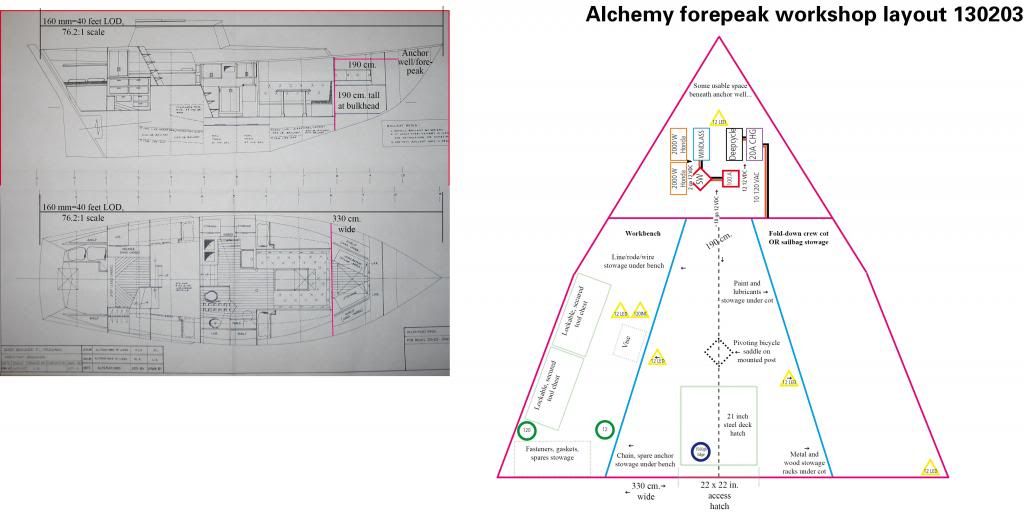
We are keeping the existing steering, winches (adding a used pair of biggish Lewmars rehabbed by me, however) and the Lavac head that convinced my wife Alchemy was a sound vessel in the first place. The biggest structural change will likely be the hatch I am cutting into the upper half of the forward collision bulkhead to gain egress into the forepeak workshop without having to go on deck.

The other good news is that most of the enhancements we are making to a boat that, after all, was quite capable of sailing when we bought it, are geared toward the aforementioned independence from shore, and at least the illusion of self-sufficiency, and a better record of diesel-burning avoidance than average. We have a pretty specific set of priorities in this respect. We intend to sail lightly over the sea, despite doing so in a 16 tonner, and that means expense and planning others might not find worth the time, desirable or meaningful.

Our point, which I suspect we have in common with most boat refitters/finishers/restorers and builders, is that doing all this work oneself gives one an intimate knowledge of every aspect of the boat's construction, which, one hopes, inspires confidence and defers worry for more important things, like catching fish for dinner and devising new sundowner recipes. And that is something worth tallying.