Copyright (c) Marc Dacey/Dark Star Media 2006-2026. Above photo (c) Marc Dacey. Powered by Blogger.

2013-04-15

Powerful silence


Pool noodles. Is there anything they can't do?

Bringing along a Honda 2000 is the road less travelled for the modern cruising couple. Most cruising boats that bother with power generation beyond that provided by alternators, wind and sun opt for smallish diesel gensets, installed beneath decks, and usually with discrete cooling and exhaust systems. While there is very likely enough room for that in Alchemy's capacious "engine room", which I can state after spending many an hour down there is more like a steel plated crawlspace, I did not like the idea of a second or third "thing that drinks diesel", if we include a Wallas or Espar heater (to name two popular brands) into the mix. One of our cruising goals is to live in a state of electric frugality from what amps could be wrested from the wind and the sunshine.

Eh, not so much. I rather be Gushing.
That said, having a Honda 2000, or even two of them (the Companion model, which is not a Doctor Who reference), is a way to have 10 or so AC amps for virtually every power tool I would bring, sparing the 2000 watt inverter from a "lossy" conversion from hard-earned DC back to AC.  I picture the inverter being on only occasionally, like when we are underway and making alternator amps, in much the same way as I picture we will make water and do other heavy draw activities. If I'm running a Dremel for a hour, however, or charging the anchor windlass battery, or need to drill a few holes ashore, the Honda or a similarly sized "luggable" genset makes perfect sense.

Not only an example of perfect sense, but a reason to sail to Oswego.
Using it aboard, however, requires stowage and perhaps a measure of protection from the elements, and its somewhat volatile gasoline fuel. Running portable gensets like the Honda 2000s on deck, particularly a steel deck, is a recipe for resonance below, and annoyed anchorage-mates above and across, even given the Honda's relatively quiet operation and near-invisible exhaust. I mean, the Hondas are quiet, but only in comparison to a similarly sized go-kart or lawnmower. They aren't silent...but they can be made nearly so.

So a couple of ideas have been percolating: Bring Hondas, but make 'em quieter and more weatherproof. I got the idea from this thread on Cruisers' Forum, and while the considerations of not poisoning oneself, or burning down the pilothouse or something else tragic and avoidable. Putting such dreams to one side, let's further consider the advantages or rather the rationale for putting two boat bucks into Honda's silly little putt-putt plugs.

My amperage has been thusly embiggened!

The happy new boat owner thinks: Why, I shall obtain for my fine vessel a passel of batteries of the finest make, thereby allowing me to charge via Nature's infinite bounty, and therefore I will have the electron-flavoured juice to watch My Little Pony videos in the inner sanctum of my cruiser's teaky saloon.

Alchemy's crew quarters are admittedly Spartan.
So one has a thousand amp-hours of batteries, for all one's powered needs. How much of that is actually usable? Keep in mind two factors: What I tend to call the "usable band" of battery power is about 30%: from 50% state of charge (SOG) to 80%. You need to have some extra bits to throw charge into a battery bank after 80% or so, and I would think it's worth it, if one has, as the Brony boatie in question, only solar as a charge source aside from the standard alternator on the diesel.

The second factor is battery draw-down. It's not always easy on boats to devise a realistic energy budget that accounts for all the amps being consumed. If you have a fixed draw, like a fridge, an investment in LED lights, foot pumps for water, extra insulation for the fridge and maybe a nice big alternator if you need to pump out 12 NM out and want to take the battery bank to 95%-100% or so, this has to be part of the plan going in. In the end run, I believe we will save on NOT having a genset or burning more diesel in one, and we will have a quieter life in a quieter boat.

Not a robot turkey, merely prudent battery maintenance

Part of this game plan is being honest: We accept that 750Ah of expensive deep-cycle marine battery capacity means about 225 Ah of actually usable power, and that wewill be cycling often enough to want to clap on an equalization charge (which may be possible with the solar, maybe not) and we will want hydrocaps and temperature sensors and SG readings and other care and feeding aspects in order to get a good five or six years out of your (hypothetical)  T-105s.


So the question is not just "how much solar" or "how big the alternators" or even "how many Hondas/Panda/Onans" but "how much use and how much capacity and how much monitoring determine how much solar/wind?"


Such is the way forward on a cruising boat: Work your way backward, doing math.

UPDATE, 14.04.07: If one is interested (and one may be, because of the handiness of using synched up Hondas as baseline hydro for one's house), here's the technical explanation for why You Can't Do That in Canada:

http://forums.motorhomemagazine.com/index.cfm/fuseaction/thread/tid/27253477.cfm

Short form is that CSA doesn't allow the type of paralleling circuit in "our" Honda standalones that the States does, or tends to do, as the standards vary state-to-state.

The "fix" is to buy two Companions, as far as I can tell. Canadian or American won't (then) make a difference.

The problem is that then you lose the 12 VDC circuit!

So we're back to one American Companion and one American "straight" Honda 2000...if you think you'd want 12 VDC, and you might on a boat, mightn't you?!

2013-04-11

Swinging the lead as little as possible

We are choosing to call that dark debris "silt". It's not silt.
A "winter storm in spring" is currently battering Toronto, increasing angst and frustration with our rehab pace and, because there is actually ice on the sidewalks, roads and Alchemy's decks, increasing the danger of even going up the ladder.

It is also 10 degrees too cold to paint. Argh.

So readers get an update today that combines a limited amount of actual progress with some anticipated directions that progress will lead.

That's "lead" as rhymes with "bleed", not "lead" as in "red".

The author demonstrates the hazards of working with power tools.
The first photo is the freshly removed section of Ghost Tank top plate, which ate about three 3/32 inch cut-off disks as spun by my venerable and compact 4-inch Makita grinder. That is,  until I switched to the beefier 4.5 inch Mastercraft "expendable" grinder and its 1/4 inch disks. The second photo shows what happens when a contra-rotational "skip" of the grinder shatters the disk and sends the pieces, Enter the Dragon-style, into flesh. The pants, they did nothing!

However, the plan to leave a five-centimeter "lip" around the tank means my clown shoes can still fit on the remainder of this tank, and I can access the debris and rust successful. When it warms up enough to paint, that is.

After much dithering and cross-eyed readings of MSDS sheets, I chose Metal Prep Rustlok 6980, a product that combines the "rust conversion" I desire to lock up the existing poo-tank corrosion and the primer function necessary for whatever topcoat I choose.

Requires a roller, a brush and 10 degrees Celsius
I've used Metal Prep before, primarily to remediate dings on the hull, which are subsequently coated in two-part barrier coat (Interlux, for those keeping notes), and the Endura two-part topcoat that most closely matches the hull colour (number 92, "cream"). Metal Prep covered by Endura and then skinned with very thin HDPE strips and butyl tape sealant is how I intend to both seal and electrically isolate the aluminum roof from the inward-turning mild steel flange of the pilothouse enclosure.

More china than steel plate. A sign you've failed to stick to the maintenance sked.


Back to the ghost tank: We can now scrap the surface of the plate and the more egregious flakes away from the surface and can lower a fan and/or a heat gun to dry out that fairly grim layer of "deposits" at the bottom. I even have a pretty powerful vacuum aboard for that last bit, but it remains to be seen how dried out that layers needs to be to allow full access. And the point of all this? As related previously, THE RUST MUST BE STOPPED on any steel vessel, for fairly obvious reasons relating to sudden onset of non-buoyancy, not to mention beverage spilling and day-spoilage. So the bare minimum for the Ghost Tank is a physical removal of the loose stuff, and a "push brush" technique of slapping on the Metal Prep. Metal Prep likes to be not quite dry when the second or greater coats are applied and that goes for the barrier coat. Whether we will get that period of sufficient warmth prior to launch is still a Known Unknown.

As previously related, it would be nice to have this low and capacious hole filled with fuel, either as a integral tank, or as a box in which a plastic fuel tank squats. An alternative course would be to fill that space with ballast.

It is a somewhat odd fact that 2,000 year old Roman lead ingots are nearly identical to ones smelted last week.

I'm going to assume that most readers grasp the function and desirability of ballast in a sailboat. Alchemy's ballast is internal, unless one considers the solid "box keel" as a sort of elongated fin-thing. The "movable ballast" or "trim ballast" is currently represented by about a half-ton of lead ingots sitting either side of the forward collision bulkhead in the form of what I'm guessing are 50-kilo bars.
Not precisely as pictured, but a potential outcome for the Ghost Tank in one manner or another.
They are where they are because the full weight of tools, spares, lumber, anchors, not to mention the full length of anchor chain are not there. The ingots are to keep the boat on her lines. Throw in two ingots' of tool or spares mass, and logically two ingots can be removed from the forepeak, and either removed or repositioned beneath the center of effort. The salutary effect of ballast here would tend to "stiffen" the boat, make it more resistant to heeling or less "tender".


One could even go for a blend: Coat the tank throughly, lay down a "floor" of lead ingots and lay over that a smaller "daytank" made of HDPE. You would get the weight in the best place, and still have a nice extension of the fuel supply.

Picture this, only better secured and under a set of saloon companionway stairs.
Of course, batteries, being largely made of lead, are heavy, too. It's desirable, therefore, to have them low and, ideally, on the centerline to minimize the chance of spillage of the highly acidic electrolyte.

So it doesn't make sense, nor do we have the time, to make this call before we install the weighty battery bank. Committing to adding ballast aft of the mid-point of the hull, as is this tank space (although not by much) would be unwise. Better to move those lead ingots about (and the tools and forepeak gear in) once the batteries are in place in order to determine further ballasting and trim possibilities. So rust-proofing it is. I doubt I will even restore a new lid...it's just part of the hull, after all.

Regarding the batteries, I've mentioned seemingly crazy numbers of the things we wish to install in the past. It's not particularly crazy, especially if you wish to follow "best practices" in battery reserve power management. One of the best resources I've yet found is at John Harries' superlative Attainable Adventure Cruising website, which has a comprehensive series on the topic. The link is to how best maintain a whack of AGMs, but it's applicable to all boat battery banks and is a good lead-in, no pun intended, to the topic of battery selection, care and usage.

Not to scale, but there are going to be certain similarities to our house bank.


Now, we am buying and installing this summer what would seem to be a coastal cruiser or weekender an insane amount of batteries. We want the ability to run LED lights, our NovaKool reefer, an SSB radio and some occasional (10 seconds of coffee grinder, 90 seconds of microwave, say) inverter-supplied AC loads. I want to be able to do this, at anchor, during five cloudy, windless days during which I can't get much from the wind genny or the extensive solar panels I already have, and during which I do not wish to run the diesel for power or fire up either of the Hondas to charge the house bank.

Of course, I can always do this, or run out 12 NM under engine (and therefore spin high-output alternators for battery "topping up" purposes) and the likelihood of windless, clouded-over days in the tropics are a "worst-case" scenario, but it's a good example of how you wish to think. So, if I use 100 Ah/day, which is pretty low and requires solar showers, foot pumped water and forethought to install micro-draws like LEDs everywhere, in order to draw down 500 Ah over five days, I need a 1,000 Ah bank, which is about 4 x 8D batteries or the equivalent in smaller 6VDC ganged to form 12 VDC "sub-banks". After five days, they would be at 50% state of charge (SOC).

Not good.

Better to have that 1,000 Ah bank and draw down between 100% to 80% between charging opportunities, although it takes some doing to bring a large bank to full 100% SOC, the last few percent being the time-consuming part.

So even though I am proposing a "non-amp-greedy" boat, I am also disinclined to run the engine to make power (but I am entirely happy to make power when I need to motor somewhere) and I am also disinclined to dock for shore power unless it's free/reciprocal, and I don't want more fuel-drinking generator capacity than the Hondas I want to use in place of the inverter for when I want to use a nice, torquey AC-powered tool. Even the ones that can give me vivid injuries.

The battery dimensional have to relate to the carpentry and the need for ventilation, cabling, etc. This is quite preliminary.


That implies a big bank in which the "usable draw-down" is, in fact, a fairly narrow band of potential amp-hours. If you dock or don't mind a genset and have a "diesel fuel credit card", an investment in lead and acid isn't a pressing concern. But it's the admittedly preliminary amp-draw calculations I've made that have driven every other systems decision, down to second pickups in the water tanks to bypass the pressure water in favour of Whale foot pumps.

The big bank is therefore part of the ship-wide internal ballast considerations, just as much as the lead ingot and "diesel tank in the keel" considerations. Or, to take it out of the hull, are the decision where to put the reef points in the main sail.
Basically, ew.
And that's enough blather for a bad day for boat refitting.

2013-04-09

Foul weather anti-fouling

Clearly, time for Cetol and a power wash. Not seen: Cat pawprints and leavings.
The Other Boat, clearly neglected over this Main Boat-focused push to finally relaunch, demanded her due yesterday. Last week, I removed the largely shredded canvas tarp. A product of Keeble Canvas of Belleville, Ontario, it had lasted about 12 years, which is, I am told, about two years beyond its expected lifespan.

Uncovered in the sporadic sunshine. The yearly hull polish is keeping this 40-year-old topsides bearable.

That lifespan might have been shortened somewhat by the exposed location of Valiente's winter yard, which is beside a dusty recycling depot with a constant and slightly ironic flow of diesel-powered, soot-spewing garbage trucks. The effect on the decks and canvas is obvious: "smoot" is everywhere, and it makes no sense in what is in essence a waterless, unpowered parking lot to attempt anything more than a token remediation. The inside isn't bad, thank goodness.

Does this bug you? It bugs me, even if a lot of my "green thinking" arises from the expression of the Scottish gene.

When it comes to tarping boats over the winter, many people opt for either "nothing", which in my view would undo all the core replacement I did at the beginning of my stewardship, or for the increasingly ubiquitous "white shrinkwrap tarp". The expense of this over a 10-year span exceeds, significantly, I think, that of the canvas tarp option, but it's the horrendous, dumpster-busting waste of it that puts me off, even if hauling the heavy canvas up ladders is rough on my ever-aging frame.
  
You'll have to imagine the howling wind. And the howling cats.
My boat partner, Clive, overcame his own shoulder issues to buff the hell out of the hull. On the inside, I installed and connected two new Group 27 batteries, installed a new, post-impeller pump "basket filter", which required the removal of the alternator just to reach the buried hose barbs on the block. We than did a gratifyingly successful test fire of the engine. The near-instantaneous ignition may have lasted a mere 15 seconds (the time it took to run the non-toxic coolant out the stern), but it's a joyous thing to know your winterization and maintenace regime was...so far...correct.

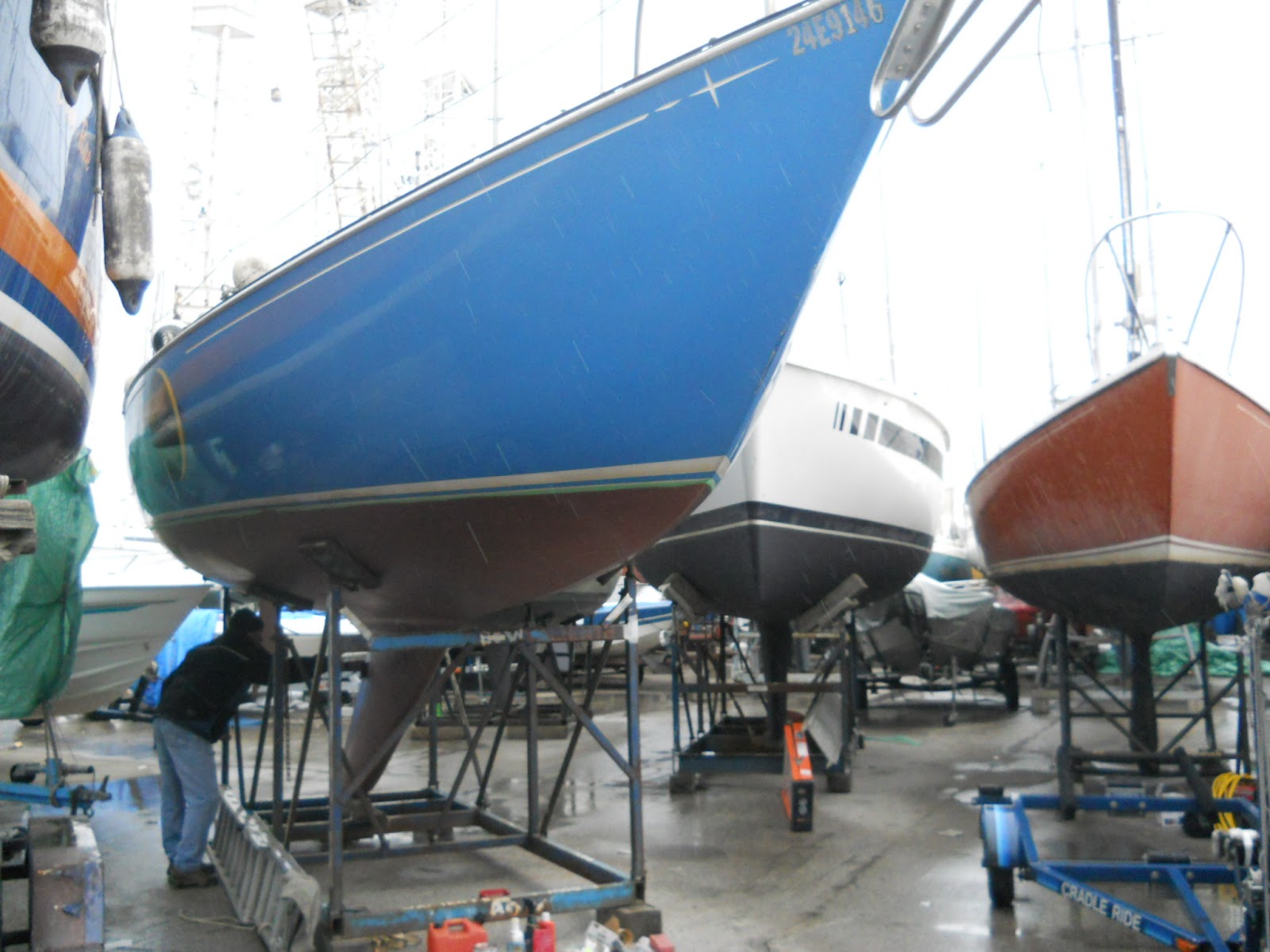
There's a limit to applying anti-fouling in the rain. This is about it.

Nice shine! Heavy overcast! Cat pee!


I have a bit more work to do in this area, but the boat's only a couple of hours from being able to be launched.
We can't get into the summer dock until April 15th or so, and so I'm back down to Alchemy to resume the drive to launch on April 27th. More on that soon.

2013-04-03

The left-handed sheet bend, or how to enjoy port

A left-handed sheet bend: Avoid, as it is sinister.

Brain function, handedness and seamanlike prudence. What do these things have in common?

I've touched before on my amateur's interest in neurology, and how the physical way the various sections of our thinkmeat interact both in response to external and internal stimuli. Function follows form, but, as with the neurotypical right-handers, sometimes there are interesting reversals. Certainly, some individuals favour logic and others emotion; I think that sailors, a group of humans generally exhibiting both confidence in their skills and an almost mystical approach to the oft-superstitious traditions of the sea, tend largely to a balance of these states of mind.

While there's a fine line between seamanlike vigilance and rampant paranoia (or so my enemies tell me), this reflects my experience as a sailor and as a person trying to incorporate sailing's life lessons shoreside.

Despite tacking through a youth that included being hit by cars, door-prized on bicycles and participating in a few martial arts, I did not break a bone until I was 36, when I slipped on the surface of the sloping alley outside my flat and snapped three of them in my leg and ankle. Picture trying to punt a field goal with your own foot and ending up with a joint in the shape of a "Z" and you'll get the image. The irony is that I was walking back to my own home from a tea party, of all things. Black ice, an Earl Grey-fuelled need to pump the bilge, and a pair of smooth-soled Florsheims in December were my undoing.  Back in my roaring days, I was very careful on foot or (regretfully, now) bicycle tacking my way home half-cut on empty sidestreets and never once fell down. How could I? I was too nervous about falling down! So I could blame the leg break on excessive sobriety! The true cause was inattentiveness, the poorly cured cornerstone of sub-par situational awareness.


Bowline, left, and "left-handed" or "cowboy" bowline, right. Nice counterintuitiveness, there, Wikipedia.

Obviously, the perception of hazard is both relative and situational. Our knowledge of the relative danger of boats at sea and the situations in which such danger might likely manifest needs to be tempered with the anticipation that it is during a random incidence of inattentiveness that is liable to bite one in the stern as much as can the dramatic "overboard" or "falling off the masttop" propositions.

I've also noticed that there's a subset of quite careful, safety-conscious boaters who seem to turn into clumsy disaster zones ashore...maybe it's related to a lack of "land legs" or simply a needed relaxation of the mindfulness required aboard, but these are the sort of guys who end up slicing themselves in the workshop or walking into walls...carelessnesses that they don't experience aboard. I have yet to see if handedness plays a role, but I know that tools made for the majority right-handers can be disorientating enough for left-handers to hurt themselves.
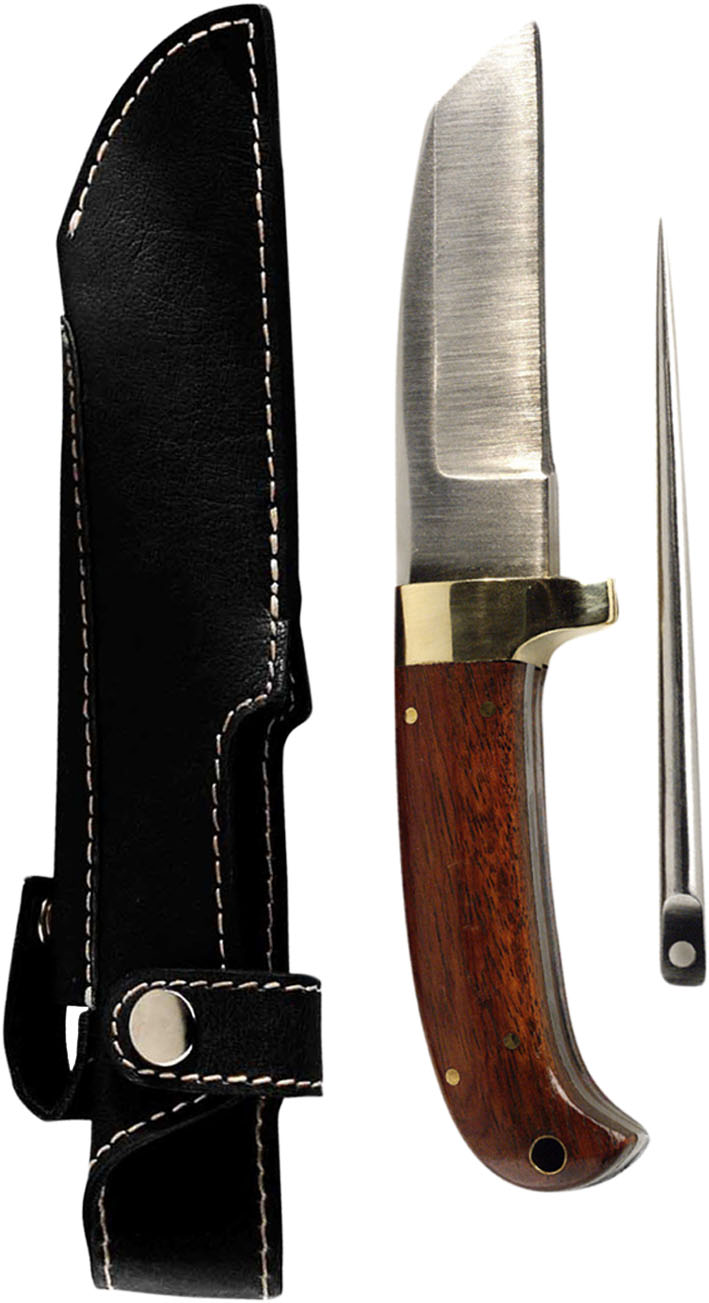
This is pretty old-timey. I prefer serrations. Fid's nice, though.


One example is the humble sailor's knife: I rarely darken the door of West Marine, as I have all the anchor-themed plastic tumblers I need, but occasionally they have a decent sale on useful gear. A couple of years back, WM had a sheepsfoot serrated blade folding knife with a lanyard for a mere $9, and I got about four of them to hang on the D-ring of everyone’s PFD.
This one. Nine bucks? I'll take a box.
While I also carry a better knife on a belt, and will go to a Spyderco or Boye non-corrosive knife for that spot before we hit salt water, having a sharp, disposably priced knife on the front of the PFD is to my mind a great idea. I tried the WM cheapo on a folded length of old seatbelt, which is roughly equivalent to tether webbing, and it cut through in a few strokes…same as with 1/2″ nylon braid. I think that if you are being dragged and the quick release is somehow compromised, the tether itself should be considered expendable if you are otherwise in danger of drowning. Whether one would have the presence of mind to effectively cut oneself out of a drowning trap is a different question.

There you go. Considerably more than nine bucks. Perhaps factorially so.


I also have had enough experiences where a knife was critical to safety. I was out sailing with my heavily pregnant wife when the wind jumped from 10 to 28 knots around a headland (yes, my fault, ultimately). I had to go forward to cut the leech line of an old No. 1 that had snagged on my spreader, all while my wife tried to keep the boat pinched hard to windward to slack the big-girl knickers of the sail. So, yes, I think an extra knife on the PFD makes a lot of sense. Your own nautical mileage may vary, of course. I also keep a couple of cheap serrated bread knives stuck with magnets either side (ah, that handedness thing again!) of the companionway (it’s a steel boat and it’s not near the compass!) for the same reason. Bread knives would make short work of even my biggest nylon rode if we had to cut and run in a hurry or I had to free someone’s purpling foot or finger from a strongly tensioned line…which I have seen happen on other boats.


The amusingly named "grief knot".

Not that I'm such a chief of surgery when it comes to sharp objects. I have some interesting scars that remind me that my blade and tool-handing techniques have been at times deficient. Whenever I think "oh, I'll just take a shortcut", there's a short cut to remind me of my lack of insight. I am nominally a right-hander, but I've always exhibited, as have some other members of my family, a certain amount of ambidexterity. I can do parlour tricks like mirror writing, shooting snooker with either arm, throwing darts with my left hand, and so on. It comes in, dare I say, handy at times, when having to operate rotational tools with either arm at full extension, or picking up tiny objects in poor light with the non-dominant hand. It's not a superpower, however: I play guitar and bass right-handedly, because that's the path of least resistance. It's more like driving a hybrid. You can opt for silent running for part of the trip. I've certainly tried to nurture my fairly weak abilities with my left hand, even as some neurologists consider "self-taught ambidexterity" to be a bad idea.

Being a left-handed sailor is perhaps both more integrated and more challenging still. Being a lefty of the pure variety (although reality tends to favour some measure of ambidexterity in lefties) means understanding the need for accommodation in a world clearly not made for your ease. It's more of a challenge when the gear could be dangerous for somewhat unclear reasons, like blade serrations on the wrong side. Nonetheless, keep your eyes peeled at the bar or on the boat: there may be more left-handed sailors than in the general population. I sense this is the case, but then it's something I tend to notice, along with untied laces and ear hair.

I've seen worse sail trim.

Lastly, this is the jelly know as the by-the-wind sailor: Handedness is possible even without hands, apparently.


2013-04-02

The Ghost Tank haunting my bilges


Behold the mysterious ghost tank.

There was concern this was a refuge for brown trout.

In my steel pilothouse cutter refit, I can still find little surprises. Most, with the coming of wisdom, or at least a lower level of incompetence, are solvable, but some problems suggest a number of solutions. Those of the the ghost tank are several, but probably only one is the best.

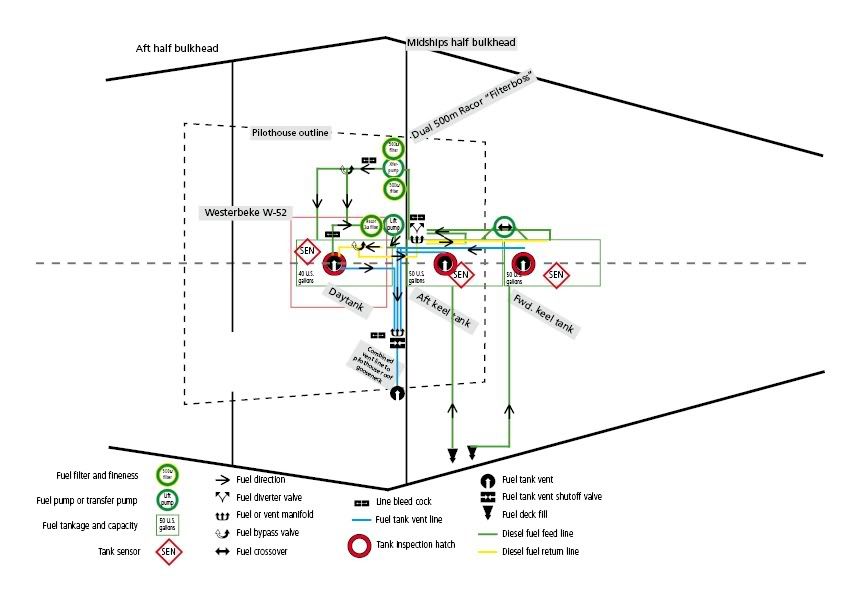
Astoundingly, although I've clearly been badly delayed in the execution, this diagram is still largely what I want to do.
As I outlined a scant three-and-a-half years back (ain't refitting fun?),  I have an unused, approximately 40 U.S. gallon capacity keel tank directly under the engine. Formerly the original holding tank, I had no idea until last week (because unbolting the access plate requires that I fly the engine completely out of the engine bay) if it had been "put away cleanly", only that the people I bought the boat from (the second owners) had a new, HDPE tank next to the head.

I have been considering repurposing this tank as a post-Racor daytank, which would give me a sort of insurance against contamination from bad fuel going into the main tanks, and would extend our motoring range to 140 U.S gallons, or 40% more than now.

We found not the usual gasket, but a sort of rubber sheet seal. It came away cleanly.

Upon finally taking off the inspection plate, I found a few gallons of water...no smell, thank goodness, of either chemicals or of its former usage. I also found significant rust:

The pipe here is the "pump out". The plumbing needed to use this as a day tank would be smaller and forward for access.


At the time we were taking pictures, I didn't think to throw a magnet down to my wife, who was taking the shots, to determine if the tank was mild or stainless steel (SS). SS would be logical and would match the water tanks I've already pulled out in favour of smaller, easier to service and anchor down HDPE water tanks. SS would also (perhaps) suggest that the rust is superficial and could be power washed off, or treated with something like Ospho, over which could go a suitable primer and topcoat that won't foul or break away into polished diesel.. Frankly, I am not sure if that's the best course.

Going the "insert" route wouldn't mean I couldn't find a pretty close fit.

The other diesel keel tanks forward in the keel are black iron and are full of diesel, basically as a rust retardant until they are needed for use. That fuel, if even still usable, will need a dockside polish.

I suppose it's uniformly grotty.

I consider my options as follows:

  1. If the tank is indeed SS, I would consider sand blasting the interior and applying a coating (if even needed). To judge by inspection of the lid and the tank top, it is pretty heavy gauge metal. There is no sign in the bilges or, thank Neptune, on the outside of the hull that there's any holes in the metal.
  2. I would consider cutting off the top of the tank, cleaning and coating the interior with something like truck bed liner, and dropping in a HDPE diesel fuel tank with fittings forward (where there is access at the front of the new engine),
  3. The same as 2, only with a 35-40 gallon fuel bladder. The advantage of this would be the ability to pump out the bladder of fuel and then pull it from under the engine for cleaning or service. It would be secured with bolted-down battens. A clear disadvantage could be the danger from having a working engine directly above this fuel.
  4. Fill the rusty tank full of ballast to stiffen the boat and buy a load of yellow jerry cans to tie down on deck.
The last suggestion is only partly facetious. The original water tanks were on frames off the hull, and their (full) weight at the sides, plus the lack of weight in that space below the engine, made the boat almost tender, which is a ridiculous situation in a steel beast of this nature. The easiest solution would be to fill the void with shot and cement and let it harden in place. It wouldn't give me 40% more range, however.
 
Any constructive suggestions, horrible warnings or sage advice would be most welcome.

Rust never sleeps, but sometimes swims


2013-03-30

Standing watch is not texting Dave

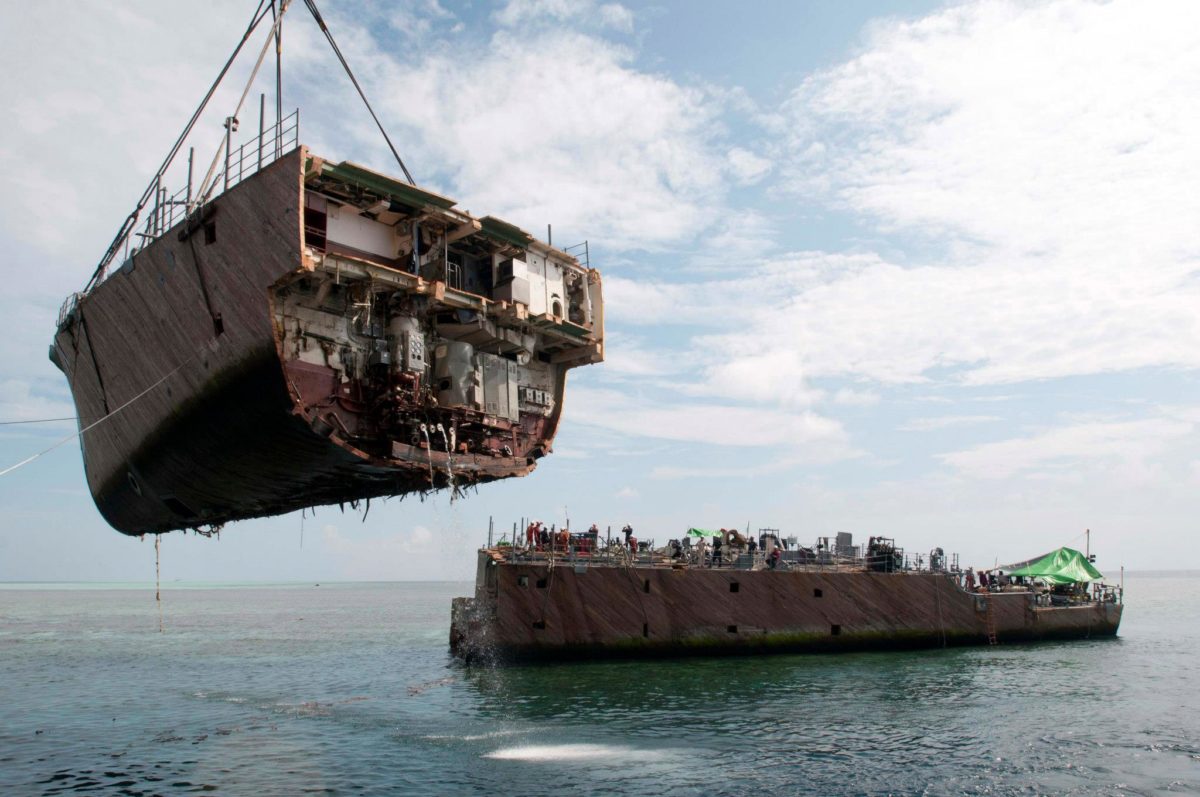
The U.S.S Guardian has been cut into manageable chunks and taken off that inconvenient reef in the Philippines:


What would one assume had been learned from this incident? The Greenpeace ship Rainbow Warrior made the same navigational error fairly famously in 2005, so it's not as if the dodgy accuracy of the charting was unknown.

No, I said "get the big sabre saw".
Presumably, if the accuracy was in question, of all the organizations worldwide who go a-sailing, the U.S. Navy would have the resources to amend, correct and revise nautical charts.

Of course, charts can be accurate or inaccurate. The situational awareness aspect of watch-keeping should still be maintained. Was it here? We may never know, nor may the people who have to live with the consequences.

Bad navigation/poor choices: They can happen anywhere.


2013-03-28

The ship's orderly will see you now

Come for the course, stay for the gruesome anecdotes
My wife has a science degree in biology and is qualified to be a high school science teacher. More to the point, she spent about a dozen years as a wildlife rehabitator at the Toronto Wildlife Centre. This centre, as are most similar organization, is a charity that cares for wild animals where they are on the losing side of interactions with humanity.
This scene has been enacted at our home. Less likely to happen aboard.
This can include treating all sorts of injuries, from concussed birds who've run into tall buildings, to turtles with guts full of fishhooks, to motherless mammals due to cars, cats or disease. The missus's job was frequently concerned with triage, deciding which animals would survive both the initial injury and the frequently long period of care required until they could be released as close as could be known to their original location.
Green is "I'm feeling much better!"

Imagine something between an emergency room nurse and about 75% of a vet's skills, only with animals from field mice up to deer and large birds of prey. Most of whom, upon first encountering my wife, were in considerable pain and probably mortal terror.

Designating her as "the ship's doctor" aboard Alchemy was therefore logical. Her medical skills, while somewhat unorthodoxically acquired, are largely transferable from the critter to the jumped-up, seafaring primates with whom she will be travelling.

Mine, however, were pretty well non-existent. Short of obtaining a few "fix my owie" merits in various children's organization, I had very little formal knowledge. And my wife, who will happily douse a No. 1 several times her size on a pitching foredeck in a part-gale, finds the engine makes her nervous. So, following the fairly successful model of our separate delivery crew trips, this winter, she has taken a diesel maintenance course and I have taken Transport Canada's Marine Basic First Aid Course. While it took some bureacratic running around to arrange, I found it a worthwhile expansion of my quasi-medical knowledge, as much for dispelling some medical myths or abandoning old-school ideas of first aid that probably got retired after World War II. (Hint: Tracheotomies are right out. Something you saw on M*A*S*H* when you were a kid has likely gone the way of the buggy whip these days.). The certification arrives in the form of a card and is good for three years. Even if taught by Vinnie Jones.


The goal of myself and my wife, of course, is to create a sort of Venn diagram of each other's skill set. If I break an arm on deck, she can service the diesel to get us to shore safely; if she does the same, I can render first aid in the marine setting, which has some special considerations, particularly in rough conditions. And of course, we can both educate our son in the basic basics, such as wound compression, splinting and treating things like jellyfish stings, which we aren't likely to avoid, and, contrary to what you might have heard, don't require someone to pee on you.
Our course instructor, Craig Hamilton, looking both nautical and uninjured.

The course, which was held last weekend at our boat club, was run by a former television producer turned charter skipper turned marine safety instructor, Craig Hamilton. He runs with his associations an outfit called Boaterskills.ca. He possesses a thick wad of certifications and teaches boat handling, docking, boater safety and the training needed to get the various marine licences required to operate a boat in Canada. Teaching the "terrestrial" Red Cross Basic First Aid course with added information pertinent to boats (like "how do you get an unconscious large person tied to a back board up the companionway stairs?" Answer: Maybe you don't, or maybe you rig the mainsheet...it depends.) There was a focus, driven in part by participants' questions, on the sort of injuries more likely to occur about a boat, like drownings, burns, and blunt force trauma from being thrown into things.

It's a shocking business, I know.

A large proportion of the course time is spent learning CPR and the use of Automatic External Defibrillators (AEDs). These are the portable, rechargeable, automated versions of the "clear! ZAP!" devices that have been a staple of medical dramas since the '70s. As they are now sold for about $1,500, they are falling into the same class of safety devices as EPIRBs, satphones, SOLAS-grade flares and liferafts: expensive, but very hard to justify ignoring.

Several trenchant facts emerged during the training: if you are not breathing and your heart has stopped, you are dead; chest compressions will only keep you from being really dead by literally pushing minimally oxygenated blood to your brain. The current thinking is that the CPR rhythm should be 30 compressions, followed by two breaths with the airway kept clear. It's real work; the CPR manikins have "sternum-strength" spring pads inside them to simulate the average chest, and you must compress a fairly small target area to have any hope of actually pushing the blood through a stopped heart. Think "unprimed Whale Gusher foot pump in the galley" and those of you familiar with those devices will sense the type of physicality involved.
You bet I can now do this. Your sternum won't thank me, but you might live to curse me.

We learned that the AED is for when you still have a heartbeat, but it is dodgy, racing or otherwise compromised. This could be from shock, fever, poisoning of some description, blood loss, a head injury...whatever. The point is to restore the normal rhythm until help can arrive. And help needs to arrive; at the level of Basic First Aid, you are merely trying to keep the person alive, and if not in immediate danger of death, to keep them from going into shock, to keep them safe, warm and confortable. It's Better Than Nothing, not Pretend Doctor. The limitations of the first aid renderer are considerable, but there is still scope to preserve life itself, to keep people hydrated and nourished (unless internal bleeding is suspected!), and to rig splints and dressings for the smaller, but probably quite distressing, injuries and maladies that can befall sailors.

We're going to need a bigger head.

At this point, I ruefully stare at my hands, which have been blistered, scorched, stapled, cut with tools blunt and scapel-like, and which sport a number of interesting cosmetic modifications. Boating for me has not been without incident or injury, but it's really part of the game to endure a few examples of the sea's rough embrace.

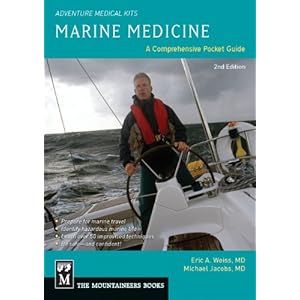
I like this one, as the doctor-authors are themselves sailors.

Should I wish to take further instruction, there's an advanced course in Marine First Aid. I'm thinking it may make sense. Thanks to an alert reader who sent along a link to a free (and very comprehensive) PDF from the World Health Organization entitled International Medical Guide for Ships. Good to know and better to read.

In a later post, and in consultation with the Ship's Doctor (Not a Real Doctor But Pretty Damned Good), we shall discuss the ship's medicine chest and its mysterious contents. Which, thanks to the expert instruction of Mr. Hamilton, who was not shy of offering a usually vivid anecdote in order to illustrate a course point, is slightly less mysterious now. Go ahead: Injure yourself in front of me. Odds are I won't just stare at you waiting for someone to do something, or perhaps smother your screams with a nearby pillow or callously suggest you rub rum into it.

Instead, I will render aid.


2013-03-25

Clash of the weather titans

Best to be wearing brown foulies if you can read this. (Image courtesy of NOAA via John C.)

I have exactly one experience with weather routing at sea. In 2009, while I was part of the delivery crew for Bruce and June on Ainia. a Bristol 45.5, Bruce consulted with the very experienced and highly regarded amateur radio enthusiast and hobbyist marine weather forecaster Herb Hilgenberg. As I related here, my skipper would check in with Herb on a pre-arranged schedule and would provide our local weather conditions, a "micro" take on the "macro" high seas forecasts given by the various governmental and for-hire weather routers, from which Bruce also obtained and pored over data in the form of downloaded GRIB files.

That was the deal: You gave Herb the data points as he requested them, and not before. Think of a queued-up list of widely separated yachts listening to particular frequencies at particular times, and only speaking when requested to do so. I suspect it was the only way for Herb to keep things straight. Herb treated each boat as if it was a mobile weather station, and thereby collected sea state, wind speed and direction readings available only to a small yacht which would often be sailing perhaps hundreds of miles out to sea. In return, he gave back his interpretation of weather trends for each vessel's stated area and intended route, plus his considered suggestions as to the least stormy directions in which you could sail.

All this effort was made for free, since 1987, and with very few days in the year away from the microphone.

Some hobby. Some value. I understand he has taken contributions to offset the cost of his extensive array of equipment and the no-doubt non-trivial amounts of electricity it takes to be a southern Ontario, bungalow-based oceanic radio network.

Not actually Herb's radio shack, but likely a reasonable fascimile.

Basically, the H.H. story is of a man who, having sailed and found the forecasting wanting, turned his retirement hobbies of weather forecasting and ham/SSB radio operation into a public service, even if that public, outside of the offshore sailing community, is largely unaware of his existence near the shores of Lake Ontario. H.H. has been directly involved on the comm side in many rescues and has received praise and citations in equal measure. I have heard that some people will not consider departing on deliveries of yachts from the U.S. coast down into the Caribbean without what they consider to be Herb's sage advice. I met Herb at a Safety at Sea seminar in 2010 in Toronto, and it was slightly surreal to see a rather ordinary looking man of senior years very nearly adored by a small crowd of people wearing clothing usually seen at regattas. Herb's the sort of rock star you become in the cruising community when his is the only voice you can hear over the wind screaming in the rigging and the smell of the crew heaving down the sidedecks.

Yes, you need all these buttons.


Recently, I checked out Herb's very 1994-style webpage to see if there was anything new. He's not a young man, and I wondered if he would still be offering his service when we finally push off for our own adventure. Weather reporting/forecasting, GRIB files and ship-to-shore communication via SailMail or an equivalent service are the reasons I purchased a single-sideband radio (SSB). That particular item will be installed when I restore Alchemy's mast and will no doubt produce some blogging as SSB installation and tuning is a somewhat information-dense and variable process that rarely goes ideally on the first try.


Books have not only been written about SSB/amateur radio installation and operation on seagoing sailboats, they've been written about just this model.

TL Sparks as a name is an inside joke to radioheads.


Now, there has been a move toward the use of satellite phones in the cruising community, particularly the Iridium type, which is considered to have the "largest constellation", i.e. most worldwide coverage. Picture the analogous GPS "constellation": the more satellites in view, the better the confidence in the reported position. Satellite phones work a little differently, and perhaps one day I can get into that. The point here is that they are getting, if not cheap, cheap enough, cheaper than SSB rigs, are familiar in the slightly bulky manner of a circa 1993 cellphone, are portable, and you can speak privately on them AND hook them into a netbook to download weather maps, e-mails and all sorts of data, limited only by your credit limit. There's a whole other level of satellite communications above these phones called IMMARSAT, but that's beyond the scope and budgets of most cruisers. It is a method, however, of keeping up with American Idol 1,000 NM from land. It's more or less the standard on commercial ships these days.

So is SSB on cruising sailboats done, antiquated, superannuated? Is it the "landline" or "dumb phone" of small boat communications? Are there apps for it?

Why, yes, there are, and I doubt SSB is done for those who like a variety of tools to solve, in this case, the problem of distance communication on a boat at sea or on the hook in Random Lagoon, population you.

While it can cost three to four grand to get transceiving, apart from a yearly SSB-to-email service fee, it's pretty well free to yak, network and receive weather faxes. For people cruising with a kid, such as we propose to do, it's a great way to send and receive lessons by email in distant locales (pictures are generally too big and best sent from Internet cafes ashore). Various "cruiser nets" exist and it's a standard method of finding out which seaside facilities are open, which port officials are on the take, and which panga has sunk right at the reef entrance...stuff you won't find in cruiser guides or marked on charts. Yes, it's semi-public, although it can be made pretty private, and yes, propagation and other technical factors can limit its range and function. And let's not forget that offshore, when you yell MAYDAY on an SSB emergency frequency, every SAR/Coastie in range hears you; with a satellite phone, a single phone rings on a single desk, because you are, after all, just capable of calling one phone number at a time.

Still, many fans of SSB consider it indispensable and the sat phone something good for the ditch bag. People who like SSB on boats like weather nets and these familiar voices, who provide important information, after all, for people living on little boats, are generally trusted.

Trusted too much? The marine writer Charles Doane would seem to think so. In an article that seems to be critical of Herb Hilgenberg's forecasting skills,  he cites a few cases suggesting  that Herb's forecasting leans toward the conservative side, pinning his "correspondents" to shore instead of profitably being at sea on passage. The comments on Doane's article range from fairly blunt disagreement and suggestions that Doane is ungrateful, to broad agreement from experienced cruisers that Herb is indeed sometimes wrong or too pessimistic. Herb's reply to Doane on hisown website seems to indicate that this criticism has discouraged him to the point of retirement.

This I would consider a loss to the greater cause of cruising safely.

Frankly, I don't get the criticism of Herb's service. Isn't this akin to saying you don't like the colour of the bookmobile lady's dress and therefore feel disinclined to borrow books? The crossing guard's stupid hat is the reason for your six-block detour? Herb is not a professional, nor does he claim to be. His forecasting is based on careful observation, but he lives down the road from me, near Toronto, some distance from much more than road salt. When he is predicting conditions in Greenland or south of Bermuda, he has the same governmental "macro" charts and forecasts available to him as is available to anyone else through many means. The quality of his "micro" forecasts (the reason sailors have found him useful) is the same for any of his counterparts around the globe: the accuracy and the density of reporting boats is critical. During a race situation such as the ARC or the Caribbean 1500, he would have perhaps a dozen boats reporting in to him: a dozen well-staffed and experienced weather stations in effect who understand his needs and can give him current and accurate conditions from which he can build a plausible forecast.

Damned useful it has been, too. But it is only a forecast. Doane suggests later in his article...and were I the writer, I might have led with this..."Herb probably is more conservative than most other weather-routers, but all weather-routers are--and should be--inherently conservative {italics mine}. Whether they're getting paid or not, they can't help but feel responsible for their clients, and a big part of their job, as they see it, is making sure those clients understand just how bad things might get on any given passage."

A small point: In Herb's case, they aren't clients as Herb is not being paid by them. They are helping a guy with his radio and forecasting hobby. Really, no more. You hear Herb and take his advice or do not. Doane continues: "Routers do provide a useful service, but it is not good when sailors become too dependent on them...Too many sailors these days believe that hiring a weather-router or joining a rally or bringing some professional crew aboard provides some kind of insurance, as though the risk they are taking can be hedged or transferred to others."

Well, now we are getting somewhere. Don't blame the guy who is better at guessing than (perhaps) you. See "don't shout at the GPS for your crappy navigation". Also, "don't blame the cross-wind for your crappy docking." None of those elements, the forecast, the GPS, the wind, for Neptune's sake, has a stake in your successful boating. You, the skipper, do. You, the crew, do. Indifferent of objects and nature in general is something in which I personally take comfort. The sea, if approached unwisely, will kill me without a second thought.

Without a first thought, actually. Ocean water is not sentient and is not capable of malevolence. Attributing motives to "evil black boxes" or "menacing greybeards" or "vanishing tethers" is very poetic, but it's poor seamanship. So is taking your helm instructions uncritically from a guy at a radio ashore as if they arrived on properly buoyed stone tablets or a burning bush on a burning liferaft.

Ultimately, whatever forecaster is being consulted is still only capable of offering an opinion or guess at local sea level about what conditions you will be experiencing in the future. The guesses are based or at least formulated in both science and experience, but they are representations of possibility. This is quite different from the view from the helm. You, the skipper, have that viewpoint. It is the important viewpoint. Listen to other viewpoints, always, but the skipper's judgement must trump all others, and not just in a legally binding sense. Unless one is impaired, disabled or otherwise required to stand down, the skipper has a moral duty to ensure the safety of vessel and crew. You can't blame others or transfer or cede that authority, in my view, nor should you be tempted to do so.

I suspect that what people see as the "conservatism" of Herb or indeed any weather router (including the paid ones, who may be thereby even more dangerously plausible) is simply the process of maturation at work. The weather titan's proclamation become, with the maturation of the crew as experienced mariners, just one more element in the mix.  If Herb learned how to forecast, most skippers eventually can, as well. And they should, because it is them, on the boat at sea, who have to decide the best direction and the soundest methods for staying safe at sea and arriving alive. 


I hope Herb is still working the airwaves when we are out there, and I hope we can consult him as a valued source and in turn, contribute the readings he requires to forecast. But even though I can recognize his voice, I would never assume he was on our boat, nor would I ever assume he had any role or responsibility in either our misfortune or our success. That's on the crew, not the weather guy.

UPDATE, June 14, 2013:  Looks like our wish is denied. Noonsite.com reports that Herb H. has put down the mike.

Thank you, sir, for a valuable and selfless service to the cruising community. Enjoy the absence of static in your ears.