Copyright (c) Marc Dacey/Dark Star Media 2006-2026. Above photo (c) Marc Dacey. Powered by Blogger.

2013-05-12

Rigging: The game

Rigging, the "standing" parts of which hold up the mast or masts of a sailboat, is a complex and somewhat contentious topic.
An undesirable outcome. Photo copyright Vincent Bossley.
To the more lubberly of my readers, it helps to think of a sailboat's mast like a tent pole. Various lines, or, in the case of a big tent or a sailboat, wires, are led from the mast/tent pole into stakes in the ground, or, in the case of sailboats, chain plates. The difference, and it's a significant one, is that whereas the tent must stay supported statically (the tent shouldn't move) against the forces of wind and clumsy/drunken campers, the sailboat mast is designed to support a device (a sail) that is continually exerting dynamic force in a range of vectors against itself. In turn, the mast, being strongly tied into the hull of the boat, is a relayer of the sail force: the wind blows, the sail experiences the lift of its airfoil shape, and that energy is transferred via the largely static mast to make the heavy boat move.
An oldie but a goodie from which I finally grasped how sails and hulls interact.

Please note that compared to masts and sails, all boat hulls are exponentially heavier, unless you are an America's Cup design.

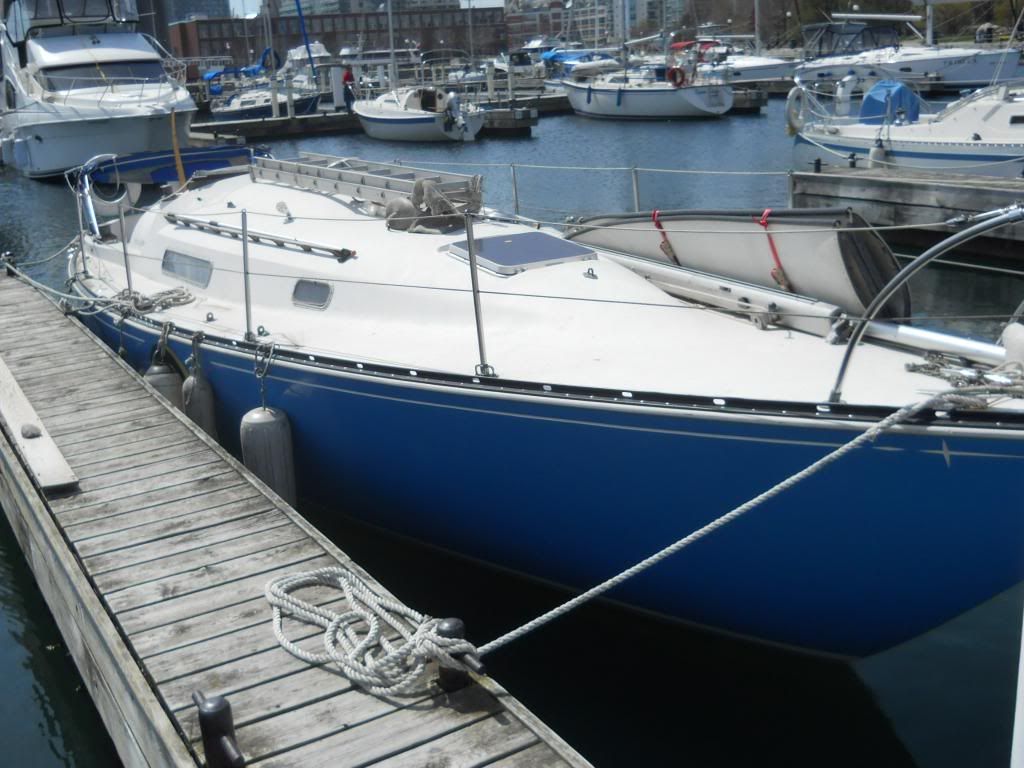
As mentioned previously, while the upkeep and maintenance on my first boat, the 1973 Viking 33 Valiente, could be considered a distraction, the truth of the matter is that, despite age and lack of most mod cons, she remains a pretty hot boat. She is a great deal of fun to bomb around in during those parts of the summer too blazing for needful tasks on Alchemy. A secondary benefit keeping her in play is that I frequently use Valiente, which as mentioned is largely amenity-free, as a test platform for projects I wish to install on Alchemy.

Alchemy's standing rigging is in excellent shape. It's never seen salt and is of high quality with Sta-lok fittings and beefy turnbuckles. But it dates from the boat's original launch date of 1988. The smart thing to do would be to replace it, at least the standing and running rigging parts; to service the rest, maybe upgrade the furler, and save the "old" (if sparkly) rigging as ready spares should a typhoon or collision break things.

But I don't need to do that this year. If I even get the stick up on Alchemy in 2013, it will be to reposition solar panels, to use the boom to hoist batteries into the guts, and generally rewire neglected conduits. Sailing Alchemy this summer? An afterthought, a big maybe. Much would have to go right and in the right order.

Valiente, on the other hand, may have been until last fall been sporting her original, factory, 1973 rigging. When I bought her, she was just short of 26 years old (Hull No. 32 and a date of "Nov. 73" on the original Monel gas tank..maybe she was first bought at a January 1974 boat show...I would have been a stripling 12!).  She is a boat that, despite being sailed hard and overcanvassed (by myself for the last 14 years..I'm the fourth owner and likely no less aggressive than the first) had by 2013 its original standing rigging for 39 years (1/4 inch 7 x 19 with really nice Merriman forks/turnbuckles).
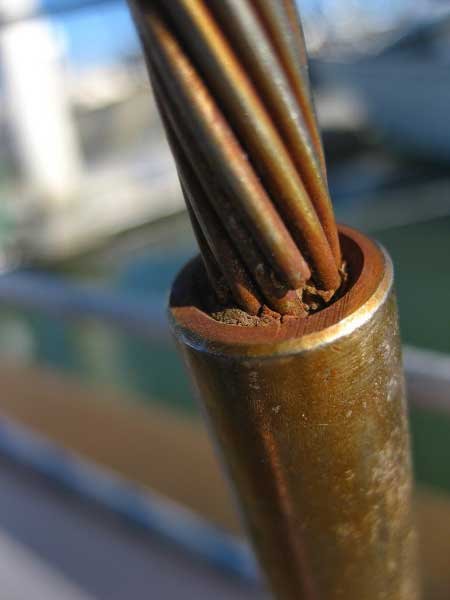
Like this, but my are in 95% rather than 50% condition. Fresh water for the win.

This sort of ridiculous endurance is probably more common on the unsalted low seas of the Great Lakes than is generally admitted. Certainly I've noted on ancient Albergs and the like, i.e. boats a decade older than mine, pretty grotty looking standing rigging that never seems to get replaced or even looked at critically.
Uhh...time for service. Photo copyright  JG Jones.
In brackish places like Florida, a lifecycle of 10 to 12 years for standing rigging is generally considered prudent by mariner and insurer alike, and 15 years seems on par for the active cruiser who regularly inspects her rigging in a strong light, reefs early and often, and rinses with fresh water when rain does not suffice. Still, a snapped stay can ruin your whole day, and 39 years is older than Mrs. Alchemy, whose snapping can be equally fearful.

So I said to myself: "Skipper, this can't be that difficult", and removed the old rigging and bought new standing rigging as a 40th-birthday present "just because".  While the old rigging still looks fine, it's cheap (under a boat buck) insurance. The fact that I've had to retab bulkheads and cabin furniture under my stewardship makes it clear that the boat has and will continue to flex, especially as I like to make it go fast. The rigging is hardly exempt, and the concept of "cycle loading" must inevitably apply.

Alchemy, the redoubtable steel cutter, has, by contrast, 11 5/16ths-inch stays and shrouds with Sta-lok terminals on a similarly sized, if thicker in cross-section, Seldén mast (40-45 feet) as the old racer's excellent Klacko mast: The whole rig of Alchemy is "overdone" by comparision to both Valiente and a "typical" cruiser, and has, like the 39-year-old stuff on Valiente, no visible wear. But as mentioned, it too is original to 1988 when the boat was splashed and so before we leave for the ocean, I will "roll back the odometer" with all-new standing (and running) rigging, due to concerns I've got, and which many share, as to the nasty surprises lying in wait for those who ignore what years of tiny movement can do to objects under tension.


Many of the items I am replacing or upgrading on Alchemy are getting better and larger sets of fasteners and fittings based on the same logic.  A related habit for the ocean-voyager is to examine the deck each morning for evidence of popped pins or bits of line or metal where they shouldn't be. They say rust never sleeps, and they are right.
Upon reflection, I could probably spray-paint a better "black band", but it rained a lot this spring

So firstly, the older boat has the new rigging. A close peer at the existing clevis pins and through bolts and tangs/straps indicates plenty of beef, no cracks and no corrosion, so back they go, with a couple of replacement bits:
The pig-sticking point

Some wiring is updated, and the new crimps and crimper and heat gun are brought to bear. I had an idea (not pictured) to wire up a couple of 6V lantern batteries to make a weak but fully 12 VDC dry cell...it's all the battery system planning affecting my mind; I see Ohm's Law everywhere...and this served to test anchor, trilight and new deck/steaming light connections. Unfortunately the wind direction/speed device leads were too short to attach without splicing in wire I didn't have handy, so that's a no-go for this year. Maybe I'll try to fix the knot meter instead!
Horses for courses
Spreaders on, some running rigging installed for convenience, and even a hoist for a pig stick...by Neptune, that's looking almost yar. 
What Constantine may have seen at the Milvian Bridge. Or not.

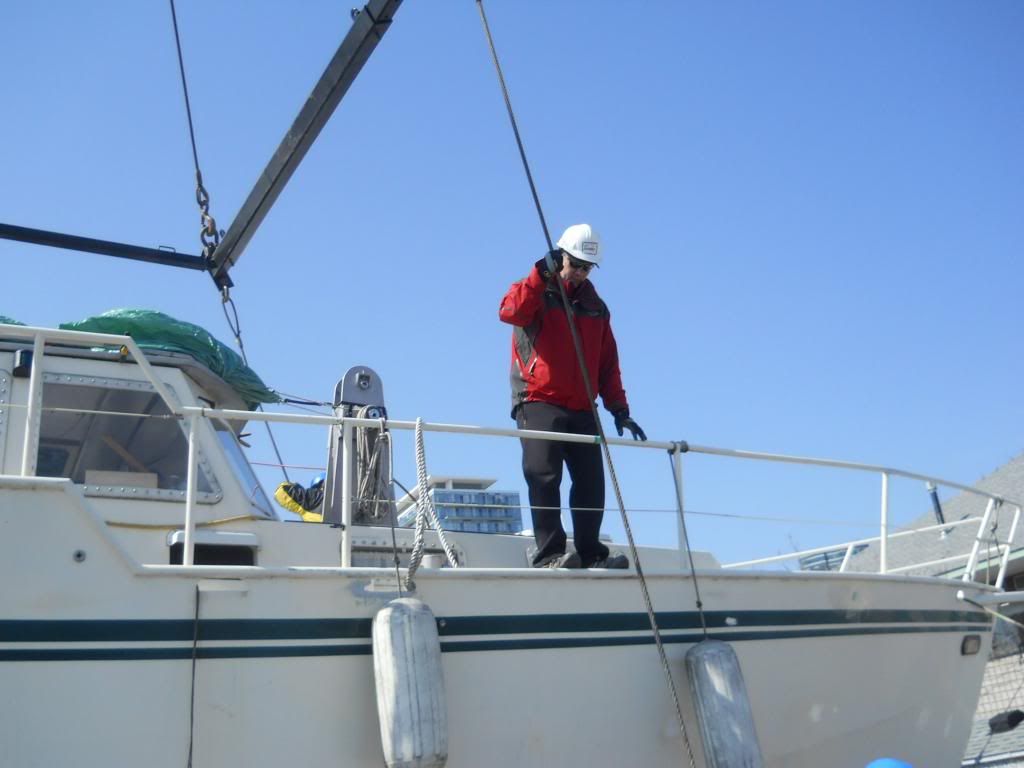
After a rather rushed, and therefore typical, mast hoist, and the solving of a problem with a forestay tang caught up in a block (solved by a fellow boat club member who did a Spiderman trick with a boat hook up the crane!), we were home.
As I broke the venerable easyBlock last season, this is the new Garhauer triple-block mainsheet. Not entirely pleased with my reeving job, and may soon revise. There's too much line, too, but I got it at a discount.


Note that this guy, whose video is even in 3D(!), is "Maine Sail" level of thoroughness and DIY-itude; if your boat is sufficiently popular, the rigger will have all these measurements at hand and would notice if your old rigging deviated very much from the expected dimensions. Label early and often!
Being avid readers, we WANT to sail away with a couple of hundred books, but this is one of maybe four books we would NEED.
Periodic inspection of the rigging and replacement if necessary is good practice, cheap insurance (this rigging cost under $1,000) against catastrophic failure, and is prudent seamanship: whatever the as-yet murky fate of Valiente, I now have reasonable confidence that she won't snap a stay short of getting caught in a full gale with all sail out.

And now I've been through a re-rigging myself, I feel more confident about doing it for the bigger boat before we push off.

UPDATE: June, 2013:  I took a little time last week during a calm spell to tune the rig at the dock. This consisted of getting a couple of levers for turnbuckle turning and a Loos Gauge.

Most people who aren't racers tend to have somewhat slack rigging, I've found
I will assume that those interested in the topic of rig tuning can read about it from the rather basic level of knowledge I possess. Nonetheless, even a basic tuning that "takes up the slack", spreads the loads among all the stays and shrouds, and keeps the mast in column can add significantly to sail performance. Good tuning also reduces vibration, wear and the tendency of the mast to want to bend or topple. Laudable, self-evident things, one would think, but to judge by some of the indifferently tuned boats I've been on, it's not a skill or even a tendency that is understood among all recreational cruisers. Which is a shame, because I consider it at least as important a factor in efficient sailing as mastering various sail controls. A Ferrari with under-inflated tires just isn't a proper sports car.

Unlike some people, I can't pluck a shroud and tell from the note if it's taut enough. I need the tool.

There are suggested tensions for rigging based on diameter and a set percentage of "breaking load". I tend to load up the forestay slightly more than the backstay, and the uppers and lowers to the suggested values. My mast is original and frankly, the fact I use recycled main sails means I'm not really going to benefit from distorting the mast in the sort of interesting shallow parabolas of modern race boats. I'm going for stable and straight most of the time, and will retune in September to see if the new standing rigging has stretched at all and needs a couple more threads of dogging down.  Alchemy, being deck-stepped and, as is generally the case, over-built in the rigging, has a greater number of larger stays: I'll need a different gauge than the one I am using here.


2013-05-06

Watching out for rescue

As I had to tell a friend once about a modern boat's boom design, "no, it's not broken, it's supposed to work that way."

While the debut of the hugely expensive Breitling Emergency II watch is not strictly within the purview of this blog, the notion of PLB/EPIRB-like beacons you can wear is. So I've updated and partially rewritten an already lengthy post on the topic of self-rescue, which remains one of the most popular topics I've covered. Go to the bottom update marked "UPDATE, 2013.05.06" if you want to get to the entirely new stuff.

2013-05-04

The other half splashes

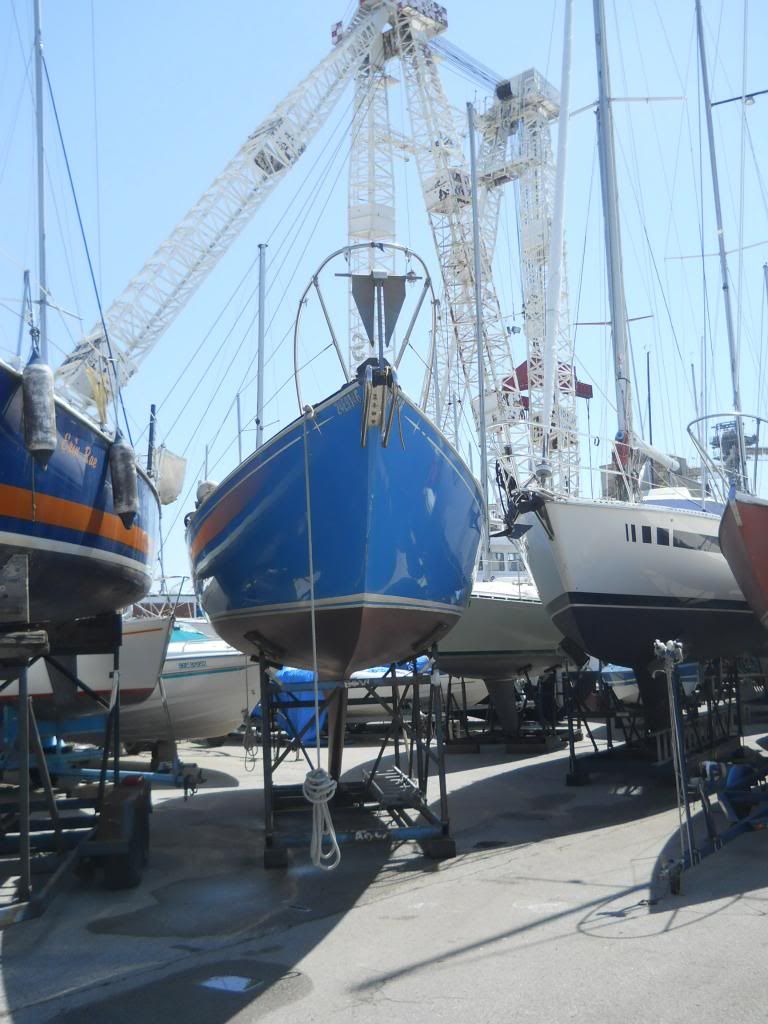
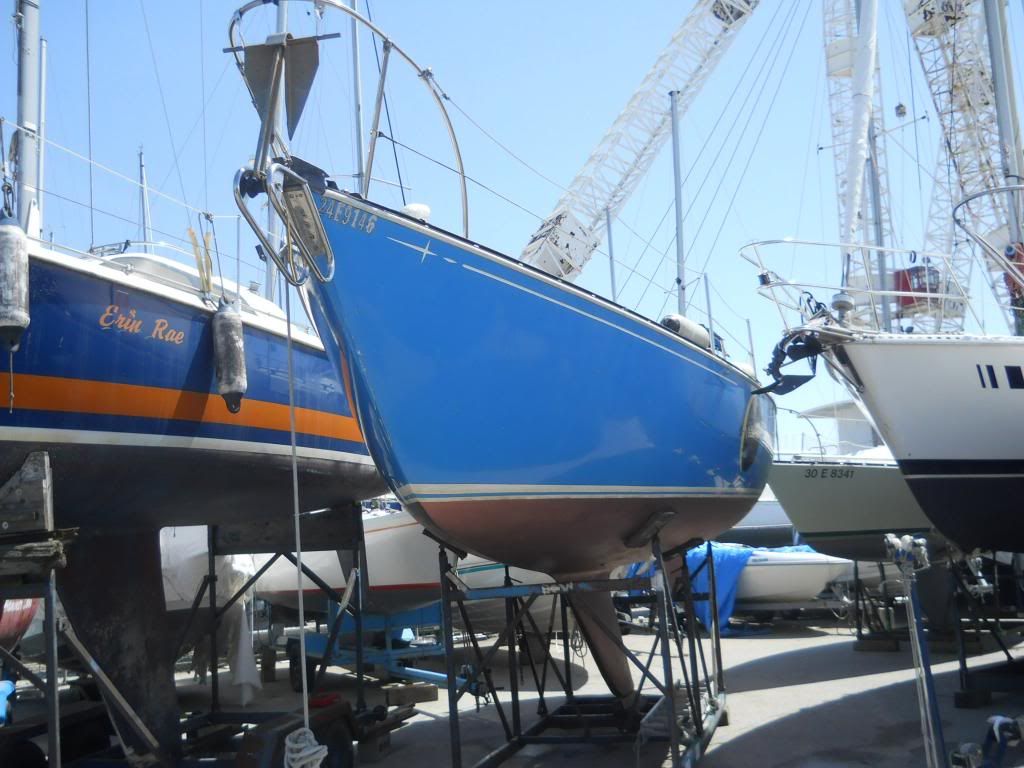
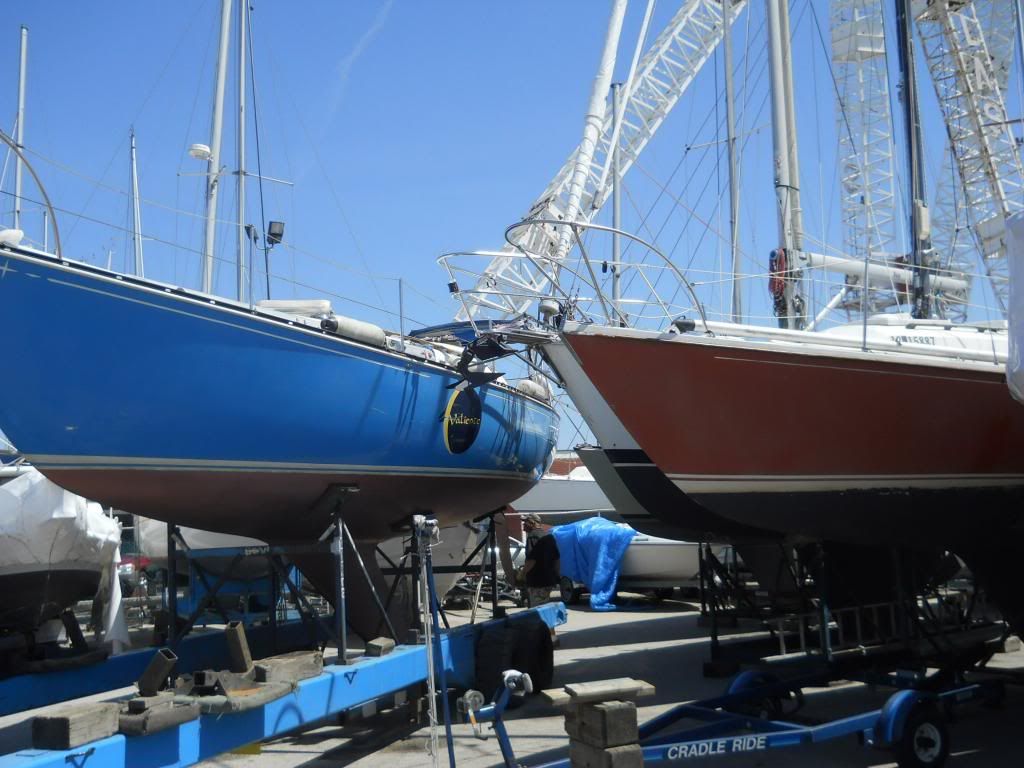
Ready for launch and surrounded by other boats


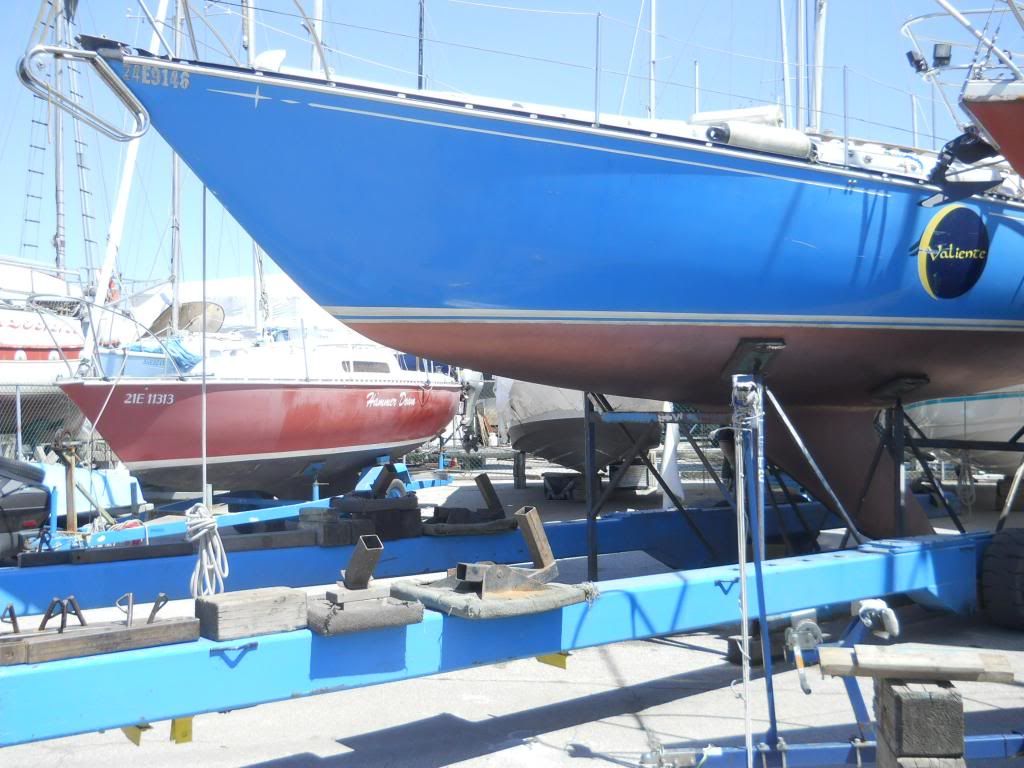
Having established that her new PSS Shaft Seal is, so far, dripless as advetised, I put Alchemy restoration aside last Tuesday to launch Valiente, the other half of my Swiss Navy-sized fleet.

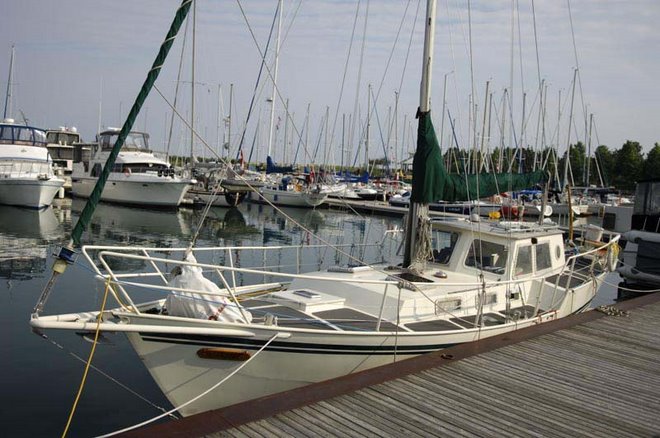
All things considered, not bad for a 40-year-old: a real Boat I Like to Sail


The collision of appalling, barely spring-like weather and its affect on finishing a bunch of needful tasks to make Alchemy watertight for its own launch postponed dealing with Valiente far longer than I had hoped: I could have sailed into our summer berth April 15th instead of 17 days later...hell, the bottom paint was done on April 9th...but I suppose it could be worse: it could be snowing.

An old-school stuffing box will remain on Valiente, as you can't clap a PSS on a direct-drive Atomic 4
Aside from the usual hurry-up-and-wait routine which is to be expected at a busy boat yard in May, boat partner Clive and myself had little in the way of trouble, although his elderly Honda 800 generator blew a fuse trying to power my 10 amp Guest battery charger, and he volunteered to get my Honda 2000 from my house, which involved Toronto traffic so dense that it delayed me on an unloaded bicycle...my offshore readers from this area can feel good about avoiding that downside to an otherwise very nice place to come from. We did the usual last-day-ashore stuff: servicing the thruhulls/seacocks, tightening hose clamps, particularly on hose below the WL, and bringing various chunks (like the Portabote and the boom) out on deck to free up space in the cabin.

Like threading a ten-ton needle
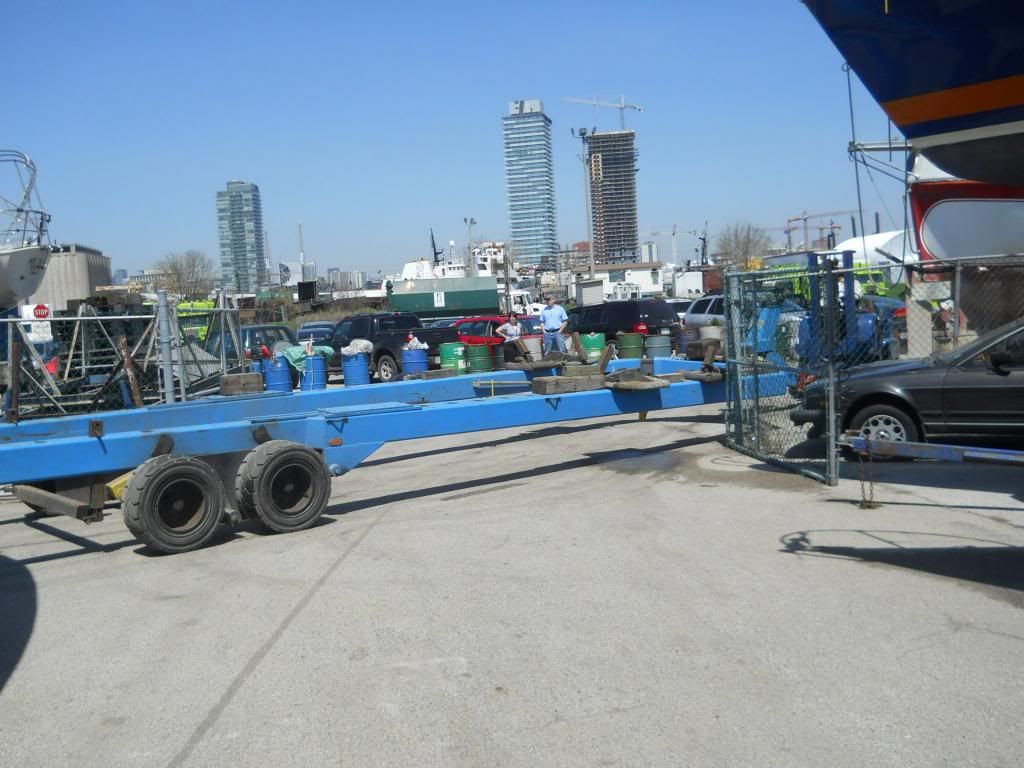
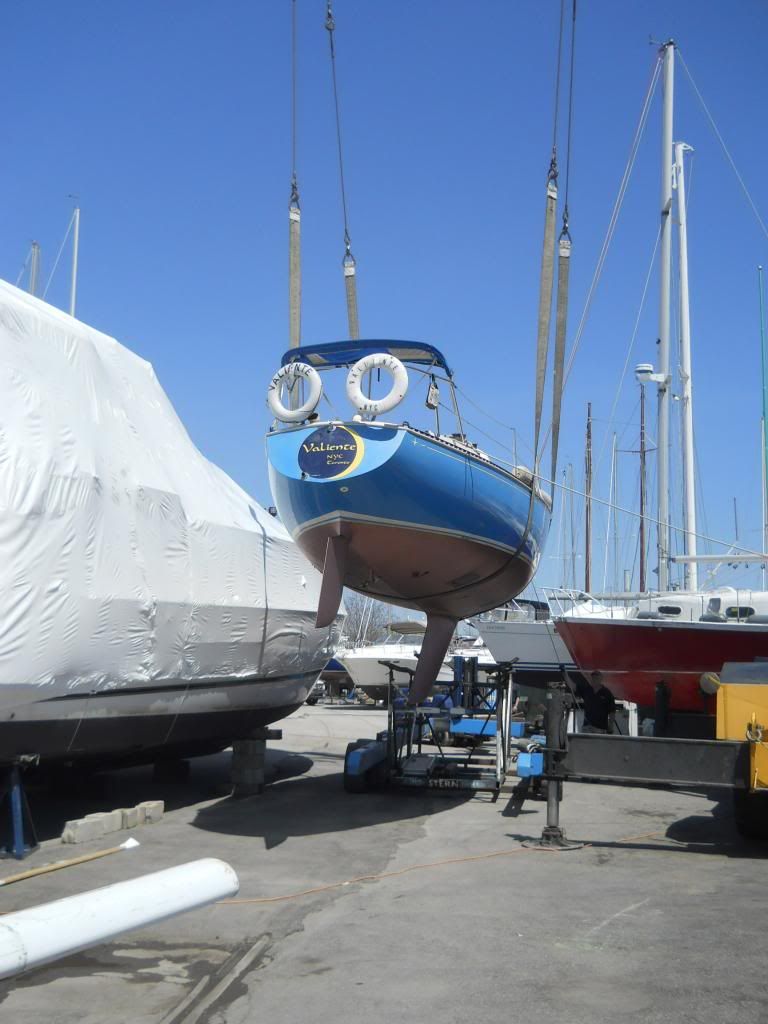
I've posted plenty of launch and haulout pictures in the past, but this time, I have some nice shots of the redoubtable Uli and Clayton maneuvering their impressive gear in what would appear to be extremely close quarters. This rig of hydraulic lift trailer and forklift is about sixty feet or 19 metres in length. From my bow to that gate is about one boat length (35 feet/11 metres). Uli, the yard manager, is driving backwards much of the time and is doing six-point turns...yikes, watching this is a tad nerve-wracking for the uninitiated. I am almost used to it, and Clive, who parks giant passenger jets in narrow airport gates as part of his day job, exhibited frank admiration for the way these guys work efficiently and with clearly well-practised spatial orientation.

The hydraulics are pressurized by yet another small Honda motor. It looks like it's off a lawnmower.

The entire cradle is raised off cinder blocks, only a few inches or so, and is pulled free.

And that's why I don't lower the fenders.

Here you can just make out that the pulpit of one boat is brushing at my aft port lifering as Valiente is hauled out of the crowd. It is not an exaggeration to say I've seen boats pass within one inch/2.5 cm of each other. The economics of boat storage depend on close quartering.

Not seen: The wind had picked up a bit and my stern swung alarmingly close to that shrink-wrap
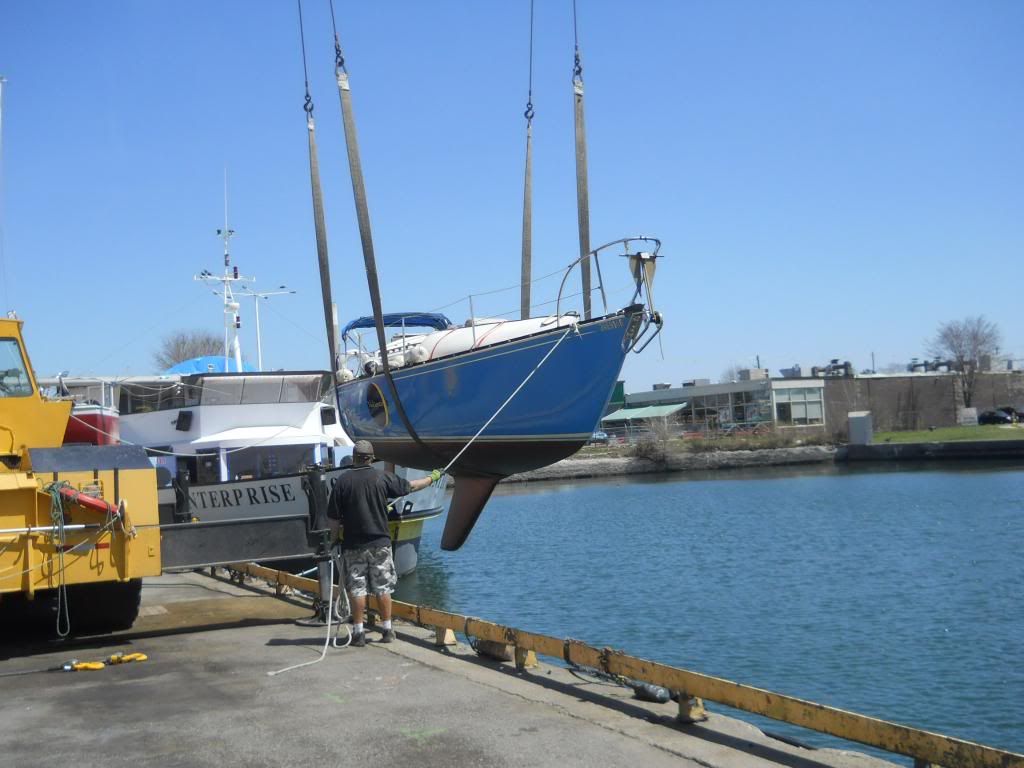
After a ten-minute trundle around the outside of the ill-defined boat-stowage grounds, it was up, up and away time into a blue sky rarely seen this year until the last week or so.

The first duty...look for water coming in where it shoudn't be.
The engine started right away, although it stalled briefly when put in gear. There was an annoying and fairly significant leak from the newly replaced basket filter to which I attribute a poorly seated gasket ring. Throw in the anticipated dripping from the stuffing box, which tends to need a few days immersed to swell to its nominal "slow drip" state, and I am glad I had the bilge pump in working order. By the time I tied up after a 20 minute chug across the harbour, there were a few dozen litres below.
That ladder will be shortly replaced by a mast
Not a worry, however. I fixed the basket leak and tightened the stuffing box a little until it settles. We'll see if both remedies work the next time I motor, which will be to put the mast in next week.

2013-04-29

Crimping and saving

Cognizant of the fact that much in the way of wiring is before me, I recently made a long-deferred purchase:
In real life, it's much higher resolution.

Behold the Ancor Double Crimp Ratchet Tool. Amazon in the States was having a sale on this and even when some adhesive heat shrink tubing and marine-grade crimp connectors were thrown in, plus the inevitable shipping, it was cheaper to buy online and "foreign".

UPDATE, 2013.05.10: Having used this crimper a fair bit now, I realized that it's important to adjust the little +/- adjustment cog on the side. I had mine too much to the "plus" side, meaning I had to bear down really hard (and I am not a lightly built, stringy individual) in order to get that final "click" of the rachet mechanism that would release the crimp. I found a few notches back gave an equally serviceable crimp (visible as practically solid stranded copper in the middle of the crimp) that I could finish with one hand, and not with a three-pound mallet strike. Still haven't figured out the "release lever", but that doesn't solve the problem of a crimp setting that requires a gorilla's grip.

A bit tinny, resolution-wise


I was schooled (remotely) in the art and science of marine-wire crimping by a character known only as MaineSail, a guy who is like a one-man Practical Sailor of demonstrably good advice and real-world testing on boat repair techniques and products. This photographic tutorial, plus the premature failure of a couple of my own crimps, made me think I needed not only the right tools, but the right techniques to create reliable, strong, and corrosion-resistant crimps.

I am guilty, your lordship, but I promise to do better in the future.
Those interested in the details are encouraged to read MaineSail's excellent treatise, but the gist is this: Marine wire is tinned copper, which resists corrosion, making it last longer (but not forever!) in the terminally damp (pun intended) marine environment of salt air and inevitable splashing. You therefore want tinned connectors.

This fellow gives an introduction:


A second factor is strain relief. A properly crimped connector can support a surprising amount of weight and belies the old idea that twisting a couple of wire ends together and soldering it over (to be followed by a few wraps of Grandpa's best roll of black electrical tape) will suffice.

Look closer. That's a crimp in the middle. Photo from http://www.pbase.com/mainecruising/wire_termination&page=3
A third element is accurate wire stripping. That involves not the home handyman's method of running a pocketknife around the wire and then pulling off the insulation layer with one's teeth...yes, we've all done that...but by using a tool with dies (are we sensing a pattern here?)

Insert "I've known a lot of strippers in my time, but..." joke here.
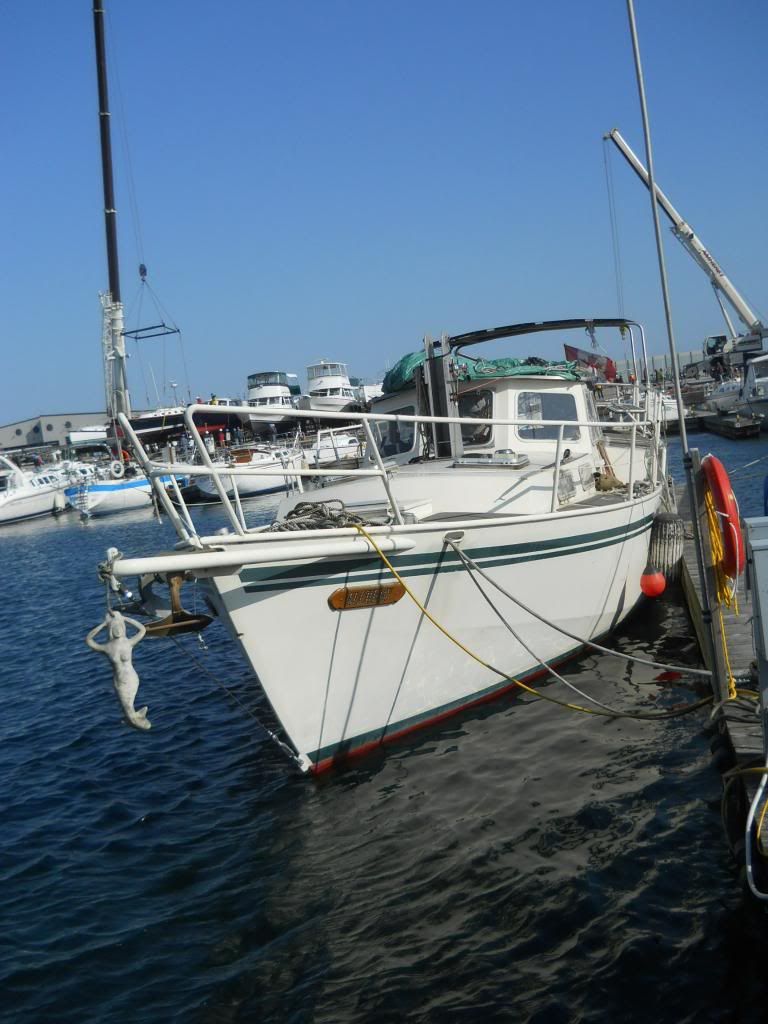
This is the Ideal Stripmaster. It handles 10-22 AWG wire, sizes that would include the majority of boat electrical work outside of battery lugs and cables, and will strip both stranded (marine standard) and solid (house standard).  As is often the case, I found a place near me with no connection, pun suggested, to the sea or boats: an electrician's tool supply place. I find increasingly that my needs for tools and supplies are met by "industrial" concerns and not "boat gear shops". I also find if I do need something definitely marine, I poke around in professional mariners and fishermen's catalogues to find it, rather than chandleries geared toward the recreational sailor. C'est la sea.

Speaking of battery cables and lugs, they are thick and expensive things that not only vary in price with that of copper and tin as commodities, but which carry high enough currents to get seriously hot if poorly crimped or sealed. And I will need a lot of 'em for my house bank and other parts of the fairly complex charging systems I wish to use. Once again, the mind of MaineSail has produced an excellent primer on the topic, and made a case for doing the job correctly by doing it for oneself.

Like this. Photo from http://www.pbase.com/mainecruising/battery_cables&page=3
So while many sailors will have heavy crimps made by a shop or a chandlery, I am looking at buying yet another tool to "get 'er done": a hydraulic hand crimping tool:


If I had two 12 VDC batteries that I needed to link to a switch with four or six cables that required crimping with lugs appropriate to Group 27s, I would have a store do it. But I need to do perhaps 20 to 30 8 AWG down to 2/0 AWG crimps of various lugs and high-current conduit connecting L-16s or an equally large form factor of flooded battery, so a tool like this will, in fact, save me money. That's my story, anyway, and I'm sticking to it.

Because boats run electrical power (and increasingly so) in a generally hostile environment, special and generally agreed upon standards constitute best practices. The ABYC documentation (which is similar to that of Transport Canada's rules on boat wiring) on these standards may not be compelling reading unless you've ever had an electrical fire. Nor do they mention the role of anchors in crimp testing. But they do emphasize the strong correlation between a good, tight, moisture-excluding wire crimp and a safer boat where things reliably happen when switches are flipped that don't include a follow-up MAYDAY call. So scrimping on crimping is a false economy.

2013-04-28

What sailor doesn't like a properly wet bottom?

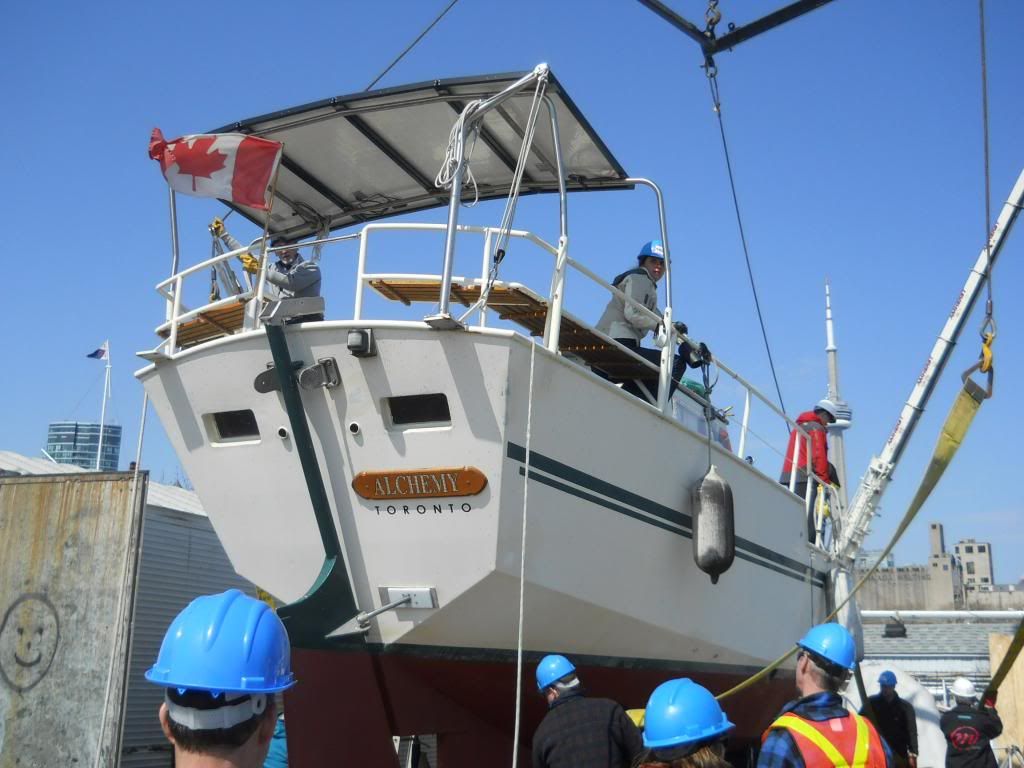
Flags out for launch.

Today's pictorial is brought courtesy of diesel and gravity.

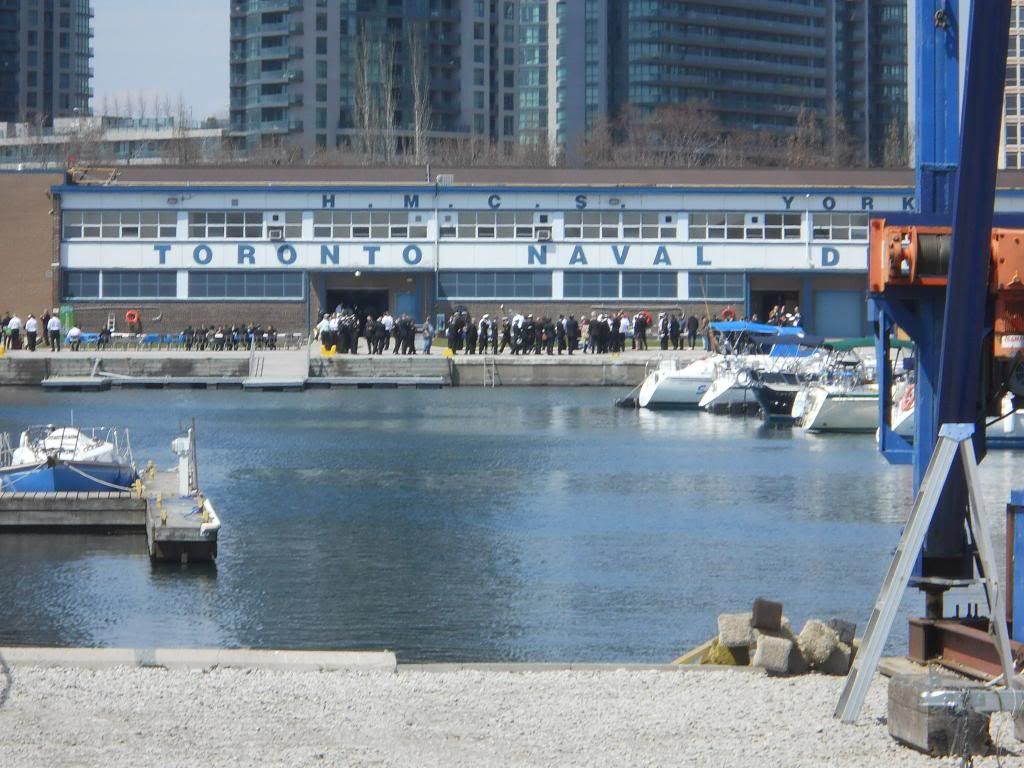
Our boat club's inner basin is shared with a second club and a modest naval base used mainly for the creation of Sea Cadets and marching bands.

A few cheers, sure, but I didn't expect a parade.
Apparently, that old sea dog Prince Philip was in town to do something regimental. It tickles me to think that he somehow looked out the window of the royal limo and spotted Alchemy aloft and later said "I say, Elizabeth, over in the colonies I saw the most astounding flying boat..."

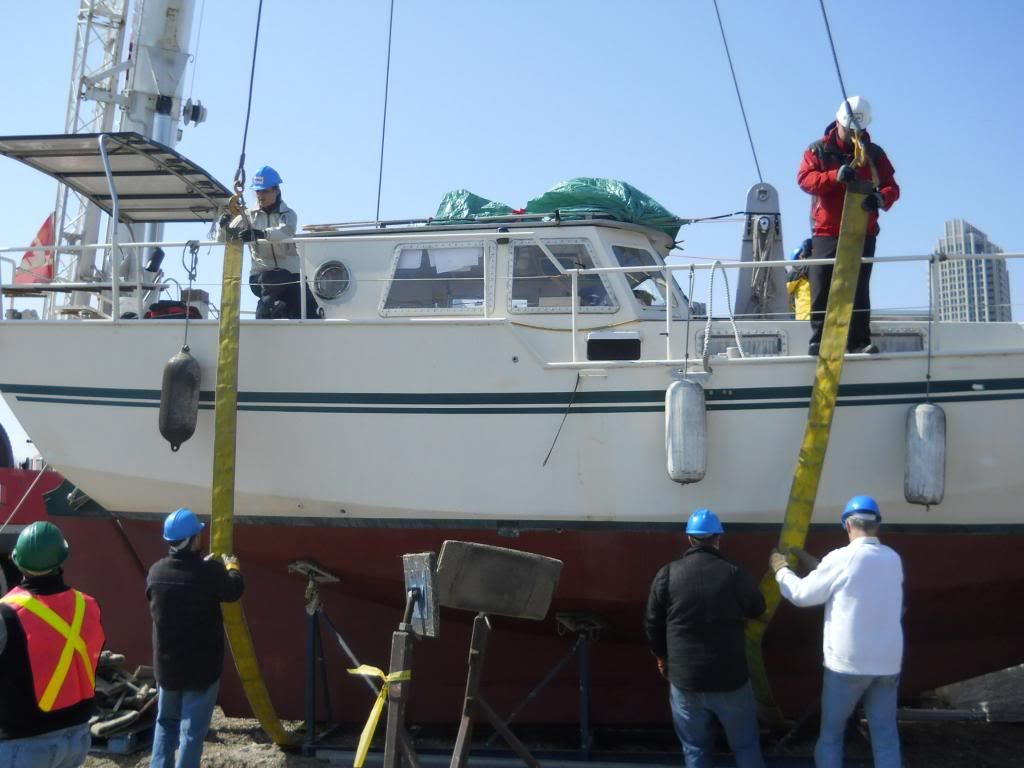
The pre-flight consisted of "slingers" and "linesmen/women" arranging the lifting and pulling items correctly:

The long lines at the quarters are to spin the boat from the ground while it's in the air. Non-trivial labour.
Mrs. Alchemy is the primary painter and appreciates when the finish escapes chipping.

These slings and the hooks and cables to which they are attached weigh a lot and require careful handling.


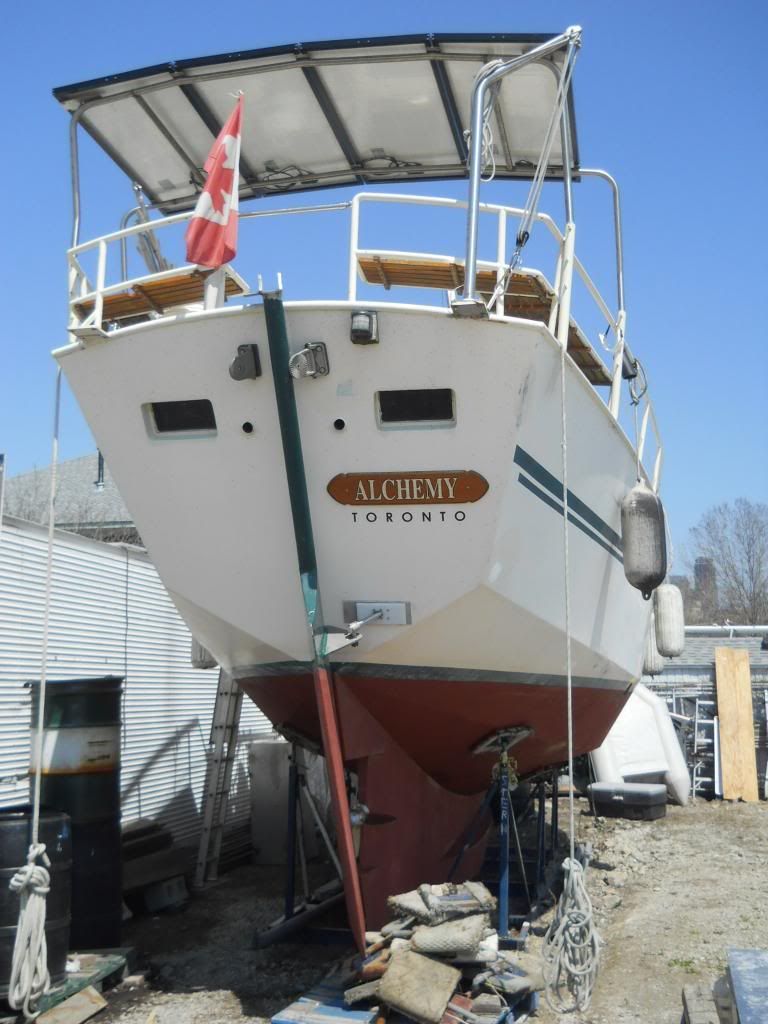
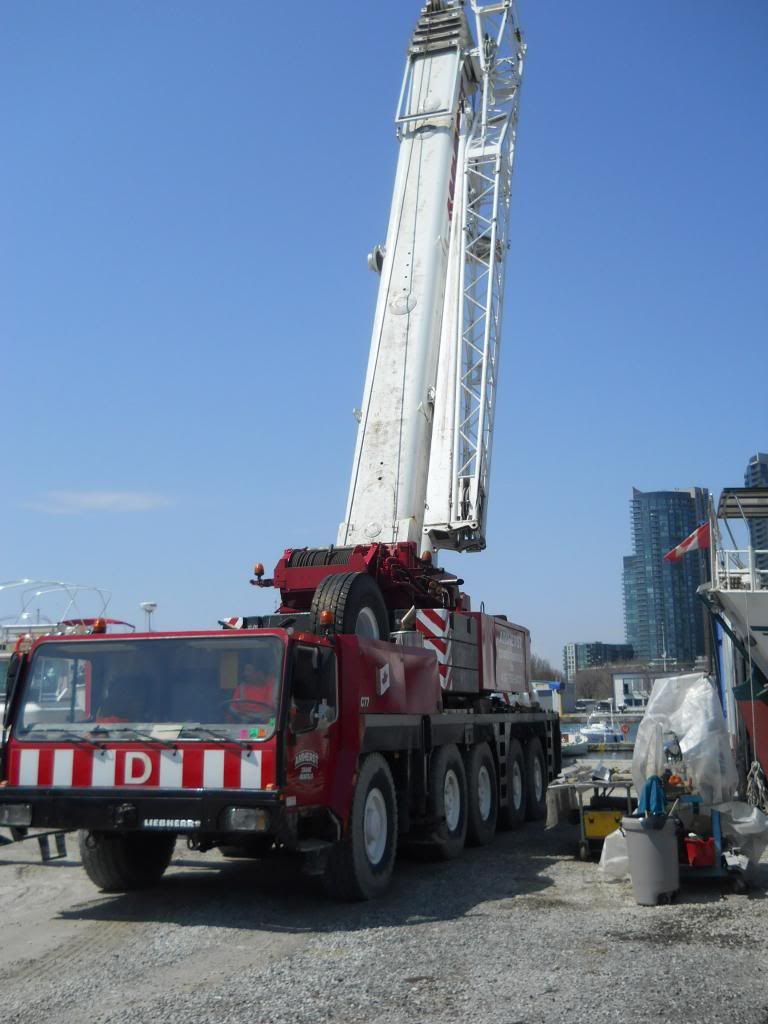
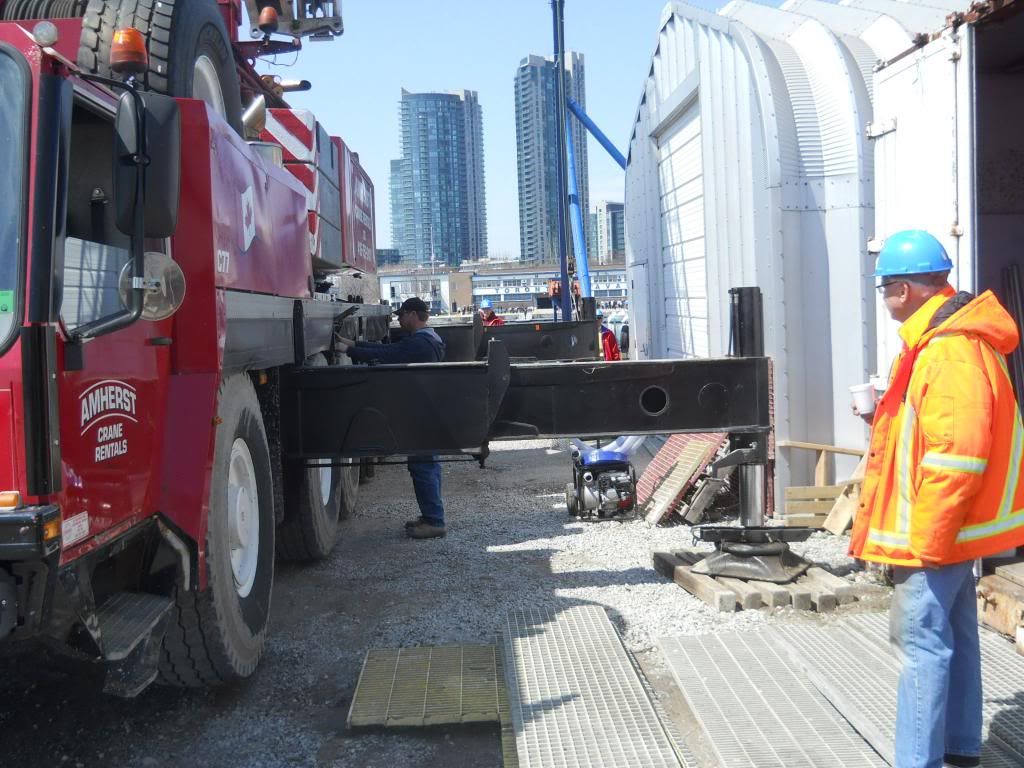
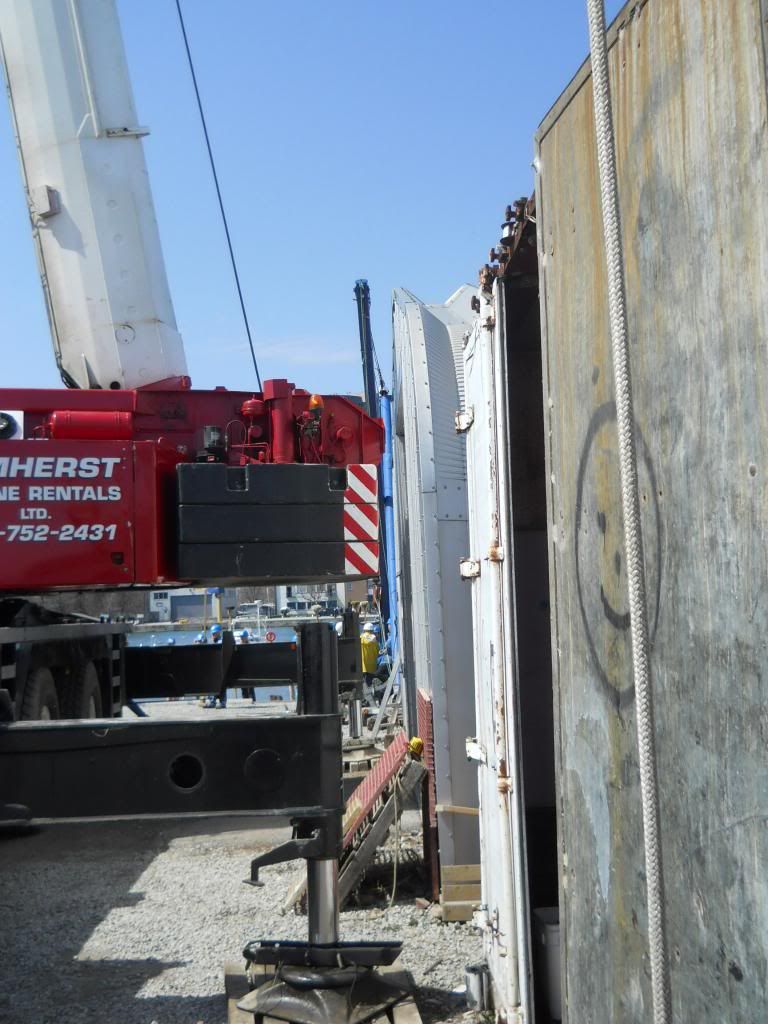
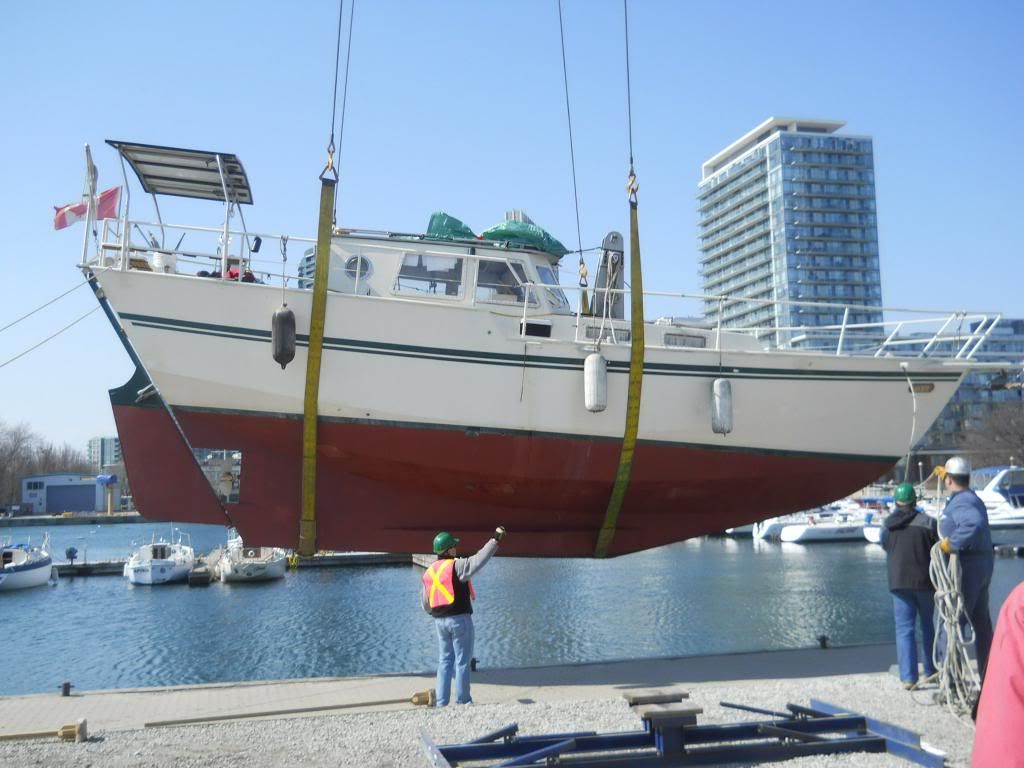
The crane slated to haul Alchemy's 14 or so tonnes skyward proved to be a snug fit between the remaining boat rows and our forklift shed.

We've used Amherst for some years. They very much know their stuff in a job that doesn't tolerate error.


The bracing legs were extended into gaps between boats and building. Tight fit!
Moving the shed would take some time.


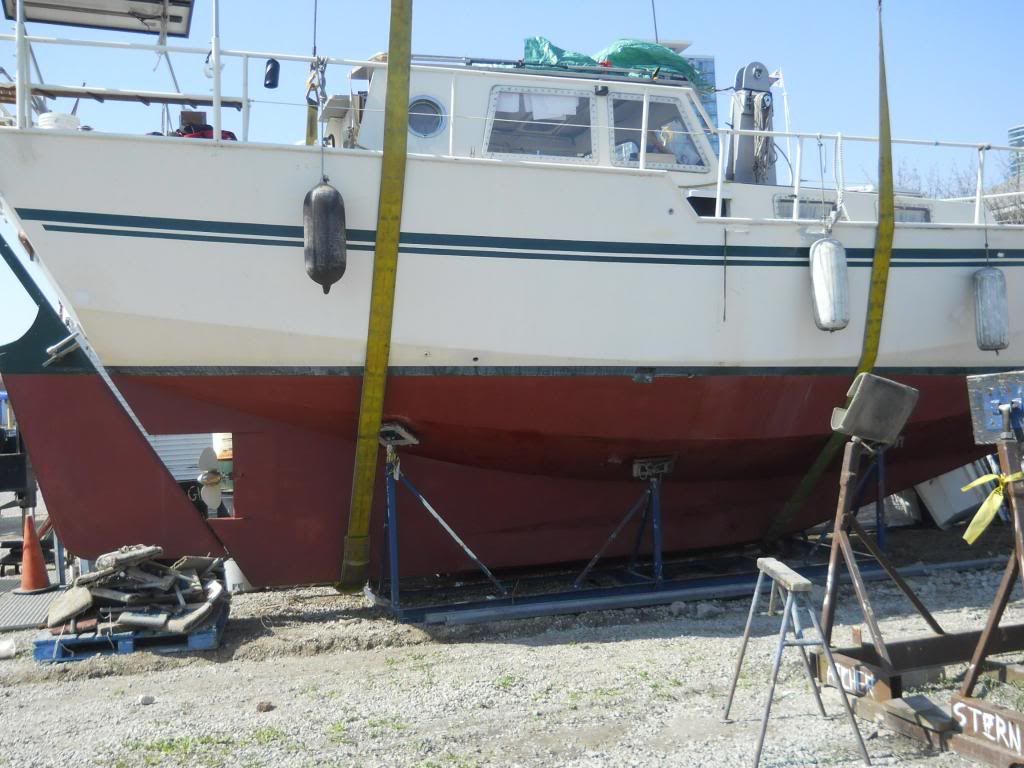
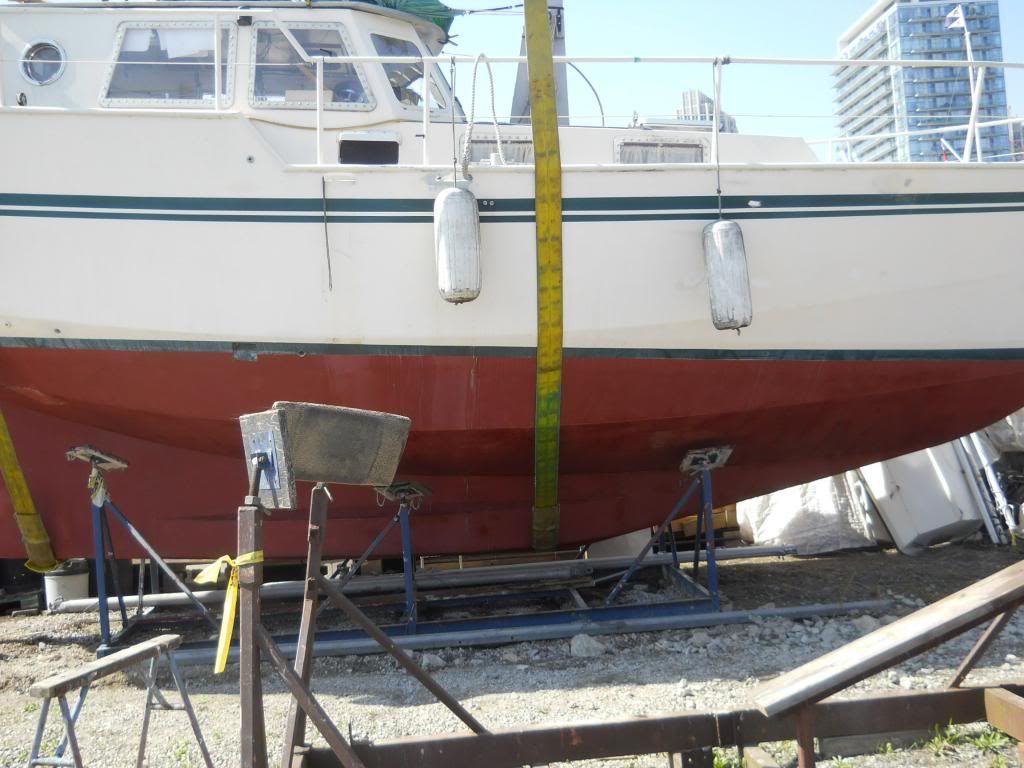
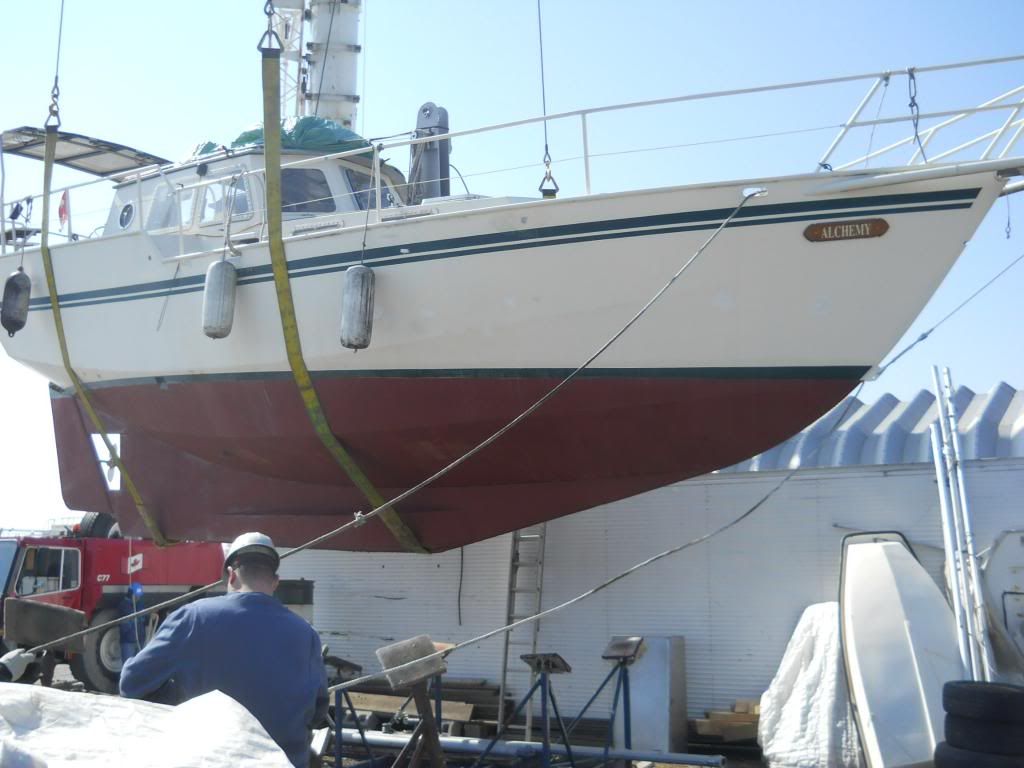
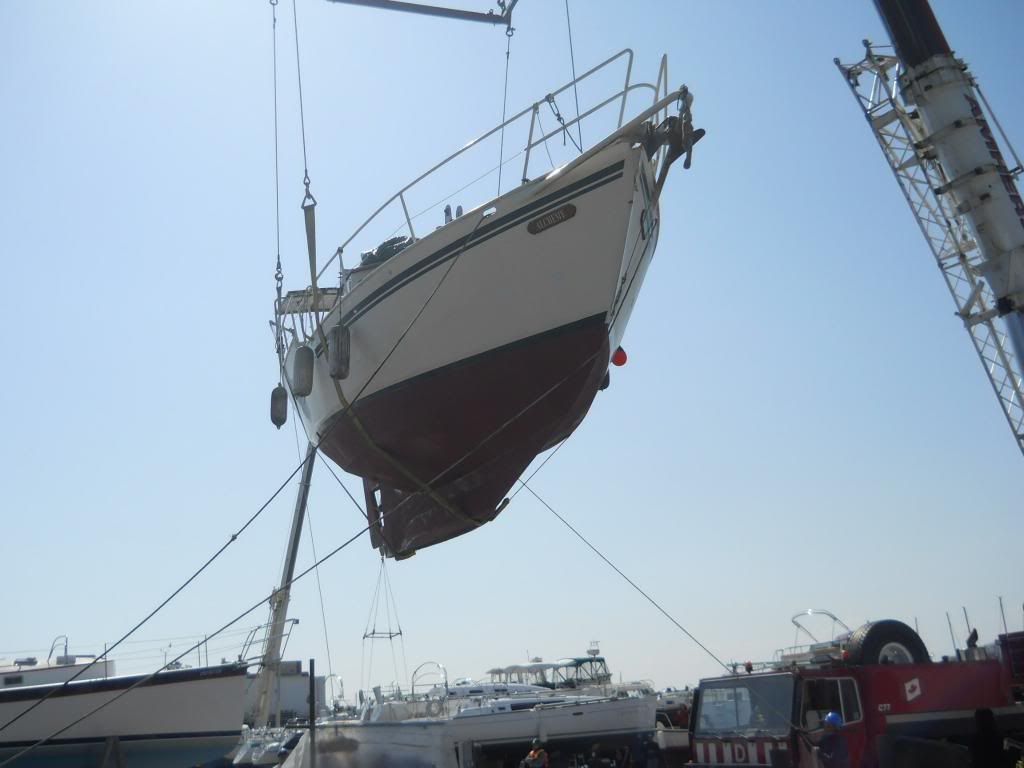
I was a little concerned that a) there was no "cinch belt" used on the slings (the horizontal belt or strap keeps the vertical slings from shifting under load), and b) the forward sling was a little too far aft. These photos seem to suggest I was right as Alchemy takes off in a decidedly bow-down attitude. 
The green tape marks on the top rail indicates the preferred sling positions.

On the other hand, having the forward sling right where the keel bottom meets the angle up to the bow was arguably a less "slide-prone" placement.

Nicer fenders are awaiting deployment. Honest.

Alchemy looks like some sort of secret U-Boat design here.


This is the part where even a modest breeze can cause trouble.


The fellow in the orange vest is actually signalling, not single-handedly lifting our boat.


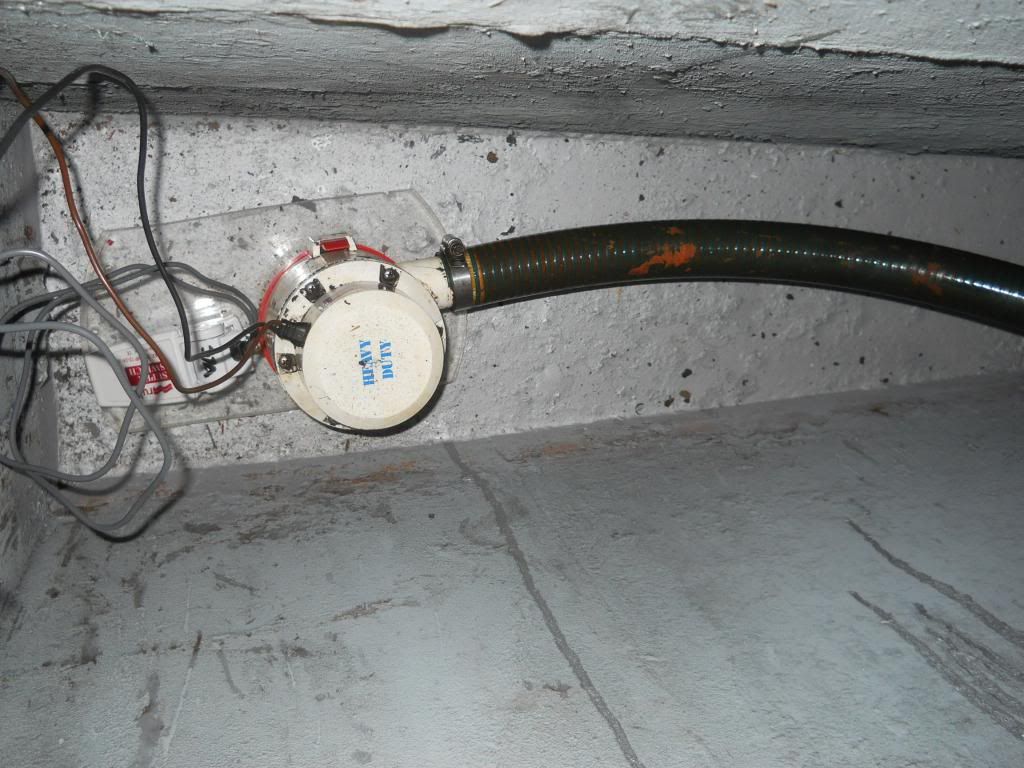
As soon as Alchemy hit aitch-two-oh, a pressing concern meant I needed the slings to be kept on for a few moments. There was a chance that a few years out of the water had, despite my inspection of seacocks and hose clamps, caused some hole or crack to appear and would allow water in the boat. There was also a possibility that the freshly installed "Dripless Shaft Seal" on the freshly installed drive train would not, in fact, prove to be remotely dripless, and that an operation called "burping" would be required. As would the laboriously wired bilge pump of bigness seen below:


The dichotomy of dry in and wet out remains fascinating.


Non-boat owning readers, or owners of boats with traditional "stuffing boxes" that are supposed to drip into the bilges, may not appreciate the pleasure with which the owner of a just-launched steel boat regards a bone-dry bilge. Steel boats, it is said, rot from the inside out, and all the painting and remediation is ideally linked to the reduction of water on the inside to as close to zero as is possible. If sinks, spills, condensation and shower sumps are, as is customary, going to be part of the boat's working life, then the goal is containment and confinement of whatever water's moving about the boat, timely removal of same, and ventilation sufficient to dry out condensation that can form when a boat filled with warm or warmed air sits in cold water. You could write a book about it, really, but the start point is keeping the water out of the lowest, coldest parts of the hull, the dreaded standing water.

Not seen: Moisture. Seen: Recycled bilge pump hose and a potential wine cellar.
Not a drop was found that day. Very good news for me, for my expert installer Cap'n Matt (this bit being very important to get right, and he'd done a very similar installation on his steel boat Creeation), and good news for the shore crew, who could direct the crane to the next boat and forget about my dramatic needs and go-tos.

And after a misjudgement in steering and "way on" that reflected the skipper's long absence from the hydraulic helm and a second go-around by the tow boat (the engine's in but the fuel system is not) in order to lay her safely on the dock, the very gratifying sight of our future home at her designated berth made both a very long day and a sometimes frustrating winter and spring all worth it.
Heck, she looks a lot bigger in the water than in the cradle!
Further adventures in boat restoration to follow.

2013-04-25

Risky post-business


S/V Alchemy: The economy upgrade

I've just had my 2012 taxes prepared. It's not too bad a hit (as a self-employed contractor, I always pay taxes), but it clearly indicates a mismatch between my earnings versus the time (unpaid and frequently costly in terms of materiel) I spend messing about in boats.

My wife thinks I should sell Valiente, but the market is soft like steam on Mars and I just purchased new rigging, which would add little or nothing to the depressed price I could command for an old and unfashionable (if fast and fun) '70s boat. But it is difficult to argue that Valiente does cost a couple of boat bucks per year, even if the summer dockage is shared, as it currently is. Ideally, meaning if I won a lottery, which is pretty far from ideal, I would like to pickle the boat in a barn or even a trench with a longish hut over it...and sail it until I croak after we return from voyaging. It is admirably suited to its purpose of swanning about the Great Lakes in a rapid and handsome fashion, just as the brutally strong and tank-like Alchemy is suited for homely and capacious, like an aunt fond of cookery named Bertha. Boat pun intended.

Not risky business at all if you are "cleared" with the bank.


Suited to purpose is this post's theme, which (again, and perhaps tediously) returns to the idea of cruising, retirement and money, three interlocking concepts that are a source of anxiety and confusion for many folk contemplating drinks and sunburn in some reasonably priced and not at all dangerous tropical locale. Given the way the game is rigged, however, perhaps they should be considering a cache of tinned goods in a sod hut instead of an RRSP or bubbly Vic-bricks in revived, coffee-house-saturated urban cores. Like ours.

Some time ago, I had a dialogue with a ketch owner who had, save for year-long employment stints/cruising kitty recharges in the Japanese educational system, effectively "retired" in her 40s. With a couple of foreign rental properties yielding a modest working income, and with her very modest patterns of consumption, this person had a frugal freedom well planned out. She faced, however, either through jealousy or spite, social criticisms that her plans to do what she felt like, on her own dime, were somehow "selfish", as if "work" was a team sport and stopping work was in some fashion an own goal.

I'm not sure if I'd call that selfish at all. My position is fairly libertarian in this respect: If one likes the deal one is offered as a wage-earner (work until 65, or possibly 70 due to pension drift, and hope the pension plan stays intact until you pop your elderly clogs), by all means one should take it...after a careful and critical evaluation of how that has historically actually worked out, with the keywords of "indexed pension", "underfunded" and "unsustainable" to act as laser flares of guidance.

I recall a fine teacher I had in high school of senior years who basically was in his last year of work, i.e. 64 or 65...and sure as hell looked it. He decided to ditch the standard curriculum and teach us his personal interest in Ontario architectural history, which actually proved useful when I needed to defend the mowing down of the 1855 apartment block I lived in in the 1980s from condo-ization. Thanks to this teacher, I could accurately cite the Georgian features and elements that went into the design of the squat flats in which I then lived, which led to its preservation to this day as a "historical marker". In which, you know, people live. The teacher died of cancer two years after his last classes at the age of 67. I hadn't even finished high school (seed of life lesson thereby planted). I'm sure he would have preferred to jaunt about observing Victorian batten-and-board homes or the variousUpper Canadian mansard-roof interpretations. Yes, I remember this stuff, and am pleased that even if the boomer eat my own pension plans, I went to school at a time when a geezer could teach 16-year-olds about indigenous architecture and make it compelling.

Not everyone has grand personal ambitions or exhibits tumour-like careerism, and if they do, they might channel them into hobbies, yoga or "personal growth".

Whatever.

Do what you will, if it harms none is what I call good advice. If your life and career choices don't involve costing me personally or bothering the horses, have at it. I would hesitate, however, to characterize one's choice as the default setting or right decision for society in general, which, quite frankly, requires a large percentage of fairly unambitious people to just get on with their jobs instead of self-actualizing the lot of us back into the Dark Ages.

Mutual fund advisors, 565 AD
Occasionally, I get some stick for declining to have ever purchased a car, but where I live, how I work and my temperament made this no-car-er a no-brainer. Also, pointing to the brace of yachts I maintain and saying "they cost less yearly than a Honda Accord to run" tends to shut people up, or at least shifts the discussion to "can we get a ride?"

When confronted with a liveaboard or a soon-to-be, there can be among those still doing the commute a hint of jealousy and fear: People on the treadmill want company and resent the fact that others, sometimes through sheer happenstance, saw the treadmill early enough to recognize it as a rat-training device and to avoid stepping on it.

Fine. As long as the cruiser/voyager/salt hobo doesn't sponge off the public teat, where such a teat even can be discerned, or finances boat living by pulling scams on four continents, it's no bother to me, and it shouldn't be to anyone else. Cruisers who "retire" in their 40s and 50s may be failing to drink the Kool-Aid, so to speak, and that bothers people who have drunk far too much already.

B. Behan: Skipper-like boozer and possessor of one of the six types of Irish face.
My late mother's half-brother, "Uncle Fred", died at 83 earlier this week, and while I certainly agree with Behan that the death of parents does focus the mind. Last Nov. 29th was the tenth anniversary of my mother's death at 68. Oct. 29th was the sixth anniversary of my father's death at 81. Yes, I suppose it's a trifle morbid to keep such calendrical observances, but I come from a small family, of which I am now the eldest living male. My mind is therefore focused.

I didn't need the small packet of inheritance my parents left me to contemplate sailing off into the sunset while I still have a full head of (mostly) brown hair, but I do feel, quite strongly, that as they didn't have much of a "retirement" together, or ever gotthemselves ro experience the travel they'd hoped to do, it's sort of a post-mortem endorsement that we go cruising in honour of their memories. I'm planning to disperse their ashes into the sea the day we actually push off.

It's a flexible deliverable.

I Googled "folly of working to a calendar" and found this. It has a boat, at least.

As is the currrent, if rapidly eroding, paradigm, many people work all their lives, only to pay off houses worth less (of late) than what they paid for them. They enter social (health care, retirement age) and financial (investments in stocks) contracts built on manifest quicksand or at the very least, questionable shorings. Many of them play the game, but the game is arguably and, when the man behind the curtain is revealed, demonstrably rigged.

So one is gradually sussing these facts out. Good for the clever dodge-drone. A realization of how and why the gears grindeth does not obviate the need to work in some fashion until the clogs are inevitably popped. That's why I refer to our upcoming voyaging as a "sabbatical", rather than a retirement. I quite enjoy illusion, but only when it is contrasted with the unblinking light of realistic probability.

Of course, I've worked hard not so much to make money, but to make money sufficient to our needs by doing (mostly) what I like doing, or more to the point, what I don't hate doing. Indifference has been a huge factor in my working life, as I suspect is largely the case across a broad range of wage earners. Largely, I've succeeded in keeping belly full and roof unleaky. Key to this was refusing to fall prey to the cult of stuff (although I do acquire to a questionable degree boat things, some of which may be considered frivolous), and to opt not to drive a car. Main benefit to me is a slow heart rate and nice legs, suitable for a kilt that lately requires taking in.

And $10,000/year left in my pocket, I figure. That's my estimate of the real costs of car ownership.

But what we have done by buying a boat in order to travel the world while renting out our overvalued urban home was no more "risky" than anyone else's choices have, over time, proven to be, and less risky, say, than having a union job in a Canadian factory like a lot of people used to.

Used to.

I run my own pension, such as it is, in part because I can count. It was clear to me as a younger man that a lot of the notions we institutionally held regarding sustainable pensions and the post-war concept of retirement were deeply flawed. UPDATE, 13.08.07: Apparently, it's getting harder to paper over the cracks in the foundational assumptions of many pension schemes. It's intriguing, and blackly comical, to me that we live in a time where people are urged to eat better and take exercise, leading to a longer, more active life, which is wrecking the actuarial basis of pension plans, which are premised on a nice, predictable average date of death.

How dare we live longer? Every year that passes which sees the typical retirement age of 65 persist is another big rusty spike in the heart of pension reform. I am unlikely to see much of it; and my wife, at nearly 13 years younger than me, will probably get a government-issued biscuit on her 90th birthday.

So I haven't, for the most part, and quite consciously, played that rigged game. The risk would have been in having a steady job at the same place for 20 years, frankly, with a decreasing chance of having a crack at a cookie jar raided too soon and too often by my oh-so-legion elders. Being self-employed, by strong contrast, has meant saying goodbye to complacency, and hello to reinventing myself on a regular basis.

Beats sudoku, I figure, and we will wave goodbye to all the middle managers with Audis on the balcony of the club when we leave...and they do not, because they are, in more ways than one, fully vested, committed and helically screwed into the holding ground of their pension plans, adequately funded or no.

Such uncharitable thoughts are not gloating, although it is coming close to it, so much as an acknowledgement that most people would find our choices iconoclastic and unstable, without grasping that their own choices are not necessarily stable at all and that a monster home full of debt-financed stuff can vanish pretty rapidly.
The Scottish gene in me forbids carrying credit card debt. Och, aye.

Sounds risky to me, much like insuring cargo ships against piracy.

2013-04-22

Launch approacheth

Busy days. Aching backs. A brief update, with the half-hearted allegation that the long-winded, more detail-oriented posts that seem to find favour among the small band of nautical shut-ins that likely comprises the bulk of my readership will resume...after I finish some last-week on land jobs.

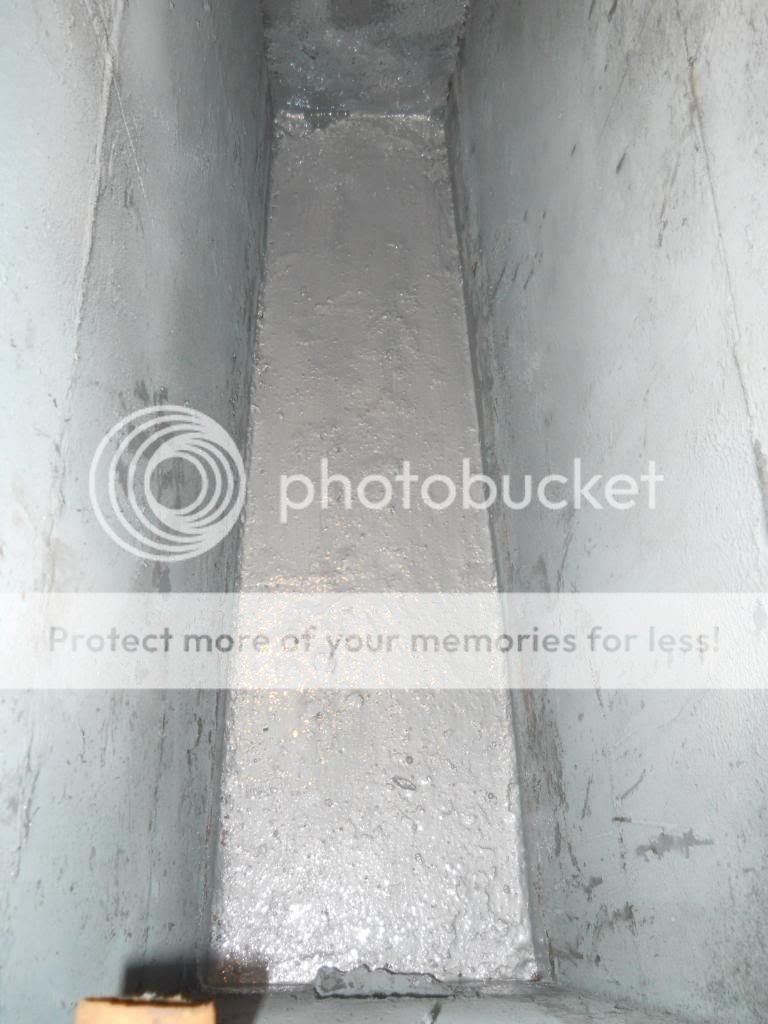
Here's the aft bilges "Metal Prepped". The Ghost Tank mentioned previously has been cleaned out (thanks to Mrs. Alchemy) for this nasty and dirty job) and has been similarly and laboriously twice coated with "Rust-Lok".
Lined with rubber, this might make a nice wine cellar.


That keel tank space has been left open (there's a 18 x 12 inch rectangle of steel cut from it now) for drying purposes. The engine's installed over it now is ready for a test fire once I rig fuel service and get my filtering sorted. While I had hoped to power away from the slings, the five days of snow, wind and freezing rain in the middle of April hurt our painting schedule, which of course had to precede the bolting-down of things.

The fate of the ghost tank will be thought of no more until the fall. I have to get lead ingots out of the forepeak and the new batteries in at the center of effort amidships before I can tell what is the best course forward.

I have, however, a sort of "compromise" idea. Next fall, I will hoist the engine again, and fully cut out that ghost tank lid. I now know, as does my leg, that it will take about three 4.5 inch cutting wheels. I will also redo the rustlok as I can see that certain spots are lifting away...it was probably too cold to apply it. After I know that I have proper "lock-up" and adhension, I will topcoat the tank with truck bed liner or whatever (maybe two-part Amercoat) will seal it up but good.

Here's the compromise solution for that space: If "static trim observations" at dock suggest it, I can get about a thousand pounds or eight lead ingots down there and still have room for a thick-walled, likely HDPE, diesel tank held down by bolted steel strapping. I estimate that could be 20-25 gallons, and it would not, being low and on the centerline, require an internal baffle.  It would sit upon and effectively confine the lead ingots, which I would NOT likely cement in, but might well epoxy in place or simply stack right-side-up and upside-down to make a nearly solid mass. I will have to do a bunch of measurements to confirm this, but that's the likely way forward. Any reader contributions would be appreciated as I am still open to suggestions...October is the next time I will do a thing about it.

Hull bottom painted and topsides Metal Prepped (too cold to top coat yet!):

The needful cove stripe cleaning and topsides touch-up will wait for warmer weather.


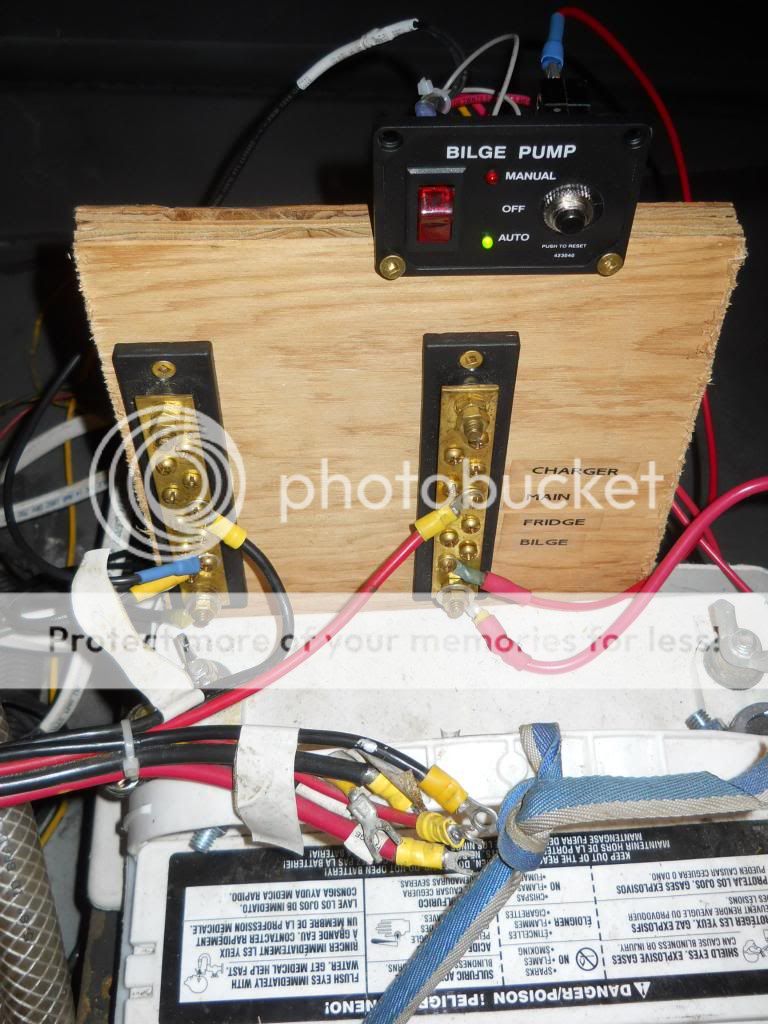
Ad hoc but functional bilge pump power and switching installed:

Something safer and better secured will follow. This is purely to power a single bilge pump at dock.

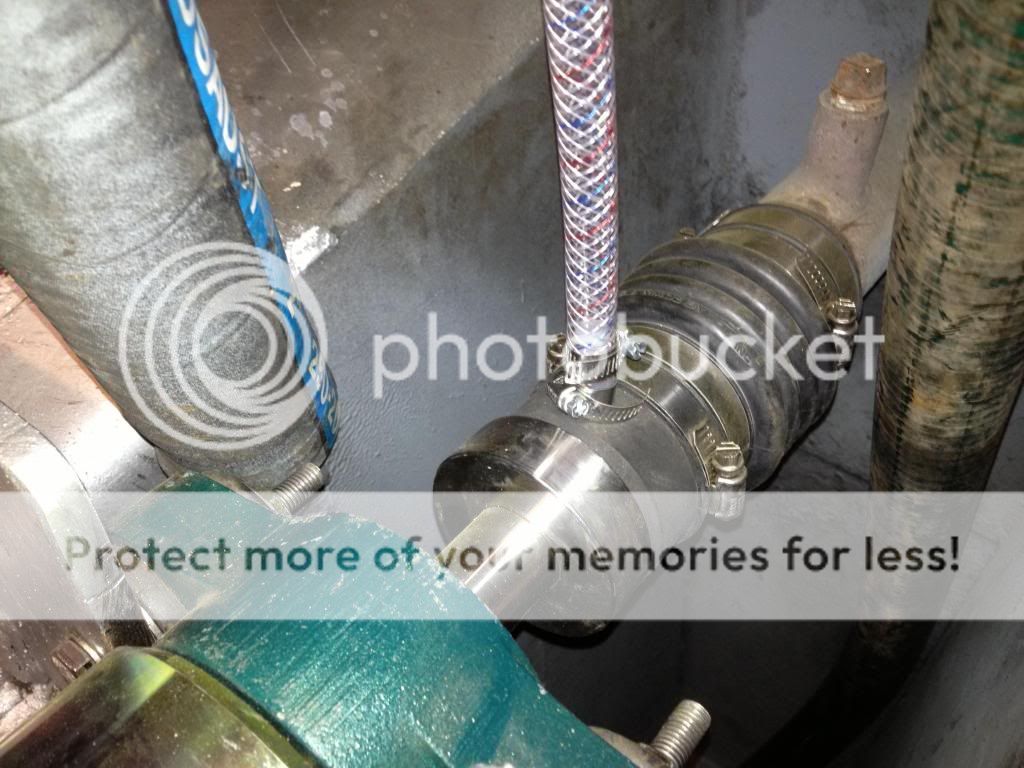
PSS unit supplied with relief hose and bolted in:

This hose is secured well above the waterline. Eventually, it will be "teed" into the engine cooling system.

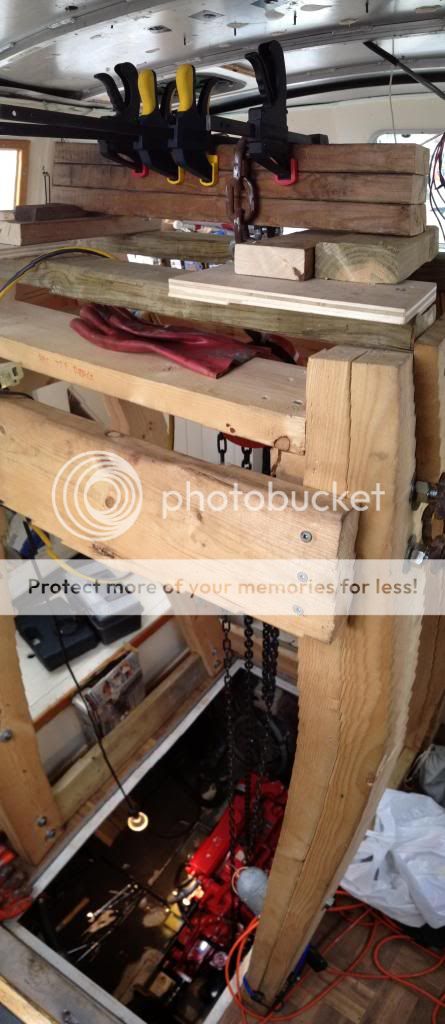
Engine bolted down and drivetrain/Aquadrive connected (thank you, Cap'n Matt). The fuel supply, waterlift and exhaust setup will have to wait until it's warmer. That large wooden engine gantry is getting taken apart today. I will stow it in the forepeak, as it is a very awkward load of lumber to shift on even my sturdiest bike cart:

Gantries in the picture are not as bendy as they seem.


Variprop and Shaft Shark bolted on and rudder serviced and restored:
Note to self: "Lubriplate 130 AA". Yeah, it's cryptic, all right.


I have to fix one wiring issue and tighten a few hose clamps. I launch next Saturday. It's been a long time coming. For those keeping track, much of one season was lost to a bad shoulder injury, another to the decision to change engines and tanks, and another to the missus becoming a full-time student to obtain a teacher's degree, meaning Daddy having difficulty getting sufficient downtime for boat rehab. The rest of the delay is purely on me being an unhandy handyman and a nautical know-nothing. Things have somewhat improved. They could have hardly gotten worse. Now, it's about maintaining momentum, enthusiasm and cash flow, sometimes goals which are at odds with each other. But I don't need to tell you that.