Copyright (c) Marc Dacey/Dark Star Media 2006-2026. Above photo (c) Marc Dacey. Powered by Blogger.

2013-09-20

Pardey like it's 2014

Aside from updates on boat modifications, and occasional foaming jeremiads only tangentially related to things nautical, like how the future will be paid for (hint: you're on the hook!), this blog doesn't contain much in the way of hard news. 


As long as it doesn't say Alchemy, I don't want to know.
Nor should it. We're trying to get away from that sort of thing, eventually. If such quasi-buggywhips such as shortwave radio persist into the latter part of this decade, the BBC World Service (my own country gave up) and whatever we hear on the cruiser nets, plus the odd bit of news cruising via poached Wi-Fi will suffice. And then some: Short of needing to know if some country directly in front of us is having a revolution or a volcano, I am determined to break my lifelong news junkie habit and to spend more time with the 500 mb chart than with the headlines.

Journalism of various stripes (ribbons?) does exist in my background, however, and I would be remiss if I did not pass on what I suspect many in the Southern Ontario sailboating community would consider a hot tip.


This is the first image produced when you put the search term "sailor with a secret" into Google.

 Seems perhaps a little off-topic, but hey, I don't make the rules.

Here's the news:  Larry and Lin Pardey are going to be at the 2014 Toronto International Boat Show.


A lot of people know these two. Photo Latitude / LaDonna © 2013 Latitude 38 Publishing, LLC
I got this tip from the nice folks at Nautical Mind Bookstore here in Toronto. The Pardeys will apparently be signing their many books (and probably their DVDs, too) at the Nautical Mind booth during the boat show, guaranteeing that the place will be a total zoo.

Why? It's simple: the Pardeys are as close to rock stars as the cruising world can produce. If you've cruised in the last quarter-century, you've heard of this veteran cruising couple, who have been "living the dream" by financing their travels (as far as can be discerned) since 1968 via the constant production of books, sailing magazine articles and instructional DVDs. Their oft-quoted motto of "go simple, go small, and go now!" has inspired...and occasionally infuriated...many an aspirational cruiser.
What simple and small looks like whilst going. (c) landlpardey.com

The inspirational part comes from the fact that they are both extremely resourceful, not overly desirious of modern conveniences, or even old-timey shortcuts, and seem skilled in all trades needed to turn small, antique boats into safe and capable ocean crossers. Or to build or rebuild same. The infuriating part is that very, very few people want to cruise in a similar "sail like its 1899" fashion, being quite fond of auxiliary propulsion (Larry favours sculling oars), electric light (the Pardey vessels sport oil lamps) and interior space that surpasses that of a Tokyo student's dorm room.

Of course, that is the secret of their sustainability right there: If I was a shipwright and was capable of lashing, splicing, sewing and fabrication most of my boat from salvaged wood, wire and canvas, I could go world cruising tomorrow (I'd have to learn to pickle veggies, I think, as well). I have a (mostly) perfectly seaworthy 33 footer capable of handling ocean sailing. We could literally leave tomorrow..ok, Monday. But it would be brutal, the paucity of stowage, plumbing, cooking and cooling capacity would make a Spartan turn pale with its level of privation, and it wouldn't be particularly safe, what with the worn anti-skid, the somewhat slack lifelines and the total absence of EPIRB and liferaft. Hence, this rigamarole, blog, steel cutter and so on. I, and the family unit as a whole, have a minimum set of requirements (including an engine and electricity and enough space to stay sane in) that exceed that of the Pardeys, who truly seem to thrive in unassisted, inconvenient, woody splendour.


The Pardeys'  29' 9" Taliesin, arguably the boat that brought them fame


Unlike sailboat racers, where the heroes are tied clearly to results involving speed and endurance, the qualfications for "heroic cruising" are more nebulous: people who go in sailboats, unassisted, to the Arctic or Antarctica are admired for their seamanship, certainly, but they are in a minority of people who wish to do such a thing, and are furthermore in a minority of people with the acumen to pull it off without becoming part of the food chain

"Heroic cruising" seems to be related to the speed at which one can stop living a soul-sucking wage slave existence, and actually go sailing, and is also linked to the endurance required to keep that cruising going until age, enfeeblement or penury led to an inevitable shoreside clog-popping..but at least you went!


The Pardeys' latest ride is the comparatively luxurious 37-foot 120-year-old Thelma. Might need bigger oars, Larry.

By that standard, the Pardeys are certainly heroic, even if very, very few cruisers seem to love cruising to the extent that they will forgo a lot of the more current creature comforts to see the world from a small, wooden sailboat. I find them both anarchronistic and futuristic at the same time, frankly: they leave a very modern "small wake" in their travels, and yet seem quite canny at this whole Internet, publishing, DVD production thing. I've personally found some of their books on storm tactics and boat maintenance illuminating; they've always made me reconsider how damned resourceful you are going to have to be if you want to run away to sea.

Because they sail old boats and "do without", Larry and Lin Pardey are seen by some cruisers as very old-fashioned, a sort of salty version of the Amish, determined to keep through personal example the knowledge of the words "fid" and "raffee" alive. But I do not see then as being Luddites or technology rejectionists by any means: if you can continue to pay for your sailing adventures by taking digital footage of the several types of line whipping needed on a boat with manila halyards...well, the Pardeys will oblige. Like the post-war cruisers that inspired them, they've made a virtue of a simplicity that was likely enforced at first by circumstance, and now is maintained by choice. 

Man, it's gonna be a zoo.


2013-09-13

Darwin was every inch a sailor

Living the cliche, baby! Just add pilothouse cutter. (c) Volker Posselt

An unspoken motivation for wanting to sail away into a tropical sunset, with the prospect of a beverage with a lagoon and coconut tree backdrop, is not just the manifestation of a desire for something positive...like voyaging in a small boat to a distant and perhaps uninhabited shore...but can rise in part from a dissatisfaction with the society that allows such opportunities to exist in the first place.

It's a paradox: Most people on Earth are dirt poor compared to myself and my family. We are resolutely middle-class (an increasingly vague term, alas) within our own society, however. Our dreams of world travel (which will inevitably involve sailing to the poorer bits) by sailboat are only achievable through fairly strict budgetary constraining. Allied with that is a conscious refusal to participate very deeply in consumer culture (save for the things found in boat gear catalogues), and me switching off lights in unoccupied rooms and riding the thermostat as if we were burning banknotes.
Now with a marina!

These aren't bad habits of mind for an offshore sailor to possess. Waste less, want less, spend less; or be prepared to make up the shortfall. Learn to fish, if fish there be. Hesitate to fire up the diesel. Provision opportunistically...heck, the Scottish gene is so strongly expressed in me that I get stick in my own house for cycling miles to get 10 cents off on tins of tuna...I have been known to buy a crate at a time. Of course, it would be crazy if I drove to do that. But I don't. Owning a car would kill the budget to finish the boat.

I do not see these habits of mind broadly in the general, shoreside population, however. I see much in the way of material enticements, expensive conveniences and minor amusements which serve mainly, it seems to me, to distract or cloud analytical thought. While on my bike running errands, I see people texting while jaywalking, emerging from between parked cars with nary a head turn. I've attempted to cull this particularly annoying herd with a thrown elbow or two, but it's a losing battle: When we made playgrounds safe, and banned snowball fights, and made of our culture one continuous seatbelt, we indeed reduced broken arms, lurid scars and the occasional knocked-out tooth. We also seemingly lost our sense of physics.

Cars are heavy, bikes are fast. If either hits you because you are tweeting your breakfast choices or bowel movements since you started with the flax, it will hurt. You may have reached a rather advanced age for an overclocked ape without experiencing much more than a boo-boo. We, your elders, have done this for you. Wait until you see what we've done to the pension plan....ow!

The clenched fist is because that iPad doesn't have 3G, I bet. (c) Tom Lynn


These thoughts depress me a bit: that my own society may be getting too distracted, overstimulated and undereducated (in ways I would consider life-preserving, if not necessarily enhancing to the ego) to continue without some nasty shocks. And Neil Postman's dead, and his critique was about television in the '80s... In the last month, we have had to explain to our two tenants, highly educated women in the mid-20s, how the recycling works (they have never not had recycling in their world, as far as I can recall), and that if power goes out in one room and not another, it is a tripped breaker, not "a blackout", and that it is fine not to just sit in a dark room passively waiting for a resolution, but to ask the landlord to reset the circuit, after unplugging the thing that was tripping the breaker.

They have in common with many younger people of my acquaintance a sort of passivity and vagueness. They seem both well-informed, if not deeply or critically, but simultaneously unworldly. You shouldn't be able to perform the equivalent of "got your nose!" on an adult in a Western society, but clearly, marketing has become easier since my youth. Only the distribution of marketing has become more complex. It's the curse of neuroplasticity, I guess.

Now, I have no illusions that younger people want to listen to windy old goats such as myself, but there does seem in some cases a declining ability to think clearly. Oh, look at this cat video!

Of course, a difficulty with clarity knows no age limit. The recurring (and, as a card-carrying human, mortifying) "warning: hot drinks are hot!" theme crawled out of Darwin's backside again this week as an adult female in Winnipeg with a mild case of cerebral palsy called for "regulations" against hot tea. A minor road accident caused her to spill her hot tea, leading to fairly nasty, entirely predictable burns. I will refrain from posting the photo of her burns. She was indeed injured.

I'm not sure how to react here. My usual mode is to snort in outright derision. The default mode for tea and coffee is hot: it is a beverage that must be brewed rather close to boiling in order to exist. Handling such a beverage in a moving vehicle is going to be intrinsically more hazardous than, say, carrying it to a table, or having a server not afflicted with vertigo place it before one. It reminds me of the people who have driven into swamps or off hillsides at the behest of wonky GPSes. Knives are also sharp! It leads one to uncharitable thoughts, I can tell you. So did the part of the story where my tax dollars were put to work by CBC staffers to compare several vendors' wares of the hot liquid variety. They were demonstrably hot and liquid!
Smug and sarcastic, just how I like my cup o' joe.
I'm not a stranger to the sudden bad turn of events. Some years back, I slipped on black ice and broke my ankle and leg. I was coming back from a tea party of all things. I did not, however, call for "regulation" of Twinings nor did I wish to sue Florsheim for making a lightly treaded Oxford lace-up. It did not occur to me. I probably should not have been walking so fast down an icy incline. Now the metal in my leg makes for charming discussions at airport security gates. So it goes.


I'm sorry this person was injured. I have to wonder, however, if this is akin to wearing high heels at sea, and then suing the ocean, or the boat builder, for a snapped ankle. I have to wonder if this person understands that hot things are hot and that extra-large hot beverages stay hot a long time, that moving metal boxes called cars in February in Winnipeg are subject to the physics of motion and inertia, and that maybe trying to drink a very big container of very hot tea while a passenger driving, in winter, in Winnipeg, with a case of CP, is sort of, maybe, asking for it. Or sort of, maybe, just an accident...like falling off the stern while urinating at sea.
This used to be satire. Now, satire is a product description that indemnifies the producer against legal action.

But mostly, I wonder about how such a person, or such a society, is created. How long can we "progress" if very basic relationships are not understood, or if we grow ever more ignorant of our technologies and the natural world?

And how the heck do you get to a place in your mind where you are sold what you ask for, and yet you feel it's the seller's responsibility to protect you from what you've purchased? I don't grasp this, but it sure is a spur to work for that lagoon-based beverage. Even if I get a boo-boo in the process, because the beverage may be hot, and I have not been warned.


2013-09-06

Rust and gravity never sleep


Corrosion on the hull, or perhaps the skipper's breeches after an unnerving blow.
It's an axiom of steel boat ownership and Neil Young admiration that rust never sleeps. In fact, that's a reason people suggest is valid in rejecting steel and favouring fibreglass when choosing which material should best exemplify a voyaging sailboat's hull: Steel rusts and needs care and feeding in the form of chipping, grinding, zinc-coating and top-coating. Of course, we've seen steel's resistance to puncture up close. A little brush-work seems a small price to pay.

The labour involved is, however, in fact true. We knew it going in. Steel does require attention. It is also true, conversely, that if you are fairly fastidious and observant about such things, your steel boat will last many decades with only weekly or "as needed" sand-and-paint touch-ups that equal the equivalent area of, say, one's toenails.

If one paints one's toenails, of course. I'm told crossing the Equator may involve similar Neptunian revels.

Generally, however, there are treatments and techniques, along with observational habits, and a sense of the most effective remediation techniques.
Still about the best, in my opinion, go-to guide for the likes of us.
Now, I plan a rather more in-depth post on the whole "keep the steel intact" topic over the winter as I come to grips with the issues of galvanic isolation, anodes and the question of bonding. Simply put, without a load of batteries aboard, a minimal charger, minimal draws and no actual connection between the prop and the (as yet unfired) engine, there's not a lot of reason (currently, pun intended) to worry about Alchemy's hull at the moment. Trawling a piece of copper from one of a multimeter's test leads to the water and the other to the hull shows no appreciable voltage differential...yet.

Steel boats and the true meaning of sacrifice.
But things, as is their nature change, and I will report in more depth on this particular topic as I turn my continuing education into continual application. It does bring to the fore, in a typically circumloquacious fashion, the idea that as miniscule forces are forever at work at sea to undo first one's good intentions, and then one's expensive vessel, so are forces ashore creating change that may undo one's lubberly plans, or even one's seemingly ever-more-expensive property.

For us, such a force was wooden. elderly, tilted and fruit-bearing.

Still, alas, bearing fruit whilst creeping at 0.000001 knots on a SE heading.
Behold our Very Large Cherry Tree. Approximately 60 feet tall and circa the age of the house (around 120 years...I have yet to count the rings or dig deep enough in the city property archives), this impressive specimen bore fruit, angry squirrels and nonchalant raccoons for the last 15 years, since we bought our place in downtown Toronto. And presumably did so for a century prior.

I suspected, given its rather close proximity to our house, that its too-close-for-comfort rootedness was  probably the result of some VIctorian pip-spitting that missed the midden I found digging beneath the back door.  I also suspected, despite the fact that we had already amputated a part of it  ten years back in hopes of reducing its tendency to cant over our breakfasting room, that we might come to a day of reckoning with Very Large, but my wife adored its crookbacked stature, cock-eyed bearing and its ample shade. I felt less happy about its role in allowing raccoons and squirrels to frolic on our roof, but was, until the epic rains of last month, overruled.
From certain angles, it looked OK, despite a narrow space between eave and bough
After those rains, however, the very extensive roots started to heave up the concrete paving beside our house, along with the footpath to the neighbour's place next door. Action was required. Inspectors were summoned, and, having inspected, permits were issued with the words "immediate" and "emergency" in bold font.
OK, this shot shows the angle of reduction: That's a hell of a heel for a massive tree.
Steps had to be taken, not only to deal with the seemingly increasing threat that the tree's sodden weight and gnarled roots would tear up the ground around, but with the possibility that, being ancient for a fruit tree, it might simply rot, blow down or otherwise fail worse than an America's Cup contender while we were off a-voyaging, and either take out a part of our house, the neighbour's garage (it was that tall), or even cause injury or loss of life.

Not to mention legal action. Nothing spoils a good sail like a lawsuit, I gather from my American friends.

A liability we could not afford, unfortunately.
So down it had to come. While I would rather have spent the money on boaty things (and professional tree removal represented a significant chunk of change, as any visits by tradesmen to our particular postal code tend to be), we couldn't dodge this any more than could Helen Keller a falling tree. The crew that dispatched the cherry were rapid and professional and cleaned up after themselves, the polar opposite to many of my dealing with "marine experts", more is the pity. They certainly knew plenty of knots and hoisting methods. One tree-removing fellow had even sailed in the Antigua races. I would've chatted with him longer...but I was watching the ticking of the clock and was paying for each second.

The upstairs gets a radically broader southern exposure.
We left a significant stump (below) for two reasons: One, my wife the biologist (not a plant biologist, however) thinks that the cherry might resprout from such a tall stump, and it would take our entire lives and maybe our son's life before it would again pose a threat from toppling; two, if it doesn't resprout, that is one very large piece of log suitable for cutting for veneer. Not to raid the tomb, so to speak, but one in our situation is well-aware of the price of decorative trim and indeed any wood suitable for cabinetry. And Alchemy's interior trim battens are already...you guessed it...cherry wood.

The pile of firewood behind this arborist is from the previous woody mutilation.
We had leaves and branches hauled off, with limbs and trunk left in convenient 50-100 kilo chunks it amused me to watch the Cabin Boy attempt to move. Lots of chunks, some suitable for firewood, others for giant's Frisbees.
Some see sadness. I see about a hundred unique side table tops.
It's now stacked for drying and, with luck, memorializing in the form of binocular cases, folding table tops, and, if I can get my router skills in order, a much-desired two-drawer map chest.

Like the bottom three drawers of this, but sized for Admiralty charts. I have a place already picked out in the pilothouse.

And so a "house" thing and boat things may eventually overlap. Showing that necessary, if somewhat sad, maintenance of this sort needn't be all about destruction...we've saved not just the wood, but a handful of cherry pips from its final fruiting. And the breakfast room is now ridiculously bright.

2013-09-02

AIS: A moving target

The newish Vesper Vision: All that and a bag of navigational chips?
Behold the Vesper Watchmate Vision, the latest iteration of a standalone AIS transponder from my (to date) favourite AIS maker, at least in the small boat realm. I'm tempted, not particularly with the touch-screen aspects, as I am at home with buttons and drop-down menus, but with the implementation of various display schemes (as decently reviewed by Ben Ellison here at PANBO; don't neglect to read the unusually erudite comments section), but due to its interesting connectivity options, which include USB and...oh, joy!...Wi-Fi.

Now, the more alert of my readers may point out that my steel boat's a friggin' Faraday cage and not likely to do well with Wi-Fi. In a sense, that's true, but if the PC is on one side of the pilothouse (right by the map chest, as per standard belt and suspenders nautical practice), and the AIS is only a couple of metres away, Wi-Fi means "one less wire to run", which has its charms in the modern age of sailing. I'm not sure who thought making an AIS a hotspot was a good idea, but if one is leaning toward a PC plotter solution over a proprietary multi-function display, it has a lot of potential. I don't really need wireless on the deck. In the boat could be useful.
ICOM's transponder offering has been described to me as solid and well-integrated with their top-end M-604 VHF base station.
Now, Vesper's just the AIS brand I currently prefer, but there are other, equally capable players in the AIS market. ICOM's a brand I generally respect (and have purchased in the form of VHF base units and our M-802 SSB). Their MA-500 seems graphically basic, but shoots the same data to a plotter that resolves as pretty little triangles in colours that show intentions, like I Am Going to Mow You Down Soon. You know, the useful stuff.

The Vesper Watchmate 850, the one I've considered best-in-class since its introduction.

The really useful stuff when it comes to AIS, however, seems to be about the ability of the unit's software to filter out non-relevant data, particularly in large commercial harbours or in busy shipping lanes. This filtering means you don't see traffic that won't pass closely, and the alarms can be tailored to truly close encounters. The problem with the otherwise Extremely Useful AIS function seems to relate in the issue of filtering the clutter, and the possibility that the "recreational rated" Class B units (more on this shortly) won't be seen. I personally think that half the function of AIS is being seen positively as another ship in fog when temperature inversions, waves or range issues render a radar presence intermittent. So "being seen" is sort of the point.

Another approach: a package deal of "black box below" and display at the helm, or even at the outside helm.

I consider AIS a great adjunct to RADAR, and a huge help when crossing shipping lanes, primarily because you can call the bridges of big fellows by ship name and using DSC and their MMSI number. This doesn't mean they can see you on radar or on their AIS. As I present on our steel hulk the radar profile of a small lightship, I'm not so worried, but a plastic boat can be invisible until uncomfortably close. I was considering, based on my research, a Class B unit called a Vesper AIS Watchmate 850: I may still, except that Vision model has some additional bells and whistles I would like to try. The 850, which I've had a chance to molest in person, remains quite intuitive and seems to look forward to the time when every buoy, pier end and jetski will have an AIS transceiver, which, as is the way of all good things, will kill the system. There are already signs of too much Class B traffic rendering full coverage problematic.
While this basic "black box" is neither cheap nor feature-deprived, it's an option for those wanting to use a PC or iPad as a display instead of something dedicated to AIS or who already have a honkin' MFD screen.

But perhaps, for the uninitiated, a somewhat deeper look at the Universal Shipborne Automatic Identification System is in order. I found that the first order of business was to grasp the difference between Class A and B AIS units. The link provided is one firm's slide show giving a medium-complexity overview of how the two classes differ.

Personally, I think that Class A would make sense were we crossing the Channel to France once a week because of its increased (12 watts) power and more rapid "refresh rate" (I'm trying to avoid the actual explanation here, which is thick with acronyms and is freely available). It's more "shippy" in the sense that while a sub-300 tonne ship doesn't require it (and it's about three times the price), your boat will, in terms of AIS, resemble commercial, rather than recreational traffic.

By contrast, a Class B (2 watts) transponder would seem to fit the bill. There's a good reason not to look like a Class A-equipped ship to the real deal. You will be actively avoided as the sluggardly unprofessional navigational hazard you are, and, by implication, all sail-driven craft are when you are looking down on them from the bridge of a vessel with five figures in its horsepower rating.

Another part of the rationale for us in opting for Class B is due to the rather simple fact that our boat is metal and returns a fat radar signal; I am also sensitive to the power draw of 12 versus 2 watts; a third is that AIS seems quite sensitive to antenna placement and general radio concepts, such as a pre-amp on the splitter, which can give a boat, either as a "receive-only" or as a target, a useful range exceeding line-of-sight from the deck, and occasionally a great deal further.

Many would opt for a solution that uses one antenna at the mast top for both VHF and AIS, which work in similar frequency ranges. Other opt for a "dedicated" AIS antenna that is sized more precisely for its frequency either side of 162 Mhz.

Speaking of distance, there is more than one school of thought about "receiver versus transponder" when it comes to AIS. A recent thread on Cruisers' Forum found the ability of AIS to advertise one's boat's location "creepy" for reasons of security. Well, so does a pair of binoculars on a sunny day, I suppose, but before one visualizes an admiral's hat made out of tinfoil, it would be foolish to acknowledge that a transmitting sailboat is both safer from potential collisions (and provides a "last reported position to SAR folk if you hit a rock) and a nice way for a thief to see you arriving with a cheap iPhone AIS app. Or even on Google Earth...how convenient!

I won't even stoke the paranoia concerning how AIS can be seen only 20 or so miles around one's boat...but can be registered by properly equipped satellites. And, no doubt, the famous black helicopters of the Nazi space lizard secret government...

Aye, aye, Skipper.

But there is a solution: turn off the transmitter. Now you can only be seen by eye, by a nifty pocket telescope, by RADAR, by VHF if you announce yourself, and by cellphone if you are close enough to shore and haven't turned the damn thing off!  It behooves the truly suspicious here to recall that cellphones can be loaded with "snooper apps" invisible to the user that report via internal GPS or proximity to cell towers the phone's location...so if you get snatched by marine kidnappers because you have a paranoid spouse, don't blame me.  The cops or the Coast Guard of probably every country on Earth can narrow your location down via your cell phone even without such apps through the magic of triangulation. AIS is no different in terms of "hey, world, look at me!"...except that you can turn off the transmitter and go "black", at least in terms of broadcasting your lat/lon, your MMSI and boat name, et cetera.

I am under the impression that most commercial vessels were obliged by regulation to transmit on AIS, (although not most military, as far as I can discern, but they aren't shy about telling you if you are crowding them in your little boat). Would I therefore stay transmitting while coastal cruising? Yes, if I was solo (because it's like a SPOT tracker to rescuers if I fall off the boat and forget to bring my bag of breadcrumbs), but "not necessarily", were we well crewed, as there is no compelling reason to announce our presence to other boats or ships on, say, a clear, sunny day.  The presence of AIS does not excuse us from keeping a proper watch by eye, or by eye and RADAR if that's part of the nav tools available. So one gains a measure of privacy in a rather tightly defined sense if one ceases to transmit as an AIS target. I define the worth of that privacy in light of my belief that a) AIS is more useful to allow the little boat to be seen by the ship capable of cutting it in half, and b) if everyone went "receive-only", the utility of the system to see anything below 500 tons would be compromised.

At night, circumstances change. In fog, at night, AIS is probably better than RADAR if one has a fibreglass boat, because it transmits (usually) from the mast top, and the typical plastic hull behind a series of waves can make a poor target for a ship's radar.  I recently read of a yacht crossing of the busy Channel in fog made non-eventual thanks to AIS. It argues that one's visibility to commercial and other large moving objects trumps the perhaps overcooked issue of privacy...unless one is, perhaps, a smuggler of forbidden cheese.

Offshore, heck yes: I want to be seen as well as to see, and AIS is frequently better than RADAR  for picking up ships barely at the horizon...as seen from 50 feet up! The earlier the hypothetical 20-knot container ship can plot our CPA, the smaller the helm correction required to give us (or we to give them, as per COLREGS) a wide and safe berth. Two ships that pass in the night doesn't, in fact, just happen.

Offshore entering the Red Sea or certain historically yacht-hostile straits near Indonesia, or perhaps the Gulf of Guinea? We would, assuming we felt a compelling need to transit dodgy waters, likely go "radio silent", which would include AIS. We would also consider dousing nav lights and whispering, as well, but would place doubled eyeballs on deck watch duty. Seriously, however, for us to find ourselves in such a situation would have to be due to a rare case of a pirate or drug-running criminal outbreak in a place not known for it. If we were travelling in convoy and were being monitored on a pre-arranged basis by various friendlies with large boomsticks, we would go full Christmas tree. We would want to be seen being seen, so to speak.

So the solution to the "creepy privacy issue" of AIS is to figure out if one's kind of sailing is enhanced by being seen, and then to find the OFF button if the answer is, "yes, but not all the time". Frankly, less clutter is better: who really needs to know you are docked? If you are using your iThing in your tender to find your over-illuminated boat via GPS and AIS tracking...you may be over-equipped for the voyage.

I have come to believe through my researches (which seem to inevitably lead to purchases) that RADAR and AIS represent a Venn diagram of watchkeeping at a distance. The reason to install a RADAR is to see where the rocks, reefs, unlit fisherfolk and beaches are, presumably to avoid them. AIS catches either ships and AIS-transmitting objects too far for RADAR (or the RADAR operator, because reading RADAR is a learned skill) to discern, or it helps to sort a bunch of blobs with names and real-time position tracking not calculated on your boat, but from the transmitting boat. Yes, I'm aware of MARPA, but one windy post at a time! The budget-minded can buy one of the newer AIS units and the cheapest sort of basic radar and have more comprehensive watchkeeping than one would have with a commercial radar of the latest tech alone.
Angry Birds and Invisible Jetskis: finally together in one device.

There's an added wrinkle, I'm afraid, and the reason for my mention of "moving targets" in this post's title: the introduction of a new class of AIS to be used on smartphones. It's still pretty new, but the "pocket plotter" is clearly a thing to be reckoned with. The utility of centralizing all one's navigational aids on a single smartphone, of course, remains to be tested. Not ideal if I'm not sporting pockets, is it?
You want to be careful fishing around in that sporran, laddie. (c) 2007 "The Grant"
AIS can be complex or as basic as one wishes. My understanding of it seems to match what sailors I respect are saying, and even if it remains a somewhat evolutionary technology, the advantages to having it aboard seem to me to be increasingly well-established if one wishes to transit the several areas of the world where commercial shipping is even remotely concentrated.


2013-08-31

The parable of the regifted Thinkpad

 
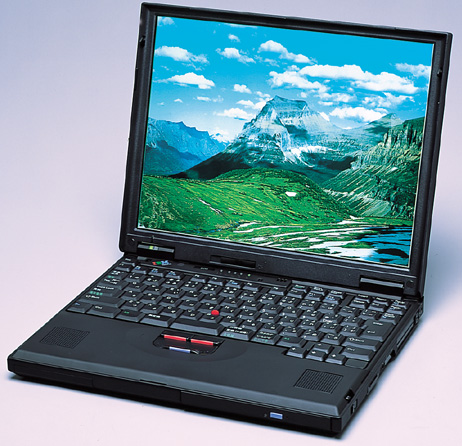
Now available on eBay for about ten bucks.
Last year, my father-in-law gave his 11-year-old grandson a venerable IBM Thinkpad 600X. He's a touch dysgraphic (my son, not his granddad) and has received permission to bring a laptop to school to aid in note-taking as his handwriting is both slow and charmingly rustic. This particular little lappie, probably 12 or 13 years old, but still capable of holding a full battery charge and getting online via its accessory wireless card, had Windows 2000 loaded.

Well, much as I personally enjoyed that particular no-nonsense Windows OS, and had to be pried off it only a couple of years back in order to run various needful programs, not a lot works with it in these brave new days of cloud this and tablet that. So I upgraded it to Windows XP, which, as a graphic designer, I have at least one legal copy in my Big Box of Dusty and Largely Superfluous CD-ROMS.

Even though this particular little Pentium III-based laptop is almost sub-par to run XP, run it does, on a well-built chassis (carbon fibre, even) and with enough brains to run Firefox K-meleon (a less ravenous resource hogging browser) and even the latest Open Office iteration...leisurely... and a free, small-footprint anti-virus program. There's even a single, slow USB slot for the requisite thumb drive for to-ing and fro-ing of school work.

See this? It's also about ten bucks, and it holds just one gig less than the entire hard drive on the Thinkpad shown above.

And even though it took me a couple of hours (on and off) to reformat it, reload and tweak it to my liking...it seems to fully work in a moseying fashion (if you restrict the automatic updates) and will serve my son better next week in school (where it will repose in safety as it is likely too antique to be worth stealing) than would almost any current Windows 8 or Mac-based notebook. My experience of such devices is that they generally break if you look at 'em funny. In fact, an otherwise decent if under-powered ASUS netbook my son was using, mainly to watch YouTube videos and play the soul-stealing Minecraft game, has started to crap out at the two-year mark...leading to the recent rehab of Ye Olde 'Puter.

I feel the pain of those who stand in service lines with their snazzy, all-mod-cons electronics, like Bill Bishop's sorry tale here, which inspired this post, or at least inspired me to finish a previous, similarly themed screed. But it's not just cheapness or economy or disdain for the folks that bring us shoddy goods that motivated me to drop a V-8 in a Model T, computationally speaking. It was the notion of It's Good Enough.
Sometimes at night, I dream of hummocks of trashed cellphones and deceased Sony VAIOs being picked over in polluted Chinese backwaters. Sometimes I dream of strip-mining in Africa. While you can't resurrect or repurpose everything, it strikes me that some well-built boat gear (yes, it was going to come back to boat gear eventually) is worth keeping going. It also strikes me that there's no use feeling guilty not keeping a dumb phone going once you've bought that new smartphone. The time to feel guilty about it is before you've bought it.

The CRT depthfinder is, by contrast, long gone.
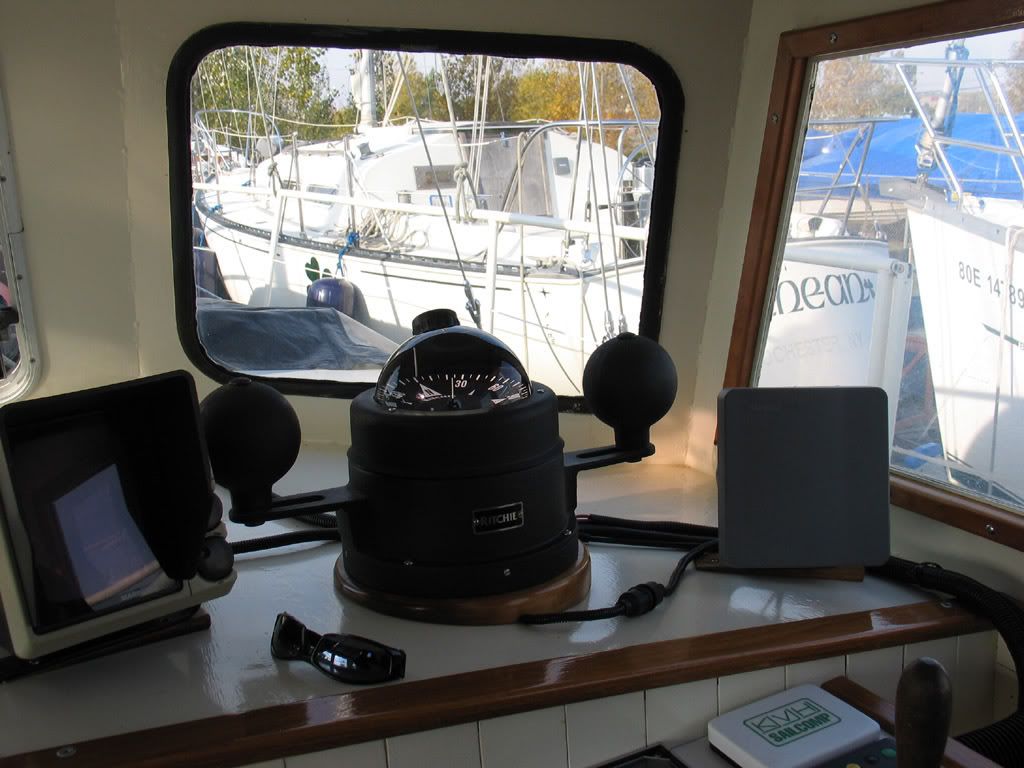
This is why we will keep aboard our elderly KVH AC103 fluxgate compass and Ritchie Globemaster and my refurbished Lewmar Ocean Wave winches and equally old Lavac in good working order and with the requisite rebuild kits.  Yes, we also have manual pumps and lead-acid batteries and real bronze seacocks and proper doubled SS clamps, etc. A clinical eye at costs and benefits told us, by contrast, that it wasn't worth it to rebuild the engine. The sail inventory is subject to predictable wear (at least Dacron ones are), and so we will probably retire as spares the half-used-up ones and purchase ones fit for sea-going conditions. Economy has its limits, after all, but so does a taste for novelty.

We've found (and I mean "we" as in me as a buyer and installer of marine-related gear and my wife as a seller of said gear in a chandlery) that many things manufactured today for boats, in the broad sense and in our direct experience, are built to break sooner than anticipated under typical use, and/or aren't often worth fixing when they do. Part of why this may be is either ignorance (how to make things properly is unknown at the design or fabrication level) or greed (cutting corners equals profits) on the part of the makers.

It is also true, however, that another part of the problem are the  conditioned responses of the purchasers to expect high quality at a low price. We've been promised more for less as an axiom of consumerism. This is a foolish and clearly naive expectation, particularly when the consequences of low-grade gear can drown you at sea, but by the time it is realized, the manufacturers of those well-made devices and aids that might still exist are out of business because of the stupidity of bargain-hunting. Certain levels of endeavour, like voyaging offshore, must, I think, be driven only in part by purely economic factors. Doesn't mean I don't like to save a buck, but it does mean I ignore all those "used liferaft" classified I see. Some things you should buy new, and sometimes that's going to mean paying retail.

Or considering if you can struggle on with the older device, like Grandpa's Thinkpad, merrily churning upstairs as it digests some fresh programming. What replaces those older devices frequently have so many "features" of dubious utility that they exceed the sort of simplicity that would make them of more protracted use. Simple and "fewer functioned" is the "slow food movement" of technology and hardware. It's easily mistaken for the jerking knee of the Luddite, I suppose, but it's not a rejection of machinery in the form of mechanical or electronic aids, but a rejection of crappy and/or superfluous mechanical or electronic aids.

As our odyssey progresses, such technological aspects of life loom larger in our thinking, as do some of the hidden pitfalls of taking a young person to sea with only a virtualized classroom. It may be a case, dangerous for sailors, I believe, where we expect more from technology, and less from each other.

This is perhaps not true of the choice to install a poorly made but "right-priced" piece of plumbing in a boat, but may extend to plotters and AISes and autopilots. Instead of aids to our authority as autonomous skippers, such technologies can shield us from direct experience of our environment, until we become accustomed to ceding our authority to our tools.


If I was, rhetorically speaking, simply sailing past a waypoint under autopilot, would I have had such a discursive wander in this post? Perhaps not, but not all parables are, strictly speaking, algebraic. Sometimes, like the albatross, they wander with the wind.

And now I have to go turn off that refurbished Thinkpad, which has likely finished a well-deserved defragmentation cycle. You wouldn't believe how sturdy the bag is that came with it. Compared to today's, I mean.

BONUS LINK: Speaking of refurbishment, and at sea, too, check out these renovated sea forts and oil rigs. You could defer swallowing the anchor indefinitely!

2013-08-29

Wanchoring

Like this, only with minor rust spots and a couple of dents.

I've had reasons to deploy the 33-footer's anchors this year, both the 22 pound (10 kilo) steel Danforth Hi-tensile "lunch hook" (with 13 feet of chain and 200 feet of 7/16th-inch three-strand rope rode, and the 15 pound aluminum Fortress FX-23 (with 15 feet of 3/8" chain and 210 feet of 5/8-inch three-strand nylon rope rode).

Like this and still pretty minty after several anchorings.
As mentioned previously, while the Fortress and the Danforth bear a superficial resemblance, I use them in different conditions. I favour the Danforth for "no wind" conditions (because it is good enough when one does not expect a wind shift or increase and is always ready to deploy), and the Fortress for when I need better holding (due to the heavier rode and greater fluke area) and anticipate a wind shift that might break out the anchor, which must reset quickly...which I've found the Fortress generally will do, faster than the Danforth. I have bigger Bruces and CQRs in storage that I could use instead of the Fortress, and even a venerable "yachtsman's" aboard Valiente, but to this point, they have not been necessary. The Fortress's rode is substantial enough, however, to switch to a heavier 33 or 45 pounder should we ever need it on Valiente. I don't know if my back is, however.

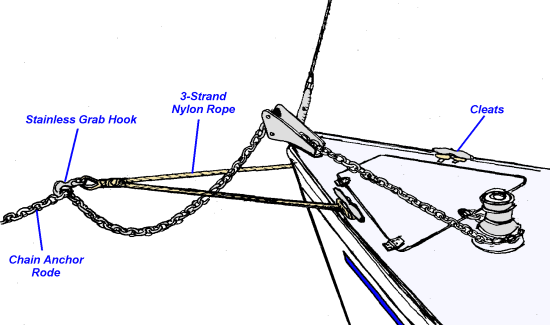
It's a bridle because it has two attachment points either side of the bow, but it's a snubber because it hooks on only one spot on the chain rode. Sailing terminology ain't easy.


Because this particular Fortress, aided by waterline snubbers and perhaps a bridle I will employ on Alchemy, will be both the "lunch hook" and the kedge anchor (and maybe the stern anchor, too), I like to play with it on Valiente as much as is practical...in the sense of "we need the practice".


The bobstay plate supports both the bobstay (the top hole) and, if desired, a snubber that can be pinned beneath it. Note that this brings the attachment of the boat to the anchor down to the waterline, and relieves strain on the deck gear.

Similar to Alchemy's setup, this bobstay tang attachment has nice stretchy nylon, which helps to lessen "hobbyhorsing" at anchor. Photo (c) The Hacking Family


We recently anchored out in the closest quarters yet...at an event in Toronto's inner harbour called "Sail-In Cinema".  While the event itself was an unqualified failure (we were too far from the screen and the advertised frequencies over which we were allegedly hearing the soundtrack emitted only the sounds of silence, and static), it was an Instructive Evening for the crew.

The prevailing SE foofy wind clearly was no strain on the ground tackle.
The anchor drop (performed ably by Mrs. Alchemy in the uncharacteristic and welcome absence of shouting and the customary sailorly epithets) and backing down went well.  The trick is to lower the rode to the bottom (in this case 32 feet below the roller) without letting the chain pile on the shank.  As has been pointed out, the doughty but underwhelming Atomic 4 cannot provide a great deal of reverse to set the anchor, so it is best accomplished with decent technique, i.e. yank on the bugger until you sense it is starting to bury.

A calm, nay, torpid evening.
It was clearly not a night to fray nerves or chafe rode. The C&C 29 crew of the boat below seen on the right actually scrawled a cell phone number on a piece of paper towel and then Zodiac'd away to a dinner at a nearby club. "Confident or foolish" would be revealed shortly thereafter, but given the parking lot aspect of the anchoring situation, you can guess which way it went.

The Hunter 42's crew to the left proved to be old hands at fending off.
There's one in every crowd: After all the sailboats anchored in a near-perfect semi-circle, Mr. Skyhigh Flybridge Shirtless Powerboater came in and dropped his hook directly in front of us (later, others), cranked up the stereo and barbequed like he was replicating the destruction of Dresden. Oh, to see ourselves as others see us.

Just prior to ignition of the incendiaries.
This well-equipped and ably crewed Hans Christian 38 was the first one we'd seen outside of sailing magazines. A pretty boat, but note the well-protected stern.
I don't consider canoe sterns particularly practical, but they certainly look nice.
 As the evening proceeded, the foofy SE wind backed to a foofy NE wind.  We noted how the all-chain rode boats obediently rotated 90 degrees, while our lighter vessel, with mostly rope rode (even if oversized) began to wander. We fended off a 42 footer and later a 29 foot Bayfield. It was more annoying than particularly hazardous as we were fully fendered and moving at cold-syrup speed.
Picture this with double the density. I had to stop taking pictures and wield the boat hook and the "sorry!"
It did, however, make me consider the value of bridles, all-chain rode and even the seldom-seen (around here, anyway) riding sail. In addition to its obvious qualities as a yaw-reduction tool at anchor, the recent discussion on LED-lit boat exteriors did not consider that the relative rarity of riding or anchor sails off a boat's backstay is an equally if not superior method of finding one's boat in a dark anchorage. Heck, one could put a luminescent initial smack in the middle of the thing, and it would clearly identify one's boat without casting appreciable light on surrounding boats, all the while keeping one's bow toward the prevailing wind.


I suspect one or more of these anchoring techniques, added to the proper anchor, which I feel we had, would have allowed us to, if not enjoy the silent movie more, kept us from wandering like a lost toddler in traffic to the same degree as we did. How did I know it was the right anchor? I was hosing and poking good, gummy Toronto harbour clay out of the Fortress's "mud palms" for some time the following afternoon: the anchor, even with the weak set in reverse, had clearly dug deep with all the gentle tugging. Nonetheless, with the rode scope reduced to 1:1, also known as "vertical" (basically by me pulling the boat to directly over the anchor's set point), the anchor came out cleanly, if not clean, so to speak. Having hauled anchor now multiple times by hand, the Danforth seems to require more effort than the Fortress beyond what the seven pound difference in weight would suggest. Not effort ever likely to call for the installation of a windlass, however...it's just not that hard a task unless we anchored out every night in this boat...which we are unlikely to do. Alchemy's all chain, all the time, however, is a different story. So are anchor/marker buoys, also called trip lines, a topic for the future.

So, it was an educational, if not particularly entertaining, evening of Adventures in Tight Anchoring. On the way back to the marina (a 15-minute motor), just in front of us, a C&C 41 hit an Island tender squarely amidships with a bang that sounded like glass being chucked into a dumpster, so it could have been worse. Our son spotted it before myself and the missus; we are pleased at his as-yet non-myopia and his improving watchkeeping skills.

Bonus retro post: Parody of how some folk might test their anchors.

2013-08-16

And you, you light up my skiff...


Elderly pop song references aside (although the alarming video above is most unlikely conversion of treacle into vinegar I could find), the miracle that is LED lighting for the boater has some darker aspects, pun intended, in my view.
Cozy but functional, LEDs are great for spot applications. Image copyright www.sintacha.com

When compared with old-school incandescent lights, i.e. "light bulb", a term soon to be as archaic as "LP" or "cursive writing" to younger people, LED illumination is cheaper to run in terms of power draw and is significantly longer lasting. Of course, this remains to be proven in some ways, as LEDs made for boats haven't been run for 100,000 hours (or over 11 years) straight. We've got some time yet before that century-old Edison-style lightbulb is eclipsed.

While the price of properly made LEDs continues to drop from when I first starting seriously considering them (mainly by purchasing and installing a few to see how we liked them), decent ones with desirable current regulation (because a boat's power supply from battery banks is variable in terms of voltage) are still not cheap. Nor, it can be argued, given the harsh marine environment, should they be. Balanced against this cost should be the LED fixture's endurance and, if you are laying out the whole circuit from scratch, the rather relevant fact that the power wires can be considerably smaller for the fractional amperage drawn by LEDs. Other considerations are beam angle and total lumens, but only a little education will suffice to light up most boats to a satisfactory degree.

Of particular interest are LED navigation lights. Given that these are legally required parts of a boat's safety gear, the idea that you can be seen just as well as with the effective but comparatively wasteful incandescent light bulb of the past is compelling a cake-having and -eating equation as you are likely to find afloat.

But as the estimable John Harries says, "beware the time suck of complexity". Sometimes the latest, greatest tech isn't entirely ready for prime time...which may be revealed when said prime time is 1,000 NM offshore. We currently have well-made Aqua Signal 40 incandescent nav lights on Alchemy that are, with 25 watt bulbs, brighter than are legally required...not a bad thing. Aqua Signal also has replacement parts, which both speaks to the quality of their products and says "in your face!" to the planned obsolescence of most marine gear manufacturers (in my rueful opinion).

Aqua Signal: Not a flash in the pan.

So the logical thing to do, I think, would be to source 25W-equivalent LED replacement bulbs...and replace 'em when needed. If we are needing running lights, we are likely "steaming", i.e. using the motor. Seventy-five watts of draw isn't going to be a big deal for us. A more compelling argument would be found to get less amp-hungry interior lights and strip lighting, and to switch to a LED mast-top trilight and anchor light combo, where both the long runs of wire and the length of time spent lit (not to mention the annoyance of changing bulbs) strongly favours the LED solution.

Less cozy and probably only functional for spotlighting inadequate genital dimensions is this whore's nightmare.
The downside to which I initially referred of the vast range of LED solutions for boats involves overkill. Because these lights draw so little of what was once a strictly metered resource: the 12-volt battery bank, and because more boats have multiple charging sources (diesel gensets, wind generators, solar panels, gerbil wheels), it is possible to deck out one's vessel into something more garish and wetter than a heavily greased Mardi Gras participant in Rio during a cloudburst.


The future's so bright, I've got to wear sunglasses at night. Two '80s references in one caption!

"Pimp my yacht" is still largely restricted to the more insecure/mobbed-up sort of powerboater (or so I have observed), but whereas one used to see sailboats lit more than regs required only when a feeble string of lights were hauled aloft at Christmas, an increasing range of LED "cockpit accent lights" and "table lights" and "gunwale lights" and so on are making appearances.

This is not the lair of the villain in a gay-themed James Bond spoof: it's a catamaran. (C) http://sailtrue.blogspot.ca

Mankind marches on: If something can be made to shout "look at me", it will be. Harley rumbles over birdsong; office tower lights over stargazing.  I recently had an exchange over at Cruisers' Forum with a fellow (SV Neko out of San Francisco) who asks, innocently enough, I'm sure:

"So, I just installed this nifty LED floodlight on the davits to light the transoms and the area between the hulls. Makes dinghy arrivals at night pleasant. It takes nearly no power and I can leave it on all night.

My question for the denizens is: When away from the boat with the dinghy, should I leave it on or off? On lights the area and may be a deterrent to evildoers who want to board. But it also highlights the fact that the crew is ashore. Maybe they know that anyway with good eyes or a flashlight. What do you think?"

My reply was, I hope, not harsh:

"I can find no reason for leaving it on, frankly. Aside from saying "WE ARE AWAY" and making boarding so much safer for thieves, even an LED flood is a source of light pollution that destroys the night vision of those trying to find shore marks or nav aids.

It's the visual equivalent of leaving a parked car idling. Or an over-sensitive car alarm. Anyone in a city knows it's hard to go a day without hearing one of those menaces.

I recall coming into Charlotte Amalie at midnight and trying along with the skipper to locate the FlR and FlG marks against the town's traffic and streetlights. Fat chance, although we eventually saw them. Throwing in a floodlight on a boat that's not even occupied would compound the issue. Imagine EVERYONE in the anchorage having them. Now you are motoring a tender at night and no one has dark-adapted eyes. It's like the definition of endless love: Stevie Wonder and Ray Charles playing tennis.

If you wish to leave a light on, leave one on in the saloon, but with closed sheer portlight curtains. No one will know there isn't anyone aboard. Throw in a stereo on low, with say a symphony on a CD on "repeat", and the illusion is near-complete. Even a thief "casing the joint" in a rowboat would select a fully dark and quiet boat over a potential interaction. As a one-time audio producer, I would probably make a classical recording with sounds of galley work, dog noises and conversation mixed in. Only the most homicidal villians would board a boat that sounded like that.

Back to the stern light: I'm not saying you shouldn't have it; it's clearly a useful safety device. But I suspect it would not be hard to add either a waterproof switch on your rail or stern or a waterproof IR or RF "remote" you can carry in your pocket to switch on the light when needed, meaning it is only ON when needed...and off most of the time.

An alternative is to get those waterproof accent lights for the boarding ladder, but switched. Pull the ladder down (after unlocking it) and the lights glow. You can then get aboard and manually switch on the stern light for area illumination to get the tender in davits.

Frankly, however, most people seem to use Petzl or similar headlamps. Some varnish the lens to throw a yellowish light...easier on the eyes. Use the headlamps to find the ladder...get aboard and then light up the boat. Hope these suggestions help...to keep you popular in the anchorage and yet meet your safety needs."
I guess the hooks, gaffs, nets, purses and dynamite weren't sufficient.
In this particular case of the stern-mounted floodlight, I'm not objecting to the light per se. I'm objecting to leaving it on when it's not in use. Consider the local fishermen who tend to have (if anything) a weak oil lamp to show where they are. A well-lit anchorage not only ruins the recreational sailor's night vision for to- and fro-ing in either the main boat or a tender, raising the possibility of collision, but also has the known effect of concentrating sealife directly off your stern (in this example). The fishermen are going to see this and fish where the light is attracting the prey. How long the fish will last so "baited" is a matter for conjecture, but I wouldn't consider it ideal for me to try to squeeze between my boat and some panga full of locals trying to bring in a load of squid at 2 AM.

In addition, half the boats strongly lit in the anchorage render those boats with just the typical anchor light or light hoist into the triangle less visible to boats underway. You have made a host of new visual distractions. The anchorage becomes a fun house of bright and dark areas. Now I must add blackout curtains to my portlights and hatches, because maybe the boats beside me are not quite so careful with their floodlight angles. Note they are called "floodlights": the light is meant to go all over the place.

Lastly, so long, starlight. You might as well be in an RV in a mall parking lot (exaggeration for rhetorical effect, but again, if everyone has a downward-pointing stern light of sufficient strength, the resemblance to street lights would be close).

Lights, when inappropriate, can be considered a form of pollution. Just as I choose not to pump out inshore, I choose not to light my boat like a stage, unless for safety reasons, I need to briefly light to embark.

Now despite the certainty of my tone above, I may be living, or at least sailing, in the Dark Ages. Dim light at sea keeps my vision ready for that which is unlit, and I find that more seamanlike. At anchorage, I prefer the stars over the Vegas Strip. I find lighting that baffles fish about what time of day it is and that do not reside in a tackle box unsporting (see "headlight hunting").

But I may be wrong here, and so I welcome comments: Be it resolved that LED lights are largely a boon for the voyaging sailor, but should be kept largely off and largely inside the boat, unless they are for required navigational lighting or safety while disembarking or embarking.
 

2013-08-12

Best to get the names right, isn't it?

I feel that if one proposes to encompass the world, it is merely a common courtesy to learn the syllables by which the natives of each country describe themselves and their state.
There's more, and in higher definition, but you'll have to visit the site.
Now, these sort of things can be read (if in a sketchy and possibly mangled fashion) from visas, zarpes and other Official Documents, the bane of which will be a future post, but why not know the endonym of a state's citizens going in?

The French probably aren't sticklers on a tricouleur courtesy flag, but the smaller places are reportedly very much so.

Along with the properly sized courtesy flag, the area of which is, it's said, should be inversely proportional to the size and importance of the country being complimented, it's best to distinguish a dominion from a republic, and a monarchy from a Workers' Collective.

It's simply good manners from a transient guest...and a reason beyond sail repair to bring along a sewing machine. All reports I've heard of indicate that even a crude representation is appreciated when seeking to bring one's boat into a little, but proud, nation's waters.