I don't live in a small country. It's the second-largest on Earth. Its population, however,
is similar to California's, and so "consumer options" are, to a certain extent, limited compared to our 10-times-larger neighbour to the south.
 |
| Handy, but, apparently, a touch tricky. |
This comes into play in the field of boat gear, which, due to reasons of low demand and fairly demanding manufacturing tolerances for weight, non-corrosivity and occasionally specialized uses, is never going to be a cheap pursuit. The joke goes that the prefix of "marine" means "multiply cost by three", and this is in fact sometimes optimistic. Could be worse; could be Australia or New Zealand, where I understand that the exchange rates, the distances, the low populations and the fact that there are few other choices that don't involve import duties combine to make most boat-related things expensive.
 |
| Boat restoration sometimes demands single-purpose tools: you should see my prop puller (which can also remove transmission tailpieces, thank goodness) |
So I wanted more Powerpole connectors as there's a lot of electrical work ahead of me on
Alchemy. Using even my decent Ancor crimper on the little silver connectors at the heart of the Powerpole pieces wasn't working well, so I decided to order, along with a fresh batch of connectors and connector housings (I've wrecked connectors, but no housings, yet), the recommended specialty crimper. The fact that I have a U.S. dollar VISA and didn't require the items immediately made ordering online from the States a no-brainer; while I know (and originally bought my first batch of Anderson connectors) from a perfectly professional
Canadian radio shop, it's a distant and uphill bike ride, and their prices reflect, as is typical, the "
Canadian markup" to which I'm become sadly accustomed.
Even though I express my Scottish genes when it comes to extracting value from my transactions, I'm not neurotic about it. My wife works part-time at a decent
chandlery, after all, and I certainly patronize them and the
other local shops (save West Marine, which has little I want) for things I need quickly or which make no sense (like exhaust hose) to order "foreign". Shipping charges and delay factor, of course, into these decisions, but in general, because I usually get free advice in addition to the products purchased, I try to patronize local marine retailers.
But that's not always logical or possible. The Powerpoles are one example; they aren't specifically boaty, and are most closely associated with amateur radio folk. It took me some research to even find them in that realm at the retail level in Toronto; ask for them in the biggest Home Depot and you'll get a blank stare. Even electrical contractor places haven't heard of them, and give the impression they would prefer you got your non-contractor backside out of their shop so they can help the guy with the 15-kilo toolbelt behind you.
That said, I did not expect to go on a retail odyssey yesterday in search of a battery cable crimp tool. The saga started with the redoubtable "Maine Sail" and his excellent and previously cited primer on
making one's own battery cables. His recommendations regarding both gear and technique have yet to steer me wrong, and feelings of child-like devotion illumine my otherwise barnacled spirit whenever I read his screeds on The Right Way to Do Things on a Boat. And he liketh not the "
hammer crimper", nor the insufficiently beefy "
starter lug". He
does liketh the
Heavy Duty Power Lug and the
FTZ Industries Heavy Duty Non-Ratcheting Crimp Tool. And it was good.
 |
| And lo, across the land, even unto the Great Satan, it was out of stock. And low-res. |
And if you are moved to read his thoughts, you may concur with me that the man is onto something, and that if you are looking at a few dozen crimps to make a whack of short, thick cables so that the batteries will stay cool and the amps will flow unimpeded,
a good, cold-formed crimp is the way to go.
 |
| Cold-forming: the copper has been crushed to form a solid mass that is largely moisture-resistant, meaning less resistance electrically. This is actually stranded wire compressed by a hydraulic crimper, one step beyond what I require. |
So I started Googling and, having Googled somewhat in vain, for the crimper in question seems to be out of stock everywhere in the States,
including the place Maine Sail suggested, I phoned the factory in South Carolina where the crimper is made and asked if they had Canadian distribution.
They had, and I phoned them (not, thankfully, long distance). They distributed to a number of contractor-grade places, and, as far as they knew, I could order from the
Torbram Electrical Supply outlet on Spadina Avenue, just north of Front.
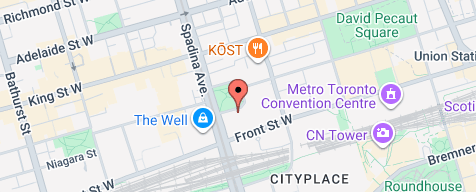 |
| If not next door, more or less in the direction of the water. |
Huzzah! So off I pedalled, as is my wont, and spoke to a nice fellow behind a distinctly industrial-grade counter surrounded by the paraphernalia of the electrical trades. He scowled at my Techspan reference numbers and went off to make a series of phone calls to them. Emails were exchanged. Images of crimpers were sent to and fro, especially as, after the first hour, I insisted on putting "FTZ Industries Heavy Duty Crimp Tool" into Google and hitting "images". Well, it turned out that despite being the FTZ distributor in Canada, Techspan had every crimper BUT the one I wanted. Some seriously weird clamping stuff, including devices suitable for a giant's
bris. This was after an hour of hovering around a room with all the ambience of the liquor stores of my youth.
 |
| This is actually from 1970 Manitoba, but Ontario's governmental boozers looked much the shame. |
Mission: unaccomplished. Time: wasted. After a briefer time working aboard than I had--HA!--planned, I went home and went online. Within minutes, I had found a place in the States...where, I know not, but it's in area code 208...that offers
the item I couldn't get in a city of five million. U.S. buck Visa in hand, I ordered it to be delivered to my club. Sorry, retail: I tried, but you and your disparate
SKUs and part numbers and suspect inventory control drove me online. I just wanted to support you!
Now, here's where my own countrymen, despite a rep (not entirely deserved in my experience) for civility and politeness, fall down. I placed the U.S. order last night around 1800h. While I've been writing this, around 1230h the next day, I've received a call from a nice fellow named Chad, apologizing that
BargainBoatParts does not in fact have the crimper in stock, and that he's been on the phone to FTZ Industries and the delay would be some two weeks, plus five days for delivery...and would that be all right?
Yes, Chad, that's fine. Particularly given I now know you are in freakin' Idaho, a long way from water. I haven't bought the cable or the batteries yet, and the Power Lugs might now extend my original order, because you've proven you want the business of a single boat restorer. U.S. firms seem to grasp on the importance of keeping even "little" customers happy, and I was gratified to experience this mysterious "customer service" of which I've heard so much. And given that every other places was out of the Must-Have Lug Crimper of the Season, I wasn't entirely surprised to hear of the delay. I was surprised to hear of it via a personal phone call. As for retail, even in my big city, sometimes it's just better to shop other than in person, I guess.
UPDATE 14.05.21: The Powerpole gear arrived today, and the crimper appears reassuringly hefty. Will start making up test leads shortly.


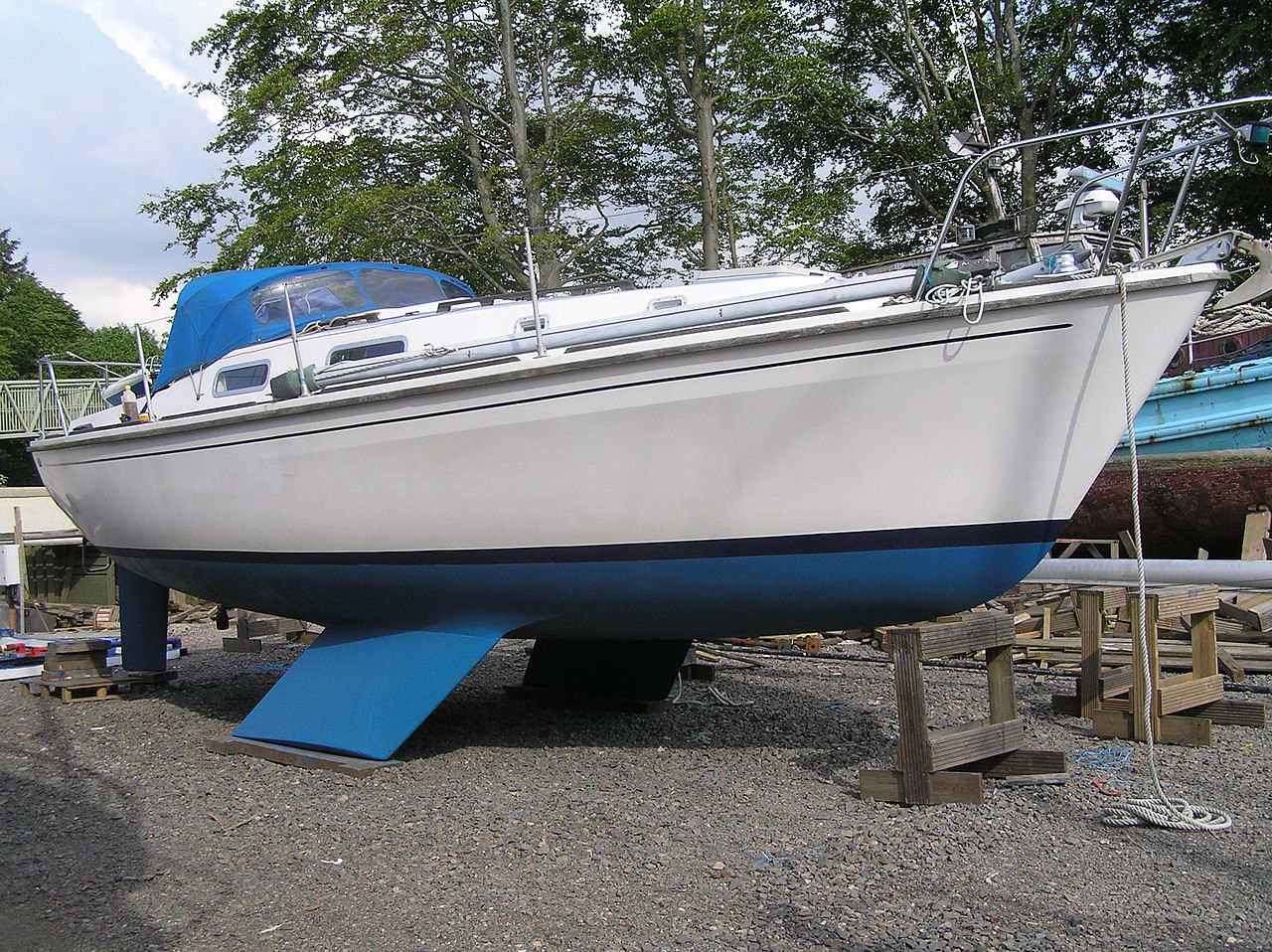


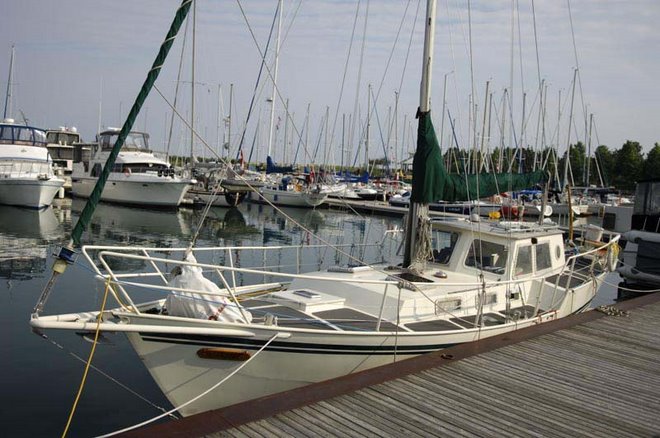
My last, feeble muttering in public was about...sad to relate...keeping the boat clean. I suppose a corollary to keeping things clean is to keep them accessible. One of the upsides of owning a custom boat is having no compunctions about sawing or drilling through a non-structural part of the interior to make an access hatch or other “points of egress” to a particular potential trouble spot, like the lowest part of the head hoses, or to making the aft cockpit sole removable to get at the transmission or the stuffing box.
Of course, this demands all sorts of planning and a deep knowledge...and a good record...of what is behind the trim. As fewer cars owners can do minor repairs in their driveways, I would suggest that fewer boat owners know where some of the wire runs, hoses and vent lines actually go in their boats.
My experience of proposing such modifications of access is that owners of production boats are quite resistant to cutting holes in their “highly designed” vessels, even though it is newer, often “modular” designs that the most egregious cases of “burying” critical gear occurs.
A friend of mine thinking of buying a boat a while back had a 2011 Hanse 355 surveyed. The very good surveyor, Wallace Gouk, acting on my friend's tip, found a flexing part of the hull that was unsupported by an untabbed bulkhead. Not a failed tab...a spot never tabbed. A big freaking void I could have put my clown shoe through. Helpfully, it was adjacent about three holes cut for wire and hose runs, further compromising the strength of the bulkhead at that point. And with the Hanse's typically modern production cruiser-style of modular design, it would have been nearly impossible to rectify this issue without cutting out half the cockpit. This boat was lovely to look at and has the clean lines of a good sailer....even as I said at the time (grumpily, because I dislike the majority of production boats I've seen since about 2000) "it annoys me less than most". I got annoyed afresh after seeing some of the pictures from the survey...eek.
Expectedly, this issue of "tabbing absence" was a deal-breaker for my friend, who moved on to a much better-built 2002 Dufour 36 Classic. Of course, the guy selling the otherwise reputable Hanse had no clue what a piece of compromised junk the boat he was flogging was, I would have wagered. My friend, on the other hand, worked for CS in the '80s and is the sort of guy who goes out in 30 knots on Lake Ontario because it used to be common knowledge that wind makes the boat go, and more wind is better, until stuff breaks, and that's probably the skipper's fault for an incomplete knowledge of physics. The baseline assumption is "I am sailing a well-found boat". Or was, once. Our materials science, when it comes to boat construction, seems to be far ahead in certain respects of the actual execution on the factory floor.
I am, with allowances made for crew and conditions, similar in spirit, and not out of some antediluvian machismo, but because it's exhilarating to sail in a stiff breeze and to feel the spray and to play the waves and run through one's hypotheticals should something go wrong.
My friend who probed the Hanse hadn't sailed for about 25 years when I first took him out in my Viking 33 a few years ago, and when he saw the high boom of a modern Hunter and asked "should we help them? They've broken the gooseneck and jerry-rigged one higher!", I realized that such is the impression modern boat design can make with a sailor who's been out of the game for some years.
Modern boats can appear to be crippled. They can also seem underdocumented, largely inaccessible (who has seen the rudder post?), and products of committees of introverts. Clearly, this is not universal, but it's common enough to make me happy that with a wide-open (in terms of access) custom boat, I can make my own fixes...and even my own mistakes...without too much in the way of hidden and potentially nasty surprises.