 |
Illustration by Gary Clement, @garyjoelclement, via http://www.greaterfool.ca/2015/01/21/the-second-coming/ |
We live in low-interesting times. Saving is barely worth it, and overextension of one's finances in order to buy, say, property at the top of the market has never been so attractive. At the same time, the irrational commodities markets have been seizing over the drop in the price of oil, which has (once again) revealed Canada's lack of economic diversity in our horrible, dopey reliance on resource extraction (which seems to have surprised only the economists), and which is partly subsidized by incentives and (frankly) graft, and partly paid for via damaged or destroyed ecosystems. Not that this seems to make much of an impression on the average North American; as soon as gasoline prices began to drop, environmental concerns were trumped by penis compensation.
 |
| Guess what? It's hardly worth it at the moment to destroy the environment. |
_XLS_wagon_(2011-04-22)_01.jpg) |
| Too easy by half. |
Whither cruising in all this? Well, the rates I charge my clients and the modest take-home my wife brings in have been static for some time, even as our taxes and fees and utilities, such as gas, electricity and water/waste, have risen, in some cases at rates multiple that of the rather abstract "inflation". I can't charge my tenants more than a figure (1.6% in 2015), even if they leave all the lights on and the water (which has gone up 8% per year for many years now, ostensibly to pay for replacing Victoria-era piping) running 24/7. So there are "bottom line" impacts in that it is difficult to both save for cruising, to refit the boat properly, and to have a life less austere. One somewhat counterintuitive course is to get the boat livable enough to move aboard, and to rent out the part in which we currently live. But this would mean more commuting (my son walks to school and will walk to high school next year) and the logistical craziness of camping out in a boat that is still a worksite. I'm not sure that the extra $1,200-$1,500/month, minus the cost of overwintering in the only marina in the same general area as to my kid's school, minus the insanity of living in a plastic-battened boat with roaring power tools, jerry-rigged heaters and rotating bunkage, even makes sense...although some have done it quite successfully.
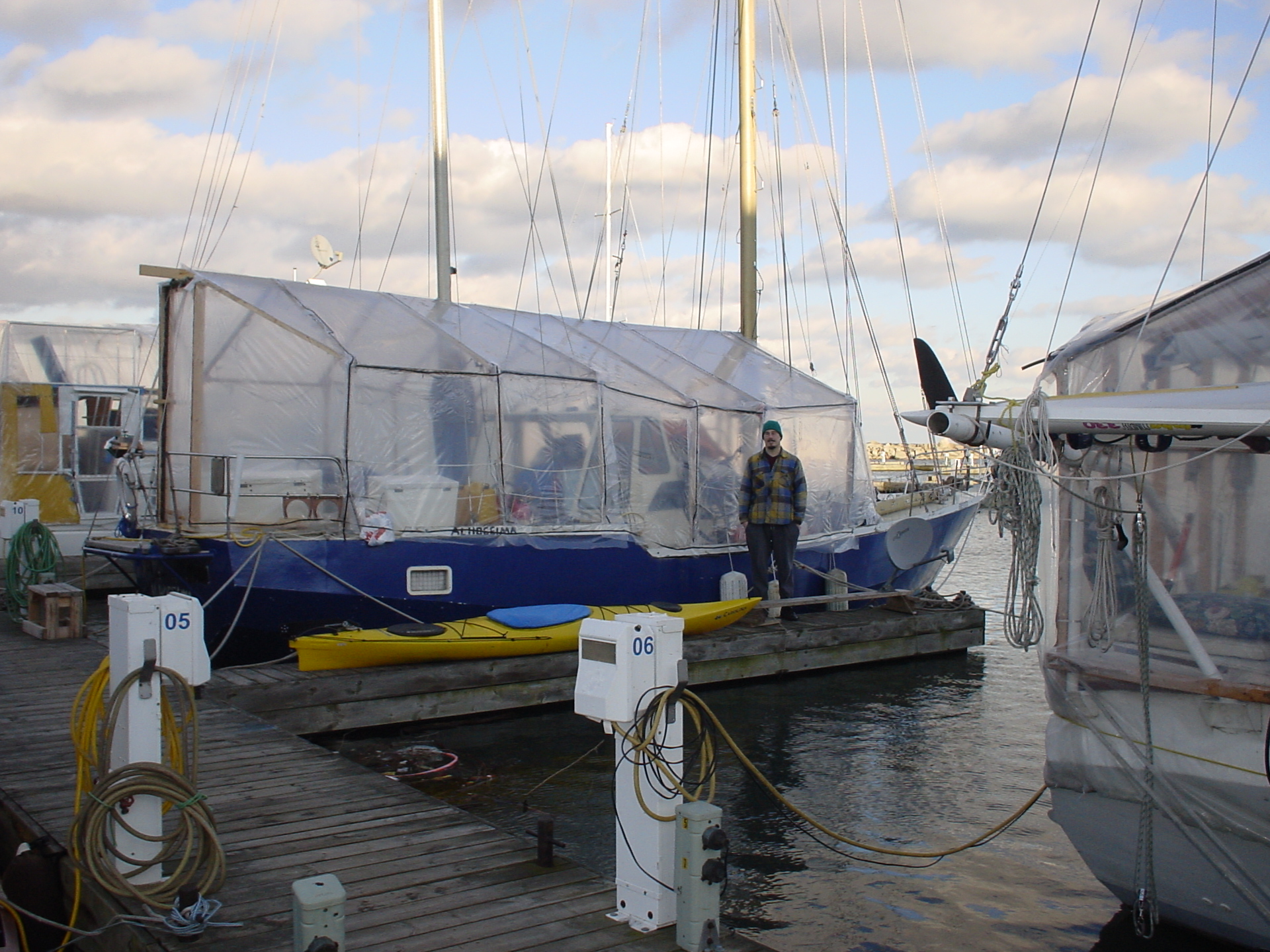 |
| This is the deal living aboard in a Canadian winter. I see someone bought this boat. I considered doing so way back in 2004. |
But that's the micro-picture. The macro picture involves energy, food, water, and therefore you and me and everyone we know. Amid all the current babble about freedoms and liberty, I'm not convinced that our vaunted democracy is the answer to solving situations demanding a planetary response. Democracy is great on the level of the local and the immediate, just like capitalism is fabulous if you've got capital.
 |
| Not seen: Hubris. |
On the other hand, the British wartime economy became a Soviet-style command economy with restricted civil liberties (like driving what you wished when you wished) in order to preserve a parliamentary democracy from Axis fascisms. Food itself was strictly rationed. When the British public had little or no access to crappy or excessive food, health improved dramatically.
 |
| Blunt, but effective: No rationing equals class warfare. |
Would Americans and Canadians, who, historically at this point, experienced far less rationing inside America, accept a "war footing" economy in order to transform their countries into ones that greatly reduced personal car use, energy consumption and sold only healthy, local foods in local shops, instead of cheap sacks of corn chips in WalMarts out by the highway?
Hell, no. That's why we fought the war!
 |
| This, however, would have to wait several decades. |
Strangely, the very restrictions for which most people would be unwilling to submit on land are seen as rational at sea on a small boat (unless you "sail" a dock queen). It's clear that if you make every amp aboard through diesel, sun or wind, you can't leave lights, even LED ones, on, can't leave the stereo blasting and can't, mostly, have hot or pressurized fresh water in practically unlimited, municipal quantities. Everything must be planned and measured...even if you have money...if shortfalls that haven't been customary since the mid-19th century on land are to be avoided.
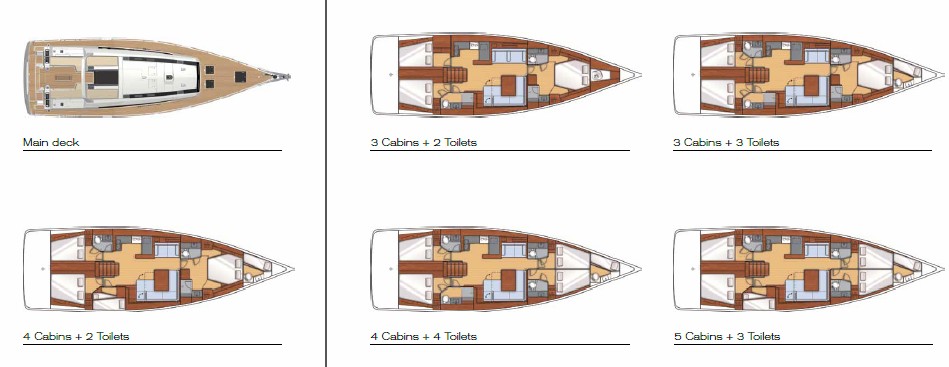 | |
| Five cabins and three toilets? That's a small motel. |
Boat living is therefore intrinsically "greener" if only in the sense that the skipper and the crew are directly involved in the means of energy production and its storage and rationing. Be oblivious to these aspects of life aboard, and you are soon reading by oil lamps, assuming you remembered to bring lamp oil, and you are also trying to spin your diesel's flywheel with the crash-gybe method, assuming you have compression levers. Of course, simplicity while sailing can be considered virturous, certainly in the sense that there is less to buy, and therefore less to break. Some rather famous sailors have made a living at living a cruising life of near-Luddite parameters.
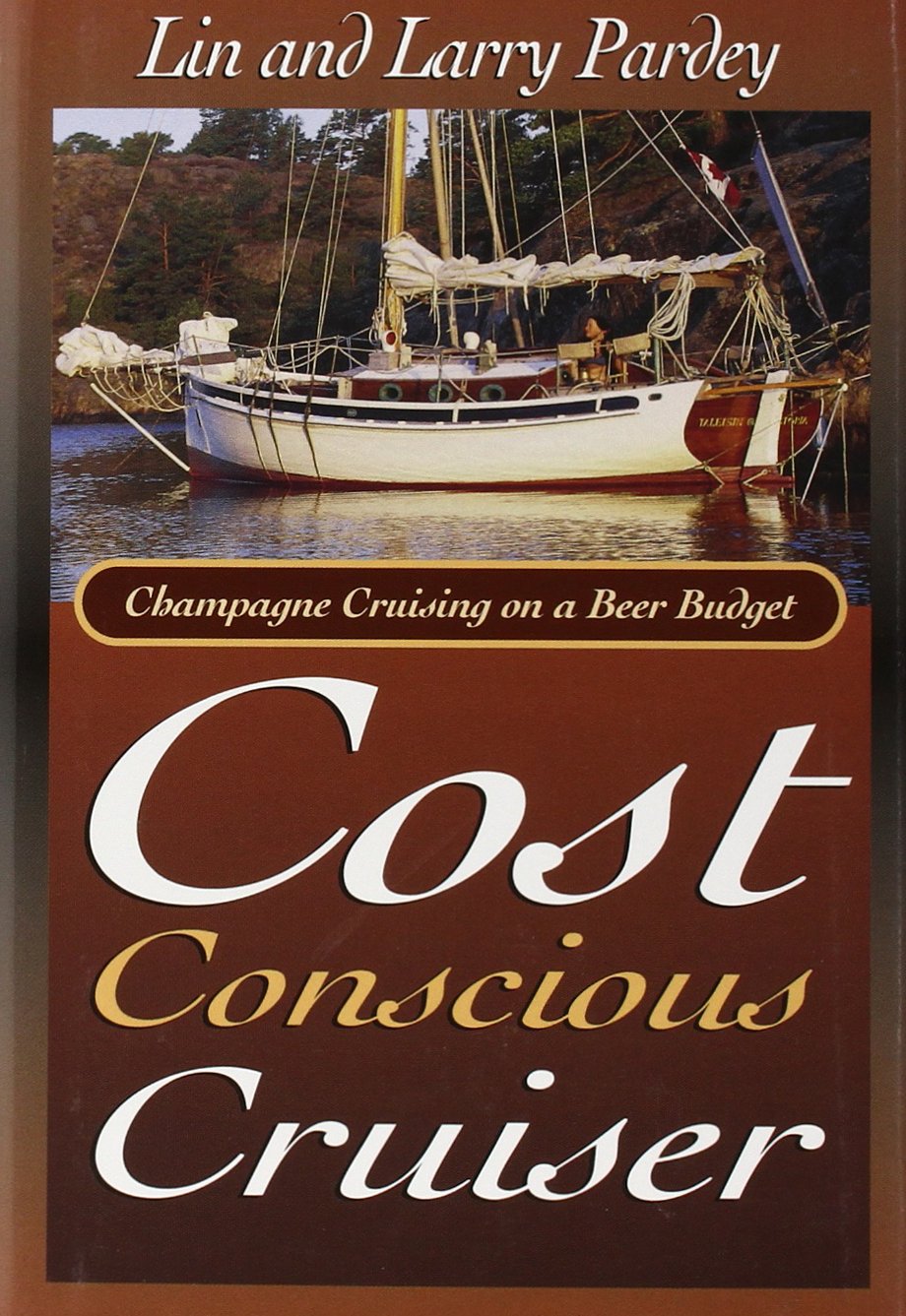 |
| No mention of rum, I note. |
In this sense of being aware of the non-infinite nature of the resources on and within it, Earth can be considered to be a very large passagemaker. We jumped-up apes may disagree on how best to address the excess and bulky crew who are forgetting to turn off the lights, but can we agree that the lights need more turning off? One can only hope so, before that decision is removed from the realm of choice.
 |
| Perhaps too cost-conscious? |
Fascism can come in any colour, in my experience. The paradox is that a more ecologically oriented democracy would, as happened in some senses during the Second World War, in terms of curtailed domestic fuel usage and food wastage, have to restrict freedom of choice in the marketplace in order to preserve freedom of quality of life on the planet.
 |
| High-fructose cornucopia. |
It's a tough order. People have difficulty working credit cards 30 days into the future (which is in fact the whole basis of the credit card industry), so saying "we need to do X.Y and Z for the next two centuries in order to make a better, more sustainable world, and it will involve not having everything you want at a cheap, Chinese factory serf-price shipped overnight to your front door, which won't be made of tropical hardwoods" is, frankly, going to be a hard sell, and not just in Western, land-based culture. If one isn't actually being kept down by the excesses of capitalism, it's easier to pretend there's no problems and to enjoy the discounts. Ultimately, most of us are only grabby monkeys with a slightly better puzzle-solving talent.
But with less stuff, we may have more contentment. "Less stuff" is the mantra of the active cruiser, who can see with the disappearing waterline stripe the consequences of unthinking acquisition. In this sense, the cruising life is good preparation for a future in which there is very likely going to be more diners splitting up a pie that, at best, gets no bigger.


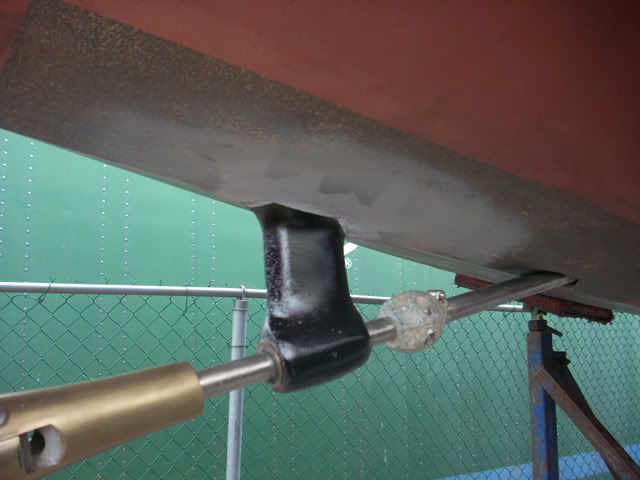
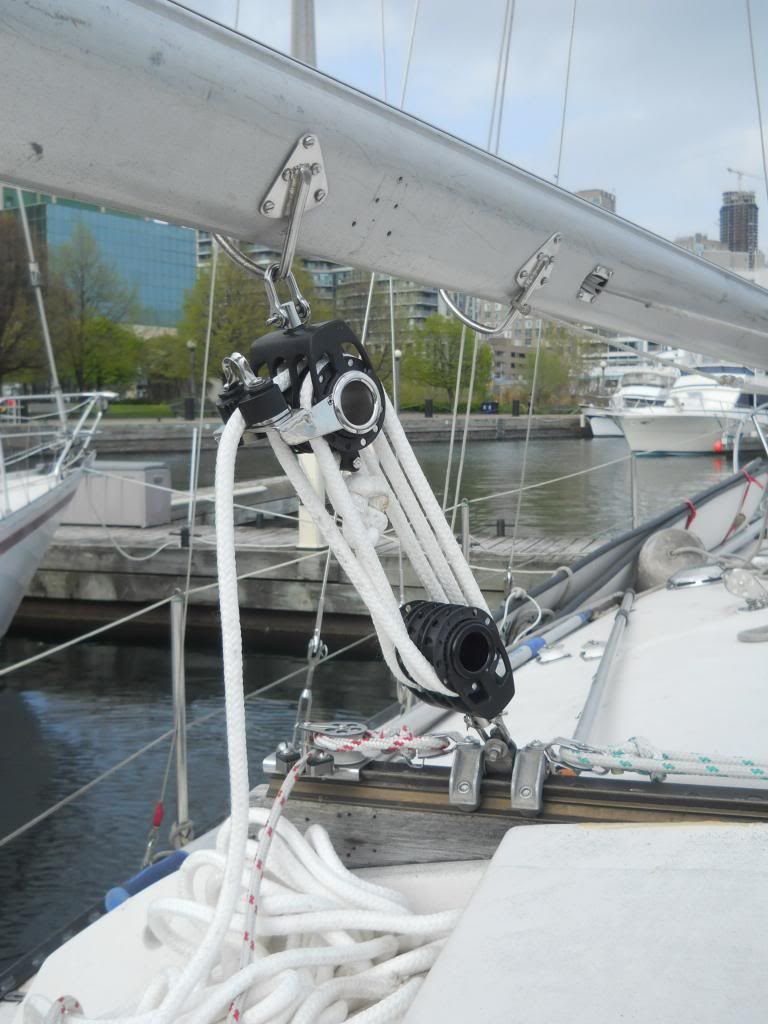


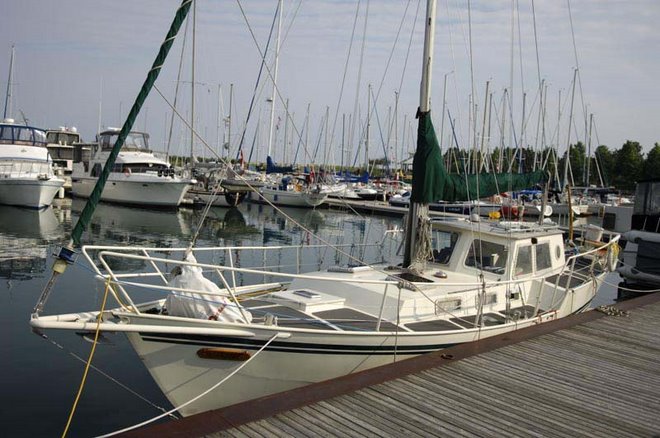
Here comes the science: I want to put nylon bushings in every steel flange hole (40 of ‘em, remember?). Then I want to lay down 1/16th strips of Delrin or HDPE atop the flange with appropriate holes for the bolts. Beside this plastic strip, which performs, along with the bushing, the role of electrically isolating the aluminum roof from the steel hull structure, I want to also lay down a line of butyl tape. This can be a fairly narrow line of tape, as it will be compressed in place as a barrier to water ingress, on the outside of the HDPE strip, which itself can be bedded with something that will given without severe difficulty in the future. Fit the 40 SS bolts and 40 new nylon washers and Nylock nuts to fit through the bushings, and put dielectric goo on the threads. Dog down as is sufficient to squish out the butyl, and trim to desired neatness.
This method (SS bolts, “other metal deck” and “other metal backing plate”) also applies for any deck gear, as making backing plates from SS is a royal pain, whereas power tools shape 1/4″ aluminum plate easily. In practice, this means attention to paint service is critical, as "rust" is a lesser worry than voltages, in some senses. EPDM rubber strips, able to withstand compression and UV exposure, seem like a good bet here when (for instance) bolting the typical sort of SS clamps to support awnings or biminis to the extant, painted pipe rails. The likelihood of paint plus rubber failure is low. And, of course, when one is making electricity, the need for effective insulation/isolation is commensurately greater.
Even on a plastic boat, I’ve sometimes chosen encapsulated ply over aluminum as a backing plate choice because of the number of SS bolts involved and the unlikelihood of keeping everything both isolated, in strong compression, and yet fully dry.
My impression is that in materials such as chain, plate or in gear such as failed stays and bolts, it is the prep and awareness of the role electricity plays in the weak electrolyte we call the ocean that defers or at least delays the majority of unpleasant surprises. Certainly the process of “ground tackle” is not commonly thought of in an electrical sense, but dissimilar metals in anchoring, even in a galvanically benign (presumably) open roadstead can have a negative effect on top of the differing material characteristics, such as ductility, of their respective parts.
I have found Bruce Roberts’ “Metal Boats” and Nigel Warren’s “Metal Corrosion in Boats” excellent resources in understanding, at least for starters, a complex subject with many possible reactions and solutions. But even if you think you know this topic, and have taken all necessary measures, one should never neglect to actually examine your vessel, metal or not, for signs of wastage or corrosion due to galvanic issues. Part of dealing acceptably with this involves a little gadget called an isolator,and is a topic I will return to in the future.