

2017-02-03
Space, the final two floors and time, for some more changes
 |
| The stairs less travelled. While I had my office up here during a brief window of tenantlessness, we've never actually lived in the top two floors of the house. We sure have laboured up there, however. |
Well, the last tenant has moved out and dust bunnies remain. We wanted to give them their notice in March or April, but they jumped the gun on us and gave their notice for the end of January. So at the cost of a prospective two or three extra months of rent, we get to move upstairs in winter instead of right at boat launching time (end of April, 2017). Frankly, I would have preferred the money.
This is a boat-refitting blog. Why am I discussing a house, and not, say, the recently past Boat Show? Well, it's simple. I took no pictures at the Boat Show, because there was very little worth recording. I went twice for a total of five hours, and while I bought the new almanac, as one does, it was mostly a reconnoitre operation to determine some purchases I could soon make. Reasonable terms were secured, delivery to come.
 |
| Acquired, reasonably, and with a $40 U.S. rebate, which is nice. |
 |
| The upper galley: compact yet functional. Note departed tenant crap left behind in the derapturing. |
- August, 1998: During the only year in which we had three incomes (my wife's job at a charity for wildlife rehab and my two as a graphic designer by night and an internet service provider marketing manager by day, we bought a semi-detached, late Victorian house bigger than we required and the lot of which opened onto a park with the intention of renting out half to pay down the mortgage. We had about a 25% downpayment in hand and we suspected we were at the bottom of the market as the price changed from $199,500 to $214,500 during negotiations...heh, I nearly walked away. Would have been an error, that.
- April, 1999: Management/ownership changes find me out of my Internet job. I get $15K in "shut up and go away" money. Great job, Internet! I have my graphics gig, my wife's income, which is paltry but helpful, and tenants' rental income on which to fall back.
- May, 1999: The future Mrs. Alchemy and I join the National Yacht Club on an eight-week "learn to sail/introductory crew" course. We enjoy it so much that later that summer...
- September 1, 1999:...we buy a Viking 33, changing the name from Dolphin to Valiente, for occult reasons. Sailing in earnest and in Lake Ontario commences.
- Summer 2000: I blow up my first Atomic 4 engine by neglecting to open the seawater inlet. An odyssey commences of small engine repair, rebuilding and installing. Much is learned and some cost is dodged. We continue with what will be five years of crewing on club race boats. I learn many sailing tricks and tactics that we incorporate into our cruising, which gets considerably more efficient. Meanwhile, I have two Atomic 4 engines rebuilt and installed. Don't ask.
- September, 2001: Our son the Cabin Boy is born. Terroristic acts of appalling brutality follow. I try not to draw any false corollaries. We take him out on his first sail at the age of five days.
- November, 2001: My mother dies at 68. My father, 10 years older, is devastated. Life is short, but can still surprise with its capriciousness and brevity.
- Summer 2003: The 1940s-built (insulated with newspapers, which is how I know) "mud room" off the kitchen starts collapsing in earnest. We pop for a replacement and I act as a labourer and stupid-question generator for our contractor. That and spacing out the build over bits of his spare time mean we come in at budget of under $10,000 for our "breakfast nook" and I learn a great deal about wood, cement and triple-glazed windows. More sailing happens.
- January, 2006: Thanks to the mysteries of double mortgage payments (most of our income blended with most of the tenant rent income), we retire our house debt. We note that our house is now valued at approximately twice what we paid for it, but as we have no plans to sell (I dislike the house for its age and layout, but like it for its vast brick garage (a former stable in which we have chosen not to keep cars) and its central location, but with a park adjacent, which has been very nice in terms of natural cooling (we have chosen not to have air conditioning, or cable TV, or vacations other than on Valiente). A pattern is noted of purposeful thrift established not only because of relatively modest upbringings, but also because we never really stopped living like students, even with a child, and we had both declined to participate much in the consumer economy. Our house, save for the modern computing gear required by my trade, is filled with castaways, hand-me-down and elderly tech, although the wine cellar's pretty first-rate. Over said excellent wine, a plan forms in our seventh season of sailing: should we go long-term cruising? Perhaps even around the world? Despite describing it as a "fiscal and learning sleigh-ride", I obtain agreement from the future Mrs. Alchemy and the search for a suitable vessel begins.
- July, 2006: After plenty of review, contemplating and searching in places as separated as Washington State, France and Panama, we locate a custom-built pilothouse cutter in steel named Alchemy. We mortgage the house afresh in an environment of further declining interest rates and learn in the process that it's now worth nearly three times what we bought it for. Our mortgage is therefore only 40% of the house's value. With most of that, we buy Alchemy. We now own two sailboats and no car. How silly of us. We return to having tenants. They pay, as has been the case for most of the time in this house, the mortgage payments. We, having the boats in hand and big plans for one of them, cease to double the mortgage payments, but still do a lump-sum, end of year payment when we can.
- October, 2006: My father dies at 81, ostensibly of cancer, but observably of a broken heart. He was a professional sailor, and I am a recreational one. He started in war at just short of 16 years old because his home had been blown apart by bombs; I started at 38 because of reasons of fun. So the link is a touch tenuous; nonetheless, I claim it. Dents are made in the mortgage.
- March 21, 2007: I'm a writer and a sailor, so I start a refitting blog. Frankly, I was hoping to have left by now. Because the blog exists, I can skip large chunks of the intervening years. Those interested can simply consult the list to the right.
- June, 2007: I spend a week in Portugal, of which two and half days are spent crewing on a coastal delivery from Cascais to Vilamoura. This is my first delivery, and my first sail in salt water outside of Channel ferries and other nasty vessels smelling of duty-free booze. My skipper is Alex K., one of the finest sailors I've ever met, even if he is a racer. I learn a lot and value the opportunity, even if hand-steering, alone, under power around suspended fish nets at dawn with a three-meter keel and bulb in unfamiliar waters was nerve-wracking. It was also seamanship building.
- January, 2008: The first of many "big ticket" purchases necessary for the refit of Alchemy are made, including a four-bladed feathering prop, a windlass and a FilterBoss Racor fuel setup. The dilatory nature of my refit has been discussed elsewhere; in my defence, I will note that a paucity of mechanical skills have had to be overcome, and, at the risk of tempting hubris, my installations to date remain fully operationable. Not bad for a guy who took poetry instead of shop. Only the windlass is still in its box and I expect to install it prior to April this year.
- June, 2009: Mrs. Alchemy does the same Portuguese delivery trip, but has livelier weather. We have done deliveries separately for some rather hard reasons: if things went pear-shaped, they wouldn't leave our son an orphan. We also believe that it's important when co-owning a seagoing boat to maintain parity in our skill sets and seamanship, while (we hope) having some differing experiences that expand our collective knowledge.
- November, 2009: I crew on a 12-day delivery from Virginia to USVIs aboard a loaded Bristol 45.5. The weather is, shall we say, lively and I learn first-hand about staying tethered, interesting ways one can use an SSB, the notion of "clear-air squalls", how to use radar to see rain bands and many other points of interest I use to the present. First encounter with the irrational officials keeping the U.S. safe from personal flotation devices.
- July, 2010: I crew in the Lake Ontario 300 race. Successively stronger squalls plaster the fleet and do damage, leading to about a third of the participants retiring. I see 68 knots for the first time, which trumps the high 40s I saw on the Atlantic. Can't say I enjoyed it, but the seasoned crew helped and no one panicked. In fact, a crew of skippers was funny in that the first thing all of us did at dawn was to circle the decks, looking for damage to the stays, cast-off cotter pins or other signs of imminent failure. It was the only time I've enjoyed mime.
- December, 2010: Having noted that the cost of the rebuild of the 25-year-old Westerbeke W-52 that came with the boat would exceed the cost of a brand-new Beta 60, we opt for the latter, despite the cash hit. While there was more expense in the form of AquaDrive, various custom weldings and fabrications, and a shaft and its accessories, the entire re-engining came in under $20K Canadian, with which I am well-pleased. And, having grounded hard last fall and redlined this thing successfully to get off a silty sandbank, it was money well-spent. I have a great deal more confidence now regarding motors and their care and feeding.
- May, 2011: After a ridiculous amount of labour to get the aluminum pilothouse roof unstuck from the steel pilothouse flange, because it had been glued there with evil 5200, the old engine and water tankage is hauled out and the new Beta 60 engine, which was ordered with some custom features, is lowered down into the boat. A great deal of further effort, fabrication, measurement, more fabrication and assembly required follows in order to make it live.
- June, 2011: Mrs. Alchemy does a delivery of an Ontario 32 from Bahamas back to Lake Ontario. Huge mechanical failures means the trip ends with a tow into Charleston Harbor. Many lessons are learned: as they say in science, an experiment which disproves the hypothesis (in this case, I would argue, that one can cruise without refitting for 11 years and expect major bits of the boat to still work) is as valuable as a proven one.
- August, 2011: A stainless steel "solar arch" is fabricated and is hoisted into place. Later, I will learn that I made an error and only two of the four solar panels will fit when the mast is actually back in.
- Winter/spring, 2013: In several discrete steps, the engine is brought to life and hooked to a spinny thing at one end. A temporary diesel source provides the not-to-code means to run the engine.
- April, 2013: I learn that the ability of a running grinder wheel to negotiate a curve in a steel keel tank top is limited at best and my left leg still has some interesting dings to prove it. This is simply the most vivid of the many self-injuries I have incurred over the last 10 years. To me, the most annoying thing about my own blood is how it makes the pliers it tend to coat harder to work. You've got to stop and find a length of goddamned gauze.
- April 28, 2013: After a few years cradled in a parking lot, Alchemy takes to the water, without, gratifyingly, taking on water. Further and only apparently endless improvements follow at dockside.
- November, 2013: Underprepared due to work, I take an RYA Yachtmaster course in Brittany. Informative and intensive as it is, fatigue and a blithering moment that has me confusing European buoyage means I don't pass, which is disappointing, but I resolve a) to study more now that I know the nature of the training, and b) to not try to skip rungs on this particular ladder.
- December, 2013: I put Valiente up for sale. More futility and cost will follow.
- September, 2014: After several months of spare time devoted to cabling, fuel issues and electrical connection, I start the Beta 60, in place, in the water, three years, four months after first lowering in into the boat.
- October 22, 2014: First dynamic test without the mast in. Flying colours are passed. The engine works gratifying well. I drive the boat into the slings at Haulout a week later and note the more superstitious sailors of my club crossing themselves at the miraculous sight of a self-propelled Alchemy.
- Late October, 2014: I take a less-ambitious RYA Dayskipper course in Antigua and pass, even though the first day was postponed due to a surprise hurricane during which those present had to try to fend off and secure leaping sailboats. New record set of "winds experienced" of 88 knots. That wind is enough to knock me, a man of substance, to all fours, but the real danger is flying debris capable of braining the unwary.
- Winter, 2015: The services of a yacht broker are engaged to sell Valiente. Result: zero. Annoying, that.
- May, 2015: Launch. Ability to motor retained. Still sailing Valiente while trying to sell Valiente. This encourages me to keep her appearances up. An estimated 40 separate visits will be made to check out the boat. Despite some enthusiastic chats with potential buyers, nothing is concluded.
- July, 2015: Fuel system redone. Fuel filters installed and tanks inspected. Old diesel found still usable. Gratitude is expressed.
- September, 2015: After another summer of labour, installation, sail repair, wiring and prepartion, the mast goes in, the sails go on and sailing operation are resumed successfully. Felt very good, it did.
- Winter 2016: A new mainsail is ordered and is fitted in the spring. Works as advertised. We find ourselves thinking of reefing lines for the first time in ages. Valiente's skinny IOR-style main never seemed to call for reefing.
- April, 2016: The mast is put in right after launch. Sailing commences in between multiple other improvements.
- June, 2016: The last of the Return of the Mortgage is converted into a line of credit at a low, favourable rate (the bank loves us because we keep coming back). Said line of credit is being paid off at a lower rate than the mortgage was to a) free up a few hundred a month and b) in anticipation that it will be brought to zero after the sale of the current house yields funds.
- Summer, 2016: Six big batteries are lowered into a new space made for them and are installed. Much crimping. Forearms expand and heat gun blisters multiply. Nav lights, dead for years, obligingly glow.
- December 2016-January 2017: A proper welder/fabricator having been (finally) found, a new engine bay hatch is delivered and a new companionway hatch and alterations to the solar arch are discussed. Further wiring run. New traveller installed. A decision on the radar is made.
 |
| My god, it's full of bedrooms! |
 |
| You will know your tenants by what they leave behind. This will be my son's Fortress of Voice-breakage |
 |
| Life with closets, instead of IKEA armoires or racks, will be something I haven't actually had since 1993. |
The plan now is to clean and occupy these top two floors in order to buff, sand, tile, polish, plaster and paint the dreadful area in which we've lived for 18 and a half years and which, being occupied by us, has seen little care, either tender or loving. It's not a slum; I've always been on top of needful plumbing, heating and electrical repair, but decor has not been seen as a pressing need. But it shall be, because as part of the Drive to the Sea, we want to sell this place and move elsewhere.
 |
| Useful, but aimed at the child-free, pre-aged crowd. |
- We want to maintain a foothold in local property, despite its currently ridiculously bubble-like cost.
- We want to do this so we have a pied-à-terre here in Toronto, consisting of a basement flat and nearby garage in which we can store our pared-back possessions and movables, and have a place that isn't a hotel in which to stay as needed. Mrs. Alchemy's parents are both alive and in their 70s, but we are talking about sailing for five years starting in 2018. We may have reasons to "drop back in".
- We have a perfectly good house from which to extract the rent from two flats already, but that means no pied-à-terre, and no place to store our stuff. Well, maybe the garage, but it's hardly four-season-ready and there's no plumbing and rudimentary electricity.
- We determined that less rent, but from just one tenant or pair of tenants, would be easier to manage. We also determined that a smaller, newer house with a separate entrance to the basement and some form of lightweight property management would be the least painful way to get a couple of grand a month to pay for rum and diesel.
- We've determined that the arbitrage between our current house and our prospective house in the inner suburbs will yield a nice cruising kitty, which means we will be less reliant on rental income while on passage.
- So tarting up this place for sale means moving upstairs. That starts today. I will need a lot of boxes for my books.
2017-01-22
Wind, light, time and warmth
 |
| The view from the side deck, Jan. 22, 2017: This is the opposite of usual and even the waterfowl seem nervous. |
Last night I hoisted a pleasant beverage or two with fellow sailor and blogger Brian Jones (Dock Six Chronicles) in the context of his amusing yet helpful Facebook group, The Low-buck Yacht Club. It's a place to exchange tools, tips, techniques and gear choices with other sailors who concur that the second-worst thing after abandoning ship is parting with money. That doesn't imply the neglect of mandatory purchases, or even choosing the cheapest (so rarely the best) option; it does suggest that boat gear and hiring others to install it is expensive, often unreasonably so, and alternatives to just raising the cost of cruising per mile to thin-air levels involves both constant vigilance and crowd-sourced wisdom. Hence, Low-buck YC, your virtual talking shop for smarter-assed cruising.
It did occur to me, however, as I cycled down to the waterfront pub in which Brian had convened about a dozen Toronto International Boat Show attendees, that I was wearing a T-shirt, a pullover and my somewhat venerable boat club fleece jacket. No windbreaker, no toque. My concern while cycling was fog, not cold. This is uncustomary for the third week of January in Toronto.
 |
| Typical local winds. Image (c) Meteoblue. |
 |
| A light to guide me. |
 |
| I'm quite pleased with this, as its appearance in subsequent blog posts suggests. Note the temperature on the baro. |
Next up: the boat show. I made quite a dent in the installation list this year, but there's more yet to do before casting off in earnest.
 |
| Regularized nicely, too. |
UPDATE, 18.02.06: I finally sourced a 24-hour clock! Unlike the one above, it will go next to the SSB radio and will keep GMT/UTC/Zulu!
2017-01-20
Time for some changes
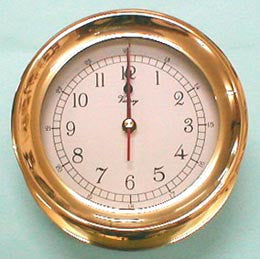
Because it was time for a change, this is my treat to myself for having sold the old sailboat. It's from around 1978 to judge by the serial number, and it's the first thing I've ever purchased on eBay. I'm rating it now prior to putting it in the pilothouse. It's in pretty impressive condition to judge by the outside appearance.
The case for a "ship's clock" wound with a key is, in some senses, not a strong one, save for the observation that I've had rather poor experience with the modern replica types which run off an AA- or C-size battery.
The problem is the cheap, generic, plasticky and inevitably Asian clockwork, which fails to keep time, and fails variably depending on the season. Nnot to mention the pot-metal contacts that corrode even in the air above a freshwater lake. The fact that these are sold with the other anchor-themed tat that fails under "nautical giftware" is really no excuse as even the cheapest models go for well over $100 and the battery operated versions from the higher-end firms, such as Weems and Plath and Chelsea, can go for multiples of that. I don't buy a clock for the boat because brass is shiny.
Now, the one above was the sort I really wanted, and was in the even more desirable version of a smallish 24-hour ship's clock that rang the bell, but the seller could not guarantee that it worked, as he had no key for it. Such timepieces are called, variably, a 24 hour clock, a deck clock or 'Zulu' clock, the Zulu having nothing to do with Michael Caine films from the '60s and everything to do with the "Z" in a phonetic alphabet that is shorthand for Greenwich Mean Time or GMT or also UTC. When it comes to time, it's a funny old world, innit?
Why did I want such a near-antique as a mechanical, hard-to-read wall (or bulkhead) clock? Well, one of the upcoming boat projects will be the installation of our ICOM M-802 SSB transceiver and its associated bits. I noticed way back on my Atlantic delivery in 2009 that skipper Bruce Clark kept a nice small mechanical 24-hour clock screwed above his nav table from which he would conduct his comms, download GRIB weather files and have his daily exchange with the alas-retired weather routing expert Herb Hilgenberg.
There's two concepts at work on a ship (and of which I have written before): local or ship's time, and the time back in Greenwich. Ship's time is useful for planning lunch, but the time in Greenwich, thanks to centuries of maritime convention, is essential to working out one's position at sea with a sextant. Which I own and know how to use and which doesn't require electricity or a network of satellites. Handy, that, particularly as we live in what are arguably interesting times. Seamanlike prudence starts with a Plan B, and besides, for logical reasons, most radio communications are scheduled in Zulu time and so are many official logbook entries. Keeping one clock aboard coordinated with an arbitrary point on the planet is therefore neither pedantic nor unhinged. And the skipper likes 'em.And has an excellent wrist chronometer as backup.
 | |
| Eight-day windup. I don't expect it to be exact, but I have little faith in the reliability of cheap battery clocks. |
 |
| Yeah, this is garbage. Sorry, "giftware". |
 |
| The keener-eyed will note that apart from the greater number of numerals, this is the same model as I've just bought. |
 |
| Unfortunately, the 24-hour one on the right took a short tumble and died. Another battery-driven casualty of life aboard. |
Why did I want such a near-antique as a mechanical, hard-to-read wall (or bulkhead) clock? Well, one of the upcoming boat projects will be the installation of our ICOM M-802 SSB transceiver and its associated bits. I noticed way back on my Atlantic delivery in 2009 that skipper Bruce Clark kept a nice small mechanical 24-hour clock screwed above his nav table from which he would conduct his comms, download GRIB weather files and have his daily exchange with the alas-retired weather routing expert Herb Hilgenberg.
 |
| Herb was routing us through this: the remnants of Hurricane Ida. Was a bit bouncy. |
There's two concepts at work on a ship (and of which I have written before): local or ship's time, and the time back in Greenwich. Ship's time is useful for planning lunch, but the time in Greenwich, thanks to centuries of maritime convention, is essential to working out one's position at sea with a sextant. Which I own and know how to use and which doesn't require electricity or a network of satellites. Handy, that, particularly as we live in what are arguably interesting times. Seamanlike prudence starts with a Plan B, and besides, for logical reasons, most radio communications are scheduled in Zulu time and so are many official logbook entries. Keeping one clock aboard coordinated with an arbitrary point on the planet is therefore neither pedantic nor unhinged. And the skipper likes 'em.And has an excellent wrist chronometer as backup.
2016-12-22
Plotting a hatch, redux
The close of 2016 marks the tenth anniversary of our ownership of Alchemy. I'm aware that's a long time. Other sailors keep reminding me. But while we're still refitting her, we've made great progress of late.
Now, to be fair, I didn't start seriously changing things until 2009, when we committed to a few seasons on the hard to replace the drive train, pull the tanks, etc. Until then, she was just one of the two boats we sailed.
One of the great challenges of the refit, aside from convincing my boat club I wasn't going to stay stuck in the corner of the yard forever, was gaining the "trades" experience to do most of the refitting on my own boat. I would not characterize myself as an expert in anything, really, but I've learned a great deal about marine engines, electrical systems, plumbing, coatings, and fabrications of all types. More to the point, I think (he said, hubristically) I'm harder to rip off, because even if I can't do all the work I need, I have, generally, a far more detailed sense of what is involved in delivering a given service or fabricating some bit of kit aboard, which is most often something I've designed alone or in consultating with the person ultimately fabricating the piece.
Now, while I purchased a small, wire-feed welding unit some time ago, the lack of space for a welding table, plus the difficulty of getting 20 amp service from the house to my garage (the price of copper means setting this up would cost more than the welding unit did), means I've barely gone down that road, though I've got the rudiments. By that, I mean I think I could weld 1/8" steel plate to make tabs or light frames without setting fire to myself. But steel is forgiving, and, in welding terms, predictable. Aluminum is different, which is why I called in a fabricator to do the engine bay hatch in the first place. Said fabricator, while a nice enough guy, had too much work to do over the winter and had to concede he was unable to do the work. So I put up with the same stupid wooden unsupported heavy goofy hatch I had before, just 25% lighter because I had cut it down.
As is so often the case, random conversations at the club, often featuring my whining at the fact I can't find reliable fabrication services for the stuff I'm grossly underqualified to do (mildly unqualified I will happily attempt if I don't bleed too much) yielded a name of a relatively new member. In fact, it was the guy taking over the committee chair position of the mooring committee on which I volunteer. My "new boss" in the club, so to speak. Turns out he's a professional welder/fabricator and millwright. He commutes for his work week here in Toronto, and works on his own boat in the evenings and has access to a full shop. Now we're talking! So talk we did, and I explained the various fabrication and welding jobs I needed doing:
The fellow in question has his own boat and understands what I need. He likes my detailed if probably unconventional technical drawings and has helpful suggestions. He's not rapacious in his pricing, and, as seen above, keeps me in the loop with his own design ideas, as can be seen above. After taking his own careful measurements, we discussed what would work best for this job. Above are the old wooden hatch dogs. They are good enough to recycle, and match the Lonseal teak and holly vinyl flooring I will install when the weather warms up. The hatch gasketing will be fitted by removing the existing plastic strip atop the steel "lip", cleaning up the steel surface to make it glue-free, painting said surface with brushed-on galvanic paint, and adhering a resilient rubber 1/4" gasket in the shape of an "L" along the vertical and horizontal surfaces, and in affixing gas struts so that the hatch can be lifted fully vertically...and will stay there unless shoved down to the horizontal. All that is stuff I can handle. The stuff I couldn't came aboard last night:
The surface, of course, will be covered, and the underside will have soundproofing panels. The effect should be a further reduction of the already quiet diesel (at least with the hatch down). This hatch is lighter by about 30% to the wooden one, and I await warmer weather to do my part. The fabricator has persuaded me that a piano hinge end attachment with flush-set fasteners will be superior to my initial idea of clevis-style pins at the corners. Furthermore, he's already made a steel T-bar cross-member (to be removable should I ever need to haul the engine out) to support not only the fourth, aftmost side of the hatch when closed, but also the forward side of what was going to be the fixed, rear part of the engine bay hatch. I've since had some new thoughts on that little otherwise useless space. You can see where the engine bay light is in the above photo that it's basically where one's foot first falls in the pilothouse off the companionway steps. Much of it (about 30 cm.) is beneath those steps.
That's dead space, really. I mean, you could keep the flares under there, I suppose. Too small for the life raft or the ditch bag.
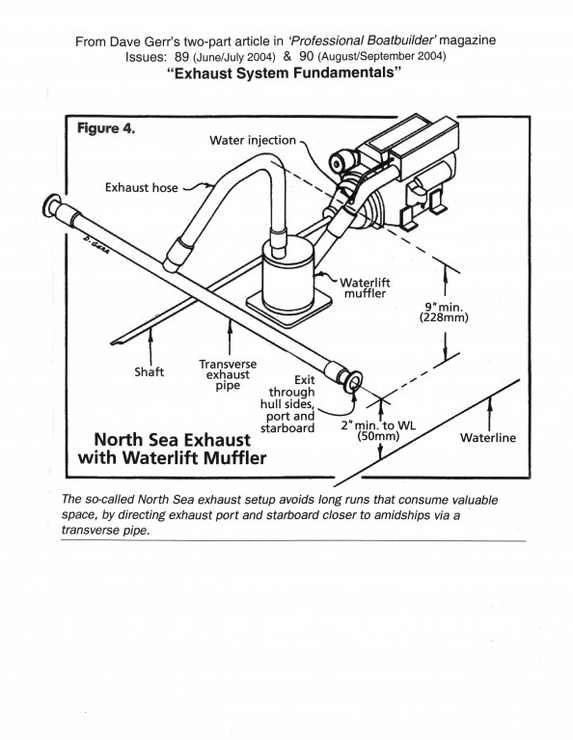
But wait, wasn't I going to install a transverse, port-starboard exhaust system, as OK'd by the author, Dave Gerr, in whose fine boat reference book I first saw it? Why, yes, I was. All the necessary bits are in fact already aboard. It's something I can rig in cold weather, should I wish to. My improvement is this: Note that in the above diagram, a nine-inch fall between the top of the exhaust hose section between the waterlift muffler and the exhaust ports in the hull is required. I can't do that in the current set up, as the underside of the decking is perhaps five inches above the starboard (and, eventually, port) exhaust.
But if I put some sort of insulated box under that last step, or, conversely, replace that last step with a box capable of supporting crew weight, I can run the waterlift to T-fitting loop inside that box, properly secured, and then it's a downhill run of well over nine inches in drop to the exhaust port. I can, finally, lose the anti-siphon break, the bane of my marine engine experience.
If I've made a mistake with my logic here, please let me know. Making water flow downhill from a marine diesel with its exhaust flange at the waterline is admittedly a dark art, but if the solution is to put the loop discreetly outside of the engine bay, I'm all for it. Having a custom boat, it's sort of the point to think out of the bay.
Now, to be fair, I didn't start seriously changing things until 2009, when we committed to a few seasons on the hard to replace the drive train, pull the tanks, etc. Until then, she was just one of the two boats we sailed.
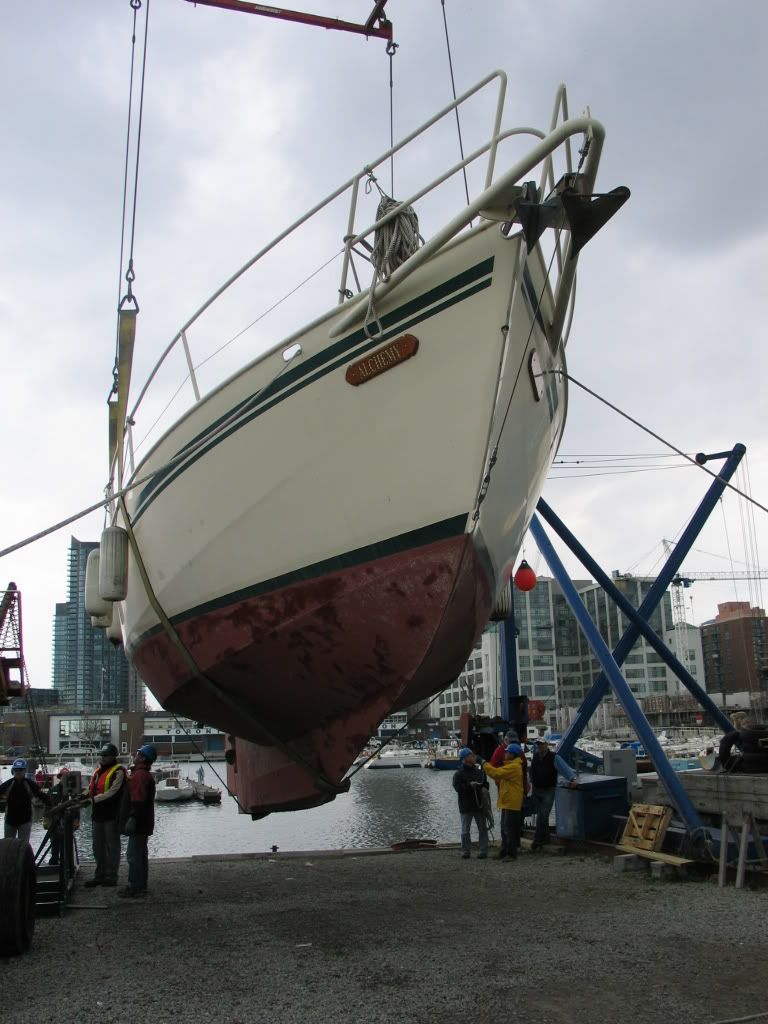 |
| The way we were, May, 2009, being shifted to a new cradle spot. |
One of the great challenges of the refit, aside from convincing my boat club I wasn't going to stay stuck in the corner of the yard forever, was gaining the "trades" experience to do most of the refitting on my own boat. I would not characterize myself as an expert in anything, really, but I've learned a great deal about marine engines, electrical systems, plumbing, coatings, and fabrications of all types. More to the point, I think (he said, hubristically) I'm harder to rip off, because even if I can't do all the work I need, I have, generally, a far more detailed sense of what is involved in delivering a given service or fabricating some bit of kit aboard, which is most often something I've designed alone or in consultating with the person ultimately fabricating the piece.
 |
| Plan "A", last consulted in 2015. |
 |
| Behold Plan "B". |
- Engine bay hatch
- Companionway door
- Clamped on support struts and welded cross-piece for solar panel arch's nav station; repositioned arch plate supports for outboard solar panels
- Studs for hull zincs
- Cutting off old hull appendage for defunct "video depthsounder" and plating over the hole.
- Etc. There's a big list of "things I would fancy" beyond just what I would like done this winter.
 |
| Dogs 30% less scurvy. |
 |
| Only 1/8" thick, but the underside framing means it does not budge. I know, I tried. |
That's dead space, really. I mean, you could keep the flares under there, I suppose. Too small for the life raft or the ditch bag.
 |
| I'm back, and improved! |
But wait, wasn't I going to install a transverse, port-starboard exhaust system, as OK'd by the author, Dave Gerr, in whose fine boat reference book I first saw it? Why, yes, I was. All the necessary bits are in fact already aboard. It's something I can rig in cold weather, should I wish to. My improvement is this: Note that in the above diagram, a nine-inch fall between the top of the exhaust hose section between the waterlift muffler and the exhaust ports in the hull is required. I can't do that in the current set up, as the underside of the decking is perhaps five inches above the starboard (and, eventually, port) exhaust.
But if I put some sort of insulated box under that last step, or, conversely, replace that last step with a box capable of supporting crew weight, I can run the waterlift to T-fitting loop inside that box, properly secured, and then it's a downhill run of well over nine inches in drop to the exhaust port. I can, finally, lose the anti-siphon break, the bane of my marine engine experience.
If I've made a mistake with my logic here, please let me know. Making water flow downhill from a marine diesel with its exhaust flange at the waterline is admittedly a dark art, but if the solution is to put the loop discreetly outside of the engine bay, I'm all for it. Having a custom boat, it's sort of the point to think out of the bay.
Lastly, a seasonal shout-out to my readers, both ashore and at sea. May your rum be plentiful, the winds fair and your crew friendly! I'll see some of you in a month at the TIBS. Until then, a blessings on your collective doghouses.
 |
| If only it was a SPADE! |
2016-12-08
Navy cut in half
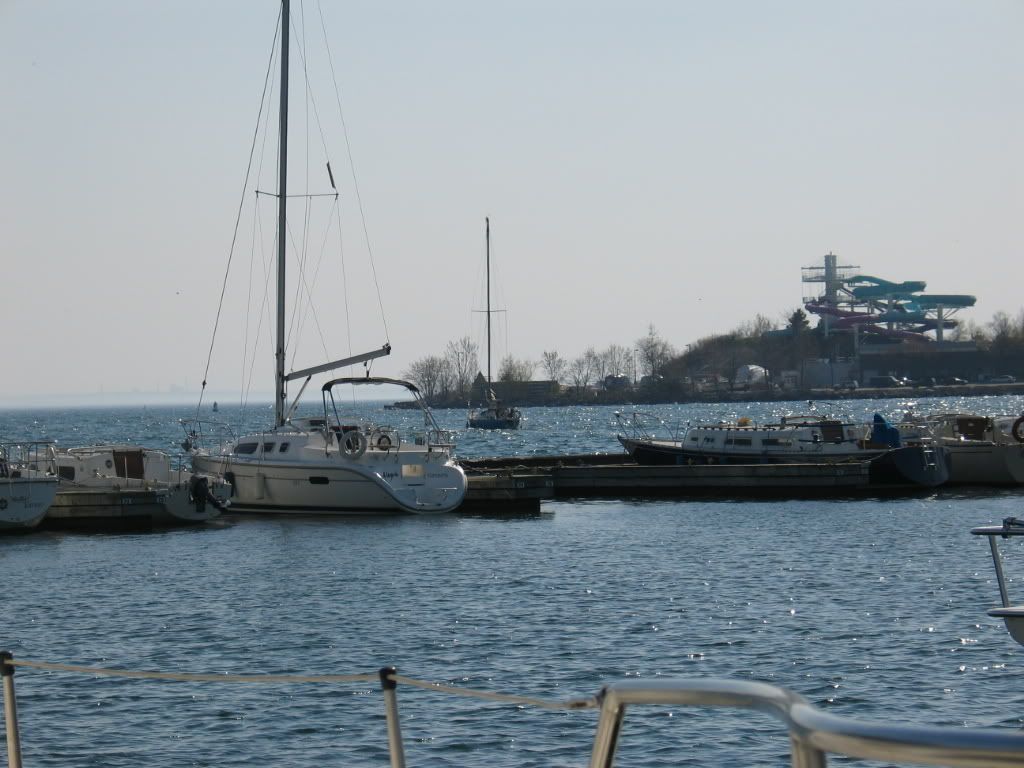 |
| Somewhat misleading, as she will be on a nearby mooring. |
Valiente has been sold.
I got a price for her that was not completely insulting, even though it was a fraction of what I paid 17 years ago, a time when she lacked backing plates, new standing and running rigging, a rebuilt Atomic 4, a new fuel tank and system from fill port to exhaust port, repaired tabbing, repaired coring, mid-ship cleats, improved ground tackle deck gear, a Gori folding prop and a nice, custom SS bow roller.
Such, however, has been the nature of the market and I was not offended. I agreed (as I predicted I would) with the buyer's first offer, and I did so perhaps more rapidly than he had anticipated. Nonetheless, I believe we are both pleased with the outcome. An added bonus is the six or seven sailbags no longer hanging from my garage's joists, and I will prefer the space to the presence of the tarp frame. Further good fortune is that I have sold the boat to a friend within the club who will keep her on a mooring. Despite the fact that this suggests I will be a nearby resource for free advice, I actually like the symmetry of Valiente returning to the club from which she sailed for 25 years before I bought her and will enjoy seeing her comings and goings under new management.
 |
| I'm not sure if the new owner will change her name; new decals are required in any event! |
Speaking of which, I see sub-30 footers in sail-away (if often damp and dirty) condition being offered for free every week. I had over 40 visitors in the last 18 months to my boat, many of who were very well-aware of the Viking 33's strengths and weaknesses. New rigging and a fresh A4 rebuild could not, however, trump the tatty upholstery or the narrow cabin or the tiller steering which, despite some obvious advantages in "helm feel" and mechanical simplicity, is apparently the goose quill pen of sailboat steering: everyone wants to be at the wheel, irrespective of the ergonomic shortcomings of this choice for boats with tight cockpits.
For my own part, I was looking for someone, ideally not too tall, who didn't mind the lack of modern conveniences and appreciated the sailing qualities and my robust and primarily structural improvements. Someone who therefore would be pleased to find a tough, fast boat with many years left in her.
 |
| It will be very nice indeed to launch her again. Part of the deal was in helping the new owner recommission in April. |
2016-11-30
Travelling plans
 |
| Somewhat similar to this, the "old-style non-CB Harken track (supplied until 2002)" |
As mentioned previously, we have a new mainsail, updated nav lights and both a beefy vang and mainsheet. The missing upgrade was the traveller through-bolted to the deck. We had been using the one that came with the boat. an elderly Harken model that had no blocks for traveller control lines, but rather had just a set of spring-loaded pins that could center the car on some part of the track, but not quickly and not easily under load. In fact, although it was cambered nicely to the curve of the deck, I considered it a bit dangerous in anything but light air in terms of finger-crushing potential and the likelihood of forceful boom movement.
 |
| This is the "MT-2" traveller from Garhauer. Beautifully made, and no nonsense. |
Evidently, I knew that I would one day have to tackle this deficient bit of kit, as I ordered from the redoubtable Garhauer firm a beefy traveller way back in 2007. Better late than never, I suppose, and the upside is that the Canadian dollar with which I paid for it was worth about 20 cents more in that year than currently. So I have that, which is nice.
 |
| Some random tools of the "most resorted to" kind. Yes, that's blood on the spanner. I'm not fooling around. |
I got a warm feeling from the Garhauer company almost immediately. Their very plain, "cheap seats" booth at the Toronto Boat Show is usually manned by the company president, who wears suspenders and seems well past retirement age. Their gear is, however, opposite of what a racer would favour: all heavy, mostly metal and easy to service, their blocks and other line-handling gear are all over Alchemy at this stage. Speaking of "service', however, I was most favourably impressed, lo, those many years ago, when the firm's fabricator in small-town California, Guido, phoned me in Toronto from a distant suburb of Los Angeles, where the Garhauer factory sits buried among carpet remnant outlets, donut shops and other single-storey sheds. I guess that's how they save money. Seems to work for them. Anyway, Guido, and I have to stress this, the man who was actually fabricating my traveller that very day, asked me if I wanted 1/4" or 5/16" holes on four-inch centers. Well, I didn't really know, but I figured even then "bigger traveller, beefier fasteners", so I said five-sixteenths would do the trick. Apparently, Guido phones a lot of people when the crumpled carbon paper he's handed by the guy who takes the money at the boat show finally reaches him. Still, all credit to the Americans, who are very good with customer service in a way often lacking in my passive-aggressive homeland.
 |
| Some surface corrosion, but pretty good under the insulation |
 |
| The tape is to keep the deck-side paint from dripping. |
 |
| Mrs. Alchemy, a daub hand with a brush. |
 | |
| She advances, masking |
 |
| Yeah, that crappy box on the binnacle's getting binned. |
 |
| This stuff is amenable to power tools, but take your time. It can melt. |
 |
| "Making a list" has a different, secondary meaning aboard. |
 |
| Prior to final fitting, this is the "starboard bridge". The dots are where the bolt holes go. |
The fabrication, done with table and chop saw, drill press and belt sander, took some time, but worked well.
 |
| From the top. Yes, I had to redrill the end one. Lucky I have so much 4200. |
 |
| The grooves hold beads of sealant. It all helps. |
After careful, if unavoidably messy, application of sealant, I put it all together with Mrs. Alchemy wielding a screwdriver above and me, with nuts, washers and a big socket wrench, below. And two family band radios, and with each bolt numbered, so I could tell her when I was ready to dog down. We are hauled out next to an airport: it can get very noisy.
 |
| Partial success! |
This was an entirely deliberate choice based on ergonomics. Most of the time at sea while on passage, we will be under sail but with either windvane or autopilot engaged with the steering duties. This area is already filled with various sheets and control lines and the traveller is used less often and usually in the context of mainsail tweaking. The exception to this is of course a surprise squall or sudden wind shift which can load up the main and cause uncomfortable or even damaging heeling. In that case, the ends of both the traveller car control lines and the mainsheet itself are "to hand" from the pilothouse; the main can be spilled very quickly, after which the autopilot or vane can be adjusted to the new conditions. The control lines, which are 20 feet a side of 3/8" Dyneema core, can be coiled on the otherwise empty bridgedeck. It's no big deal to operate them from behind the wheel if needed, but reducing deck clutter at that helm is important. I am considering adding a third pair of winches back there so I have a pair for warps, drogues and stern anchor use, another idea that's a blast from the past. More currently, I'm also installing a second throttle/shifter in that area. So it's going to be a busy place!
 |
| Moorings never sleep, and neither does their rust. On duty with "the Committee". |
 |
| Water can slosh underneath the "support posts" and if I get a leak, I'll know fairly quickly from which hole. |
 |
| Starboard side. I think I prefer a straight traveller. It's something to grab. |
 |
| Some careful razor work required to get the excess squish away. |
 |
| Pleased with the result. Now I need to put the mast back. |
Subscribe to:
Posts (Atom)


In terms of rescue technology, safety at sea and tangible benefits such as making one's own power, the sailing is fair, indeed. In terms of the chance that your vessel will be dogged by red tape, corrupt officialdom and crime, kidnapping or piracy, not so much. The high seas may be free, but clearing in and out of countries can still be a bureaucratic nightmare...and may be, in a world growing more hostile, be even harder ranging to impossible.
Although Harries received some pushback from what I perceived were politics-weary Americans, he's got serveral trenchant points when it comes to visiting countries with law-dodging, authoritarian regimes. We are daily seeing how xenophobia and bureaucracy are self-reinforcing tendencies, and that even the properly credentialled can be dealt with arbitrarily and seemingly on a whim when confronted by an overly zealous border guard. Or, one presumes, customs official or port authority functionary. Like the Canadian of evidently insufficient paleness stopped at the U.S. border, we are not Christians, nor would I surrender the contents of my phone to some functionary were I sure it was not required of me by law. Word get around about such places. They are better avoided than debated with, even though I would hope their own citizens challenge the erosion of the rule of law, if they are able to do so.
To fail to consider both the politics and societal factors of a country to which one intends to sail one’s home (and, often, one’s dearest possession) seems to me unseamanlike, unwise and willfully naive.
Unless cruisers intend to go non-stop, the quality of the stops will be largely determined by such issues as the rule of law, the rate of crime/social disruption, and the level of tolerated or institutional corruption.
Realistically, this conclusion increases the need for independence from the shore: energy, food and spares storage and meticulous maintenance gain in importance when one cannot take for granted the civility or safety of every port available. I doubt it will actually shorten our plans for a five-year circ, but it will likely increase the time we spend between longer passages; New Zealand looks good on a number of points in this regard, particularly as a place to haul out for service “mid-circ”. The shortwave radio and occasional internet access will be of great help in speccing out the next area or countries we visit. It’s not all glum news, mind: a sharp reduction in Red Sea piracy has restored the option of “South Africa around the Cape or the Med via the Suez” to our prospects. But we remain watchful. A lot could change by the time we are, say, reading pilots in Galle, Sri Lanka.
We also believe that it is very possible that deteriorating political, economic and climatic conditions will make world cruising in the near future perhaps too difficult for the person of only average affluence to contemplate. Fixing up a boat, selling up and sailing will persist in places like the Caribbean, but we suspect we might be in the last cohort to actually be able to do this at a parsimonious price and as a family. Which means what people like the Smeetons and the Hiscocks pioneered in the 1950s and '60s, when cruising in small yachts was a far less supported pursuit in nearly every respect save for the ease of sourcing tinned butter, may be drawing to a close as a lifestyle, which I find sad, frankly. Bribes we can tolerate to a point, but a country that abandons its own laws will not see out sails on their horizons.