On a message board I frequent, one poster was commenting on the increasing isolation he feels in his small town due to technology, or rather, his failure to participate in the broader culture because he and his family don't watch television. Being not much of a "joiner", I could sympathize, but I don't necessarily buy into the vaguely Luddite sentiments expressed.
It's not so much the tools as the toolmakers, or probably the job site. The creation of post-war suburbia, and the cessation of walking most places, has fostered this sort of isolation. I live in the middle of a large city, and I don't own a car. I have a TV, but it has "rabbit ears" (I used to be a TV critic, so I do know what I'm missing, if missing is the right word). I have purposely limited the normative exposure to certain technologies (car, cable TV) in favour of different choices. While this was once driven by sheer financial strictures, now it's primarily a straight-ahead decision not to participate in "car" or "TV" culture.
These decisions can easily lead to both social isolation and smug bastardry, I will freely admit. I bicycle or walk or take the streetcar (trolley to some) that stops outside of my house. I work alone from home, so I try to chat with people if only to get out of my own head occasionally. In fact, my wife calls me one of the friendlier misanthropes she's ever met, not that one gets to meet many misanthropes, I suppose. But I like people one-on-one, but I tend to want to avoid "humanity", particularly the band leaders in the parade of stupidity, ignorance and factionalism that constitutes a lot of what we laughingly call public life in North America.
But it's an effort for me, although I doubt that would be obvious if you met me in person. And I think it's an effort for a lot of people, because (and this may seem a strange observation) of the decline of formality in social interaction in the last 100 years. I'm all for a blurring of the social distinctions that used to see poor people "tipping the hat" to their "social betters", but these days everyone is on a first-name basis and one is expected to immediately go to an informal mode of speech and to pretend that strangers are in fact dear old friends. The use of "Mr." and "Mrs./Ms." to refer to business acquaintances, one's childrens' teachers, service people and social contacts is nearly extinct, except with health professionals and in law courts, and I think this paradoxically isolates people by forcing an artificial intimacy at times.
I would argue that technology, on the other hand, when actively and creatively used, is a great tool for communication. I have, for instance, filed copy to magazines and newspapers for nearly 20 years now, and done so from home since 1990. It's been a very productive choice for me to work from home, because working in an office can be a bit of a waste of time. Frequently, I find time at the oddest spots in the day (I am writing this at 0600 hours on a Saturday morning), and am able to knock off in two hours the work that would take me a full day in a noisy office. And if we factor in the cars I haven't bought, and the gas I didn't burn running them, I feel better about the occasional motorsail with the 50 HP diesel!
I used to be a letter-writer, as in pen to paper. Now I use e-mail and I've started this blog to keep track of my progress on getting our boat ready for long-term cruising. While it may serve only as a warning to others, the fact is that I've read so much useful information online from other cruisers, either preparing to go, underway, or recalling their adventures, that I felt obliged to "give back a bit". Also, the proper use of communications technology will allow me immense latitude while on board to receive helpful information, such as GRIB weather files, chartplotting information, e-mails, educational materials or "distance learning" for my child, and to stay in touch with my rather modest family "back home". It will also facilitate making a living while underway, as well as the usual financial transactions that are hard to imagine doing via stamps and paper these days.
I would say, therefore, that the technology is not at fault so much as our inability to edit the gush of information those technologies bring. Choosing active (like message boards, web pages and e-mail) over passive forms (TV, movies) helps, as does a willingness to "turn things off" and an ongoing engagement with the natural world around one. As another poster pointed out, achieving a balance is the goal, and although this balance point will vary from person to person, it's pretty clear when it's been reached.


2007-05-16
"The Loaner"
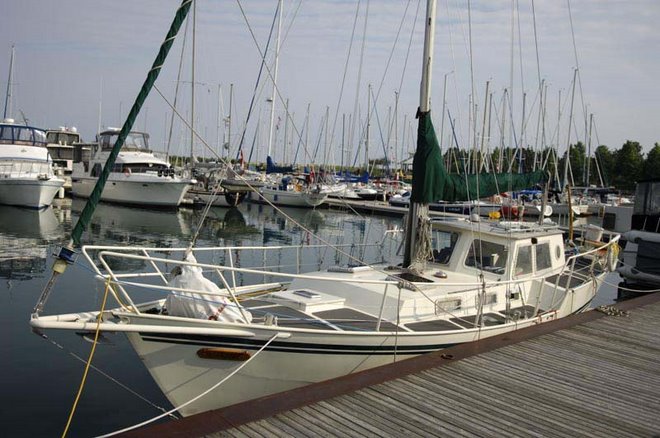
Here is the dilemma (and I am painfully aware that my dilemma of "one too many sailboats" is absurdly trivial): I have, with my wife, a new sailboat. See below. If it is not destroyed and our health, will and money hold out, we want to go to sea as a cruising family.
Nice, eh?
I had a boat already, a boat suited not for cruising the South Pacific independent of marinas and fuel pumps for weeks at a time, but a classic plastic racer. Think "MG ragtop" versus "Land Rover equipped for safari". This boat I had bought myself, and largely repaired myself, and certainly sailed alone a fair bit. And, sentimentality aside, it was and remains a near-perfect boat for the sort of short-haul cruising and daysailing I have tended to do on Lake Ontario. The new boat has attributes of a different, more oceanic kind: it needs more than 10 knots to get going, and points less well even as it goes downwind rather better.
So I thought: "Well, the sensible thing would be to sell it. You can get a nice radar and a pair of those purple Crocs for the new boat."
But when has owning a boat been about the sensible thing?
So I thought further, and realized that if planning for a five-year circumnavigation represents the victory of hope over experience, I might as well emulate the late Chairman Mao and harvest crops not yet budded. I decided to keep the old boat, but to give it away.
Quite the head-scratcher, isn't it?
Here's the plan: I find a person willing to take on the running and storage costs of the boat (club fees, dockage, insurance, winter storage and its maintenance chores), and sell the boat to him for an agreed price. Then I don't take his money. Instead, I become a lien holder for the entire amount, and for a fixed term (until my projected return). He becomes the go-to guy for insurance and fees, and in return gets the use of a boat he can race cheaply. At the end of the term, I can reclaim the boat, sell it to him for the previously agreed price, or if he doesn't want it, sell it on the open market and give him a commission of that price.
This allows me to maintain a real hold on a boat that I am essentially loaning without the difficulties of being called back from the ends of the earth if a crane drops it on someone's head, which would be the case if I were a co-owner, and not a lien holder. As a lien holder, if an insurance claim is made, the cheque goes to me. On the other hand, if the fellow who's borrowing the boat tires of it or want to bail on the deal, I can simply take it back or attempt to replicate the deal elsewhere. It's "please drive my car while I'm away" writ large, or a type of lease of the "no money down" variant.
The fellow in question is a decent sailor who already owes an eight meter race boat, and who also happens to be our general contractor. I have no fear that he'll maintain the boat. I also intend to maintain it myself (protecting my interest, so to speak) in the two years until we go. I also intend to keep sailing her on occasion, just so I remember how to work a tiller now that I've got two hydraulic wheels with which to play. There goes Valiente now, the wee boat in the distance...off to a new berth three miles west. Mixed feelings, yes, but relief also that keeping two very different boats won't play havoc with our finances and divide quite so radically my boat-altering attentions.

My hope is to eventually get Valiente back in 2014 or so, and to sell Alchemy in Europe as a "proven design". My fellow cruisers think I'm delusional, anticipating that I will ever go from a comfortable pilothouse cruiser back to a cramped and frankly Spartan racer that will be over 40 years old. Perhaps my fellow cruisers are right. I spent several years getting Valiente the way I like her, however, and I feel she's an ideal boat for the kind of sailing we do around here. So this is a blatant attempt to have it both ways, I suppose, and hinges on an improbable set of circumstances.
In this way, it's quite like the idea of encompassing the world.
Nice, eh?
I had a boat already, a boat suited not for cruising the South Pacific independent of marinas and fuel pumps for weeks at a time, but a classic plastic racer. Think "MG ragtop" versus "Land Rover equipped for safari". This boat I had bought myself, and largely repaired myself, and certainly sailed alone a fair bit. And, sentimentality aside, it was and remains a near-perfect boat for the sort of short-haul cruising and daysailing I have tended to do on Lake Ontario. The new boat has attributes of a different, more oceanic kind: it needs more than 10 knots to get going, and points less well even as it goes downwind rather better.
So I thought: "Well, the sensible thing would be to sell it. You can get a nice radar and a pair of those purple Crocs for the new boat."
But when has owning a boat been about the sensible thing?
So I thought further, and realized that if planning for a five-year circumnavigation represents the victory of hope over experience, I might as well emulate the late Chairman Mao and harvest crops not yet budded. I decided to keep the old boat, but to give it away.
Quite the head-scratcher, isn't it?
Here's the plan: I find a person willing to take on the running and storage costs of the boat (club fees, dockage, insurance, winter storage and its maintenance chores), and sell the boat to him for an agreed price. Then I don't take his money. Instead, I become a lien holder for the entire amount, and for a fixed term (until my projected return). He becomes the go-to guy for insurance and fees, and in return gets the use of a boat he can race cheaply. At the end of the term, I can reclaim the boat, sell it to him for the previously agreed price, or if he doesn't want it, sell it on the open market and give him a commission of that price.
This allows me to maintain a real hold on a boat that I am essentially loaning without the difficulties of being called back from the ends of the earth if a crane drops it on someone's head, which would be the case if I were a co-owner, and not a lien holder. As a lien holder, if an insurance claim is made, the cheque goes to me. On the other hand, if the fellow who's borrowing the boat tires of it or want to bail on the deal, I can simply take it back or attempt to replicate the deal elsewhere. It's "please drive my car while I'm away" writ large, or a type of lease of the "no money down" variant.
The fellow in question is a decent sailor who already owes an eight meter race boat, and who also happens to be our general contractor. I have no fear that he'll maintain the boat. I also intend to maintain it myself (protecting my interest, so to speak) in the two years until we go. I also intend to keep sailing her on occasion, just so I remember how to work a tiller now that I've got two hydraulic wheels with which to play. There goes Valiente now, the wee boat in the distance...off to a new berth three miles west. Mixed feelings, yes, but relief also that keeping two very different boats won't play havoc with our finances and divide quite so radically my boat-altering attentions.
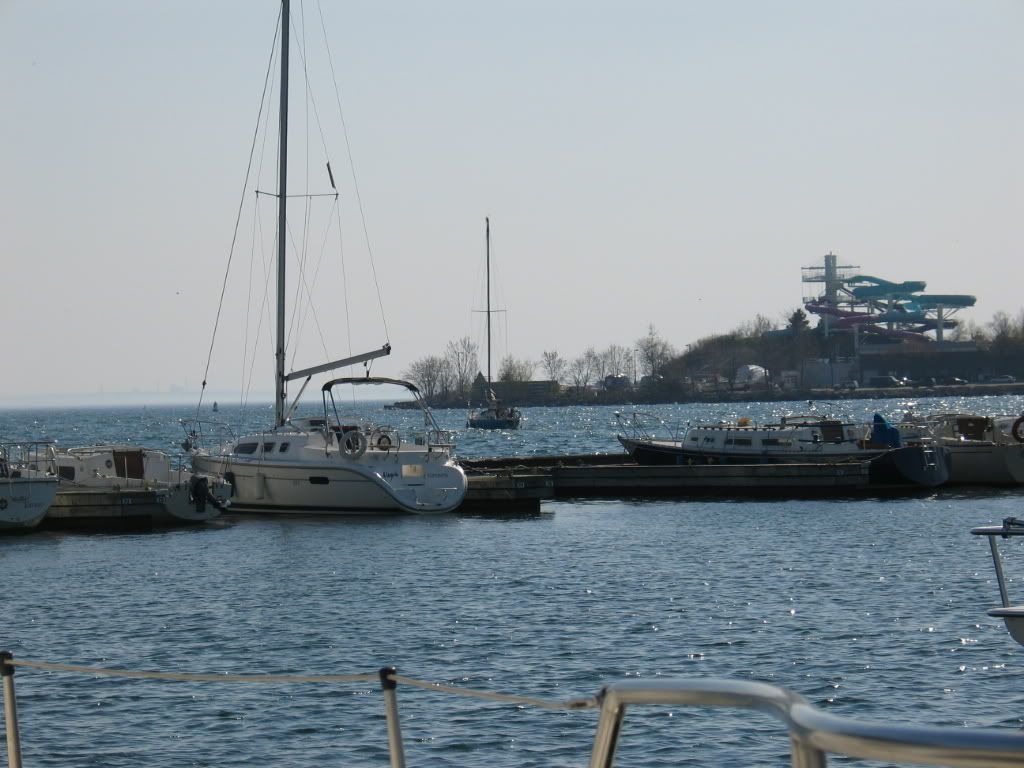
My hope is to eventually get Valiente back in 2014 or so, and to sell Alchemy in Europe as a "proven design". My fellow cruisers think I'm delusional, anticipating that I will ever go from a comfortable pilothouse cruiser back to a cramped and frankly Spartan racer that will be over 40 years old. Perhaps my fellow cruisers are right. I spent several years getting Valiente the way I like her, however, and I feel she's an ideal boat for the kind of sailing we do around here. So this is a blatant attempt to have it both ways, I suppose, and hinges on an improbable set of circumstances.
In this way, it's quite like the idea of encompassing the world.
2007-05-14
The old girl
While both myself and my wife need to acquire salt-water sea time before we depart (as crew, probably on deliveries...more on that later), we aren't entirely new to the sailing game.
After adventures in the dot.com world of the late '90s, I unexpectedly fell prey to a management change and lost my job. This wasn't the tragedy it might have been, as I also had a pretty decent freelance designer and writing business on which to fall back. And the compensation, or "go away and shut up" money was generous, so much so that instead of doing the sensible thing of someone rounding middle age might do, such as buying a mini-van or paying 9.2% of the remaining mortgage, I bought an old sailboat.

This is Valiente, a 1973 Viking 33 cruiser-racer built by Ontario Yachts. I bought her with my "compensation" on August 31, 1999. The next day, we learned of the death of Doreen Valiente, a British author my wife and I admired. Add to that the fact that Valiente is Spanish for "brave" and also is easily understood over the radio, and the choice of name was easy.
This boat, while a year older than the missus, is quite fast and is strongly built. I've had her out in 40 knots of wind, and we've cruised Lake Ontario in October in 25-32 knots of steady breeze with a four-year-old on board, so we've had some experience.
I had, purely due to my own mechanical ignorance, some engine problems that led to replacement of Valiente's "Atomic 4" gas engine in 2005. I eventually figured out that the exhaust system, and not the engine, was at fault, and replaced that as well. I also hit on the idea of "recycling" modern sails from racers, who will frequently find minor flaws in a sail used to race that won't bother the economy minded cruiser.
So by 2005, I had an old boat with a rebuilt engine, refreshed sails, a new fuel tank, new exhaust system, new batteries and several modifications only of interest to the obsessive-compulsive sailor.
So naturally, we got Alchemy and the process began all over again, although with the new boat (1988), there is much less to redo and undo than on the old.
Still, the fact remains: I own two boats, and yet am not twins. More on how I'm trying to resolve this embarrassment of nautical riches in the next post.
After adventures in the dot.com world of the late '90s, I unexpectedly fell prey to a management change and lost my job. This wasn't the tragedy it might have been, as I also had a pretty decent freelance designer and writing business on which to fall back. And the compensation, or "go away and shut up" money was generous, so much so that instead of doing the sensible thing of someone rounding middle age might do, such as buying a mini-van or paying 9.2% of the remaining mortgage, I bought an old sailboat.
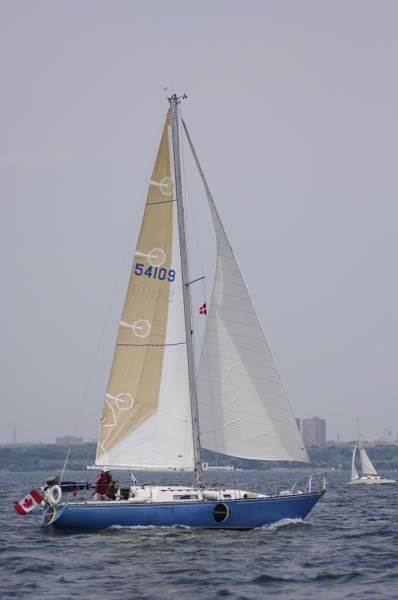
This is Valiente, a 1973 Viking 33 cruiser-racer built by Ontario Yachts. I bought her with my "compensation" on August 31, 1999. The next day, we learned of the death of Doreen Valiente, a British author my wife and I admired. Add to that the fact that Valiente is Spanish for "brave" and also is easily understood over the radio, and the choice of name was easy.
This boat, while a year older than the missus, is quite fast and is strongly built. I've had her out in 40 knots of wind, and we've cruised Lake Ontario in October in 25-32 knots of steady breeze with a four-year-old on board, so we've had some experience.
I had, purely due to my own mechanical ignorance, some engine problems that led to replacement of Valiente's "Atomic 4" gas engine in 2005. I eventually figured out that the exhaust system, and not the engine, was at fault, and replaced that as well. I also hit on the idea of "recycling" modern sails from racers, who will frequently find minor flaws in a sail used to race that won't bother the economy minded cruiser.
So by 2005, I had an old boat with a rebuilt engine, refreshed sails, a new fuel tank, new exhaust system, new batteries and several modifications only of interest to the obsessive-compulsive sailor.
So naturally, we got Alchemy and the process began all over again, although with the new boat (1988), there is much less to redo and undo than on the old.
Still, the fact remains: I own two boats, and yet am not twins. More on how I'm trying to resolve this embarrassment of nautical riches in the next post.
2007-05-08
It's not a great day when...
...you slave over your boat all winter and the "B-team" at the marina decides to test the laws of gravity using 15 tonnes of steel cruiser.
And it started out so calmly:

It appears that the trailer guys...who did a great job in the fall...are now DIFFERENT, LESS EXPERIENCED trailer guys who take turns a little wide. I would suggest boat owners never do this. It makes a bad, bad, heart-crunching sound when a loaded cradle falls off a trailer and toes six inches into the road.


You can just make out the touchdown point here:

Eventually, after removing the forestay and about two hours of deep thought and dancing with melonoma, the TraveLift is made to do its thing.
...which it can only do by lifting the cradle with the boat...

Amazingly, no actual boats were harmed in the performance of this stunt (although, my cradle got a bath). After checking for leaks and for engine/shaft misalignments, we proceeded four hours late to our home club.

And now, if you will excuse me, I am going to have a jumbo-sized Dark and Stormy. My nerves are shot.
And it started out so calmly:
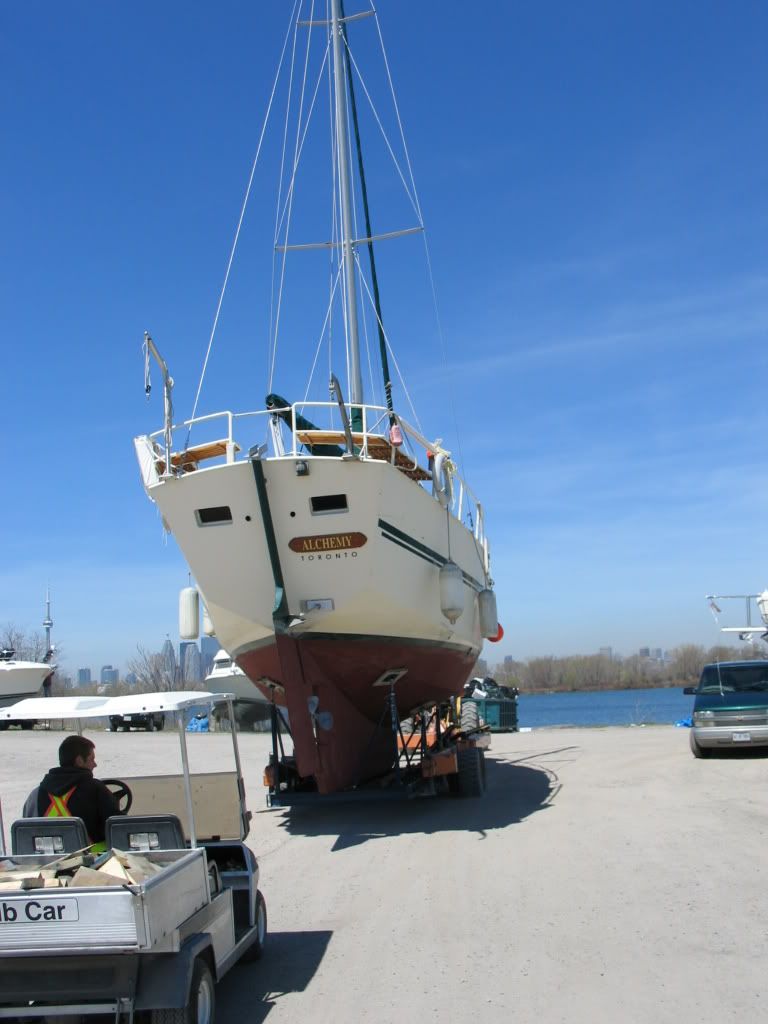
It appears that the trailer guys...who did a great job in the fall...are now DIFFERENT, LESS EXPERIENCED trailer guys who take turns a little wide. I would suggest boat owners never do this. It makes a bad, bad, heart-crunching sound when a loaded cradle falls off a trailer and toes six inches into the road.
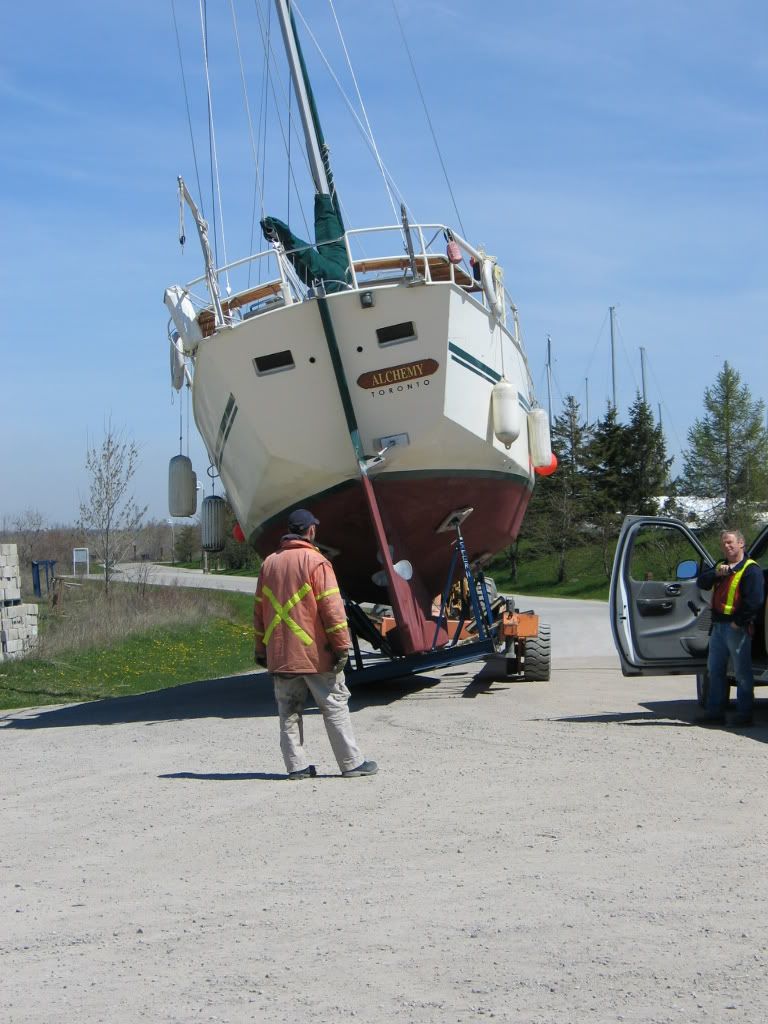
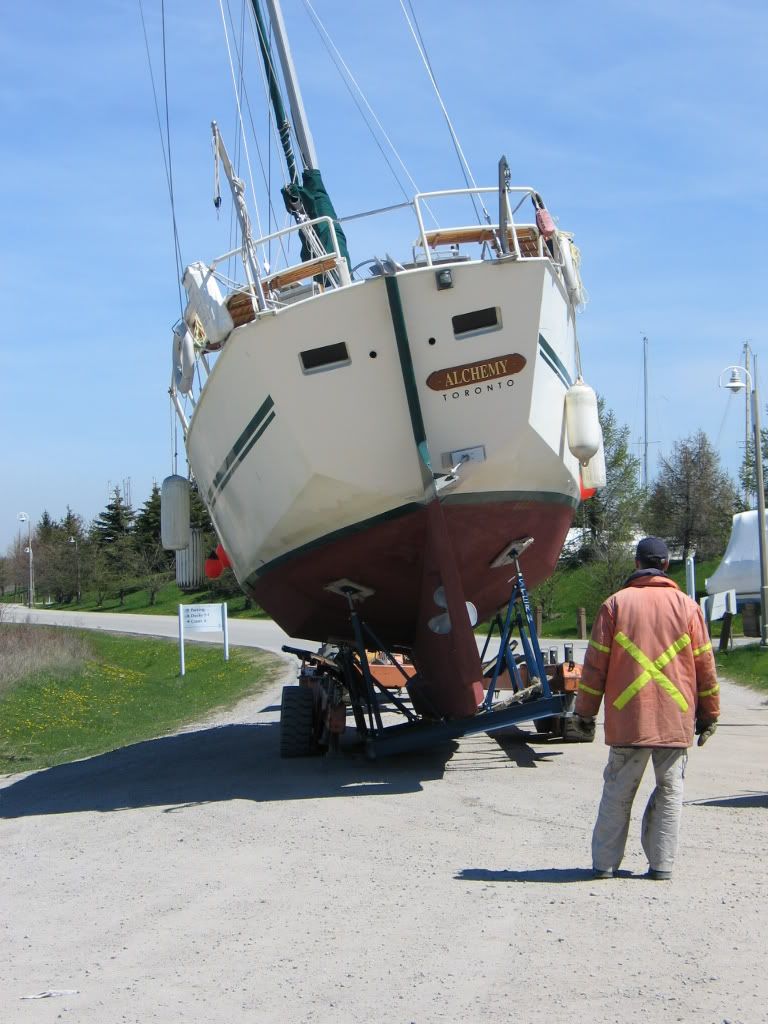
You can just make out the touchdown point here:
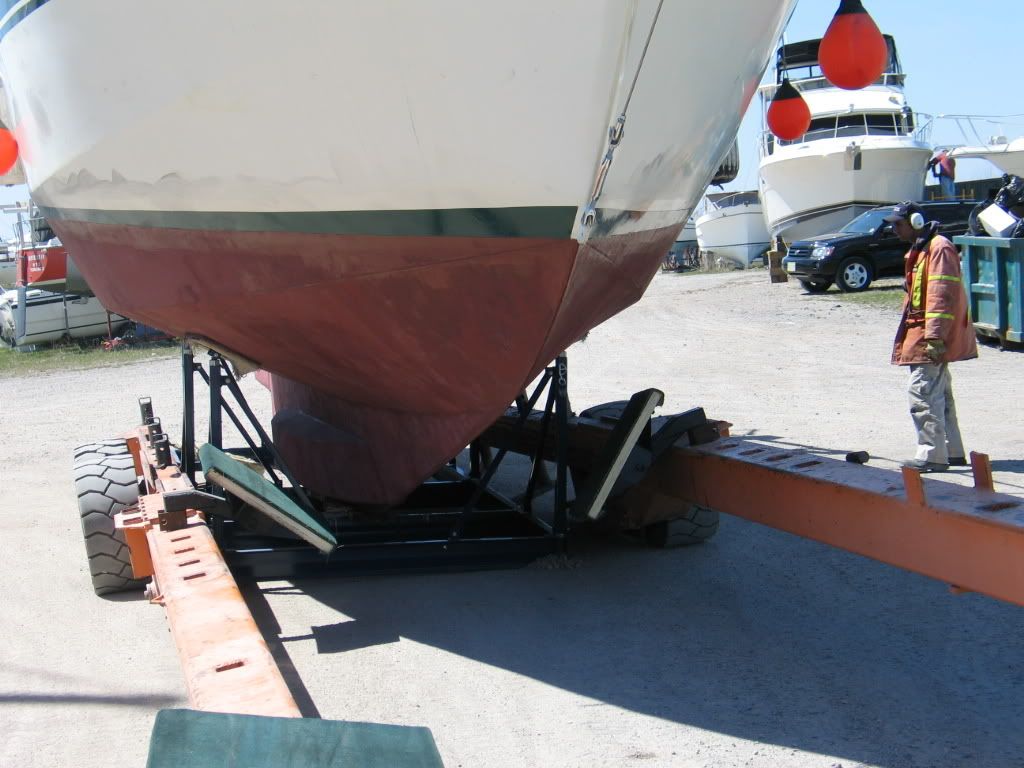
Eventually, after removing the forestay and about two hours of deep thought and dancing with melonoma, the TraveLift is made to do its thing.
...which it can only do by lifting the cradle with the boat...
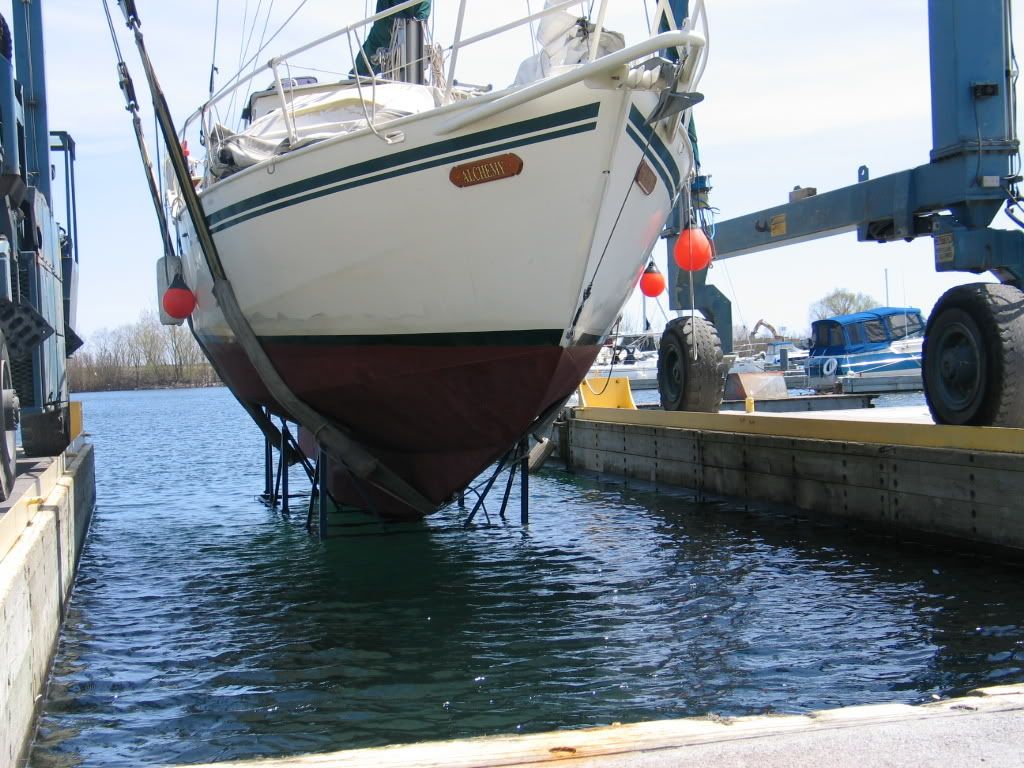
Amazingly, no actual boats were harmed in the performance of this stunt (although, my cradle got a bath). After checking for leaks and for engine/shaft misalignments, we proceeded four hours late to our home club.
And now, if you will excuse me, I am going to have a jumbo-sized Dark and Stormy. My nerves are shot.
2007-04-27
How to spend a boatload of money
A mere portion of what I decided was necessary to purchase this winter for future installation on the vessel. As previously mentioned, while there is plenty to do (and to buy, evidently), there is not a great deal to undo, as the boat simply lacks some things to make it more than a really overbuilt lake cruiser.

1) Xantrex RS2000 inverter/charger. This is sized to handle the output of any combination of solar panels, wind generator and Honda 2000 genset I might decide to employ to charge a prospective three 8D size AGM battery banks.

2) Lofrans Tigre windlass: This will go in the anchor well on a steel mount, and has both enough pulling power and the manual option to handle all our current ground tackle. It will be powered by a separately charged flooded cel battery I am going to install forward, not only for the shortest possible run of wire, but because I like the idea of recycling the "nearly new" current house banks, and a flooded cell of sufficient capacity for a windlass would make a good start battery should the AGM system back in the engine room fail.

3) The third photo shows the anchor well wherein goes the windlass. I am leaning away from my original (and more common) plan of cutting a hawse pipe into the forepeak so I can stow chain below. I like the idea (and it's a drier one) of simply flaking the chain into the well, which makes it easier to see and to clean. I am debating putting some sort of clamshell doors here to give me a place to stand that isn't on the chain in fair weather. In foul weather, the anchor well increases safety when working forward on either of the forestays.

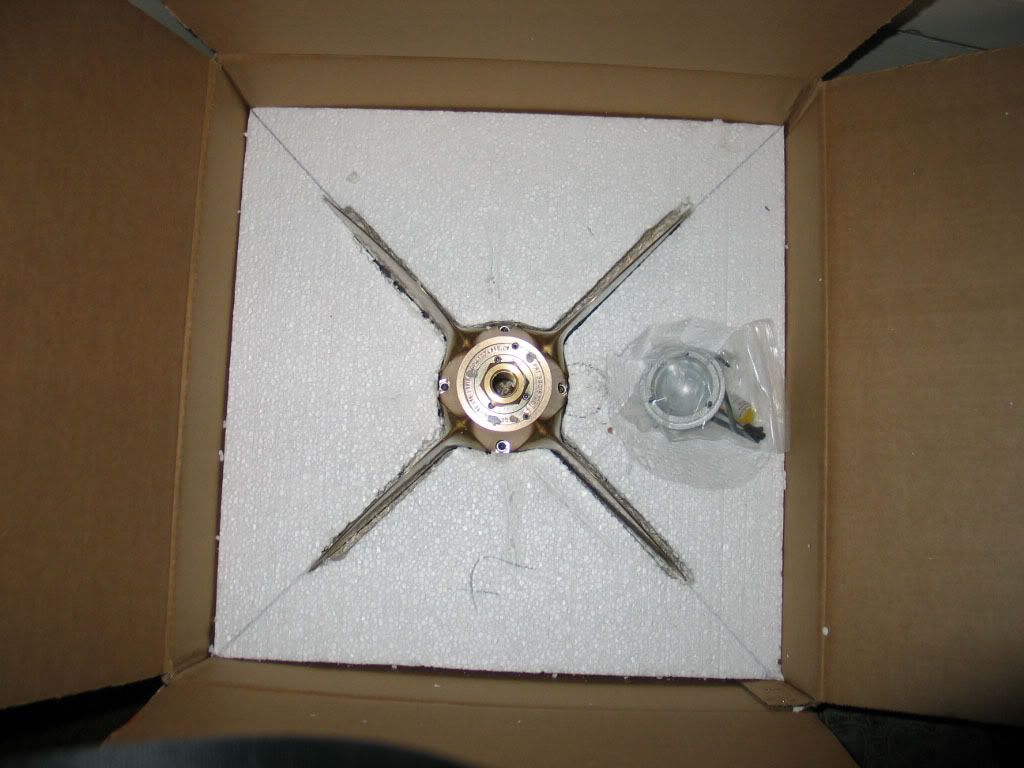
4) This is the new prop feathered, a VariProp D-107 19 x 15 feathering model. I won't even tell you how expensive it was, other than to allude to the fact that friends with steel boats and AutoProps (more on them later) swear by them for low-speed control of the boat, optimal engine performance, and the gaining of precious knots under sail (when feathered, the drag is minimal, gaining in particular boat speed in light air...a sore point in a metal full keeler loaded with provisions!). I also chose the VariProp because you can change the pitch in the water without dissembly, and you can select differing pitches for forward and reverse gears, allowing maximum stopping power, if desired. Having seen boats similar to Alchemy get docked with the sort of precision seen with minivans snagging narrow mall parking slots, I was persuaded...

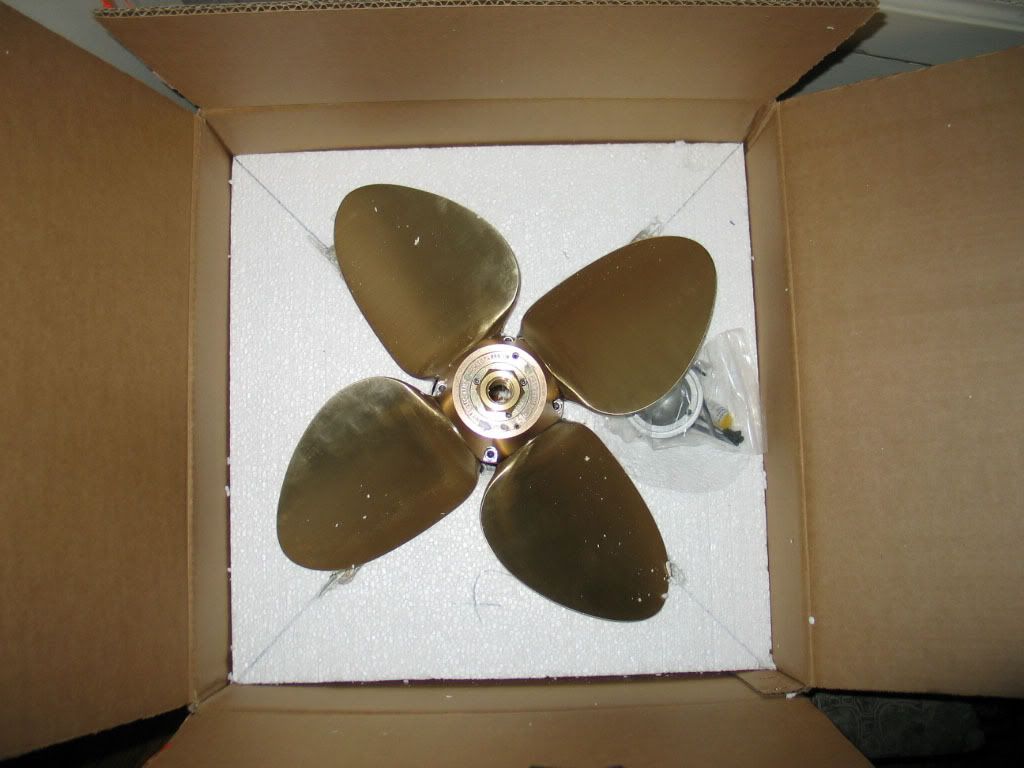
5) Same prop in all its glory. My mind rejoices, but my wallet aches.
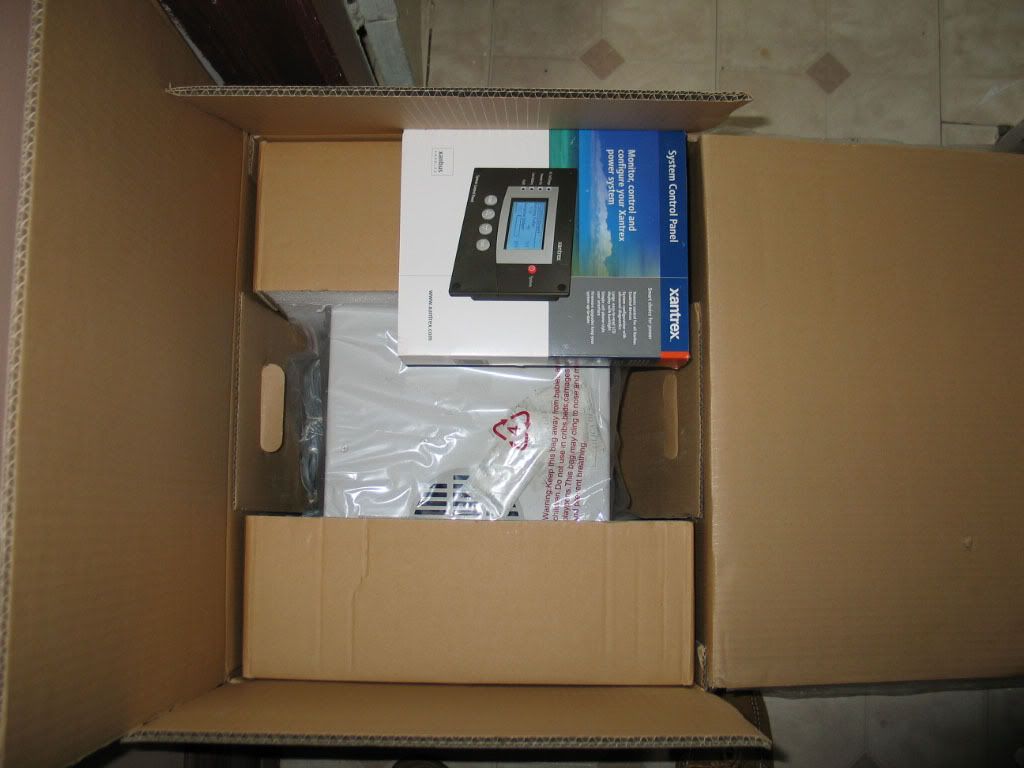
1) Xantrex RS2000 inverter/charger. This is sized to handle the output of any combination of solar panels, wind generator and Honda 2000 genset I might decide to employ to charge a prospective three 8D size AGM battery banks.
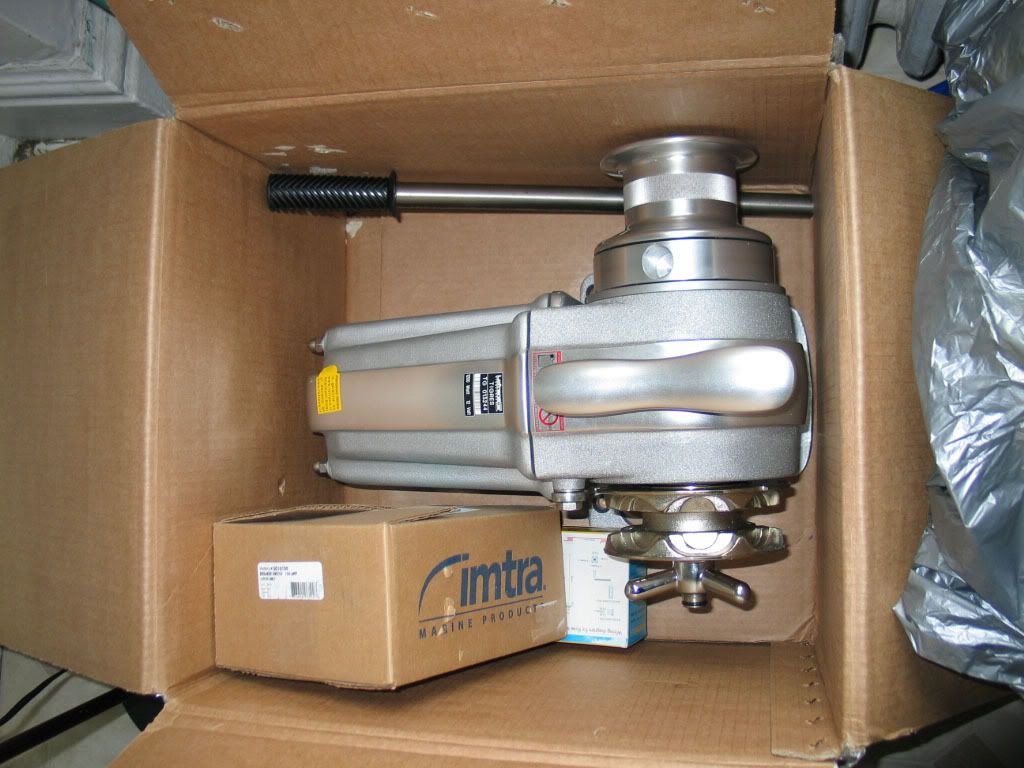
2) Lofrans Tigre windlass: This will go in the anchor well on a steel mount, and has both enough pulling power and the manual option to handle all our current ground tackle. It will be powered by a separately charged flooded cel battery I am going to install forward, not only for the shortest possible run of wire, but because I like the idea of recycling the "nearly new" current house banks, and a flooded cell of sufficient capacity for a windlass would make a good start battery should the AGM system back in the engine room fail.
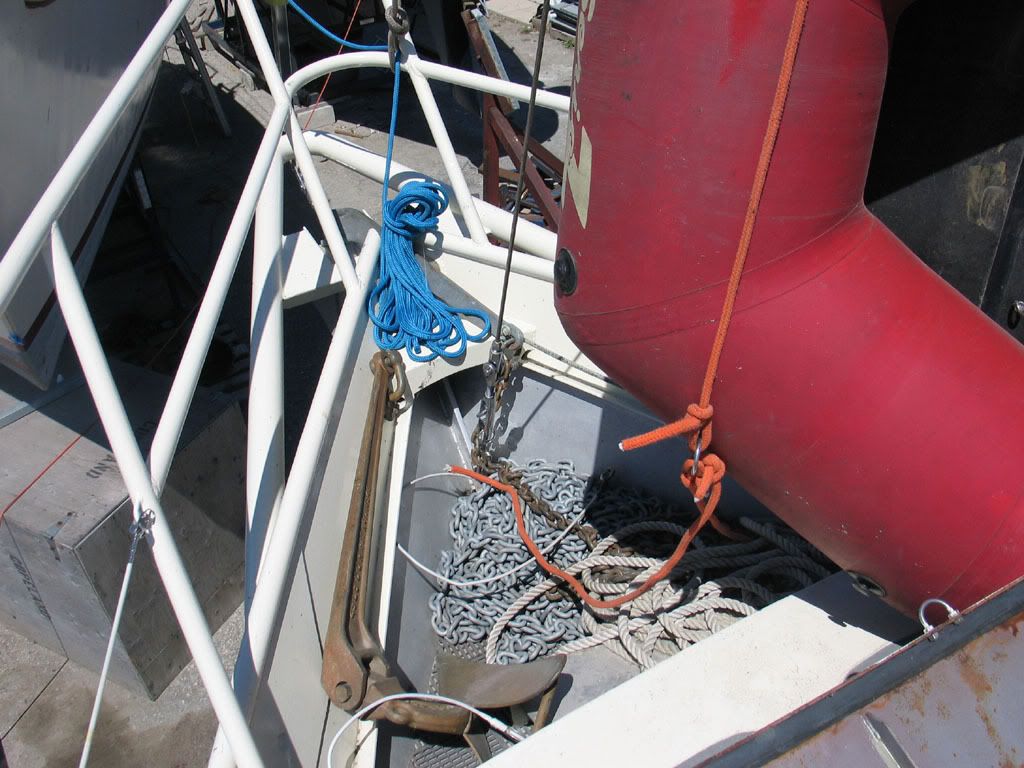
3) The third photo shows the anchor well wherein goes the windlass. I am leaning away from my original (and more common) plan of cutting a hawse pipe into the forepeak so I can stow chain below. I like the idea (and it's a drier one) of simply flaking the chain into the well, which makes it easier to see and to clean. I am debating putting some sort of clamshell doors here to give me a place to stand that isn't on the chain in fair weather. In foul weather, the anchor well increases safety when working forward on either of the forestays.
4) This is the new prop feathered, a VariProp D-107 19 x 15 feathering model. I won't even tell you how expensive it was, other than to allude to the fact that friends with steel boats and AutoProps (more on them later) swear by them for low-speed control of the boat, optimal engine performance, and the gaining of precious knots under sail (when feathered, the drag is minimal, gaining in particular boat speed in light air...a sore point in a metal full keeler loaded with provisions!). I also chose the VariProp because you can change the pitch in the water without dissembly, and you can select differing pitches for forward and reverse gears, allowing maximum stopping power, if desired. Having seen boats similar to Alchemy get docked with the sort of precision seen with minivans snagging narrow mall parking slots, I was persuaded...
5) Same prop in all its glory. My mind rejoices, but my wallet aches.
Rust never sleeps on a steel boat, part 2
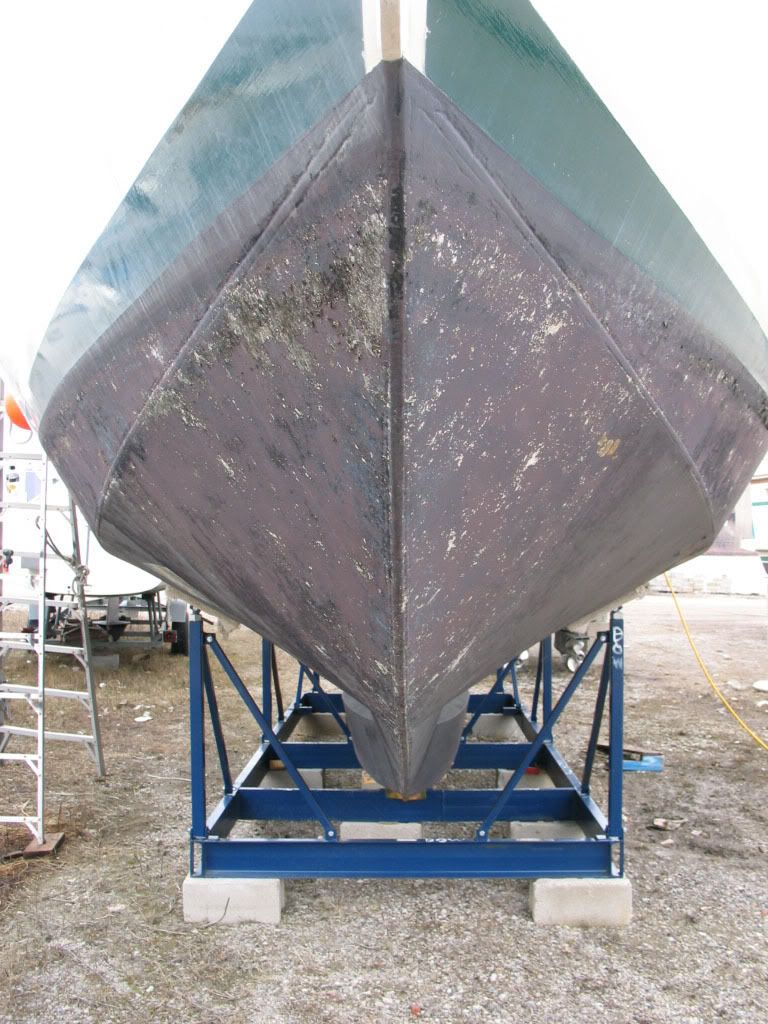
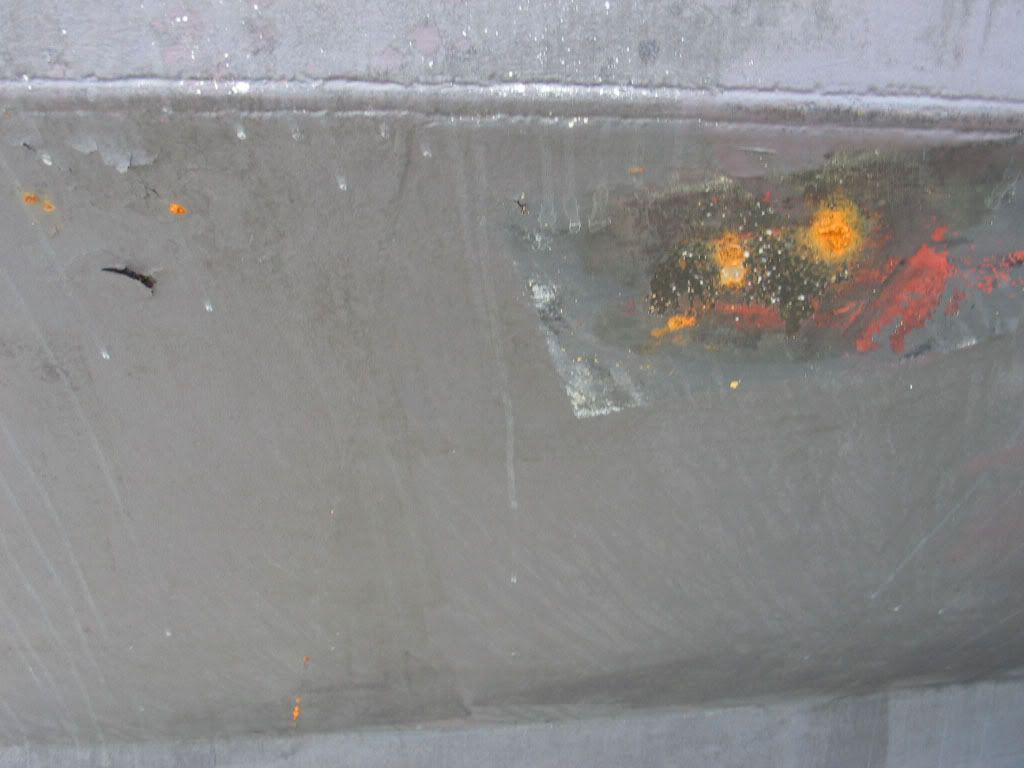
We launch Alchemy May 7, and there's some stuff yet to do to the hull. Some "rust bubbles" have appeared where the barrier coat seems to have failed. While I intend to have the entire hull laid bare and fresh primer and barrier coat put on before we go, there's no reason not to fix these particular spots now with a grinder, a "flapper disk" sanding wheel, and some rust-binding primer.
We will be using this stuff on the recommendation of the previous owner and others:
http://www.petitprod.com/catalog_browse.asp?ictNbr=95 (you can download the PDF if interested). Three tacky coats of that later, we'll apply Pettit Premium ablative anti-foul...it's only good for a season but suits Lake Ontario until we redo the bottom entirely and switch to a "hard" antifouling for tropical waters.
I'm actually looking forward to this job as it's been difficult to do much on the boat over the winter due to the distance (by bicycle at least) to the storage yard, my work load, and the fact that the weather has been fine when I've been working and awful when I've been free.
2007-04-14
Why the Business of Sailing is Unlike Others

I was down at my boat a couple of weeks ago in one of the fleeting moments of neither winter nor spring that has left the local climate and boat maintenance jobs in a bit of a holding pattern. I was there to measure the boltholes in my old and troublesome Harken traveller. There's nothing wrong with it, really, aside from an awkward, peg-style design (see photo), which I dislike and is why it's getting replaced by the estimable people at Garhauer with a continuous block and tackle, "variable" traveller set-up. I may recycle the track as a pole lift for the front of the mast, which is currently so free of penetrations as to be considered virginal.
Garhauer is a relatively small company that makes very good and comparatively cheap blocks and tracks and other deck gear using the oddest business model I have yet to see. And if standing on a cradled boat with a tape measure in a late winter Toronto half-gale isn't romantic, I don't know what is.
Anyway, I had ordered a new traveller in January at the boat show from an elderly, mumbling gent with no signage over his meager booth aside from a tiny piece of card with the word "Garhauer" on it. This was loosely lashed over a church basement type of folding table covered in shiny blocks and beckets and complicated, spinny things that make sailors go "ooh". And the prices are half that of the "big names". So this old fella is Bill, the president of the company, and he takes my order on a carbon copy form of the type I last saw in the '70s. I suspect there was a wee tray into which the scrawled orders were stowed until the exodus for California was over.
Six weeks later, I get a call from Guido, the man who will actually fabricate the traveller. He says, in an accent that is more Milan than New Jersey: "You have four-inch centers on a six-foot track listed...but how far in should the first bolt hole be?" "I dunno...good question", I reply, hence the bicycle trip some miles away to the dank and muddy marina.
I phone back to California and ask for Guido, who is busy polishing something large. Eventually, I give him the required information. He *then* says: "So, do you want quarter-inch bolt holes or 5/16ths?"
Jesus feck, I'm not going back again until Monday. "Make it 5/16ths", I say, "Bigger is better and as I can drill a bigger hole if needed, I can't go wrong with 5/16ths. We are intending to go offshore..." Guido seems on his game. It's certainly the personal touch, all this carbon paper and Guido-quizzing. And I suppose it's why I keep buying their gear. Hence the provisional endorsement (I haven't seen the traveller yet!): www.garhauer.com
2007-04-08
Navigational musings, or "spot the sailor"

A clever, prudent navigator of the old school recently posted on a sailing forum that "generally, it is assumed a given that ships do not go down in benign conditions". To which I replied that "Greek cruise ships in broad daylight in flat seas mowing down reef-mounted fixed nav aids excepted, I guess". Excuses? While it's easy to play at Armchair Admiralty, this sounds weak even to a freshwater sailor: http://edition.cnn.com/2007/WORLD/europe/04/08/greece.cruiseship/
The difference between a navigator and a navigational aid is profound and vast, and I suspect that sometimes our reliance on admittedly wonderful and convenient technology causes us to fail to "internalize" what might be described as a "positional sense" (where am I? how far am I from other objects? how long will it take to get from here to there?) that is critical for real-life navigation. Coastal pilotage, celestial, DR plots, LOPs and just looking out the damned window occasionally engage us physically with our surroundings, whereas an over-commitment to graphical displays with no reference to the vast hull filled with machinery and passengers below us can divorce us from such useful instincts.
Boats can be made safer and navigational aids are now many and in the main, accurate (until the power goes out). But can skippers be made smarter? The test cases are sometimes discouraging.
2007-03-31
Rust never sleeps on a steel boat
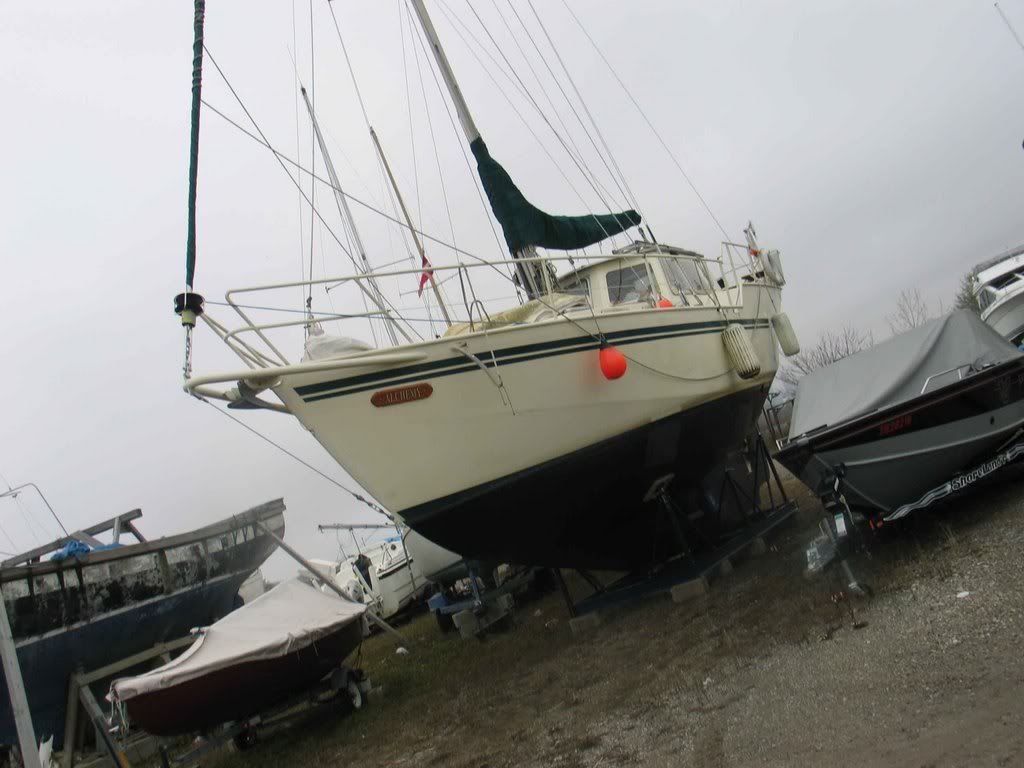
...but I knew that going in, didn't I? Although this shot was taken in November, 2006, the boat looks about the same now that winter is largely past, save for the sub-zero nights. Launch is May 7th, which means we have about five weeks to tend to certain jobs that fall under the heading of "periodical maintenance". A steel boat is a wonderful thing, and is more dynamic that you might expect something so seemingly inert to be. Part of that dynamism is expressed via corrosion: steel boats want to rust, and the only way to fight the rust is to attack it directly via grinding and removal, chemically via special primer paints and epoxy barrier coats, and protectively via bottom paints that act as much to protect the barrier coat as much as to keep the boat from being an increasingly sluggish mobile home for barnacles, weed and terribly misguided remoras.
There are small, orange rust bubbles on certain spots on the hull. My friend and in a way my sailing mentor Capt. Matt, who also has a steel boat and a usually well-informed opinion on such matters, is suggesting that it's a "gas bubble" caused by a chemical reaction of the zinc-based galvanizing of the bare steel. The solution is to grind the coatings off, to reprime and to recoat with epoxy, essentially sealing the surface in a sort of plastic coating. You lay the barnacle-discouraging paint atop this epoxy coat.
I had planned to repaint the anti-fouling this year anyway, but now is as good a time as any to get on with what will be the price one pays with a steel boat: keeping on top of the rust.
Suggestions and techniques and secret recipes are welcome. I probably won't get at it for another week or so until the daytime temperature favour the "kicking" of the barrier coat.
2007-03-22
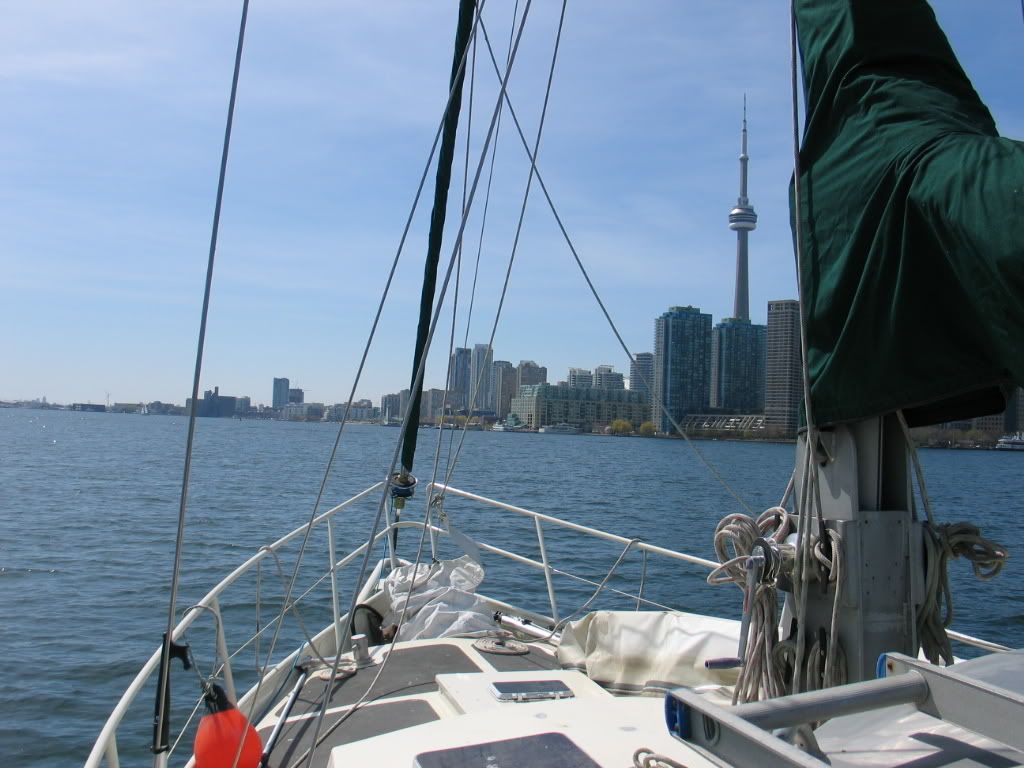
View from the Sailing Helm, July 2006

A day of dubious wind and my first solo sail in Alchemy. I was very much still "checking things out" and so kept the main sheathed for a very basic motorsail.
2007-03-21
Lost and Found at Sea...or at least Lake.
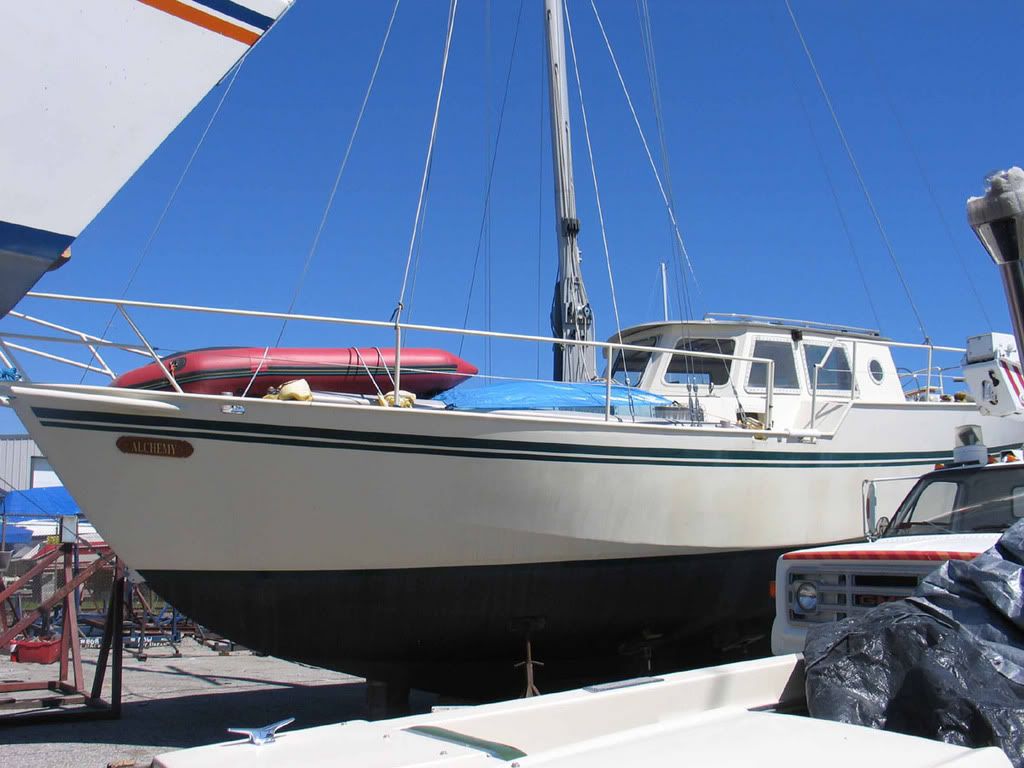
I said I wouldn't succumb to the temptation of starting a blog, because the potential for self-indulgent wankery and time-wastage is high. But it did occur to me that not only would it be handy to have a place to record my thoughts as me and my family prepare for a life at sea, but getting feedback from others on this very topic might be....educational.
I've also come to the realization that I personally have benefitted from reading of the experiences, trials and hard-won knowledge of other sailors who have already boldly gone, etc. etc. So this is a way to participate in that process, and perhaps to give something back.
So when I have spare moments, I'll attempt to explain to whoever dares read this just why we are bent on taking a mid-life sabbatical without benefit of years of salty seamanship, or the plush excesses of a lottery win, or with little prospect of employment underway.
I'll try to explain why we are taking our small son, and what we hope to show him of a world that has the potential to rapidly change during his lifetime.
And I'll try to give the benefit of my small but growing experience on how those who stumble onto this site can consider this life path for themselves. Hint: Bring money. There is plenty to do, but thankfully, not a lot to undo. The boat is sound and up to the task, we sincerely hope, of travelling the world's seas in a measure of comfort and in a good deal of safety. The rest, of course, is up to the crew.
Details of the boat:
S/V Alchemy is a Canadian registered yacht of steel construction, with a pilot house and a cutter rig. She was custom designed by Phil Friedman, N.A. as a "Kodiak 41" and is hull no. 1. Phil himself has hull no. 2 and that's all that have been built.
We are the third owners. The fellow who had her built in 1988 sold her in 2002 to a fellow who worked in a chandlery and used his employee discount to good effect. We bought her in July, 2006, when changing life circumstances put paid to the previous owner's dream of going south. Unusually for a vessel so obviously constructed not for freshwater daysailing, but rather for the open ocean, Alchemy has never seen salt water, having spent her 18 year existence on the Great Lakes.
Length: 41' 10" feet LOA, 31' 6" LWL
Beam: 12 feet six inches
Draft: Five feet, eight inches.
Displacement: Approximately 29,500 lbs. light load (full fuel tanks, empty of water and much gear), probably 33,000 lbs. fully loaded (Metric to come).
Engine: Westerbeke W-52, 52 HP engine.
Prop: 18 x 13 three-blade fixed...shortly to become a 19 x 15 four-blade feathering.
That's all for tonight. More to come.
Subscribe to:
Posts (Atom)