This is what happens, I guess, when artistic meets statistics.
I could watch it all day.
UPDATE: I've been in e-mail contact with Fernanda Viégas and Martin Wattenberg, the designers of this wind map, and while they are concerned (fairly naturally, I think) about the kind of bandwidth charges peering at this sort of graphical representation this could cost, they are considering making it more accessible (i.e. embeddable) for more general use.
So I'll stand by and await results. If nothing else, it's very beautiful. The developers in question have several very intriguing ways of presenting statistic in memorable, aesthetically pleasing fashions.
2012-03-29


2012-03-28
State of heads
 |
| It's called a "Popular". In southern climes, a sobriquet no doubt absolutely truthful |
I have an older, if very lightly used, Lavac head on Alchemy. By "older", I mean it was installed by a previous owner, and so went in prior to 2006. But by "lightly used", I mean "hardly sullied as per its bailiwick". The boat's not travelled very far without access to shoreside facilities, and naturally, I encourage that over the indiscriminate filling of the 50-gallon holding tank, which I usually am deemed worthy to empty.
Indeed, without getting overly graphic, I discovered a flaw in said tank only after we reached the one-third full mark and, well, you can visualize the rest. Hauling a stinky HDPE tank out of the boat is what convinced me, among other considerations, to opt for four 50 gallon water tanks, instead of two 100 gallon tanks. I can just about manage shifting one, whereas I need mechanical aid to budge the other.
But I can't fault the Lavac in that now long-past unpleasantness. As I've mentioned before, it was the presence of a pristine Lavac, the boat bog what ate jeans without gagging...a somewhat curious selling point, in my view...was the deciding factor for my wife in the purchase of Alchemy, so sterling is its reputation as the top shelf of seagoing heads.
The feeding of the typical cruising boat head is obvious, even if visitors keep screwing it up requiring orientation seminars on deck. The rule of thumb (rule of bum?) is to not put anything it there save toilet paper and what has passed through, or at least has lingered, in the body. The plumbing of the typical head, while robust, is only a fraction of the diameter of the average home's "waste pipe", and feminine sanitation products, cigar butts and small plastic toys will cause extremely unpleasant aneurysms of sewage and a very upset skipper or other designated boat slave.
The care is less clear. Obviously, one brings rebuild kits for the various parts and, equally obviously, they are not cheap. But while one can, with a little practice, make a decent low-pressure gasket by hand out of a sheet of cork or even a cereal packet, certain items require The Approved Replacement Parts.
A Lavac, being the vault of Malkuth, falls under that heading. Yes, another sea toilet pun.
 |
| Amusingly, this is titled as "Exploded Diagram". I blame Taco Night. |
The Lavac is available in manual and electrical pump version, but I am of the opinion that electricity and toilets should have no more proximity than bankers and financial reform regulation, and that to believe differently is to exhibit insufficient superstitious dread suitable for cruising. Besides, the heart of the matter, the "Henderson Mk. V Pump", is easily understood, more or less modular, and the pumping action allows measured application should you wish to do various remedial freshwater rinses. Besides, a simple diverter valve means that a) the same pump can be used to pump out the holding tank overboard in the legal areas of the sea, and b) a similar valve can be used to empty the bilges or, more typically, a shower sump inside the head. I suppose c) would be "exercise", but if you are pumping the Lavac enough to build your biceps, you may have issues beyond the device's stated functions.
 |
| This is actually, if not a pleasure to work on, a straightforward thing to service |
Now, we aren't even in fresh water currently, and so the Lavac is in hibernation via the magic of "winterization", but we are fitting out for extended ocean travel after extended freshwater travel to get there. This brings us to the "care" side of "care and feeding". I am considering purchasing an entirely new pump, gaskets, lid, etc. (the Lavac works on a sort of vacuum pump principle, and the lid seals shut during the pumping process), and taking the aged but sound parts as spares, cleaned off as required and bagged, of course. This is the same principle as getting a new diesel (if about 1% the price): Replace good parts with new parts, reset the odometer in theory, and reuse the older parts as spares.
Due to the rubber/nitrile seals and the innards of the pump, which in some cases contain aluminum bits, I have heard that these otherwise excellent units can suffer from over-aggressive cleaning with the sort of cleansers and solvents once resorts to in order to clear out, uh, tenacious leavings and to kill the nearly inevitable lifeforms brought in from the seawater used to transport the human elements.
Many, therefore, use vinegar. But vinegar is expensive and bulky, and it's not really necessary. The portion you want is the particular acid that gives vinegar its kick: acetic acid. You can buy acetic acid (which is only about 5% by volume of typical white food-grade vinegar) at near 100% concentration and can dilute it yourself for economy, but if you can collect and tank rainwater, a good method for Lavacs is to (carefully) plumb in a Y-valve to your seawater intake line and to give the whole system a freshwater rinse. This will kill the "critters" that may otherwise colonize the more attractive bits of real estate and will, with the acid treatment, move the debris back to its mother, the sea.
I'm no expert on this, even with the wealth, so to speak, of resources out there on the topic of "marine sanitation", but years and years of reading Peggie Hall's posts and articles have convinced me she is indeed worthy of the title "Head Mistress". So aside from hearing from the readership as to what works, what helps to avoid trouble, and what is definitely to be avoid unless one has very particular enthusiasms for living in filth, I would encourage the curious to read her "bible of boat bogs".
 | |
| Dense, green cartoonish vapours suggest you've let things ride too long. |
I have the feeling, much like The Warm, Dry Boat, and the fixit guides of Nigel Calder, this book will be a well-thumbed volume in the ship's library. Perhaps even read in a sitting position.
UPDATE (March 28/12): Regular reader, current cruiser, fellow Torontonian and Lavac-owner Geoff C. on s/v Beach House sent me his thoughts on Lavac installation, complete with photos (!), and has given me permission to quote him here.
Our previous boat had a Lavac head which is why I installed a one on Beach House. It is a bullet proof unit so long as the seat seals and connections keep the air out.
Recently I did a pump overhaul because it had been at least a year since the last one and it was getting hard to pump.
The joker valve was a little puckered and because the output has to point up, there was old "debris" caught around the outside of the valve thus limiting it's opening and restricting the output flow. I've decided that the output hose will be removed more frequently so that expansion of the joker valve can be checked.
After this rebuild, and a few days later, we could hear a hissing and the bowl wasn't filling properly. The seat seals were removed, cleaned and reinstalled. The issue remained. On taking the pump apart, I found that the joker valve was dislodged at the top. It seems that the longer screws in the kit aren't quite long enough and didn't bight into the valve enough to hold it.
Naturally I didn't have screws that would work in my box of fasteners, so off to Budget Marine. We are now waiting to see if this fix holds.
One other issue we have is access to the lower pump (input) connection. There is not quite enough space for me to get both hands in to force the hose off nor is there enough space to bend the hose to meet the input connection.
My solution was to create a bend using household plastic plumbing parts. 90 and 45 degree bends did the trick. Sealand makes 1.5" sanitation hose to plastic pipe adapters. I bought mine from Eastern Marine and I found the Union in a hardware store in Antigua. So now my input connection is quickly disconnected by unscrewing the collar which clamps the two halves of the union together. No more undoing clamps and messing about with forcing hoses on and off.
Photos -
Lavac - Union = stand alone part
Lavac - Union from top
Lavac - Union from below.


I don't know how your pump is installed, but if access is an issue this might help.
To which I replied: Geoff, thanks for the e-mail. I like your solution even though I have a fully accessible Henderson pump with easy access. That's not to say there aren't other places well hidden where I might want to lob in a diverter.
So the timeliness of your e-mail relates to understanding how the various parts need to work properly to make that vacuum, without which "she no workee".
Now that I know how you keep the joker valve functional, may I ask how you keep the passages free from sea salt deposits and the local wildlife? How do you manage offshore pump outs? Do you ever get air vent or anti-siphon vent clogs? Having had issues with exhausts on both boats, I will go to some lengths and even dip into the rum fund to make the setup as bulletproof as can be reasonably expected. I'm not shy of the muckiness (well, not keen, either), but I feel that a proper design from the outset gives peace of mind and reliability, rather than trying to fight the physics of the thing with the application of more force.
Glad to find another Lavac fan.
And to which Geoff replied: No problem with you using it.
We don't have a screen on the input water so occasionally we get a little debris, but since the input sea cock is about 3 feet down very little. So far no wild life other than a little phosphorescence which is quite pretty and makes a midnight visit worthwhile.
Our sanitation hoses were new in 2005 and hit salt water in 2008. They aren't bad but there is no way around build up on the walls. I think it is a bigger issue when boats are stored and the coatings get really dry and hard. The longest we've stored Beach House is a month and all seems well. We're into four years without any appreciable issue. If you have concerns think about using a good but not expensive hose and replacing periodically. In 2005 I installed good hose but as I modify things I'm using a lesser hose. To anyone headed (no pun intended) south I always suggest replacing the sanitation hoses while they have the time before they leave.
Pump out facilities generally hard to find down here so most boats just go from the head to the sea. A few will up anchor and drive out to sea and dump their 50 gallons of waste, complete with anti smell chemicals etc, until they get tired of the routine of the weather closes in.
So far no clogs, but then we pump a lot of water through with each flush. We determined how much flushing to do buy putting some toilet paper in the head and counting the pumps until I saw bits of paper beside the boat. The problem with holding tanks is that you are conscious of the amount of flushing water you use and skimp. Skimping may mean you leave solids in the line.
A good working head means a happy Admiral. A happy Admiral means a happy Captain.
I can only heartily agree, and thanks, Geoff, for both your observations and your excellent explanatory photos.
I do agree that whether one thinks it a sign of irreversible Western decadence or not, we have become to expect toilet facilities of a certain standard of reliability and function, and people will endure hard bunks, bad cooking and twisting seas as long as the toilet is working properly. Geoff's point about redoing the hoses completely more often (as opposed to getting the super-duper "sani-no-smell wonder hose" is also taken, as are the comments about the relative rarity of North American-style pump-out stations.
As for "skimping" on flush water, heaven forfend. I suppose if I was looking for a reason to keep the 50 gallon holding tank, there it is. The threat of leaving "solids in the line" is why I avoid butter; if more water means less clog, we'll all have very strong wrists and diluted pumpout.
And as for getting tired of the routine of going to sea to pump out, we'll see. Inculcated as I am (and my wife even more so) in the idea of treading lightly on the sea bed, to mangle a metaphor, I do not wish to be part of the reason brown trout outnumber tropical fish in any distant anchorage if I can avoid it. And while I'm not squeamish about the topic, I feel my cruising experience might be a little sullied by sipping my morning coffee to the sight, sound and smell of a number of nearby boats at anchor ejecting poo rockets from their topsides into waters I want to row through after breakfast. It just seems a little off-putting. Yes, I know fish crap in the ocean...whales, even. I also know that the sewage treatment for the locals is going to range from straight into the ocean to rudimentary at best. That doesn't mean we as cruisers have to pump raw inshore when we have other options. My vote goes to as-needed six-mile round trips. At least the engine gets oil circulated and I won't object to turning the fridge up to make ice cubes. Which will, inevitably, lead to more use of the head.
 |
| Simba, descale me! |
2012-03-23
"Artisanal shipping"? Hilarity ensues
My last post arose out of a reply to a topic at anything-sailing.com regarding the revival of an old two-master as a light freighter. Chip, a sailor out of Barnegat Bay, New Jersey, with whom I've had the pleasure of hoisting a pint here in Toronto, more or less ran with the concept and came up with an "old school" advertisement for our entirely imaginary shipping sideline.
I think it's freaking brilliant, especially the phrase "artisanal shipping" applied to small-scale, sail-powered transport of (arguably) hipster products.
Cheers, Chip! You gave me an audible laugh this morning and about a dozen graphics ideas.
UPDATE: Here's what I riffed into being after I found a few salty fonts:
 |
| *Illegal will cost you more |
I think it's freaking brilliant, especially the phrase "artisanal shipping" applied to small-scale, sail-powered transport of (arguably) hipster products.
Cheers, Chip! You gave me an audible laugh this morning and about a dozen graphics ideas.
UPDATE: Here's what I riffed into being after I found a few salty fonts:
 |
| I couldn't ever ship PBR...the stuff is vile. |
2012-03-18
Cargo by sail? It's the latest thing
 |
| Good bight, Irene. |
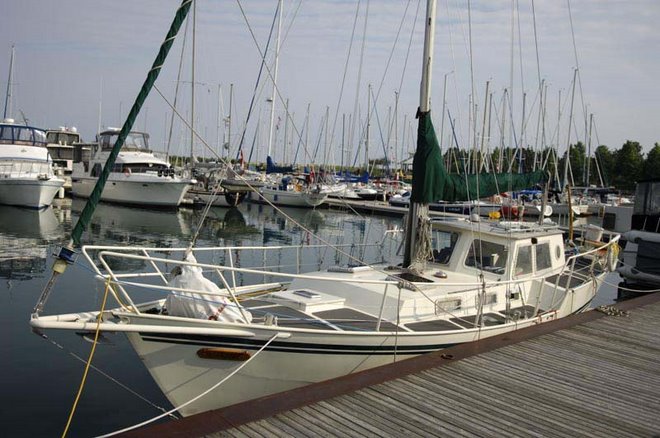
We bought a steel full keeler for a number of reasons: strength, capacity, tankage, strength. We didn't buy it for speed, even though it's not as pokey as one might assume. We also considered that as we sought independence from the shore (involving making our own power and water and carrying a full complement of spares and tools, including the ability to fabricate some items) that we might wish to do a little informal cargo or passenger transport in some of the more remote Pacific atolls we are likely to cruise.
Note that these transactions would be of the "put the diesel drum on the deck, and the roast pig in the galley...thanks, man" type. Cash, not so much.
Alchemy, irrespective of her other fine qualities, is undeniably a capacious steel boat with pipe railings, light-duty crane potential and space to carry several 55 gallon drums on deck. I could safely carry in mild conditions quite a bit of gear or a couple of people willing to kip on deck.
It has occurred to us, therefore, that inter-island transport of essentials outside of the usual cargo freighter runs (or carrying a few passengers in return for a roast pig or something) might be a possibility for us, even in a 41 footer.
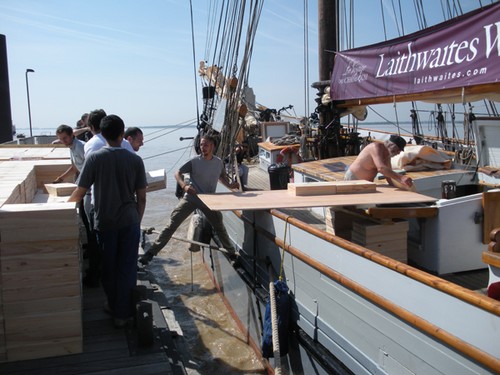
Then I read this story.
 |
| Avast ye, maties, and steer for Carrot Common! |
As for large-scale sail cargo, sure, why not? The 400 foot steel barquentines worked until 1939 at a profit hauling guano and wheat. Mechanization could mean a four-master could be run with a dozen guys. I can see "charter cargo" for carbon-credit types or the richer sort of greenie. Coffee at 20 bucks a pound barely scratches the guilt of some people. Shipping under sail is a perfect fit for shade-grown coffee picked by sponsored orphans...or am I being cynical? Too bad. I just want to see working tall ships come back.
 |
| You know what? Screw being a floating restaurant. Anchors aweigh! |
Not everything needs to get there in 10 days. If you can wait, you can get it by sail. Next up: freight Zeppelins. Or, if you wish, today's cargo ships with tomorrow's sail assist.
 |
| The new sail-biogas hybrids are not junk |
 |
| It's called a "ship puller". Duh. |
Time and the price of oil will likely determine whether this ever exceeds the "Western guilt/boutique" level of enterprise, but I can actually see, having budgeted the cost of mostly-sail travel per NM, that this could work with certain high-value, non-perishable cargoes and on certain breezy routes.
Is this just a romantic fantasy? No, but containerized shipping via bunker oil-fuelled vast freighters is already so efficient and (relatively) cheap that oil would have to get very expensive indeed before fresh fruit in winter and Chinese-made rubber ducks and other dollar-store staples vanished from Western shelves.
But I can easily see sail being a small component of the mix, just as I can see a return to the cargo dirigible for certain applications. It's not just about running out of fossil fuels. It's the environmental cost of extraction and the willingness of individuals to buy into that, along with the political cost of dealing with unpleasant people in charge of certain areas.
If pne runs the numbers for high-value goods going in the right (downwind) direction, I can see a case being made, especially if one can price in a "feel-good" premium. Putting a two- to five-buck per bottle price hike on an absolutely bog-standard dark rum that was shipped by sail-only brig from the Caribbean to, say, Nova Scotia is a given, even if you've never worked as I have in marketing. Sailor Jerry, may I point out, is a long-dead tattooist, and yet "his" rum gives off the slightly naughty nautical impression people seem to find worthy of buying. If there's anything more y'arrr than Island rum shipped by sail, it probably involved putting a splice in a body part.
| Like my shimmy? Then make with the shake, hipster! |
It's the entire reason people buy Apple tablets, after all. They don't work so much better, and in some respects not even as well as less image-oriented devices, but they look great and people wish to be seen carting them around. So price them 40% higher and keep the Chinese factories on the down-low! As for Lululemon's line of pricy "yoga-wear", it's indistinguishable to me from stuff one could buy at Winners, and yet it's priced for prestige.
Seen from that point of view, sail works a treat.
UPDATE: According to my usually reliable readers on Grenada-based Silverheels III, chocolate is on sail:
UPDATE 12.12.30: Apparently, Tres Hombres, the 32 metre, engineless sail cargo vessel mentioned in the above link, has been involved in a mid-ocean rescue of a German sailor with a busted rudder. It's been some time since a sail-only vessel has done tugboat duty this far offshore, I suspect. Good luck to all involved.
 |
| Bar none, that's the sweetest freighter I've seen |
2012-03-17
Links in the chain
 |
| Seem familiar? Yeah, that's why I got the job. |
I belong, like most recreational sailboaters, to a yacht club. Most recreational power boaters, by contrast, seem to belong to marinas. I don't know why this is, or even if it's just my mistaken observation, but as I belong to both a yacht club and rent a dock at a marina, I can say that the general tenor of each place seems different.
A yacht club, apart from the general perception that its focus is on rich guys swanning about in fake admiral's rig notwithstanding, is premised in most cases on a certain amount of member participation in the dirty work. This usually means volunteering to keep the facilities in order and to tend to the club's equipment and seasonal tasks, which are many. Most yacht clubs will have volunteerism extracted in the form of "club hours" or some other commitment of time and labour to avoid, defray or lessen the cost to all of hiring outside, paid help.
Generally, this works well, but with the average age of YC members creeping ever upward at the same time as the world continues to get busier, seemingly, for all of middle aged and older, it is sometimes difficult to co-ordinate even the well-meaning volunteer, or to utilize them once co-ordinated.
After about 10 years of editing the club newsletter (not a stretch for a professional writer/editor/publisher, frankly), I decided to switch things up a little and to join the "Mooring Commitee" at my club. This is the team responsible for maintaining, repairing and replacing as needed the various floating tires, ramps and other assorted bits and pieces that are chained to railway wheels at the bottom of the club's basin, the acreage devoted to mooring non-dock-owning boats.
Lake Ontario is not particularly benign, nor is our mooring field particularly sheltered. There is usually damage requiring attention: strained, stretched or corroded mooring chains, sunken tires, rusty hubs, and assorted debris. We have two main tools to aid us: a purpose-built, self-propelled pontoon barge with a hydraulic crane to hoist the railway wheels on and off the bottom, and a venerable, approximately 65-year-old work boat named Storm King.
 |
| Storm King: Not dead, merely rusting. |
I am going to be taking over the care and feeding of this old boat shortly, as the fellow who was doing it has time commitments elsewhere. I'm already the driver of the barge, "driver" in that case meaning "just don't hit anyone", as its steering characteristics resemble that of a saddled three-legged pig.
Storm King is not appreciably better, having no real neutral gear, a permanent list, insensitve helm, a 1950s Chysler block with various leaks, cracks and "little ways", and a hull of sub-optimal thickness. It's clear that we need a new workboat, and soon, nostalgia for this otherwise useful and stalwart little tank notwithstanding. Storm King also provides tows for boats with engine trouble (not uncommon) at the club's launch and haulout, even though its keel is laughable and the towing process is like making a complicated bank shot in snooker, underwater, via robot arms.
 |
| What James Bond might use to dive on a mooring. The landing craft gate at the front would make an excellent dive platform. |
Storm King is simply very worn at this stage. No amount of rehab or maintenance of the non-cheap variety could reasonably be expected to overcome the many deficits of this vessel, at this stage. We can likely (I certainly hope as I will be driving the thing) keep it from exploding, sinking or otherwise making a dramatic exit for this season, and there are many attributes to the boat specific to our existing duties everyone involved would like to see carried on with a successor work boat (see the picture above), but there's no feeling at this stage that replating the hull or putting in an efficient diesel makes economic or functional sense.
The fact that I am rehabbing my own steel boat, using hoists, modifying hydraulic steering gear and so on, is not at all coincidental. This job, such as it is, plays very close to my own activities and interests, even if it's of the patch 'n' mend variety.
We'll see as the season progresses if a series of pallative measures renders further insight on the best method to keep a younger boat in better condition for the years to come. Certainly, if I were at a marina and not a club, I wouldn't get to volunteer for a position that dovetails so snugly with the sort of stuff I'm already doing/learning/trying not to lose a finger at. It's all, puns intended, links in the chain.
2012-03-13
Arise, O diesel! Alignment awaits!
 |
| The greatest hoist ever executed. |
Getting the diesel into the boat recently was comparatively easy...about an hour's work with a guy on the Polecat crane, me and a friend shifting and using radios and whatnot.
The typical marine diesel engine, for the uninitiated, must sit on four "motor mounts" bolted to engine stringers, fore-and-aft steel girders (in Alchemy's case; f/g boats have either solid or wooden-cored engine stringers covered in a thick, reinforcing layer of fibreglass), and aligned between the engine coupling (the heavily built spinning disc at the back of the engine), and the propellor shaft coupler, a similar metal disc about 12-15 cm wide at the inside end of the propellor shaft.
 |
| Typical marine diesel mounts. Photo (c) "Dual-Flex" |
 |
| Typical "drive-saver" coupler insert designed to reduce vibration. |
In most boats, this has meant a quite exact alignment, as the flat surfaces of the shaft and engine coupler must "mate" as close to exactly as possible.
The reasons are twofold: The couplers' surfaces are very smooth and are secured by three or four or even more bolts; a more close-to-perfect fit means a tighter fit, meaning the bolts are evenly stressed. The second reason is that misalignment, even below the level of casual observation, can induce both vibration and destructive wear on the engine's drivetrain and the "stern tube", the glass or metal pipe that encloses the prop shaft on the way out of the boat.
Misalignment can wear all the parts of the drive train, from the crankshaft and bearing inside the engine, to the prop at the far end. The engine prematurely wears, the stuffing box can overheat and fail, the expensive shaft can become scored and worn, and the prop' s blade can wear. The cutlass bearing can fail. Worse case could be an engine seizing or the shaft failing: Boom, you can have a nice chew out of your rudder as water comes hosing into your engine compartment. You do have tapered wooden plugs and a prayer shawl back there, right?
So the so-called "solid" coupler requires careful alignment using an interesting little device called a "feeler gauge". Essentially a little jacknife with several little slips of metal of differing thicknesses, this gauge tells you how close to ideal the coupler surfaces are. Considerable dinking around with the engine mounts can be involved, little 1/8th turns of the heavy, and by that stage, load-bearing bolts in the motor mounts, to raise or lower the engine fractions of a degree to obtain as close to "completely aligned" as is possible.
While it is quite possible to do all this with wedges, crowbars, foul language and a small quantity of blood sacrificed to the sea gods, my particular situation called for some inventiveness. In short, I needed an engine gantry, something to allow me to haul the engine up and down over its stringers (the longitundinal beams to which the motor mounts are bolted) and forward and aft until I found the exact spot needed.
 |
| Ideal, but expensive and way, way too big to fit in the pilothouse. |
 | ||
| Great for a car, not for a boat with a "diesel pit": you can't lower the engine past the legs. |
 |
| I was not sure I wanted to drill holes in the pilot house deck, bolt, back and brace this underneath. Cool gadget, however. |
I solicited advice from my fellow sailors, and seriously considered making something out of steel pipe and Kee Klamps, with which I am familiar from work in the film industry...
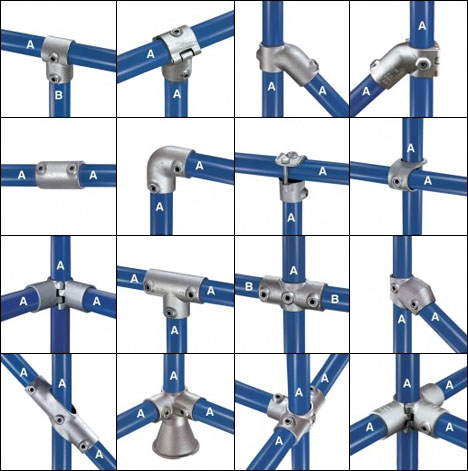 |
| Not cheap, but reusable and essentially man-sized Meccano. It was hard to resist. |
The Kee Klamps would have been used as pictured. Their use seemed so practical, if pricy, that I started to design in earnest:
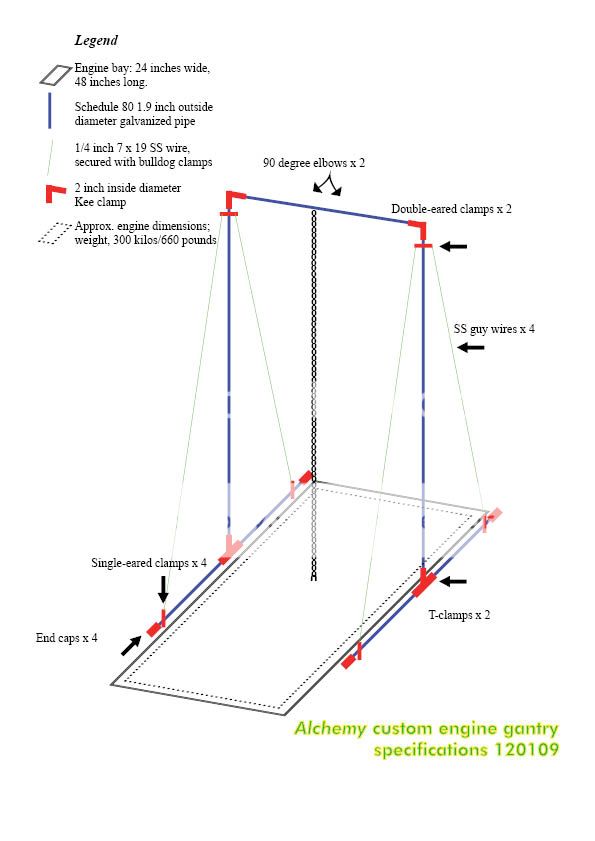 | ||
| Oh, Kee Klamps, we would have been good together...but you cost top dollar. |
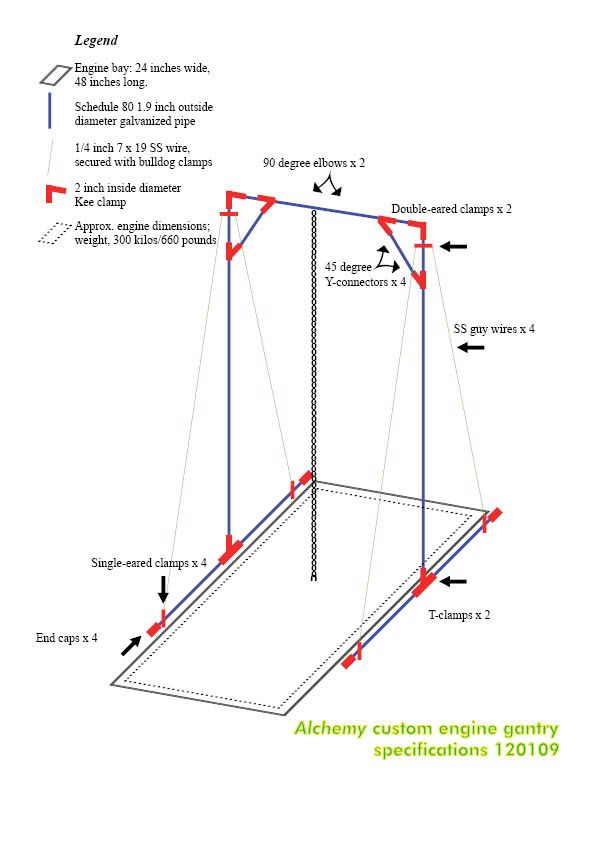 |
| I even did Version 2, beefed up at the corners |
 |
| Not enough spread on the load bearing surface, and the engine would snag the chains. |
 |
| I'd have to take the roof off. |
So in the end, decided to build in dimensional lumber: Two triangles, cross-braced and bolted, should have done it. I got "designing", a dignified term for engineering of the level usually found on the back of a napkin.
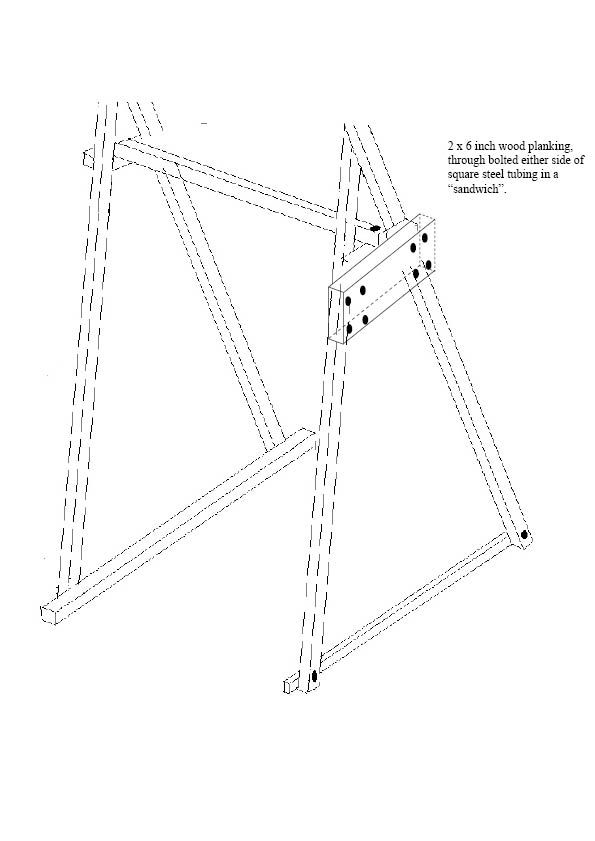 |
| I started by modifying my engineer friend's basic design. |
Then I actually took measurements and made modifications.
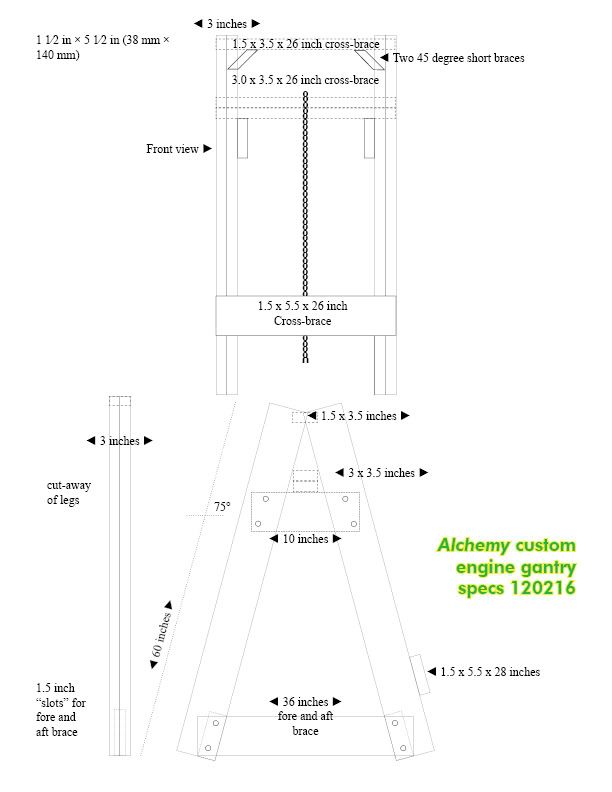 |
| Then I smoked crack. Things got a little out of hand. |
The opportunity to learn through building and the chance to save a bit of money (I estimate I spent $80 on all the bolts, screws and lumber) meant I could live with inelegant and heavy if it was strong enough to persuade me to get under the suspended engine. No joke...I could get killed in a fairly vivid fashion (arrgh, pump the bilges...) if I failed to cobble together something sufficiently strong.
I went with KD-grade construction spruce 2 x 6s, about five 12 foot lengths.
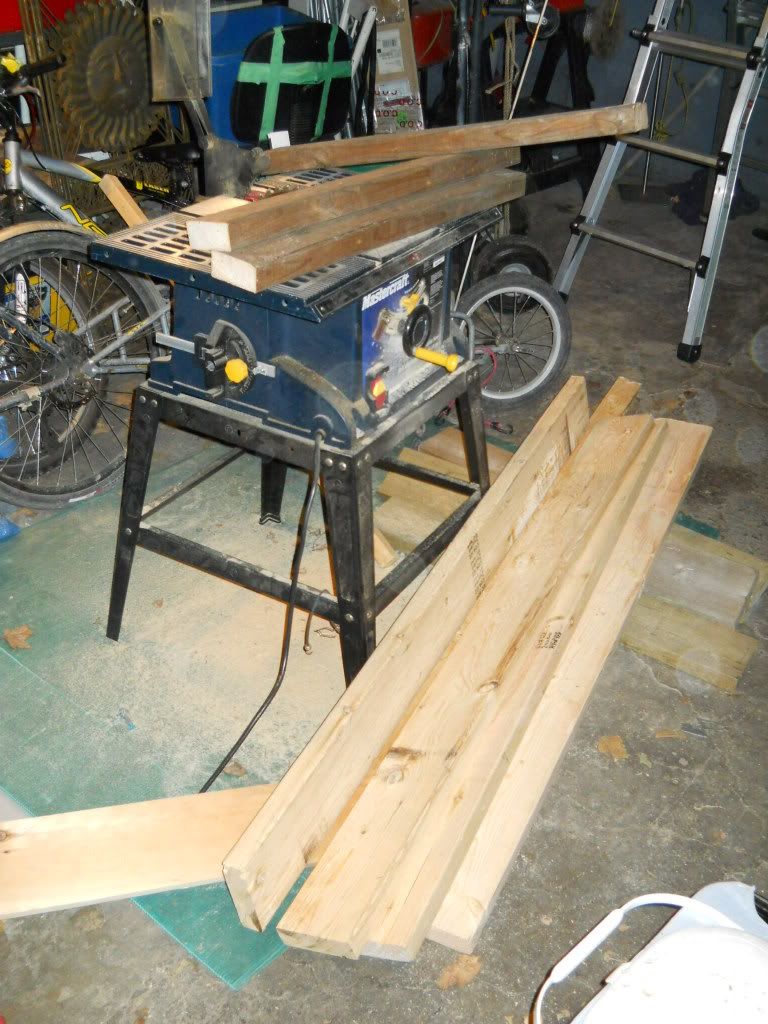 |
| Reminder: Sweep garage |
Using my table saw top as a work area, I first cut the cross-beam, which would end up "floating" and held only by the engine weight, on braces.
 |
| One of my oldest and best-performing power tools, plus a very manly drill bit. |
This was to enable me to easily reposition the beam, and thus the hoist's vertical drop, some short distance fore and aft.
 |
| That very long racheting wrench thingie was a deal. The radius means you can crank fast enough to warm up the nuts, and what man wouldn't like that? |
The beam itself was made from hemlock 2 x 4s I salvaged from the rebuilding of our breakfast nook off the kitchen (it used to be a drafty, sinking "mud room"). Unlike modern lumber, these were a lot closer to being 2 x 4 inches, and hemlock is strong. Thinking I'd double the thickness, I eventually decided to triple it. I did not wish to here a single creak. Through-bolted with six inch long, half-inch thick SS bolts, washers and nuts, it seemed pretty well tied together.
 |
| I liked using a template, to a degree |
I decided I wanted a pair of 2x6s for each of the four "legs", and that the base 2 x 6 should be mortised in between them, and then double-bolted for strength. This required a bit of geometry to compensate for the angled legs, so I made a rough template.
 |
| Not as inaccurate as it looks. |
 | |
| I saw things above plastic because beneath is the drain for the horse piss: my garage was built as a stable. Not that I intend piss of any kind to happen in the garage. That's what the garden is for. |
Dicking about with these cuts took some time. Knowing what you want and having the experience to take a shortcut, or to see that one might exist, are different things.
Fortunately, years of low-grade, faffing-about house repairs mean I generally can lay hands on the right tool.
 |
| It's Black and Decker, a crap brand. However, it was on sale for $29 and the tippy plate thing comes in quite handy when the alternative is a plastic mitre box and calories. |
Or, rather, the "right now" tool.
Eventually, I had four more or less equal-length gantry legs with mostly similar trapezoids cut out of their insides.
 |
| Like your prom date, it's even worse up close. |
I had a slight change of plan when it came to making the "triangles".
 |
| I needed good light and level concrete for this bit. I got good light. |
I decided I wanted ones with brushcuts.
 |
| Apparently, I was on the level |
Things were coming together. The keen eye will note my Honda 2000 genset. I run a crappy line to the garage, just for lights, pending the rental of a backhoe to dig the requisite legally deep trench, and I don't like to run power tools AND lights in there as it could trip a house breaker 100 feet away. So I use the Honda. Handy little bugger.
 |
| Based on an abandoned IKEA bookshelf for frost giants. |
So I had a brace for the forward face, a brace over the top, and two "keeper" planks to center the hemlock triple-width beam.
 |
| So clean! (Not the garage, the gantry) |
That was basically that. The "open" side would allow the transmission to clear the gantry, or so I thought.
 |
| This is the reality of two boats, no car, folks. And yet if I had a car, I probably couldn't swing even one boat. |
The problem now was to disassemble the thing and get it down to the boat.
 |
| Nice lashings, at least. |
My customary mode was, to put it bluntly, overtaxed. Riding this over a little bump might, I thought, either kill me or snap my frame, bike or trailer.
 |
| Cockles, and mussels, and lumber, ei-oh. |
The gantry weights over 100 pounds/45 kilos, after all. So a hand truck or dolly that can convert to a four-wheeler and can take 800 pounds of weight was needed. After the Makita drill, I use this thing all the time. A great deal I got for about forty bucks.
 |
| It only *looks* like a DIY trebuchet. |
After much personal heroism and unappealing grunting, I humped this Frankenwood assemblage down to the boat, and used the handy deck crane.to haul these chunks aboard. Inevitably, they required even further deconstruction just to fit down the companionway.
Much unrecorded swearing, bolting, noting the base was one-half-inch too narrow for optimum, recutting, rebolting, drilling and screwing, the "wide stance" frame was in place:
 |
| Pit, but I hope no pendulum. |
This length of line was fine for deposit via the Polecat crane, but I replaced it with a short piece of chain to lessen the gap between the beam and the engine.
 |
| Not much point if I can only get it partway up, said the actress to the bishop. |
I cut some chain to fit the beam and...
 |
| Suitable for hoisting diesels or torturing heretics. |
...making sure I was more or less centered over the engine's mass, so as to avoid a nasty swing when I cranked it free...
 |
| It shifted a bit because I'm not quite zeroed on with the hoist and chain positions. Easy enough to fix, however. |
,,,hoisted away. The chain hoist is a one-tonne model I got from Fastenal on sale for $69. Needless to say it will come in extremely handy for a) installing water tanks, b) installing half a tonne of batteries and c) removing 600 kilos of lead ingots from the forepeak put there for trim purposes. Which infers the amount of tools, chain and anchor our boat is meant to sport.
 |
| WHEE! |
 |
| DIESEL GOES UP, DIESEL GOES DOWN...yay... |
The chain hoist is one of those devices (much like the similar winch) that you think you can anticipate how it works, and then you use it, and it is actually far easier. I can lift this engine with one hand on the chain, and lower it precisely. It's a fine thing, this hoist. Particularly on a steel boat. Looks the part, this part.
 |
| Ok, stop already. You can play with it tomorrow. |
And the rather elaborate and painstakingly constructed (because I am clumsy, hence pain) engine gantry thingie?
Fabulous. Nary a creak, not a shift, groan or wobble. The floor of the pilothouse is similarly unprotesting. I am well-pleased.
 |
| Four feet to the shaft seal? Where's my measuring tape? |
As for the ultimate reason for all this levity, or rather levitation? To get the new engine on these flexible feet, to bolt the coupler to the Aquadrive unit, to bolt the Aquadrive unit to the shaft, gird as it will be with that PSS Shaft Seal thingie, and to clap on a four-bladed feathering propellor fit to power us off lee shores of exceeding remoteness.
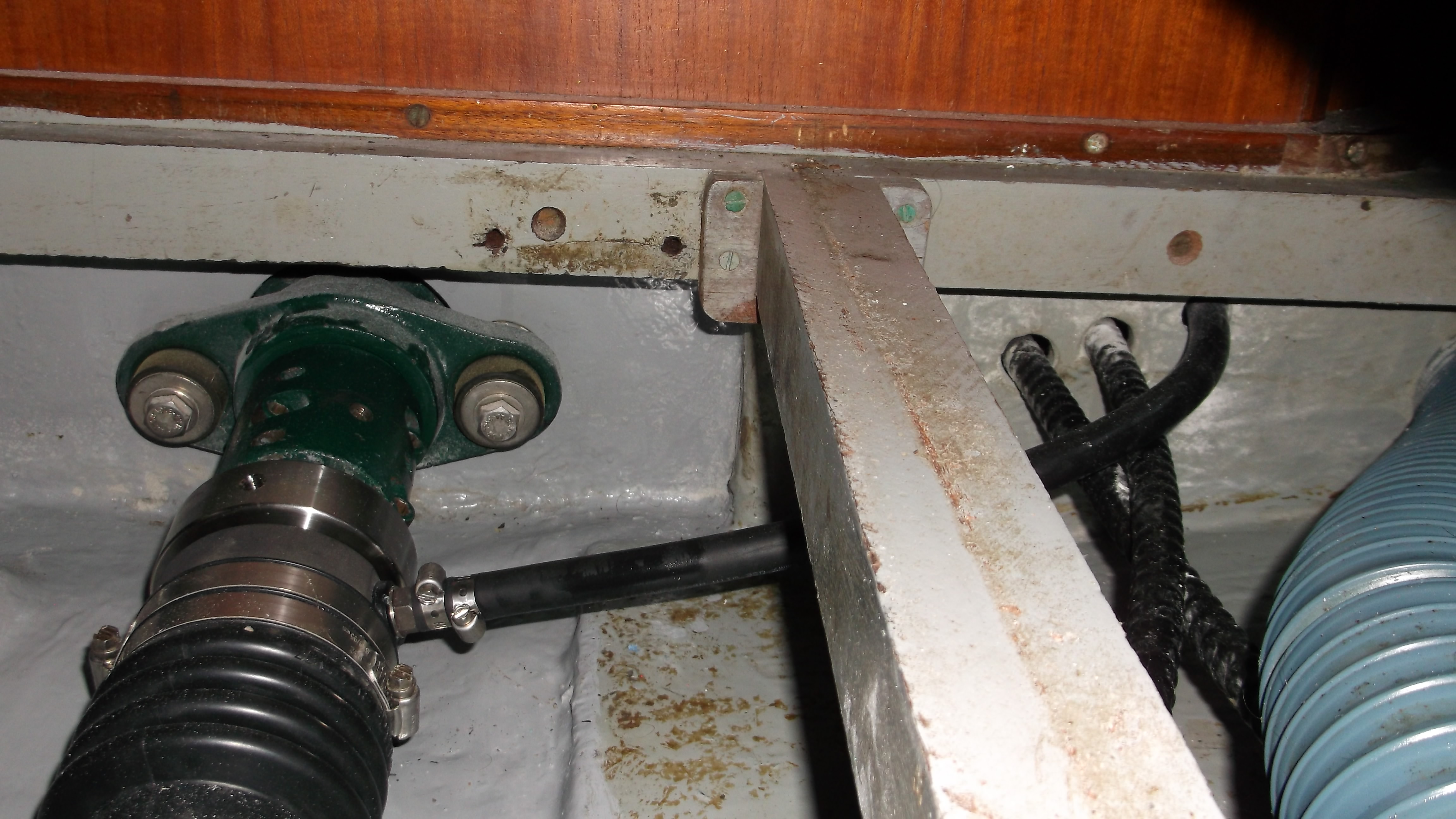 |
| Eventually, it should resemble this. This is very cool, if you understand the issues with motoring a small boat in a seaway. Saves vibration, wear on the drivetrain and shaft misalignment issues. Photo (c) http://www.botanybay.org |
And that's the boat that Jack built, or is building. Further reports shortly.
Subscribe to:
Posts (Atom)