Copyright (c) Marc Dacey/Dark Star Media 2006-2026. Above photo (c) Marc Dacey. Powered by Blogger.

2015-10-20

Unsticking and other season-ending events

Bye, bye, summer!
Some might see our efforts to put up Alchemy's mast in August only to take it down in mid-October as fruitless or even silly labour. Clearly, we disagree. The exercise was very useful (and was also good exercise) in determining where and how best to run sheets and halyards, to do the small repairs due to the long hibernation of the mast in the club's racks, and, of course, to get the mainsail measured in preparation for a new one with an improved batten car setup.
Blurry, but repaired, jib topsail in full effect.

Next season's head start also included a new and seemingly effective installations of a VHF antenna and a blindingly bright tri-colour/anchor light/strobe, and the afore-mentioned halyard replacements. We also marked on our solar arch the location of the passage of the twin backstays, meaning that particular bit of custom work can be altered to accommodate all four panels as designed.

Once more unsticked.
But the real benefit of getting in a few actual Alchemy sails in was of course to crew morale. A great deal of the last few years has been spent either research in front of a computer screen, designing things in front of the same screen, drilling and bending things in a garage or installing things in an often cold, dark and cramped area of the boat. To actually use the thing was a great joy to myself and Mrs. Alchemy, and provided a real boost to further off-season labour in the cold and dark, which is less dim and miserable a prospect when lit by memories of  late summer's sailing. We learned a lot, and even if the semi-symbolic nature of an August "start" can be justified by the better state of prep next spring, it's been a blast this year to even drive about staring at a mast base.
It needn't be complex. It needs to be on the outside helm binnacle.
The sail control lines are working well, but I do want to install a third pair of winches for speed, and will do so after I install a new traveller this winter. The rehabbed Lewmar 44s I picked up some time ago should do nicely. Once again, it's been a case of me springing on a deal of sorts well before it ends up being installed. Revealed over the last two months were the rather pressing need to install a second throttle/shifter at the outside helm, as my ability to see the dock is assumed rather than actual from the middle of the pilothouse, causing either a sudden backing down or calls to "go around again; you're six feet off". Luckily, the shifter, engine and four-bladed prop are working very well, and I fancy people think I have a bow thruster, given the tight maneuvering we are capable of. So...that's promising, but I need to dock from outside.

Not seen: the 35 knot gust that happened while this massive ramp was briefly 10 feet in the air on a club forklift that impressed me by not falling into the lake. I was handling the tiny yellow rope in the foreground.
Amidst personal boat stuff, there is the club preparation for the months of not-sailing. Above is the dinghy ramp, sturdy enough to have a trailer and not necessarily lightweight boats on it, plus any number of kids learning to sail. It would be damaged were it to stay in all winter, so out it must come. The wind was constantly over 20 knots yesterday, and often crested 30 (I checked with the nearby airport weather info site for pilots) and it was a cheek-reddening sort of day.
It got even wavier (two to three metres) later.
I'm on the Mooring Committee, as I've mentioned before, and we seem to do (without exaggeration, I think) a lot of the tougher jobs, such as keeping the moorings serviced, moving disabled boats, and lifting heavy things up and down. Yesterday we discovered, while looking for a boat reported missing, a second boat which had chewed through one of its two mooring lines.
Speed was in this case of the essence, so we took the water taxi instead of the heavier, more powerful work boat.
It's no joke to re-reeve a mooring line on a boat and a water taxi that are both in motion of differing periods. Pictures don't do justice to just how much of the lake was sloshing over the sea wall, but that spouting wave hitting the end of the airport runway gives an impression.
Thar she blows!
After securing the boat above, we went to the far end of the basin, where an old Shark monohull was chewing its topsides on the eastern seawall. A quick tow to safety and too much time trying to push a line through an abandoned fender later, and the owner should buy us a beer.
 
Two hundred-odd kilos of get you offshore, fit to be tied.
The same mates from the Mooring Committee were kind enough to help when Alchemy's now extracted (at sunset the previous, less windy, day) stick needed to be racked for the winter. Friday and Saturday are "Haulout", a melancholy, if in these parts necessary, duty.
While a more complete paint-job will happen in spring when I can get underneath it, Alchemy's cradle got some Tremclad love today.


2015-10-14

What cannot be borne

It's funny what gets on people's nerves. Expert sailor and good friend John C. was so bothered by the horrible sight of downed fenders on our September photos of Alchemy under sail that he Photoshopped them out in favour of dangling lines! I do admit we were perhaps preoccupied and they are all up on the port side...I swear!
Fenders rendered and surrendered.

2015-09-28

Plotting a hatch

Note the Swamp Thing hatchery in evidence.
Between work of the paying sort (both Mrs Alchemy and myself are hard pressed this month, which has already taken the edge off winter storage fees) and the algae attack in the basin of my boat club, it's been hard to consider pushing off for more sea retrials. But that doesn't mean the game's not afoot.

Measure twice, figure out the coefficient of thermal expansion, and cut once.
Behold Tony Johnson. He's a welder/fabricator, a marine engine mechanic, some variety of general contractor, and a professional diver. Truly, a hand for all seasons. He's taking on the task of turning my much-modified idea for an engine bay hatch and turning it into reality.

The Metal Supermarket-acquiried plate fits nicely, but needs building up in the form of HDPE frame-up to get it flush (minus the thickness of its eventual LONSEAL covering) with the rest of the pilothouse decking.
Behind Tony is the plate I bought myself to make the "fixed" part of the design below, which will only need to be unbolted should the engine or tanks require moving. Another advantage is that the fixed plate will make an excellent spot on which to mount some engine bay general lighting. Not all engine access issues happen in full daylight, after all. 
Evidently, I lowballed the measurements by about 1/8th of an inch, because I didn't realize the lid could be made as snug as Tony will build it...which is good.
While Tony will make up the metre-long aluminum hatch, I will drill the pin holes (I want clevis-type pins for this as they just need to stay in place) and to put in the struts (perhaps gas struts, but I already have friction-knob types and this hatch won't be super-heavy) and latches and insulation to finish the job, because that I can do. Given that I will need to isolate dissimilar metals with (likely) strips of EPDM rubber gasketing, which is one of the same materials I will use over the winter to insulate the mild steel inward flange of the pilothouse from its aluminum roof. So I'll need a fair amount, although it need not be thick.
A closer look: Tony told me to stick to Imperial measurements, which I found ironic coming from a guy in his 30s, but c'est la vie.

Getting rid of the existing framed plywood will cheer me up a great deal and a hatch that lifts forward, unlike my original "clam shell" design (see below) of vertically lifting half-doors, will actually be stronger and will allow better use of the floor when I need to deploy tools, and will have the added benefit of not having to make the lowest companionway step able to lift vertically.
Hatch plot the first: Elegant, but unnecessarily so.


2015-09-23

The bitter end

Our main, it has been suggested, has been cut down along the foot from something considerably bigger. Photo (c) Jeff Cooper
There is no picture of the visit yesterday of Ron Fernandes, the owner of Triton Sails, because I was hauling and flaking and going hmmm. Ron came by to measure and to discuss the New World Main (yes that may be a Rush pun), the details of which will be shared in the future. Amidst all my rattling on about chafe patches, triple stitching and the need to widen the mast gate in the slot a touch for the Tides Marine batten slide system I intend to get (the measuring kit arrived very promptly, which is nice), Ron suggested that the angle of the batten pockets and certain other giveaways argued that our main was once the top two thirds of a much larger main, like off a 55 footer or something in that class. The number is suspiciously low.

He's probably right, which is why he is the sailmaker and I am the customer, because this never occurred to me. But in the shot above, you can see what he's getting at. What I am getting at is that this sail, while in remarkably good shape given that it may be original to the boat, i.e. 1988, it's not 27 years old, it's a maximum of 20 years old, as it's been packed away in my garage for seven years. Furthermore, I don't think the previous owners sailed very much, as it shows little of the sort of thread damage or signs of chafe one comes to expect. So the above main is now the "Light Air/Spare Main"; it has three reefs and plenty of life in it yet, but it's somewhat lightly built for the ocean, in the view of myself and the sailmaker, who may be biased.
This is possibly too much roach. Illustration from Wikipedia

Looking more closely, one can see that there is zero roach to this sail, and as we are going to have battens to better control and shape the sail, we might as well get the benefit of some extra sailing area, and therefore, extra drive, out of a new mail. While some disagree that battens are necessary or desirable, not me. I like them and I want them. While the headboard of the current main is properly sized, it's pretty well the long side of the triangle down to the outhaul from there; even a conservatively cut roach will add precious oomph. My thoughts on where the reef points should go, I will save for now.
Yes, you are looking as a miscalculation.
The sharp-eyed will note that there are only two Kyocera solar panels here, and not four. This is because I failed to recall that I had backstays when I had the solar arch fabricated. Needless to say, I feel a right twat, but this can be fixed with a little welding of plate and some repositioning of the mounting fittings. Live and learn...the hard way.

These holes are as small as I could make them and are well off the anchor well decking.

A more successful needful task was to make up a place to attach the anchor rodes to the boat. Such a place is normally called the bitts, and was traditionally two heavy timbers lodged into the frames of the boat or ship. This bitts differ from bollards, which are deck-mounted structures that perform the same function as cleats, but which are generally more heavily built. The term bitter end is the end of the anchor rode, which can be rope, chain or both, which attaches to the vessel. 
Pacific Fasteners, you are so much more reasonably priced than chandleries.

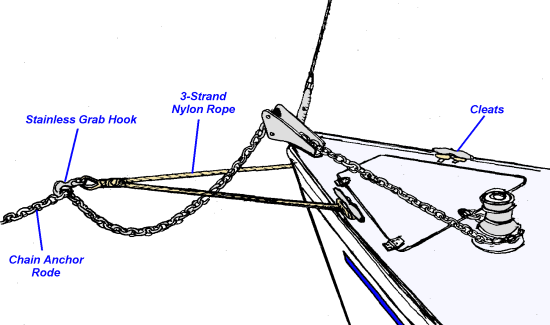
Non-sailors assume that this is where the anchor rode pulls at the boat at the bitts; this is not in fact the case. The anchor rode can be attached to the bow of the boat at the waterline with a snubber, a plain piece of stretchy rope with a chain hook, or via a bridle, two ropes that run up to cleats and bollards. Other pieces of colourfully named equipment, such as a devil's claw or a chain brake, come into play as well.

A fairly typical bridle and hook setup. Some sailors tie the nylon rope directly to the chain. Illustration (c) Bosun's Supplies
The point is that the chain, which in any kind of a sea can experience very impressive shock loads, is not in fact directly attached to the bow roller, the windlass or, indeed, the end of the rode, directly to the boat without some kind of intermediate shock absorber to tame the yanking motion of the boat going up and down in waves. The weight of all-chain rode does dampen this naturally, but the idea is to have stretchy or springy materials absorb and smooth out the sometimes abrupt loads.
Some dielectric paste and Lanacote to mitigate the dissimilar metals.

Now, the gold standard of making this up would be to not use aluminum plate as a load-spreader with a stainless steel U-bolt going through mild steel. I know this. But I also happened to have these pieces of aluminum, which I originally drilled years back as backing plates for deck-mounted cheek blocks on Valiente, handy, and I had Lanacote and dielectric paste, plus butyl and the fact that all surfaces are painted on my side. So I'll test this and see if it is sufficiently galvanically isolated to not corrode overmuch.
I love butyl and I cannot lie.
First off, I put butyl strips on the back of the "outside" plate. The SS threads and nuts were liberally coated with dielectric gel.
The whole forepeak will be emptied this winter, and will get a fresh coat of anti-rust paint, topped with bright white two-part for maximum light down there.
The same process was repeated for the back side of the anchor well, inside the forepeak.
Finger-tightened. No butyl is escaping at this point.
I added washers for very little reason, save that I had them nearby. There's enough leftover threaded U-bolt inside to conceivably make a bracket or a light mount there. Depends on my ambition, really.
Why, yes, I did have an 11/16ths inch deep socket. Doesn't everyone?
Dogging down the bolts consecutively, the butyl started to squeeze out around the edges of the backing plate. I've done this sort of job with butyl and bedding goo so often, I can usually estimate "enough" without needing to trim or to fetch rags.
Done...for now.
Here's the finished job on the outside, although I will trim that slight over-squish next time I'm there.
Strong enough to step on. I know, because I did it.

The two rodes, one a rope and the other a chain attached to a rope attached to the U-bolt, here performing the function of the bitts, are now securing the anchors safely. Whatever else I do, I can't easily let the anchor rode run off the boat now. 
Looks like it's supposed to be there. I can also attach chain hooks to this if I wish.
But what of the bitter end? See that red, white and blue piece of knotted rope? That's a cut from the spare Dyneema cored halyard I bought when I reroved the mast halyards. It's between the U-bolt and the bitter end of the chain rode that terminates at the other end at my Fortress anchor's stock. If the chain ran completely out in benign weather, sans bridle, snubber, chain brake or devil's claw, it's strong enough to take the pull. If, however, we get hit at anchor with such heavy winds that it is impossible to retrieve the anchor without injury or damage, and we have to put to sea...fast...think of that piece of rope as a fuse. It can be cut with a few strokes of a serrated knife, and a small, labelled buoy can be affixed to the bitter end with enough light line (enough to match the depth of the anchorage) to let the buoy float. Heavy weather passes, and you go back and haul in the chain and anchor. It helps to keep a non-rusting, serrated knife nearby, but you should have one in your pocket or on your PFD.

Now I think I'll relax with some bitters in my rum.
Paradoxically, I'm feeling less bitter already.


2015-09-15

Sail of the decade

Well done, main.

This the main of Alchemy. It is pulling 15 tonnes of steel pilothouse cutter through the water.

Note the ever-so-slight heel. We are off the dock, folks.
This is the still-warm water. It's Lake Ontario on September 15, 2015. It's what we call "a good start".

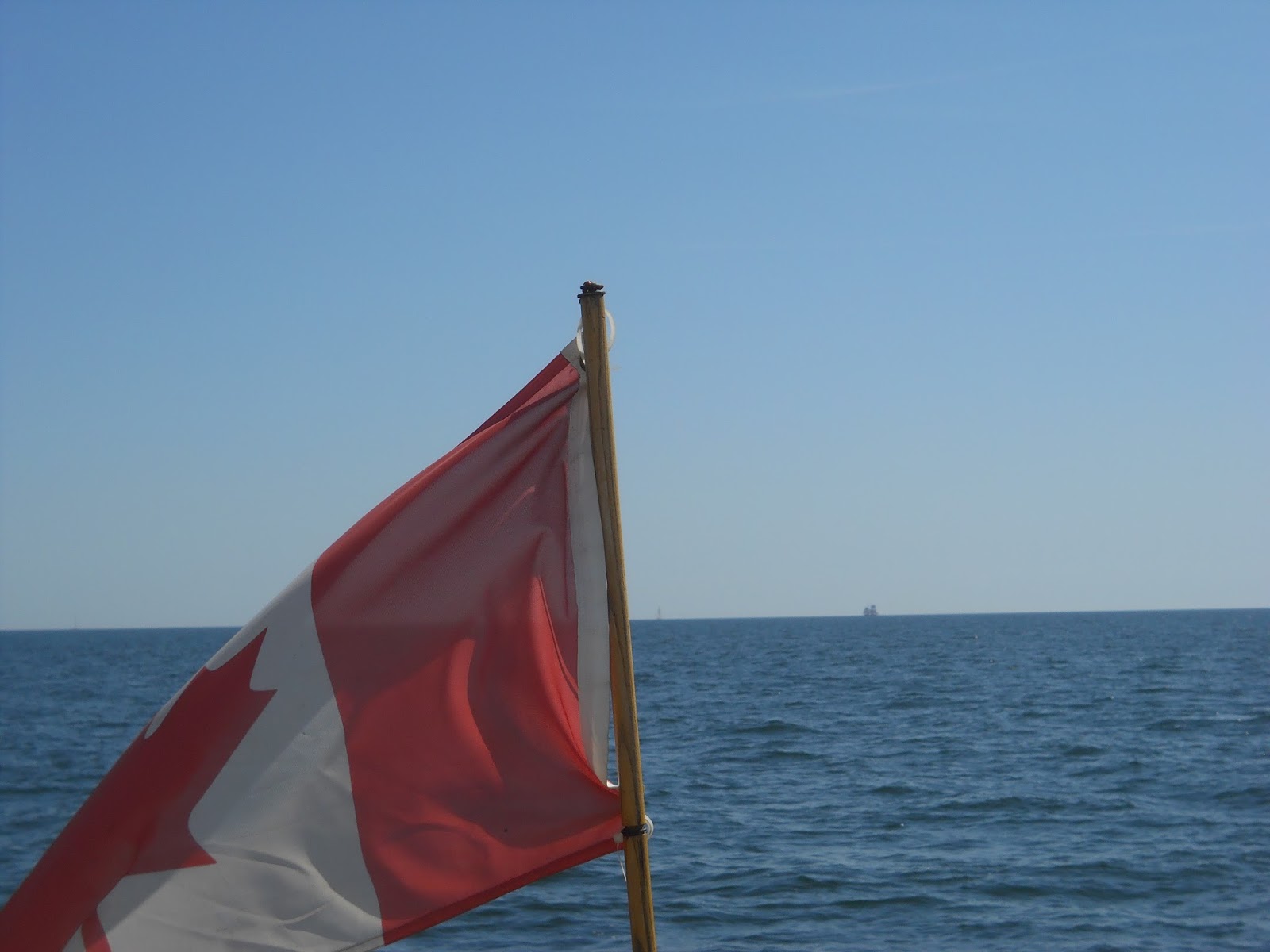
I have a much more impressive flagpole in the garage, which is what a lot of middle-aged skippers say.
This is Toronto. We haven't left it yet, but we appear to have the means, if somewhat primitive and in completed, to do so in the form of a functional sailboat, functional in the sense of "sails".
This beauty is Cristal, a Dufour 36 Classic, a very nice find for Mr. Cooper, seen at his own bow, showing immense trust in his autopilot.
The man at the bow above is Jeff Cooper, a good friend with a very nice boat who, upon hearing we were fixed upon casting off today with intent to sail (it was a sort of light air day that would give us the opportunity to correct screw-ups, should they arise), decided to come over and take some pictures. The best one, in my view, is at the end of this post, but this is pretty excellent, as well:

You can make out where the luff of the "temporary jib" is just about three inches too long. Photo (c) Jeff Cooper
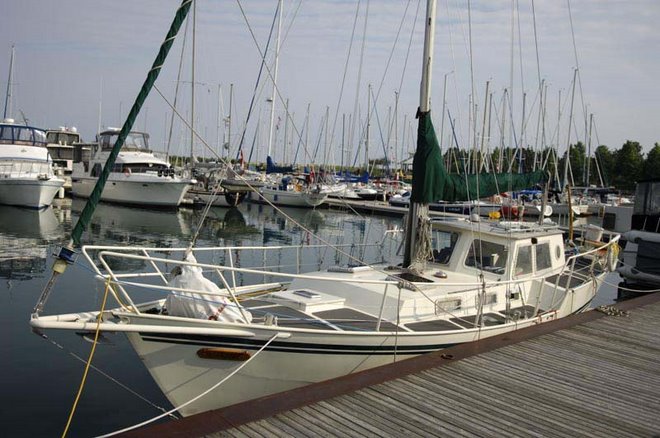
I think she looks rather good. Like many boat owners who don't own a drone with a GoPro, I haven't seen my own boat from a nicely framed distance very often...even with the sin of descended fenders visible.

If I can get this furler about five cm. higher, I'll be able to use this completely inappropriate Kevlar No. 2 racing jib (from, if I recall, a C&C 34) as a spare light-air genoa. Or I can just cut down the foot a bit.
Today's "test sail" was to see if all our lines would run freely and to just try to remember how to sail a cutter rig with a furler way out front. Mostly, things went well, although I would consider furling the jib when tacking if the wind was 15 knots or more, as the space between the forestay and the staysail stay is rather tight.
What the numbers and "J" means, I have no idea.
The main, seen above, is in good shape, but it's light for ocean work (but fine for Lake Ontario) and is full battens with slugs...and is 27 years old. I want a new, heavier main for ocean work, so these photos are getting shown to the sailmaker tomorrow.
Flying well, given the somewhat undertensioned halyards.
The original Yankee-cut jib is damaged from an inopportune hoist last week, so the same sailmaker will evaluate it for repair or rethinking. The staysail is also a tad on the light side for ocean work; I am mulling over a heavier one with a line of reef points to make it good to 50 knots.
This is the square-rigged steel sail-training brig Playfair, off making use of her sail area.
So filters did not clog, nothing ripped or tipped, nothing broke and, despite the presence of possibly dozens of PFDs, nothing went into the water. A very minor 90 minute or so sail in steady, if featherweight, winds, but enough to get us sailing what has not been sailed in this decade.
WE'RE BACK, BABIES! (Photo (c) Jeff Cooper)

Please ignore the dangling fenders. The dock-departure checklist was significant and they were overlooked in the rush to get out and sail, probably because we dock portside at the end of a finger and these are basically "preserve the other boat" fenders...The sharp-eyed will also note the missing solar panels on the solar panel arch over the aft helm station, i.e. "the poop deck". These were removed in order to better position the backstays (there are two). I'll figure out how to get them placed shortly, as I'm going to move onto The Problem of Batteries soon.

2015-09-08

Jibbering

Why, yes, I would on occasion like a car, but I also like to look good in a kilt.
After the main, in the usual course (nautical pun intended) of sail events, comes the jib. I had some issues with the furler track, however, which I thought I had thoroughly cleaned out of several years of accumulated grubbiness of the mast rack and spider debris sort. Long, somewhat painful story short, the Yankee jib jammed near the top of the furler track and ripped at the junction of UV cover and headboard. Above see it and an unsuitable candidate for Replacement Jib trekking back home prepatory to repair at the loft.
This actually worked.
I knew that sending up a human or bringin the mast down to clean out 1/100th of a gram of spider web wouldn't work from a time management point of view, so I tried a different approach. Being Canadian, I resorted to duct tape and a large screwdriver. After drinking, I remember I had an even larger screwdriver. Lashed it was, and slotted and downhauled it rose. 
Lanacote, for your sticky groove thang.

My can of Sail-Kote and McLube wouldn't work here...I had no way to spray above seven feet off the deck. So I gooped up the screwdriver and went for Round 2 of higher elevation. Given that I was replacing the damaged Yankee with a slightly long in the luff, somewhat elderly Kevlar No. 2 I had never converted to hanks for Valiente, a greasy luff rope was not concerning.

Clearly, this works better when you have someone furling and someone else tensioning the sheets.
Well, she went up a little reluctantly, but without ripping, and the furling, while clumsy and in need of more fairleads (which are somewhere aboard...) worked well enough with no Allen bolts shearing or snapping of UV-damaged lines.
Eh, it'll work for today.
Cabin Boy helped stow the tender into one, shorter unit, and a day was called (a very hot September day, at that). I think I might go for a sail.
Looks almost functional, doesn't it?


2015-08-28

Mainly

To what "1024 J" refers, we have no idea. But check out those butch reef lines!
Yesterday, after some difficulty poking spider products from the mast track with a screwdriver duct-taped to a boat hook, we raised the mainsail on Alchemy. Good grief, I could hear the gasps of shock from the clubhouse. Spidery excavations aside, and Lanacote lightly applied, battens went it and up she went.

Partly because I have yet to locate the winch handles native to the boat (one would think they would be too large to lose, but this is apparently not the case), and partly because I have been promising one to my wife, the compactly built Mrs. Alchemy, for some time, we used a freshly purchased Harken "Carbo" winch handle, the type with the bar on top you can press to release the winch from the winch socket.

Ooh, born porn: CRANK HARDER.

It just seemed appropriate as it's been a rather extended period of time since Alchemy has had need of a winch handle. Now, of course, I'll have to service all the winches, but on the day they functioned well enough.

Not just for sailing, but for templating, if that's a word.
Now, while we were happy to see that years stowed in our allegedly dry garage did not seem to leave unsightly dirt on the main, the fact is that this main came with the boat and is of unknown age, although it's unlikely to be original to the boat's creation in 1988. And you can subtract "years in the sailbag" from its real age. Nonetheless, it is somewhat light for what I expect from the open ocean, and because Alchemy, as a custom-built boat, is not "in the book", I will have to have my sailmaker down to see the sail in action and to possibly leave with it to cut a second, heavier main (with deeper reefs, as I've gone off putting in a trysail track), reinforced corners and cringles and properly placed anti-chafe patches. The fact is that Alchemy has a very strong rig and can "carry" more sail somewhat longer than a lighter-rigged boat, and if I have a strong main with a third reef and a storm staysail (or the less-common reefed staysail). Given her motorsailer status, I'll want to keep moving under sail, even if it means keeping more sail up a little longer than would be prudent in a lighter boat.

More to come on sails in a couple of months. Given the rather close correspondence in mast height between Valiente and Alchemy (the latter's mast is one foot taller), we are bringing Valiente's cruising chute along for light air downwind work on the basis that I paid three grand for it and want to keep it! The Yankee-cut jib is another matter: we may want a second foresail of the genoa style for the furler. We'll see.