Copyright (c) Marc Dacey/Dark Star Media 2006-2020. Above photo (c) Marc Dacey. Powered by Blogger.

2016-01-22

The winter of some content

Ready, aye, ready. Yes, only 5.5 hours on the meter. It is a sailboat, after all.
 A brief update to prove I haven't been lost in a blizzard or in a salesman's spiel at the almost miserable Toronto International Boat Show. Almost because I attended some interesting lectures conducted by the Shards, Andy Schell and Mia Karlsson, and Lee Chesneau, the 500 mb Guy. I didn't bother to even board the scanty collection of production boats available to see and complain about this year. Usually, I'm up for that, but as I've been watching the build of Robert Perry's latest carbon fibre classic done (in my opinion) correctly on Facebook, I really don't have the time for what an accountant considers fit for purpose and/or seaworthy beyond a sheltered dock.

I did speak to tank fabricators, electronics sellers,  and guys who could make me a companionway door to my design for $2,000-$3,000. So I think I'll try it myself for about a tenth of that. McMaster-Carr, here I come. They also make the nylon bushings I want to reattach my pilothouse roof without dissimilar metal contact. I've also decided on batteries. My goodness, I think I've sussed why I haven't posted much...too busy!
A welcome sight in winter's icy clutches: a fully charged starter battery
Anyway, after yet more excitable, if fruitless, boat showings, I've listed Valiente with a broker. Expect a higher priced listing to emerge shortly, as I've completed the requested paperwork. Is it possible to be distressed emotionally and bored at the same time? So it has proven in this wretched process of selling a beloved first boat.

I've had to take a series of measurements (and I just learned I forgot to take "internal round sail track diameter"....argh...) for the Tides Marine sailtrack project. No pictures; it was too cold and fiddly trying to measure things on a mast rack, but I'm nearly there. The gear will be trans-shipped to Triton Sails in the hopes I can hoist a new, ocean-grade main right after launch.

It turns out that when contemplating Canada's current currency woes, the best thing I could have done in the past was to bank a small pile of U.S. dollars when the Canadian dollar was last worth more. That U.S. dollar Visa will shortly get a workout. Most things to do with boats cost a lot, but a 30% depreciation would sting overmuch. More to come shortly.

2016-01-06

The (hard) sell


PLEASE NOTE: THE VIKING 33 VALIENTE IS NOW BEING SOLD THROUGH BRIDGE YACHTS, A YACHT BROKERAGE. 

PLEASE EXPECT THE NEW PRICE TO REFLECT THIS.

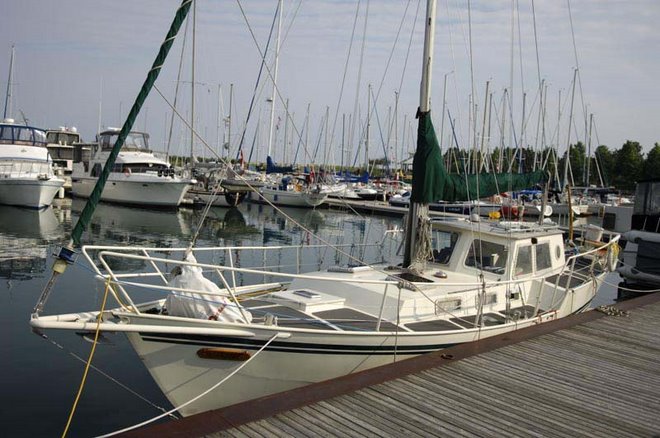
Beautiful, fast and sea-kindly, even in freshwater seas. Photo (c) 2011 Jeff Cooper
This is an unusual post, because it's an edited repeat of my first and apparently ineffectual attempt to sell Valiente, my 1973 Ontario Yachts Viking 33, and is linked to my ongoing Kijiji sales ad, which may not be giving the fullest picture of the boat's qualities and therefore I'm going to repost the Kijiji ad for a few more days until I fling this at a broker at a higher price. So act now and get sailing in the spring! I will help launch the buyer in the spring and will give basic instruction in how to sail her, because she's a very good boat that I wish to see go to a good home, or dock.

Photo (C) 2006 Matt Phillips.
It's been a good run, but it's time to simplify our situation regarding the "one boat surplus".
Centrally located slip, as well. Talk to me, people.

1973 VIKING 33 Hull #32 FOR SALE

1973 Viking 33 in middle blue. I have owned her since 1999.
Atomic 4 engine rebuilt in 2006. Some 150 hours run time since then.
Stock 35 amp alternator. Coil replaced in 2012. A4 crank included.
Fuel system replaced in 2006. Water-fuel separator and raw basket filter.
Vetus waterlock with 2007 exhaust hose.
10 U.S. gallon Tempo fuel tank with 5/8” vent line, new in 2007.
Whale Gusher manual bilge pump with handle.
Whale Sub 650 electric bilge pump…needs servicing.
Guest 10 amp battery charger; 30 amp shore power circuit.
Traditional stuffing box, repacked 2013.
All original gate valve seacocks replaced with ballcock valves.
30 Imperial gallon holding tank.

And excellent light-air performance.
Custom-built anchor roller adds about 15 inches to length overall (LOA).

A very useful addition.
Slip at Marina Quay West, Toronto is potentially available with the boat. 
2015 cost: About $3,100 for the season.
Gori two-bladed folding prop 11.5 x 8.
I gained about a 1/2 knot when I installed this.
ICOM M-45 VHF radio.
Seafarer III depthfinder (from the '70s, but quite functional!)
Most deck gear backed with custom-installed, quarter-inch aluminum plates.
Custom teak-mounted amidship cleats.
New wiring to batteries, new main battery switch and terminal blocks (2013).
2011 Garhauer triple-block mainsheet, newish 7/16th inch jib sheets and traveller control lines.
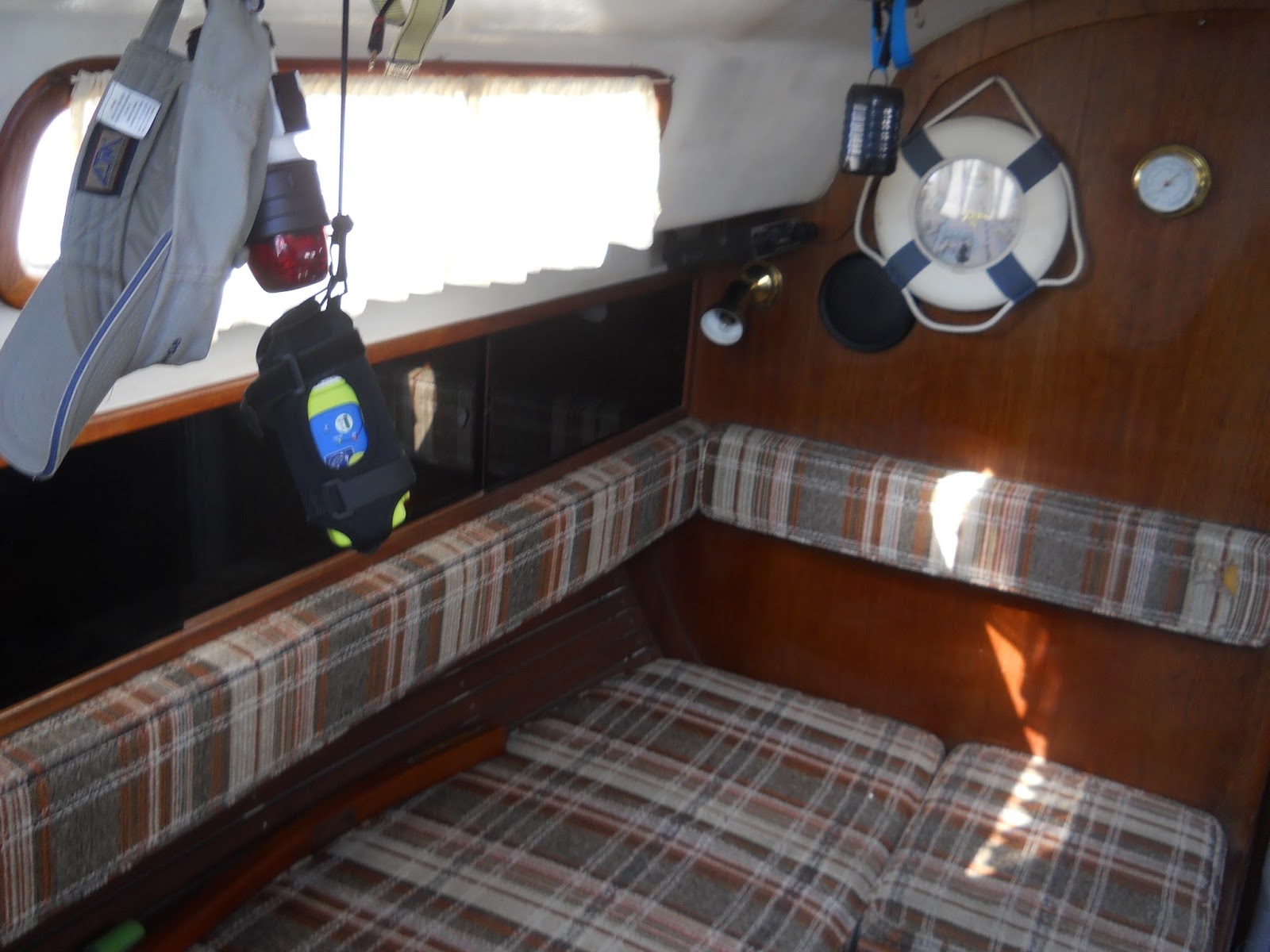
Teak and holly floor, and, alas, original upholstery...sorry, "vintage".

Double berth and all of my stuff is out of there now.
Bright, airy V-berth and hanging locker.

The engine is under this companionway....easy access.
Full navigation station and chart storage area.
Full set of dock lines, plus “away” dock lines.
Danforth 22 lb. anchor and chain and rope rode (approx. 13 feet of chain and 150 feet of line). Hawsepipe opening with SS hinged lid. Barlow 26 primaries and Barlow 20 secondaries, well maintained.

Elbow grease brings back the gelcoat in spring.
I like labels.
New folding boarding ladder 2013.
Run for the boarder.
Electro Systems propane/gas sniffer.
Legal complement of flares and extinguishers.
Two lifesaving rings.
Heaving rope, elderly LifeSling.

Standing rigging (1/4 inch 7 x 19 SS wire) fully replaced in 2013 via Genco Marine, Toronto.
Yes, she's fast.
Extensive sailing and engine spares inventory.
Many spares available. Thorough maintenance logs available.
Force 10 rail barbeque.
Custom light blue fitted cockpit cushions.
Six-pad Marine Cradle Shop cradle. Custom-made Quinte Canvas tarp frame...needs replacement tarp.
Rudder repair, 2012:
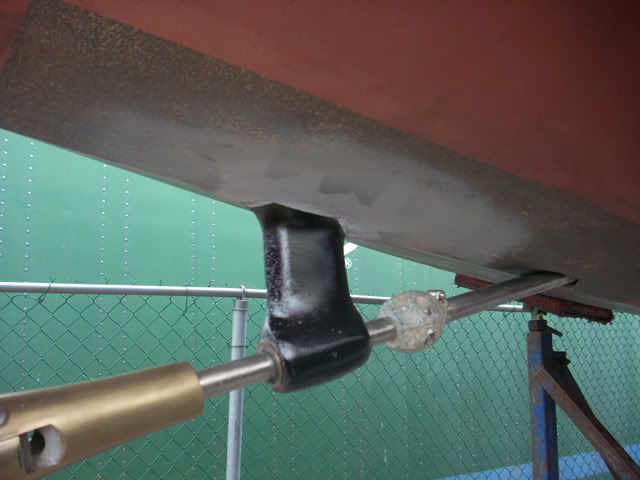
 
This needed a touch of fairing forward of the strut. There was no structural issue or misalignment.
There is a saloon table aboard and a new table support base, but as we don’t use the table, I haven't installed it.
Sails: the main is relatively new Dacron and there are a wide variety of "less old" sails that will come with it. Quite frankly, I've got a lot of sails "in reserve" hanging in my garage. I have things like lightly used Mylar No. 1 and 2s in the garage off a C&C 34 (Aristo out of NYC) that can be converted to hank-on for about $150/sail. I've done this with the Kevlar/Mylar No. 1 and a previous main, but the current composite No. 1 is getting a bit tatty. We carry a No. 1, 2 and 3.
Keel fairing repair, 2010:
Items not included in the sale: Triton asymmetrical chute, foredeck whisker pole, Fortress FX-23 anchor and rode, 10 foot Portabote, and the sailing repair box, the “crash box”, the camp stove and all tools and personal effects. The customary big bag of "make us legal" keyhole foam life vests remain. They make good headrests.
I would also throw in some Atomic 4 spares as I wouldn't be needing them anymore, including extensive documentation, some gaskets, various pumps and belts, the stock alternator and so on.
If the interested party is in Toronto, it may be possible to "inherit" my 30-foot slip at Marina Quay West, which I would think is a big incentive, unless they really want to be in a yacht club.

Price: Deal with the broker or make me a decent offer. "Decent" is probably less than you think.

Ooh, shiny.
The main downsides are the original upholstery, which looks worn and is plaid, and the fact that Valiente needs a redo of the ITT Brydon head, because we essentially just day sail her. So while there's not a lot in the way of amenities...she just sails really well.
Frankly, if I could bag this boat and retrieve it when we return, I would, because I believe it's a really good, fast, strong and capable boat for sailing around the Great Lakes.

Interested parties are welcome to search my blog www.alchemy2009.blogspot.com for posts on "Valiente"; there are records of the many fixes I've made in the last few years, because I've done them on Valiente first before doing them on Alchemy.

2016-01-01

Time and tide

The tender's come adrift!
Interesting start to what promises to be an active year on the boating front. Having arisen rested and refreshed from the festivities of the last day of  2015, I checked my e-mail only to see that my only inbox entry was from the manager of my boat club:
"I wanted to let you know that when I arrived at the club this morning I noticed something that’s been stored on your deck has come adrift and is about to fall off your port side.  You may want to come have a look at your earliest opportunity to avoid any damage."
Auld line snagged?

No, just a knot flogged loose. The Portabote in question, The Permanent Crimson Assurance, had slid its lifting body-shaped self from the pilothouse roof, but was constrained at one end to a rail. Looked worse than it was, really. A few pokes with a ladder and a few fresh lashings later and it was returned to non-alarming status.
The hatch view, 2016: Boom and Bote back. Note the El Niño effect in the absence of ice in the basin.
I took the unscheduled visit to bring down some coveted Yuletide sailor-type presents I received from Mrs. Alchemy and the increasingly taller Cabin Boy: a pair of ship's clocks (battery type) I have asked "Sailor Santa" for many a time. The left-hand clock is a regular clock with a tide arm: you figure out when high tide is at the location you are, move the red arm to the middle of it, and then you know as long as you stay in the same spot when the tides are. In much of the world, this is not particularly dramatic an event or even critical knowledge to possess, but if you are, say, getting in a tender in Brittany or Nova Scotia, to return to the boat, you very much want to know the hours when the tides are at their lowest ebb. Saves on rowing, screaming.

The sharper-eyed will note that the Zulu clock is not, in fact, set to GMT. I want to "rate" the clocks to see if they run fast or slow compared to a trusted source (a radio time signal) and I'll adjust the Zulu clock later.
The second clock on the right is called by a number of names: "Zulu" clock (from the old terminology of calling 0000h Greenwich Mean Time (GMT or "Zulu" or "Z"), a "radio room" clock or a 24-hour clock. Even though the Greenwich time as a "standard" has been eclipsed by "Coordinated Universal Time", an internationally standardized measurement that involves atomic clocks and virtual longitudes and not things that tick in perfidious Albion, a lot of sailors still use the phrase "Greenwich" or "Zulu" for the nautical associations, as the whole point of agreed-upon time standards was driven by that need to determine location at sea. Indeed, it's still called nautical time, and involves some radio usage conventions I will discuss once I've fired up the SSB aboard..

A product of the British Empire, minus the sunset.
For the purposes of using a sextant or a radio, convention states that there's two types of time, "ship time", which is just the time on the boat reflecting local noon and which will be advanced or rolled backed based on longitude east or west of Greenwich's longitude, and the time it happens to be in Greenwich, now inside London, but once an observatory with a sideline in longitude. The story of the painful ascertation of longitude in the 18th century has been told elsewhere, but the upshot is that if you know local noon (discoverable via sextant aboard one's vessel) and you know the time in London at zero degrees of longitude (an arbitrary distinction that is nonetheless essential), you can figure out where you are on the surface of the oblate spheroid we call home. Particularly the damper parts in which we are interested. 
Looking over the deck of a Whitby 45 to the west to reveal the under-snowed New Year's Day.
Anyway, the installation of radio room clocks suggests the installation of a radio, in this case, an ICOM M-802. While it makes more sense to do that with the mast in and the weather warmer, the prep for that will precede it in the form of a house battery bank and all sorts of special wiring and installation provisions to keep our "rig" fully functional and, naturally, bone dry.

The year 2016 will likely be the last one in which we live in our house, either because we'll move aboard or sell it for a smaller house which we will rent out entire, instead of having two pairs of tenants (more money, but also more headaches). Despite my recent run of silence, I expect the pace of change and improvement to continue this year, as well as the actual adventure of sailing our passagemaker. With intent.

2015-11-23

Mainly, over the winter

Drooping fenders Photoshopped out to avoid bruising the eyes of the sensitive...photo (c) Jeff Cooper

When I last discussed the topic of Alchemy's main, we had yet to actually sail with it. Well, now we have, and we and our sailmaker (Ron Fernandes of Triton Sails) have judged it's worthy to keep as a spare. In the meantime, as previously mentioned, it's been taken to Mississauga to act as a template for a new, 9.5 ounce, roachier, heavier-built new main.
It's only laid out on a floor that the curve of the luff and the "belly" of the sail are apparent.
I have the Tides Marine measuring kit and will order that gear shortly with American dollars put aside for such things. Ron concurs that it's a good choice for offshore, combined, of course, with mainsail lazyjacks to "tame" the now-reliably plummeting main. The combination of a main designed to be loose-footed, but with full battens (chafe-resistant patches in the right places) and tripled, UV-resistant stitching and reinforced grommets seems to be the way to go.
The little bits of line are called "reefing points" and allow an orderly capture of the unused folds, or "bunt" of a reefed-down sail.
The actual location of the reef points, which can be thought of as "gears on a sail" as they act to reduce sail area and therefore the ability of the wind to drive the boat, is still to be discussed. I favour a deep first and second reef for Alchemy, based on the her rather high S/AD ratio, i.e. she likes a good breeze to get going, although she will move in the light stuff, and this attitude is premised on a full hoist into the low 20-knots apparent wind range, but a deep first reef in order to take gusts to 30. The second reef could leave as little as 40% of the main's area still in play, or as John Harries puts it "the third reef". The question whether or not to use a storm trysail is still an open one, as of yet. I want to deliberately sail Alchemy in crappy, if transient, heavy weather here on Lake Ontario (if I can find it, and I seem to have that knack, alas) to see if even a fully reefed new main is too much when we intend to keep actively sailing, instead of hoving to. So more research and opinion-culling is called for, and I will be discussing in January my conclusions with our sailmaker, who is a genial fellow and seems quite pleased to be doing a relatively rare for him (given our inland locale) "offshore" mainsail.


2015-11-03

Hauling glass and metal...


I like full keels and I cannot lie.
Haulout 2015 is done, somewhat wistfully. In the case of Alchemy, hauled October 24th at National Yacht Club, it's the mixed emotions that we got two months with the stick in, the sails pulling and the fuel filter system complete and (so far) without flaw...and that we got just two months. Still, a lot was done and my cheerfulness has increased thereby.
Stand back, everyone...

Alchemy went up and down without much fuss, although despite a few launches and haulouts without tow assist now, I still get the odd club member (most are) expressing surprise at seeing her self-propelled. I've known for some time that as a boat restorer, I'm a bit of a club joke, having taken years to show progress visible to anyone not actually doing the work, but I feel waving goodbye is more than enough by way of seeing honour satisfied. Speaking of which, we are discussing, prepartory to leaving, downsizing our house; more on this over the winter. Down went the boat, and I'll winterize tomorrow as, after a chilly and gratifyingly breezy October, we are in a days-long warm stretch conducive to such tasks.
Angles like these really show her volume.

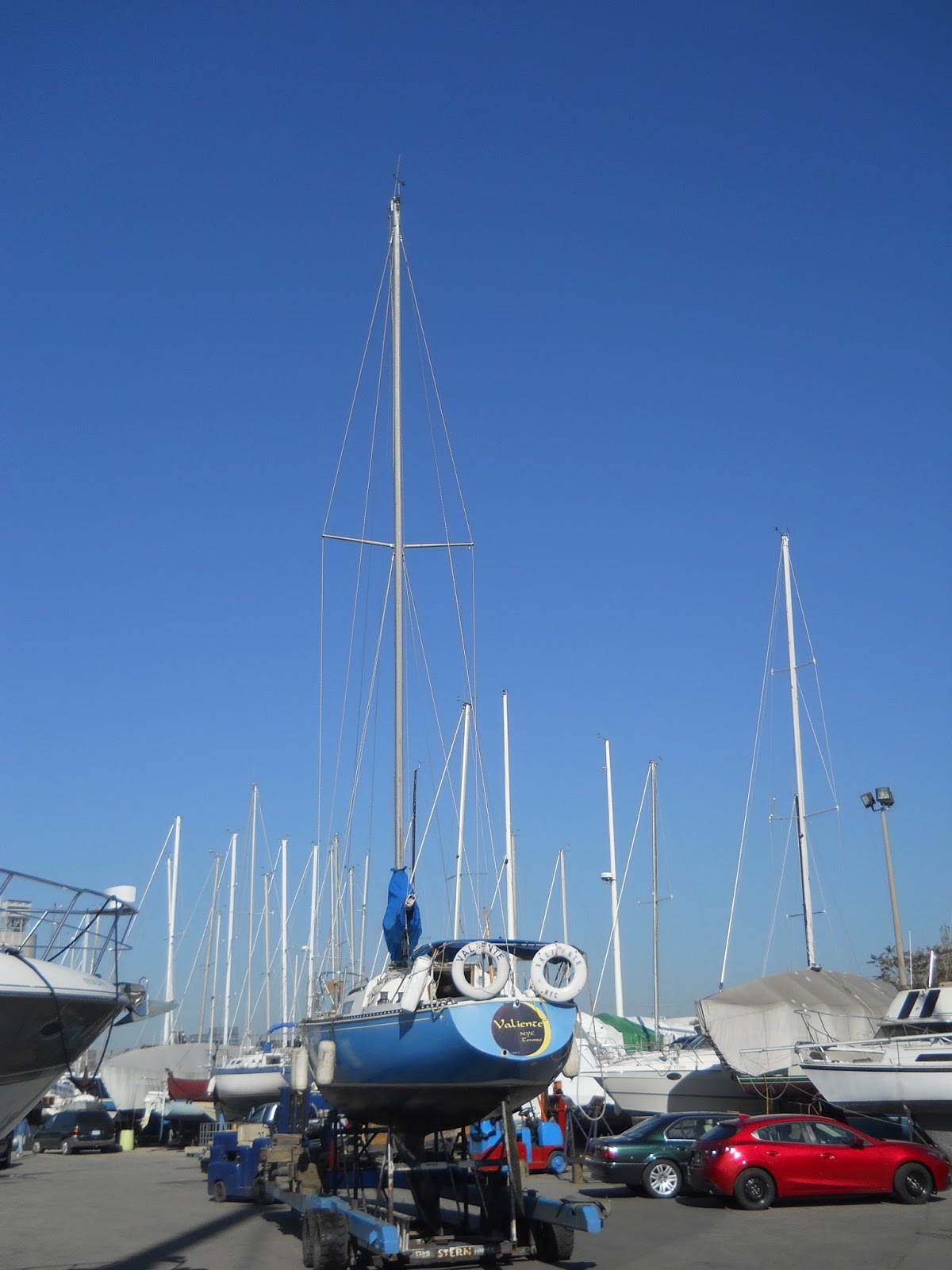
Valiente was put on Kijiji last week at what might charitably be called an "incentivizing" price. I got over 350 views and a few phone inquiries; she's been shown (on Sunday, in the water) once and will be shown on Thursday in her cradle, as today was her haulout day. Haulout at Pier 35 off Cherry Street is dirty, because the place is dirty and is abaft a very dusty recycling plant, so the boat is no longer as pristine externally as she was a few weeks ago. Still, a bargain. Felt sad, but then I felt sadder still when I wrote the cheque for winter storage. Sentiment is dangerous to a sailor. Dangerous to the wallet.
The view forward to the east end of Toronto's Inner Harbour. The bike is to get home from Cherry Street.
I have to admit, however, that I couldn't devise a better day to haul: full sunlight, about 5 knots of SW wind to ripple the waters, and temperatures in the teens that required that I shed my sweater by 1000h. Not bad for November 3rd.
Middle right is Marina Quay West, which, despite liking the place and having been treated very well, I hope not to see again soon. Time and salesmanship will tell.
The usual ill-tempered staff (they are competent enough, but the seamanlike language predominates) threw the slings to the marks and up the relatively compact Viking 33 went. Note the placid waters. Much nicer than years in which 20 knots made for exciting crane operations.
While Valiente's hull is flat enough not to require sling cinch belts, I've never seen them in use here, even when a full keeler (see below) is getting hauled.

Just before I arrived, the booze cruiser behind my stern was having its 75-person liferafts removed for a May 2016 recertification. Some actual commercial marine work at Toronto is not often seen.
I deem the VC-17's antifouling performance this year "meh". Let's hope the next owner switches it up.

The slings landed on the pads, leading to more profane pantomime.
After some wobbly repositioning of cradle and slings, Valiente was down and off to her cat-beset winter sootery. Let's keep collective fingers crossed that this Very Good Old Boat is sold the next time I write about her.
Bye for now! And yes, I will winterize the engine and remove the main later this week. Frankly, I want the boat to look like a boat for as long as I'm showing her to potential buyers.


2015-10-20

Unsticking and other season-ending events

Bye, bye, summer!
Some might see our efforts to put up Alchemy's mast in August only to take it down in mid-October as fruitless or even silly labour. Clearly, we disagree. The exercise was very useful (and was also good exercise) in determining where and how best to run sheets and halyards, to do the small repairs due to the long hibernation of the mast in the club's racks, and, of course, to get the mainsail measured in preparation for a new one with an improved batten car setup.
Blurry, but repaired, jib topsail in full effect.

Next season's head start also included a new and seemingly effective installations of a VHF antenna and a blindingly bright tri-colour/anchor light/strobe, and the afore-mentioned halyard replacements. We also marked on our solar arch the location of the passage of the twin backstays, meaning that particular bit of custom work can be altered to accommodate all four panels as designed.

Once more unsticked.
But the real benefit of getting in a few actual Alchemy sails in was of course to crew morale. A great deal of the last few years has been spent either research in front of a computer screen, designing things in front of the same screen, drilling and bending things in a garage or installing things in an often cold, dark and cramped area of the boat. To actually use the thing was a great joy to myself and Mrs. Alchemy, and provided a real boost to further off-season labour in the cold and dark, which is less dim and miserable a prospect when lit by memories of  late summer's sailing. We learned a lot, and even if the semi-symbolic nature of an August "start" can be justified by the better state of prep next spring, it's been a blast this year to even drive about staring at a mast base.
It needn't be complex. It needs to be on the outside helm binnacle.
The sail control lines are working well, but I do want to install a third pair of winches for speed, and will do so after I install a new traveller this winter. The rehabbed Lewmar 44s I picked up some time ago should do nicely. Once again, it's been a case of me springing on a deal of sorts well before it ends up being installed. Revealed over the last two months were the rather pressing need to install a second throttle/shifter at the outside helm, as my ability to see the dock is assumed rather than actual from the middle of the pilothouse, causing either a sudden backing down or calls to "go around again; you're six feet off". Luckily, the shifter, engine and four-bladed prop are working very well, and I fancy people think I have a bow thruster, given the tight maneuvering we are capable of. So...that's promising, but I need to dock from outside.

Not seen: the 35 knot gust that happened while this massive ramp was briefly 10 feet in the air on a club forklift that impressed me by not falling into the lake. I was handling the tiny yellow rope in the foreground.
Amidst personal boat stuff, there is the club preparation for the months of not-sailing. Above is the dinghy ramp, sturdy enough to have a trailer and not necessarily lightweight boats on it, plus any number of kids learning to sail. It would be damaged were it to stay in all winter, so out it must come. The wind was constantly over 20 knots yesterday, and often crested 30 (I checked with the nearby airport weather info site for pilots) and it was a cheek-reddening sort of day.
It got even wavier (two to three metres) later.
I'm on the Mooring Committee, as I've mentioned before, and we seem to do (without exaggeration, I think) a lot of the tougher jobs, such as keeping the moorings serviced, moving disabled boats, and lifting heavy things up and down. Yesterday we discovered, while looking for a boat reported missing, a second boat which had chewed through one of its two mooring lines.
Speed was in this case of the essence, so we took the water taxi instead of the heavier, more powerful work boat.
It's no joke to re-reeve a mooring line on a boat and a water taxi that are both in motion of differing periods. Pictures don't do justice to just how much of the lake was sloshing over the sea wall, but that spouting wave hitting the end of the airport runway gives an impression.
Thar she blows!
After securing the boat above, we went to the far end of the basin, where an old Shark monohull was chewing its topsides on the eastern seawall. A quick tow to safety and too much time trying to push a line through an abandoned fender later, and the owner should buy us a beer.
 
Two hundred-odd kilos of get you offshore, fit to be tied.
The same mates from the Mooring Committee were kind enough to help when Alchemy's now extracted (at sunset the previous, less windy, day) stick needed to be racked for the winter. Friday and Saturday are "Haulout", a melancholy, if in these parts necessary, duty.
While a more complete paint-job will happen in spring when I can get underneath it, Alchemy's cradle got some Tremclad love today.