Copyright (c) Marc Dacey/Dark Star Media 2006-2020. Above photo (c) Marc Dacey. Powered by Blogger.

2011-09-06

Frigate (insert own rude pun here)


While it's logical and indeed expected to note that the majority of my readers are American, some of them might not instantly recognize that I, my family and our boat are not. After all, we appear to speak a common language, and over large parts of the land mass that we share, after stealing it from the natives, it's often difficult to distinguish in a physical or geologic sense where one country ends and the other begins. Indeed, a bone of contention among some of the previously mentioned aborginals of North America is that they don't much care to flash passports at the Canada-U.S. border as in many cases their traditional tribal lands are on both sides of the imaginary line, much of which remains unfenced, and despite various security initiatives, unwatched.

Living in Canada and writing in English on the internet means a lot of contact with Americans, who, when they think of Canada at all, do not see us as a particularly belligerent bunch, as a sort of self-deprecating politeness seems to be our collective sociological trait, where we can be distinguished from Minnesotans or Vermonters at all (save for les Quebecoises, I suppose, whom Americans sometimes think are found everywhere in Canada in large numbers).

And yet like many other Commonwealth countries like Australian, New Zealand and even the Gurkhas of Nepal, we have been and continue to be quite a feisty bunch. The current debate about fighting in hockey in Canada would be unlikely to happen elsewhere, as apart from MMA and boxing, there are very few sports in which out-and-out brawling is considered part of the game. Even rugby is arguably less violent.

Which brings us to Canada's often-derided armed forces. We possess a vast country and a diffuse population, which, while wealthy on the scale of nations, is not really numerous or threatened enough to justify the sort of army, navy and air force that would impress a middle-rank dictator. Indeed, more than one American has alleged that Canada gets a "free ride" in terms of our own military defence, although one might say "a free ride from the enemies of America, perhaps", but that wouldn't be true, either.


The truth is that our compact military has been at it for years at the a large human and financial cost since the Second World War, during which Canada fielded disproportionately large navies and armies. We once had an aircraft carrier, for instance, but it has since made more sense to have frigates. Recently, as a "last day of summer holidays treat", we saw one of our own, HMCS Montreal. (The other treat was a honking fast sail in Valiente.)
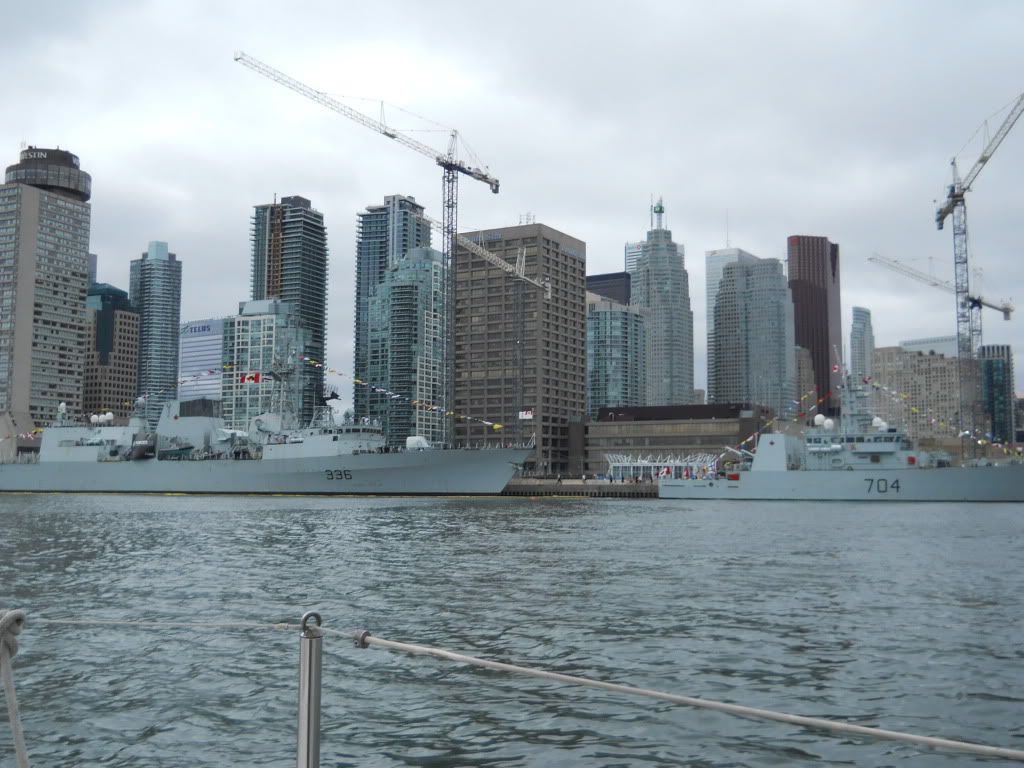


Montreal and two smaller minesweepers are currently patrolling the Great Lakes...for what is not precisely clear, but I'm sure the crews appreciate not being in their usual Atlantic patrol areas in September.

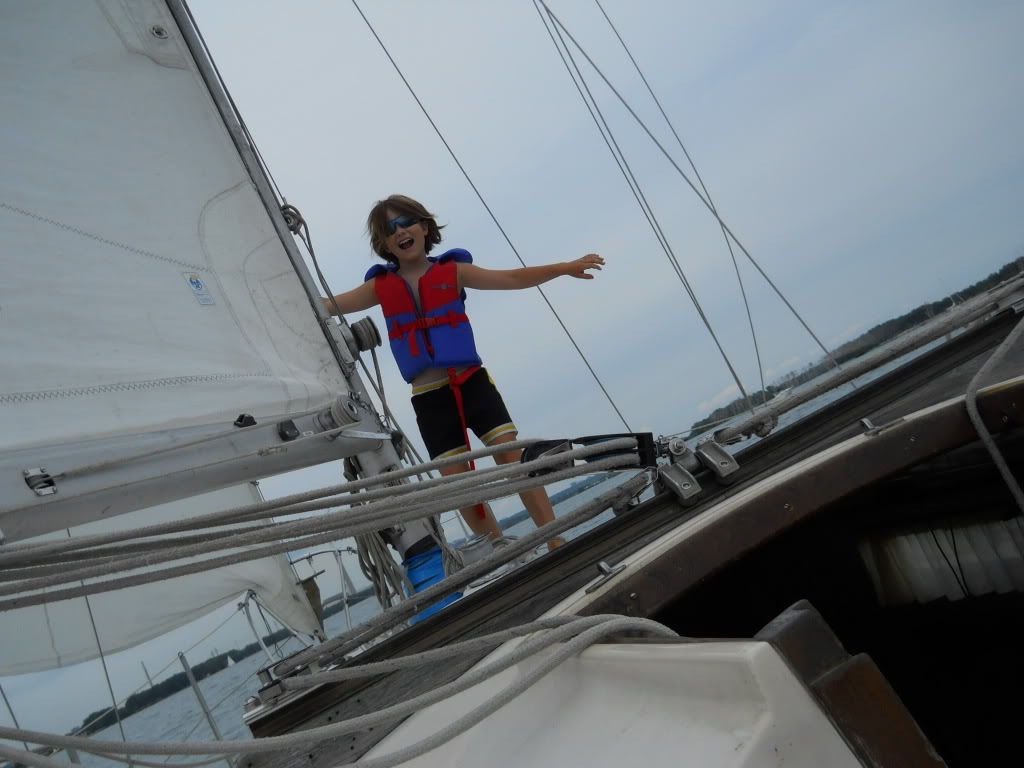
Our son, Mr. Cabin Boy, appreciated the opportunity to see large red buttons reading "ARMED" and "FIRE" and to field-test the rigidity of the deck gun. For a non-taxpayer, he has some firmly held ideas on what constitutes value.


Dad, meanwhile, appreciated those aspects of a 480 foot frigate that have application in his own steel hulk of approximately 1/12 the length...and it's more than one might think. Their liferafts look bigger, but are still recognizably liferafts.


The ground tackle, while impressively sized, was also not radically different in design, although the forces involved in holding something this massive and lofty exceed my imagination.


The "devil's claw", used to secure the chain and relieve strain on the windlass (I guess "capstan" is more appropriate).


It's adjusted with this hulking turnbuckle thingie.


Which is in turn "adjusted" with a Navy-issue sledgehammer.


And the chain goes out via this suspiciously well-polished hawse pipe. Modern warships seem to favour a centerline chain deployment and anchor stowage.


Possibly the only compass I've seen that's nicer than our Ritchie Globemaster, but mine still has the hilariously named "compensator balls". The balls on this one must reside below decks, one assumes.


And clearly, one would prefer to "operate" this part of the ship. Alas, no.


As for navigation, I was gratified to see that they are no better equipped than ourselves in the paper chart department:


...although their RADAR is a bit more elaborate.


...and so is their plotter...


My favourite bit was spotted as we were leaving...HMCS Montreal has an interesting approach to deploying fenders:


No doubt effective!

While not personally particularly militaristic, I come from a family in which active military service has played a role, and I respect the work of our armed forces who are frequently given tasks at home and overseas for which our federal government seem unwilling to finance. The sailors aboard were courteous and well-informed, and seemed to welcome the opportunity to mingle with the public that pays for the ships. Given a world in which future conflict is likely to persist, I hope "big city visits" like that of the Montreal and her sister ships inculcates a willingness to maintain an effective armed force for Canada.


2011-08-20

And that's how the "Solar Stik" was made obsolete


A few years back, a company producing a solar panel mounting system called "Solar Stik" came in for some good-natured ribbing about its claims of maximizing solar panel output, which is often sub-optimal on boats due to angles and shadows from masts, etc.

Many solar-panel-equipped sailors, of course, have made for themselves various methods to optimally angle their expensive panels. It's not rocket science, after all: The "smartest" mount would track the sun all day, as the "equatorial mounts" on the better sort of telescopes move to keep a given celestial object in sight for long photographic exposures. Even better would be a way to tilt the panels relative to the sun's height, which varies with the seasons, and would make the tracking at the constant right angles at which most (but not all) solar panels produce the most amps.

Some people, of course, just bolt panels for "morning" and "afternoon" on their cabin sides, or on the lifelines when conditions permit, and accept that 1/2 of total output is better than a kick in the diesel tank.

This kid
decided to approach the problem using 800-year-old mathematics and by observing the growth of trees. Perhaps the key to fostering genius in the young is keep from them what is considered impossible. The Fibonacci sequence is, like Fermat's Last Theorem and Pythagoras's Famous One, among the oldest notions in Western math. And yet this young fellow figured out how a tree was better than a solar array when you don't have 300 acres of desert to lay it out in.

So, he may be onto something, but whether it will find application in the way sailors use solar energy remains to be seen. "Sun Tree on the stern? Sure!" One wonders if very light, flexible panels could be hoisted partway up the mast without coming apart in the wind, or maybe another solution would be to make flexible panels part of the mast itself.


2011-08-11

Tank battles


Meet Starboard McStainless, the 100 gallon water tank I hauled out yesterday. Nice piece of work, yes? Inspection port, threaded outlets and inlets, an internal baffle, very little in the way of scratches or rust. Why would I want to yank such a nifty tank out of the bilges of Alchemy, one might ask. And, with dimensions of 48 x 24 x 20 inches, and an engine room hatch of 48 x 24 inches, would I perform Moebius-strip contortions to get this beast out? (Not to mention the removal of the pilot house roof and the use of a truck crane?). It came out, in the end, fairly smoothly, although grabbing the thing in yesterday's high winds as I yelled instructions to the invisible crane guy via another guy on the side deck was quite stimulating.

But why? Well, here's the deal. The sibling to this tank, Porty McStainless, is identical, save for a top end hose barb that takes the deck fill hose, which snakes torturously through a tool locker to reach the break in the deck. The fill routine consisted of filling this port tank to overfilled status, at which point a hose would fill the starboard tank. When were they both filled? When the boat stopped listing and water came out the starboard vent.

The shortcomings of this method were many. Worse, however, from my point of view, is that these tanks are (or were) mounted on angle iron a good two feet off the hull. Filled tanks, or worse, ONE filled tank, actually made my steel boat a trifle tender, because the weight was too high. In somewhat heavy seas in 2007 (yes, Lake Ontario can throw up the occasional eight to 10 footers if it's been blowing 30 knots all day from the east or south-east), these tanks BOOMED as they flexed and sloshed as the boat pitched forward and back.

The baffles, they did nothing.

Lastly, those fine inspection ports were on the TOPS of the SS tanks...within one inch of the underside of the pilothouse deck. Unless one was willing to unbolt the tanks, take apart the hoses, remove the engine and yanks the tanks under the hatch, nothing was ever going to get inspected.

Well, that's not going to work, is it?

So I decided that I wanted to improve my boat's "stiffness" by getting the water tankage (which is the better part of one tonne and is "non trivial" in terms of ballasting the hull) lower, resting just off the hull in through-bolted angle iron supports (the bit I liked), and placed between the frames. For ease of handling and management and even for trim purposes, I'm opting for four approximately 50 gallon water tanks, made of HDPE, ideally. They will be small enough not to require baffles, and low enough to keep the weight where it should be, as close to the keel as is possible.

Something like the above, times four. Inspection ports are at knee height, all hose fittings are accessible, there is now air above for hanging awkward light stuff like fenders, pipe and lengths of hose (all secured, of course).

Why four tanks? Aside from the insurance that if one tank goes "bad", there's three others, we intend to get a smallish watermaker. The idea is that one tank will hold collected rainwater for "wash" water, water used to clean the boat, flush the head (a Y-connection allowing a freshwater flush or three of the head will get rid of many of the critters and sediments that would otherwise clog the works...apart from the usual traffic that can clog the works...), and do the onboard laundry.

The other three tanks would contain either trusted "municipal" water, or water we make ourselves while motoring in clean seawater. One of the reasons for having a double PTO on the new engine is to run twinned alternators to charge maximally the house bank when underway for the weekly holding tank pumpout, for instance. (Note to self. Make fresh water AWAY from pump out zone...ewwww....)

I will install two water fills (there is evidence one used to be on starboard, but is mysteriously under a welded plate), and will rationalize the tank vents so that even a capsize would be unlikely to put salt water in the tanks. I will also plumb these tanks so that I can pump water between them to keep the weight either high side on long reaches in trade winds, or to keep it in the forward two tanks for better balance.

Lastly, I will have foot pumps (I like the Whale type) plus pressure water in the galley. The galley will have the existing "domestic" tap set (pressure hot potable water from the hot water tank and the Flojet pump) and potable foot pumped water, and lastly, a hand-pumped seawater tap for "utility" wash ups.

It sounds complicated and expensive, certainly, but the decision to go with plenty of water tankage (it's the same amount in a different configuration, really), and a watermaker was not taken lightly, and is prompted by the same "shore-independent" set up that is driving the multiple charging sources design and the somewhat oversized battery bank capacity.

Everything's relative, of course. I understand 840-1000 Ah is not, in fact, as big as many folk with more amp-greedy gadgets than I plan to install already have.

Like this times three:

I just want to run my fridge and make the occasional SSB foray and netbook charging for five cloudy, windless days at anchor without thinking "damn, I have to fire up the diesel to make amps".

By the same token, 150 gallons of drinking water is considerable for three humans, even in the tropics. The ability to make it from the sea using amps made from the wind and the sun? Priceless.

Now, to get Porty out...

UPDATE August 22, 2011: The fine fellow who purchased the starboard tank phoned me to ask if I would trade it for the port tank (identical in size but the mirror image in plumbing fixtures).

So up it came. "Identical" in custom-made boat gear is a relative concept, as the tank proved about a quarter-inch wider than the hole in the pilothouse floor. Snug wasn't the half of it.

Anyway, using brute strength, 3D mental visualizations, and the Amazing Folding Wife, we managed to crane out the thing standing on its end, and away it will shortly go.

Now, to find a buyer for a starboard SS water tank!

2011-08-09

They're like seatbelts...for your boat!


On both my 33 and 41 footer, even though they are quite safe boats in an absolute sense, I usually wear my auto-inflatable PFD. While I make it optional for adults, all children under 18 must wear the foam type, of which I have a variety of the manual and autoinflate vests, plus a number of the foam type in a range of sizes for the kiddies and visitors.

Plus a bag of the obligatory old foam types used mostly as cushions, but which allow me...legally...to carry about nine adults.


Not that I do. But then I don't race the boat. Others have, and that's why there's a bag of untouched cheapo legal foam types aboard.


In addition, we have tethers and carry knives, Fox 40 whistles and the occasional strobe.


I won't even mention the waterproof VHF, the ACR personal locator beacon or the hand flare in a baggie I bring on deliveries. Let's just say I'm personally drowning-averse, as one is. And yet people drown across Canada, and elsewhere, with alarming regularity.

Let's just say we will be fully equipped...and fully habituated...to boat rules like "mandatory PFD wearing on watch, mandatory tether on watch, mandatory clipping on jacklines when working forward and no leaving the cockpit without waking a crew". These were the rules on my first Atlantic delivery, and, having nearly slipped out of the cockpit at 3 AM when we slid off a wave, only to be stopped by my tether, I see no reason to modify them in concept or practice.

Does this mean a full, awake, daylight crew in an angel's fart breeze on a tropical beam reach requires full time PFDs? Maybe not, if you can outswim the boat. It'll certainly leave interesting tan lines given the clothing-optional nature of passagemaking!

Now, when I sail alone, or when I am in either my Portabote or my sailing dinghy (about 10 feet each), I wear an old purple and yellow kayaker's vest. Why? Because if I'm alone, off or out of the boat, and *unconscious*, the bulky, unfashionable, hot and slightly stained foam vest will keep my head out of the water. I know this, because I've jumped off the boat and even when I relax, I can't easily even put my face in the water.

So even though I realize I might drown or freeze anyway, the vest means that if I am merely stunned, I might "come around" without aspirating water, which is perhaps the difference between a bad situation and a fatal one.

I've seen this new, "not USCG-approved" system by Spinlock called the Deck Vest, and I like the fact it's a PFD with crotch straps, with an integral harness and plenty of reserve buoyancy, and yet it fits closely. A crew, a Canadian army major, wore one on an Atlantic delivery and he was a pretty large guy as am I and he remarked on its comfort and utility. And of course if you are tethered, the crotch straps keep you in the PFD if overboard, and allow you to rotate yourself from an inverted position, as can happen.

If injured, but conscious, it would also aid crew in clipping the tether end to a line reeved onto a block on the boom, so it can be considered an option in a retrieval system.

You can't always save yourself or be saved on a boat...or off it...but thinking about why it's clever to wear a PFD when underway increases one's chances. Also, if you like to boogie on deck, PFDs protect you from inconvenient obstacles, like the mast.


2011-08-05

On the rode again


I have, as I believe I've mentioned, obtained a nifty 15 pound aluminum FX-23 from the fine folk at Fortress Anchors. It's designed for 39-45 feet LOA boats, like what my currently beached Alchemy is, and is therefore oversized for Valiente, my 9,000 lb., 33 footer that is the "operational" part of our Swiss navy.

C'est la vie: Nobody ever resented an oversized anchor that weighed 15 lbs. My nine-year-old can hoist it into the cockpit if I don't mind buffing out scratches. My compact spouse can haul away without resorting to the seaman's vocabulary.

The existing 13 foot chain and 200 foot rope rode on Valiente is three-strand 7/16" mated to slightly larger chain and shackled to a 22 lb. steel Danforth High Tensile anchor of indeterminate age, if relatively good condition. Certainly, it's the classic "lunch hook" and we've been using it as such. It has held in every unchallenging case we've thrown at it, which is to say it might as well have been a cinder block on 12 gauge wire for all the holding power demanded of it.

In testing the larger, if lighter, Fortress on this modest rode, however, we found it impossible to veer out in reverse under power, "under power" in this case being understood to mean a direct-drive Atomic 4 (about 17 HP) in reverse spinning an 11.5 x 8 inch Gori folding two-blade prop at 1:1 gearing in six knots of wind...not exactly a tractor pull. Nonetheless, we were concerned that the new, grippier anchor and the old rode were not a good match, so off to the marine store I went (And Princess Auto, like a marine store, only cheaper).

Not only did I want the security of a right-sized rope and chain (and shackles) rode for the Fortress's size, I wanted the opportunity to splice. 12 years of boat ownership, and it's never come up, even though I have sewed patches, reeved all sorts of line and have sealed, whipped and knotted many, many things. I have yet to SCUBA, too, but that's another post.


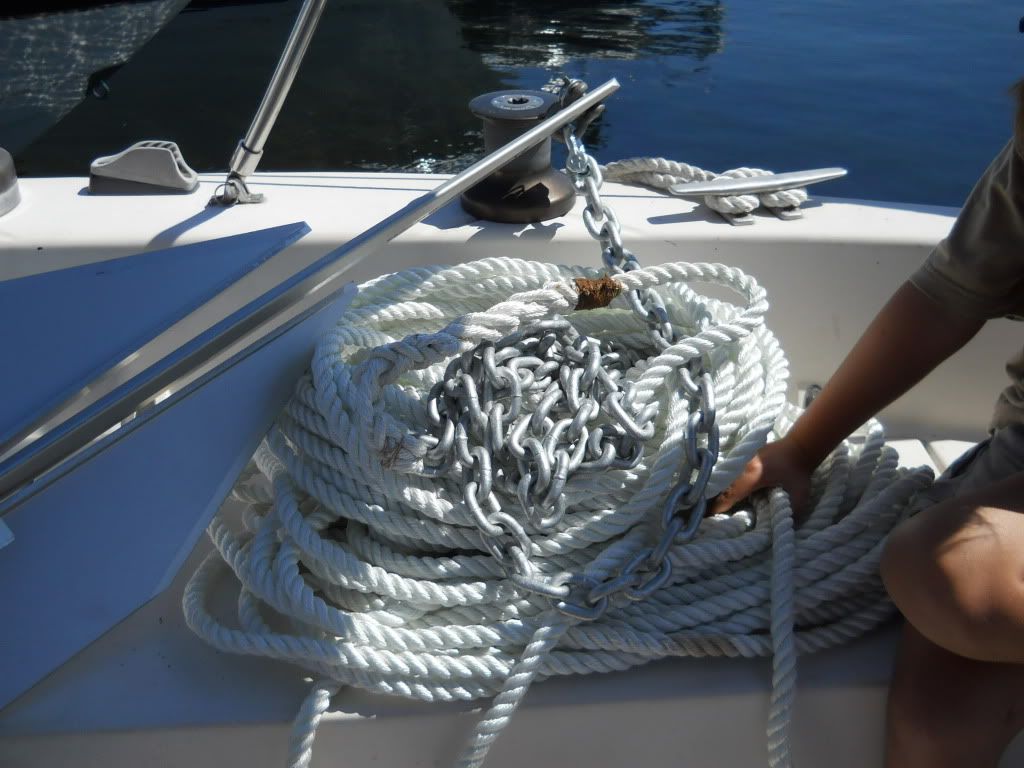
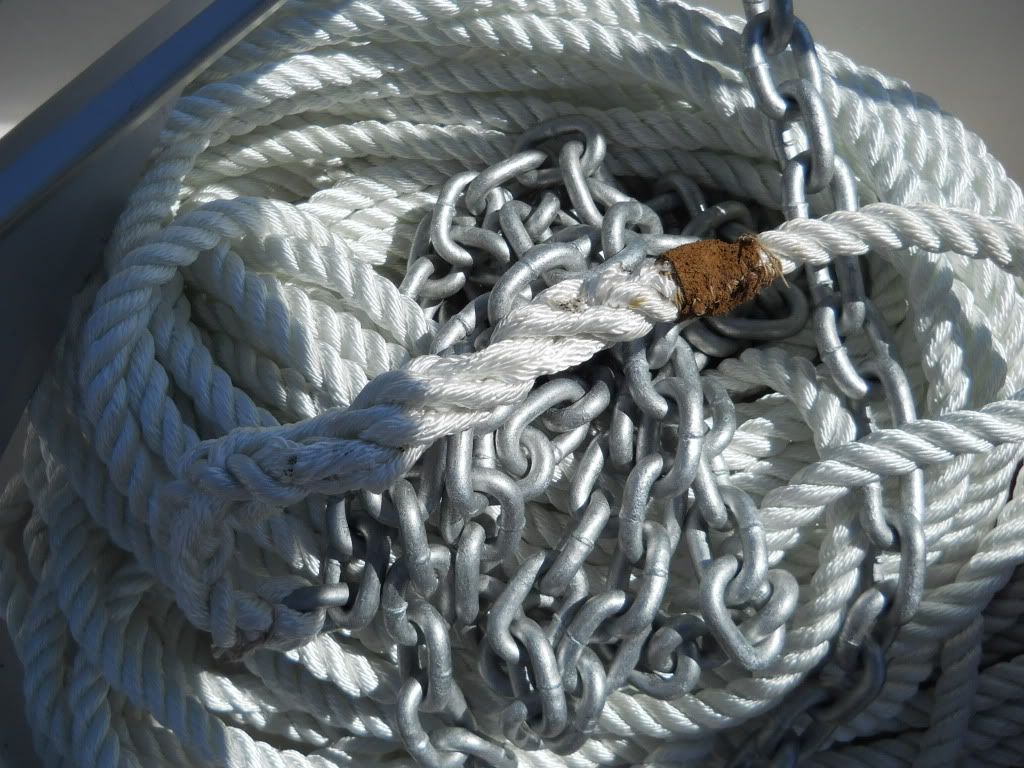
Obviously, more practice is required. I did test the thing, however, and 'backspliced' a full 18 inches, with three tucks before trimming instead of two. My biggest challenge was keeping the taped strands similarly twisted as they preferred to undo into a sort of yarn-like limpness, hence the somewhat irregular braiding. I suspect that this will actually look a bit better after use, and next time, I'm going to heat-shrink the ends instead of taping. The brown bit of leather is covering a spot of whipping I did to cover over the last pokey strands, and I did the recommended touch up with the recommended hot knife. It took about 90 minutes. I know, because that's how long my son whined "is it done yet?" from the shady, beveraged-filled cabin while Daddy paid court to Madame Melanoma in the sun-drenched cockpit, the scent of burning nylon vying with the smell of dead carp. Sailing: Come for the glamour, stay for the slaving.

The new rode is 200 feet of 5/8" three-strand with an 18-inch back splice (as this is my first, it's a little lacking in art and is untidy) to 15 feet of 3/8" chain. Shackles hold the anchor to the chain. This gives us 7:1 scope in 30 feet of water with a little left over, which is going to suffice 90% of the time in the Great Lakes and pretty close to 100% of the time in Lake Ontario.

I will leave the Fortress unshackled from the rode as they are awkward to move together. I also have made provision for the lashing of a light line leading to a float to go on the crown of the Fortress as an anchor buoy and, if ever needed, a trip line if we snag a log or something. I have not yet had a problem, however, merely driving over the anchor as I haul in rode and just yanking the anchor directly up. It comes up cleanly and the chain/rope/anchor combo is, I would say, less than 40 pounds...not a big deal for us and there's no budget for a windlass!


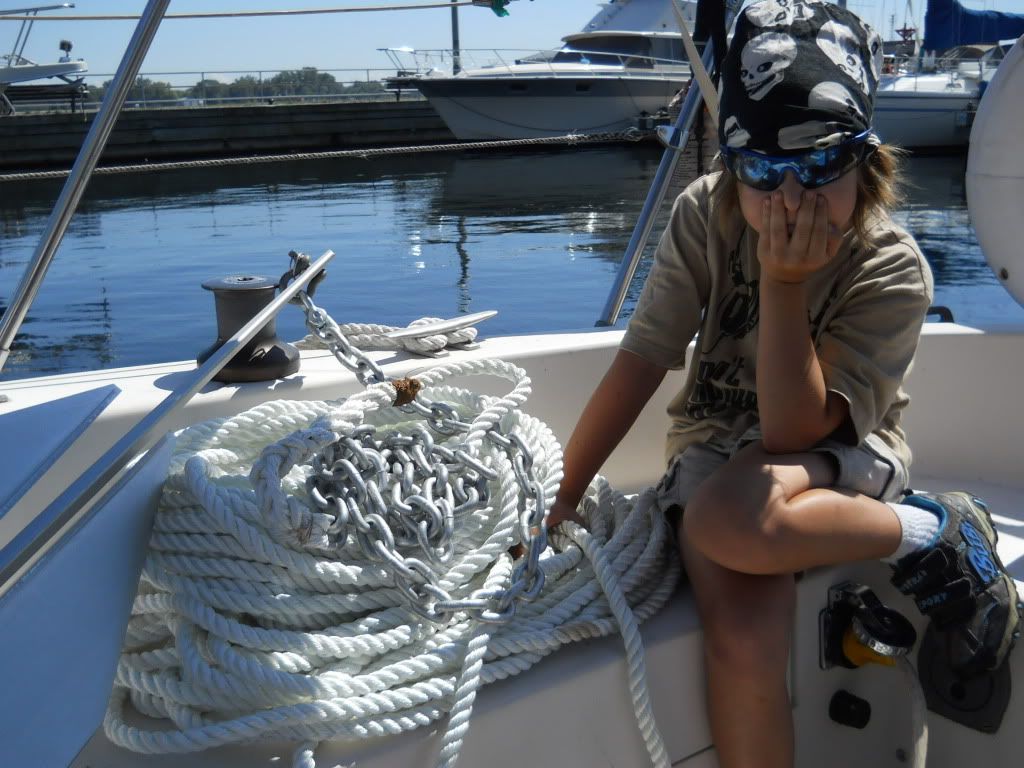
Note the expression of the crew when hearing the familiar refrain of "no budget for that".

We will likely use the existing "nothing wrong with it and it fits the anchor hangers" Danforth for a lunch hook, and bring out the Fortress and this new rode for overnight and heavy weather. As I intend it to be the lunch hook for Alchemy, it's certainly sturdy enough, and we anticipate sleeping soundly at anchor when we go down the lake in a couple of weeks.

2011-07-28

Look out, Portabote


I recently helped a friend sell a PVC Zodiac inflatable and a 15 HP Mercury outboard. Not much remarkable about that, but upon inflation and inspection, the Zodiac proved to have a rotten (as in "transect with poking finger") transom and more than one hole in its various parts.

The buyer, another, unrelated friend, was quite understanding and is endeavouring to salvage the Zodiac, while was just about worthless at time of sale. The engine worked fine, thank goodness.

My friend the seller had never used the thing, but it made me think of the damage, largely invisible in this case, that was done merely in storing a significant piece of boat gear between uses. As one does. Apparently, moisture was also stored with the rolled up Zodiac, and rot was the result.

Extrapolate this to the concept of a life raft case mounted on deck in all conditions, and the concept of "what happens at sea to gear we want very much the one time we really want it". Stuff like "emergency tiller/tiller head", "parachute flares" and "hand-powered watermaker" come to mind, also.

Our choice of nesting dinghy and folding Portabote was in part influenced by such considerations. One can be fixed via familiar epoxy repair and the other with glue and plastic, but both are fundamentally stronger than an inflatable (unless they come in Kevlar, I suppose). The point here, however, is that they are going to be used regularly; problems will hopefully manifest in a small way subject to easy remediation rather than in the "wasn't that supposed to inflate?" way that may be the last words uttered at sea for some unfortunates.

Well, although it's more toy than watercraft, some clever buggers have made an origami plastic rowboat.


Made from a single sheet of plastic (excepting the oars, I gather), the boat was designed in a paper-folding workshop that focused on generating 3D forms out of 2D drawings.
I would suggest they succeeded, although how stable the thing is remains to be seen. What it does demonstrate is that even the very clever and increasingly popular Portabote folder might be yet improved, lightened or made dimensionally more compact, which I would image those who see some compromises with inflatable may judge as a Good Thing.


Of course, there are other ideas on how to get to shore without getting one's feet wet (or semi-wet). I don't see these as practical for any place beyond a mill pond, but they do show innovation and that all the good ideas haven't been thought of just yet.

Consider the Shuttle Bike. It's a way to convert the average mountain bike into a water taxi. As someone likely to bring bikes along when cruising, this holds some appeal.


Or how about an Amphibious Bike? (Shh, it's only a model...)


Or if you can't ride, make like Jogging Jesus and stride across the wavelets.


How many of these concepts are applicable to the cruiser? Maybe none. Maybe I'll follow the herd (and not the Pardeys) and opt for a "soft" over a "hard" tender. (Note to foreign readers: "Hard tender" is one of those nonsensical phrases, like "jumbo shrimp", that litter English. Nautical English is particularly confusing.)

But we shall see, and in seeing, shall learn.

2011-06-17

Friday funny


This seemed to be of nautical interest in this morning's paper...

2011-06-11

Ahoy, readers! Artificial waypoint dead astern!

Sometime over the last 24 hours, this little "fixing a boat" blog, which was started in late March of 2007, crested 10,000 "distinct views".

OK, Steve Jobs, I am not.

There's a number of hobbies, fetishes and political/religious viewpoints of which not one of those 10,000 patrons has likely ever heard of that are more compelling and worthy of perusing. Reading traffic stats of websites is not exciting, but it's revealing, and "boat restoration/prep for cruising" is not remotely in the same league as watching reality TV or even translating Buddhist chants from Tibetan into Latvian. Nonetheless, I continue to post, as it's a diary of successes, failures and "teachable moments" for me and the crew, and the interaction with readers is something I've come to value greatly.

I do believe, however, that for such a protracted and specialized narrative, that the experience of blogging has grown from "cheat notes for the inevitable cruising book" into a sort of meditation on What It All Means via Boat Repair. You can spend time, money and sweat equity in fixing a boat, particularly when you start with such a poverty of manual skills and technical know-how as I, the boy who quit shop class for theatre because all the girls weren't in shop, possess in such modest amounts. But as I acquire, painfully in some cases, these skills, I am finding that my attitudes toward the work, the trip, the adventure and in some senses my own culture is changing. We have never been particularly materialistic in my family...not being rich will have that effect...but a sharp consideration of life aboard for years at a time has tailored expectations even more. What we really need is a fairly short list; what we would like to have has to pass a number of filters, such as cost, energy needs, maintenance cycle and spaces required.

In 2008, we weren't going to have a watermaker. Now, we will. We were going to rebuild the engine, now we have a new one. And so on. Charting the evolution of opinion and mindset both within and around the perimeter of "the project" is simple when rereading this blog, and even if it's only of personal interest to me, I have found it revealing and instructive.

As for what has proven popular, the fine folk at Blogger make that tally easy. Doom, realized or in potential, brings in the eyeballs. My entry on the 2010 Lake Ontario 300 race and its brief if intense, sail-rending squalls have been the most read post to date, with 507 "pageviews". Next is this post from 2009 about how realistic it is to recover a COB (crew overboard) in bad conditions. Over 400 readers found that sufficiently interesting, which confirms to me that nothing brings a crowd like a good accident.

After that, things tail off considerably, and it is clear that I am not writing for an audience. Fair enough...I am surprised to have had 10,000 reads in the first place.

My sincere thanks to my readership and to all those who have taken the time to comment and to inform.

And so the journey continues.

2011-06-09

Bright and butyl full


No, this is not a duplicate post of this one from last fall. It is, however, an illustration of how outside forces can derail certain aspects of the renovation schedule. Above you see a completed installation of the fab Newfound Metals portlights, for which I was grinding larger holes late last September. I had actually dry-fitted them as ye olde post describes, but I ran into a run of work, had to pull the other boat out of the water, had to secure permission for further time on land, made a fairly critical bit of ligament in my left arm n0n-functional trying to hand-lower big batteries off the boat (note to self: Warm up muscles first, then purchase small crane.)

Then we had an appalling winter and an appalling spring. Despite arm protests, minus the problematic waving, I managed to do a little work aboard, and replaced the plastic sheeting over the gaping portlight holes four times, and the tarp I keep over the pilothouse roof until I can find a replacement for the Atkins and Hoyle gasket that doesn't cost fifty bucks, a total of three times.

The good news is that not much else leaks. At the moment. We've had so much rain this year that if it did, the bilges would be awash. Awash, they are not.

I was able to prime the holes in April, but I only got time, sunshine and heat enough to mix up the Endura two-part epoxy paint I use for touch-ups this week. It was also an opportunity to paint over some scraps and dings, and, I suppose, a glimpse into the future, when I expect a weekly "hour of touch-ups" will be on the activities board of international travel.

The butyl pun, of course, refers to butyl tape, a humble and venerable synthetic rubber compound with the consistancy of bubble gum, a tendency to self-adhere, and a great ability to keep water out. Having found, while doing various repairs, gobs of "still alive"...as in still flexible and damp-feeling...butyl used as bedding and sealing material on the nearly 40 year old Valiente, I grew to appreciate butyl's qualities, which are somewhat passe in this age of more modern and glamorous polymers, compounds and sealants.
The real thing, as sold by the redoubtable "Maine Sail".


Nonetheless, I've decided in concordance with other boat fixers (a secretive and possibly inebriated clan of misanthropes for the most part) that butyl would be the way to keep the sea out of the pilothouse portlights, assuming, of course, that the negligent crew had remembered to dog down the lids when the wind piped up.


Who left the dogs up?

I wrapped narrow, snot-like strings of butyl on the trim rings (the outside SS rings through which the body of the portlight passes), going inside and outside the 1/2 inch little stubs into which the mounting bolts went. Then I pressed slowly and firmly on the rings until they stuck to the recently dried epoxy paint. You can see a little bit of extruded grey stuff above, which I will trim with a little Exacto knife...apparently a Canadian term, so for my southern readers, think "artist's boxcutter", I suppose. I used Sikaflex 291 on the bolts, using a "twirl around the middle of the bolt shaft" techniques I've found keeps the threads dry and yet allows removal if needed.

I created a second gasket around the sort of flange that pokes out of the boat a bit. Then I spent about a hour gradually tightening with my largest socket wrench the rather unusual 6 mm bolts I had to travel by bike to Etobicoke to obtain. The whole assembly, crudely cut "spacer" rings and all, is now practically welded together, and if leaks appear, they should be immediately obvious, as restoring insulation and panelling and wood trim that will bury that crudely cut ring is one of the last jobs I'll tackle pre-departure.
Prevailing winds come in here.


Note the little chain thingie at the top of the photo. That's the little clip that holds the portlight open as needed. I drilled a couple of boltholes in the aluminum roof "underflange" to mount them, but that area will also one day be restored to a more shippy, woody look and they'll probably go into a piece of glued wood at that point. Today's point is that tomorrow's rain will not enter the pilothouse, and the next time I'm there, southerly or northerly breezes will suck the heat out better than previously, previously being 1/2 inch clear circles of Lucite, bolted with 30 little bolts.

A last word on butyl: The aforementioned aluminum roof is, of course, through bolted to the inward top flange of the sides of the steel pilothouse. I have already repainted that flange, but will likely create nylon bushings and will apply goo of the galvanically isolating kind to keep the SS bolts from reacting with the aluminum roof, through which I have run and will run again considerable numbers of volts and amps for the various pilothouse gadgets, sensors and lights. In addition, I will use thin strips of both bedded HDPE plastic and a special sort of butyl used in roof sealing called EPDM rubber in order not only to electrically isolate the metals, but to keep the sea out effectively if we take a wave. I have found evidence that the bead of 5200, while personally challenging to my sabre-saw blade budget, was not entirely good at keeping out the water, which is not my idea of proper to a voyaging vessel.

2011-06-06

Rode work ahead


Even though I continue to repair and refashion Alchemy, it doesn't mean I don't tend to the needs of the old sloop Valiente. Getting her in fit fashion this year in the face of bad timing, daunting weather and the need to make money in Non-Boat Land has taken some time, but I finally got the ground tackle sorted.

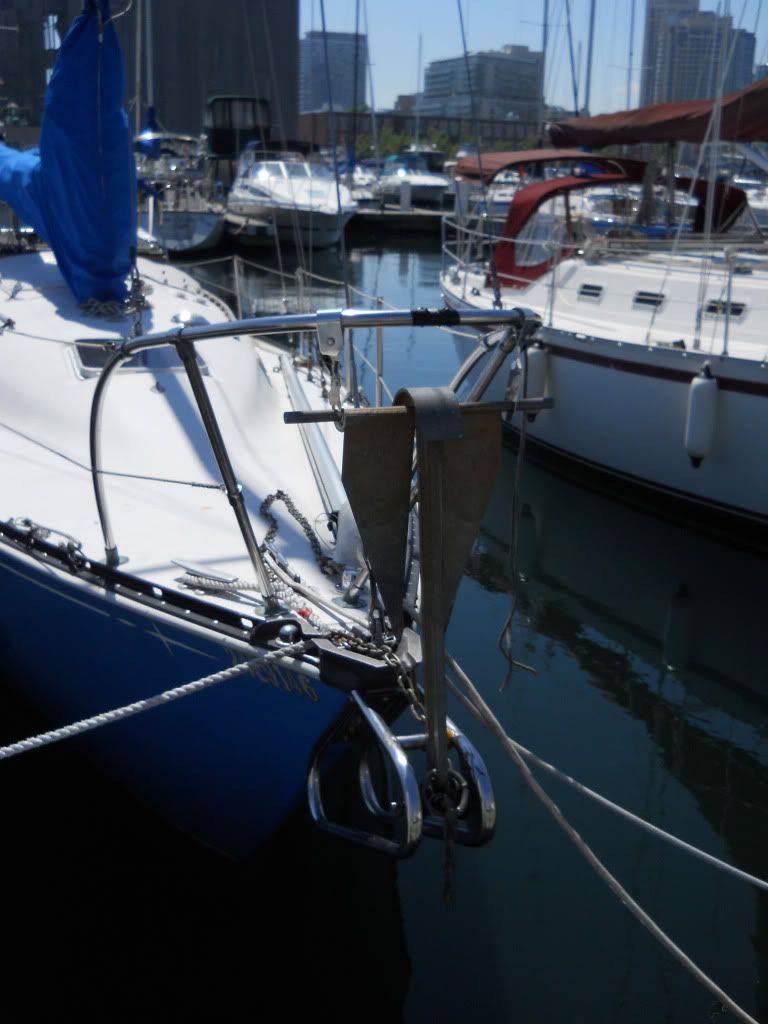
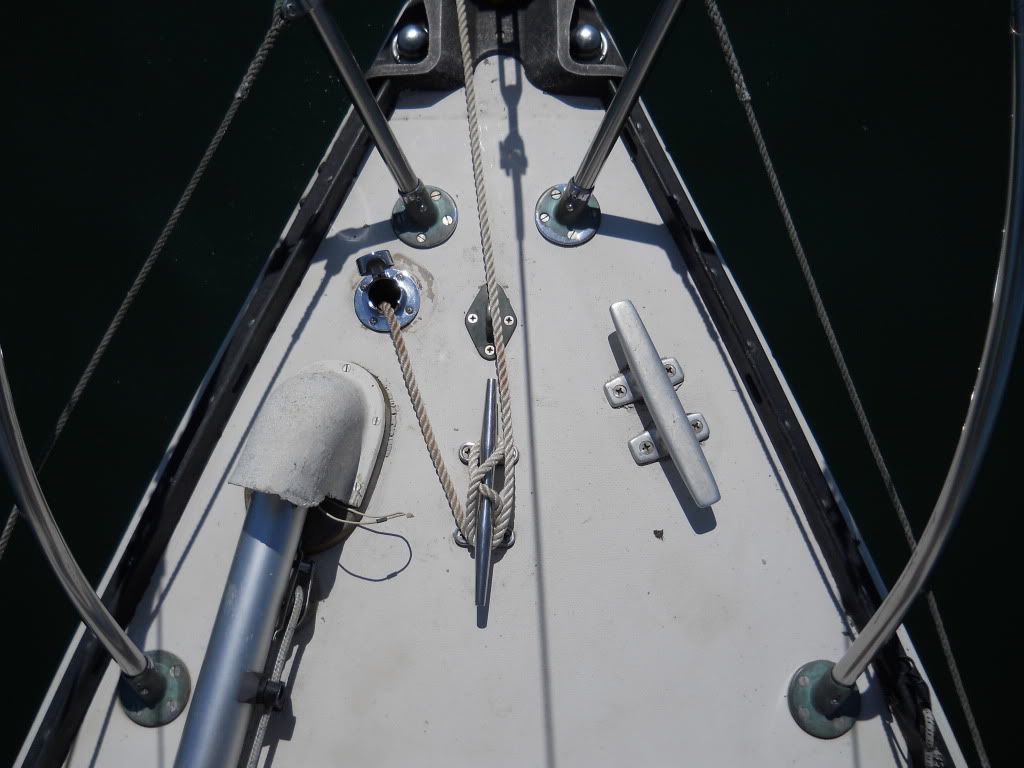
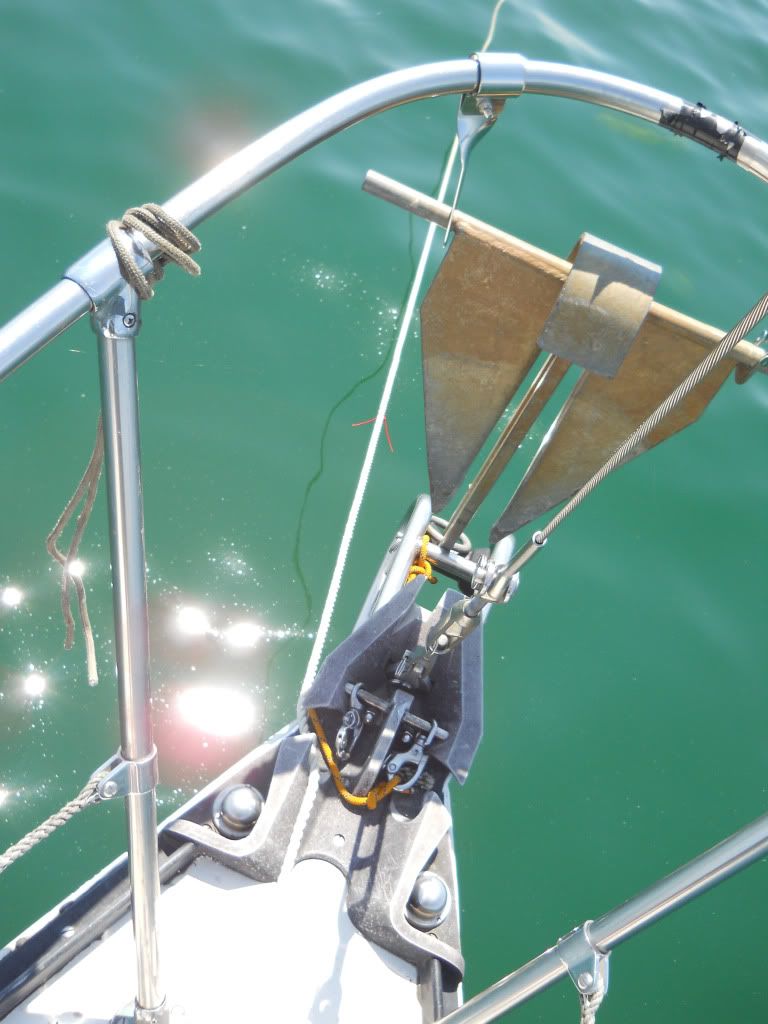
As can be seen, this involved putting on a short bow roller (salvaged from a C&C 35!) and a hawse pipe hinged cap (found in the "spares" locker at my club, and putting in anchor hangers (alas, I had to actually buy these). One club workshop-fabricated backing plate made from a length of genoa track later, one garage-fabricated U-bolt and backing plate installed in a bulkhead for the bitter end, and everything looked like it had been on the boat for ages. Mainly because it's old.


The hawse pipe (please ignore the dirt) can only contain the rode, unless I take apart the short length of chain. This is not necessary unless I am leaving the boat for some time and want to remove the anchor itself. This anchor, by the way, is a steel "hi-tensile" Danforth knockoff from (likely) the '70s. I will keep it as the "lunch hook". The "main" is of course the thing I didn't take a picture of, the Fortress FX-23:


That's the anchor we actually tested for the first time today, in admittedly benign (a mere five knots of wind, firm sand and grass bottom) conditions.

What benign conditions resemble:


Lacking foresight, means and a sense of nautical decorum, we simply used a fender to buoy the anchor, in case the somewhat modest rode parted due to the mighty backing down power of a recently tuned Atomic 4 engine with a wee prop, or the aforementioned sheer age of the thing.


But all went well. We let out 80 feet of rode in about 15 feet of water, which was, to be sure, only just over five-to-one scope instead of the recommended seven-to-one, but the anchor is sized for a boat 12 feet longer and the wind consisted largely of angel farts, so the recklessness continued unchecked.

In short, we held just fine. Veering hard in reverse did nothing...once set, the Fortress did not break free when subject to a mighty churning aft. Not fancying my chances with the rode, however (which I will size up to perhaps 1/2 inch or 9/16ths or something beefier, I think{I eventually purchased 5/8"
}), we merely pulled in the slack by hand, and, when directly over the anchor, a half-hearted yank upwards freed it and it was soon on the deck looking suspiciously clean.


So that test went in the right direction: sticking firmly when deployed, and easing out cleanly when hoisted.

Lurching into a crowded anchorage with 30 knot gusts and a square chop will no doubt prove more educational, but I suspect this anchor will rise to the challenge as it sinks into the bottom.

I will play further with the "as found in bottom of locker" steel Danforth to contrast and compare. I have a 33 lb. CQR and a 33 lb. real Bruce I could fling off the front as well, but it's best to invest in more robust rode first, I think.