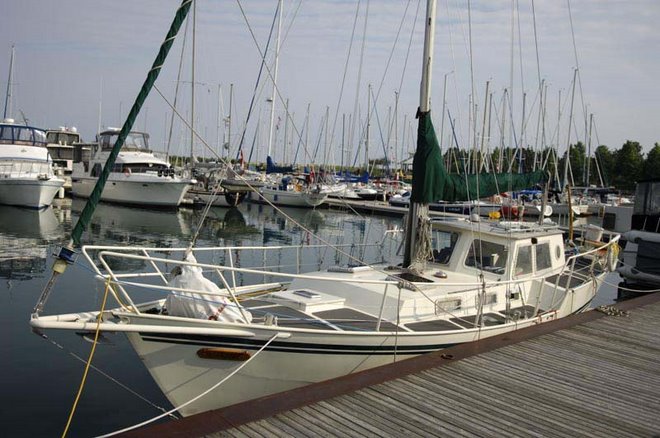
Copyright (c) Marc Dacey/Dark Star Media 2006-2020. Above photo (c) Marc Dacey. Powered by Blogger.

2016-07-30

Getting the lead in, Part 3: Powering up

Everything's equally long and or short. This makes sense if you wish resistance to be futile.
When last we met, I was gushing over my nice crimping and cable-cutting for the six L-16 525Ah deep cycle batteries.
Ooh, yeah.
Charging had commenced, although nothing from the charger or the batteries was actually hooked into the boat.
Absorption is the second stage of three-stage charging.
Now, all this cabling in an exposed state is fine at dock, but real boats in the real ocean move nearly constantly. "Battery box tie-downs" are needed to keep the boxes from moving and they must hold the batteries just short of snugly (because batteries can swell at times) and there has to be room for the electrolyte to go if there's an accident.

White oak planks hold down the boxes tied into the floor plates with eight threaded rods.
I will make a lid for the aft-most pair of batteries when I rebuild the saloon stairs that will cover this battery bank, I have further leads to run and cabling to properly secure yet.
Mind the gap: there's room for a 3/4" "wall" to keep galley and batteries apart.
Mrs. Alchemy came down to remove painting supplies from the head, which would be a nonsensical sentence for anyone not refitting a boat. I was busy driving the club workboat for mooring inspections when she phoned to tell me her labours were interrupted by the discovery of raccoon poop aboard as well as the excavation of a galley cabinet and the scattering of some fossilized corn nuts. Such is the sailor's life. She was then bitten on her shoe by Mr. Sleeping It Off Raccoon. Stern measures were taken, as was necessary as the little bastard fled to the aft cabin.

Luckily, Mrs. Alchemy is a wildlife rehabber, meaning she is skilled at trapping recalcitrant raccoons. After a mere 90 minutes of pointless interruption, "Rocky" was boxed and on his way via the water taxi to parts unknown, or Ontario Place.
10 kilos, easy. Foul-tempered, too.
He won't grasp this, but he's very lucky my wife found him.

Headed for whatever passes for the treeline in a defunct amusement park that used to be futuristic.
Now there's a stretch of water, an active cycling path and a dog park between the boat and Mr. Rocky. Let's keep it that way, and I'll keep the portlights dogged.
Torquey Makita and orbital chuck sounds like a punk band from the future.
The next step was to put in a breaker panel that would allow the AC side to have either shore power or inverter power in a logical and fuse-protected manner. Much crimping ensued.
Heat-shrinking ring terminals are in fashion this year. And yes, if needed, we can actually sail and even motor.
I made up a set of "patch cords" for the new panel, which had to co-ordinate the 30 amp service, the inverter and the follow-on rest of the AC circuits. This was more labour than it looked: I had to, for safety reasons, undo the positive side of the charger/inverter (there's an impressive capacitor inside for what I assume are "surges" of AC the inverter can produce to start pumps, etc.) and it's quite easy to get a mild shock with a cut three-conductor wire, so I did not fool around and undid the shore power. The power tools, and there were several, were run off a 15-amp extension cord. This left, however, insufficient juice to run a fan. Did I mention it gets to the high 30s Celsius in the pilothouse? Well, it does.
Yes, there are two inlets for shore power. I can take 60 amps. I just have never bothered.
The wiring was pretty straightforward, and the running of the AC cabling less so. Everything took too long. Or too hot. And why is it called "hot and neutral" in some applications, and "line and neutral" in others? You'd think there's be some common ground.
Nice bit of kit I got at 40% off.
I had to fab up a fused line for the panel backlighting for some obscure reason. As it was 1 amp over 18 ga. wire, I just piggybacked it to the VHF breaker on the DC panel, as it's almost always left on. If it trips, I'll relocate the wires for the LED backlight nearby to something with amperage to spare.
Gray wire was on sale!
Figuring there was no point tidying up until I confirmed continuity, I carefully restored the shore power, tested the multimeter on the line and neutral wires for circa 120 VAC on both circuits, and lit up the board. Yay, no reverse polarity!
I could have cut that new hole better, but it was ridiculously tight and I had to remove the helm seat to even get in there.
After a slightly sparky reattachment of the battery leads, which involved the removal of the tie-downs...perhaps I should leave them off until I'm fully finished...rhe charger was engaged, the inverter was enabled, switches were thrown and boom, the fan was working (expensively in terms of energy efficiency as the process of inversion, which is tranformation of direct current (batteries) to alternating (house) current is quite lossy). Still, not attached to shore and...running fan. Kind of cool, literally, and no hint of magic smoke.
Of course, I could have run the air conditioning, but it currently drips into the bilge and I dislike that.
 I even lit up my worklight in honour of this new phase of pure (sine wave) power.
And you, you light up my life.
ENABLED, baby. Funny thing is after all these labours is that it'll probably just run the microwave at anchor.
So far, nothing's broken and no fuses were shorted making this production. The next step is to put in new busses for the more diversified DC draws, to hook the new batteries into the Big Switch to power the boat's DC side, to put in the swanky Pentametric battery and systems monitor and...finally...to connect up the Echo Charger so that my bereft starter battery can once again charge, rather than discharge. Think I'll water the lot, too.
Floating my boat's battery bank. Construction ahead.
There's still holes to drill and the mysterious split flanged bearings to acquire, but it's been a good bit of advancement of late. May it continue, as long as I remain hydrated.

2016-07-26

Guess who's coming to dinner?

Mooring committee work. Not seen is Brian, the diver, who is measuring mooring chain wastage in the frigid depths of 12 feet or so.
I had thought that my next blog post would complete the saga of my charger/inverter installation. I was considering something flashy, like a shot of me unhooking the shore power and starting the rarely invoked air conditioning via just the strength of my battery bank alone. But fate had a different plan this day.
Charge account.
In order to finish the job, or at least to move on to the next phase of "getting the lead in", I needed access. As I was committed to my Mooring Committee duties of diver spotting and "find the sunken mooring", my wife was kind enough on her day off from a supervisory gig at the Toronto Wildlife Centre to come aboard to empty the head of various painting supplies and to generally stow away the saloon so I could route conduit in obscure places aboard, like from the inverter to a newly purchased 30 amp sub-panel bought for the purpose on the advice of Capt. Matt, whose experience in these matters exceeds my own, mainly because his dad's an electrician and he tends to install the same gear faster than me.

Little did I know as I was tootling around a mooring field in the club's workboat that the day, which had started stormy, would continue with shit and growling.

I'd say "you little bastard", save that this bugger weighed at least 10 kilos.
Mrs. Alchemy called to say our boat had been invaded by a raccoon, the fecal evidence of which she was, thanks to her years of work at TWC, all too familiar. Throughly stale corn nuts and almonds from some previous season were scattered. This was not good news, especially as I was trying to avoid running down a volunteer diver. Later, as I approached the boat, she warned me off in person, saying "he's still aboard!". Apparently, he had been sleeping under the saloon table in a food coma, only to rouse himself sufficiently to bite her sandal. Mrs. Alchemy has been bitten by a large variety of birds and beasts and has the rabies titres to prove it. She determined to flush out Rocky by means according to her training, i.e. non-lethally. The raccoon got lucky today.
The NYC's water taxi has had some beastly passengers, but rarely ones this bitey.
I borrowed one of the club's live traps (this is not an uncommon outcome) and after tempting the hot and evidently bothered (but neither rabid nor distemper-afflicted ) vermin into the trap, we ditched the idea of letting it loose beyond the gate and took it instead for a boat ride. The club's water taxi, used to and from the same mooring field in which I'd worked in the morning, was driven to the farthest reaches of our basin, adjoining the former amusement park Ontario Place.
The big reveal
In a flash, Rocky made for the trees and is now separated from our docks by a large dog park, a major bike path and a big stretch of water, although given that he got into the boat via a recessed aft cabin portlight left open for ventilation, he may one day return. But it won't be as easy. Not impossible, mind you; raccoons are extremely resourceful. I recall getting one of the first city-supplied conic composting bins in the early '90s when I lived overlooking a raccoon-filled valley. The lid was screwed on and was large, about 45 cm. across. One evening I went out to my workshop overlooking the backyard where the composter was. A single raccoon was spread-eagled on the lid, gripping it at four points. Two other raccoons were slowly turning the first. I was reminded of a World War II prisoner-of-war escape movie. Vigilance will be required aboard, stuffy boat or not.

Look closely and you can see his big furry arse making for the lumber.
Now, that day having been shot, if in an unexpected fashion, I'll resume modifications shortly.

2016-07-14

Getting the lead in, part 2

The repositioned fuel manifold. I will monitor the heat from the red, boxy March pump to see if I need to insulate it from the diesel lines.
Well, it's been some time since my last post, but I have not been lazing about in the summer heat. Quite the contrary: I have been getting the lead in by prepping the place where it will go. This has involved an array of modifications, such as the relocation of the fuel manifold from the side of the "under-stairs" to the saloon, to the building of an otherwise unobtainable battery box, to the shoring up of the floor to take the third of a tonne of batteries aboard, to quite a number of wiring decisions, crimpings and savings.

Access to this plumbing had to be maintained.
Above is the standpipe and the newly relocated fuel mainfold. This needs access from above, and I have decided to retain the existing first step of the new companionway to the saloon because it matches the new space I've devised and constructed.
The first box I bought. The second I had to build
First acquired was the hard-to-source (a couple of calls to a B.C.-based distributor were needed, as is often the case with the weirdo form factors I seem to require) L-16 four-battery box. This allows side-by-side storage of the batteries, meaning the customary roll of the boat both mixes the electrolyte more effectively and keeps less of the lead plates uncovered by it, assuming we keep the electrolyte levels at their proper volumes.


The four L-16 batteries' box. There's about one inch either side of it.
Critical to success so far has been "dryfitting" and plenty of measurement. The spare area in this spot is less than a sheet of letter paper, and measure twice, cut once is only the start of things.
I often have an audience aboard when I'm not grinding or drilling or exercising "sailor talk". This bird thinks I need a bigger rode bucket.
The second battery box, for two L-16s side-by-side, required lumbering around. I went with 3/8" inch which is confusingly labelled 11/16th, but as bigger is better in some respects, fair enough.

Mitre-cuts could have been better, but the workshop's bloody table saw was out-of-order.
The results, me being not a great carpenter, were rough, but strong. I fastened the plywood pieces together with brass screws (not that I plan on getting this box wet, but they were the right size) into pre-drilled holes.
Eh, not bad. The corners are plumb.
The dry fit here consisted of inverting the box and dropping like a slightly oversized hat onto two adjacent batteries. I've given some space to spare in case of battery swelling, but I also have a battery temperature monitor to cut charging should that be an issue. I won't equalize, ever, and court thermal runaway without a) plenty of ventilation in case of hydrogen production; b) plenty of "live monitoring" (no equalization voltages while underway, for instance); and c) careful attention to the proper voltage setpoints by confirmation not just from the system's intrinsic monitoring (either the charger or the MPPT output or the alternator's regulation, but via decent voltage metering.

Close, and a cigar.
Another dry fit involved both boxes plus a partition I would eventually cut down to the same height as the battery boxes.
Note to self: Do not do this again in a flat-roofed workshop in July. Thermal runaway detected.
Next came the hot work of glassing the box to strengthen it and to seal it...it's supposed to contain battery acid in a worst-case scenario, after all. I considered fastening quarter round at the corners (or exterior metal clamps), but I filleted out all the seams extensively with epoxy and fibreglass cloth and I don't think it was necessary, nor did I desire an overly snug fit for the batteries. 
Not pretty, but pretty thick. I later Multimastered off the more egregious bubbles and blemishes.
While all that set up (which took hardly any time at all and I had one pot of epoxy go all jelly on me), the inverter went in.
It's a Xantrex RS 2000 inverter/charger. It's no longer made; we bought this as is so often the case, well ahead of installation when it went on sale.
The inverter/charger is a 30 kilo beast and there's now six bolts in the head that I'll have to back with plates and then cover with a shallow plastic lid. But this was the logical spot in terms of weight, short (and expensive) runs of the required 4/0 ga. DC conduit and ease of access. We gave up two coat hooks.
Access from below isn't crazy; there's an accessory panel display that will be put at eyeball height.
Once again, the purchase of a proper crimper, stripper and other electrical wire work supplies is paying dividends. All this improvement to the boat's electrical systems is expensive but also will succeed predicated on proper installation, which is also a factor in the durability when faced with the harsh marine environment. 
AC IN 10/3 marine-grade, labelled, clear heat-shrunk and prior to putting in the strain relief.
I like to label because I literally get a better understanding for my underfamiliar tasks thereby.
AC IN and OUT installed with strain relief. The AC IN goes to a 30A breaker on the AC panel, and the OUT goes to a Blue Seas panel breaker that keeps SHORE and INVERTER well apart.
Shoving the inverter's AC wiring to one side, I did a dry fit of the Two-Box and the Four-Box to check my measurements.

I don't realize when it's getting dark enough to justify a flash because I'm a carrot-munching sailor.

I threw in the token partition between the battery area and the plumbing/fuel area. It's angled slightly to permit a seacock lever to be rotated fully.
I subsequently tidied up the glassed-up box, although it's never going to be seen except by the crew.
I also took the opportunity to shoot the camera in the midship bilges. These limber holes proved essential to fastening the threaded rod I'm using for battery box securing.
Very little rust, which pleases me as accessing this area for painting would require removing the floor.

I am not convinced this "previous owner" work is to code, but it looks secure.
Next, everything was removed and the area was drilled to take the threaded-rod for tie-downs. Basically the two ways to secure a battery box are with strapping, either of the webbing type over the battery box secured to padeyes or directly to the boat, or via lumber or angled metal drilled to take fender washers and nuts. I went with the latter because the boxes have very little room to move inside the "further" box of the stairs down to the saloon, and because I can further secure them by locking the stair steps that will allow access for maintenance and inspection.

The deliberately offset "sliders" for the dropboard-like partition.

The partition in place. All this does from a functional point of view is stop water from a cracked hose spraying into the battery compartment. It wouldn't really stop the battery boxes from shifting if we had a lurch strong enough to shear the threaded rods.
Drilling the rod holes involved feeling around to make sure I didn't hit something I'd regret. The threaded rod bottoms out on the heavy steel plate into which the keel tank inspection lids are bolted and serve an auxiliary support function to the wooden shoring I fastened beneath this floor a few days ago. Every bit helps, although this floor is secured to steel framing and even 750 pounds of lead is not going do much over this area.
The doubled threaded rod in place
The threaded rod has fender washers and nuts below and above the floor. When the batteries are all in and wired up, I will cut 1/2 inch white oak planking and secure the boxes with the same arrangement and cut to fit. Only then can I rebuild the saloon stairwell, which will project somewhat more into the saloon and will make the galley slightly more snug...but in a good cause. It's just going to make one step in and out of the galley an option.
Looka like it fits. The fibreglassed battery box will get its own lid later on.
The dry fit with the threaded rods confirmed my measurements. Tying the tops of those rods, which will be trimmed for height, together should make the boxes very secure. They'll have nowhere to go, really, even in a complete inversion, once the steps are in and locked. But let's not dwell on complete inversions.
Long-time readers will recognize that beam and chain fall from the engine installation.
As I had the gear to hand, instead of cleaning up, stowing the multiple tools I had out and calling it a hot, hyperextended and dirty afternoon, I decided to drop two of the six batteries that have spent a few weeks on my pilothouse deck into position. It worked surprisingly well, although I'll bring my son down tomorrow to work the fall as I position the last four L-16s in the "four-box".
Nice fit, buddy!
I was going to do this in two installments, but clearly, the project has grown to justify Getting the lead in, part 3: Powering Up. Watch this space!

2016-06-15

Under cover

After three bike trips out to Mississauga, the new mainsail cover is in full operation.
Those mast steps are looking brilliant. I had to use my teeth to tie that knot.
The sail itself is not flaked very well; one batten has flopped off the "stack" and is making the aft end hard to secure. Still, given that we are immobile until the horde of batteries are installed and secured, this will keep the UV exposure well down. 
The old cover fits the old main, which is relegated to "spare, light air" status. It's actually in good shape (the old main, not so much the cover, which needs some TLC) and will come with us.

Now is when the FTZ crimper will pay for itself.


During my leg-powered journeys, I picked up some 4/0 gauge tinned wire at Genco; it's actually not easy to source as it's overkill for most applications. Not, however, for my inverter/charger, which specs 4/0 gauge as the desired conduit for delicious amperage.

No luck on the dual "port-starboard" L-16 battery box. Well, there was a guy who would make it out of thermo-plastic for me...for $432. I figure epoxied plywood is a better idea, with the advantage the the aft "wall" of the dual battery box can also serve as the partition between the standpipe/fuel manifold area and the battery zone.