Copyright (c) Marc Dacey/Dark Star Media 2006-2020. Above photo (c) Marc Dacey. Powered by Blogger.
Showing posts with label Gear and products. Show all posts

2020-06-06

Absolutely floored

The Lonseal was very carefully cut by Mrs. Alchemy based on paper templates and You Tube tutorials.
As mentioned last post, the good ship Alchemy came with many desirable features, but nice flooring was not one of them. So we decided if time allowed, we would "refloor" in Halifax over the winter. Well, time allowed and, thanks to the pandemic, it very much has, we determined to do the job this spring, prior to leaving.

The Lonseal product is not cheap, but it looks very nice and has a reasonable quality of non-skid (non-skiddiness?) desirable on a sailboat. In other words, given a decent shoe, you can stand without slipping on a fairly vigorous angle of heel. It is applied to wood or metal decking with a two-part epoxy. Once on, it's unlikely to come off.

Which brings us to the prep. The saloon was done first, which involved a prepatory sanding and cleanup of the existing subfloor, which is 3/4" thick marine plywood screwed to framing, which in turn is through-bolted to the frames and stringers, and in some places, such as the area above the forward diesel keel tank housing the 350 kilos of batteries, has been reinforced by me, because 55 kilo batteries stoving in the top of a keel tank at sea is considered undesirable.


The previous floor covering was green indoor/outdoor carpet in the saloon and the floor was held down with coarse drywall screws. The latter would surely rust in the sea air and were replaced with slightly longer (1 1/2 inch), slightly larger (#10) silicon bronze screws, which are far less likely to corrode in place and are often used in wooden boat building. So all that took time to prep.

The template cutting, which involved both cutting out multiple hatch covers and matching the "holly" lines neatly, also took a lot of work, all credit to the missus, who did a fine job and now we can have people over without cringing, mostly. Where I came in was in the pilothouse.


You've seen these two photos before, but they bear repeating. To the left is prepped metal, to the right is flap-disked and Ospho'd metal.
The former flooring was, in sum, metal decking over which odd, wide-headed self-tapping screws held down a quarter-inch of cedar ply, over which was glued a further one-eighth inch of cedar ply, over which was a sort of vinyl parquet pattern substance, also glued.

Friends, to use sailor talk, it was a fucking mess. Parts of the floor were rotten, other parts were heavily worn, and there was evidence of mold in the wood. I took it up with a combination of prybars and a Multimaster knock-off that is about the best $99 I may have ever spent...it's so reliable and useful in the more nasty jobs like this that I buy it actual Fein blades at great cost. But they work and they fit. Were I using this tool everyday, I would pay four times as much for the real thing, which appear indestructable.
The self-tapping weird metal screws were, of course, rusted in place, so I had to grind off about 60 of them. Makeshift curtains and rounds of vacuuming were made to keep the grit thereby made airborne out of the rest of the boat. The helm seat, which, as one might imagine, I installed particularly strongly, was unbolted, cleaned up and reinstalled. Acetone wipes, metal prep and protective paints were applied and there was much dryfitting upon the face of the waters.
Looks nice, doesn't it? There a massive hatch in this picture.
But the results were worth all the odd smells, tiptoing around while things "set up" and labour and dollars expended. The boat is cleaner, safer and looks markedly better. We'll do the aft cabin floor, which is tiny, after we get to Nova Scotia, which looks like it's going to happen, fingers crossed, as the Seaway locks open to pleasure craft June 22. We will pause to see if a pandemic "second wave" happens that could affect marinas or our passage materially, so early July is our new "go date".

Held together and to the countertop with countersunk #12 SS screws, it's not likely to move.
But back to further improvements: My wife has remarked on the disagreeable habit of the galley sinks not completely draining even at zero heel. While nothing short of a grey water tank with separate pump out could solve all of that, the simple addition of a two-inch HDPE sink surround has now raised the two galley sinks enough to permit full drainage, even if I can't take a decent picture of it.

Rubber strips glued to the underside of the wind generator pole should provide a bit of cushioning and, we hope, sound deadening.
I designed a simple base for a wind generator pole that fabricator pal Andrew Barlow knocked off in stainless steel with his customary skill. Before the wind generator is mounted, however, I have to make it more stable with struts at the rearmost solar arch and at the stern rail. I'm thinking Kee Klamps, but my friend Dean Muto is an actual rigger and I will see if he thinks that's a good idea.

Pipe goes over this well-bolted stub and is cross-pinned. Wind generator is collared to the top of the pole and clears the adjacent panel by about 15 cm.
 So we've got a few more projects to go, but arguably five weeks to get them done in, which will include "family docking in cross-winds" lessons, anchoring setting and retrieval practice, and the relocation of both the liftraft from rail to foredeck and the mounting of the nesting dinghy ... somewhere...Enjoy last night's brush with a squall!
This one had little rain, but over 30 knots of wind, always fun on the nose tied to a wall.
But we got a rainbow in the boatyard, which was nice.


2020-04-22

Earthed, wind and fire

Close, but not quite. Annoying, this.
This is a replacement solar panel for the one that fell off the boat a couple of winters ago. It's from the same maker, Kyocera, and it is the same form factor as the other three, but the flange to which the "rivnuts" (or "swage nuts", the terminology seems inexact) are mounted is about one-half inch more narrow than the older panels. The panel is otherwise identical, save that it delivers at peak output five more watts. Of course, the custom-built solar arch has hard-to-drill 1/8" stainless steel mounting tabs welded to the pipes, so I have been presented with a dilemma.
The old bits of tape were used to indicate where the two backstays transit through the arch.
Luckily, the man who is doing other fabrication jobs aboard, was aboard, and suggested we secure the outboard side with rivnuts as planned, and simply make up an aluminum 1/4" thick "tab on a tab" throughbolted to the existing stainless, and then rivnutted (that doesn't look right) from aluminum tab to aluminum frame. Pretty sure I can handle that job, and the galvanic isolation it probably wants doing.

There can be many versions, and I left a phone message today with a couple of further refinement suggestions.
Andrew was visiting the boat for an "as social as possible under the circumstances" reason, as well as further discussion on the fabrication of a pole for the Air-X wind generator I am finally installing to complete our renewable energy scheme, at least from the "watt creating" side.

You don't have to put out the red light...
Speaking of wind, I installed a Caframo "Maestro" 12 VDC fan in the galley. This involved drilling, wire-stripping, crimping, heat-shrinking and circuit-chasing, this time in the galley's DC subpanel. The fan has a bright white LED and a dim, red one, good for evenings, and its speed is controlled by a simple rheostat that clicks off.
I put in a little rocker switch, seen to the left of the pair of wires. The mounting plate of the propane sensor with necessary 3/4" hole for the mass of its leads is below.
Unfortunately, the rheostat appears cacked...it worked on the test run, in which I provisionally wire together the circuit to check for flaws before I dog down everything and drill multiple holes, and the light switch works fine, but it's "always on full" when attached to the terminal strips. I mean, I could turn it off, along with all the cabin lights forward, from the main DC panel, but that's just awkward. So I put in a little rocker switch from A1 Electronics on North Queen (25 cents, probably) and it works fine now. Still full on, but now with added off.
Yes, it works. I have a propane torch nearby for test purposes.
Mounting the new propane sniffer/alarm was a touch more involved as it required a hole through the cabinet (and cutting down some trim pieces and a hole through the bottom of the cabinet so that the sensor lead could go down to the front of the stove near foot level, where propane is likely to "flow" if we had a leak of it. Those wires will be cleaned up and mounted neatly later.

It's becoming a busy time. Eight days until it's home again.


2020-03-04

Staying with the boat


Yet another gale bent the boat cover in new and exciting ways recently. Before...

I've given my opinions on the somewhat dubious odds of self-rescue, in my opinion, at sea before, and while we've invested in items both expected and slightly exotic, including the EPIRB route, the best way to not drown, as better sailors than us contend, is to stick with the boat.
...and after. The red tape of shame is doing a fine job, despite the abuse.
The best way to do that is not to fall off. Sounds obvious, doesn't it? It takes, however, some planning and, more importantly, the habit of clipping on. Even then, one has to be careful in assuring that if you do "stay with the boat", it isn't in an attitude of potential drowning.
Irises in Toronto on St. David's Day (March 2) suggest both spring and our departure are coming on fast.
There's no secret here. All crew must, in all but the most benign, all hands on deck situations, wear fully functional tethers that hold them to the boat, either at a padeye or on a jackline. Now, there's plenty of ideas about jacklines; a typical setup can be found here. But best practices of running them port and starboard with sufficiently strong webbing suit us; the existence of the pilothouse means we want them to run from the aft end of the pilothouse to the forward bollards, The tethers come in three-foot and six-foot (1 and 2 m., respectively) lengths, which will allow us to go forward to the nearest padeye or other suitable anchor point to safely work on the foredeck for anchoring or sail adjustment purposes, even in heavy weather. Which will likely be neither comfortable nor dry, but if there's one thing I've learned at sea, uncomfortable and wet beat waving at a rapidly shrinking stern every time.
The super-beefy Wichard folding padeyes, through-bolted and backed to the aft part of the pilothouse. And yes, those shavings and drill dross have been removed.
I put in two pretty massive Wichard folding padeyes for where our webbing will start. These feature breaking loads of 9000 kgs, so I can't imagine a force that would break them without killing anyone attached to the jacklines they carry. These will be lashed as tight as I can make the to offer as little deflection (and therefore a chance to pick up speed or add to the tether's length) as we can manage.
The tethers we have include strong and simple webbing ones, and these double ones.
In the above photo is seen the elements of getting out on the aft "sailing" deck at, for instance, watch change. The tether's smaller silver hook goes on the D-ring of the PFDs we have. Ascending the companionway, we clip on the shorter tether to the
That propane tank will be better secured shortly, I know.
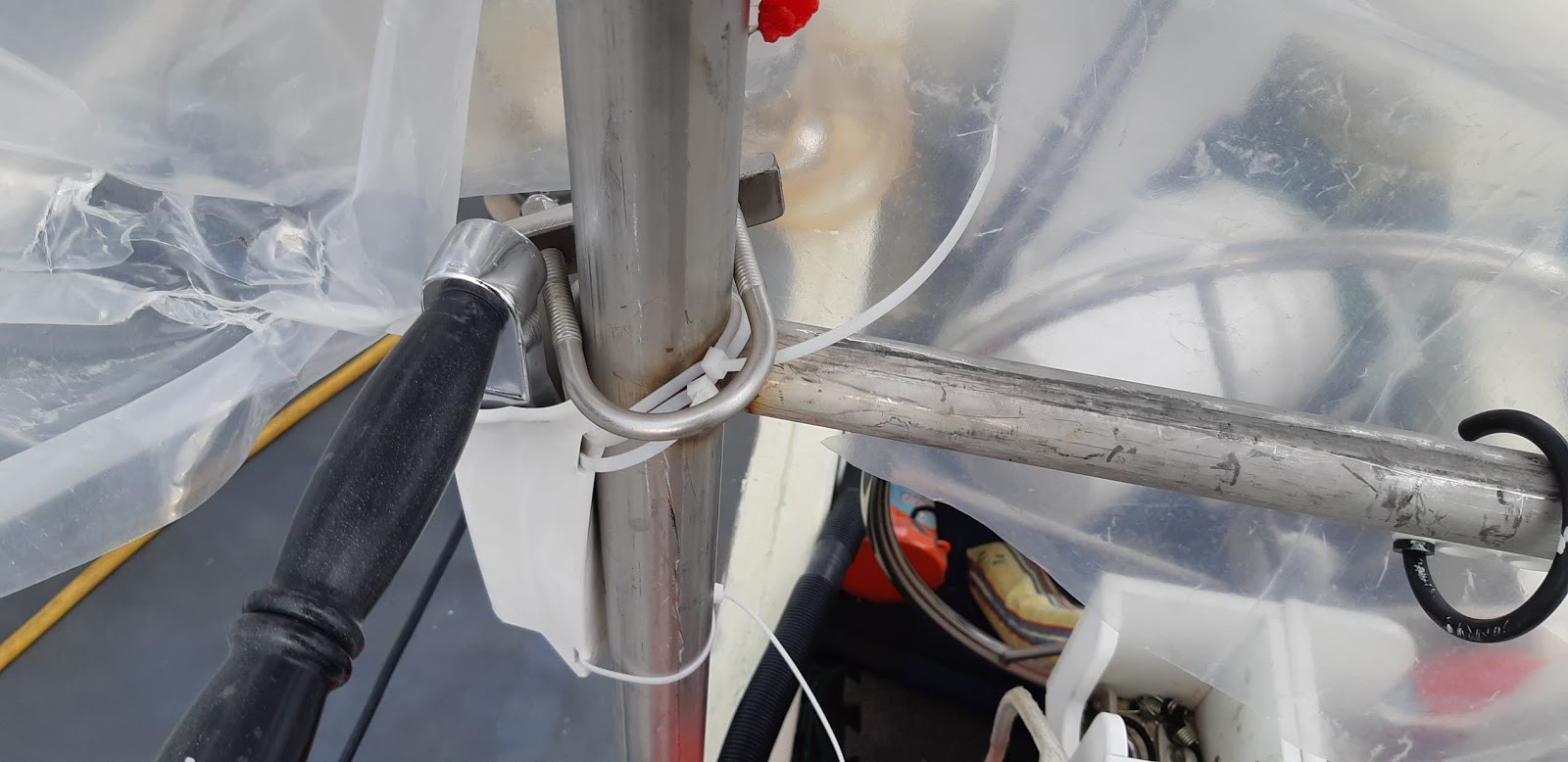
Once on deck, the longer tether will be clipped onto one of two stainless-steel U-bolts, backed with 1/2" SS plate, around the solar arch at its strongest point.
Obviously, that plastic shrinkwrap will soon go, too.
The U-bolt isn't pretty, but that's not that kind of boat. Being capable of rotation, it can follow the tether into the footwell in which the watchstander/helmsperson stands. Once clipped on, the short tether is released, the crew moves into position, clips onto one of the two U-bolts and releases the longer tether which can hang from the PFD. Reverse order to get back into the pilothouse.


The starboard U-bolt. Despite the inelegant look, they aren't going anywhere. They have Nylok nuts and threadlocking.
I'll put the jacklines on once the boat cover is off in a couple of weeks. There's a bit more to do in bolting on padeyes to either side of the mast tabernacle to allow safe working at the mast, and perhaps the addition of further carbiners and Spectra loops instead of hard points to make everything run smoothly, but this is, I hope, a prudent start to a complex topic.
I also rewired the foredeck battery pair, but that's for another post.


2020-02-20

Workshipping (1)

That's possibly too many lubricants.
Four years back, I sketched out a vision of what I wanted to do with the workshop in the forepeak of Alchemy. The first seven feet of the boat is a a snug, utilitarian room forward of the collision bulkhead that is reached by ladder beneath a strong steel hatch on the deck. I had ideas of putting a bicycle seat on a post in there, and having a fold-down cot for extra crew on the starboard side, and of having the windlass over the anchor well. I even wanted to cut a big, doggable hatch (above the waterline) into the saloon with an eye to ventilation and even working on the boom down there.

Well, a lot of that thinking has gone by the wayside. The ladder down into the forepeak is not a big deal and it is a compact solution to egress and the thought of engineering a square hole into the saloon...without compromising the deck support...seemed unnecessary. So did the idea of a folding cot down there. We've determined that we can stow storm sails and the light, if voluminous, cruising spinnaker in the available space if it's better laid out. The windlass was ultimately positioned farther aft so as to drop the anchor chain farther aft (better for weight out of the ends). The batteries powering the windlass are at the foot of the ladder (covered, of course) and on the centerline. The charger is on the bulkhead and there is now 12 VDC and 120 VAC (20 amps, too) outlets in this little compartment. Little bright lights to follow.
The heavier things are now farther aft and the tools and spares aren't all on the port side now. Trug is still misspelled.
This is the new look going forward. Experience actually sailing with a bunch of long/tall bits of gear have persuaded us that a sort of "rack" in which to stow the tiller, oars, PortaThwarts, and the sailing rig, rudder and centerboard of the nesting dinghy. Most of this gear is light and will, if restrained by shock cord, stay put even in rough seas, but the keyword is "restrained". The rest of the starboard side of the workshop space is now ready to have another 53 inches of working surface. This is, on most boats, an unheard-of luxury.
Working the grinder meant putting a fire blanket over the batteries to even nod in the direction of "to code"
Once again, welder/fabricator Andrew Barlow was enlisted to weld together three lengths of 1.25 x 1.25 x 3/16th inch L-bar mild steel into something strong enough to take a marine plywood top (that's my job to obtain and cut). The foredeck is covered in boxes of line, shore power cords, a few sailbags and other bits and pieces formerly loose on the starboard side and bungeed into lumps. As soon as the weather crests freezing, Mrs. Alchemy will coat the exposed metal and the weld beads I've now ground down to keep this stuff from rusting.
As can be seen, some of those tools and spares on the left would be better on the right.
I discovered, too late, that there was no 15 amp outlet on the marina's power posts. We've used 15 amp service successfully in the past via one of my 12 ga. contractor-grade extension cords, but this time, I had to take power from the 15 amp outlet inside the boat, powered from the 30 amp shore power service.
Stick around, you'll learn something.
Unfortunately, this circuit breaker kept tripping, and the irony is that I knew I was receiving two Honda eu2200i gasoline generators the very next day. Combined, these two beasts could have easily supplied Andrew's welding rig with enough juice to get the job done.
When sparks fly...you vacuum the entire compartment the next day.
So I spent quite a bit of time waiting for the breaker to trip and then flicking it back on. Andrew started to do shorter beads and eventually got full penetration of the welds, but it was an annoying few minutes and I was feeling the AC breaker board for any signs of warmth. There wasn't any.

So simple, but it will be so useful.
So we paint, and then I cut the plywood top to fit and then I bolt said top to the metal and rearrange the tool boxes and spares stowage. I have SS eyebolts so I can hang spare line more neatly, and eyestraps to keep everything lashed down. Lastly, I'll add a few more lights down there and get a larger "trug" for the anchor chain.
These are locked to the mast, so no funny stuff.
More fun to come soon as we ramp up to moving back aboard.

2020-02-16

Drogue therapy

This is a Jordan Series Drogue as built by Angus Coleman of Ocean Brake in the UK.
There's a surprisingly long list of items, some quite expensive, one hopes never to use as a sailor. These include obvious ones, like a SOLAS-grade flare and the liferaft, to more cryptic items, such as drogues, warps and sea anchors.


Amusingly, the drogue, which weighs about 18 kgs., came wrapped in two very big IKEA bags.
The idea of a drogue is to slow the pace of a boat running off in heavy weather. Running off is the opposite tactic to that of heaving-to, in which the jib, main and rudder are all set so as to sail the boat slowly upwind. Heaving-to as a tactic is largely passive: one can tie off the wheel or tiller and essentially doze, if not entirely comfortably, as the storm passes over or even to delay a harbour approach until daylight reveals potential complications. Heaving-to is something some boats do more readily than others, and requires practice to fiddle with the sails in order to balance the desired slow forereaching that keeps the boat slowly "crabbing" forward.

The forces of the sails and the rudder nearly cancel each other out and the wave train is therefore met with "the pointy end" and at a low speed. Expect a twisty ride, but not a dangerous one. Diagram (C) Sail Magazine
To run off in a gale or a storm situation is a more active strategy requiring active steering, but it also allows more options in terms of reacting to worsening weather. Running off means to steer downwind at a slight angle to the wave train and (usually) the wind aft in order to make more speed either away from the storm or gale, or away from the dangerous quadrant of the storm or gale. The problem with running off is essentially the same as the problem with heaving-to: eventually, the winds and wave heights may exceed the usefulness of the given tactic and at that point, the transition has been made from "heavy weather sailing" to "survival conditions". Not good.

The IKEA bags reveal the drogue elements of bridle, leader, cones and tail. And the bag (black mesh) in which to store the lot.

If the skipper and crew have opted to run off in heavy weather, a problem that will soon be made apparent is that of too much speed. Even in conditions of reduced sail, or even bare poles, a boat can travel faster than its hull speed, at which point the rudder can lose its effectiveness and/or the hull can "surf" and be prone to broaching, capsizing or pitchpoling, all dangerous outcomes at sea.

The bridle "legs" are shackled to the chainplates bolted to the stern and meet at the drogue leader, after which the cones deploy.
The best option, once running off has been decided upon, is to ready a series drogue should the sea state intensify to the point where the boat may become uncontrollable. While this will vary from vessel to vessel and depends on hull type, design and less quantifiable aspects such as windage, the outcome desired is to slow the forward progress of the boat to allow the waves to roll beneath it. The boat is still sailing actively and is still moving, presumably away, from the worst parts of the storm conditions, but its speed has been reduced by the drag of a long, trailing line with fabric cones that act like a large rubber band to retard forward movement smoothly and which, thanks to a weighted end, will stay submerged in the advancing wave faces.

Now, this doesn't mean a carefree ride. Note all the complexities of retrieval of the drogue in a chat between sailors Randall Reeves and John Harries in the video above. And even the drogue won't necessarily keep you dry: The aft part of the boat can still be smacked by a pooping wave and the motion inside the boat can still be considerable. But if the boat is sailing actively, even in heavy conditions, the odds of not only surviving, but of preserving the rig and gear and avoiding injury or worse among the crew increase.
The black straps attach the cones to the drogue's single leg.
Series drogues exert great stresses on themselves, which are transferred to the hull. We therefore ordered ours with Dyneema cores, which made the drogue both lighter and more compact and stronger than the nylon-line alternative. Angus Coleman, the amiable contact at Ocean Brake in the UK, actually dissuaded us from buying the drogue last year as he was on the verge of introducing all Dyneema-core drogues and wanted us to have the opportunity to order that style. Of course, the Dyneema aspects makes the drogue less stretchy than nylon line, but I suspect this is not going to be a particular problem with our steel sailboat. Nonetheless, I am mindful that the attachment points must be engineered correctly so as to transfer all the shock loads that may arise non-destructively. So we are going to have chainplates fabricated to accept the estimated (by Coleman) nine-tonne working loads on the stern. We actually have beefy bollards that can likely handle these loads, but outboard chainplates throughbolted to the hull won't have anything to chafe on, nor will they have much of a chance to catch on the windvane or the transom-hung rudder.

So this is another piece of the puzzle of preparedness. While we will do a practice deployment or three, let's hope, as with the liferaft, we need never use the thing.


2020-01-28

Last of the Toronto Boat Shows? We certainly hope so!


Well, I might as well wipe my feet on something nautical.
I've spent the last two weekends (and Mrs. Alchemy eight of the last 10 days) working at the Toronto International Boat Show at the Genco Marine booth. The missus worked there when they had a harbourside store for a few years when our son was but a nipper instead of the hairy young man he is today, and she has come back to help (wo)man the till for the January event.

This year, I was asked to work weekends as a human filter for Mitch Kitz, who has an encyclopaedic knowledge of marine electronics and can be considered the Ken Jennings of Salty Jeopardy. Which doesn't exist, but if it did, rum would be involved.

I've been attending this boat show since 2000, right after we bought our first boat Valiente on August 31, 1999. Due to the possible fudging of press credentials, volunteer work at my boat club's booth, and now getting in as an "employee" of the most transitory type, I count with pride the fact that I have never paid to shop at the boat show.
All that pink fluid is plumber's antifreeze for the winterization of various water feeds. The strut is being removed and replaced with stronger models for that "ssssh" effect I enjoy.

I have, however, shopped. Search this blog for "boat show" and examples abound of engine and prop purchases, lights and tank bargains, and the inevitable "consumables" of boat hooks and fenders, of which the missus says we have too many and too much. And plenty of sarcasm about dodgy sailboat designs...I didn't even bother with the few examples of dock jewellery present this year. I did get a nice LED 10 watt-equivalent light, however, which is one of two now brightening the engine bay at a "cost" of just 0.0833 amps, times two.
Not the best, no, but I consider them sacrificial in the locks we will soon transit.

The boat show, alas, is not what it used to be, not that it ever was this far from the ocean. Most of the boats and most of the visitors, of whom I spoke with dozens and dozens in my "may I help you" role, are orientated toward power boats of various kinds and it was nice, if fleetingly so, to chat about sailboats. None of the sailboaters appeared to be below 50, a grim little factoid about the demographics of those who prefer wind to fuel.

There were several of these and they proved popular. Apparently, the PR disaster has passed.
But any boat requires an anchor, and so I was deemed "the anchor guy", despite a relative paucity of, you know, anchoring much yet on Alchemy, though we did drop the hook a fair bit on the previous boat. I was a little disturbed at the general poverty of knowledge of ground tackle and how to use it, but this is partially due to nearly half of the visitors to Genco's anchor corner stating "I just bought the boat and it's got a rusty Danforth and no windlass...let's talk." The generational transition proceeds apace and new people are learning that boats remain cheap: it's the fitting out with better gear that costs money.
Man, people love grilling on boats.

A lot of barbeques were sold, and I did get a little cross-eyed relating in excruciating detail the attributes of what is essentially a propane mantle in a steel box. But the focus around here is on the beer, the cottage and combining the two with meat on or beside a lake. The ocean is far away and probably cold.
Last seen in the "salmon mousse" scene.

Which is why I bought this otherwise impractical item. It's a Gul neoprene zip-up 'rigging jacket', thick and a little heavy, like a bondage blazer. It looks like I would have heat stroke in it in any other place than where we are going, which is the North Atlantic via the St. Lawrence in 10 or so weeks. Ice, snow, sleet and wind may be factors, and this I deem the watchstanding jacket to do it in. Besides, it's discontinued and was very cheap.

The biggest purchase was that of two Honda eu2200i portable gensets, which can be linked together to produce 4000-odd watts, or 30 amps, which is suitable for light welding or running our whole boat in most situations. Our existing 12-year-old Honda 2000, the predecessor model, will be pickled and stored in Trenton as it is not done yet by a long shot, but it can't be hooked together with a "companion" model like the newer, somewhat more powerful models as they weren't CSA-approved when I first bought it. The  new ones are. I saved about $300 and the sales guy will deliver them to Alchemy.
Bonus use: as bicycle helmets for retrieving supplies in port. We are bringing at least one bike to Halifax.

Lastly, in terms of notable purchases (aside from upping our total of Spinlock Deckvests to four) were the trio of Gul helmets suitable for sailing, kayaking, getting a glancing blow from a boom, surviving a short fall down the mast, or smacking a hard part of the boat falling over. They were also a good price, about half that of MEC, and I remain persuaded that a helmet in a good blow is a good idea.

The boat show, however, is but a shadow of its former self and I am having trouble reconciling words like "Australia is on fire" and "carbon tax" and "impeding doom" with the massive powercruisers, wave riders and pontoon boats with giant outboards I saw casting wicked spells on middle-aged men and bored-looking spouses. Nonetheless, working on the retail side was interesting and I have yet to manifest the 'flu. And Ben Gartside, the man from B.C.who sells me my Beta Marine spares, gave me that rather fetching door (deck?) mat at the top of the page. I will both treasure it and wear it out.


2019-07-17

Good grief, we are aboard!

Had to come down at dark o'clock to secure this on deck during a gale: Thus is boat life.
My apologies for the long delay in blogging, but boat jobs, moving jobs, the appalling need to downsize and a severe time crunch involved in all of the above have hampered my "free"time and, ironically as we are supposed to be in semi-retirement, I have never worked so hard in my life, and I suspect Mrs. Alchemy would concur.
Replaced the fridge compressor. It's doing well.
Rather than list my domestic horrors trying to ship half of our possessions into storage and realizing the remainer equalled three boats' worth of stowage, I will simply list the jobs done, approached or best avoided.
Hatch strut for forepeak. Stayed up in 25 knots.

 Some jobs have manifested on the basis of deliveries or even weather. In the inevitably severe "culling of the gear", a few items were obviously and quickly done, like putting handholds in tricksy spots.
Needs further protection, obviously.

 Other jobs relied on outside contractor enthusiasm. These welded-on SS bars make the three-inch bollard horns four inches...a small but real improvement suggested by Mrs. Alchemy.
"Barlow's Bollard Extenders"
Other mods/additions were literally a decade in coming. I acquired these Lewmar 44 winches in 2009 or so. They required very precise measuring to get them in place where they would a) not interfere with each other and b) could be effectively bolted onto the deck. They are the new primaries, with the Andersen 40s relegated to staysail heavy weather sheeting and/or drogue retrieval. I spoke to Angue of Ocean Brake who suggested their switch to all-Dyneema leader in the fall means I should defer a drogue purchase to the winter.
Brought to you by trig and ADD.
Biggest winch handle versus working clearance.
It's down a bit, but not more than six inches. There's a shallow beach on the seawall beneath the waves.
 Meanwhile, flooding proceeded apace.
He's usefully taller now, about three cm. shorter than me, which makes him able to reach pretty well everything aboard.
 Cabin Boy completed his secondary school education.
Water tank frames completed.
The water tanks were measured, ordered and prepared for.

Huge pain in the ass, this job, but necessary.
The pilothouse roof was hoisted, strips of electrically isolating HDPE were secured between the mild steel flange and the alu roof, butyl and sealant and bolts restored and rubber leak-stop was sprayed.
Bonus: It holds the hatch open for brief, calm-wather egress.
The Lofrans Tigres windlass was installed. Still facing some wiring issues and a hard short to find, however. If it wasn't raining today, I'd have it apart on deck today instead of blogging about it!

Bit of a saga choosing 2 ga. wiring.
 

Every journey needs a map, right? Most of the jobs I do are first-time for me. The windlass is more like rewiring a starter motor, so not completely weird or novel.
So many holes in the steel deck makes me nervous....
The job took a couple of days and a couple of hole saws. I've gotten pretty efficient at putting holes, however, in steel decking, by necessity.

HDPE standoffs insulate the windlass body from the steel deck, as recommended by the Italiate instructions.
Looks good, but I have to trace a short.
Other ridiculously varied tasks followed. We had a custom table support made for the saloon. It lowers so that the table forms a bed platform if one is not overly enthusiastic.
 Windshield wiper finally found. I had to fab the link in the shop...
And wire it up...later...
We had to get out of our rental apartment by June 30. June 27, a truck with three burly Bellevillians showed up and hauled our "stuff" to the Trenton rental property. Said stuff filled a basement bedroom and about 60% of two sheds. We should have, in retrospect, given away even more, because too much crap came aboard and we are still culling, although the sole is visible in places now and other club members are benefitting from our compelled largess.
So many...heirlooms?

Mrs. Alchemy questions the logic of materialism.
The older, wooden, more tool-orientated shed features limited electricity.

Books, beds and toaster ovens?
That Pelican cooler is great, but too big for the voyage. We brought the beat-up Koolatron as an auxiliary fridge.
Behold the spare main...at least it's not stuffed into the forepeak.
 Once again, despite having significantly reduced our belongings last year, we gave away/Freecycled/curbed a vast amount of surplus things. Apparently, one is richer than one thinks!
The ubiquitous "Billy" bookshelves. Six of these were successfully curbed in the alleyway.
Well, that's nice.
We got aboard, although it nearly broke Mrs. Alchemy and made us uncordial at points, and started to experience life aboard. But more was to come...
Another case of loads of measuring and planning and interior alterations to get this, pun intended, in gear.
 Behold the second, "outside helm" throttle shifter. This allows us to correct a real shortcoming of Alchemy and to operate the engine from beyond the pilothouse.
I did not know one could purchase a 2 3/8" hole saw a close match for an Italian spec. Now I do.
 

Took some adjustments, but it works as advertised and we've practised docking with it. A fine mod.
Mast, moon and mainsail.
The "sundowner" has become a fixture of the day, but so have very early nights (2130-2200h) and rising with the dawn. Mainly due to exhaustion. 

Wait until you see the plumbing this requires...oy!
There's doings on the autopilot front, but I will save that for a later post. Needless to say, it's deferred our departure (again) and I'm doing it myself.

Foot plus switch.
Yes, that's a fused negative. Buy me a pint and I'll tell you why.
Further progress on the windlass. Nearly there...

This seemed a reasonable spot, semi-protected yet near the end of the vessel.
Lastly, or rather, lately, as in yesterday, I mounted the EPIRB, the emergency beacon designed to alert search and rescue folk we've got trouble aboard, or no board at all.
Goes off both in water or if buttons are pushed.

Belt, meet suspenders.
May we never, as with the liftraft, need it.