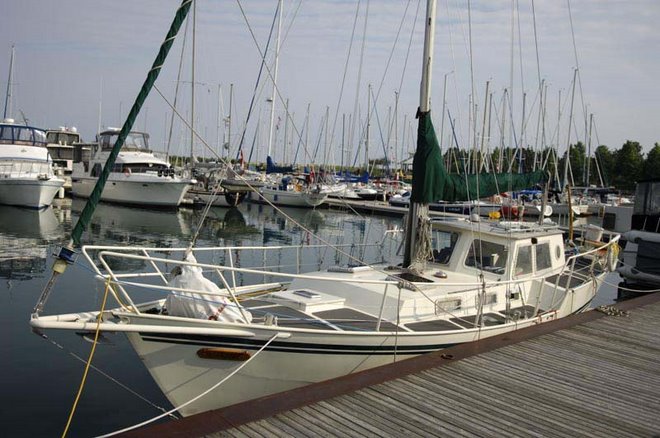
Yet another gale bent the boat cover in new and exciting ways recently. Before...
I've given my opinions on the somewhat dubious odds of self-rescue, in my opinion, at sea before, and while we've invested in items both expected and slightly exotic, including the EPIRB route, the best way to not drown, as better sailors than us contend, is to stick with the boat.
...and after. The red tape of shame is doing a fine job, despite the abuse.
The best way to do that is not to fall off. Sounds obvious, doesn't it? It takes, however, some planning and, more importantly, the habit of clipping on. Even then, one has to be careful in assuring that if you do "stay with the boat", it isn't in an attitude of potential drowning.
Irises in Toronto on St. David's Day (March 2) suggest both spring and our departure are coming on fast.
There's no secret here. All crew must, in all but the most benign, all hands on deck situations, wear fully functional tethers that hold them to the boat, either at a padeye or on a jackline. Now, there's plenty of ideas about jacklines; a typical setup can be found here. But best practices of running them port and starboard with sufficiently strong webbing suit us; the existence of the pilothouse means we want them to run from the aft end of the pilothouse to the forward bollards, The tethers come in three-foot and six-foot (1 and 2 m., respectively) lengths, which will allow us to go forward to the nearest padeye or other suitable anchor point to safely work on the foredeck for anchoring or sail adjustment purposes, even in heavy weather. Which will likely be neither comfortable nor dry, but if there's one thing I've learned at sea, uncomfortable and wet beat waving at a rapidly shrinking stern every time.
The super-beefy Wichard folding padeyes, through-bolted and backed to the aft part of the pilothouse. And yes, those shavings and drill dross have been removed.
I put in two pretty massive Wichard folding padeyes for where our webbing will start. These feature breaking loads of 9000 kgs, so I can't imagine a force that would break them without killing anyone attached to the jacklines they carry. These will be lashed as tight as I can make the to offer as little deflection (and therefore a chance to pick up speed or add to the tether's length) as we can manage.
The tethers we have include strong and simple webbing ones, and these double ones.
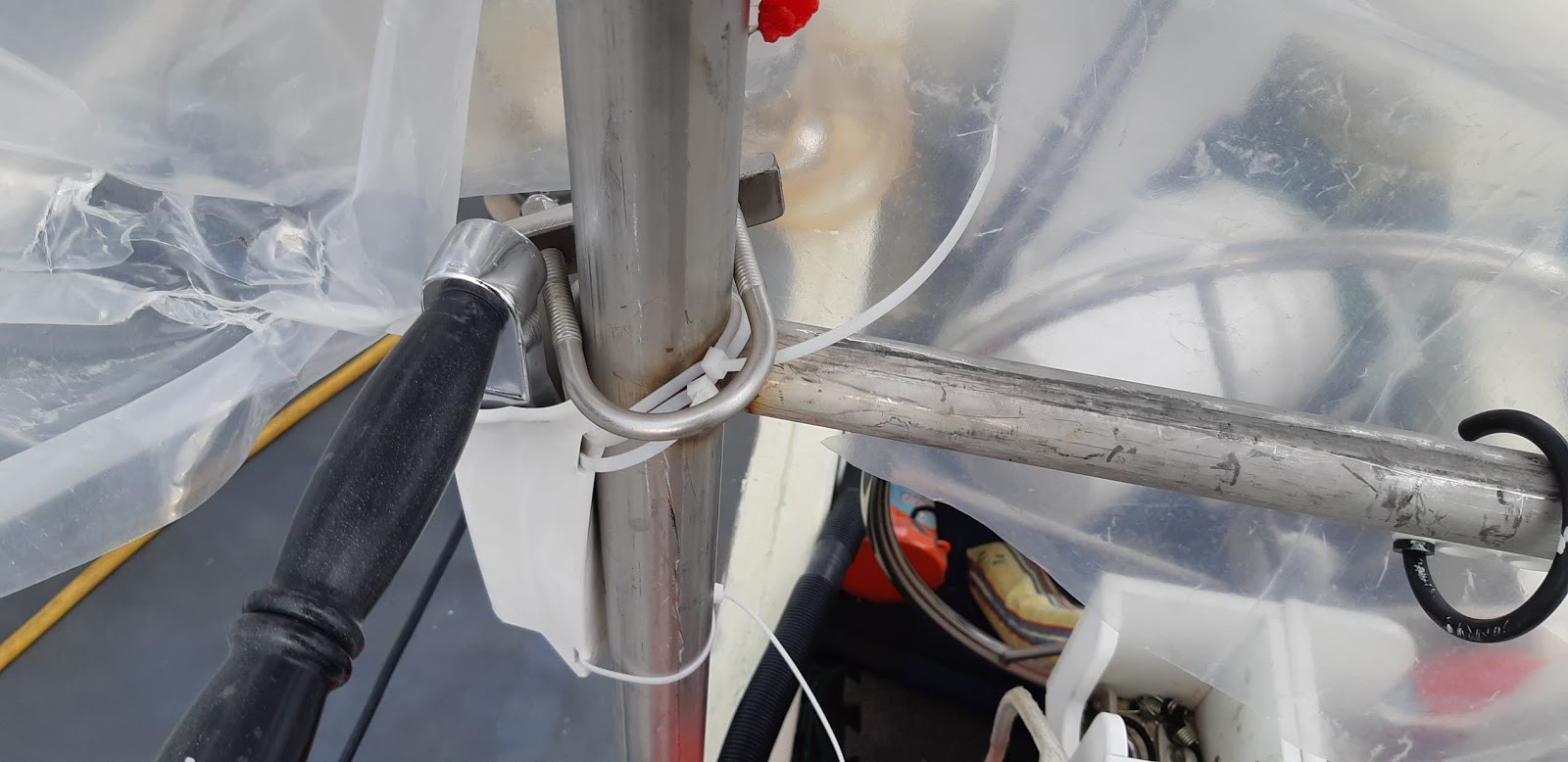
In the above photo is seen the elements of getting out on the aft "sailing" deck at, for instance, watch change. The tether's smaller silver hook goes on the D-ring of the PFDs we have. Ascending the companionway, we clip on the shorter tether to the
That propane tank will be better secured shortly, I know.
Once on deck, the longer tether will be clipped onto one of two stainless-steel U-bolts, backed with 1/2" SS plate, around the solar arch at its strongest point.
Obviously, that plastic shrinkwrap will soon go, too.
The U-bolt isn't pretty, but that's not that kind of boat. Being capable of rotation, it can follow the tether into the footwell in which the watchstander/helmsperson stands. Once clipped on, the short tether is released, the crew moves into position, clips onto one of the two U-bolts and releases the longer tether which can hang from the PFD. Reverse order to get back into the pilothouse.
The starboard U-bolt. Despite the inelegant look, they aren't going anywhere. They have Nylok nuts and threadlocking.
I'll put the jacklines on once the boat cover is off in a couple of weeks. There's a bit more to do in bolting on padeyes to either side of the mast tabernacle to allow safe working at the mast, and perhaps the addition of further carbiners and Spectra loops instead of hard points to make everything run smoothly, but this is, I hope, a prudent start to a complex topic.
I also rewired the foredeck battery pair, but that's for another post.
It's odd to hope you never see this deployed in earnest, or in the absence of the main vessel, really.
Having a freer hand with the boat gear purchases made the recently visited Toronto Boat Show reviewed last time a lot more fun than usual. But I've spent a lot of time in research/review mode, as well, trying to make the best choices in gear for our vessel's voyaging. First up of the "big buys", if just about the last to arrive, is the Viking RescYou six-person liferaft. Last to arrive, because the clock starts ticking on the service schedule from when the raft arrives, and we don't need to mount this until after we launch in late April. We also got the rail-mounted cradle and the "hard" container, as this isn't something I want to muscle out the companionway if things go pear-shaped. We already have a ditch bag and are debating its contents, but a handheld watermaker is already in there.
Now, to rig jacklines and bolt padeyes in all the right places.
Continuing on the safety front, we now have a pair of Wichard ProLineR 2m/1m safety tethers. I picked this version for flexibility as I plan on installing Kong Tango carbiners on jackline webbing as needed and snapping onto that. This allows the smaller shackle to be used on "static" clip-ons, such as padeyes on the mast tabernacle or wire. A shout-out to Attainable Adventure Cruising, which has been, as in so many other areas of offshore sailing, a source of great value.
Self-rescue the better way.
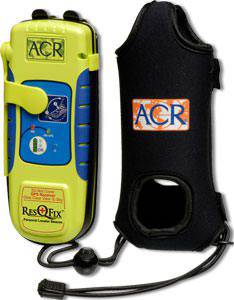
Now, tethers keep crew on the boat, when used effectively and without exception. But you'll see the problem inherent in the system: human behaviour, plus simple misfortune of, say, tripping off the boat. There are a number of ways to address this, starting with "always wear your PFB on deck. Always." Now, after that, the options multiply. We've had PLBs (pictured is the successor to ours), and we have liferings and throwing line slings and danbuoys and assorted means to retrieve a COB (crew overboard). But the device pictured above is a step beyond.
Arguably, the most dangerous time for a crew is watchstanding at night; smaller crews, as ours will largely be unless we pick up crew, will have the nightwatch hours split into two or three shifts, at least one of which will have only a single crew, tethered on deck, awake. Should a crew fall off the boat, this AIS MOB1 will not only transmit to the AIS receiver on board, it will also send a DSC alarm to the VHF, which is going to wake up everyone on board. Lastly, it's got a strobe. Save for survival conditions (stay aboard, kids), in which case the crew would almost certainly be awake and tethered and ready for anything, this seems like a game-changer for self-rescue, a topic that has interested me for some time. Fact is, in most cases, save relatively near to shore, the boat from which the crew has unexpectly departed is best placed to get their crew back alive. Search and rescue not only take time, they are generally not available more than a couple of hundred NM offshore. So this is a helpful advance.
Hello, hello? Dinner is ruined!
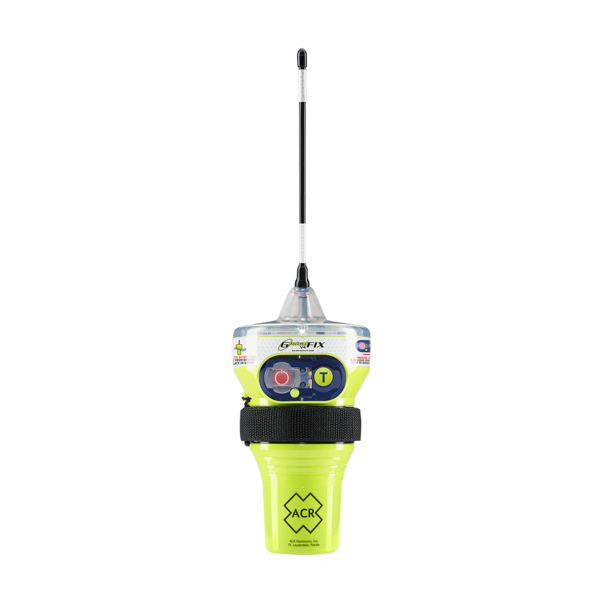
Now, what about the boat? We could have a medical emergency, a dismasting or a small fire that cripples our ability to make passage. We needn't be sinking. We needn't be taking to the liferaft. But we may have to call in outside help. That when you trigger the EPIRB. I selected this model for its balance of features, and because we also have a functioning PLB and will also have a satellite phone and handheld VHFs with GPSes (as does my watch). We are making it hard to get lost, frankly.
Slightly less capacity, greatly less corrosion, much easier to haul to shore.
Speaking, more or less, about cooking up solutions, we have now a fibreglass propane tank to replace the steel one that came with the boat, which is at least 13 years old and probably uncertifiable. This one will be easier to haul ashore empty or filled.
I can see clearer now and can correct for variation.
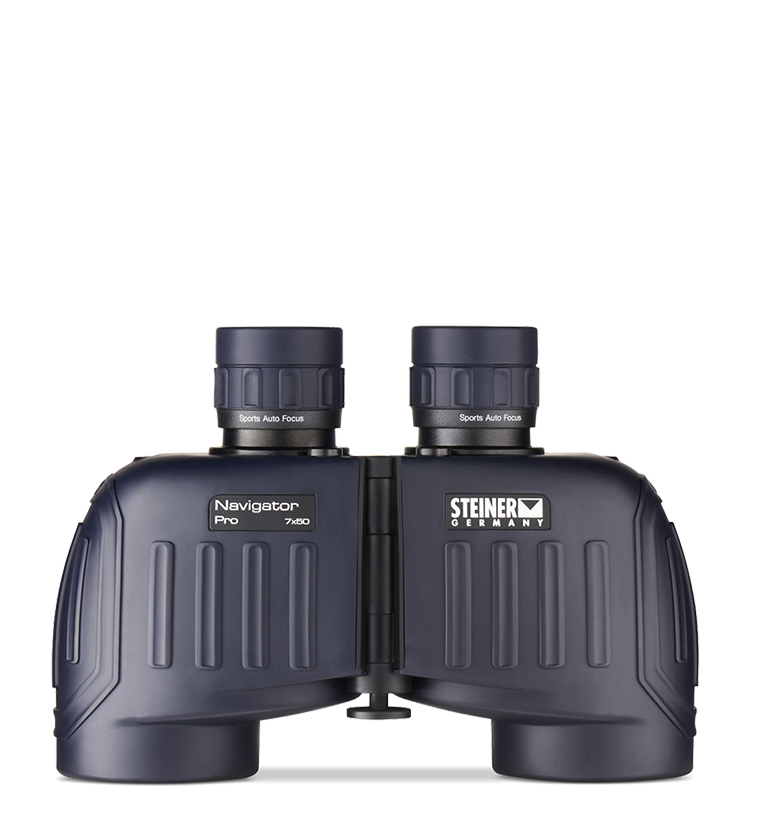
These were not strictly necessary as I possess fairly good, if vintage, Kurt Muller circa 1940s 7 x 50 binoculars. But these Steiner Navigator ProC binoculars have a built-in compass and very impressive optics, making buoy spotting or bearings to landmarks very simple, once I figure out how the steel deck affects them. Experience suggests "a lot" for my compact wife and "not at all" for my loftier son and myself...the steel seems to bother compasses to about the 165 cm. mark above deck and then hardly at all.
If you're going to pump with enthusiasm, go hydraulic.
I don't favour Gill particularly, but we've ended up with Gill gear because we've had very few issues with it and it's good value for our money, particular if you buy last year's wonderfoulie. But then we have a dry boat.
"Non-compliant": yes, we know. We haven't used it since shortly after getting the boat. Probably is empty. Photo (c) Peter McGuire, Fastnet Yacht Surveys.
Had a survey for insurance purposes last Sunday, something our insurers haven't asked us to obtain A couple of things we knew (Mrs. Alchemy was present as a learning opportunity), such as the superannuated propane tank and the propane hose that needs replacement after 10 years, and that the inline filter for the air condition seawater circuit was not ABYC-approved. Both are easily fixed, and the last one can find a use for a salvaged little Perko-type strainer I already have stowed.
It's an Octopus, but not the breaded kind.
We also know we need an isolation transformer. It's on the list. What I didn't know or noticed was that the hydraulic hose going to the pilothouse helm pump is starting to "sweat", meaning Its Time Has Come. As I am planning on installing a hydraulic autopilot this summer, I think I'll buy the replacement and the "new" hose and fittings at the same time. Still unsure of which autopilot brain box I'll install, but I'm leaning toward this. And this display. While we intend as a matter of course (nav pun) to steer to a heading, rather than to a waypoint, so as to reveal set, drift and leeway, etc., we are going to preserve the option of interfacing with the existing plotter. But mainly, it's about robustness.
So is risk assessment. A lot of decisions on the boat are driven less by what we think we can "get away with" and more by "if we do these things and follow these practices, we will lower our chances of catastrophe". That's more than wishful or magical thinking, it's prudent seamanship, which is something even a land lubber can practise. We try to follow the precepts of "renovate, repair, and, if possible, improve". It's why the failed Schedule 40 galvanized steel pipe nipples topped with bronze ball valves have been replaced with Schedule 80 (beefier) stainless steel pipe nipples with Marelon ball valves.
Before...
And after...still to do, the reconnection to the respective drains.
Was I always this cautious? No, but near-sinkings and hanging from tethers over a wild sea will sharpen one's sense of the transitory nature of life and boats, and suddenly backflow preventers and gas sniffers seem like sound investments. This was brought home to me, again, just 12 hours ago.
You'd be melancholy, too.
This
fine old fellow is "Doba". How he ended up on our ratty couch at 0300h is
a cautionary tale. Doba is an elderly Dogo Argentino, a large breed of hunting dog, allegedly, but he is possibly the mildest-mannered beast I've
ever encountered..."big suck" only approaches his degree of stolid
amiability. Last night, circa 2 AM, I was fighting with a reinstallation
of Google Earth when I heard barking and shouting from the street. Now, as we
live way downtown; sonic shenanigans of this sort are not unusual of a Friday evening. I would have
ignored it and turned in had I not heard the loud arrival of a police
car, followed by that of the first of many fire engines.
One of
the rowhouses across the street was on fire. Which one was not immediately clear,
but I could see loads of smoke from my second-floor window and, briefly, flames curling up above the
roofline. I woke the missus and went outside. Sure enough, Doba's
owner, Paul, one of the two tenants in the building, and Franco, the
building's owner, were on the street, with Franco clearly in shock. The
speed with which the place had burnt was alarming: the second, top floor
was effectively burnt out, but the four fire trucks on scene had
knocked it down rapidly.
Turns out Franco on the top floor had
left a cigarette burning on an ashtray that may or may not have been on
the bed while he went to the bathroom. The bed caught fire and then the
room caught fire. Everyone got out, save one of two cats (we've just learned that Cat Two was found) but I suspect the building is effectively
condemned. Or so it looks.
We learned from Paul that Franco has had a loose
relationship with risk management: while he owned the property outright,
he carried no home insurance (unmortgaged houses are not, in fact,
obliged to do this, which was news to me...and to our real-estate agent). He also had, as is required
by law in our province and presumably in others, no smoke/fire detectors on each floor. Whether this would have
helped is unclear, but it might have been possible to put out a
smouldering bedding fire before it really took off had an alarm sounded.
The house was from 1890 and that dry hemlock wrapped in horsehair was
like an oil-lamp wick, unfortunately.
We loaned Paul and the
basement tenant a couple of coats and had them in for tea and brandy.
When the "warming bus" arrived, we offered to take Doba overnight. He
did whine a bit, understandably, but he settled on the couch to sleep
and was otherwise the perfect guest. Around 10:30 AM this morning, Paul
came by to pick him up to shed elsewhere. I wish them good luck. They'll need it.
I relate this tale not to point blame at Franco or at any home or boat owner with a non-rigorous approach,
but to illustrate that three people now homeless (plus three pets, including the vast Doba) and,
probably, with a few hundred items destroyed or damaged possessions, might have avoided this
outcome with some pretty basic forethought. What the surveyor pointed out by way of needing attention needs attention (although my insurance company took this year's cheque without complaint), but a shortage of alarms and extinguishers aboard weren't among the remedial aspects covered. Same with the
house: we had tenants for years and there's smoke detectors on every floor with a
CO detector next to the furnace, plus more fire extinguishers than are
required in various potential problem spots. We have full house insurance, including coverage should I be
unable to work from home, as it's my usual spot. These things are stated not to seem smug, but
to indicate habits of mind. I have commented in the past (and recent events in the sailing world have kept it top-of-mind) how viewing the
universe as more or less indifferent to one's well-being seems
realistic, as do clear-eyed assessments of risk in one's environment,
particularly that of the sea on small boats. There are parallels to
small houses on land. You may think because you've never screwed up, you are an expert at something. This may be the wrong approach.
Prudence only looks like paranoia to the unprepared.
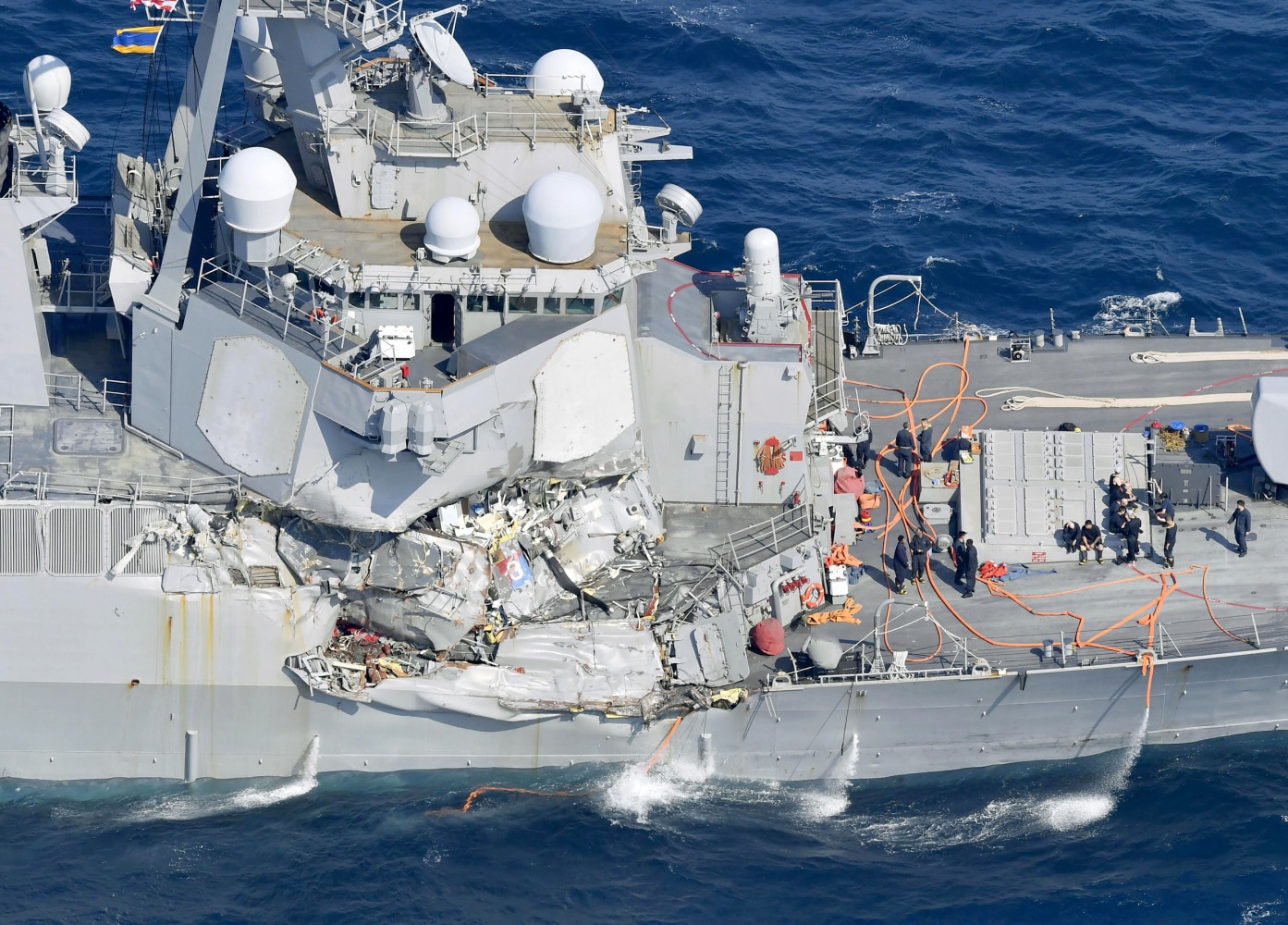
Apparently, the interior of the Fitzgerrald skipper's stateroom is visible in this shot. Good grief.
Risk assessment is more than reading a forecast or watching a radar's guard zone. It's a holistic, ongoing
appreciation of what all sorts of inputs are saying while one is in command (or crewing) on a boat, including the
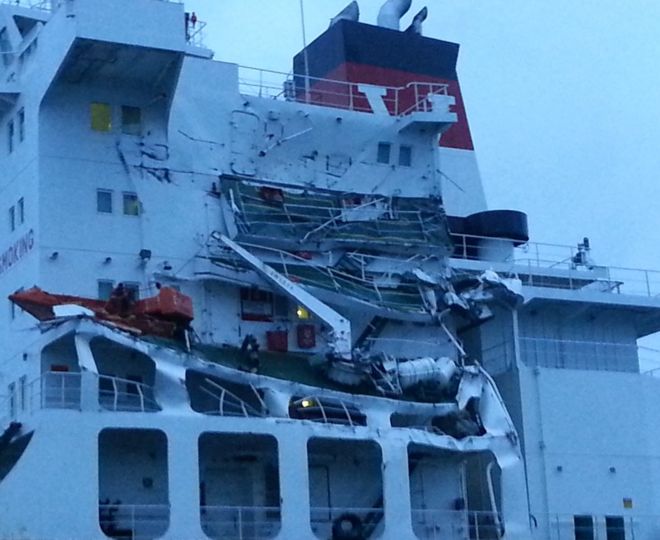
harder ones to quantify, like gut checks or the smell of the air. It's too early to speculate on the precise chain of events that led to the recent incident involving a container ship that killed seven sailors on the U.S. destroyer Fitzgerald, depicted above, but even the already-known facts are reminiscent of the way another U.S. Navy ship, Guardian, managed to ground itself in 2013 on a charted reef (even if the charts were known to be predictably inaccurate), which led to a total loss. Ironically, considering the ecological damage done, the last biggish vessel to ground on this reef belonged to Greenpeace in 2005. Incorrectly, in my view, they also blamed the chart.
Minesweepers are made of wood, so a few weeks on coral...
Our tools, in this case, our navigational tools, are not ourselves, or, to put it another way, they are not extensions of ourselves. While it is not always possible (think of a submarine at depth) to lay physical eyes and ears on our surroundings, to put more emphasis on representations of said surroundings, rather than going outside of the glass bridge to have a look-see, would seem imprudent.
Despite the as-yet absence of a full investigation (which, like the one that dissected the USS Guardian incident, may be redacted or opaque with naval jargon), a lot of mariners have discussed this incident as it features some fairly clear-cut premises on which modern civilian and military ships operate. Particularly hard-to-turn, unhandy and comparatively slow cargo vessels and agile, fast naval ships bristling with detection gear. As this article sums up, avoiding collisions is a shared responsibility, but U.S. warships are not supposed to be crept up on by 750-foot container ships.
How agile? This agile. This is the same class of destroyer as USS Fitzgerald.
If, as is customary, both ships were on autopilot, that doesn't get anyone off the hook, of course, as this more in-depth article suggests. The consequences are real and are, of course, tragic. While we think of warships as intrinsically strong, they are merely strong enough; if you want speed, you can't build a ship with 30 cm. thick sides. Most modern naval warfare involves missiles at a distance and countermeasures to missiles at a distance, not ramming. I cannot imagine what went through the skipper's mind as he was (apparently) nearly ejected from his ship. What is known is that it was a new gig for him.
Physics has the final word, again.
Even in the seaways with the most heavy use and the arguably most closely monitored traffic separation schemes (TSSs), the scourge of under-crewing and lax watch standards can cause ships to collide. Again, this is a recent (July 1, 2017) event, but I will wager that someone who should have been looking around wasn't, or was beguiled by a screen. Makes sense in such circumstances to avoid ships entirely if they exhibit zombie-like behaviour, doesn't it?
Yes, the struggle is real.
Back in the small-boat realm, I just read a rather good article (in which the writer, rarely in my experience, seemed to have sailed and knows what a sailor would care to know when reading about a bad day on the water) on a heavy squall that hit a post-race group on Mobile Bay, Alabama in the spring of 2015. The description in the article make it clear that a host of factors led to tragic outcomes, but a few people chose not to race that day. The technology didn't fail those who did choose to race, but perhaps their instincts faltered. I can't make that judgment, frankly, and it would be hubristic to try. But I have noticed that a) people rely a great deal on technological inputs while sailing (readers may recall we ourselves recently updated our plotter) and b) the traditional skill sets of the sailor are beginning, I would argue, to wilt. Who sails today with just a handheld VHF and maybe a bulkhead compass? Perhaps the lack of screens might sharpen some skills that may be shown, once again and sadly, to be absent on some of the largest and most-crewed vessels on the oceans.
The ship's wheel being handed over to rescuers prior to the scuttling of S/V Rebel Heart. One of the sadder photos at sea that I can recall.
It's a funny feeling only possible in the last 20 years or so: the sense of vague familiarity that fleeting contact on the Internet renders possible between otherwise complete strangers. My first contact with Eric and Charlotte Kaufman, the American owners of a Hans Christian 36, was through, mainly, Eric's posts under the handle "Rebel Heart" on the Cruisers' Forum website.
S/V Rebel Heart as seen from a U.S. Navy helicoptern 900NM off Mexico
Now, there are some who feel that calling for help is inviting regulation of the cruising lifestyle; sailors are supposed to be self-reliant and to only seek aid in the most dire of circumstances. And yes, it's easy enough to come up with episodes where squadrons of SAR resources have been dispatched for what many would derisively consider trivial reasons.
But we aren't all alike in our capacity for managing trouble aboard. Maybe we should be more so. I'm trying to gather experience and training to that end because of incidents I've heard of where accidents could have been avoided...or not required rescue...had the crew been a little less unknowing. Or more lucky, one can also conclude.
Reefed down to keep the motion kinder, I suspect.
The reason the Kaufmans hit the big red button on the EPIRB is still not entirely clear to me, but a series of rough weather episodes, and a cascade of no-doubt-related equipment failures, was tipped over into the "rescue us" category by the youngest (one year old) Kaufman daughter exhibiting a persistent fever. Of course, being some 900 NM offshore, rescue was not instantaneous; my understanding is that it took three days before a ship with Zodiac-style tenders and the right sort of SAR personnel could arrive at Rebel Heart's location to take the crew off, and to "cut the hoses" and deliberately sink the Kaufman's vessel as it was far too distant from shore to be reasonably salvageable, and because an uncrewed 36 foot yacht is a significant hazard to navigation. It's therefore customary, if abandoning ship, to sink it by cutting below WL hoses or opening seacocks or even punching a hole in the hull.
Rebel Heart was a Hans Christian 36. Also known as a "Union 36", you'd need a big chisel to punch a hole in this hull. It was made of fibreglass, but weighed only about three tons less than does Alchemy, a larger and steel boat. It was a reasonable, if not particularly swift, choice for conservative cruising.
Rebel Heart's skipper Eric Kaufman has some sort of U.S. Coast Guard qualifications and is a former submariner; he would have known this. All else aside, the deliberate and necessary sinking of one's seaborne home is an occasion of deep sympathy for any sailor.
Probably because of the three-day window before a ship could reach them, and very probably because very young children, ages 1 and 3, were involved, this story "broke big" and became, briefly in the ever-advancing news cycle, big news. I first read about it on a comedic news aggregator website, and was shocked to realize "hey, I know of these people". The news site's members, not in the main being sailors and taking their cue from the press, were predictably scathing. Today's easily outraged online commenter does not hesitate to call for the authorities to remove children from their parents' custody, or to advocate "making them pay" for their own rescue.
The general public's feeling on learning that small children may, at times, cross oceans in Bob Perry-designed boats.
Less obvious was the criticism found on various sailing forums, particularly the one where Eric and occasionally Charlotte posted their plans for several years. Some of it, despite our own somewhat different circumstances, hit home with me. Eric and Charlotte, whatever the quality of their seamanship and their choices, were quite typical of younger cruisers in their commitment to blogging and documenting their preparation and thoughts on cruising. They had so much to say, in fact, that they split their "boat blog" into two sections: one for the dad and one for the mum. Both are pretty good writers, but while Eric's blog is a fair bit like mine, Charlotte's is more wide-ranging and covers a lot of mothering issues and deals with her child-prep and children's clothing. There's even a link to her Etsy shop. There's even (as seems sadly inevitable in these cases) stories of "I told you so" coming from "concerned family members". Hmm.
A sobering shot.
While such "mommy" musings are clearly not unusual, they seem to have drifted into "oversharing" waters, raising the ire of many. Other sailors have been quick to dredge up Eric's criticism of the preparations or skill set (as he perceived them to be) of other sailors who've required saving. What's clear (and not much is) from this online palaver is that things said online are virtually forever, and that everyone, whether lubberly or skipperly, is a self-appointed critic of anyone else who dares to list their plans when it comes to getting the topsides wet. I have even read some very cynical (and I usually consider myself to be more than typically cynical) theories concerns the near-complete silence of the Kaufmans since their safe rescue: that they are going to write a book and that they are soliciting donations.
Well, can you blame them if they kept silent? Why open oneself up to attacks like this?
Charming, as is the case with humanity at one remove. Image (c) therebelheart.com
This couple are likely homeless, or perhaps couch-surfing for some time, and the home they've worked on for nearly a decade is at the bottom of the sea. They've also just survived a situation that might easily have killed their kid 20 years ago, before EPIRBs were generally in use on small sailboats. So given these things, I would be surprised if they engaged their critics on any level beyond a dimissive expletive.
So, as I still don't feel I've heard Eric and Charlotte's analysis of "what
went wrong", I will withhold my opinions on their actions, not that they would really be helpful, except in a forensic sense that would perhaps serve our own endeavours. It's a truism of the shipboard life, however, that at sea, the skipper(s) make the call: they must have that autonomy and the preservation of the crew must take precedence. That's pretty well the end of it, for me. I wasn't aboard, and don't know the details, and further speculation must remain empty.
I am quite
interested, however, because we are planning much the same sort of trip,
but with some differences. The main ones for me are as follows (and are
to this point):
1) We have one son, currently 12 1/2, and the same size now as my wife.
He's been sailing since he was seven and is taking further advanced
courses this summer.
2) My wife and I have done two saltwater deliveries each (and separately) since 2007.
3) I've taken an RYA course and will take more. So will the missus.
4) We both know our pilotage, diesel repair, CN, and first aid and have taken courses (and fixed things while underway) to that end.
5) We've done most of our own refitting. That's why we haven't left yet!
Refitting/re-engining a mid-size offshore-capable boat is like
apprenticing in four or five different trades, or so it seems. Whatever else can be said for this, if something breaks, you will usually know what broke, where it is, where the spare is, or how to fashion a fix...if you installed it in the first place.
6) We've each experienced, on different boats, sustained gales of 40-50
knots and squalls past 65 knots. We know what that sounds like and how
to heave to, deploy drogues or reduce sail to kerchiefs. We know of the necessity of giving ourselves a rest and respite, something very young children are unlikely to grasp or endure.
7) This might be the most important part: We plan to leave Toronto for a summer's cruising in Nova Scotia, and then to haul out for winter in Halifax prior to a following spring Atlantic crossing of the British Isles.
Our "shakedown cruise" will therefore be in waters tidal, oceanic and yet domestic. The Gulf of St. Lawrence and the Atlantic in front of Nova Scotia is the real deal, and yet is well-supplied if things break. And things always break. S/V Rebel Heart, by contrast, made their first offshore cruise one of the longest one can make: between Mexico and Polynesia. I wonder, however, if my own blog posts and forum musings will come back to haunt us, should we experience difficulties, from the Hun-like hordes of those who, from the comfort of their keyboards, know better how to sail and "wouldn't have gotten into this mess".
Maybe we should cast off, and then "go dark". I know of a few cruisers who purposefully delay their posts for some weeks for reasons of security (why tell the world, which of course includes pirates and theives, where you are or where you anticipate going?). In light of recent events, I have a fresh appreciation for this tactic.
It's too close to spring launch for me to read Rebel Heart's blogs or even do more than sample the largely useless speculative threads on various sailing forums, but I would suggest that our plans and preparations may
serve us better in the long run than did theirs, if only because ours are deliberately incremental, and because our son will be a near-adult and will be capable of being a real crew. Toddlers are, by contrast, incontinent cargo. I'm sure they have other charms, but even though we took our son sailing in a bundle and then a car seat from a very young age, we did not choose to go out of VHF range or in particularly tough conditions. Now we do: he's a good swimmer and lives in a PFD. I look forward to further progress.
The First Mate at five days of age, September, 2001. I cannot say that I haven't taken an infant sailing.
I would still like to
hear the Kaufmans' side of their story if they choose to relate it.
Alive, if boatless, the Kaufmans and their rescuers in California
UPDATE: 2014.05.06: I found a post by someone named "Weavis" on the Cruisers' Forum website that is very apt and is applicable to all who venture an opinion on those who go down to the sea in ships, or Hans Christian 36s, for that matter:
Originally Posted by weavis
As a young
physician in training, I was filled with a burning desire to change the
world. 5 years on, and having worked with wiser experienced men
and women, I came to understand a few immutable principles for living a
life. And as an older physician now, the principles hold good.
Every single
person is entitled to respect. This means, as a friend, a parent, a
spouse and as a stranger. We have to respect every one enough to let
them live their own life. To make their own path, and to let them
succeed or fail on their own terms.
We need to be in FULL possession of ALL the facts before we can assess ANY situation.
When an event happens, and its not a good outcome, we need to ask ourself, "Is it my job to fix this?"
We need to see what help, if any, can be
rendered in practical terms for people, if required to ensure they
have lots of space to recover and regroup and regain heath or
balance.
We need to ask ourselves a number of
questions privately, "What can I learn from this episode if I am
faced with a similar situation?"
"Would I have taken the route that was taken to arrive at the situation before me now?"
Am I allowing personal, religious or
that inner set of rules (that we all have), or the outcome itself
to influence my analysis of the situation?
There appears to be a lot of rancour
regarding this situation. It would appear some C.F'ers have issue with
the personality of the man. Some have issue with decisions made
regarding his wife and children, and some have issues with post scenario handling of money.
Life law: We need to be in FULL possession of ALL the facts before we can assess ANY situation.
Even without all the facts, we are faced with the other life Principles to consider:
The journey is over, the vessel is no more, and life has forever changed for this family. It is not our job to fix this.
Ours is to reflect on the situation and decide for ourselves
whether we would have, firstly undertaken the journey, and secondly,
what bits we would have done differently. We have the unique perspective
of being observers and learning without the pain of experiencing results of choices and circumstances.
Reality is that there is NOTHING we can do. President Kennedy was shot.
World wars happened, our parents died, the Titanic sank, and Rebel
Hearts journey concluded when it did in the manner it did as a
culmination of all things that led to it.
We cannot change a thing. It happened.
Eric cant change what happened, because he would if he could. And all the people irritated or morally outraged that he took his children
with him, cant change a thing. All the people aggravated at his
personality and attitude who feel a sense of karma in this, well thats
ok too, he that lives by the sword dies by the sword, but......... thats
a different issue to the CHOICE you would have made in preparing for
this trip, and that is all that matters.
We get one go at this life thing. Some of us approach it quietly and some announce it on the Radio.
We are owed nothing by Rebel Heart.
The C.F. community, comprises of all sorts of
people who write for a variety of reasons, and if they trumpet and blow,
and then the quiet descends, well that is all there is. We are not
Erics Mom or Pop or someone owed money,
we are just associates, we are not even real friends REGARDLESS of what
you think. He has other things to work out and needs to find the best
path to live with himself and continue this life.
There is also the 50-50-90 rule:
anytime you have a 50-50 chance of getting something right, there's a
90% probability you'll get it wrong. There is no starting over, you just
have to live with the mistakes you have made, and that what you consider mistakes are not what others might.
It would be nice if at some stage, the crew of
Rebel Heart tell their story. But you know what? It wont matter to some
people. There will be no change in their view or positional stance. It
will only inflame them more to convince the world that they are correct
in their assessment of everything that happened. And truth is, they
might have parts of it right, maybe all of it, and it doesn’t change a thing to what has happened. It can only change what we do in our lives.
About two and a half years ago, I posted my thoughts, immature as they were, on what I suspected was the reality of self-rescue on a sailboat in the middle of the ocean. By "self-rescue", I mean a way in which the solo sailor, having fallen off, can reboard his/her vessel, or how a single and perhaps smaller member of a couple can retrieve the big dope that's slid overboard in the night.
It starts with understanding the difference between EPIRBs (a beacon
for the boat) and PLB (a beacon for the body that has fallen off the
boat). This video explains it succinctly:
It
is quite conceivable that if you came up on deck 200 NM offshore to
find your PLB-equipped crew missing, you would a) call a MAYDAY on your
SSB and VHF, b) hit the EPIRB to get a plane in your general vicinity,
and they would c) attempt to zero in on the PLB signal, which is
normally weaker and of lesser range than a boat's EPIRB.
I was of two minds then, and I remain so today, with a couple of caveats and an evolving suite of MOB devices to blame for the rethink. My original position was, and remains, to stay aboard the boat. Sounds easy, right? Obvious, even. And yet people fall off boats all the time. On the Atlantic delivery I crewed after I wrote the original post on self-rescue and problems I saw with getting someone back aboard in bad conditions, the boat came off an odd and higher wave while the AP was on during my middle of the night watch. I had been watching the stars, so brilliant at sea and had been lying on my back. The boat slid, the cushion I was on slid, and suddenly my feet were under the lifelines and my backside was on the toerail.
Then the tether went twang. I stopped my slide with my feet washed by the waves of the sudden, clear-air gusts or rogue waves or whatever the hell it was that threw us over without warning.
I was able to quickly haul myself (and the cushion) back, switch off the AP, and actively steer back to our course. By the time the skipper appeared, all was well and I had re-engaged the AP.
But it was a lesson or a warning. I never failed to tether on in the Atlantic when on solo watch, because intellectually I understood that the likelihood of finding someone on a moonless night with 10-12 foot waves was pretty low. I could be pretty far astern, and injured, before anyone found me. The PLB might...might...have helped, but we were between Bermuda and the USVIs at about 63° West, and likely beyond SAR aid. Past Bermuda, I saw two ships, at a great distance. Maybe. Could've been a UFO.
So stay aboard. Don't cause your friends, or SAR personnel, or even your crewmates to play what I grimly termed "spot the corpse". Believe in your saviours: the tether, one hand for the ship, the PFD and the Personal Locator Beacon...wait, what about that PLB?
I still have that ACR "Res-Q-Fix" PLB. It lives on Valiente during the season, because while it's not an EPIRB, it's better than nothing. I wear it when I sail solo, again because it's better than nothing. But it's five years old now, and it's due for a battery replacement. I have to wonder, in light of PLB technology's "cheaper and more features", if it's worth bothering. (Since writing this, I found a place in Hamilton which will swap out the battery, so that and visiting HMCS Haida are reasons to go to The Hammer.)
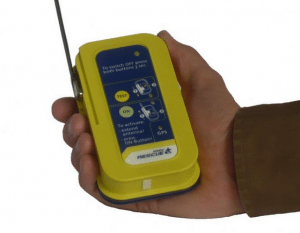
The manual operation aspect is an issue, as well: If you are knocked out or have broken fingers (not a crazy assumption if you were knocked off the boat), you are going to have issues activating some of these units once in the water. It's a two-hander job.
So are the new style of near-range "life tags" the way forward? That depends, I think, on comparing features.
I don't know if devices like these are practical, but as we creep closer to our own ocean adventure, I do consider them in the context of overall crew safety at sea.
While I agree that the majority of sailing done is coastal and within
reach of such SAR resources as may exist, I am thinking specifically of offshore use,
where the distance exceeds the range of SAR personnel, and the odds of a
person being alone at the helm in the middle of the night is greatest,
and it is this possibility of having to be the only possible rescue
vessel in the area that I am thinking of.
The short form is that these beacons incorporate AIS and DSC signals to aid boats in turning around and locating people in the water. They can sound an alarm if the wearer gets more than, say, a boat length away from the AIS.
It's interesting, even if the two-mile range seems short to me. Obviously, it's only for multi-person crews able to physically retrieve people from the water, which means that a) there's a ladder or Lifesling or other means of getting them aboard, and b) they aren't so injured that they are unable to aid in their own climb back on deck, and c) conditions allow coming alongside a person in the water without slamming them further or chopping them to bits with the prop.
Point goes to staying aboard. On the other hand, with a "proximity beacon tied to the AIS, you know if somebody is off the deck very quickly. Even if they are passed out and have a broken arm, guaranteeing a hard recovery, the search aspect would be the smallest part of the operation.
Different AIS-SART, same hand?
That aspect is better this than waving a sputtering penlight, I suppose. Yelling is right out. Anyone who's tried to shout from an aft cockpit to the bow where the anchor handler is knows this is true.
On the other hand, in a heavily trafficked area such as Lake Ontario, I actually would prefer what I already have: a submersible VHF with which I can directly shout MAYDAY on Ch. 16. My Standard Horizon 850 gives me not only a radio that can float/take a dunking, but can also give me a lat/lon thanks to an integrated GPS. The likelihood on a summer's afternoon near Toronto is that I would be hauled out by another boater monitoring Ch. 16 and halfway back to my own boat before I saw the yellow helicopter.
But that's not really the scenarios for these gadgets. They are more-or-less designed for offshore. More presumptions include that:
a) all crew on deck are wearing these devices at all times.
b) the devices themselves are always charged and functional, meaning they are
"always on" in a sort of "guard mode" until lack of proximity to the AIS
transceiver sets them to "active mode".
c) that you keep your AIS on continuously in order to hear the alarm.
It may be the case that the ideal solution is for a PLB/GPS combined with a
two-mile COB beacon, allowimg the greatest number of options for
"self-rescue" or thanks to the more typical guys with the slings in orange helicopters. I wonder
if a simple clamp and extending, brightly coloured pole (like the sort
on bicycle carts) on the PFD would increase the visibility of the COB
and, if the beacon was on the top of a two-meter pole, would the range of the beacon then be much greater than two miles? I understand also that some PFDs inflate a "soft danbuoy", a sort of inflatable, brightly coloured plastic pole that deploys off one shoulder. That seems like a good idea, but would be only marginally better at night.
That "laser flare" is looking good at this stage. Certainly, what I currently have is enough for Lake Ontario (mostly) fair-weather sailing. But I follow developments with interest, as do I check up on the international standards.
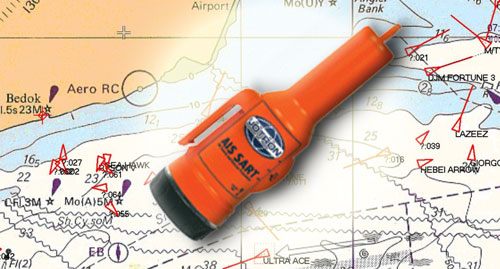
It only looks like a bottle of rum
This AIS-SART technology looks promising, but is it translatable to the self-rescue set-up we are discussing? Dunno. Must learn. Maybe this would serve. It calls your VHF using Channels 16 and 70 via DSC, providing a set of GPS lat/lons. It also has a strobe and can be water-activated.
The "old school" trailing floating rope is an old trick from the days of cork-filled
"life belts". I have read of a couple of cases where it worked (for
obvious reasons, you don't hear about when it doesn't work). A refinement
of this idea is attaching this trailing line via shock cord and a sort
of pin and block to the control lines of a wind vane. The weight of the
line is not sufficient to pull the pin, but the weight of a body on that
line, being dragged at several knots, is. You pull the pin, the wind
vane is disengaged, and the boat (hopefully!) rounds up. You haul
yourself forward and hope you were clever enough to buy the sort of
folding ladder you can deploy from the water's surface.
Again, you have to be fit and largely uninjured and conscious to accomplish this. If you've ever been towed behind even a dawdling sailboat, you know you'd have to possess considerable arm strength to pull yourself forward. Adrenaline might help, but if the water's not tropical, not for long.
You could rig this "release and round-up" to a jib sheet, too, but I
would have to look up how that works in the old 'single-hander' books I
have. It might be only suitable for dinghies.
Needless to say, these methods are in no way guaranteed, but if I was
single-handing on the open ocean in relatively easy conditions, I would
consider trailing a floating line aft. It wouldn't induce that much
drag, and it's cheap, if "last chance" insurance.
It's an interesting topic, to say the least of it. People who
"self-rescue" get to tell their stories. Rarely is a single-handed boat found adrift and uncrewed
in which it's clear how the skipper departed, or why.
UPDATE, 2013.04.13: Of course, all these gadgets are predicated on being hauled back aboard in a timely manner, and from water that will slow the onset of hypothermia. Given the time of year from where I'm writing (early, fitful and sleety Spring), a reality check on falling into cold water is relevant. A couple of article by the excellent Mario Vittone on the equally compelling gCaptain website are worth linking here for the reality of hypothermia's role in complicating self-rescues, or indeed any rescue.
The Truth About Cold Water: A grim but honest examination about some of the myths concerning what a person can and cannot hope to do once off the deck and into the cold sea/lake. In my recent Marine First Aid course, we learned a bit about cold shock and cold incapacitation, and a little bit about post-rescue collapse. But I haven't been trained as a paramedic, just as a first responder of the most basic (and perhaps only) kind available. All I can do is be aware of these factors if a person I can retrieve is appearing hypothermic.
Drowning Doesn't Look Like Drowning: Just as movie heroes seem to have infinite bullets, and Batman's sustained more concussions than a thousand Sidney Crosbys, so many of us have a rather fixed idea of what drowning looks like. This idea is completely wrong, according to Vittone, and you do learn the truth in a proper marine first aid course.
UPDATE, 2013.05.06: Thanks to sailor and long-time reader John Cangardel for sending me this, which I suspect is based in part on a prop from a James Bond movie.
Interesting how at 1:43 the helo spotted him on the infrared...in the daytime. But I cavil. This is, like, the Garmin Quantix I mentioned earlier this year, a bit of a paradigm shift in PLB form factors. Interestingly, it's orientated to calling in rescue resources from afar, not the "self-rescue" discussed above. Is this therefore of most use to solo sailors?
No, Mr. Bond, I expect you to drown.
The Breitling Emergency II model is interesting to me as it shows the convergence of certain types of wearable beacons with pricy, if more quotidian items like watches or brooches, et cetera. Clearly, the day when we have a combination radio and beacon of the Star Trek "communicator" type cannot be very distant. Certainly the widespread popularity of the far, far cheaper SPOT Messengers is a harbinger, and while the SPOT beacons have some shortcomings, they are a terrific and low-priced adjunct to proper emergency beacons; even the daily "I'm OK and here's my lat/lon" message from vessels on delivery is useful to loved ones while one is offshore.
If you sink this close to shore, skip the beacon and just get out and walk.
To my knowledge, there isn't (yet) an AIS-SART in a watch that would alert people that you've fallen off the boat and are bobbing on a bearing of 271 T. Why would there be? Increasingly small devices, now down to not much bigger than a couple of packs of gum, do that already. And yet a watch has the cultural heft of a customarily worn item of "clothing", and doesn't look like a conspicuously bright piece of plastic rescue tech. It looks like a very expensive watch, which, if one is relieved of it through robbery, might reveal the location of the thieves, if only by them fiddling with it!
According to this,
the Emergency II will transmit for 18 to 24 hours. I am guessing it is both
121.5 and 406 Mhz because neither transmission contains a GPS string. I
think an EPIRB with GPS wins in this regard, plus a SART for the last
few miles.
I am also a little suspect at the length of time it
will broadcast. Hit a container in the South Pacific and you could be in
that raft for a few days, even with a working EPIRB and your location
tracked via COSPAS. Interestingly, COSPAS-SARSAT frequency issues are discussed by Breitling, who maintain that the analog 121.5 Mhz signal is still valid for final "homing in".
I also question the need to secure the watch
to the top of the raft (bring a C-clamp in the ditch bag, perhaps?), although clearly one cannot
deploy the antennas and continue to wear the thing. I can see this being
of some use to hikers, mountaineers and back-country skiers,
perhaps...the sort of people unlikely to carry an EPIRB or even a
standard PLB (although that is a good thing to consider if it's the 406
Mhz GPS transmitting kind).
Nonetheless, even a fifteen-grand, short-lived beacon you can wear will appeal to some. Not me, however: I wear a worn Suunto Vector with a cracked crystal, said crystal getting cracked in the first place because the Vector is somewhat chunky; the Emergency II is even larger and heavier. I like my old watch's barometer feature, however. but am considering switching up to a Suunto Core, which has a "storm watch" alarm feature some sailors have reported useful to them in getting sail off before bad weather hits.
Dorky, yes, but I don't have to lash it to the top of the raft to use it.
I can acquire one of these for $250. Of course, many sailors say you can get a perfectly fine Casio for under $50 and not worry. Others go completely "island time" and lose the watch entirely. That's fine, too: I didn't wear a watch except for suit gigs until I got the Vector for sailing use. I use the barometer function a great deal and that feature alone is attractive to me.
For fifteen grand, however, the Breitling Emergency II would just make me more nervous than the possibility of stepping off into the raft. I also can't help but reflect that I could spend the same amount and could ballast the liferaft with EPIRBs that would last a month.
Note that I would not in fact spend that amount. That's also about four very nice liferafts.
This German-made AIS beacon starts transmitting when the PFD inflates, which is handy if you are unconscious, but alive, when you fall off the boat at 0300h.
UPDATE 2015.09.12: As predicted, it seems that the utility of adding AIS to a wearable device attached to a PFD (along with laser flares and other "here I am" devices, is proceeding apace.
The online log of S/V Alchemy, her restoration, her crew and their voyage
“You never enjoy the world aright till the sea itself floweth in your veins, till you are clothed with the heavens, and crowned with the stars: and perceive yourself to be the sole heir of the whole world.”-Thomas Traherne
"He that has patience may compass anything."-François Rabelais
"The Great Lakes sailor is wild-ocean nurtured; as much of an audacious mariner as any. "-Herman Melville
"[The sea is] neither cruel nor kind ... Any apparent virtues it may have, and all its vices, are seen only in relation to the spirit of man who pits himself, in ships of his own building, against its insensate power." -Denys Rayner
“For those who believe in God, most of the big questions are answered. But for those of us who can't readily accept the God formula, the big answers don't remain stone-written. We adjust to new conditions and discoveries. We are pliable. Love need not be a command nor faith a dictum. I am my own god. We are here to unlearn the teachings of the church, state, and our educational system. We are here to drink beer. We are here to kill war. We are here to laugh at the odds and live our lives so well that Death will tremble to take us.” -Charles Bukowski
"A dream you dream alone is only a dream. A dream you dream together is reality." -Yoko Ono
My wife, my teenaged son and I plan to start voyaging in spring of 2020, plagues notwithstanding, for an estimated five to six years. I hope to move us aboard before that point to work out the kinks of living on a boat.
The careful reader will note the URL of this blog has "alchemy 2009" in it, a reference not only to our boat's name, but also to the original, anticipated departure date.
This is called "tempting the gods of the sea and life in general" and will not be modified. You have to know when to fight, and when to appease. Frankly, it matters that we go, not when we go. This is a good lesson for all aspiring voyagers, I think: the hubris of long-range planning lurks like an evil watermark on every "to-do" list.
Here you will find various notes on our preparations, labours and education as we try to become better sailors in a good old boat. I hope to continue to discuss in this blog the realities of preparing for a marine-focused extended sabbatical, the issues both mundane and philosophical confronting the potential cruiser, and the efforts required by everyone involved to make it happen.
Please note that all text and images on this site are copyrighted and may not be used without permission of their respective authors and creators.
Please note that I have not bothered to resize photos and they may be seen at full size and aspect ratio simply by clicking on them. Some photos formally hosted on third-party servers are not at present appearing; I will locally host these photos as I can afford the time to relink them.
Please also note that anonymous comments are usually spam and will typically be deleted without reading.
Author's text and most images other than product shots specifically created by product manufacturers are copyright 2006-2021 M. Dacey/Dark Star Productions. Photos sources linked from online news and related organizations are copyrighted to their creators.
Middle-aged, bookish Canadian with compact family in process of exploding career and prospects in favour of lengthy, low-rent sabbatical has boat, seeks ocean. Must have non-smoking bilges.
All contents (C) 2007-2021 M. Dacey/Dark Star Productions