Copyright (c) Marc Dacey/Dark Star Media 2006-2026. Above photo (c) Marc Dacey. Powered by Blogger.
Showing posts with label SSB radio. Show all posts

2017-01-20

Time for some changes

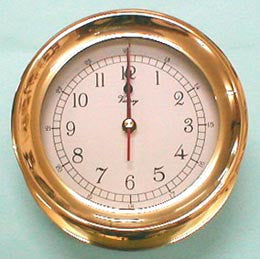
Because it was time for a change, this is my treat to myself for having sold the old sailboat. It's from around 1978 to judge by the serial number, and it's the first thing I've ever purchased on eBay. I'm rating it now prior to putting it in the pilothouse. It's in pretty impressive condition to judge by the outside appearance.
Eight-day windup. I don't expect it to be exact, but I have little faith in the reliability of cheap battery clocks.
The case for a "ship's clock" wound with a key is, in some senses, not a strong one, save for the observation that I've had rather poor experience with the modern replica types which run off an AA- or C-size battery.
Yeah, this is garbage. Sorry, "giftware".
The problem is the cheap, generic, plasticky and inevitably Asian clockwork, which fails to keep time, and fails variably depending on the season. Nnot to mention the pot-metal contacts that corrode even in the air above a freshwater lake. The fact that these are sold with the other anchor-themed tat that fails under "nautical giftware" is really no excuse as even the cheapest models go for well over $100 and the battery operated versions from the higher-end firms, such as Weems and Plath and Chelsea, can go for multiples of that. I don't buy a clock for the boat because brass is shiny.
The keener-eyed will note that apart from the greater number of numerals, this is the same model as I've just bought.
Now, the one above was the sort I really wanted, and was in the even more desirable version of a smallish 24-hour ship's clock that rang the bell, but the seller could not guarantee that it worked, as he had no key for it. Such timepieces are called, variably, a 24 hour clock, a deck clock or 'Zulu' clock, the Zulu having nothing to do with Michael Caine films from the '60s and everything to do with the "Z" in a phonetic alphabet that is shorthand for Greenwich Mean Time or GMT or also UTC. When it comes to time, it's a funny old world, innit?
 
Unfortunately, the 24-hour one on the right took a short tumble and died. Another battery-driven casualty of life aboard.

Why did I want such a near-antique as a mechanical, hard-to-read wall (or bulkhead) clock? Well, one of the upcoming boat projects will be the installation of our ICOM M-802 SSB transceiver and its associated bits. I noticed way back on my Atlantic delivery in 2009 that skipper Bruce Clark kept a nice small mechanical 24-hour clock screwed above his nav table from which he would conduct his comms, download GRIB weather files and have his daily exchange with the alas-retired weather routing expert Herb Hilgenberg. 
Herb was routing us through this: the remnants of Hurricane Ida. Was a bit bouncy.

There's two concepts at work on a ship (and of which I have written before): local or ship's time, and the time back in Greenwich. Ship's time is useful for planning lunch, but the time in Greenwich, thanks to centuries of maritime convention, is essential to working out one's position at sea with a sextant. Which I own and know how to use and which doesn't require electricity or a network of satellites. Handy, that, particularly as we live in what are arguably interesting times. Seamanlike prudence starts with a Plan B, and besides, for logical reasons, most radio communications are scheduled in Zulu time and so are many official logbook entries. Keeping one clock aboard coordinated with an arbitrary point on the planet is therefore neither pedantic nor unhinged. And the skipper likes 'em.And has an excellent wrist chronometer as backup.


2016-01-27

Unforced mating

As a kid, I built 1/72 scale models of this historic bomber. If you'd told me then that in 2015 I would own a steel sailboat and one of these would have flown over it, I would have laughed. Screencap (c) CBC
I was alerted by a fellow YC member that an episode of the Rick Mercer Report, a CBC comedy show, featured a flight in one of the world's last two flying Lancaster bombers. This World War II stalwart was made here and in Britain in the thousands for the purposes of German urban renewal. Now, I was potty enough about "warbirds" in my callow youth that I recognize the distinctive sound of the four Merlin engines (the same engine that powered the Spitfire) that drag this pristinely restored 100,000 rivets flying in formation through the sky, and as they do their fund-raising flights over my house and my boat, I usually don't miss a chance to look up. This shot captures the moment the Lancaster flew over National Yacht Club in fall of 2015, and yes, I've helpfully pointed to S/V Alchemy, just as metallic, if not...yet...as storied.

Batteries were out on the camera, otherwise I would have zoomed in on the waves splashing the runway. About 25-28 knots, I think.
Back in the bleak midwinter of 2016, the wind was up and a reason to tie off the ladder was clearly evident. The tarp over the pilothouse roof will need replacement, as is the case at least twice each winter, as the wind and the snow tend to shred it. I was aboard because, despite the wind, it was about 4C out, almost balmy for late January, and I wanted to charge the battery and take some measurements. I actually use my electronic calipers (which I bought during a 70% off sale) quite frequently, because of the multiplicity of fasteners and holes and mast measurements I have to take. By the way, the mast slide system from Tides Marine has been ordered and should arrive at the sailmaker's next week.

The aft cabin is not just a radio room, but this is a good start.
Firstly, however, was dealing with my Christmas presents. Mrs. Alchemy finally heeded my long-standing request for a "24 hour clock" and threw in a tide clock as well. They fit nicely and are easily seen from the pilothouse and from the aft cabin. The tide clock, which is admittedly not so useful on the Great Lakes, can nonetheless show "ship's time" or that of the local time zone in which we are sailing, whereas the "ZULUTIME" clock stays on UTC time...all the time. Simple, really! Also, if I ever form a cruiser-based pickup band in the tropics, we're going to be called "ZULUTIME".


Needs a touch-up, definitely.
Now that the engine is (one hopes) reliably situated, I can bolt down the aluminum pilothouse roof to the steel inward flange of the pilothouse itself. The problem is one of dissimilar metals, exacerbated by imperfect painting and the completion of the "circuit". Another reason to do this, of course, is that this roof has a fair number of electrical leads going thorough it of the power and signal variety: fluxgate compass, GPS, overhead lighting, and so on, and while this will be carefully handled, an alu roof electrified and in contact with the steel hull would be A Bad Thing, galvanically speaking. Now, while it's true that the mild steel of the pilothouse and the aluminum are pretty close on the galvanic series, the stainless steel of the fasteners used to hold one to the other are very definitely farther away in said series, and are therefore more likely to trouble the mated metals. So, unmating them is key.

Ignore at your peril if you own a metal boat sailing in a weak electrolyte, such as the ocean is.
I'm doing this mainly through keeping them mechanically separated. One metal will not  touch the other. It starts in the spring with removing the pilothouse roof; now that the mast will be back in place, lifting the pilothouse roof straight up using the boom and the topping lift and a harness should be simple. It's in fact one of the reasons I rigged a Dyneema topping lift: to hoist stuff in and out of the boat easier. The other reason was to use it as an aid, when combined with a tackle, in getting crew overboard back on deck.

The "roof remediation" starts with roof removal. Then the various bolt holes are cleaned out, primed and the whole flange is painted, above and below, with two-part Endura, the current touch-up paint aboard. This takes us to the zero point: there is now paint separating flat steel and aluminum plate. But there's irregularities: the join must be sealed. So here's my idea: Glue three-inch wide strips of quite thin HDPE sheeting (a good insulator) in place over the steel flange. Drill holes from beneath. Insert unthreaded soulder spacers with flanges in the holes; these are also called bushings. Lay down a bead of sealant on the innermost edge of the flange, and lay our old friend butyl tape on the outside. Both sealant and butyl will stand proud of the plastic stand-off strip. Restore the aluminum roof and replace properly sized bolts, nylon washers and nuts through the mated holes and tighten. For those holes tapped directly into the aluminum framing, use Tef-gel or Duralac to isolate the dissimilar metal. Dog down bolts (there's 40 of them) and trim any overflow. None of the stainless steel fasteners should, if I do my work well, be in contact with either the steel or the aluminum, and yet they will all be compressed firmly and will keep everything snugged down. Yesterday was the day I measured all the holes and the (slightly variable) thicknesses of the un-mating surfaces in order to order the proper bushings. It's a glamourous life I lead.
The front of the "lid" has a sturdy flange of plate aluminum underneath into which I expect to rivet or bolt some "eyeline" armatures for screens that can be lowered as needed.
Once the bolting together and sealing part is finished, we can restore the electrical runs, the closed-cell insulation and the rather handsome cherrywood battens and stretches of white masonite that make the restored pilothouse a pleasant place from which to run the boat. So I will remast as soon as I can to get this done before it gets stonking hot in the spring.

Lastly, Valiente's is now on Yachtworld.com. Maybe she's got a future in the States. She's priced to appeal to that particular currency's wielders and it is now, as foretold, in the hands of the broker. I've been asked to elaborate on my painful and boring journey of discovery as it relates to the failure to privately vend a discounted boat; I will consider it after she's sold.

2016-01-01

Time and tide

The tender's come adrift!
Interesting start to what promises to be an active year on the boating front. Having arisen rested and refreshed from the festivities of the last day of  2015, I checked my e-mail only to see that my only inbox entry was from the manager of my boat club:
"I wanted to let you know that when I arrived at the club this morning I noticed something that’s been stored on your deck has come adrift and is about to fall off your port side.  You may want to come have a look at your earliest opportunity to avoid any damage."
Auld line snagged?

No, just a knot flogged loose. The Portabote in question, The Permanent Crimson Assurance, had slid its lifting body-shaped self from the pilothouse roof, but was constrained at one end to a rail. Looked worse than it was, really. A few pokes with a ladder and a few fresh lashings later and it was returned to non-alarming status.
The hatch view, 2016: Boom and Bote back. Note the El Niño effect in the absence of ice in the basin.
I took the unscheduled visit to bring down some coveted Yuletide sailor-type presents I received from Mrs. Alchemy and the increasingly taller Cabin Boy: a pair of ship's clocks (battery type) I have asked "Sailor Santa" for many a time. The left-hand clock is a regular clock with a tide arm: you figure out when high tide is at the location you are, move the red arm to the middle of it, and then you know as long as you stay in the same spot when the tides are. In much of the world, this is not particularly dramatic an event or even critical knowledge to possess, but if you are, say, getting in a tender in Brittany or Nova Scotia, to return to the boat, you very much want to know the hours when the tides are at their lowest ebb. Saves on rowing, screaming.

The sharper-eyed will note that the Zulu clock is not, in fact, set to GMT. I want to "rate" the clocks to see if they run fast or slow compared to a trusted source (a radio time signal) and I'll adjust the Zulu clock later.
The second clock on the right is called by a number of names: "Zulu" clock (from the old terminology of calling 0000h Greenwich Mean Time (GMT or "Zulu" or "Z"), a "radio room" clock or a 24-hour clock. Even though the Greenwich time as a "standard" has been eclipsed by "Coordinated Universal Time", an internationally standardized measurement that involves atomic clocks and virtual longitudes and not things that tick in perfidious Albion, a lot of sailors still use the phrase "Greenwich" or "Zulu" for the nautical associations, as the whole point of agreed-upon time standards was driven by that need to determine location at sea. Indeed, it's still called nautical time, and involves some radio usage conventions I will discuss once I've fired up the SSB aboard..

A product of the British Empire, minus the sunset.
For the purposes of using a sextant or a radio, convention states that there's two types of time, "ship time", which is just the time on the boat reflecting local noon and which will be advanced or rolled backed based on longitude east or west of Greenwich's longitude, and the time it happens to be in Greenwich, now inside London, but once an observatory with a sideline in longitude. The story of the painful ascertation of longitude in the 18th century has been told elsewhere, but the upshot is that if you know local noon (discoverable via sextant aboard one's vessel) and you know the time in London at zero degrees of longitude (an arbitrary distinction that is nonetheless essential), you can figure out where you are on the surface of the oblate spheroid we call home. Particularly the damper parts in which we are interested. 
Looking over the deck of a Whitby 45 to the west to reveal the under-snowed New Year's Day.
Anyway, the installation of radio room clocks suggests the installation of a radio, in this case, an ICOM M-802. While it makes more sense to do that with the mast in and the weather warmer, the prep for that will precede it in the form of a house battery bank and all sorts of special wiring and installation provisions to keep our "rig" fully functional and, naturally, bone dry.

The year 2016 will likely be the last one in which we live in our house, either because we'll move aboard or sell it for a smaller house which we will rent out entire, instead of having two pairs of tenants (more money, but also more headaches). Despite my recent run of silence, I expect the pace of change and improvement to continue this year, as well as the actual adventure of sailing our passagemaker. With intent.