Small boat or large driver? Hardly matters in a pool.
WARNING: Graphics-heavy supersized post follows! The annual Toronto boat show is an odd event for me. It's been years since I went solely to check out new boats, and the kind I prefer (sailboats) have become increasingly rare over the years as the nature of the boating community has, as we shall shortly learn, shifted away from wind-powered fun to one predicated on fossil fuels.
A HobiePhat? Inflatable, portable pontoon thingie.
But as we own a diesel-driven motorsailer, I risk hypocrisy here, even though we try to motor very selectively and have kept the hours low. But it's a definite trend at the boat show: I have never seen a greater variety of powered fishing boats, runabouts, outboards and cabin cruisers in one place. So...much...chrome...And so much for carbon taxes, eh?
On the other hand, this is the Canadian-approved Honda eu2200i and "companion" pair of gensets, a way to get about 3600 watts of 120 VAC, or 30 amps (continuous) in two approximately 20 kilo "luggables". Now, for us, this is an attractive alternative to having a small diesel genset aboard as it is portable (as either one or both in operation) and needs little gas to run for several hours (which we would carry for the small outboard we're bringing) and allows us to run pretty serious standard power tools without engaging the inverter off the battery bank, which is generally considered "lossy". In addition, a pair of these can themselves charge the house bank or to power the watermaker, should the renewables and the alternator be out of commission. Another option is to bring them ashore if we need to do work (or help locals) on distant beaches. Lastly, they can be fit in existing compartments and lashed in place for safe stowage. I've had the predecessor model, the eu2000i, for some 10 years and the Hondas are reliable and well-built. And yes, I know not to run them at the bow when anchored.
I will point out that the speed limit in Toronto Harbour is six knots.
Overcompensating, Skip?
The Honda 2.3 HP aircooled outboards now out are not to my mind worth the upgrade from my simple, 12 kilo Honda 2, and while propane-powered outboards abound (which I don't entirely understand, given the energy density of propane versus gasoline or diesel, although I'm willing to stand corrected), there is seemingly no other air-cooled outboard option.
Because I would go for a 3 or a 3.5 HP one of those, thanks to the weight savings and mechanical simplicity of an air-cooled four-stroke outboard...and yes, they are noisy little buggers, but you can refill them from a water bottle if you want. Well, a water bottle capable of holding gas safely.
There's a 2.5 HP Yamaha, but it's water-cooled and about four kilos heavier than the one we own.
So...many...fishing boats.
...but enough fish?
Now, powered boats of all kinds have always dominated the Toronto boat show, and given the thousands of small lakes and rivers within 500 km. of here, that's not surprising. But the floor space devoted to sailboats has declined precipitiously in recent years and appeared to be at a new low, to judge by the shoved-off-into-one-corner appearance of the few Hanses, Dufours and Beneteaus present.
So, maybe 10 sailboats?
A new approach to making bow thrusters accessible?
Rectangular portlights...ugh. The grey hull is nice, however.
I usually prefer the Dufours, but they've gotten as "samey-samey" as most other production boats at these price points.
More on Boat Show sailboats (and powerboats) a little later, but the changes at the show arguably reflect more than reinforce changes in the marketplace demographics of boating, its costs and indeed, its likely future form. I had the good opportunity to sit down and talk boats with Wallace and Sharon Gouk, the survey/yacht delivery team responsible for Port Credit Marine Surveys.
Fits the driveway, doesn't need the dock.
Veterans of the local boating scene and long-time liveaboards, neither is short of opinions on the changes in boating in southern Ontario and elsewhere over the years; indeed, Gouk posts on the popular Cruisers' Forum website. I asked him to speak as a surveyor to note some of the major changes he and his wife have seen in recreational boating over the last few decades. Wallace replied that, in terms of the demographics of the sort of boats with which he is involved, mainly "cruiser-type boats, whether power or sail", boating mirrors society. "People are getting older," Gouk says. "The demographics of [boaters] are getting older, too." He adds that "boating is becoming more complex, extremely expensive and it's hard for younger people to get into in until they collect the inheritance from the boomers."
The companionway is a little shallower, meaning there's extra stowage in front of the engine here. Clever? Depends how hot it gets, but that's decent access to critical stuff for a production boat.
But Gouk does not see money as the only obstacle to the continuance of a thriving recreational marine scene. "I don't think the interest is there among the young people" he says. "There's a bit of a different attitude that goes way beyond boating. Kids are coming out of school with [significant] debt. That changes their attitudes about everything. The ones that have an interest are looking at smaller, trailerable boats, or at chartering, but for a young family to lay out $200,000 for a good used cruising boat, that's not going to happen."
One pair of winches on a 41 footer? Huh. I'm going to three this spring.
Gouk sees a decline in sailboats of the cruising type, but also sees a fallback in sales of the larger cabin cruisers and powerboats. "Nobody's doing very well [on new boats]." But the outlook is perhaps even worse for used boats. The surveying couple, who also do the appraisals on seized boats for Port Credit Harbour Marina, part of which is a "graveyard" for abandoned boats, sees more 'classic plastic' as unsellable at any price and destined to be cut up for scrap.
"That particular problem I see as mushrooming over the next five to 10 years," says Gouk. "The shell of the boat, the part that's going to last forever, that's the cheapest part of the boat. It's the systems inside of the boat that are really expensive. People buy a 32-foot sailboat? I can take you to 50 of them right now you can get for $500. People go into this with the dream of 'I can fix that up' ...well, maybe, but it's going to cost you $3,500 per year to store the boat while you're fixing it up."
Hmm. Why boating's in decline is no mystery.
Gouk does not see, in his work as a surveyor, the level of competence he would hope to see in restored boats, noting that "marine electrical work is different from that done on land". Your correspondent can agree with the assertion. Nonetheless, the skilled amateur wanting a cheap boat has not got long to wait. "In the used boat market, the prices are dropping simply because boomers are dying off," says Gouk. "The biggest tip-off is in the demographic make-up of the yacht clubs. The younger kids have an entirely different outlook on life. They're not coming in at the bottom of the market to pick up an old boat."
The man I sold Valiente too is in his (quite fit) 70s...I have to concur.
This realistic assessment may extend to even the more popular brands of "good old boat". Gouk, who has been inside hundreds of them in a near-forensic assessment of their qualities, is emphatic: "There are no 'good old boats'" he says. "You get into those older boats, and there's gate valves, solid-core household-grade AC systems, and sloppy construction techniques. And yet some of them are still very expensive on the used boat market."
Having had a '70s boat, which, besides its fine sailing qualities, was more or less a ready-to-sink firetrap when I bought it, I can only concur. A special thank you to the Gouks for spending time with me and I encourage a visit to their interesting and comprehensive website for some great resources (and some horror stories!) from deep inside the world of boats.
These lads were doing fine work for an underappreciated cause that could render a lot of fishing, save for carp, unlikely.
But back to the show. The numbers support Gouk's assertion of a
shrinking market for boat owners of all types. According to show
management,
"the 2019 Show attendance totalled
73,464, down 5% from 2018, having experienced 8
out of the 10 days with major snowfall, ice and extreme cold across the
province effecting travel for show-goers. The closing weekend had over
1,800 e-tickets unredeemed, likely due to
weather conditions."
Likely, sure, but a lot of clubs in the Toronto area also have empty docks, and as noted, the demographics of people who might enjoy boating of any type are getting longer in the tooth...how are you going to get a 24-year-old into a Shark when Netflix is streaming?
This looked to be popular, but as we sail pantless offshore, it would be rather inappropriate for our lifestyle choices.
That said, sales were apparently reasonable enough to keep vendors happy; Mrs. Alchemy worked a few shifts for Genco Marine, which we have personally enriched this winter with multiple purchases I'll outline in a later blog post. Anyway, my co-skipper reports that sales appeared to be strong this year (the incentivizing discounts no doubt played a role), and other vendors with whom I spoke gave the impression that the trade was "fewer, but better". May this continue. The boat show is a big regional draw, and irrespective of my attendance, or indeed our presence in Canada, a lot of people would still clearly miss it.
More square windows? Have they never heard of the Comet jetliner?
I often go not to see the boats...I mean, we have a boat...but to see the innovation. With a steel pilothouse cutter that will plow more than glide through the waves, "slick" isn't a priority. Advances in control gear, safety gear and the "working the boat" elements are, and I like to quiz various vendors, especially at the less-frequented booths, about lingering, obscure questions I might have. Pro-tip? Go on a Monday or Tuesday of the show, because the mornings are sparsely attended and you'll have the marine industry pro's attention more easily than on a weekend.
This pro must have been on break.
For instance, I had a particular issue in that want to weld on studs for hull anodes this year. Without going into detail at this stage, I have to change over from freshwater-sutiable magnesium anodes to ones capable of providing protection to our steel boat in brackish and salt water, at least until we get our hull recoated. We are going out to the sea via the St. Lawrence this summer, and it had been recommended to me that I switch to aluminum anodes for the hull, rudder (aluminum, too, but of a different grade) and prop. I could source them, but I could only find zinc anodes to fit my DF-107 model VariProp. Well, they exist and I found that out at the show. Fizzing averted.
Found out some details about EPIRB registration here, as well.
Along with the multitude of free and paid educational seminars available (although Paul and Sheryl Shard and Andy Schell and Mia Karlsson were not present this year, both of whom I count as friendly acquaintances and at whom I enjoy throwing impertinent questions, the show remains a great place to pick up knowledge without actually getting wet in the process. I think in the rush to promote big, shiny things, this aspect of the show is somewhat underplayed, but as we are about a thousand miles from the ocean...and it's winter...time spent learning from sailors on break from full-time lives aboard (or people like forecasters or delivery skippers) is of great utility and interest.
This firm makes a Travelift not made by Travelift, which tends to monopolize locally the boat picking-up business.
A couple of last points: The commercial marine business is not well-represented at the boat show, and perhaps it should be. It is very difficult to convince Canadian youth to take trades-type jobs these days, but perhaps if they knew more about them, there'd been some attraction, interest and uptake. This booth, for Georgian College's marine trades courses, saw very little action and was tucked away in a presumably cheaper corner.
Didn't help that I couldn't attract this guy's attention to speak with him, so absorbed was he in his screens.
Perhaps that's the wrong approach for a labour-starved field to take.
I also noticed that some popular booths were not in attendance, particularly Garhauer Marine and Ontario Battery, both of whom from which I've bought significant amounts of gear in the past. I also noticed that Ray of Ray's Marine didn't have his usual double booth, or indeed any booth, another surprise and another vendor I've spent money with. While I can still find multiple outlets for pepperoni, hammocks, miracle waxes and Sperry shoes, it's the more "hardware" places I miss.
Holland Marine Products: I patronize them and will again.
Knowing our plans to depart this summer, I spent more time at the show than I had in years, and appreciated, I think, its rhythms and emphases. It's a circus, sure, and it's not necessarily even a place to score bargains (although I did pretty well in that regard this year, probably because I was keen to "finish" certain necessary areas on the boat). But it remains a great place to window-shop, to pick up well-priced "sundries" (every third person seemed to have a fender, foulie jacket or boat hook to hand) and to think of the warmer months to come.
I am surprised, but perhaps shouldn't be, at how many people I know, or run into, at the boat show.
Got a fresh 2019 almanac and confirmed we can order the charts for our big trek to Nova Scotia at The Nautical Mind.
Finally, like all boat clubs these days, our strong racing and junior sailing programs protect my own National Yacht Club from the march of time and division of attention that so strongly suggests boating 20 years hence will be even more niche an activity than it is now. However, it's not all gloom: the NYC booth attracted a lot of favourable attention, and the cadre of over 30 friendly and informative club members acting as "ambassadors" garnered around 150 serious enquiries from people contemplating a club from which to enjoy life on the water.
Good. I'm rather fond of the place myself.
Sure, the location's great, but the people are pleasant, too.
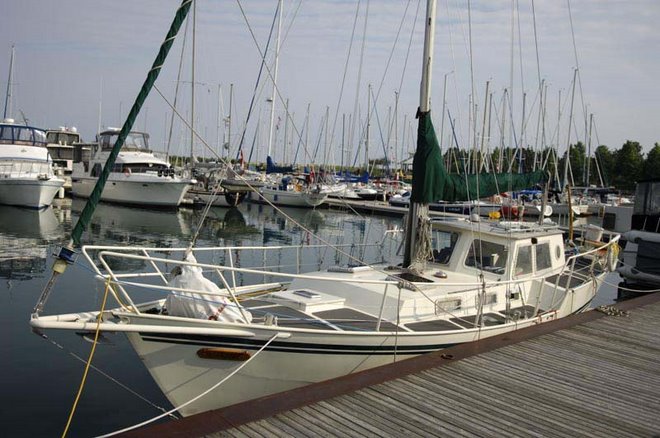
This was the good, if slightly neglected, ship Alchemy a couple of days ago. Good, because I try to leave her ready to sail and motor at all times, but neglected, because several weeks of this rapidly expiring summer has been spent on processes and events both tangential and necessary to slipping the dock lines. Our levels of effort, labour, confusion and delay have been so high as to cause the greatest gap in blog posting (horrors!) of at least the last decade. But on that fact hangs a tale.
Had you asked my wife and I, say, three months ago, if we were particularly materialistic, we would have demurred. We've never owned a car, never had cable TV, and have not, having lived in half a house with tenants above, had the space to acquire much save books...or so we thought. But as the date of the close of the house sale approached, we realized that our nearby flat, rented for just one year so that our son could finish high school nearby with minimal disruption (and, to be fair, so we would be no further away from our boat and its later refitting stages) was in no sense large enough to accommodate our vast amount of "stuff". Furthermore, we needed to rent a garage from our new landlords just to hold my power tools, things migrating to the boat over the winter, things I would want in our new, out-of-town place (more on this below), and the sort of heavy-duty racking, sawhorses and bottle-jacks one hesitates to just put on Kijiji.
The new flat's living room was quite spacious until I put in a load of dining room furniture and six seven-foot bookshelves.
A particular struggle were my books. Bibliophilia is only a problem in confined spaces, and our old house only looked small because there were so many damned books. Maybe two or three thousand, down from four or five thousand before I did a radical cull a few years ago. Now, apart from service manuals, almanacs and "how to cruise" books, the approximate space budget on Alchemy for recreational reading in paper form is probably five paperbacks per crew. So disposal, even in terms of getting to the interim land-based habitations, was going to be a big deal. And so it was.
These are just two of the half-filled boxes of just sea-related books I either sold or gave to my club, which had to build a new set of shelves to bear them. The filled boxes numbered at least 15, all transported by bicycle cart.
So the Great Culling commenced with nautical books. Keeping in mind I run a business from home and am not actually retired, this took a couple of weeks, and, as is the way of such things, the idea of lifting boxes up a flight of stairs at the height of summer led to an increasingly unsentimental attitude to the keeping of books I would not be taking on the voyage. Off about 500 salty volumes went. Enjoy, National Yacht Club members and visitors: I did.
You know what's large? A windvane in an aft cabin is large.
Certain other pieces belonging to the boat had to vacate the garage also. The wind vane above was one. Oddly, because I have complex reno plans for the aft cabin this winter, I will likely install it on the stern, but not make it functional with lines until next spring's launch. I'll fashion a cover to keep the weather out.
Atomic 4 oil pan, one of the many valuable pieces that came, sales pending, to the new garage.
While I made a nice little packet in July on some Atomic 4 parts, I had to haul (via hand-cart, see below) a few items to the new garage, which we have rented only until November 30 and which is not quite filled, but certainly piled higher than I'd hoped.
The vast uncluttering included the running of a garage sale (once enough crap had been removed from the garage to permit the sale!); two separate visits to load up a van with scrap metal, surplus racking and far too many fence posts; the rental of a dumpster bin in which went a brim-ful collection of unwanted piano (I tried to give it away, as it was free to me 10 years ago, but you can't give them away); and a visit from a two-tonne "GOT-JUNK" truck we filled with the remainder of our crap.
Moved by mechanical advantage: it's good to be a sailor.
Amid all these focused efforts were a constant stream of chests of drawers, boxes of books, racking, flooring, fans, heaters and related mildly desirable acquisitions to the curb in front of the house to be sold, where the magic of big-city salvage made most of it vanish. We also used the garbage and recycling bins at both properties (our landlords are away on holiday) and some bins at the club to dispose of things like sails I'll never use.
Not materialistic, eh? Reality and the terrified housecat, who was moved last in an increasingly barren, echoey house, begged to differ.
She is not coming out until you've damned well finished moving.
But, painfully (for I was moving the three blocks from old house to new flat via hand-cart, the process of which ground down the turning wheel bearings to little shavings), the decluttering proceeded.
We were astounded, as was the buyer of our house on her final walk-through the day prior to the scheduled close, at how much space was actually on the property once we'd nuked, shifted or otherwise vanished our ridiculous amount of possessions.
The mancave returned to its original form as a stable.
The dark spot in the middle is where the horse-pee drained away to whatever sewer arrangements pertained in 1900.
Quite airy, minus mahogany accents and IKEA shelving.
Somehow, we managed to jam in an end-of-August day trip to the nearby town of Trenton. I had been surveying real estate there on the basis of several parameters, which can be summed up as follows:
1) We wanted to maintain a Canadian, and specifically, an Ontario, address while we were off a-voyaging. We did not want to "sell up and sail", but to keep a toehold in our native country. This would simplify certain interactions with the government if we had just one principal residence, even if it was a pied-a-terre in the basement of a place we otherwise rented out.
2) We needed this place to be within driving distance of a relative skilled in property management who would be our point person with said tenants and who could do, or arrange to have done, maintenance as needed.
3) We needed to be beyond the "halo of greed" generated by Toronto's insane house valuations in order to maximize our bang for buck of our Toronto house sale. We did not care to tie ourselves or our gotten gains to Toronto, with its high taxes but limited upside for rent (and ease of access to our possessions, when required). At the same time, we needed the place to be of sufficient size to have a train and a bus stop, and to be close to a major highway. Trenton has all three and it's 130 km. or 90 minutes by car east of Toronto.
4) We needed said house to be of sufficient value to hold its purchase price for the next five years in a town with both a tight rental market, but also with relatively high incomes. Trenton has a nearby university, light manufacturing, a big new marina and recreational industries (it's the start of the Trent-Severn Canal system) and a large airforce base (CFB Trenton).
So we saw five places with the rather odd request that "a separate entrance granny flat plus a garage and shed...the rest just has to be rentable" was the mandate. Our Trenton-area real estate agent complied as best she could in a place where maybe a couple of hundred houses of any type change hands in a year. A couple of hundred houses within walking distance of me, by contrast, are getting quarter-million dollar renovations as I type here in Toronto. Our old house is also slated for some version of creative destruction.
Just as an addendum to how we afforded the house (and, by extension, the good ship Alchemy) in the first place, I'll recap by noting that we paid
off our house in 2006. It had doubled in value since 1998 when we
bought it, paying it off via tenants' rental income and dedicated (bi-weekly mortgage payments) debt reduction, so once paid off, we borrowed against it to the tune of a 40% loan
structured as a new, first mortgage. As we had paid off the house in seven and a
half years once already, we got attractive terms of about 2.15%.
We
had tenants paying down the mortgage and we kicked in a few thou a year
as a top-up. Long story short, we were down to $60K owed (still at
around 2%) last summer. We wanted to have the flexibility to sell the
house, now valued at over a million due to location, so we converted
that to a HELOC and the last pair of tenants conveniently moved on. We paid off the HELOC
at $1,000/month and are once again mortgage-free. The line of credit
also allows us to renovate in anticipation of sale, which we never actually did, opting for an "as is, where is" exclusive listing, and because we had
so little to do directly with paying off the 2006 loan, we essentially
consider the passagemaker we will shortly move aboard to be "a free
boat".
Of course it isn't. There's tens of thousands in gear and
(mainly my) labour aboard. But it was a smart way to afford a boat using
the house as a successful and friendly bank. Let's face it, no bank would loan money for a 30 year-old boat! Also, few home owners would live as on-site landlords in the less appealing part of the house without car or cable TV or much in the way of vacations for years on end in order to eliminate debt. But that was the only way to pull this scheme off, which I described to Mrs. Alchemy in 2006 as "a sleigh ride you can't leave once you've started down the icy slope." Which was, in retrospect, a little melodramatic.
Sticking with the real estate component of making the crusing life possible, I won't bore my long-suffering readers with the saga and photos of the somewhat odd places we saw, but they were all of a price that our house sale in Toronto would have allowed us to buy all five, with a bit left over. But we settled (very rapidly; having Mrs. Alchemy's retired home inspector father's input helped here) on a house very reminiscent of my youth in the suburbs. Behold: The Storage Locker.
I am easily swayed by proper drainage.
This house has everything we wanted, save for the separate entrance. We will have to sort that out with whatever tenants we acquire, but it's no biggie. Some of the features were fated to appeal to me: a separate, automated 17 KW, natural-gas genset that will heat and light the house should the main power fail...
It's called a Generac, and it looks clever.
...plus "hydronic heating", which the home inspector deemed a very tidy installation.
I like tidy installations.
The tenants will have to pay off all the utilities, and we'll handle the taxes. We'll be doing some minor repairs and will have to shift the garage contents from here to there by November, at which point we will know how much space the rest of our possessions will take up. This crazy plan may actually come together. In the meantime, we are renters who will also be owners who will be prepping to be landlords who live on a boat.
A colourful symbol of hope and refraction.
So now we are ensconced in the new and frankly very nice apartment. Boxes are being (finally) unpacked, and after a titanic struggle with the idiot phone company, my landline is working.
One of the five technicians over four separate visits dispatched to fix what was essentially a work order screw-up. Can't wait to install my SSB.
We are enjoying the balcony off our bedroom and have recreated, sort of, the "fire pit" area of our former back yard, minus the fire, save for a candle or two.
At night, the trash pandas sing.
Now that I am beginning to unwind from the ridiculous level of dirt, detail work, sweating and hauling and lifting that this interminable process has demanded, I've come to the realization that all those who intend to cruise must come to terms with: possessions not directly related to the safe operation, repair and maintenance of the boat must be ruthlessly reduced and scruntinized, because there's not only limited space on a boat, but you can't leave most things unstowed when underway, because of the rather good chance they may become projectiles. Extending this (minus outside of earthquake zones the projectile consideration) to houses has made us realize that the urge to acquire, whether it be through inheritance, scavenging (much of our furniture was cleaned-up curbside acquisitions or bargain-hunting (we have enough tinned food to last a year) is, or can be, pathological. Material goods can save your life, but they also have the power to restrain your life. Sentiment can be a set of chains, and so can fear of poverty: we gave to charity about a dozen full bags of surplus clothing but really, the boat's only got room for maybe 10 days' of t-shirts and shorts and two sets of "shore clothing"; the rest is foulies and boat-specific gear. So there's still work to be done on that front. We all need, I feel, to "unmore" our lives. This process has taught me that less is more.
I have also come to terms with not, in the usual sense, anticipating missing our house much. Partially, this was because we paid it off (twice) via rentals to a rotating cast of tenants of varying degrees of aptitude; we lived in the dimmer, less renovated, more cluttered half and while I enjoyed and continue to enjoy the surrounding neighbourhood, the house was a means to an end. It's certainly paid off in the monetary sense, but that same advantage is driving us out, ultimately, of our home town: we didn't want to own another "crap shack" at Toronto prices just to rent it out for five years for little return when we could spend a fraction of what we've cleared down the road and make about two-thirds in rental income. The arbitrage wasn't sentimental, either.
On that personal front, while all but about 12 months of my marriage was spent in the sold house, not all the memories I have of it were positive. One of the reasons I have a free hand to sail away today is because my mother, father and only sibling have all died since 2002. There's not a lot holding me here now...my nephews live elsewhere in Ontario, as do my wife's extended family. A lot of friends have, prompted by the increasingly hard logic of overpriced housing, moved away from Toronto. So unmooring in terms of sentimental attachments has been made easier.
Long-haired hippie crew with the infamous cart on its 100th shortcut from Crap Shack to Chateau Nouveau
My wife and son put in Herculean efforts to make this happen: the phrase "worked like a two-dollar mule" was not used figuratively this summer: I thank them both. And now we return to boat-fixing and, I hope, a few sailing expeditions prior to haulout at the end of October. More to follow soon.
Cabin Boy's "back to school" haircut, done at his request.
"Non-compliant": yes, we know. We haven't used it since shortly after getting the boat. Probably is empty. Photo (c) Peter McGuire, Fastnet Yacht Surveys.
Had a survey for insurance purposes last Sunday, something our insurers haven't asked us to obtain A couple of things we knew (Mrs. Alchemy was present as a learning opportunity), such as the superannuated propane tank and the propane hose that needs replacement after 10 years, and that the inline filter for the air condition seawater circuit was not ABYC-approved. Both are easily fixed, and the last one can find a use for a salvaged little Perko-type strainer I already have stowed.
It's an Octopus, but not the breaded kind.
We also know we need an isolation transformer. It's on the list. What I didn't know or noticed was that the hydraulic hose going to the pilothouse helm pump is starting to "sweat", meaning Its Time Has Come. As I am planning on installing a hydraulic autopilot this summer, I think I'll buy the replacement and the "new" hose and fittings at the same time. Still unsure of which autopilot brain box I'll install, but I'm leaning toward this. And this display. While we intend as a matter of course (nav pun) to steer to a heading, rather than to a waypoint, so as to reveal set, drift and leeway, etc., we are going to preserve the option of interfacing with the existing plotter. But mainly, it's about robustness.
So is risk assessment. A lot of decisions on the boat are driven less by what we think we can "get away with" and more by "if we do these things and follow these practices, we will lower our chances of catastrophe". That's more than wishful or magical thinking, it's prudent seamanship, which is something even a land lubber can practise. We try to follow the precepts of "renovate, repair, and, if possible, improve". It's why the failed Schedule 40 galvanized steel pipe nipples topped with bronze ball valves have been replaced with Schedule 80 (beefier) stainless steel pipe nipples with Marelon ball valves.
Before...
And after...still to do, the reconnection to the respective drains.
Was I always this cautious? No, but near-sinkings and hanging from tethers over a wild sea will sharpen one's sense of the transitory nature of life and boats, and suddenly backflow preventers and gas sniffers seem like sound investments. This was brought home to me, again, just 12 hours ago.
You'd be melancholy, too.
This
fine old fellow is "Doba". How he ended up on our ratty couch at 0300h is
a cautionary tale. Doba is an elderly Dogo Argentino, a large breed of hunting dog, allegedly, but he is possibly the mildest-mannered beast I've
ever encountered..."big suck" only approaches his degree of stolid
amiability. Last night, circa 2 AM, I was fighting with a reinstallation
of Google Earth when I heard barking and shouting from the street. Now, as we
live way downtown; sonic shenanigans of this sort are not unusual of a Friday evening. I would have
ignored it and turned in had I not heard the loud arrival of a police
car, followed by that of the first of many fire engines.
One of
the rowhouses across the street was on fire. Which one was not immediately clear,
but I could see loads of smoke from my second-floor window and, briefly, flames curling up above the
roofline. I woke the missus and went outside. Sure enough, Doba's
owner, Paul, one of the two tenants in the building, and Franco, the
building's owner, were on the street, with Franco clearly in shock. The
speed with which the place had burnt was alarming: the second, top floor
was effectively burnt out, but the four fire trucks on scene had
knocked it down rapidly.
Turns out Franco on the top floor had
left a cigarette burning on an ashtray that may or may not have been on
the bed while he went to the bathroom. The bed caught fire and then the
room caught fire. Everyone got out, save one of two cats (we've just learned that Cat Two was found) but I suspect the building is effectively
condemned. Or so it looks.
We learned from Paul that Franco has had a loose
relationship with risk management: while he owned the property outright,
he carried no home insurance (unmortgaged houses are not, in fact,
obliged to do this, which was news to me...and to our real-estate agent). He also had, as is required
by law in our province and presumably in others, no smoke/fire detectors on each floor. Whether this would have
helped is unclear, but it might have been possible to put out a
smouldering bedding fire before it really took off had an alarm sounded.
The house was from 1890 and that dry hemlock wrapped in horsehair was
like an oil-lamp wick, unfortunately.
We loaned Paul and the
basement tenant a couple of coats and had them in for tea and brandy.
When the "warming bus" arrived, we offered to take Doba overnight. He
did whine a bit, understandably, but he settled on the couch to sleep
and was otherwise the perfect guest. Around 10:30 AM this morning, Paul
came by to pick him up to shed elsewhere. I wish them good luck. They'll need it.
I relate this tale not to point blame at Franco or at any home or boat owner with a non-rigorous approach,
but to illustrate that three people now homeless (plus three pets, including the vast Doba) and,
probably, with a few hundred items destroyed or damaged possessions, might have avoided this
outcome with some pretty basic forethought. What the surveyor pointed out by way of needing attention needs attention (although my insurance company took this year's cheque without complaint), but a shortage of alarms and extinguishers aboard weren't among the remedial aspects covered. Same with the
house: we had tenants for years and there's smoke detectors on every floor with a
CO detector next to the furnace, plus more fire extinguishers than are
required in various potential problem spots. We have full house insurance, including coverage should I be
unable to work from home, as it's my usual spot. These things are stated not to seem smug, but
to indicate habits of mind. I have commented in the past (and recent events in the sailing world have kept it top-of-mind) how viewing the
universe as more or less indifferent to one's well-being seems
realistic, as do clear-eyed assessments of risk in one's environment,
particularly that of the sea on small boats. There are parallels to
small houses on land. You may think because you've never screwed up, you are an expert at something. This may be the wrong approach.
Prudence only looks like paranoia to the unprepared.
The online log of S/V Alchemy, her restoration, her crew and their voyage
“You never enjoy the world aright till the sea itself floweth in your veins, till you are clothed with the heavens, and crowned with the stars: and perceive yourself to be the sole heir of the whole world.”-Thomas Traherne
"He that has patience may compass anything."-François Rabelais
"The Great Lakes sailor is wild-ocean nurtured; as much of an audacious mariner as any. "-Herman Melville
"[The sea is] neither cruel nor kind ... Any apparent virtues it may have, and all its vices, are seen only in relation to the spirit of man who pits himself, in ships of his own building, against its insensate power." -Denys Rayner
“For those who believe in God, most of the big questions are answered. But for those of us who can't readily accept the God formula, the big answers don't remain stone-written. We adjust to new conditions and discoveries. We are pliable. Love need not be a command nor faith a dictum. I am my own god. We are here to unlearn the teachings of the church, state, and our educational system. We are here to drink beer. We are here to kill war. We are here to laugh at the odds and live our lives so well that Death will tremble to take us.” -Charles Bukowski
"A dream you dream alone is only a dream. A dream you dream together is reality." -Yoko Ono
My wife, my teenaged son and I plan to start voyaging in spring of 2020, plagues notwithstanding, for an estimated five to six years. I hope to move us aboard before that point to work out the kinks of living on a boat.
The careful reader will note the URL of this blog has "alchemy 2009" in it, a reference not only to our boat's name, but also to the original, anticipated departure date.
This is called "tempting the gods of the sea and life in general" and will not be modified. You have to know when to fight, and when to appease. Frankly, it matters that we go, not when we go. This is a good lesson for all aspiring voyagers, I think: the hubris of long-range planning lurks like an evil watermark on every "to-do" list.
Here you will find various notes on our preparations, labours and education as we try to become better sailors in a good old boat. I hope to continue to discuss in this blog the realities of preparing for a marine-focused extended sabbatical, the issues both mundane and philosophical confronting the potential cruiser, and the efforts required by everyone involved to make it happen.
Please note that all text and images on this site are copyrighted and may not be used without permission of their respective authors and creators.
Please note that I have not bothered to resize photos and they may be seen at full size and aspect ratio simply by clicking on them. Some photos formally hosted on third-party servers are not at present appearing; I will locally host these photos as I can afford the time to relink them.
Please also note that anonymous comments are usually spam and will typically be deleted without reading.
Author's text and most images other than product shots specifically created by product manufacturers are copyright 2006-2021 M. Dacey/Dark Star Productions. Photos sources linked from online news and related organizations are copyrighted to their creators.
Middle-aged, bookish Canadian with compact family in process of exploding career and prospects in favour of lengthy, low-rent sabbatical has boat, seeks ocean. Must have non-smoking bilges.
All contents (C) 2007-2021 M. Dacey/Dark Star Productions