Showing posts with label Politics. Show all posts
Showing posts with label Politics. Show all posts


2016-04-08
Do you cruise on port or starboard?
 |
| Cartoon (c) 2016, Steve Benson |
While I can't say there is a strictly political preference among the Canadian, British or French or Caribbean sailors I've encountered, there are certainly more politically conservative American sailors, at least to judge by various sailor-centric forums and Facebook groups of my acquaintance, along with a few I've met in person. This may be because a lot of American sailors, mindful of their Constitutional rights and often with a record of service in police or military organizations, often favour being armed in their boats. But many Americans, in my view, while very clear on the Second Amendment, seem less clear on the Fourth. I would add that a lot, or at least a lot of those whom blog or post online, don't seem to understand why other countries don't always allow them to sail armed in their waters. It's not just Americans, of course: many rich-country sailors are not always as attentive to the local laws of the often-poor and often-corrupt places to which they sail. Even the wealthy can learn the hard way that, yes, ignorance is no excuse.
Now, a fondness for weaponry is not necessarily a trait identifying a person with right-wing sympathies, although I'm not sure precisely what "right-wing sympathies" means when America is concerned. I do know that a relatively moderate or nuanced political viewpoint among U.S. sailors, at least among the bloggers, is less common to my eye. It doesn't mean it doesn't exist, clearly: my sample size is not overlarge, but it's equally not difficult to imagine the average investment-portfolio-funded cruiser failing the "feel the Bern".
In the broader sense, however, politics of any stripe is only a small part of sailing, although political considerations have influenced quite a few sailors, such as Leslie and Carolann Sike of the steel sloop Aqua Star, pictured above circa the late 1980s, to undertake voyages of nautical detente. Also, it can be argued that sailing itself tends to make sailors both conservative and liberal in their outlook, for this is what the sea itself demands: entrepreneurial innovation and anarchist vim in equal portions. The sea, after all, doesn't care how you voted; it doesn't give a tinker's about "dreams" and will kill the underprepared. There is among sailors, therefore, a certain OCD, double-checked list, give 'er a quarter-turn and check the belt tension mentality at work, a fussy sort of "I do what works because I must" attitude that is sometimes associated with conservatism.
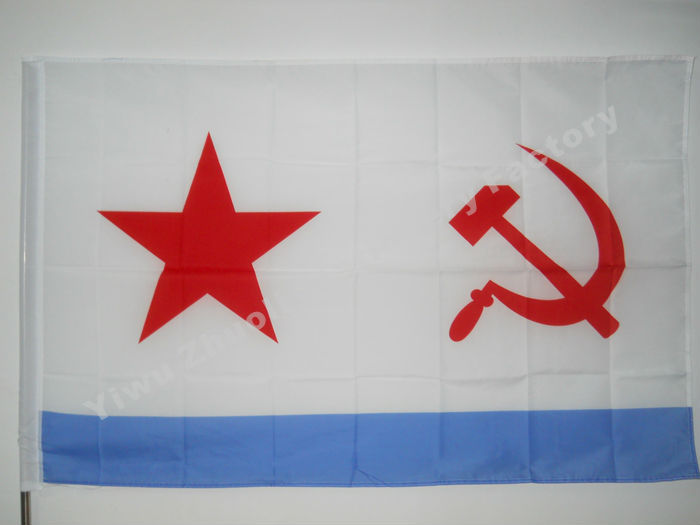 |
| The sea will drown Bolsheviks and Objectivists alike, tovarisch. |
And, in a more basic sense, we love to "make and mend" and hate to part with something that can be fixed. Most of us love the latest gadgets, but bring leadlines and sextants. Many of us are also sailing for the solitude and the participation in nature, which is a different sense of conservation. Yet opposing this mindset is an often tolerant and, I dare say, liberal approach to human relations, otherwise one would never get off the boat. This is frequently combined with a near-anarchic sense of personal responsibility best expressed as a wish to flee well away from the herd mind of shoreside affairs, along with a determination to travel as cheaply as possible. I've met, and I'm sure many of my readers have, some crusty old salts who have been "hard left" politically while quietly making long back splicings by feel. Crusty need not equal conservative, and a '70s Marxist, presumably thanks to a pension, can be found at many a helm. I don't know how to categorize politically the new generation of crowd-funded cruisers, but surely there's a socialist element in having society pay for one's voyaging.
Of course, just as planning to cope with fickle Nature by drawing on 500 years of sailing and life preservation techniques (hint: if they drowned, it's not a great technique) and being rigorous about clipping on, lashing down and keeping the mast up appeals to the inner conservative, so does provisioning, hot-bunking, watch-standing and a constant sense of "we are all in this together" foster a sense of brotherhood and communitarianism so often absent ashore. Many sailors, travelling deep into the cultures and daily life of exotic countries, are often moved to acts of support and charity. In fact, this is quite common in the world of sailing, where, admittedly, there is often the odd wealthy person to be found, some of whom seem conscious of the role good fortune and accidents of birth have played in their ownership of big, gorgeous boats. Others of less flush circumstances donate time, skills and labour to improve the lot of those whose countries they visit.
It's tricky, however, not to come off as arrogant, insulting or to exude the scent of noblisse oblige. Not every one you may visit considering themselves particularly deprived and giving away pencils and old T-shirts may be rude, when wage work or errands from rich yachties (and even the poorest North American or European arriving in a filthy old boat is often "rich" by definition) would be much preferred. There's quite a history of well-meaning charities doing wrong in attempting to do right. In some places, a jerrycan of watermaker output, or a few hours of Honda 2000 runtime to do a construction job on a distant atoll may prove more ingratiating than any number of good-condition textbooks or dollar-store reading glasses. Check before you gift, and be aware of the social customs, some shading into taboos, of the places to which you're sailing.
The charitable impulse need not flower from a bed either right or left, but can arise naturally from the experience of sailing, which is itself a privilege. The context in which Westerners have political difference is luxurious as few of us are so hungry or so overworked so as to not have time to develop political viewpoints. This is not always the case in the places you'll go. I plan on sailing lightly as much as we can, and that includes politically.
 |
| She's unhappy about illegal logging in the Solomons, and rightly so. Photo credit: Catherine Wilson/IPS |
 |
| And if they want you to buy a fishing license, do so. |
2014-09-23
The runway not taken
 |
| The valiant Valiente's Cabin Boy fends off the creeping scourge of the airport's Marine Exclusion Zone. Note the required "horn, bell or other sound signalling device". |
Astute
and probably local readers will recall the ongoing (some would say interminable) fight of many Toronto residents to restrict the expansion of the Toronto Island-based airport. Despite a 1983 agreement to deny what was once a small civilian airport the use of passenger jet aircraft, there is a move originating from various corporate interests and the politicians they rent to bring jets in, despite the rather striking fact
that Pearson, the main Toronto airport, is underutilized and is about to get a direct rail link.
 |
| It's getting pretty skinny trying to leave via the Western Gap. |
If one reads last spring's TAO report, which is very illuminating about the potentialities surrounding the proposed BBTCA expansion in ways that many local boaters, kayakers/canoeists, residents and enjoyers of the harbour may not have considered. More airport means less water, a lot less, and what is left will arguably be less safe.
I keep Alchemy, the titular subject of this blog, at National Yacht Club, which, along with the adjacent Alexandra Yacht Club, are situated at the west end of the restricted channel known as the Western Gap. Even if one discounts the considerable noise and the fumes over and above the current stinky and loud level, the extensions of the existing Marine Exclusion Zones (MEZs) required by government regulation for the proposed extended runways required by the physics of the proposed passenger jets, will likely lower the appeal of these yacht clubs site to the point where it would be impossible to continue running them. So I feel I have a direct interest in the matter. As I consider it unlikely that the federal government and its functionary arm, the Toronto Port Authority (TPA), under whose aegis Toronto Harbour lies, propose to blast a ship canal through Ontario Place, I suspect the needs of the MEZ will effectively bar the Western Gap, the harbour's gateway and the "frontage" to several boat clubs, from civilian and indeed commercial traffic. We can't leave our basins if the assumed (on good, Transport Canada-mandated grounds) new MEZs go in. Even the TPA itself warns against it!
I would imagine the same fate would await (perhaps paradoxically) of the TPA-run Marina Quay West and Pier 4, access to both of which would be very constrained by the new, expanded and jet-friendly MEZs. And yet to have jets, one must build more runway, but is it even necessary to have jets? Not to mention that the jets in question, the ones on which all the runway sizing is predicated, are neither out of the prototype stage nor appear likely to exist for some time to come.
Hence last week's protest:
 |
| It started off small, or at least small kayaks. |
 |
| Nearly the Dunkirk spirit? |
 |
| A regular flotilla. |
 |
| Close quarters and plenty of slipping in and out of gear. |
 |
| We saw some nice vessels as a bonus. |
 |
| Ironical overflying. |
 |
| Protest does not exclude creativity. |
 |
| Tri to grasp the rationale, politicians. |
It would be interesting to hear the viewpoints of the executives of Royal Canadian Yacht Club and Island Yacht Club and Toronto Island Marina: All of them would see their boating activities truncated or perhaps made untenable by these extensions. Contrary to what may be public perception, not all yachters are wealthy or even privileged; clubs around Toronto Harbour, including NYC, run extensive learn-to-sail programs for adults and children, and summertime Junior sailing (seven to 16 years old) is currently done either close to or inside the assumed MEZ extensions. So is a program called Broad Reach, a registered charity which teaches underprivileged kids how to sail in donated race boats that brush the current 18-metre mast height. Jets have a shallower "glide slope" than the current Q400 turboprops...it is arguable if 18-metre masts will be able to go anywhere in the Inner Harbour aside from hugging the easternmost seawalls.
 |
| The future of Toronto Harbour or a reasonable fascimile of the future? |
So while the concerns of sailboaters may seem only a small part of the mix, we aren't all in possession of big Beneteaus. Some of us are teaching your kids how to sail, an activity best done without, I think, the roar, blast and stink of commuter jets in a situation reminiscent of the notoriously crowded Kai Tak airport in Hong Kong prior to its closure in 1998.
We've seen this future of putting jets in tight to towers, trees, bird sanctuaries and actively used waterfront before, and it's in the past.
Subscribe to:
Posts (Atom)




In terms of rescue technology, safety at sea and tangible benefits such as making one's own power, the sailing is fair, indeed. In terms of the chance that your vessel will be dogged by red tape, corrupt officialdom and crime, kidnapping or piracy, not so much. The high seas may be free, but clearing in and out of countries can still be a bureaucratic nightmare...and may be, in a world growing more hostile, be even harder ranging to impossible.
Although Harries received some pushback from what I perceived were politics-weary Americans, he's got serveral trenchant points when it comes to visiting countries with law-dodging, authoritarian regimes. We are daily seeing how xenophobia and bureaucracy are self-reinforcing tendencies, and that even the properly credentialled can be dealt with arbitrarily and seemingly on a whim when confronted by an overly zealous border guard. Or, one presumes, customs official or port authority functionary. Like the Canadian of evidently insufficient paleness stopped at the U.S. border, we are not Christians, nor would I surrender the contents of my phone to some functionary were I sure it was not required of me by law. Word get around about such places. They are better avoided than debated with, even though I would hope their own citizens challenge the erosion of the rule of law, if they are able to do so.
To fail to consider both the politics and societal factors of a country to which one intends to sail one’s home (and, often, one’s dearest possession) seems to me unseamanlike, unwise and willfully naive.
Unless cruisers intend to go non-stop, the quality of the stops will be largely determined by such issues as the rule of law, the rate of crime/social disruption, and the level of tolerated or institutional corruption.
Realistically, this conclusion increases the need for independence from the shore: energy, food and spares storage and meticulous maintenance gain in importance when one cannot take for granted the civility or safety of every port available. I doubt it will actually shorten our plans for a five-year circ, but it will likely increase the time we spend between longer passages; New Zealand looks good on a number of points in this regard, particularly as a place to haul out for service “mid-circ”. The shortwave radio and occasional internet access will be of great help in speccing out the next area or countries we visit. It’s not all glum news, mind: a sharp reduction in Red Sea piracy has restored the option of “South Africa around the Cape or the Med via the Suez” to our prospects. But we remain watchful. A lot could change by the time we are, say, reading pilots in Galle, Sri Lanka.
We also believe that it is very possible that deteriorating political, economic and climatic conditions will make world cruising in the near future perhaps too difficult for the person of only average affluence to contemplate. Fixing up a boat, selling up and sailing will persist in places like the Caribbean, but we suspect we might be in the last cohort to actually be able to do this at a parsimonious price and as a family. Which means what people like the Smeetons and the Hiscocks pioneered in the 1950s and '60s, when cruising in small yachts was a far less supported pursuit in nearly every respect save for the ease of sourcing tinned butter, may be drawing to a close as a lifestyle, which I find sad, frankly. Bribes we can tolerate to a point, but a country that abandons its own laws will not see out sails on their horizons.