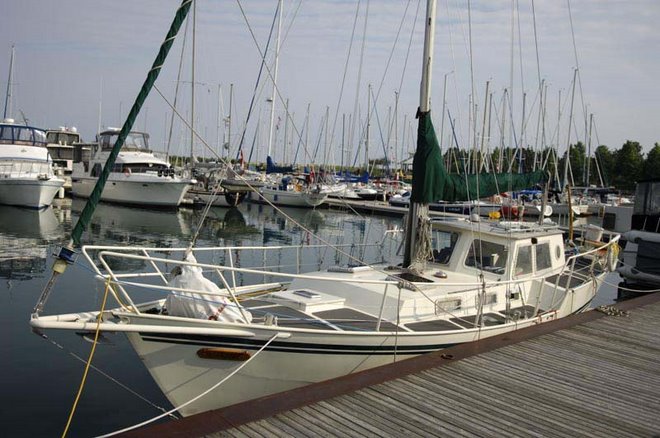
Copyright (c) Marc Dacey/Dark Star Media 2006-2020. Above photo (c) Marc Dacey. Powered by Blogger.
Showing posts with label Sails. Show all posts

2020-02-24

Workshipping (2)

Six bolts ought to do it.
When last we gathered, I had had welder/fabricator Andrew Barlow make up one of his simpler efforts, a three-piece steel frame for the starboard side of the forepeak "workshop", so I could better allocate spares, tools and other items, such as line, cable and wire.

What Mrs. Alchemy gets up to whilst I am swearing at the bow: a much-needed repainting of the pilothouse interior.
Given the size of the forepeak, however, construction within is largely a solo effort; besides, given that I have a touch of tendonitis in one shoulder (which is better than a torn rotator cuff, according to my "tough love" physician), no one needs to hear that much vile sailor talk when I am bearing down on a Makita drill.
Moving a couple of toolboxes elsewhere on a boat is predicated in large part on keeping things from moving. To date, I've relied on eye straps and shock cord. And certain mechanical aids, such as the chunk of wood meant to confine the spares box.
The box is cheap, but fit for purpose. It's half spares storage and half tools I want to hand in this work space.
The lashing down of fairly heavy boxes is provisional at the moment. I may put further chocks or hold-downs to keep said containers in place should the sea prompt quick action. Or if I have to access something while we are flailing about. The point is that the above toolbox, which weighs about 18 kilos, is now about 30 cm. aft of where it was on the port side. Which, from a boat trim point-of-view, is desirable.
This box contains a couple of sanders and some hardware odds and ends. It's light and can therefore go forward without much penalty.
There's a small work area left free of stowage. A bigger area now exists on the "heavier-duty" port side. Beneath both workbenches are eye bolts for stowing line, anchors and any appropriately sized gear capable of fitting in the space. Should this gear amount to significant weight, I can remove or reposition trim ballast (lead ingots) off the boat or further aft.
Where the eye bolts go. There's a fair bit of space here in which spare/specialty lines can be kept neat and ready.
Clearly, I'm not finished yet. Some sort of coating to preserve that fresh plywood would be advisable, but one calm, warm day this coming spring can see that completed. Also, there's a foredeck full of gear and line wanting stowage in this currently unstowed space. This, too, shall pass.

The underside. Lines/gear can hang on carbiners or just via loops on these eye bolts. If I need chafe gear, I'll install it.
There's room at the end for sail stowage. Currently, there's a spare main, which will go in newly made space in the aft cabin (yes, more on this shortly); a storm jib of ridiculous heaviness; a smaller staysail than the one rigged, just acquired today; and a cruising spinnaker. The last three sails are light, or rather, lightish, and at perhaps 12 kilos in total, can sleep in the pointy end, especially if I move several dozen kilos of chain down and aft.
Behold "the closet". It's where pointy, light things will live.
The last portion of the new construction is "the closet". You'll have to visualize that worklight cord and the anchor windlass conduit cleanly secured on the outside of the little length of wood on the hinge. The reason for the hinged wood? I have a lot of pointy, awkward objects, such as oars, plastic Portabote thwarts, Alchemy's 2.2 metre tiller, nesting dinghy mast parts, and mostly et cetera, which, while not particularly heavy, take up some space, particularly vertical space. Being tall and not alive, they tend to fall down, even more often at sea. So I need a place to stow them, either on a series of hooks and loops overhead, or in this snug spot seen above. That little piece of wood is not strong enough to keep anything truly set in motion in place, but it is enough to stop things from tipping out of that space, especially when lashed down.

Or so I hope. Like most of my ideas, "provisional" is the keyword.

2018-10-15

Falling into winter

It was the jib's time, actually.
For Canadian sailors on the Great Lakes, October can be a sad time. The same weather that brings exciting sailing in the form of cool, windy days great for long trips also heralds the five months of the year (here inland at Toronto at least; it's different on the east and west coasts) that our boats are, generally, cradled on land. Decommissioning, which involves at our club demasting, is a fair bit of work and preparation to avoid damage or even injury (our mast may be 200 kilos to judge by the grunting five adults make to get it off the dolly and into a rack).
The naked foretriangle is shocking!
This year, however, is (I certainly hope) the last year we'll be in Toronto for some time, and we are crowding the boat with all sorts of spares and tools we've previously kept in a garage or a related storage space. Making room for every sail we intend to bring has involved a fair bit of planning. And there will be more to come.

I was able on a relatively light air day to take off the yankee-cut jib by myself and to bag it and the staysail in the forepeak. The mainsail removal required Mrs. Alchemy, as the day selected was very breezy (20-28 knots) and only the favourable WNW wind direction that made "head to wind" at dock over the deck, more or less, allowed a reasonably crisis-free stripping and folding away. No pictures, alas...I'm sure it was dramatic from shore!
The pensive Mrs. Alchemy did not, evidently, fancy being in this shot.
Because I need to prep the inward-turning pilothouse flange to restore its roof, I needed to have a look-see. I want to clean up this flange and put a wide strip of HDPE plus butyl tape for sealing purposes all the way around to separate the steel from the aluminum prior to bolting it down; the bolts will have coatings and nylon bushings to keep them from reacting electrically with roof or hull. The roof, although it's aluminum, is a well-built, heavy thing, so I rigged the boom to work with the topping lift to hoist it up.
Needs a clean, but the two-part's intact.
Unfortunately, the imminence of the haulout this coming weekend means I may have to wait until the spring in order to finish this job (paint not kicking well in mid-winter), as without the boom, I would either have to rig a gantry to lift the roof or, as has been the case in the past, find four men willing to lift the thing gently to one side or to find a Polecat crane.
That "polished" part is where the old fluxgate compass sat, and where the new heading sensor will go.
One outstanding task is to regasket the pilothouse roof's opening hatches. Both drip a bit in the rain, and as a stop-gap, I've taped them up.
The sharp-eyed will note I went from the straps to the line. More secure.
Lastly, I brought down the Honda 2 to sit on its designated workshop mount. One-armed lifting and shifting is a beautiful thing. Tomorrow, the mast comes out.
There's a newer 2.3 HP Honda, but I'm not tempted. An air-cooled, 15 kg. 3.5 HP? Perhaps.

2018-09-18

The rare instance of actually enjoying the vessel

We are coming around to the "no instruments on deck" idea...maybe a compass and maybe a tablet holder to show course, but not "the bridge of the Enterprise" as that distracts from keeping watch. Ignore the not-to-code propane tank...it's empty.
The day started with legal stuff, and then semi-related banking stuff. Then cleaning stuff (the never-ending aspect). But there was still enough hours and (more or less) enough wind to attempt a "let's get reacquainted with the boat" two-hour tour. Because we haven't sailed in weeks. We've done a bit of boat work, and we've been down to check bilges and clean away sad cobwebs, but there's been little time to actually get off the dock and move about on the water. So, despite a lingering cold and impressively hacking cough, off we went.

I'm still giddy at how accurately Marinetraffic.com can report our movements, and aware that I will want to turn the AIS off sometimes.
The wind was SSW 9-11, fitful at best, so we didn't crack much more than 4 knots and more often dawdled in the mid-three range. But that was undemanding and there were few other boats out, despite the weather being very warm and sunny for mid-September.
Outrunning a Hunter 24 was not difficult, even for a barge such as ours.
Save for the occasional plane landing nearby, it was quiet and cool. What a difference to the sorted chaos of the last couple of months. Regretfully, we have only a few weeks to enjoy this, as haulout is early this October, on the 19th/20th weekend, meaning I'll have to haul the mast a week or more before that. We may try to squeeze in a trip to Trenton, where our new house is, in the first week of October, but that's about that for the season.
Mrs. Alchemy's head, diesel jerrycan and Toronto skyline: a fairly representative prospect.
Gratifyingly, we still know how to sail. Nothing failed, no leaks, no engine blips and I laid the boat right on the dock upon our return well enough to see the missus step off with two lines and no waiting.
A bit loose as the wind merited it. The little grey blotch was a wasp starter kit.
I've started a somewhat frightening to-do list for the winter that will be the subject of another post soon. I recently heard an Andy Schell podcast with sailor Paul Exner, who has had to rehab his damaged boat after Hurricane Irma and sail it to a new phase of life in Hawaii, in which Exner defines seamanship not only in terms of knowing your knots and your splices, but in terms of time and labour management, as both are finite resources. I found it a rather compelling proposition.
Could we have gotten a pointless 0.8 of an extra knot with the staysail up? Guess so.
All in all, a beautiful, relaxing break and a mild injection of peaceful fun to remind us why the hell we've been subjecting ourselves to such levels of disruption on the home(s) front. It's for the greater good.

Yelling out "STARBOARD" not necessary in this case.
Now, I also reacquainted myself with an issue that is fixable, but remains a touch ambiguous in terms of "best fix". I have reason to believe our engine is significantly over-propped, which I can fix at haulout easily enough, but I would like to get my pitch numbers right. With a low-hours Beta 60 and a clean, if heavy-displacement, steel full keeler, I hit cruising speeds at too low (1800 RPM) a throttle settingand can't get above 2,050 RPM in relatively flat seas when I hit hull speed under motor. I do not have evidence of overheat or overpressure, however, which is good.


I've input my numbers into this worthy app, but the fact is, I have a 19-inch four-blade feathering prop (a Variprop D-107) on a steel full keeler and that isn't going to change. What can change is the pitch of said prop in forward (overpitched in reverse means I can stop and back down "with authority" and I don't care if I'm lugging for 30 seconds). But I do care I can't get the engine revving at hull speed a full 600 RPM short of its rated max, meaning unneeded strain and poorer fuel economy at cruise speeds (75-80% WOT).
The prop in, and with, question. Works like a charm otherwise.
This adjustment of pitch is probably a drop from the present 15 inch pitch to 11 or 12, but I'd rather do the math before I tinker with the stops in the hub. As a side note, everyone unhappy with their fuel burn or their RPM at WOT should understand this topic as it really makes a large difference in terms of efficiency and wear. There's even books on it, but I really just need to experiment at a slightly coarser pitch than the app (a very flat 10 inches!) suggests.

2017-07-03

Flat, but out

A pleasure cruise in Hamilton Harbour was vetoed by the skipper due to inclement weather conditions.
As it was both a holiday weekend and a rare three days off in a row for the hard-labouring Mrs. Alchemy, we took the boat to Hamilton to visit friends. Hamilton's about 30 NM WSW from Toronto, which means "head to wind" most of the time. So about a five-hour motor.

The day was near dead calm, with occasional fog and mist, anyway, and I had a reason to want to motor. Alchemy has two keel tanks of about 50 gallons (200 litres) capacity. Both were filled to their respective brims in 2009 before I went into a cradle for a few years to replace the engine, the entire drive train and other needful things. The diesel at that point was primarily intended to keep the tanks of black iron from corroding. I got it from a marina that I knew didn't sell diesel with ethanol in it. I had yet to spec out the new engine, but I had already heard of the ethanol additive effect on deleterious gaskets and seals and its tendency to absorb moisture from the air.

The interesting part came after I had installed the fuel filter system and had stopped (basically) using a siphon from a jerry can, which even in my mind was asking for it. The diesel from the aft tank looked good. It seemed to work. After cleaning the pickup tube (a tiny bit of gunk was found), all seemed to be well. The diesel purred. The boat moved. All was well. I regularly mixed in new diesel and kept that aft tank full.

But I didn't address the forward tank. That was filled with nearly nine-year-old, pure diesel. I topped up that vintage fuel with fresh diesel (if ultra low sulphur, which is another issue). Then I ran the fuel  from that tank for an hour at dock (at about 1,300 RPM; I'm not a monster) Again, no issues.

So it was with some trepidation that we departed circa 0800h yesterday. While I knew I had a "good tank", I was keen, frankly, to burn off as much old fuel as I could. As it turned out, the Burlington Bridge, a lift bridge that allows the only access to Hamilton's large harbour (and which we've seen before on our now-sold first boat), only opens on demand and every 30 minutes. My new plotter told me if I could steer tightly, we would get to the piers in front of the lift bridge at 1228h. Yikes. Apply throttle!

So, flat out through flat water it was. I like my hydraulic steering just fine, but under motor and plenty of it, the rudder tends to drift slightly and corrections applied are not subtle. While I don't think this is a problem, particularly, I will be inspecting the fluid levels and the state of the seal. And the purchase of an autopilot, because steering by hand in calm conditions is actually a bit of a drag.

The photo at the top indicates why I didn't take our hosts out for a boat ride. It poured and blowed a fair bit, but the evening and our dinner and convo were great. The next morning, we left the literally brand new and mightily impressive docks of the Royal Hamilton Yacht Club with a lesson learned: the prop walk I use to slip Alchemy's stern to port side with a quickness isn't such a benefit when leaving from a starboard docking. I had to do some awkward spinning between rows of boats to get out. The solution(s) were: to have gone in stern first and docked to port; to have walked the boat back nearly to the bow of the boat in the next row, and then steered to port in forward; or to have done the previous move warping off against a line. Ultimately, no harm, no fouls, no buffer required, but I dislike giving a show before my coffee's settled, and the need to make a bridge opening (it's about a 30 minute motor from the YC to the bridge) by a specific minute (we did) makes for unseemly concern.
Mrs. Alchemy mulling over autopilot brands.

Sea state: Stateless
As can be seen, it was another windless day (although it improved at the last stretch and we motorsailed with a more or less effective jib adding a couple of knots).
How to Avoid Huge Ships: Lake Ontario Edition.
Both legs of this otherwise minor journey, I took an interest in the doings of the little AIS targets on my VHF. The CPA calculation is the one I find most useful in AIS monitoring. When we sailed yesterday in moderate fog, we of course noted that plenty of boats did not have AIS and therefore required careful watchstanding (we have as yet not installed a radar). But there were quite a few that had it going, and even the scant data delivered by our AIS-equipped radio gave us a heightened awareness. Not to mention notifying us when the large lake freighter had started to move off its pier at 90 degrees to our course. Handy, that. 
Water scene with duck.
We were just missed by another line of thunderstorms and made it home tired but happy. The Canada Day Weekend involved an enormous rubber duck (see photo). Patriotism continues to baffle me.
My god...the harbour...it's full of duck!

2016-11-30

Travelling plans

Somewhat similar to this, the "old-style non-CB Harken track (supplied until 2002)"
As mentioned previously, we have a new mainsail, updated nav lights and both a beefy vang and mainsheet. The missing upgrade was the traveller through-bolted to the deck. We had been using the one that came with the boat. an elderly Harken model that had no blocks for traveller control lines, but rather had just a set of spring-loaded pins that could center the car on some part of the track, but not quickly and not easily under load. In fact, although it was cambered nicely to the curve of the deck, I considered it a bit dangerous in anything but light air in terms of finger-crushing potential and the likelihood of forceful boom movement.
This is the "MT-2" traveller from Garhauer. Beautifully made, and no nonsense.
Evidently, I knew that I would one day have to tackle this deficient bit of kit, as I ordered from the redoubtable Garhauer firm a beefy traveller way back in 2007. Better late than never, I suppose, and the upside is that the Canadian dollar with which I paid for it was worth about 20 cents more in that year than currently. So I have that, which is nice.
Some random tools of the "most resorted to" kind. Yes, that's blood on the spanner. I'm not fooling around.
I got a warm feeling from the Garhauer company almost immediately. Their very plain, "cheap seats" booth at the Toronto Boat Show is usually manned by the company president, who wears suspenders and seems well past retirement age. Their gear is, however, opposite of what a racer would favour: all heavy, mostly metal and easy to service, their blocks and other line-handling gear are all over Alchemy at this stage. Speaking of "service', however, I was most favourably impressed, lo, those many years ago, when the firm's fabricator in small-town California, Guido, phoned me in Toronto from a distant suburb of Los Angeles, where the Garhauer factory sits buried among carpet remnant outlets, donut shops and other single-storey sheds. I guess that's how they save money. Seems to work for them. Anyway, Guido, and I have to stress this, the man who was actually fabricating my traveller that very day, asked me if I wanted 1/4" or 5/16" holes on four-inch centers. Well, I didn't really know, but I figured even then "bigger traveller, beefier fasteners", so I said five-sixteenths would do the trick. Apparently, Guido phones a lot of people when the crumpled carbon paper he's handed by the guy who takes the money at the boat show finally reaches him. Still, all credit to the Americans, who are very good with customer service in a way often lacking in my passive-aggressive homeland.
Some surface corrosion, but pretty good under the insulation
First job was removal of the old traveller. We lack a whisker/spinnaker pole track on the front of the mast and this might find a use there. Second job was removal of the insulation and clean-up below. I slapped on a few coats of rust conversion product and it did some good. A few more and I'll lay on galvanizing basecoat and epoxy topcoat before I restore the insulation. Frankly, I need to confirm my sealing job.
The tape is to keep the deck-side paint from dripping.
After cleaning up the deck, we laid down zinc-heavy galvanizing paint and then more or less matching top coat. The barrier effect is more important than the colour and we will be redoing the non-skid at some point.
Mrs. Alchemy, a daub hand with a brush.
The paint didn't entirely dry overnight as it was at the limit of its temperature range, but a watery southern exposure helped. A bit.
She advances, masking
A couple of coats later...not bad. Recall that a large traveller will be covering almost all of this.

Yeah, that crappy box on the binnacle's getting binned.
The next step was  to fabricate stand-off, or "bridges", to support the traveller at either end between the bolt heads and the underside of the deck. Because I am cheap, I had kept the HDPE I used to create framing standoffs for my pilothouse opening portlights (which have yet to leak a drop in five years). The trick would be to measure the distance from underside of the first three bolts inbound from either side and to make an angular cut with a bandsaw to match as closely as I could the camber, or curve, of the deck.
This stuff is amenable to power tools, but take your time. It can melt.
The trick was that the boat is not currently level. She's pitched forward about three degrees and to port about two degrees in her cradle as a result of a windy day in the slings and maybe the half-tonne of lead pigs as trimming weight in the forepeak...
"Making a list" has a different, secondary meaning aboard.
So I temporarily "pinned" the traveller at the center two bolt holes. Guido's work was very, very close. I had to widen just a single hole, beyond redrilling all the 1/4" existing holes to 5/16" to accommodate the new, larger bolts. 
Prior to final fitting, this is the "starboard bridge". The dots are where the bolt holes go.

The fabrication, done with table and chop saw, drill press and belt sander, took some time, but worked well.
From the top. Yes, I had to redrill the end one. Lucky I have so much 4200.
After further tinkering, and after overboring all the holes in the deck to 5/16",I went for a "dry fit". This confirmed (for the most part) that I was in the fastening zone.

The grooves hold beads of sealant. It all helps.

After careful, if unavoidably messy, application of sealant, I put it all together with Mrs. Alchemy wielding a screwdriver above and me, with nuts, washers and a big socket wrench, below. And two family band radios, and with each bolt numbered, so I could tell her when I was ready to dog down. We are hauled out next to an airport: it can get very noisy.
Partial success!
The technique was to "butter" the bridge bases with sealant and to put a wrap of it around the bolt threads about halfway up the bolt's length. This wrap is meant to fill the hole of both the traveller bolt hole and the passage through the HDPE bridge, leaving the protruding bolt end down below largely clean. We actually achieved this much of the time thanks to all the backing plates and deck gear I through-bolted on Valiente. The sharper-eyed among you will note that 10 bolt hole remain open...we tarped up the work for the next not-freezing day. Others of a more sail-handling bent will note that the traveller's cam cleats and car appear to be reversed; they are facing not aft to the rear of the boat and the primary and secondary winches, but forward, toward the companionway.

This was an entirely deliberate choice based on ergonomics. Most of the time at sea while on passage, we will be under sail but with either windvane or autopilot engaged with the steering duties. This area is already filled with various sheets and control lines and the traveller is used less often and usually in the context of mainsail tweaking. The exception to this is of course a surprise squall or sudden wind shift which can load up the main and cause uncomfortable or even damaging heeling. In that case, the ends of both the traveller car control lines and the mainsheet itself are "to hand" from the pilothouse; the main can be spilled very quickly, after which the autopilot or vane can be adjusted to the new conditions. The control lines, which are 20 feet a side of 3/8" Dyneema core, can be coiled on the otherwise empty bridgedeck. It's no big deal to operate them from behind the wheel if needed, but reducing deck clutter at that helm is important. I am considering adding a third pair of winches back there so I have a pair for warps, drogues and stern anchor use, another idea that's a blast from the past. More currently, I'm also installing a second throttle/shifter in that area. So it's going to be a busy place!
Moorings never sleep, and neither does their rust. On duty with "the Committee".
The warm day we sought came soon enough; it's been an unusual November, and after belting out to Johnson Plastics for some Delrin rod in the right (1.5 inch) diameter, I repeated my earlier technique of measuring angles and heights and made what are essentially heavy-duty spacers or sleeves for the mounting bolts. Fitting them required a bit more precision and I had to angle the drill a touch in one spot, but Guido's work was excellent when done nine years ago. I'll learn shortly if the rain keeps out.

Water can slosh underneath the "support posts" and if I get a leak, I'll know fairly quickly from which hole.
My wife did the same deal and after three hours of fabbing, trimming, fitting, more trimming, sealing and more blood (Delrin can be sharp), the actual bolting down took about ten minutes.
Starboard side. I think I prefer a straight traveller. It's something to grab.
Now, the tarp seen above will still cover this until I'm sure I will have no leaks. I also have no need to reeve the line until spring. I also need to coat the interior before replacing the two inches of insulation (and running leads and other cabling along the underside of the deck; see "SSB"). But I'm pretty pleased seeing this long-purchased gear in operation. I hope to spill the main with renewed confidence.
Some careful razor work required to get the excess squish away.

Pleased with the result. Now I need to put the mast back.


2016-06-15

Under cover

After three bike trips out to Mississauga, the new mainsail cover is in full operation.
Those mast steps are looking brilliant. I had to use my teeth to tie that knot.
The sail itself is not flaked very well; one batten has flopped off the "stack" and is making the aft end hard to secure. Still, given that we are immobile until the horde of batteries are installed and secured, this will keep the UV exposure well down. 
The old cover fits the old main, which is relegated to "spare, light air" status. It's actually in good shape (the old main, not so much the cover, which needs some TLC) and will come with us.

Now is when the FTZ crimper will pay for itself.


During my leg-powered journeys, I picked up some 4/0 gauge tinned wire at Genco; it's actually not easy to source as it's overkill for most applications. Not, however, for my inverter/charger, which specs 4/0 gauge as the desired conduit for delicious amperage.

No luck on the dual "port-starboard" L-16 battery box. Well, there was a guy who would make it out of thermo-plastic for me...for $432. I figure epoxied plywood is a better idea, with the advantage the the aft "wall" of the dual battery box can also serve as the partition between the standpipe/fuel manifold area and the battery zone.