Copyright (c) Marc Dacey/Dark Star Media 2006-2026. Above photo (c) Marc Dacey. Powered by Blogger.
Showing posts with label Instruments. Show all posts

2020-04-13

An outbreak of boat jobs

Can't. About to move aboard!
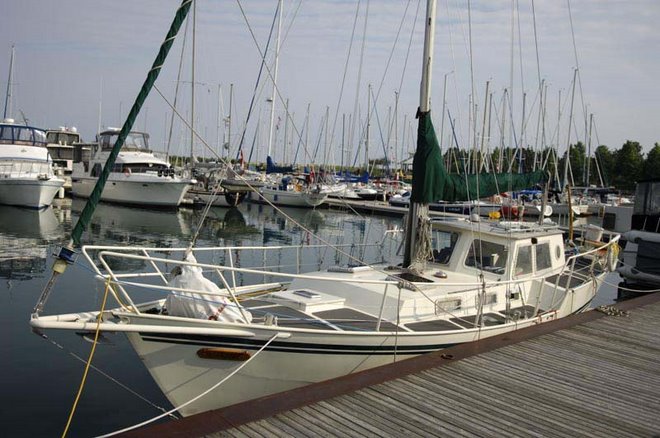
The above request is courtesy of Marina Quay West, which has several dozen liveaboards in residence and where the good ship Alchemy is being readied to being a floating home once again, and, it is most devoted to be wished, a sailing home by April 30th, which is when our apartment lease and our marina dock lease expire.

There have been many, many changes since the last post. A major one was the offer of our boat club, National YC, to offer us a dock (good thing we never "cashed in" that dock right, right?) for the summer, which means going "up" the membership status ladder from "crew" to "senior"...which will cost us money. Given the extremely tentative nature of our plans to leave Lake Ontario this season, even to get just to Nova Scotia and get our hull recoated and our standing rigging redone, leading to the possibility that not only might we cruise in circles this summer, but might also have to haul out (because the antifoul paint will be rather tired at that stage) in Toronto, our plans scuttled for another years, we decided to rejoin the club and get a dock, a course both providential in terms of timing, but a little bitter in terms of dreams deferred.
The underside of the wind generator "body" has a compressing collar and Allen bolts. I believe it is happiest with a 1.875 OD pipe.
Nonetheless, while there remains even a glimmer of hope of leaving on May 8th (the first day of what was the "suspended until further notice"  aspect of locking down the Seaway for boats such as ours), we press on with the refit just because we should. One long-postponed project is the installation of an Air-X wind generator on the stern to supplement the solar panel portion of the shore-independent power regime. This 12 VDC model is not necessarily the best or the quietest, but I traded it for a 24VDC acquired at a yard sale from the people who sold us our solar panels, and it seems reasonably robust, although it needs a paint job. Andrew Barlow, fabricator extraordinaire, is going to make up a pole for it and a footplate on which said pole will be mounted, which in turn will be bolted onto the flange off the stern of Alchemy fit for the purpose. Its role is supplemental to the solar panels, and we'll see if it earns its keep in that regard on, for instance, night passages when we'll presumably want radar and AIS chewing amps on the night watch.
Because it wouldn't be a passagemaker without a load of gear off the arse.
Other improvements include the resurrection of Alchemy's original 20 amp charger, which I found was made not only for Westmarine, but in versions labelled by StatPower and Xantrex (as the Truecharge model). Manuals are available still, and this is a pretty straightforward unit suitable for keeping two Group 27 deep cycle batteries of about 210 Ah capacity and wired in parallel topped up.


Does the job and so did the 5200 in sticking the board to which it's screwed to the collision bulkhead.
The idea here, which I consider not overly crazy, is that if the main house bank fails or otherwise requires service (or simply needs to be moved out of the way for access or repair of the tankage and plumbing beneath it), I can have two Group 27s at the ready to "become the house bank" or the start batteries as needed. After all, the windlass can also be worked manually, if onerously. Belt and suspenders thinking at work!
The energized windlass breaker and solenoid box: This is tidier than it looks.
Part of the prep of moving aboard is sending things into storage. To that end occassioned a socially distanced visit from my nephew Ryan Dacey and his still-under-warranty missus, Alex. The two of them brought some of my late parents' records, old photos and other "treasures from the basement" of their mother, my late sister. Off to Trenton it shall go.
Try not to cough.
Onward to the construction of the bed platform, which, being 90° rotated from the original, needed accessorizing to serve as an athwartship double berth. First up was constructing a crosspiece on which the hinged "bed flap" could land smoothly and capable of supporting the weight of two dozing admirals. This required an aluminum backing plate for the inside of the hanging lockers.

Why, yes, the vacuum cleaner got a workout in this process.
The flap itself is 1/2" marine ply, reinforced by stiffeners underneath and hinged with a stainless steel piano hinge and two SS strap hinges at either end. It will be held just past vertical when not in sleep mode by a peg set into the bookshelf surround, backed up by an eye-and-hook.
The underside is shimmed 1/4" to make the whole thing level. There will be a strip of gasketing material to keep those bolts and screws from chewing at the wood and metal. Stowage is below.
The upper side will have, at first, thick closed-cell foam as a Velcro'd on base, with memory foam as a mattress. We will have to improvise to get the hinge covered for comfort, but expect to get fitted mattresses and a Froli-type substrate sometime down the road. Mrs. Alchemy is already planning out lee cloths.
Prior to strap hinges and, you know, the bedding.
Imagine, if you will, that we are on either starboard or port tack, at night, with Cabin Boy on watch. We can shift our head or feet to either end, and our weight is farther forward than it would have been. A simple movement gets us into the pilothouse (there's a new handrail just out of shot) and there's also new stowage (the rectangle cut out of the former port berth) for light items, such as fenders. We hope it serves us well. 
Moved logbook rack, restored 24-hour ship's clock and freshly repainted port-side helm area suitable for chartwork.
John Cangardel was kind enough to give us some anti-chafe gear that wraps itself around line, such as our "cross-channel" bow spring to the docks opposite. Handy, this.

Yes, our son finally cleaned the deck. Well, somewhat.
Lastly, I spent a couple of hours yesterday tracing some wiring glitches and restored the radar's power circuit and that of the AIS. This involves taking down the pilothouse wire loom secured on the forward part of the pilothouse just below its roof and getting busy with the heat shrink. When I deselect the B&G plotter's internal GPS for that of the Vesper XB-8000 AIS unit, which has its own GPS receiver above the radome some seven metres up the mast, the positional accuracy was improved...the big scribble in the second slip was "before" and the boat running its forward-looking sonar was "after": we are in fact in the first slip of this pier.
But not travelling at 0.1 knots.
A few fuses blown last year (perhaps during the October "thrashings" we administered while racking up sailing hours) were replaced; some legacy circuits at 2 amps or under have glass inline fuses, which is a better solution in some ways for small draws than endless five amp circuit breakers. So back on came the helm reading lamp.
Maybe too many pens, pencils and loose cable ties? Can confirm.
Mrs. Alchemy is prepping the saloon floor with a vigorous belt sanding so that our freshly purposed roll of Lonseal Marine teak and holly flooring can spruce the joint up a bit. It had better: it was impressively expensive, even for something with the word "marine" in it.
Wiring to be confined better before we actually leave, which could be in either May or 2021...sigh. The boxes are full of watermaker parts.
More to do, of course, but we are clipping along nicely, despite the dour circumstances. More to come soon as the seacocks are opened for business...after it snows this week.
That Chelsea clock is keeping near-perfect time now, thanks to Mr. Del Rosario's ministrations.

2018-05-20

Comms 'n' sea

The baffled cat, "Shadow". Much as I would like to bring her, she's not coming on the voyage. Wouldn't be fair, and likely would be fatal for the cat.
Leading with a cat photo should not only get me some cheaply earned hits, but also suggest I am capable of whimsy. Which is true, but not often when it comes to the boat. However, I'm willing to make an exception when it comes to my cat, who only goes into the entirely wild yard under supervision.
The Vesper XB-8000 AIS transceiver booting up. All the wiring is loose (and the holes in the pilothouse unsealed) until I can route said wiring back into the pilothouse roof, which will be thereafter fastened down to the pilothouse frame for the first time in ages.
I, on the other hand, tend to work solo on the boat. This is because Mrs. Alchemy works at a distant wildlife centre for stupidly protracted hours, particularly in fertile spring, and I work from home upon request as an editor. Which means, in practice, plenty of work some days and bugger off  by 1100h others. That's condusive to boat work, which is why I haven't worked in an office since I got into boating in 1999. Sincerely, what have I missed? Oh, yes: NOTHING.
Had to download some USB drivers, but otherwise, this installation of Vesper Marine's software was a doddle.
Anyway, in a week that saw, as part of our house-sale process, the acquisition of a stackable washer-dryer and the transport of same about three kilometres by hand cart and shoe leather (we lack a car and rarely miss one, save for when we have to do this sort of First/Third World transit), I was able to drill some strategic holes and get both the radar and AIS cabling inside the pilothouse. The cabling is sloppy and excessive because I have yet to decide where to mount the AIS module and the radar display...to think I thought "I wonder if it's big enough?"...damn, it's huge from 45 cm. away.
From marinetraffic.com, evidence that Alchemy can both see and be seen, at least in terms of AIS. And yes, I turn it off when I leave the boat. I actually have no interest in pointing out where I keep my tools.
The AIS setup was pretty straightforward, save for the usual search for the USB drivers and the paranoia surrounding the correct inputting of the MMSI number. However, all went well and, as seen above, we are now transmitting a Class B AIS signal, complete with some related data attached to our MMSI number. Huzzah! I didn't screw up the mast connections!
Boat, as seen from the boat. It's all a little meta, isn't it?
Sure, English, but just this once.
The Furuno 1815 manual and related guidance (note the "quick start" flip cards to the left of the above photo) are excellent, if densely detailed. Because I tend to learn by doing, I will likely take the now rigged-for-sailing boat out tomorrow to play with the radar controls and see what I (literally) see from a few miles south of Toronto.
The first sweep. Of course, inside a basin next to about 300 condos, plus a tree line, it's a dog's breakfast.

The radar is complex in terms of the variety of tunings, ranges, guard rings, and display options, but not dauntingly so, and on first glance it seems very much what the skipper ordered. What remains to be done is linking the plotter via a to-be-purchased NMEA 2000 patch cord to the AIS unit, so that AIS targets (and their calculated distance away) are visible on the plotter. I may also link via the secondary NMEA 0183 wiring the radar to the AIS, so I can have AIS information available on the radar screen. What I won't likely do is have radar "layover" on the plotter...I think that would be visually too distracting and I want to keep radar church and plotter state separate for now. Still, a good few days' work.


2018-05-17

Sticking around

That big radome doesn't look so big up there and seems like it won't interfere with the sails when tacking. That rescue hook is not part of our rig, but of our dock.
When I last posted, it was about an unexpected day-long power outage during which our frozen and refrigerated food was saved by a portable generator. Today's post is about the extensive modification of the mast prior to putting it in, or, in the case of our deck-stepped mast in its tabernacle, on Alchemy. Said extensive modification involved the running of four lengths of wire (two 1/2" thick LMR-400-UF cables for AIS and VHF antennas, one 18 mm Furuno radar cable and one 1/4" UHF-style GPS cable). This proved to be...tricksy.
In order to get a greater bearing surface for the AIS antenna mount, I added a bit of scrap teak to an existing teak pad on the spreader. Saved drilling fresh holes in said spreader.
The prior RG-58 VHF cable was inside a cable-tied length of nasty foam pipe insulation, along with several 14 ga. wires for the various mast-mounted (and now LED) lights. So while I could clip the PL-259 connector from one end and pull the cable out of that half-assed loom (presumably to reduce mast noise and halyard abrasion/fouling, but a pain in the ass for us), I could not use it to "fish" new cable. In addition, the new cables, save for the wee GPS run (which is part of the Vesper XB-8000 package) were considerably bulkier than is customary on Lake Ontario, because they transmit more power to the antenna with less signal loss, a worthy ambition for the prospective offshore sailboat. So that meant cutting holes in the mast large enough to get them in.

Five screws, tidy heat shrinking and no sharp radius. Should work well.
So I had to get inventive. In my garage of Too Many Boat Things, I found the 1/4"(6 mm) forestay to Valiente I had removed in 2013 when I rerigged. I cut off the terminals and I had abour 40 feet/12 metres of reasonably stiff wire. I drilled the VHF hole in the top plate of the mast between the sheaves and, with the coax taped to one end of the forestay wire, carefully pushed it down the mast. Carefully, indeed, because it's a busy area in there and I did not wish to foul halyards or that grubby, if still functional, foam loom of 14 ga. wire.
This is the Scanstrut LMM-2 gimballing radome mount. It's pretty slick, but I had to be careful to get it centered and rivited correctly.
After I learned I could spin the stay to get it past obstacles, the work went slowly, if productively. Together with Mrs. Alchemy, we fished the four wires to the appropriate mast-base exits. After that, it was time to do the radar mount.
A total of 12 3/8" pop rivets are holding this on. Feels pretty permanent to me.
This was mostly just careful work and following the IKEA-like instructions from Scanstrut. Then the usual routine of inking the right spots, using a  nail punch and hammer, followed by the use of a small drill bit and then a larger drill bit, and then the riveting. It took about three hours.
The Vesper AIS's GPS receiver is mounted on the same gimbal as the radome, nice and high.
May we never heel or pitch-pole this much! But I'm ready if we do.
Loads of crimping, chafe-guarding and tidying up later, we moved the mast to the Place of Hoisting.
Two of the delays in getting the mast in were the realization that Alchemy was pointing in the wrong direction and that the mast had to be craned on its "back"
Because I have so many stays and shrouds and must mount rather exactly into the tabernacle, the crane activity can take longer than the allotted 30 minutes per boat, and it's to the credit of my friends who helped me that certain slowdowns (like the inability to retrieve the hoisting line) were dealt with in such a patient way. I need to tell the crane operator I'm going to need an hour next time.
Alchemy unbound: waiting for my turn.
Some frustration, followed by a round of beverages purchased to mitigate frustration, later, Alchemy was back at her dock with shrouds and stays provisionally tensioned....which reminds me, I need one of these.
Nice! Got the full-length battens in unassisted this year, which is always a little tricky.
So the jib and staysail are now in place, as well as the rather good-looking mainsail pictured above. I declare the season underway.  The next steps will be drilling fresh holes in the pilothouse in order to route all those cables to their new devices.


2018-02-14

I ♥ my new radar

She's a big 'un.
As the snowy weather, some welcome work and a minor surgical procedure have me sidelined this week, I thought to unbox the new Furuno 1815 4 KW radar I intend to bolt to Alchemy's mast in late April. The kids seem to like it.
Always good to know.
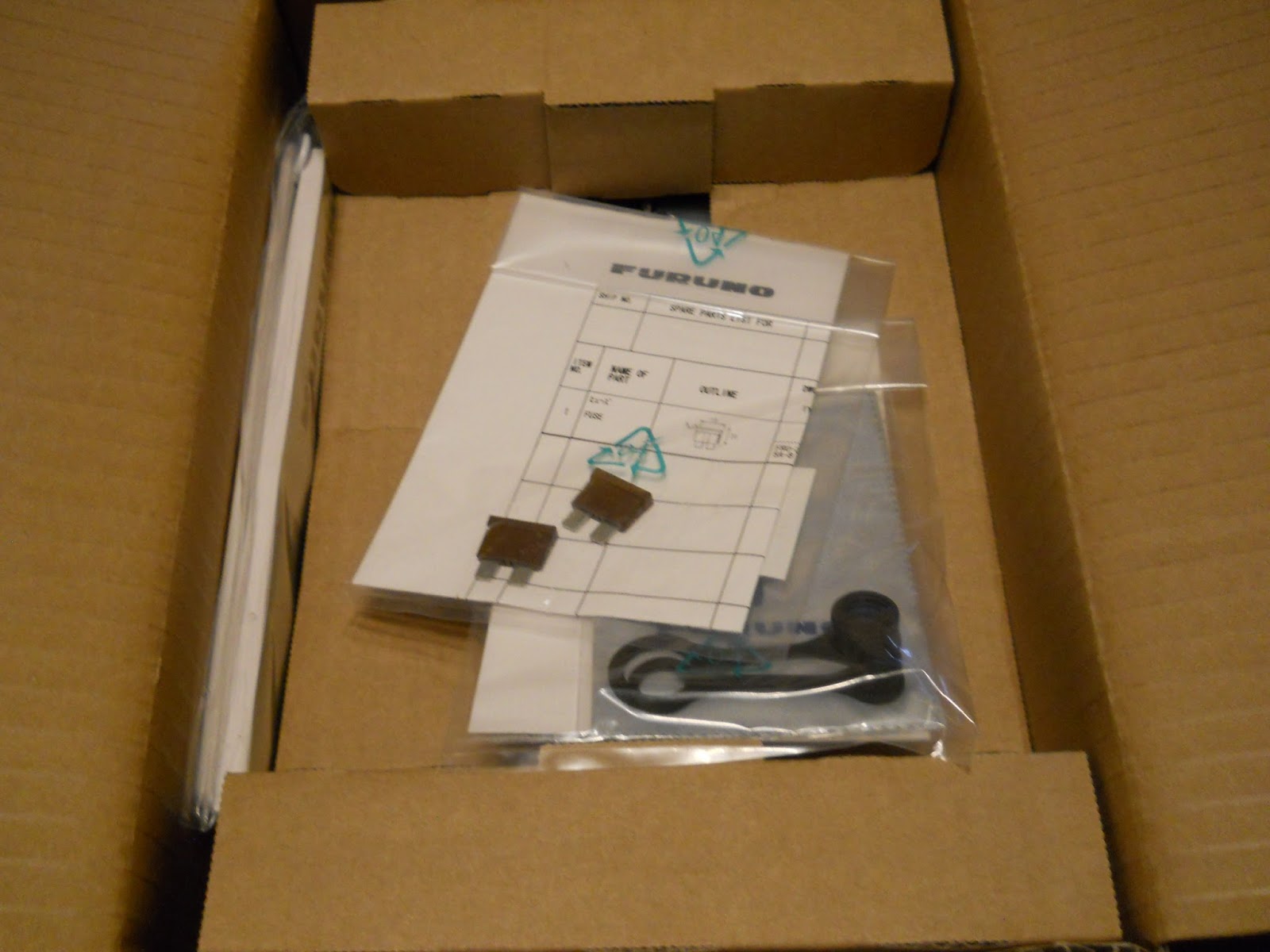
Furuno gear is as well-packed and organized as any higher-end Japanese gear I've encountered. The "important information" is undoubtedly online, but it's a nice touch to include the info in the box, because it would be HUGELY ANNOYING to get the radome up the mast, attach all the requisite wires and then get nothing, or the wrong thing.
Do NOT unwrap prior to installation.
The default power/data cable is 10 metres in length. This may well be enough to go two thirds up the mast, down to the deck and into the pilothouse, but I'm going to have the seller exchange this for a 15 metre length (it's coming in next week or so in another shipment) and I will hand this one over. I would rather have too much than too little cable; for instance should I for some reason wish to take the radar display aft to the outside helm, I'd use most of that 15 metre length.

There's a packing list and templates for each compartment in the 25 kilo box.
The chunkiest part, of course, is the 4 KW radome, which appears to be of the 19.2 inch form factor. The other model I was considering, the Furuno 1835, has a 24-inch dome that's heavier. The range is similar, however, and the power rating is identical. The difference between the radomes, for those of a technical bent, is as follows for the 1835: a horizontal beam width of 4.0 degrees and a vertical beam width of 20 degrees. The equivalent numbers for the unit I've purchased are 5.2 horizontal and 25 on the vertical. Both units work from 0.0625-36 NM in range, although the higher, the better, if you want that distance range. You may calculate your own potential range here.

These numbers break out in interesting ways: the higher the horizontal beam width, the lower the discernment or "sharpness" of the display. The vertical beam width, on the other hand, should be desirably high to account for the typical pitching of a sailboat at sea. The heeling, on the other hand, is dealt with by a self-levelling radar mount. I'm getting this one.

The main use for our radar will be twofold: seeing marine traffic on passage and seeing weather around us. I'm more interested in distance (hence the 4 KW radome, although the draw is reported as just 38 W) than I am in spotting a stick in the water a mile ahead. The nature of the sort of sailing we intend to do is largely high seas: radar buys you time. That said, this radar can be tuned to a pretty tight standard of seeing canoes and geese at 3 AM in the fog 1/2 NM ahead, should that be necessary. But I have seen radar used to steer between thunderheads and localized downpours, and I think this radar will excel at that.
I expect great things from you, radome.
There was no need to unwrap this radome prior to installation: this was just a check. 
Thorough, aren't they?
The 1835, which a few ocean folk have recommended to me, is a pretty sweet unit, but the 1815 debuted in 2017. It "paints" AIS targets more readily and has visual clues, such as "True Trail" mode, which visually suggest the speed and vector of objects of interest, such as radar targets that are also AIS targets.
The AIS info at the bottom of the cursored vessel is smoothly displayed with the radar return.
Rain and storm clouds and squall lines provide variable returns, although they are often gratifyingly tall enough to  be seen beyond the nominal distance limits of the radar. The same can be said of masthead-mounted AIS: it would not be ridiculous to "see" the AIS data of a fast-moving container ship at 50-60 NM given that its own antenna might be 60 metres off the surface of the water. AIS is also in the VHF band; certain atmospheric conditions can cause "skip" and multiply the occasional reception by several times. I once heard, for instance, the U.S. coastguard in Cleveland, OH in Toronto...on my handheld. It didn't last, but it was an example of skip. I wonder if an AIS target, ported to the radar display from my Vesper transceiver, would show up on the screen not as a "blip", but just as a contact on the lower half of the display? I'll enjoy playing with this, I can tell you. Someone else will have to sail!
It's possible to avoid a lot, but if you can't, it's good to have some warning of heavier weather approaching.
Above is the "weather" use of radar. The 1815 has a full manual mode, which, having fiddled with older radars and radios, I'm accustomed to using. I look forward to this as well, because I want to see if radar can spot certain phenomena, like "clear-air squalls", I've experienced at sea. Or maybe it was a microburst. Anyway, a bit of warning would have been nice, if that's possible.

The wires that go into the display. I have to run right-sized wiring to the display unit, but the draw is pretty low: 3.2 A
The plan is to have the display at the helm. While this unit is supposed to be either helm-mounted on a pivoting base, or flush-mounted into a nav station bulkhead, I am going to try to mount it on a strong armature from the pilothouse roof. That way, it can be tucked away and secured when not needed.
More fuses and covers and literature.
My plans to do this, however, might have to change if the radar display affects the helm compass, which is actually pretty accurate (locally, at least; it will almost certainly have to be swung in the Southern Hemisphere).
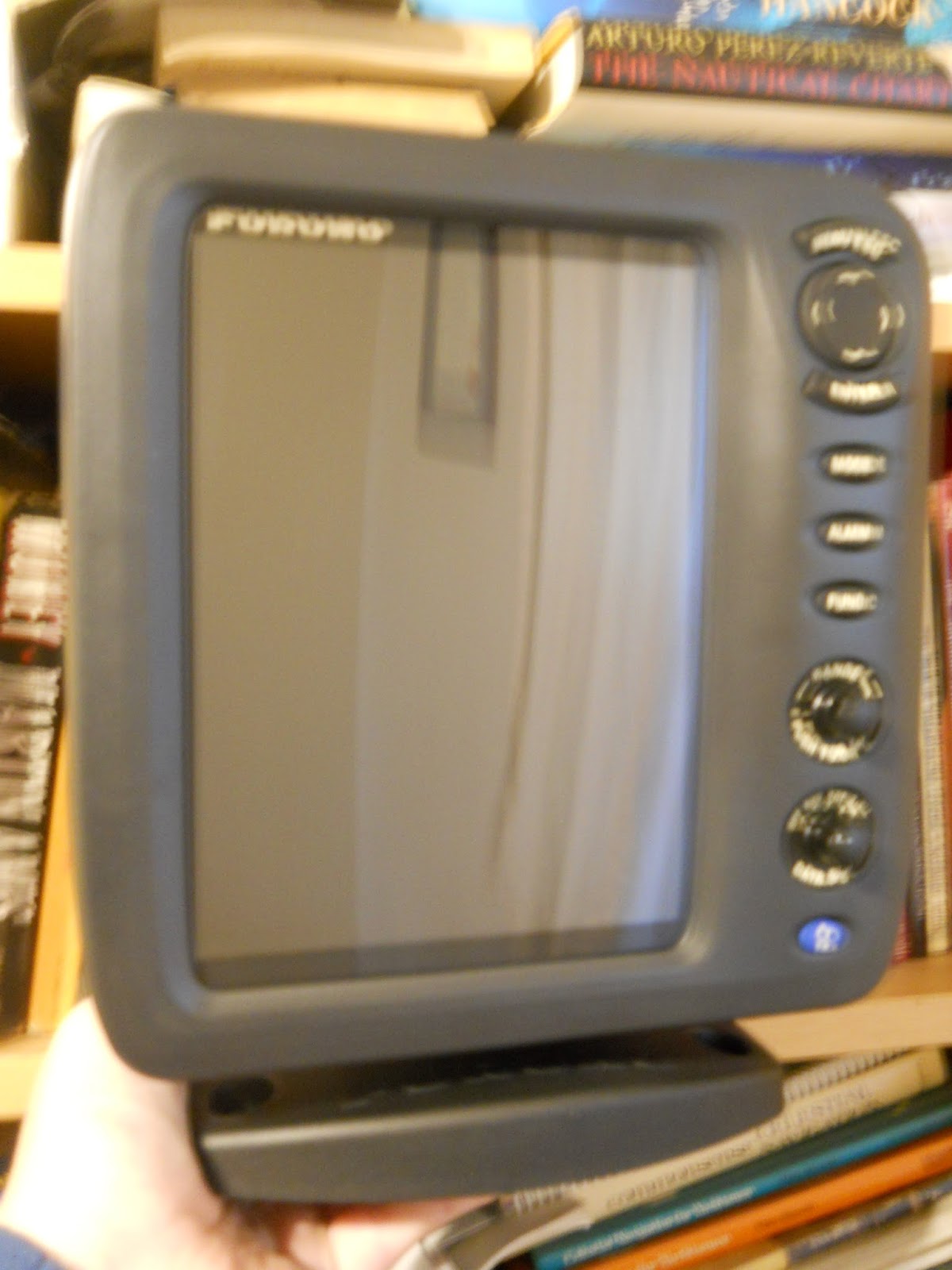
I was concerned this unit would be too small. My hands are large: I need not have worried.
The display unit itself is 8.4 inches top to bottom. That seems small, but I had a good look at it, as did Mrs. Alchemy, dragged over from her Boat Show gig as temp worker at a chandlery, and while there's a lot of information on the screen, it's easy to read. Again, this is most likely going into the pilothouse and will be closer to our eyes, should we wish, than the plotter will be, and it's only seven inches wide.
Sorry for the focus; I should've used the flash.
The back of the unit is pretty simple and robust. I'll post about it again after it's installed and running.
Oh, the places you'll go and you'll see their outlines first!
In the meantime, insurance survey time has come around again and there is much to do aboard prior to that expensive but necessary exercise.