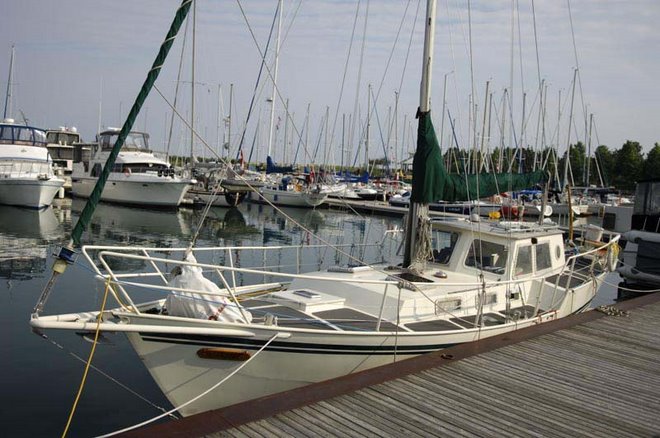
Copyright (c) Marc Dacey/Dark Star Media 2006-2020. Above photo (c) Marc Dacey. Powered by Blogger.

2017-09-14

Well, that was an eventful month

Warning: This post is both multi-topical and heavy with photos.

Well, I haven't posted for a month, which is historically unusual. This was due to a series of events both fortunate and unfortunate. We went in mid-August twice for a few days away, which in this case involved visiting both friends in Frenchman's Bay and a trip across the lake to visit for the first time the scenic, if tourist-ridden town, of Niagara-on-the-Lake.

Frenchman's Bay was fun, if blustery. As seen above, we aren't usually subject to heel at dock, and a fender sacrificed itself on behalf of our paintjob. Crewman Lucas experienced warm if near-oceanic waves, and the lake ate his foolishly-taken-swimming sunglasses.
The next one ate his shades.
The trip back was fine, if (typical of Lake Ontario) the motor was needed were we to get back in time for dinner. I noticed I had passed the 25 hour engine run time mark, and realized I was supposed to change the transmission fluid for the first time. This wasn't recorded photographically, as it was mucky and I needed a third arm. About a litre of ATF (which looked brand-new) missed the bucket and ended up in the aft bilge. This will become important information later.
To the east of Toronto is a long artificial "spit" that's become quite a nature refuge. Also, it means a long diversion to the SW to get back into the harbour.
The high water May-end of July has receded from the club, but that hasn't discourged some unusual visitors. As I am frequently on the boat at odd times, like "middle of the weekdays" depending on my workflow, I see quite a bit of local wildlife not present at busier times. I think this fellow was a witness to the day I put in the new anchor.
Egrets, I've had a few.
A recent mid-week job was the addition of a keyed lock to the companionway door. Yes, I can see the slight gap between frame and lid. It's an easy fix that will happen over the winter. The point is that this door is now somewhat harder to break through.

I mean, a crowbar and a chain clipper will still do the job, but this is meant to discourage, not prevent.

Another trip on the weekend of the recently solar eclipse (70% partial over Lake Ontario) brought us to Niagara-on-the-Lake. We were told we were very lucky in our timing to get a spot on their wall as they were still in "recovery mode" from extensive flooding that had delayed their launch until late July. Their boatyard was still pretty full, suggesting that some people had just given up on the year, which was sad.

Evidence of damage was all over the place, as was evidence of circa four-knot current in the Niagara River. I made good use of our new sounder, and better use of the throttle. I wish I had been clearer on the "don't enter the docks area" warning, however, as it was a very tight turn or three to get out after I learned I was meant to go on the wall (bow to current). But we docked easily and had a good time in town and at the beach.

I'm just guessing here that the bottom drops off like a cliff right behind him. Just to the left are about three sailboats that were rafted up on an anchor, evidence of a big counter-current as they were pointed to the north shore.
The Monday of the eclipse was nearly calm and dead useless for sailing, but quite good for sextant work. The general effect of a partial eclipse (I've been under a few) is like high cirrus cloud: a generalized dimming, but there's no evidence of the moon's "bite" if you glance at it. That takes binoculars!

It begins!
What I choose to call "total partiality".
Lucas, after most reluctantly taking the wheel, because we have yet to install an autopilot and he is even less keen on helming than Mrs. Alchemy, took a break from that "torture" to wield his mother's sextant and check out the progress of the moon.
Sure, welder's glass is cheaper, but not nearly as seamanlike.
Now, during the voyage, the galley drains were acting up a bit and, well, not draining. We weren't sailing and therefore couldn't heel, and I wasn't sure if there was debris in there. In addition, there was a stuck inline valve of this type under the sink as well that wouldn't close. We got back and figuring it out went on the list of "things to check out and/or repair."
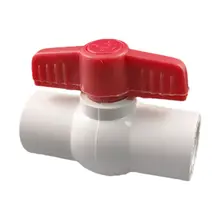
Like this and, upon reflection, not great for below-the-waterline use.
The next day, my club's Commodore, Don Weston, and myself went to check out the "Blue Barge" for a failure to start. Well, we got it going, all right, but discovered it either has a cracked block or a failed gasket between the manifold and the block. The first one is a lot worse than the second, which I could fix.
This old motor both propels the Blue Barge, which is used to shift the railcar wheel mooring bases in the mooring field, and, via a power take-off, pumps the hydraulics that work the crane (top of photo). It's a beast, but a useful one.

Hey, foreshadowing! No, seriously, this was bad. It's either an annoying fix or a "do we buy a diesel" fix.
I then had a nice lunch and debated going back to the boat for its 50 hour oil change. When I stepped aboard and opened the engine bay hatch. I was pretty shocked to see it largely filled with water. I was equally shocked to see about a foot of water in the salon.

Alchemy was sinking.

You'll have to excuse my lack of interest in recording photographically either the depth of the water or my robotic response to the crisis. The bilge pump was off, because I had spilled some ATF during the process of changing that fluid and didn't want to pollute my club's basin until I could swab it up by hand.

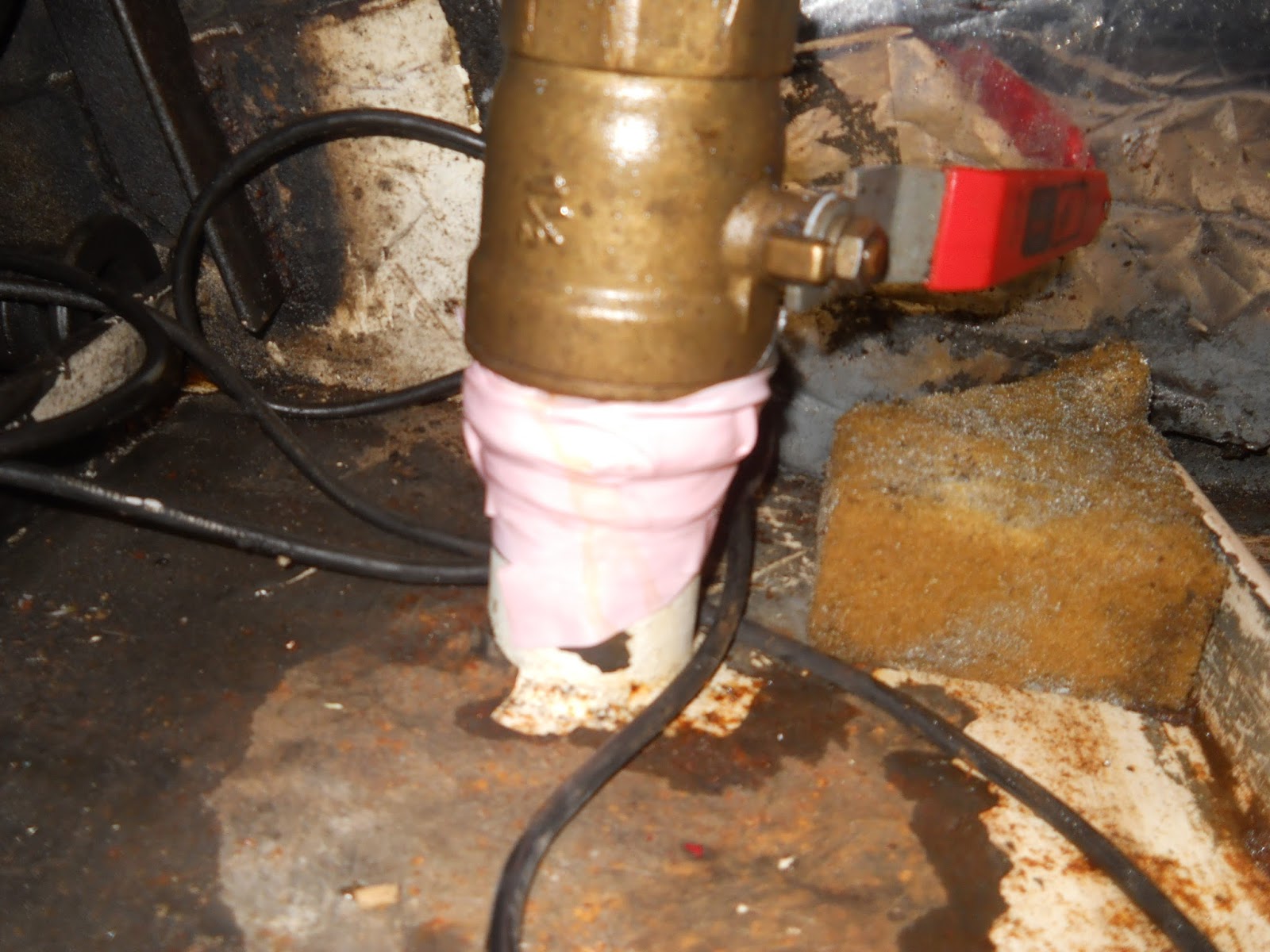
Well, I got over that instantly. The Rule 3700 worked (it was powered off a subpanel still above water I installed earlier in the year) and, despite being about a metre down gamely pump water up the new hose I had installed recently (I don't post every improvement I made, actually) threw it off the boat. I ran to the club office to get an AC powered "crash pump", a residential-grade sump pump and a length of hose we use for boats that have single, non-SS hose clamps in the head. It took about 20 minutes to get the water out of the engine bay sufficiently to reveal the problem: the galley drain through-hull pipe was weeping vigorously.

As the "crack" was below the seacock, turning it off was of limited use. Self-amalgamating tape was.

I was able to get down onto the slick stringers and hull and stop the leak with plumber's helper tape, or at least reduce it to a drip. Only then could I survey the damage. That's what's kept us busy since the 21st of August, frankly.
Another shot of Groundwater Zero. Yeah, that's all getting repainted shortly.
Firstly was discerning the cause or causes of the nearly fatal leak. The short answer is I can't tell untill we haul out. I arranged to have that done at Toronto Island Marina and to have a new section of pipe welded on at least this side via Andrew Barton, my fabricator and a fellow member at NYC. But that would have involved a tow as the engine suffered damage and the diesel supply was perhaps compromised. Andrew agreed to do the work (he has a day job on the Island and it would have been convenient for him) but suggested that if the tape was working and haulout was seven (now five) weeks away, I could bung a plug into the thru-hull opening and that and the tape should flood proof the boat until haulout and doing a series of weld jobs with Alchemy cradled.
Secondly, because I cannot at this point remove the seacock, I can't confirm what I suspect is the problem: that the pipe threads supporting the seacock seen above have fractured or otherwise cracked. I am not sure if the mechanical forces of attempting to turn the inline valve imparted a shearing force on the pipe stub; or, after 29 years, there was corrosion and it was just "its time"; or (my initial thought) there might have been galvanic corrosion as the boat next to me had had a jury-rigged garden-grade extension cord going to his race boat that I've found more than once in the water on my port side where this outlet is. I have yet to mount flat zincs directly on the hull and all the anodes are on the prop or the rudder. Clearly, that's moving up the list now.

Frankly, I can't point fingers. It could be a combination. I might not even know when we fix it (and its possibly suspect starboard side drain for the head) after haulout. But I'm paranoid now (and the bilge pump is permanently on "auto", the carp be damned, although most of the goo is out of the bilges now), and I'm down there most days. There's no new ingress of water. In fact, once the mopping up was done, the boat's really dry. Still, I bought one of these for myself and it and 25 feet of hose are at the ready should something of the same nature present itself to me again:
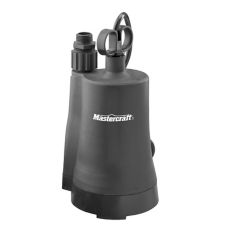
It's merely supplemental. The Rule 3700 can throw three times the amoutn overboard, but it will give me time to think and I can run it off the inverter if I must.
The Commodore is also keen on not seeing members' boats sink: apparently, the paperwork is horrendous, so as he had a few dive jobs scheduled, I offered to crew and he graciously offered to bung the offending pipe. The hope is that "bung plus tape plus vigilance" will keep us afloat until more permanent and presumably stronger steps can be taken.
Note the ramp and the diving ladder. The Commodore picked these attributes and they are damned handy.
The club's able workboat, Storm King, was lashed aside in the late morning (best light for this job). I  gave directions as to which hole to bung. I had purchased a special foam bung as seen on the right. Id clipped the end as I knew the interior diameter was 1.5 inches, but Don reported that too much of it would protrude to guarantee it would stay put. So that was put aside and a more traditional "tapered softwood bung" (on the left) was given to him. This was smacked into place and, I hope, will do the trick.
A tale of two bungs. Really, I think the one on the right is better pushing into a hole from the inside than the other way around.
Diving for bungs is less romantic than diving for pearls, and there's no use wearing nice shoes on a greasy boat.

The list of what was damaged is sort of good news, bad news: The new depthsounder is fine, but the starter motor was fried and gave only the "click/hum of death" when keyed. More on that below. Mercifully, the battery boxes worked as designed and the house bank was untouched by water. The interior carpet was wrecked (except for the head sole, which never got wet) and is gone. And the Nova Kool refrigeration compressor, a Danfoss BF35 unit, got wet and is non-functional. But really, these problems are dozens of hours and hundreds of dollars, not "fetch the salvage barge". It could have been much worse. Like "hurricane hole" worse.

What worse looks like.
As I had mentioned, I was on a mission when I discovered the flooding to change the oil as I had surpassed by six hours the recommended initial change interval of 50 hours. Well, I expected to find a 'grey milkshake' of watery oil and perhaps a need to do several kerosene flushes, as I had been done this road, sadly, before with a duff waterlift with the old Westerbeke W-52 engine pre-2011. But it appears that my new diesel's gaskets are still tight, because the "used" 50 hour crankcase oill was the colour of night, as it should have been. There was zero evidence of water. Same for the transmission fluid. In these respects, we got very lucky.
Healthy and black. The next oil change isn't until 350 hours on the clock. That's probably going to be in Halifax.
Back to the starter. The corrosion seen here was also evident on the starter battery and its associated cabling and fuses, some of which I can likely salvage. The battery was fully submerged, yet when I took it off the boat yesterday (we are going for a full paint job down there before water tanks go in), it still read 12.75 VDC. It's old (about six years) and I'm going to scrap it anyway in favour of a different setup; more on that later, but it's still impressive to me that it didn't completely discharge.


Yeah, not great. The good news was that I cut back that cable and the interior was perfect, suggesting that my power lug crimping and heatshrinking technique is pretty waterproof.
Back at the block, I took the starter off and figured out my next steps. As I found with July's farcical filter fiasco, it pays to do one's research. I learned a great deal about this starter: it's a common 12 VDC, 2KW nine-toothed CW starter used in a variety of Beta Marine diesels, namely the 43, 50 and 60 HP models. Meaning also that it's used in a variety of Kubota backhoes, diggers and tractors.

Now, I checked out the prices for this item from the English Beta Marine site. It goes for £164.95, or about $270 Canadian. Ouch. Still, she doesn't spin without it, which is a case for decompression levers, I suppose.
As above, so blown: That wire and plug is a 40 amp circuit going to the wiring harness and then to the key on the panel

So my first and somewhat cynical stop was the nearest Beta Marine parts dealer, Craig Morley, who advised me that as he would just have to order the thing from the main Beta parts dealer in Canada, out in British Columbia, I would do better to source it locally via a Kubota dealer. Thanks, Craig. You could have just sold me one and cost me a lot of money. You just went to first place in my "surveyor" list.

Just to cover my bases, however, I phoned B.C. and got a price for this Beta starter, which is actually a Kubota starter, which is actually a Denso starter. I was quoted a price of $1,700 Canadian. Plus shipping and this is a fairly chunky item. Yikes.
Before opening this up, I realized someone had been a touch lazy with the "Betatastic" paint job.

I called a Kubota dealer out by the airport. I was quoted $701 Canadian. Well, a grand better. Let's keep it up. Meanwhile, I poured out the water and dried off the guts. Craig had suggested the sooner I did that, the more likely I would be able to have it repaired.
The coils and brushes inside were cruddy, but the rest was easily cleaned.


So I did two things: 1) I ordered a new starter, minus the key circuit, which is a small mod, from the States. Cost to me? $264.32 U.S., including shipping. It arrives tomorrow. It will be, once modified, the spare starter and will be bagged and tagged to avoid this in the future. I was going to do that anyway...2) I took the drowned starter to a reputable local starter rebuilder place.

Unusually for my life, this was downtown and not in south Etobicoke or Mississauga. Most convenient!

They turned it around over the weekend, although with a new look; evidently, they paint everything they rebuild. Cost to me? $160 Canadian. Well, well.
NICE!
Being careful, I tried to tighten all the bolts. They were all tight. I am well-pleased.
About 20 minutes of reinstallation later, the engine started. Yay! Of course, because I don't yet know whether there's water in the keel tanks, I stopped the engine right away. But we're back, baby!

As a side task, and because I was swabbing out the forepeak workshop which took on some water via a limber hole I will keep plugged on passage, I emptied much of the forepeak, dried it out, and removed two surplus anchors and about 250 kilos of "trim ballast" in the form of lead shot in thick, taped-up plastic bags. This was orignally in place to keep the bow on its proper lines with a) different engine and b) two 100 gallon water tanks aft of the mast and c) a couple of Trojan T-105s as the house bank. Now there's a new 30 kilo anchor out in front, six L-16s under the mast, loads more tools and stores and the tanks, when they go in, will be smaller (probably about 400 litres over two tanks) plus the weight of a watermaker system. The effect was noticeable. And now my garage has a lot of scrap metal potential.

Having that bobstay/snubber plate proud of the water hasn't happened for some time. I like it.
Now, there is still a lot of trim ballast left in the form of several 50 kilo lead ingots on either side of the collision bulkhead. Plenty to move around as and if needed, but as I move gear/spares forward and stores lower, they may need further shifting.

The last significant damage was the fridge compressor. I have it disconnected at the moment as I have to replace some wires before I can determine if it just shorted (and I can find the fuse on the PDF I found of its wiring) or is shot.

You can see where the water went: that rusty four-screw terminal is the DC power hookup.
The "muffin fan" is easily replaced, but I have to do yoga to get two hands in here to finish the job. Fingers crossed, because it's a pretty effective unit and if we ran it at more than 2 out of 7, stuff in the fridge section would freeze, even on hot days. Also, they aren't cheap. So we'll see. I think I will reroute the DC supply above the base up that back wall (which is actually part of the bench seating over lockers) and put in an inline fuse suited to the 10 ga. that's supplying the compressor.
Worth saving, I hope.

Thanks for reading this tale of woe mitigated by less woe. This was bad, but not voyage-endangering.



2017-08-14

Calling a SPADE an anchor

Now, this one has been some time coming. I started to review and consider anchors a decade ago.

One hook to rule them all, One hook to mind them; 
One anchor to make them fast and to the bottom bind them.--with apologies to JRR Tolkien


So, I have been anticipating this arrival of my latest precious for some time, mainly because some bolloxed paperwork held it up a week somewhere in a Pennsylvania depot. Meet the new main anchor, although not at present the best bower, of the sailing vessel Alchemy. It's a SPADE S 140, the 30 kilo/66 pound galvanized steel and lead anchor that is about one and a half sizes oversized for the boat, which is a good margin in my mind. Should we have to, we can bring it up and in through use of a manual windlass, or even by hand, although that, I can attest, having tried it at dock this afternoon, while possible but not fun.

Ground tackle by FedEx: the delivery man was a touch flushed bringing it to the door
The unboxing supplied a lot of packing material: in fact, the 66 pound anchor's packaging came to 76 pounds, which I found unlikely, but it certainly arrived intact. The reason I ordered a couple of weeks ago was because SPADE Anchors USA were having a decent sale and because I had had some strong recommendations for the SPADE (which is, apparently, always shouted) via both John Harries of Attainable Adventure Cruising, whose opinion I value, and from the convincing and thorough videos of "S/V Panope", which have compared a variety of anchors with an eye to short-scope holding. While I do not prefer to anchor that way, if an anchor has problems, or problems in certain bottom types, or in terms of resetting, that's where they'll be most likely revealed.
The anchor's two-piece: the plow part and a forged shaft that slots in a keeper and is secured with a 3/4" bolt.
The breakdown into two pieces facilitated transport by bike trailer down to Alchemy. Transport mostly downhill, thank goodness.
Very well-cushioned!
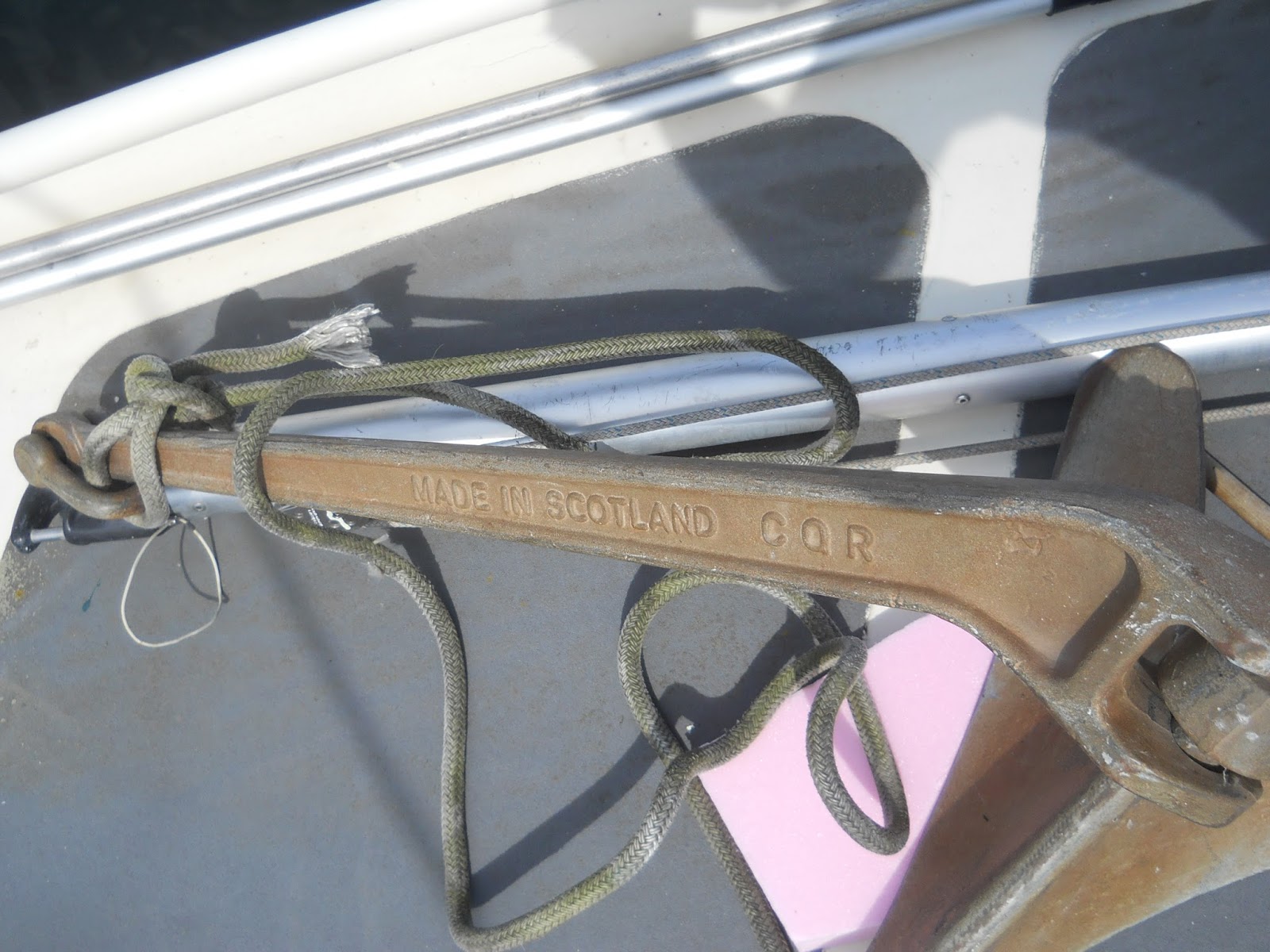
 I made some room by removing the old main anchor, a 45-pound original CQR.
It's in good condition. It should be: we've never used it.
Yes, the real thing. The best 1930s ground tackle designers could devise, but things have changed since then.
Even a boat with as bluff bows as Alchemy is not insensitive to weight in the ends. So I took out another anchor, a CQR knock-off in excellent condition called a Kingston (made in Kingston, Ontario) K 27. It's (unsurprisingly) 27 pounds and would make a decent main anchor for a boat up to around 33 feet. It's going on Kijiji or people around Toronto can make me an offer.
Hard to see, but it says the anchor make.
As in "make me an offer".

That is the shiniest damn galvanizing I can recall ever seeing.
The SPADE anchors are built like many other plow styles, but in a "boxed" format with weight concentrated in one end. The tip, which has cast lead in it to guide the anchor through the substrate, was sharp enough to leave a mark on the deck.
I may change this for a split pin.
The shank sets into a welded box base and is kept by a heavy bolt which is in turn kept in place by a Nylok nut and a cotter pin.
The SPADE doesn't look as massive as I had thought it would vis-a-vis the anchor roller and bowsprit fittings. In fact, it looks a good fit.
The installation went smoothly: two beefy Winchard shackles, properly moused, now link the SPADE shank to 150 feet of 3/8" chain. That's only enough to anchor with a conservative rode scope ratio of 7:1  to 22 feet, but it's not hard to find less than that around the lake and in anticipated light weather, a scope of 5:1, or around 30 feet, would be fine. I truly believe getting the correct ground tackle is one of the more important decisions one can make. Another is using it correctly, and part of that is found in putting out enough rode. We have two: rope and chain for the Fortress and all chain for the main.
The shank is secured by a 3/8th inch line and the chain by a chain hook. In addition, the shank is wedged under the end of the pipe rail. I may devise a "keeper" (even just a piece of metal plate) to secure the anchor more firrmly on its roller.
So the anchor inventory is now as follows: a 30 kilo SPADE as main anchor; a 15 kilo Bruce as secondary; a 10 kilo Fortress FX-37 as lunch hook/kedge/storm anchor, and a six kilo FX-21 as a stern anchor. The 45 lb CQR many or may not come along with us...we'll see. You'll note that I have a very mixed bag in terms of the way these anchors work: unlike some anchor manufacturers, I believe that while we can approach a "one anchor for all bottoms" state of grace, it's better to err on the side of caution and some bottoms favour even older designs, like the Bruce, while others favour less obvious designs for heavy weather, like the Fortress, which shares the bow with the SPADE now, as it is a great hook for fair-weather, short duration anchoring, but also has an excellent record as a storm anchor thanks to its large area and tendency to dig itself deeply.

Some considerations to come include the installation (at last!) of the Lofrans Tigres windlass, which will necessitate a rather daunting rethink of the forepeak workshop, plus the drilling through of a hawse-pipe through the deck for the chain fall; the making up of a better chain hook, a snubber for the plate at the waterline below the bobstay seen in the photo above, the making up of a suitable anchor bridle, and even the creation of a cheap anchor buoy. Finally, a use for a Clorox bottle!

2017-07-29

The portlight fantastic

Fixed plasticky fixed portlight: Not wanted on the voyage
The recent installation of the new stainless steel companionway hatch deviated from the original design in that both the fabricator and Mrs. Alchemy suggested that a fixed port light in the upper hinged flap of the door was unnecessary and would weaken a properly vault-door-like presentation.

I came to agree with this sentiment. After all, at sea, the "cat flap" will be down in fair weather, even boisterous fair weather, and plenty of air will come in. So the new hatch is flat and fearsome and hard to dent. Then, as my last post indicated, we tidied up the AC power inlets and did a spot of painting. All this made the 5 x 12 inch plastic fixed Beckson-type portlight, which came with the boat and merely shed a bit of light down the aft cabin companionway, look a little sad.

After some thought, I decided to replace it with an opening portlight, both for ventilation and for communication with the afterdeck should the main companionway be closed off. Ventilation, even once the pilothouse roof insulation is restored, is a big deal on a steel boat and will be even more so in the tropics. I had had a good experience (and indeed, am still having it) with Newfound Metals' line of reasonably priced and sturdily built products, and the circular portlights put in during 2011 are still looking great.

A call to Newfound Metals got the owner, Richard, on the phone and, as is often the case with smaller marine-trade manufacturers, I had an entertaining and insightful chat with him about his business. He recommended the self-sealing Trimatrix port and I ordered a teak spacer ring (as the metal sides of the pilothouse are thinner than the typical fibreglass boat's cabin house, plus a chromed bug screen. They arrived from the Seattle area in about four days and cost about $180 U.S. Newfound Metals, realizing their customers have, uh, variable skill sets, provide very good online instructions and even videos, meaning only the truly ham-handed can screw things up. As for build quality, I consider Richard's firm the equivalent of Garhauer for quality and strength. From me, that's high praise.

The original 5 x 12 inch void with the 12 new and enlarged bolt holes and space for the "spigots" cut in

When I removed the old fixed portlight, while the basic 5 x 12 hole was good (it was actually 5.5 x 12.5 inches with radiused corners), I had to carefully grind out little divots for the "spigots" that drain water from the glass of the portlight and keep it from pooling on the frame. Then I had to drill 12 (!) new holes for the carriage bolts (gasketed and mated to metal strips on the outside) to mate with the 6 mm SS bolts. Despite being told by Richard that I needn't use butyl, I did use it in thin strips to position and temporarily stick the outer ring and the inner teak spacer ring on either side of the pilothouse bulkhead.
The unboxing: I have yet to be disappointed by the quality of design, materials or execution of Newfound Metals' products.

The drilling was two-stage, first with a 3/ 16th inch cobalt bit and secondly with a 3/8th inch titanium bit, both on my monster Makita. Knowing that this was a tough job to do solo, I waited for the next day Mrs. Alchemy was free. She painted the bare metal and drill holes and we cleaned up the debris of metal shavings and then she pressed down the outer ring from the outside and put in the first carriage bolt head. This was tricky, but once four were loosely in, things got easier. We realized a couple of my drill holes were fractionally off and would not let the bolt head nestle in their spots, so out came the Dremel with a grinding stone attachment and I can live with a couple of slightly egg-shaped bolt holes that will never again see the sun, I sincerely hope.

We are rather pleased with the results:
Light, air and bug stopping. All I ask for, really.
The hatch dogs required some adjustment for a) the thickness of bulkhead plus spacer and b) the same plus the thickness of the inset bug screen. It's simple to adjust and the box contained the needed tools.
Closed for business.
 Dunno if I'll bother oiling this teak. I think it's nice as is and will take years to "silver".
Open for the airing out.
 And that's the aft part of the pilothouse, improved.

2017-07-26

Back of 'house changes

In the midst of things...the plywood had been removed, revealing some rust requiring remediation
Reliable readers will recall that the pilothouse recently got a new companionway hatch; we are quite pleased with it to date and only a few tweaks (like a way to secure it fully open with some sort of chock in the deck or via a light chain) remain to be done. But a lot of old and suspect plywood was removed in the process: essentially, the outer "skin" of the aft part of the steel pilothouse frame, and while there was a reasonably intact paint job beneath, there were also plenty of small holes used for mounting said plywood which will need to be dealt with. There was also the matter of the AC shore power connections.

As can be seen, there are two of them. The boat can accept a combined 60 amps of power, which was probably what the house in which I grew up drew. I never use two shore power cords in daily use, although I occasionally run a second 15 amp line if I'm using a high-draw power tool so I can continue fully charging while I work. Nonetheless, the removal of the plywood sheathing on the pilothouse would leave these sockets literally dangling, so I had to improvise.
Mrs. Alchemy did the paining, of which there's more to come. We need more paint.
I took an offcut of UHMWPE plastic, the same type I used for the traveller stand-offs last fall, and measured either side of the plug assemblies plus their respective width. I then bored with a hole saw two holes 1/8" larger than needed with the club's workshop drill press. This plastic heats up easily and I had to take it slowly. The dry fit was promising, so I disassembled the two plug assemblies, tidied up the wire ends (which looked remarkably clean after who knows how many seasons) and reinstalled it with the "backing plate" where the plywood once was. I think it looks fine.
If I weld and run the A/C, I'll need 30 more amps.
The plugs are protected from the elements both by the overhang of the trailing edge of the pilothouse roof and by a vertical sheet of metal as seen to the right in the above photo. The plastic block should resist UV and weathering well thanks to this.
I had to lengthen the wires a touch, so self-amalgamating tape to the rescue.
Six small wood screws set into undersized drilled holes made the lot of it secure and (one hopes) dry and the power was restored with no errant lightning bolts. The next step in the rehab of this end of the pilothouse will feature shortly.

2017-07-21

Filter search


Supposedly rare, these bright little twerps seem to dislike my head
Before we get to today's rant, it must be said that spending a lot of time aboard a boat does expose one to a more varied palette of nature. These are barn swallows on our rail; Mrs. Alchemy, an expert in such matters, says they are "threatened". Perhaps by those humans they imprudently dive-bomb, perhaps. I counted six when I came aboard the other day and peevish they were, too. And keen on low passes over my head. I had the wife check the anchor well for a nest (it wouldn't be the first time: we've had ducks), but she called out the all-clear and besides, they prefer the boom, which is why she's stuck a Scotch-Brite pad in there. Seamanlike prudence comes in many forms.

To make? Small change. To buy? Oy.
The humble object pictured above is the transmission fluid filter for a Hurth ZF25A hydraulic transmission, such as is usefully bolted on the back end of Alchemy's Beta 60 diesel. The manual I treat like holy script, for lo! we wish to power our ark for many thousands of hours before rebuild! suggests an initial filter change at 25 hours of run-time. Well, it was more like 35, and there hangs a tale.

Despite the very common nature of ZF transmissions, both mechanical and hydraulic, and also despite the fact that this specific filter is used in a wide range of Hurth transmissions, including ones suitable for engines seven times more powerful than ours, it was a hard item to source and the prices quoted had no relationship to each other, or indeed, to reality.

Such is the process of spares acquisition, unfortunately. A filter is a simple thing: oil filters, being common, are cheap and plentiful. "Marine", however, infers a yachtie level of free cash sloshing around the bilges, and this is reflected in the price. My odyssey of bargain-hunting (which is very much a relative term in this case) involved about eight phone calls to various local suppliers. Few had the filters or knew how to get them. One took several calls and messages to get back to me and then couldn't quote a price ("...ah, maybe a hundred and a quarter?"). One very helpful woman, Peggy from Eastmar Marine, was able to find this filter, but the price varied from $135 to over $210 Canadian. Keep in mind that this is something I'm supposed to change every 300 hours. I could put 4,000 hours on in the next five years.

I did find one on eBay for $50 in American currency...but the "freight fee" for this 50 gram little box was an additional $45! I have, as has proven to be wise, a U.S.-dollar VISA card and some funds in that denomination tucked away for these sort of purchases, but the price galled me. I went to the ZF Parts distributor list and found the one place that had a toll-free number. I wasn't going to compound my wallet's reaming with mid-day long-distance charges. The laconic but efficient Georgian on the other end of the line said "yes, I have some at $50." I said "how many do you have?" "Five." "I'll take them all." They are a consumable, after all, and I care not to worry about this until I have 1,525 hours on the tach. They arrived in about four days and cost, all in with freight and customs, about $350 U.S., or $70 per. This was still cheaper, even with the exchange rate, than the cheapest, if vague, Canadian supplier's price, and while I'm not happy with it, I am more content than had I bought one and one alone around here.
I've often thought of marine mechanicals manuals as the Berlitz course of sailing
After further thumbing the already well-thumbed documentation, I removed the "old" 35-hour-runtime filter, which looked (of course) immaculate. It went into a box called "SPARE", because if my last one goes, I like to have a "get me home". Yes, I checked for bits of metal and other evidence of hard use...nothing. Looked minty. So a spare it becomes. Then I looked for the drain plug.

Hmm. The diagram in the manual suggested low (naturally) on the housing and on the starboard side. Feeling around didn't reveal much save for the cooling fins (or what I assume do that on a hot transmission). Fetch the extendable dental mirror. Nope. Get the inspection camera. Wow, needs a spot of paint, but no plug. Then...ah hah! I felt the port side of the housing. There you go.

The plug was a brass hex bolt with a straight thread, gasketed with an O-ring. It was a European piece of kit and so was presumably metric. I had only one socket, however, that fit: 7/8th inch. And it wasn't so snug. That suggested 22 or 23 mm...sockets I (of course) lack. I top out at 21 mm. Again, this is utterly typical of the refit experience.
The draining did not go well. I needed a third hand as I was doing this over the metre-deep aft bilge and I didn't want to drop the plug. I needed a bigger funnel, a bigger measuring cup or (ideally) a sort of pan I could hang off the transmission to capture the draining fluid. While I got the job done, somewhat messily, it led me to consider alternatives to a drain plug, which led to an interesting bit of crowd wisdom on a sailing forum.
The good part here is that two jugs of fluid are good for over five changes. If I don't spill it.
Topping up was easy, although the "not too much" band of filling the transmission is, to judge from the dipstick, fairly narrow. I used a Dexron III-type nothing special fluid as recommended in the manual. That's the cheap part of the operation: that the transmission takes nothing exotic or hard to source. Like the filters.
Some of the many jugs necessary for smooth operation.
Next comes the first oil change at 50 hours. I feel that will go more smoothly (the Beta has an oil change pump on one side) and certainly more cheaply. But the lesson here is it pays to shop and it pays to buy, where logical to do so, in bulk for those things you can anticipate using, like filters, gaskets and other "consumables". The freight for a dozen is often barely more than the freight for one.

2017-07-16

Fab results

Four years, four months later...
The process of boat refitting is rewarding and frustrating in equal measure. The reward is in gaining skills and experience that will undoubtedly be required once the voyaging begins. The frustration is realizing that sufficient skills to do some jobs cannot be learned in a timely or effective fashion and that outside help will be required. Such was the case with our desire to replace Alchemy's flimsy and awkward dropboard-style companionway hatch.

That hatch, which mated with the oceanic-grade sliding hatch in the pilothouse roof, was flimsy because it was just a quarter-inch-thick sheet of smoked Lexan glued to a cherrywood lip, which slid into two grooved pieces of wood screwed into the steel sides of the pilothouse formed into a supporting flange. A single kick...or even a modest pooping wave, would have stove it in. Adding to this impression of insufficiency was that the dropboard, relying on mere gravity to keep it in place, was ungasketed: a driving rain or a snow-covered deck would cause water to seep down the companionway steps, ticking off the skipper. The dropboard was awkward because it was either all out or all in, a 16 x 26 inch flat wind-catching rectangle of bother that had no proper home when out and would constantly fall over if not secured strongly. The redesign came early, as did the frustration, because while I could draw what I wanted, as I did with the engine bay hatch (which turned out differently once I confabbed with the fabricator), I did not possess the skill nor the tools to do it myself.
Both frame and door hatch materials were made from stainless steel plate and bar stock bought locally
So Andrew Barlow, fellow NYC club member and welder/millwright/fabricator extraordinaire, was put on the job. He is approximately the fifth or the sixth person with his skill set to have seen and commented on my design, and it is the bane of my existence that I can't despite my best efforts persuade tradespeople to come to work on the boat. Part of that reason is that the work is on a boat: many fabricators are unfamiliar with them and prefer to stay in their fully equipped, predictably immobile workshops and I can understand that. Andrew, by contrast, lives on a vintage wooden power boat during the week, and goes to work in a 24-foot Shark. He gets boats and consequently, grasps (and can creatively critique) my ideas, such as they are. And, from my point of view, he actually executes the work, which is the hardest stage to overcome. I sent the above design to some professional marine fabrication places and was basically told "your job is too small for us to bother with."
SS hinges! The bar across the top was just for support and to keep the pre-welded-in frame from twisting.
As it turned out, there were a few onsite mods required, and the full-on custom approach paid off. Also, seeing a heavy chunk of stainless steel fabrication emerging from the small cabin of a Shark sailboat rafted off my starboard midship bollard proved amusingly nautical.

This piece was "dry-fitted" more than once to ensure as snug a pre-weld fit as could be managed. The only thing I really changed was to nix the fixed port in the upper hinged part of the door, which was dubbed "the cat flap".
The new door was meant to a) take a pooping (over the stern) sea, although that is pretty rare due to the height of the "stern castle" of Alchemy,  My job was to take off the painted plywood outer surface of the aft steel plate of the pilothouse; it was held on but simple galvanized studs and plastic battens and was construction-grade exterior plywood sheathing. It wasn't going to be missed. I also sourced after much searching the beefy "hatch dogs" that would act both as handles to the upper and lower parts of the companionway door, but would also secure it, thanks to the magic of compression, against seas and, with the addition of a locking mechanism, potential intruders. I am a big believer in deterrence in the sense that if you make your already clearly metallic and industrial boat more metallic-and industrial-looking, thieves will move on to the airy and bright Beneteau with the beautiful paint job three moorings over. Nobody wants to steal a dirty hammer.
This relatively minor sub-plywood rust has already been "Ospho'd" and painted. A decision about insulation and further covering this will come later when some other decisions, like where to put the propane supply, are made.
As is customary with jobs like these, I want the welder to do welding. Cleaning up the surfaces, removing the flammable stuff and making sure the beer is cold are my jobs, as was running a "clean" 15 amp 12 ga. line to the power post as the compact Miller welding machine kept tripping my onboard breaker.
Amazing to watch, if indirectly, Andrew was the perfect combo of fast and fastidious.

I'm only part-way through educating myself about welding, so welding chat with Andrew was confusingly technical but illuminating, as was the combination of stick tack-welding, as in the above shot, and MIG welding with stainless steel wire to "fill in the gaps" later on. I was impressed by the quality of both Andrew's gear and his technique. I don't have the shop nor the experience to have made this job a reality.
An early fit: We learned that the massive dogs would interfere with the flap lying flat enough to open the whole hatch enough. They would themselves get ground down a bit.
A note on the design: As can be seen, Alchemy's pilothouse roof is not flat. Like its deck and its solar panel arch, it is curved to shed water more effectively. This means, however, that a single-plate  companionway hatch door hinged on one side cannot open beyond 90 degrees to the roof. To do so, a second hinge must allow a "flap" (dubbed "the cat flap") to fall forward so the whole door can nestle under the overhang of the pilothouse roof. Such a door is known as "a Dutch door" and was inspired by one used by long-time cruisers and writers Evans Starzinger and Beth Leonard. Besides solving the opening issue, the cat flap allows a nice 25 cm. opening for ventilation and communication between sailing helm and pilothouse in all but severe conditions.
Some discussion about cutting down these handles was necessary.
That was the theory, anyway. Much of my refit journey has involved making virtues out of necessities.
More lining up revealed a gap in the plate that Andrew would fix.
A couple of fitting and modification sessions later (during which I had to take apart and reinstall the old crappy dropboard pieces so I didn't leave the boat wide open), we were largely done.
This flange on the cat flap comes just inside the overhang of the sliding hatch.
 In the photo above is the flange that mates with the underside of the sliding hatch when closed. Gasketing may be required here, but it will be hard to do permanently until I physically bolt the pilothouse back down later in the summer after installing several necessary wire runs and after using HDPE plastic, butyl stripping and Tef-Gel-isolated bolts to dog it in place.

The stainless steel part: Filling the gaps between frame and bulkhead with molten wire.

That visible rust is what happens when you grind SS with a non-SS wire wheel: residue.
After Andrew's part was finished, I had a door that would open, close and flap down, but nothing particularly tightly. That part was on me. I cut, fitted and glued rubber stripping and an HDPE strip of thin stuff (1/32nd of a inch thick) to make the door have a compression fitting to block water ingress, and then I fabricated out of UHMWPE triangular wedges against which the dogs could further compress the door at four points.

Needs a daub of paint and probably a layer of insulation, but I got what I wanted.

The wedges are secured by bolts drilled through the SS frame and the mild steel pilothouse plate

The remaining to-do jobs in this respect are mainly cosmetic.We can paint this or insulate it and paint it, and I need to pack the handles with some sort of grease to keep them limber in their nylon bushings. In addition, we have to decide if we want some sort of peephole or small fixed glass porthole to let in light when the boat is sealed up here. Also needed is some sort of means to hook or otherwise capture or restrain the entire door when it is fully open at sea ("fair-weather mode"). Still, it's been a big advance and clearly, a long time coming. Yay us!