Copyright (c) Marc Dacey/Dark Star Media 2006-2026. Above photo (c) Marc Dacey. Powered by Blogger.

2016-04-16

In appreciation to the readers of the ship


The long, strange trip continues.

It's not nearly a lonely life at sea as it once was; in fact, I have heard some mutterings from old salts that the ability to receive a cellphone call or text in the middle of the ocean is not so much a glittering advancement as it is an unsolicited horror. Nonetheless, the same cannot be said of the self-taught boat restorer/mechanic/carpenter/welder/bottle drainer and washer. That would be me.

I spend most of my time alone. I work alone from a home office in monkish solitude and I work (thanks to an employed Mrs. Alchemy) alone the vast majority of the time aboard Alchemy, winter and summer, as we crawl at reduced speed toward our goal of Sailing Away. I'm not saying I mutter to myself in the bowels of the boat on dark, windswept winter days, but I do have a keen sense of the acoustics of the vessel.

Writing this blog (also done alone) is a way to organize my thoughts as much as it is a chronicle of what I'm doing and what occurs to me while I'm doing it. It's not radically different in tone, I've found, to the writings, in blog or book or forum post form, to the musings of the mostly men who bother to write about this pursuit, hobby, life goal or lifestyle. A certain taciturnity takes hold, limned with superstition; the willingness to discuss what one is up to declines, just as the eagerness to forecast even a provisional date of departure is avoided, lest Neptune notice and throw a trident in the works. My stock line is "drop by for a rum when the boat's lit up like a Plymouth whorehouse: that'll be one week's notice".

But this post, marking as it does another numerical milestone, or, I suppose, cardinal buoy, in our voyage toward functionality, is made in appreciation of the advice, help, constructive criticism and useful tips I've received from readers of this blog since (gasp) 2007. A great deal has happened in those years, or at least has been mentioned in just over 300 posts. Quite a bit more, and of some interest, I hope, is to come. If my readers have liked what I've chronicled to date, there's plenty to anticipate, given that Alchemy is now mobile by prop and sail.

A preview of the next tranche of posts would be precipitous, but would probably be hard to view, thanks to the blaze of welding ahead. More, however, is very much to come, and thank you for what is past. Launch 2016 is in 14 days. Tomorrow and Monday are shorts weather: there's a ladder in my future.

2016-04-08

Do you cruise on port or starboard?

Cartoon (c) 2016, Steve Benson
Political discussion amongst sailors is nearly as verboten a topic as declaring which anchor style is best, or other sincere matters of faith. And yet sailors, not tending to be shy with their opinions (although there are always exceptions) will, between each other, tend to talk about anything contentious or even divisive, particularly after the third sundowner.

While I can't say there is a strictly political preference among the Canadian, British or French or Caribbean sailors I've encountered, there are certainly more politically conservative American sailors, at least to judge by various sailor-centric forums and Facebook groups of my acquaintance, along with a few I've met in person. This may be because a lot of American sailors, mindful of their Constitutional rights and often with a record of service in police or military organizations, often favour being armed in their boats. But many Americans, in my view, while very clear on the Second Amendment, seem less clear on the Fourth. I would add that a lot, or at least a lot of those whom blog or post online, don't seem to understand why other countries don't always allow them to sail armed in their waters. It's not just Americans, of course: many rich-country sailors are not always as attentive to the local laws of the often-poor and often-corrupt places to which they sail. Even the wealthy can learn the hard way that, yes, ignorance is no excuse.

Now, a fondness for weaponry is not necessarily a trait identifying a person with right-wing sympathies, although I'm not sure precisely what "right-wing sympathies" means when America is concerned. I do know that a relatively moderate or nuanced political viewpoint among U.S. sailors, at least among the bloggers, is less common to my eye. It doesn't mean it doesn't exist, clearly: my sample size is not overlarge, but it's equally not difficult to imagine the average investment-portfolio-funded cruiser failing the "feel the Bern".


In the broader sense, however, politics of any stripe is only a small part of sailing, although political considerations have influenced quite a few sailors, such as Leslie and Carolann Sike of the steel sloop Aqua Star, pictured above circa the late 1980s, to undertake voyages of nautical detente. Also, it can be argued that sailing itself tends to make sailors both conservative and liberal in their outlook, for this is what the sea itself demands: entrepreneurial innovation and anarchist vim in equal portions. The sea, after all, doesn't care how you voted; it doesn't give a tinker's about "dreams" and will kill the underprepared. There is among sailors, therefore, a certain OCD, double-checked list, give 'er a quarter-turn and check the belt tension mentality at work, a fussy sort of "I do what works because I must" attitude that is sometimes associated with conservatism. 

The sea will drown Bolsheviks and Objectivists alike, tovarisch.

And, in a more basic sense, we love to "make and mend" and hate to part with something that can be fixed. Most of us love the latest gadgets, but bring leadlines and sextants. Many of us are also sailing for the solitude and the participation in nature, which is a different sense of conservation. Yet opposing this mindset is an often tolerant and, I dare say, liberal approach to human relations, otherwise one would never get off the boat. This is frequently combined with a near-anarchic sense of personal responsibility best expressed as a wish to flee well away from the herd mind of shoreside affairs, along with a determination to travel as cheaply as possible. I've met, and I'm sure many of my readers have, some crusty old salts who have been "hard left" politically while quietly making long back splicings by feel. Crusty need not equal conservative, and a '70s Marxist, presumably thanks to a pension, can be found at many a helm. I don't know how to categorize politically the new generation of crowd-funded cruisers, but surely there's a socialist element in having society pay for one's voyaging.

Of course, just as planning to cope with fickle Nature by drawing on 500 years of sailing and life preservation techniques (hint: if they drowned, it's not a great technique) and being rigorous about clipping on, lashing down and keeping the mast up appeals to the inner conservative, so does provisioning, hot-bunking, watch-standing and a constant sense of "we are all in this together" foster a sense of brotherhood and communitarianism so often absent ashore. Many sailors, travelling deep into the cultures and daily life of exotic countries, are often moved to acts of support and charity. In fact, this is quite common in the world of sailing, where, admittedly, there is often the odd wealthy person to be found, some of whom seem conscious of the role good fortune and accidents of birth have played in their ownership of big, gorgeous boats. Others of less flush circumstances donate time, skills and labour to improve the lot of those whose countries they visit.

It's tricky, however, not to come off as arrogant, insulting or to exude the scent of noblisse oblige. Not every one you may visit considering themselves particularly deprived and giving away pencils and old T-shirts may be rude, when wage work or errands from rich yachties (and even the poorest North American or European arriving in a filthy old boat is often "rich" by definition) would be much preferred. There's quite a history of well-meaning charities doing wrong in attempting to do right. In some places, a jerrycan of watermaker output, or a few hours of Honda 2000 runtime to do a construction job on a distant atoll may prove more ingratiating than any number of good-condition textbooks or dollar-store reading glasses. Check before you gift, and be aware of the social customs, some shading into taboos, of the places to which you're sailing.

The charitable impulse need not flower from a bed either right or left, but can arise naturally from the experience of sailing, which is itself a privilege. The context in which Westerners have political difference is luxurious as few of us are so hungry or so overworked so as to not have time to develop political viewpoints. This is not always the case in the places you'll go. I plan on sailing lightly as much as we can, and that includes politically.
She's unhappy about illegal logging in the Solomons, and rightly so. Photo credit: Catherine Wilson/IPS
Nonetheless, and irrespective of your crew's love for Donald Trump or Naomi Klein, sailors go places where they may be literally the only available face of the West's (including China) rapacious appetite for resources. The forests may be cut down and the seas plundered in some places, and your visit, representing the countries that are raping the local environment through their corporations, may not be welcoming. This may not discourage you from sailing where you feel it's safe, but only a fool would sail unaware of local feeling about happy, well-toothed foreigners in beautiful boats swanning into the bleached-coral lagoon.
And if they want you to buy a fishing license, do so.

2016-03-30

Lofty ambitions

Spring in the yard.

Silence does not suggest inactivity. Work expanded recently to fill a scheduled week away in March on a Caribbean sailing charter that was unfortunately abandoned, due to the sudden illness of the skipper,  Nonetheless, things are proceeding in the run-up month to launch.
Featureless cylinder to some, galvanic isolation to me.
A visit to the redoubtable Johnston Plastics in Etobicoke (everything marine is there in Ford Nation) got me a big sheet of 1/32" thickness HDPE. I will cut this into strips to isolate the aluminum roof from the steel framing of the pilothouse. Nylon bushings will isolate the SS fasteners, and butyl tape and a bead of sealant will keep the ocean out.
Not seen: the shattered "radome" for the flux gate compass. There goes another dollar.
The tarp I use to keep the heat and rain out needed replacing, as is often the case in winter's blasts. The rain comes from a persistent leak I need to fix prior to replacing all the insulation and some new and additional wire runs, as well as from some failed gasketing on the port side top hatch...I need to order a specific shape of gasket material from McMaster-Carr.  There's a rather extensive list of things I require needful of the U.S. Visa card, which is making little whining noises of late.

Before all was a trackless waste.

The "sailtrack" portion of the Tides Marine setup. After reading the directions and looking at the current bound and stacked mast of Alchemy, I think I will wait until I have the mast in its pre-hoisting position on sawhorses to install this. I need the mast to be facing the sky, and I may have to tap a few holes. 
Exceedingly pricy bits my sailmaker seems to understand.
The other bits went to Ron Fernandes at Triton Sails, who has laid out the new main's shape and whom I visited earlier today to see where he wanted to put the two deep reefs I want.

I wondered how a) he told all these lines apart and b) how often he had to repaint the loft floor.
The orange pin represents the tack end of the mainsail, the part that is through-bolted to a fitting on the mast end of the boom. The red writing indicates the position of the first or lowest of four battens, which will attach into batten cars, which will pivot on slugs which will slide on the sail track currently inside the big hexagonal box. See? Nothing to it.

More arcane squiggles.
Knowing a bit about how Alchemy needs all her sail to move her heft, I explained that our ambition was to carry a full main much of the time: Alchemy will do quite well up to 20 knots with a full hoist and a staysail running off, although I prefer to roll up much of the Yankee. What more theoretical, and is where Ron's experience and some back-of-envelope calculations that made me SA/D came in, is deciding where to put the reefs. They can't interfere with the battens and they must be, in a heavyweight, ocean-quality sail like this, represent meaningful reductions in sail area for when the wind is howling and the seas are well-developed.
Money goes here.
Reefs are akin to gears on the boat. Put a deep first reef in and everything stands up a bit more and slows down to a less frantic pace. The sails power the boat's progress: reduce the sails and the progress is reduced.

I believe this is the second reef. I was trying to follow Ron's descriptions.
On our original main (which we are keeping for light air duty and as a spare), there are three reefs, although they were not set up in a permanent fashion. The first reef subtracted five feet of sail height; the first reef here subtracts eight. Because we aren't racers, and because we will more likely be running off the wind than to weather, I would prefer a decisive depowering should we decide to reef. Pilots, other offshore sailors and my own experience tell me that it's the lack of wind, not too much, that is usually the problem, but, should we find some, I don't mind going slightly slower than we potentially could, because I may not have all the facts at hand, such as "will this stay steady in the mid-20s?" or "are the seas yet fully developed?" Often, I will have these facts, and if I know we're in for the milder sorts of squalls interrupting a good 15 knot steady blow, I would likely ease the main, fully up, and just faff around until we could resume travelling at a good clip of 6 to 7 knots.

Possibly the second reef? It was much clearer at the loft.
The second reef makes the main less than half its normal height. Not quite trysail-sized, but enough to provide drive and control up to about 40-45 knots, or so I project. It's the reef I would put it, if the wind allowed, for heaving to purposes, and I would consider dropping our fairly large staysail in favour of our heavily made storm staysail, which, as the "stay" part of "staysail" suggests, would be the last sail before we went under bare poles.
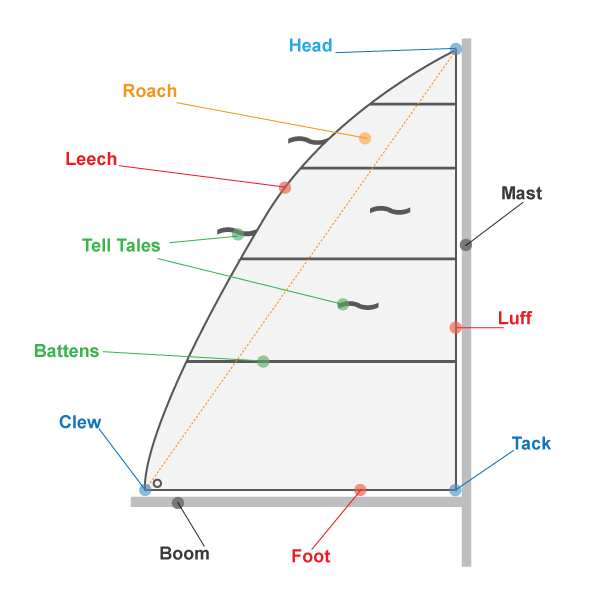
Helpful terms for the uninitiated.


It's hard to see, but there's a white chalk mark to the right of the line representing the original main's leech or aftmost part of the sail.
A welcome addition to this sail is about 20 square feet of extra area. The original sail is clearly a cut-down main from (Ron estimates) a 55 footer. It's very triangular in the sense that the leech is very straightly cut from clew to head. There's a big gap between the current main's leech and the twin backstays I want to fill with roach, and Ron has cut a lovely curve that will give us a little more oomph. More oomph, however, dictates that deeper first reef. The reason I haven't gone with three, as is customary, is due to weight aloft (more reefs equal more weight higher up the sail) and the rather stolid nature of our boat: she needs, most of the time, all the sail she can carry, but when she doesn't, I want to take it easy. As I stated long ago, around the world at four knots is fine by us...if we can get there in one piece, including the main.
More hard to see and confusing lines.
Across the street was Holland Marine, where the bottom paint we favour until we really have the hull blasted and recoated was paid for in full knowledge of the crap Canadian dollar. More to come soon.


2016-02-12

The three-sided garage

Clearly, I may have overthought this.

Winter and hurry up and wait freelance employment give the earthbound sailor time to mull and to ponder various infinities, and many sailors do have philosophical bents. A sailor's boat, however, is a finite space: no matter how large or small, most skippers would prefer more space in which to put more things. The list of tools and spares is long: there's never enough money or space to carry every damn needful thing.  So it's important to plan not only which spares, consumables and tools are brought along, but where they may best be kept and how.
Bloody luxury

The thing is, boats move. I know, I know, this is not readily apparent if one walks the docks of many a Great Lakes yacht club, but it's true. Not to tell anyone how to use their boats, but fair-weather sailors can pack a plastic tool box in the lazarette. This sort of post is not for you.
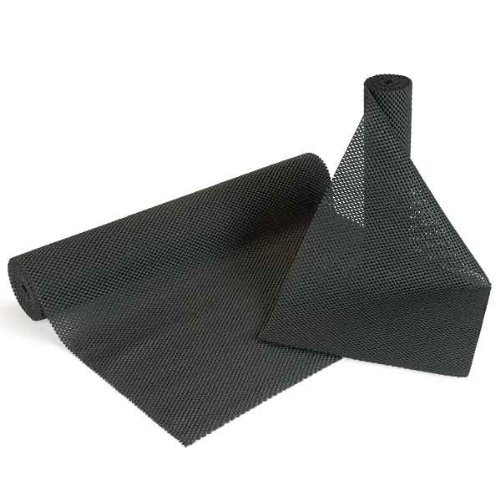
These are simply rust-deterring versions of the sort of mats many aboard use to keep their dishes from moving around the saloon table.
For those for whom tools are essential ballast, movement, particularly of tool metal on tool box metal, is undesirable
This product is used in gun cabinets, but I see no reason it wouldn't work in tool boxes or drawers on boats.

So is the resulting possibility of rust. Mitigating rust is a priority, given that stainless steel tools are very expensive and yet, in certain cases, are not as good as the usual alloys.

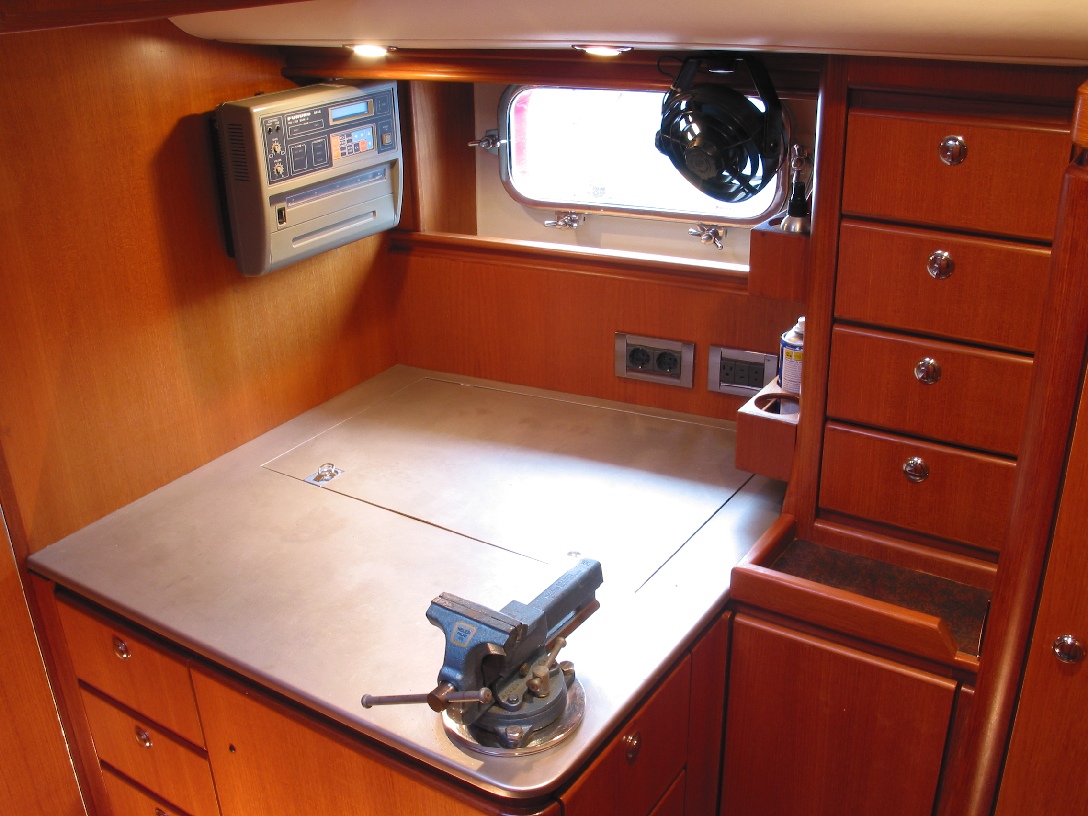
And this sort of workshop is a bit precious for me, if very, very pretty. Photo (c) http://www.yachtmonalisa.com/

Tools, the extensive ones I wish to bring because of delusions of competency and a desire for self-sufficiency, do not move if you stow them in foam insert in lockable drawers in chests throughbolted the steel collision bulkhead, but still, there are considerations. In the photo above, I do not see fiddles nor enough of an overhang to apply clamps, two things I would miss at even a modest heel.
This is more like it: the workshop on a steel Brewer 50 for sale here.
Note how some onboard workshops incorporate clever ideas. The usual sliding door cabinets are pretty standard, but in the photo above, open shelving is angled downward at the rear so that loose objects within, including awkwardly shaped things like what appears to be an assembled Henderson pump, can stay put but accessible unless the boat's heeled so far over that the crew have other pressing concerns than crashing noises coming from forward.
A characteristically Spartan workspace, but not wildly different from what I want, save for the headspace.

Sailing veterans Larry and Lin Pardey were, over the last few decade, about the ultimate in self-sufficiency. Having met them, I can say they are also compact enough that I suspect the modest if incredibly tough boats they lived aboard did not present an issue, but Larry's ingenuity allowed his tools to be stowed both safely and without corrosion.
Caddy-type bags and tool racks are best considered temporary storage. A screwdriver would fret through that quickly at sea.
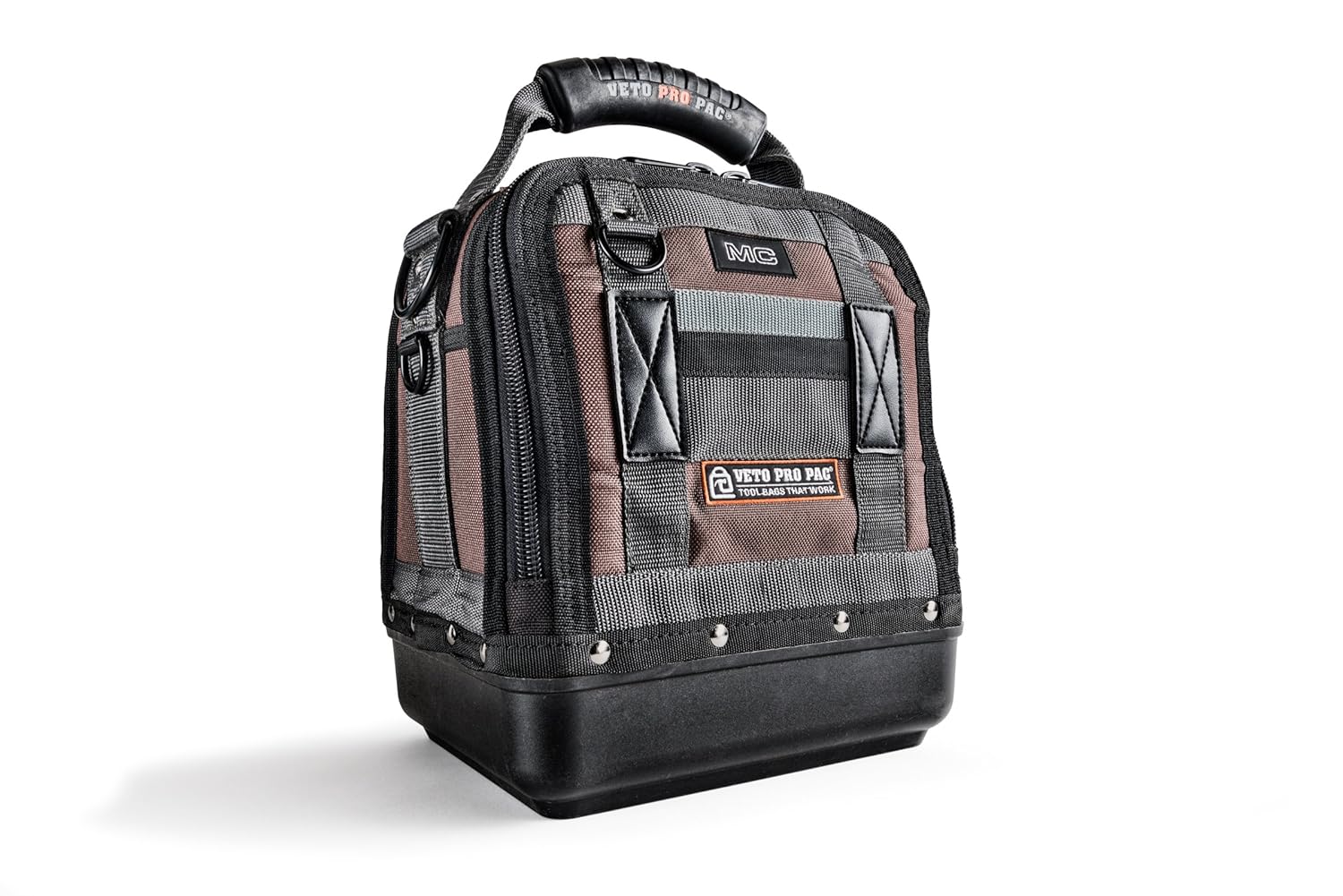
Another solution, or perhaps an additional one, would be compact but tough tool bags. With attachment points, naturally.
I've seen this and various "pegboards" on boats, but they don't inspire confidence as a tool chest does.
Fine for a four-sided garage, but for a forepeak? Not so much.

You do have the typical tool caddy or plastic rank thingies on some boats (see above), but that's just to keep them handy while working. When the job is done, the workbench must be completely clear unless you are clamping something; then the clamps themselves must be lashed down. Because...boats move.
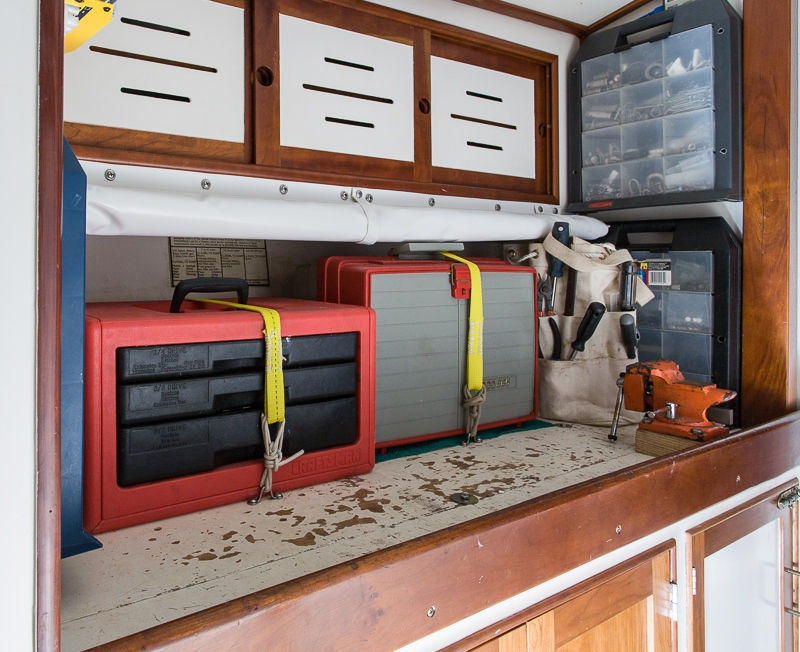
The workbench on Morgan's Cloud: If you want a good tool space to emulate, this is a great picture to mull over.
Above is the workbench area of Morgan's Cloud, a McCurdy and Rhodes 56 foot cutter in aluminum. John and Phyllis Harries, her owners, are fans of high-latitude passagemaking: access to tools and spares is critical aboard a boat that at any given point might be a thousand miles from the nearest SAR facilities, never mind a well-stocked chandlery.

Things I find of note in the picture are the aforementioned heavy fiddle. Not only should this catch most tools and fasteners should the boat give a lurch, it's also a handhold for the person doing the work. Note also the mounted plastic fastener organizers and the toolboxes lashed into place by webbing for storage AND held with eyes screwed into the bench top. That vise is nice, too, and right-sized for repairs...I think at least one of the skippers is left-handed. Jammed into the corner, there is a "ditty bag" of assorted tools suitable for a grab-and-go job and for taking up the mast securely from a lanyard from the bosun's chair. Lastly, there is what appears to be a snap-down cover to keep ongoing projects from taking flight. A nice bench in a tight space that appears to have seen a lot of action.
I think this sort of thing exceeds my skill set, but it's a beautiful piece of kit. (c) Sailing MeVoy
Some sailors, of course, bring woodworking skills to bear. This toolbox above is indeed beautiful and wonderfully well-made, but it's "too beautiful" for me. I prefer metal or plastic boxes for tools, because if I can't keep them coated in CRC or Boeshield or some similar rust-inhibitor, they won't last long or work properly at sea. This implies the possibility of tools staining or marking the trays in which they live, and that would damage a wood tool box.
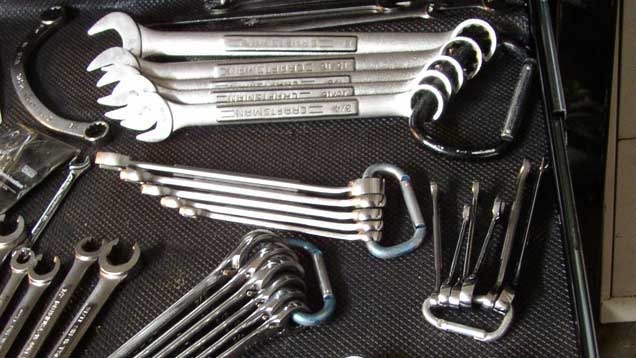
This is better than the foam inserts because of the better use of space and because you usually want more than one wrench.
This sort of organization appeals to me as a good way to store tools in "ranges", as this is more or less the way I sort them currently.
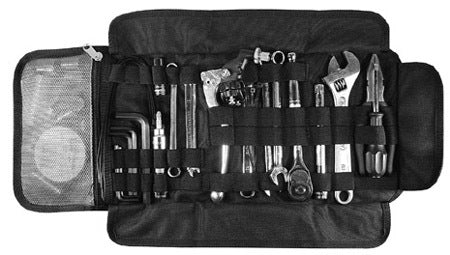
We've got a bigger boat. We're going to need a bigger bag.

Of course, you don't need the traditional tool boxes with loose tools, which could get damaged moving about unless they are packed pretty snugly or with dividers or inserts that won't absorb the salty air. Reader and sailing buddy Jeff Cooper points out that "tool rolls" were once the standard on the old cars he restores and are still a good idea. Compartimentalized bags "open up flat for easy use, [are] well organized and roll up for security and take up less space when stored." An advantage here, I think, is that a sturdy box with a front-mounted lid and a very secure hinge and hasp/staple could hold several of these roll-up tool selections, labelled and perhaps even colour coded for ease of access. The heavy rolls, packed properly, aren't likely to roll and therefore chafe, but the choice of material would, again, have to be non-absorbant of sea air.

These roll-up bags can get quite elaborate.
A "low-buck" choice for stowage of such roll-ups, which a reasonably skilled person could sew up from fabric scraps, as has Low-buck Yacht Club member Eric Van Andel here...


Photo (c) Eric Van Andel
Nice work, there. Photo (c) Eric Van Andel
Like a spring roll in your tool chest. Photo (c) Eric Van Andel
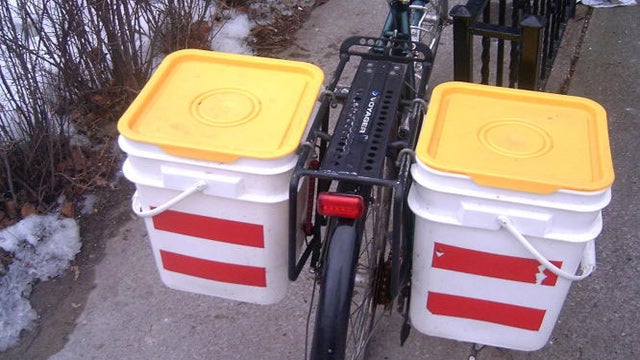
...would be the seven-kilo square kitty litter bins which are very popular on boats, even cat-free boats. Lashed shut and lashed to the boat, they could keep the tools in place and yet keep them from chafing. And they are free for the repurposing.
I'm never this bored, but it does show the versatility of these plastic bins.
If they are durable enough for winter biking, they will probably survive your under-settee stowage space.
The idea of a bike seat in the workshop is a pretty obvious one, I think: it's cheap, it pivots, it is easy to mount to the sole and it keeps my legs well-braced. Best of all, I can move it and stow it if I need to stand or to maneuver inside this space.

Decent lighting in a workshop is important: While I have a 21 inch square steel hatch I can fling open, I would be cautious about doing so in anything but a benign sea. This hatch, which needs a different method of sealing I will discuss in a future post, has a 5 x 12 inch opening port for some light and ventilation, but there are both 12 VDC and 120 VAC runs from the electrical panels to provide "ship's power" lights and enough power to a conventional AC power bar from shore or inverter to run strong lights, and items such as a small vacuum, drills or grinders. The least obvious item in the drawing at the start of this entry is "the chain trug"...more on this later in the year when the windlass is installed! The hatch into the salon is still a "perhaps", but I would love in bad conditions not to have to climb onto deck from this workshop to get back below. Another advantage would be in communicating with the rest of the crew while forward, and to pass items (boom ends? whisker poles?) into the workshop So that's still a question mark, as discussing anything that would put a big square hole into a collision bulkhead should be.

2016-01-27

Unforced mating

As a kid, I built 1/72 scale models of this historic bomber. If you'd told me then that in 2015 I would own a steel sailboat and one of these would have flown over it, I would have laughed. Screencap (c) CBC
I was alerted by a fellow YC member that an episode of the Rick Mercer Report, a CBC comedy show, featured a flight in one of the world's last two flying Lancaster bombers. This World War II stalwart was made here and in Britain in the thousands for the purposes of German urban renewal. Now, I was potty enough about "warbirds" in my callow youth that I recognize the distinctive sound of the four Merlin engines (the same engine that powered the Spitfire) that drag this pristinely restored 100,000 rivets flying in formation through the sky, and as they do their fund-raising flights over my house and my boat, I usually don't miss a chance to look up. This shot captures the moment the Lancaster flew over National Yacht Club in fall of 2015, and yes, I've helpfully pointed to S/V Alchemy, just as metallic, if not...yet...as storied.

Batteries were out on the camera, otherwise I would have zoomed in on the waves splashing the runway. About 25-28 knots, I think.
Back in the bleak midwinter of 2016, the wind was up and a reason to tie off the ladder was clearly evident. The tarp over the pilothouse roof will need replacement, as is the case at least twice each winter, as the wind and the snow tend to shred it. I was aboard because, despite the wind, it was about 4C out, almost balmy for late January, and I wanted to charge the battery and take some measurements. I actually use my electronic calipers (which I bought during a 70% off sale) quite frequently, because of the multiplicity of fasteners and holes and mast measurements I have to take. By the way, the mast slide system from Tides Marine has been ordered and should arrive at the sailmaker's next week.

The aft cabin is not just a radio room, but this is a good start.
Firstly, however, was dealing with my Christmas presents. Mrs. Alchemy finally heeded my long-standing request for a "24 hour clock" and threw in a tide clock as well. They fit nicely and are easily seen from the pilothouse and from the aft cabin. The tide clock, which is admittedly not so useful on the Great Lakes, can nonetheless show "ship's time" or that of the local time zone in which we are sailing, whereas the "ZULUTIME" clock stays on UTC time...all the time. Simple, really! Also, if I ever form a cruiser-based pickup band in the tropics, we're going to be called "ZULUTIME".


Needs a touch-up, definitely.
Now that the engine is (one hopes) reliably situated, I can bolt down the aluminum pilothouse roof to the steel inward flange of the pilothouse itself. The problem is one of dissimilar metals, exacerbated by imperfect painting and the completion of the "circuit". Another reason to do this, of course, is that this roof has a fair number of electrical leads going thorough it of the power and signal variety: fluxgate compass, GPS, overhead lighting, and so on, and while this will be carefully handled, an alu roof electrified and in contact with the steel hull would be A Bad Thing, galvanically speaking. Now, while it's true that the mild steel of the pilothouse and the aluminum are pretty close on the galvanic series, the stainless steel of the fasteners used to hold one to the other are very definitely farther away in said series, and are therefore more likely to trouble the mated metals. So, unmating them is key.

Ignore at your peril if you own a metal boat sailing in a weak electrolyte, such as the ocean is.
I'm doing this mainly through keeping them mechanically separated. One metal will not  touch the other. It starts in the spring with removing the pilothouse roof; now that the mast will be back in place, lifting the pilothouse roof straight up using the boom and the topping lift and a harness should be simple. It's in fact one of the reasons I rigged a Dyneema topping lift: to hoist stuff in and out of the boat easier. The other reason was to use it as an aid, when combined with a tackle, in getting crew overboard back on deck.

The "roof remediation" starts with roof removal. Then the various bolt holes are cleaned out, primed and the whole flange is painted, above and below, with two-part Endura, the current touch-up paint aboard. This takes us to the zero point: there is now paint separating flat steel and aluminum plate. But there's irregularities: the join must be sealed. So here's my idea: Glue three-inch wide strips of quite thin HDPE sheeting (a good insulator) in place over the steel flange. Drill holes from beneath. Insert unthreaded soulder spacers with flanges in the holes; these are also called bushings. Lay down a bead of sealant on the innermost edge of the flange, and lay our old friend butyl tape on the outside. Both sealant and butyl will stand proud of the plastic stand-off strip. Restore the aluminum roof and replace properly sized bolts, nylon washers and nuts through the mated holes and tighten. For those holes tapped directly into the aluminum framing, use Tef-gel or Duralac to isolate the dissimilar metal. Dog down bolts (there's 40 of them) and trim any overflow. None of the stainless steel fasteners should, if I do my work well, be in contact with either the steel or the aluminum, and yet they will all be compressed firmly and will keep everything snugged down. Yesterday was the day I measured all the holes and the (slightly variable) thicknesses of the un-mating surfaces in order to order the proper bushings. It's a glamourous life I lead.
The front of the "lid" has a sturdy flange of plate aluminum underneath into which I expect to rivet or bolt some "eyeline" armatures for screens that can be lowered as needed.
Once the bolting together and sealing part is finished, we can restore the electrical runs, the closed-cell insulation and the rather handsome cherrywood battens and stretches of white masonite that make the restored pilothouse a pleasant place from which to run the boat. So I will remast as soon as I can to get this done before it gets stonking hot in the spring.

Lastly, Valiente's is now on Yachtworld.com. Maybe she's got a future in the States. She's priced to appeal to that particular currency's wielders and it is now, as foretold, in the hands of the broker. I've been asked to elaborate on my painful and boring journey of discovery as it relates to the failure to privately vend a discounted boat; I will consider it after she's sold.

2016-01-22

The winter of some content

Ready, aye, ready. Yes, only 5.5 hours on the meter. It is a sailboat, after all.
 A brief update to prove I haven't been lost in a blizzard or in a salesman's spiel at the almost miserable Toronto International Boat Show. Almost because I attended some interesting lectures conducted by the Shards, Andy Schell and Mia Karlsson, and Lee Chesneau, the 500 mb Guy. I didn't bother to even board the scanty collection of production boats available to see and complain about this year. Usually, I'm up for that, but as I've been watching the build of Robert Perry's latest carbon fibre classic done (in my opinion) correctly on Facebook, I really don't have the time for what an accountant considers fit for purpose and/or seaworthy beyond a sheltered dock.

I did speak to tank fabricators, electronics sellers,  and guys who could make me a companionway door to my design for $2,000-$3,000. So I think I'll try it myself for about a tenth of that. McMaster-Carr, here I come. They also make the nylon bushings I want to reattach my pilothouse roof without dissimilar metal contact. I've also decided on batteries. My goodness, I think I've sussed why I haven't posted much...too busy!
A welcome sight in winter's icy clutches: a fully charged starter battery
Anyway, after yet more excitable, if fruitless, boat showings, I've listed Valiente with a broker. Expect a higher priced listing to emerge shortly, as I've completed the requested paperwork. Is it possible to be distressed emotionally and bored at the same time? So it has proven in this wretched process of selling a beloved first boat.

I've had to take a series of measurements (and I just learned I forgot to take "internal round sail track diameter"....argh...) for the Tides Marine sailtrack project. No pictures; it was too cold and fiddly trying to measure things on a mast rack, but I'm nearly there. The gear will be trans-shipped to Triton Sails in the hopes I can hoist a new, ocean-grade main right after launch.

It turns out that when contemplating Canada's current currency woes, the best thing I could have done in the past was to bank a small pile of U.S. dollars when the Canadian dollar was last worth more. That U.S. dollar Visa will shortly get a workout. Most things to do with boats cost a lot, but a 30% depreciation would sting overmuch. More to come shortly.

2016-01-06

The (hard) sell


PLEASE NOTE: THE VIKING 33 VALIENTE IS NOW BEING SOLD THROUGH BRIDGE YACHTS, A YACHT BROKERAGE. 

PLEASE EXPECT THE NEW PRICE TO REFLECT THIS.

Beautiful, fast and sea-kindly, even in freshwater seas. Photo (c) 2011 Jeff Cooper
This is an unusual post, because it's an edited repeat of my first and apparently ineffectual attempt to sell Valiente, my 1973 Ontario Yachts Viking 33, and is linked to my ongoing Kijiji sales ad, which may not be giving the fullest picture of the boat's qualities and therefore I'm going to repost the Kijiji ad for a few more days until I fling this at a broker at a higher price. So act now and get sailing in the spring! I will help launch the buyer in the spring and will give basic instruction in how to sail her, because she's a very good boat that I wish to see go to a good home, or dock.

Photo (C) 2006 Matt Phillips.
It's been a good run, but it's time to simplify our situation regarding the "one boat surplus".
Centrally located slip, as well. Talk to me, people.

1973 VIKING 33 Hull #32 FOR SALE

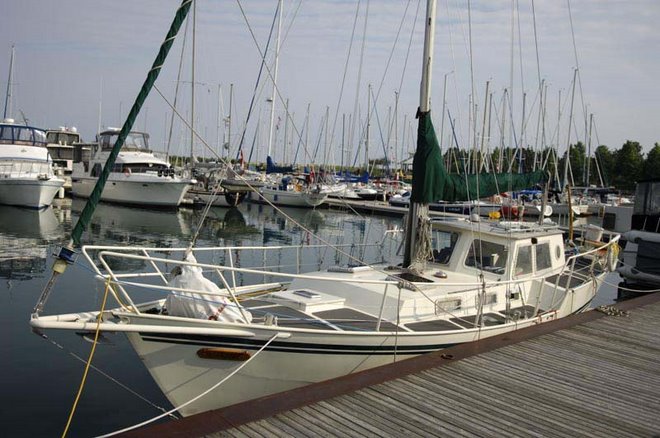
1973 Viking 33 in middle blue. I have owned her since 1999.
Atomic 4 engine rebuilt in 2006. Some 150 hours run time since then.
Stock 35 amp alternator. Coil replaced in 2012. A4 crank included.
Fuel system replaced in 2006. Water-fuel separator and raw basket filter.
Vetus waterlock with 2007 exhaust hose.
10 U.S. gallon Tempo fuel tank with 5/8” vent line, new in 2007.
Whale Gusher manual bilge pump with handle.
Whale Sub 650 electric bilge pump…needs servicing.
Guest 10 amp battery charger; 30 amp shore power circuit.
Traditional stuffing box, repacked 2013.
All original gate valve seacocks replaced with ballcock valves.
30 Imperial gallon holding tank.

And excellent light-air performance.
Custom-built anchor roller adds about 15 inches to length overall (LOA).

A very useful addition.
Slip at Marina Quay West, Toronto is potentially available with the boat. 
2015 cost: About $3,100 for the season.
Gori two-bladed folding prop 11.5 x 8.
I gained about a 1/2 knot when I installed this.
ICOM M-45 VHF radio.
Seafarer III depthfinder (from the '70s, but quite functional!)
Most deck gear backed with custom-installed, quarter-inch aluminum plates.
Custom teak-mounted amidship cleats.
New wiring to batteries, new main battery switch and terminal blocks (2013).
2011 Garhauer triple-block mainsheet, newish 7/16th inch jib sheets and traveller control lines.
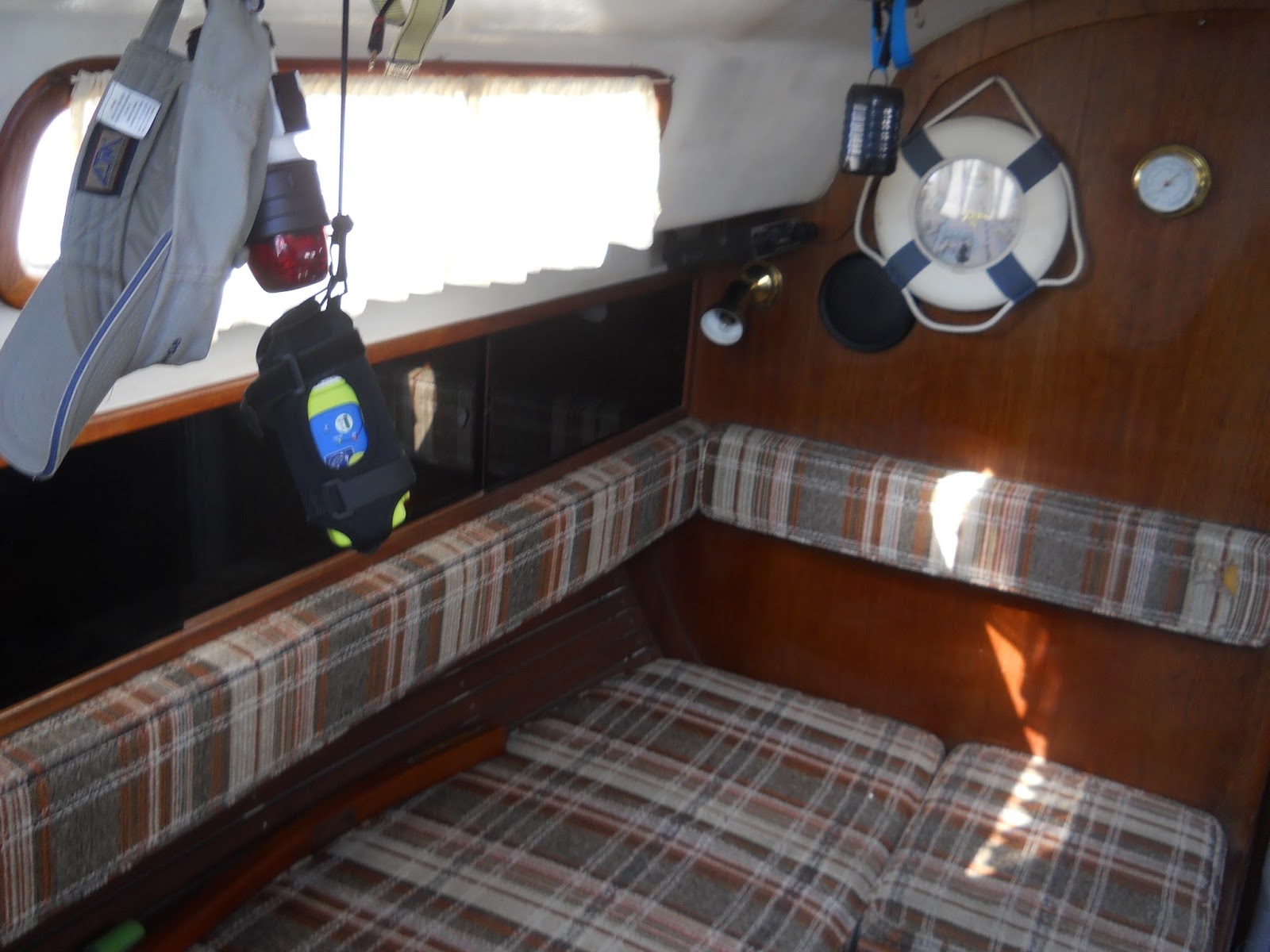
Teak and holly floor, and, alas, original upholstery...sorry, "vintage".

Double berth and all of my stuff is out of there now.
Bright, airy V-berth and hanging locker.

The engine is under this companionway....easy access.
Full navigation station and chart storage area.
Full set of dock lines, plus “away” dock lines.
Danforth 22 lb. anchor and chain and rope rode (approx. 13 feet of chain and 150 feet of line). Hawsepipe opening with SS hinged lid. Barlow 26 primaries and Barlow 20 secondaries, well maintained.

Elbow grease brings back the gelcoat in spring.
I like labels.
New folding boarding ladder 2013.
Run for the boarder.
Electro Systems propane/gas sniffer.
Legal complement of flares and extinguishers.
Two lifesaving rings.
Heaving rope, elderly LifeSling.

Standing rigging (1/4 inch 7 x 19 SS wire) fully replaced in 2013 via Genco Marine, Toronto.
Yes, she's fast.
Extensive sailing and engine spares inventory.
Many spares available. Thorough maintenance logs available.
Force 10 rail barbeque.
Custom light blue fitted cockpit cushions.
Six-pad Marine Cradle Shop cradle. Custom-made Quinte Canvas tarp frame...needs replacement tarp.
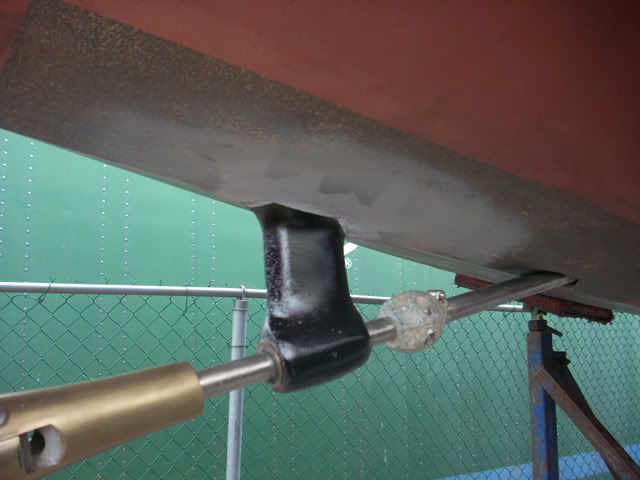
Rudder repair, 2012:
 
This needed a touch of fairing forward of the strut. There was no structural issue or misalignment.
There is a saloon table aboard and a new table support base, but as we don’t use the table, I haven't installed it.
Sails: the main is relatively new Dacron and there are a wide variety of "less old" sails that will come with it. Quite frankly, I've got a lot of sails "in reserve" hanging in my garage. I have things like lightly used Mylar No. 1 and 2s in the garage off a C&C 34 (Aristo out of NYC) that can be converted to hank-on for about $150/sail. I've done this with the Kevlar/Mylar No. 1 and a previous main, but the current composite No. 1 is getting a bit tatty. We carry a No. 1, 2 and 3.
Keel fairing repair, 2010:
Items not included in the sale: Triton asymmetrical chute, foredeck whisker pole, Fortress FX-23 anchor and rode, 10 foot Portabote, and the sailing repair box, the “crash box”, the camp stove and all tools and personal effects. The customary big bag of "make us legal" keyhole foam life vests remain. They make good headrests.
I would also throw in some Atomic 4 spares as I wouldn't be needing them anymore, including extensive documentation, some gaskets, various pumps and belts, the stock alternator and so on.
If the interested party is in Toronto, it may be possible to "inherit" my 30-foot slip at Marina Quay West, which I would think is a big incentive, unless they really want to be in a yacht club.

Price: Deal with the broker or make me a decent offer. "Decent" is probably less than you think.

Ooh, shiny.
The main downsides are the original upholstery, which looks worn and is plaid, and the fact that Valiente needs a redo of the ITT Brydon head, because we essentially just day sail her. So while there's not a lot in the way of amenities...she just sails really well.
Frankly, if I could bag this boat and retrieve it when we return, I would, because I believe it's a really good, fast, strong and capable boat for sailing around the Great Lakes.

Interested parties are welcome to search my blog www.alchemy2009.blogspot.com for posts on "Valiente"; there are records of the many fixes I've made in the last few years, because I've done them on Valiente first before doing them on Alchemy.