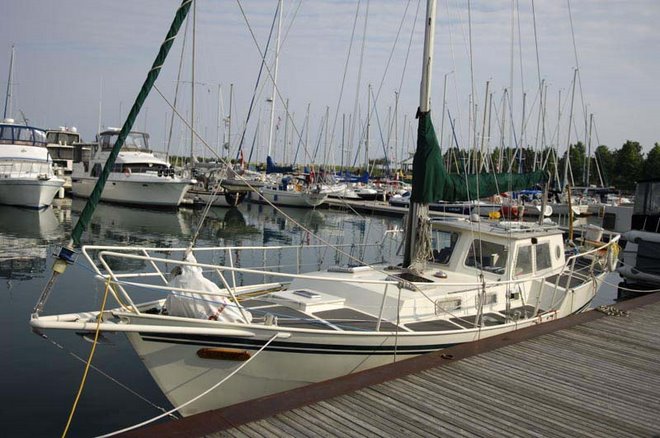
Copyright (c) Marc Dacey/Dark Star Media 2006-2026. Above photo (c) Marc Dacey. Powered by Blogger.

2018-05-05

Powerless (almost)

This is the heavy-gauge extension cord not on the boat. It's powering the fridge...
A short digression on preparing for life aboard was prompted yesterday by a rather strong wind storm (gusts of 60 knots were reported at the lake, and there were perhaps some local downbursts of greater intensity. Intense enough to down large trees across the city, anyway, which led to a large number of discrete power outages.
...which is powered by the dependable Honda 2000, now easily over a decade old and showing the wear and tear of being bicycled for many winters to an otherwise electricity-free boatyard some distance away. Why? To charge batteries on Valiente I enjoyed transporting even less.
Ours started between five and six o'clock Friday; I don't know for sure as I was having a mast-moving-inspired nap, which was broken by Mrs. Alchemy's return from errands shouting "HAVE YOU SEEN THIS WIND?" (I suspect she thought she was still outside). Thinking better of my CanLit-inspired answer of "no, who has seen the wind?", I arose to relative silence: a house without electricity in it is, even to my comparatively aged ears, a quieter place. Save for the honking of the cars negotiating an intersection with dead traffic lights outside, of course. Plus that howling wind.

Wood that it had stood.
Sailorly habits mean we have candles and flashlights to hand and the outage was only the south side, our side, of the street; we had no particular reason to assume it would be long, so we picked up a pizza for dinner and played Settlers of Catan by candlelight. The game's vaguely medieval, so it made sense. But as the hours went by with no restoration, I started to be concerned that the food in the fridge and the chest freezer would defrost or otherwise perish. Other sailorly habits include shopping the grocery flyers, meaning we have food items bought on sale to last a few weeks, and some of which are frozen. So it was time to invoke the generator.
As seen on Kindle.
The Honda 2000 I bought many years ago has yielded stalwart service when I've needed to charge batteries or run a power tool too far from an outlet for even the ridiculous lengths of extension cord we own. This was such a time. Its output is approximately 10 amps on the AC side, with a brief allowance for surges, meaning I could safely alternate fridge and freezer (and charge my son's computer which holds his textbooks) to keep their contents sufficiently cool (the furnace, too, was off, but the house was about 19C).
Wires were gnarled, but that house was missed, luckily.
It worked a charm. I ran it about two hours last night and three hours this morning before going off to do mast work, and when I got home, power had been restored. We did something similar a few years ago after a summer thunderstorm-related outage, and it's been a good reminder that life restricted to 10 amps is more or less daily boat life in some ways, and that being conscious of what life without mains power is like is salutary to a future when sun and wind will keep the batteries, for the most part, topped up. I'd write more, but there's a hot shower to take.

2018-05-03

Mast appeal


At what I estimate is about 220 kilos, this is always a group effort to remove from the mast rack.
As we continue to actually install things in preparation to cast off next year, there are a number of alterations, modifications and fabrications to do or to prepare to do. The mast is getting a few upgrades, for instance, including the replacement of fairly worn-out, if still functional, RG-58 VHF coax for more rugged and less signal-lossy LMR-400-UF coax; this was on the learned advice of fellow sailor Ken Goodings of S/V Silverheels III. The coax will run to a mast-top Metz antenna and also to my new Vesper AIS antenna on a separate run to our new XB-8000 AIS Class B unit. For a nice change, I'm not a total newbie at radio comms; I had a CB radio and SW receiver hobby as a teenager and that's how I learned to solder. I'm sticking with the familiar crimp and solder PL-259 connectors, which I will "skin" with heat shrink tubing at the antenna ends.
It's raining today, so Mrs. Alchemy and I will do the stays and shrouds and untangling tomorrow
So I will have to "fish" the new cable carefully and then solder in the yard. Just out of shot is a light stand with two outlets; once again, my 12 ga. "contractor grade" extension cords will earn their keep as I solder and heat shrink out of doors. In addition to those tasks, I will be tapping threaded holes for the new gimballed radar GPS mount, plus, of course, making a hole in the mast large enough (and smooth enough) to take the radome's cable. There's sufficient slots in the mast base to accommodate all these new cable runs, but it will complicate putting the stick in when that happens.
I was gratified to realize this was a near-perfect fit.
Like many local sailors, I have a few examples of the well-built Blue Performance cockpit and bulkhead storage bags aboard. They've stood the test of time (perhaps because we've kept them essentially below decks) and they are very useful for keeping various bits of equipment in place. The bag pictured above spent a few seasons (well, since it was put in) on the back of the pilothouse helm seat, but this prevented the seat from rotating 360 degrees. So it struck me yesterday that the companionway hatch might work. Did it ever. With a series of drill bits, the torquey Makita, and some cutting oil, I made two holes, tapped them and put in two 1/4" hex head 3/4" bolts in the SS "lip" behind the hinge in the companionway hatch's top flap. I like the fit and I can stow a VHF, a couple of winch handles, sunscreen and maybe a pair of binoculars to hand. Most of the time at sea, this hatch will be secured in the open position; in following seas or moderate rain, the top flap will be open. Only in heavy seas or driving rain will it be fully closed, so this small change will allow us to retrieve a small list of items without leaving the "sailing deck". Nice.

Port side, reporting! (That rust is from grinding, not deck corrosion...). The whole boat needs a good wash after winter.


Speaking of nice, the new transverse exhaust installation is, to my deep satisfaction, working properly (and the boat isn't filling up with stinky water, either). The exhaust "note" has changed slightly, which I'm guessing is a function of the reduced back pressure. I am thinking of putting in an exhaust gas temperature unit with an alarm to warn me if I'm seeing the higher exhaust gas temperatures that would suggest, indirectly and without actually peering over the side, reduced cooling water flow (or that I've sucked a plastic bag into the circuit or thrown a couple of vanes from the impeller). Such a device can also provide data about how hard the engine is working with a given prop pitch, which, having a VariProp, I can remedy in the water.  But for now, I am content with the winter's labours.

Motoring on a heel will tell me more, of course, but for that, I'll need the mast in. Watch this space.
...and the starboard exhaust is exhausting nicely, too.

2018-04-30

Return to the floating world

Still to replace: the cracked shut-off hose under the actual sink. It's complex down there.
Behold the (mostly) completed new galley drain. That four-piece AWAB opposing hose-clamp set-up is the apotheosis of belt-and-suspenders sailing, given that it's a ridiculously short piece of hose...but then I was the one who specified a taller pipe nipple, meaning the PVC elbow and the nipple on the Marelon ball valve very nearly meet in the middle. Oh, well. It didn't leak from there on the day.

Still life with bicycle and boat. Yeah, she's a bit hefty, that boat.
The day in question was Saturday, April 28th, cool, windy and frequently rainy. Sub-par in most respects, save that a big push from Mrs. Alchemy (painting a specialt) and myself (wrenching the same) got the job(s) done.
The bottom paint this year was once again Pettit, but of a delightful Hunter Green not unlike the cove stripe (which also got touched up by my fastidious co-skipper. Next year, we grind back to the bare metal in Nova Scotia, but that's a future post.
The new outlet for the head drain is behind the redone caulking for the forward-looking sonar.
There was a little bit of water ingress from the depth transducer last year, so Mrs. Alchemy took charge of "dissolving the old 5200", a stinky and labourious process, and applying "fast cure". She was more careful inside and out than was possible with last year's rushed (and bloody) process, and nothing is leaking as of yesterday's dockside inspection.
"Fire Escape", owned by a fire chief, naturally.
Unlike previous launch days, the crane position dictated we were to go in quite early, as the second boat in the east yard, shortly after 7 AM. It was calm, however, and not yet raining...
The "sling crews" step from boat to boat to do their work.

That fibreglass hull needs a touch more TLC than ours.
The front row of what we call "The Inner Basin" is full of alarmingly large powerboats: Alchemy is far from being big in such company, although at about 15 tonnes, we are not insignificant.
Sling marks obtained!
The head of hair belongs to the owner of the next boat after us.
Note the "cinch belts" holding the slings in place. This keep the slings from "creeping" up the slope of the keel, as I am never sure if my moving things about in the boat all winter has altered the ideal place on which to put the slings in terms of a level hoist.
People never fail to take a step back at this stage. Note the nice job done on the keel bottom. That plate is 3/4" thick.

You can never have too many fenders for this gig.
The lift this year was quick and efficient; compared to the more methodical haulout process, launch is usually faster.

Putting pennants on moorings in better weather earlier in the week. At launch, it was too wet and busy for photos!
After docking, however, I was crewing on the club workboat and we had the highest number of "splashed with dead motor" cases I can recall...so it was a very busy morning on that boat.
Maybe I should shift the sling marks aft a little bit?
Long morning story short, the engine fired instantly (I had done a static test in the cradle the previous day) and we docked without further incident, although there was slight leaking beneath the new Marelon ball valves that needed a bit of tape to cure, no pun intended. I may have to spin them off next fall and be more generous with the pipe dope. As of yesterday, however, the damp has been banished. We will monitor for further issues. The dual exhaust is also, gratifyingly, dual exhausting, and the engine "note" is slightly changed, suggesting that there is, in fact, reduced back pressure.
The benefits of being (nearly) first in is getting an unobstructed beauty shot.
Next up: Manifesting the radar love and readying the mast with new VHF and AIS runs.

2018-04-21

Exhaustive reasoning, part 2


It's the most wonderful time of the year! Docklines at the ready.
The pins were barely in the steel before I was walking along the reassembled dock to put on my docklines. I've been told that, instead of every previous year when ours was one of the last boat in the water at launch (this year on April 28th), we would be one of the first, thanks to a change in the crane deployments. That means an extra emphasis on being ready to rock off the slings. Or at least, to motor sedately.
The angle is intentional: the waterlift muffler is not on the centreline. Blurriness unintentional.
Behold the stainless steel exhaust circuit shut-off. It's the culmination of a long-planned alteration to Alchemy's diesel exhaust setup, one that (after an appropriate real-life test period) will allow me to get rid of the dreaded anti-siphon loop, which I consider a weak spot in getting water out of the boat, having had them fail on me on two different vessels.
Yes, skipper, there is something called a "flash".  Seen on the right: the anti-siphon valve. Mine's a Vetus.
I got the idea from Dave Gerr's excellent Boat Mechanical Systems Handbook, which I endorse wholeheartedly as Damned Useful. In the picture above can be seen the fibreglass "T-fitting", a short run of exhaust house down to a SS ball valve, and a further length of hose down to the waterlift muffler. Also visible is the anti-siphon circuit, the purpose of which is to keep cooling sea water from backing into the engine once it ceases to use its exhaust to "push" it uphill and out of the boat. Well and good: my diesel is at or below sea level, and is more so on a heel. Water sucked in for cooling purpose via a seacock off the standpipe is perhaps one metre below sea level: anyone who has attempted to hold an inverted bowl full of air in a swimming pool can get a sense of the pressure involved. So the anti-siphon valve, by dissipating this pressure, allows the impeller to send seawater (and the heat it draws from the engine via the heat exchange) out of the boat, combined with the diesel's exhaust. It's why one's boat squirt out the stern, or, in our case, out the side.
Yes, I like to label. This shows the distance of the valve above the waterlift muffler. The top of the valve ball is just about at the waterline level of the boat at zero degree, or "no heel". This means that very little water can accumulate above it without draining to either side of the transverse exhaust.
Problems can occur with this anti-siphon valve, however, and I wanted to avoid complexity. Even though we sail in fresh water, I have had the "plunger and spring" part of the valve corrode and or stick shut and have had exhaust water back into the exhaust manifold, occasioning the dreaded "hydrolock" and extensive repairs and remediation. That's why I wanted to avoid the issue entirely: that's why, noting I already had an unusual starboard side exhaust, decided to go for a two-fer.

The new, port-side exhaust outlet being welded into place.
It got warm.
This involved some fabrication: Stainless steel "nipples", Sch. 80 and grooved to better accept hose-clamped exhaust hose, were welded in port and starboard. All credit to A. Barlow, my welder/fabricator of choice. As mentioned previously, he also did the new galley and head drain nipples in the same, robust form factor.
Back to the bare metal. It won't be the only time: we're having the entire bottom redone in Nova Scotia.

The idea was to dispense with the need for an anti-siphon loop at all. This installation means, in essence, that the area of the exhausts is effectively doubled (there's now two exhaust hoses, not one). This leads to less "back pressure"; the exhaust gases that propel themselves and the cooling water do not have to work as hard to get the mixture off the boat. The absence or negation of the anti-siphon circuit is compensated by the fact that the boat is nearly always heeled to some degree; the downward slope of one exhaust hose leaves the "windward" or "high side" hose open to the atmosphere, which allows the exhaust to exit properly.


That "T" is as high as it can go at present, but if it needs to be higher, I can make a box for it to increase the slope of the exhaust hoses out of the boat via that removable plate. As I've mentioned, I've been thinking of this for some time.
Now, this arrangement is neither common nor written about much, which accounts in part for the delay in implementation. Most sailboats have long hose runs to the stern and while that's fine in terms of function, unless the engine's in the saloon, an anti-siphon loop is essential, but the run is long and the possibility of having following waves flood the exhaust is real.  That's why I took this route and, let's face it, I was already, with a starboard exhaust out one side, conceptually halfway there.
About as neat a "bead" as I can manage in tight quarters.
Tests will follow once launched next week. In the meantime, I've finished the new bilge outlet. This is an above the waterline hole in the boat that takes a plastic fitting. It's bedded outside and in with 5200 Fast Cure sealant, which is the nuclear option for boat glues. But, as Mrs. Alchemy pointed out, one doesn't want the bilge outlet to leak, and so the big gun was brought out.
Recycled copper strapping. I suspect the hot water heater will go in the 'blank space'.
While I was down there, I gave extra support to the bilge pump hose, which is rather cheap and may be replaced before we skitter off the edge of the world.
The PSS "burp line" is better secured now.
In the process of strapping down the exhaust hose and ball valve, I secured the shaft seal's vent line high in the engine bay. It is not, in fact, the recommended two feet above the waterline, but coiled as it is, the water would have to be "extreme" indeed to crawl up that line. I have never seen it more than a few centimetres above the seal itself, in fact. Should this become an issue, however, I can easily raise it significantly higher...and drier.

Just because I often get asked about costs, the four nipples (two drain, two exhaust) cost about C$400; the run of corrugated exhaust hose (about 3.5 metres) was about $180; the AWAB SS 44-51 size hose clamps were about $60 and the stainless steel ball valve and tailpieces were about $230. We will soon learn if this was a wise investment.


2018-04-15

Droning on about drones

Vista enhanced: The view from a drone. Photo still (c) http://www.captaincurran.com/2014/11/how-to-fly-drone-from-your-boat-1.html
Small, reasonably priced, remotely controlled (by either smartphones or dedicated console) camera drones are not just for annoying people and pets in public parks with their high-pitching whining. For the cruiser, they offer some practical advantages...if you can keep them free of the rigging. Not to mention your delicate flesh.

The advantages of the drone aboard the cruiser go quite a bit beyond boat selfies and bringing a bit of local colour to one's passagemaking blog. Some of them can be flown in fairly stiff breezes (although retrieving them can be tricky), and a range of several miles, using drones as "eyes in the sky" could reveal approaching weather or marine traffic, or even, when used as a "virtual crow's nest", reveal potential obstacles, such as wrecks or coral heads, that could ruin an otherwise beautiful lagoon visit.

It's important to note, however, that most drones are limited by their software as to the altitudes to which they can ascend; this is for practical reasons, such as the safety of aircraft, which also restricts drone operators as to where they may be flown at all. At sea, however, and away from land-based air traffic, there are fewer restrictions beyond battery runtime. Even so, a height of 100 metres is significant from sea level and is five to six times higher (and therefore gives a great "height of eye" distance to the observable horizon under fine conditions) than even the view from the top of the typical mast. For instance, our approximately 15 metre tall mast on Alchemy allows me to see an object of sufficient size on the horizon at 13.8 kilometres away; 100 metres of altitude on a drone would allow nearly 36 kilometres. And that's for relatively low objects; a ship of sufficient height could be seen even farther away, and a squall line thousands of metres tall would be obvious even further away and long before those on deck perceived the dark line of it approaching. This interests me, and not just because I've yet to install a lazyjack setup.
Mast steps galore: The smaller one's feet, the smaller the step can be; but the shorter the crew, the closer they'll have to be. Photo (c) Don Street/Cruising World.

In the past, the only way to get this sort of vantage point was by sending up the sharpest-eyed crew on mast steps, which was more convenient than just a bosun's chair alone and arguably safer as the last ones at the mast top gave the crew a place to more or less stand while repairing light fixtures or other mast-top fixtures, or examining standing rigging or freeing a snagged or damaged furler part.

The most esthetically pleasing mast step, as well as the least-likely to snag sails or lines, is the folding type.
But mast steps add weight and complexity aloft and can be expensive to purchase (depending on how many you require, which is a function of leg length and mast height) and laborious to install. (In the link provided, the fasteners are rivnuts, which I use with the solar panels; rivets or tapped machine screws are also possible choices). There's also a concern present in my mind of putting so many holes in one's mast and whether that has a compromising effect on its strength.

I would not hesitate to place a pair of mast steps near the mast top (particularly ones that are simple to fabricate, would be unlikely to snag anything, and would fit my huge feet), because I can see the point of that when combined with that bosun's chair. But installing mast steps all the way up just to get a better view? Perhaps the drone as nav aid makes more sense. Much as AIS complements RADAR, it strikes me that a live feed from a drone ahead of the boat would complement the forward-looking sonar we are already using. 

I think that the most productive use of drones at sea, apart from littering one's blog with stunning aerial shots, would be in noontime approaches to gaps in reef walls to confirm the least-tricky turns and the presence of uncharted coral heads. It was about two years ago that I realized drones were becoming cheaper than a full set of mast steps, and, because they can look directly down from well in front of the bow, are better for spotting keel-threatening hazards. I can easily see when an overlay of GPS co-ordinates and virtual AIS markers could use live drone inputs sent directly to the plotter so the tech-savvy could steer safely in undercharted areas by "live charting". Perhaps someone is already doing this: it seems like the future.

Logically, the most compact drones with the longest ranges and flight durations would be preferable for onboard use, but compact and long flight times don't always appear in the same models. Another consideration is the danger of losing something that costs one thousand dollars or greater into the salty sea; few current drones are capable of water landings (or take-offs or easy COB-style retrieval) and that's also going to restrict their use to fair weather and plenty of on-land practice prior to on-deck snatches) and the ones listed here seem too toy-like (or expensive) to take to sea, or to crash into it.
This is indeed wee. Photo (c) Steve Mitchell/Sailbits.com

Ocean cruising is a niche activity, and drone use during it is a niche of a niche, so word gets out quickly as to what works and what doesn't. A popular drone maker, and not just at sea, is DJI; their Mavic Pro and Phantom models seem to have quite a few fans, and I like how compactly the Mavic model can fold down to the size of a shoe for stowage. In January, I attended a rigging seminar with Andy Schell and Mia Karlsson of 59 North.com and the good ship Isbjörn. Andy and Mia run a popular charter business aboard their Swan 48 and they travel to some seldom-frequented latitudes worthy of shooting in high-definition with their DJI Phantom drone.
The DJI Phantom 4 drone: It's the handles you want to reach for.


After the seminar, which featured quite a lot of cinema-grade footage of Isbjörn underway, I asked Mia about the Phantom's performance parameters. She suggested the "big loops" of the Phantom model seemed superior in terms of safe retrieval; its maneuverability, being a larger drone, made it easier to control. I was surprised to learn that the drone could be flown easily at 15 knots apparent wind speed, although Mia suggested this was a big power drain and made retrieval increasingly difficult. 

There's plenty to consider before we ante up for a drone, but I think before we leave, I will have it sorted out for consideration as another useful tool in the navigational armoury. After all, if it's good enough for Paul and Sheryl Shard, who am I to disagree?

2018-04-14

Fame, spares and the Great River

Unless one is moving house, you can never have enough spares. OR CAN YOU?
The above assortment of Atomic 4 parts, surplus to my needs and to my garage as I no longer own a boat with an Atomic 4, and we've sold the house and the garage with it, recently left the premises in a mutually agreeable exchange. The buyer saw my ad in Kijiji and an identical notice in my club's buy-and-sell section got a few nibbles but this one actually showed up. I've sold Atomic 4 parts before, including a working rebuilt block and a good-condition oil pan..and there's still more to come...but the approaching move has underlined the fact that we have Too Much Stuff. A large percentage of this are Boat and Boat-related Odds and Ends.

Decommissioning possessions, however, is tricky. We are moving in stages: we will attempt to rent an apartment or condo locally so our son can finish school and I can continue unimpeded (save by my own levels of competency) to make Alchemy livable. I am loth to sell off or reallocate tools, but the facts are stark: I have a lot of duplication between the boat and the garage, because I haven't been keen, for instance, on lugging entire socket sets back and forth. Ever dropped a socket set while descending a boat ladder...in winter? I have. Two hundred bucks to avoid it by buying a second set for the mancave seems cheap.

Now, the process of selling boat gear is complex due to the valuation. A 40-year-old carb for an engine that hasn't been made since Pierre Trudeau was last prime minister is either junk or gold, depending on who needs it. But Lake Ontario still has a few thousand of these engines in equally venerable, freshwater-only boats: it would be stupid to repower most of them with modern diesels when the gas inboard is still reliable. So the trick is to put out the word and to be flexible on price. My fellow boaters are resigned to certain levels of expense involving the word "marine" (as, alas, am I), but everyone likes a bargain. Price to move unless you want to carry it to the next shack. I have a friend who does vintage car parts for a living and is basically in "continuous auction mode" for the very limited number of people on Earth who need the obscure things he sells. He says I should sell and keep selling. I think he's got a point.

Boats are finite in carrying capacity, although we have, with a steel full keeler, more stowage than most. Every kilo carried, however, slows the vessel down if only by a tiny fraction; every metal object on board is a potential projectile if not secured and a locus of rust if not protected. Unless one sails in a TARDIS, one must choose wisely which spares and tools to bring. Equally true is that most boaters should review what they've hoarded, or scavenged, or bought and never used, or used once and never again, and critically think if it would be better in the hands of others than on a blockaded shelf in the garage. Or in a sail bag hooked to the ceiling. Rum's not getting cheaper, after all, nor are boat interiors getting bigger.
Speaking of which, this genuine CQR is for sale.
As is this 27 lbs. "Kingston" CQR knock-off. Drop me a line.

So, the garage mining proceeds. Interestingly, the buyer of the first lot has a number of boat restoration and fixing projects on the go, and already knew of me as a long-time reader of the blog. He knew I was moving, for instance. While this isn't the first time I've met in real life blog followers, and with the number of "hits" approaching one-quarter million, odds are good I'll continue to do so, it's still a touch disconcerting. When we actually depart, I will rejig the blog and add a great deal more visual content as we start going to interesting places; perhaps by that point, I will be more accustomed to having strangers know things about me because I've posted them online...I am more surprised than I should be, I suppose.

And by way of the rather obscure post title, my family is watching 20-year-old episodes of Star Trek: Deep Space Nine on DVD. Our son, who is 16, hasn't seen them and is enjoying them; we've half-forgotten many episodes and are equally entertained. The one we saw last night was this one, and "the great material continuum" referred to a mercantilist philosophy of having discrepancies between having and wanting, i.e., the basis of commerce. Besides, as a person who went to his first Star Trek convention as a teenager in the 1970s, any excuse to wed Trek and sailing will do.


2018-04-07

Surveying the risks


"Non-compliant": yes, we know. We haven't used it since shortly after getting the boat. Probably is empty. Photo (c) Peter McGuire, Fastnet Yacht Surveys.

Had a survey for insurance purposes last Sunday, something our insurers haven't asked us to obtain  A couple of things we knew (Mrs. Alchemy was present as a learning opportunity), such as the superannuated propane tank and the propane hose that needs replacement after 10 years, and that the inline filter for the air condition seawater circuit was not ABYC-approved. Both are easily fixed, and the last one can find a use for a salvaged little Perko-type strainer I already have stowed.

It's an Octopus, but not the breaded kind.

We also know we need an isolation transformer. It's on the list. What I didn't know or noticed was that the hydraulic hose going to the pilothouse helm pump is starting to "sweat", meaning Its Time Has Come. As I am planning on installing a hydraulic autopilot this summer, I think I'll buy the replacement and the "new" hose and fittings at the same time. Still unsure of which autopilot brain box I'll install, but I'm leaning toward this. And this display. While we intend as a matter of course (nav pun) to steer to a heading, rather than to a waypoint, so as to reveal set, drift and leeway, etc., we are going to preserve the option of interfacing with the existing plotter. But mainly, it's about robustness.

So is risk assessment. A lot of decisions on the boat are driven less by what we think we can "get away with" and more by "if we do these things and follow these practices, we will lower our chances of catastrophe". That's more than wishful or magical thinking, it's prudent seamanship, which is something even a land lubber can practise. We try to follow the precepts of "renovate, repair, and, if possible, improve". It's why the failed Schedule 40 galvanized steel pipe nipples topped with bronze ball valves have been replaced with Schedule 80 (beefier) stainless steel pipe nipples with Marelon ball valves.
Before...
And after...still to do, the reconnection to the respective drains.
Was I always this cautious? No, but near-sinkings and hanging from tethers over a wild sea will sharpen one's sense of the transitory nature of life and boats, and suddenly backflow preventers and gas sniffers seem like sound investments. This was brought home to me, again, just 12 hours ago.
You'd be melancholy, too.

This fine old fellow is "Doba". How he ended up on our ratty couch at 0300h is a cautionary tale. Doba is an elderly Dogo Argentino, a large breed of hunting dog, allegedly, but he is possibly the mildest-mannered beast I've ever encountered..."big suck" only approaches his degree of stolid amiability. Last night, circa 2 AM, I was fighting with a reinstallation of Google Earth when I heard barking and shouting from the street. Now, as we live way downtown; sonic shenanigans of this sort are not unusual of a Friday evening. I would have ignored it and turned in had I not heard the loud arrival of a police car, followed by that of the first of many fire engines.

One of the rowhouses across the street was on fire. Which one was not immediately clear, but I could see loads of smoke from my second-floor window and, briefly, flames curling up above the roofline. I woke the missus and went outside. Sure enough, Doba's owner, Paul, one of the two tenants in the building, and Franco, the building's owner, were on the street, with Franco clearly in shock. The speed with which the place had burnt was alarming: the second, top floor was effectively burnt out, but the four fire trucks on scene had knocked it down rapidly.

Turns out Franco on the top floor had left a cigarette burning on an ashtray that may or may not have been on the bed while he went to the bathroom. The bed caught fire and then the room caught fire. Everyone got out, save one of two cats (we've just learned that Cat Two was found) but I suspect the building is effectively condemned. Or so it looks.

We learned from Paul that Franco has had a loose relationship with risk management: while he owned the property outright, he carried no home insurance (unmortgaged houses are not, in fact, obliged to do this, which was news to me...and to our real-estate agent). He also had, as is required by law in our province and presumably in others, no smoke/fire detectors on each floor. Whether this would have helped is unclear, but it might have been possible to put out a smouldering bedding fire before it really took off had an alarm sounded. The house was from 1890 and that dry hemlock wrapped in horsehair was like an oil-lamp wick, unfortunately.

We loaned Paul and the basement tenant a couple of coats and had them in for tea and brandy. When the "warming bus" arrived, we offered to take Doba overnight. He did whine a bit, understandably, but he settled on the couch to sleep and was otherwise the perfect guest. Around 10:30 AM this morning, Paul came by to pick him up to shed elsewhere. I wish them good luck. They'll need it.


I relate this tale not to point blame at Franco or at any home or boat owner with a non-rigorous approach, but to illustrate that three people now homeless (plus three pets, including the vast Doba) and, probably, with a few hundred items destroyed or damaged possessions, might have avoided this outcome with some pretty basic forethought. What the surveyor pointed out by way of needing attention needs attention (although my insurance company took this year's cheque without complaint), but a shortage of alarms and extinguishers aboard weren't among the remedial aspects covered. Same with the house: we had tenants for years and there's smoke detectors on every floor with a CO detector next to the furnace, plus more fire extinguishers than are required in various potential problem spots. We have full house insurance, including coverage should I be unable to work from home, as it's my usual spot. These things are stated not to seem smug, but to indicate habits of mind. I have commented in the past (and recent events in the sailing world have kept it top-of-mind) how viewing the universe as more or less indifferent to one's well-being seems realistic, as do clear-eyed assessments of risk in one's environment, particularly that of the sea on small boats. There are parallels to small houses on land. You may think because you've never screwed up, you are an expert at something. This may be the wrong approach.

Prudence only looks like paranoia to the unprepared.

2018-03-24

Regrets and boat sales

One way to get it done. Photo (c) Yachtworld

"That's simply ridiculous when man with minimum education tells me that he's market expert (for example). Rip-off expert - I would believe so."
The above quote is from a recent Cruiser's Forum post in which an individual objected to being "pestered" by a broker with high-ball offers he judged, possessing the infinite wisdom of these sort of internet forum participants, unrealistic. There is a case to be made that apple polishing exists at the offshore end of the boat-selling spectrum, the potential passagemaking boat buyer needs to exercise some common sense about how worn boats at sea for years obviously can get.

You'd have to have been confined to a brig or live under a bridge not to realize how collapsed the market is for used boats, save at the nosebleed altitude of mega-yachts, and even those aren't commanding "oligarch" prices these days. Why would they? They are too numerous and it's cheaper to impress the people you want to have sex with on land.

I did find the obtuseness of the poster, however, interesting. He was simultaneously complaining that a broker he had approached for advice was pitching him boats, because he knew the prices were too high and resented the pitches. His contempt for the brokerage trade was not confined.

Brokers have a legitimate job in the ecosystem of the acquisition of boats, and, like used car sales folk, they are widely despised for it. But I'm not sure why the hate exists. The onus is on the buyer to ask for recent surveys, or, if the money involved or the lack of expertise on the buyer's side suggest it, to hire a purchase survey. The opportunities for getting ripped off are limited when reasonable boats in reasonable condition outnumber potential buyers. The broker, however, can be a useful filter in this process, but, in the era of Craigslist, Kijiji and other DIY operations, not a necessary one. But that is not their fault nor their concern.

The potential buyer can be correct about not needing a broker but can also be indifferent to their existence. And there is more than one way to sell or buy a boat, with variable levels of formality and agency. As an example, we just sold our house. I worked in concert with the realtor to show the place to ONLY developers, renovators, investment property buyers, and people who already owned houses in the area: in other words, to people who saw the place in context, didn't care that the paint was old and the floors needed sanding and that some of the improvements were visible through holes cut in the ceiling. That doesn't matter when you already know you are going to gut the place. It would be like putting on full makeup prior to having plastic surgery. So we didn't. I kept my old boat clean and gave it a cursory topsides buff, but I didn't, by a similar logic, pretend it wasn't 43 years old.

We avoided a general listing with the house. We showed it about a dozen times over five months. No "fluffing", no $25K "staging" or "white boxing": just a sign out front with the "Exclusive" label on it.

We named a fair price. We got that fair price. We paid a fraction of the usual commission. The tactic and the price was based on my extensive research of the 20 nearby houses that had changed hands in the last 36 months.

I mention these aspects because houses and boats sell according to similar agent/broker models, but those models are variable...if you, the buyer or seller, so request. If you don't like the game, change the rules. If you don't like the game with changed rules, don't play the game. I see non-garbage boats on Kijiji I would jump on, if I didn't already have a boat and if I knew anyone who wanted a boat...but, of course, I don't. If you're not paying a broker's cut because you resent broker's cuts, you can keep a surveyor on speed dial. Apart from the price used boats command, selling and buying one outside of the former paradigm is, like so many other fiscal activities in our brave new world, largely frictionless. That said, I can't blame a hungry and probably depressed broker for trolling any name they have. Neither should any buyer or potential buyer. After all, you may want to sell your boat someday, and, unlike an algorithm, a broker may not be interested in your custom at any price.

I had my first boat with a broker for 18 months. We showed it about 25 times. Not a single offer. A guy in my club offered me half of what I'd listed it for, no survey, all cash. I see my good old boat sailing off the mooring regularly. I have no regrets, save I'll never get those 25 showings' worth of time back. And that includes the hard and generally (in my experience) honest work brokers supply.