Copyright (c) Marc Dacey/Dark Star Media 2006-2026. Above photo (c) Marc Dacey. Powered by Blogger.

2014-05-22

Finally, a little sailing

Completely unrelated to this post, but this 1973 Spencer 53 pilothouse ketch visiting NYC last Saturday  was so nice I had to include it. Thanks to Whitby YC-based owners Dave and Sherry for letting me crawl over her.
 While I am becoming more comfortable with the idea of selling Valiente, it doesn't mean the process of parting means I've given up sailing her. Over the last long weekend (May 18th), I took the family out for the inaugural messing about.

Fantome: looking good for older than Joan Rivers.
The air was mournful angels' farts in the Inner Harbour, so we hoisted full main and the No. 1, a relatively rare event unless we are trying to get somewhere as it's vast and wants precise folding. We found more wind (like 9 knots AWS!) in the Eastern Gap. We also found our club's "Around the Island Race", which was more of a drift, really.

We gave way as we weren't racing, and realistically, at 40 feet LOA, and a honking great mast, they are probably the faster boat in any airs.
And away! Note the 10 cm. swell.
So we had some fun avoiding them while trying to find chunks of moving air. As a former, or rather rare, racer, I appreciate that "giving other boats your dirty air" is just poor form, so I stayed to the lee of every boat I could.

Old sails, sure, but still capable of getting the job done.
I had sewn in some battens the previous day, the zippered batten pockets being a little worn, and had also tucked in a few telltales on the leach. Or "leech", as some would have it, although I think a leech would die of hunger on the trailing edge of a main sail.
Mrs. Alchemy in her role as Mrs. Valiente. Note the flaked-down tails. One must be tidy, one must.
While the winds only sporadically freshened to the point where we actually approached five knots SOG, it was a decent day and the rain mostly held off. I resisted the surprisingly strong urge to pull a Dave Rogers and to chuck off a fender while murmuring "man overboard..." Next time, perhaps.

It was a "one-telltale" sort of breeze. And yes, I should have reefing rigged, I suppose, but I only reef above 30 knots, a probably bad habit.
The engine seems fine, which is always gratifying as I am its only mechanic. Despite the replacement of the little spring in the "little spring and ball oil pressurization mechanism", I still get a drop from cold oil at 60 PSI to warm oil at 25 PSI, so I might switch to straight 30W instead of 10W30...assuming I can find it. It's a minor issue and could be related to elderly meter calibration. The engine itself hovers after 10 minutes at its usual 165F, which is as high as is likely in this still-cold lake water. She starts on first turn of the key with full choke, which can be eased back to full lean after about 10 seconds of running. The tune-up and my cleaning of the spark plugs (RJ12YCs gapped to .040) seems to be doing some good. Only 140 hours running since rebuild in 2006, so I want to actually get through an entire 10 gallons of gasoline this year if only to have all fresh gas aboard.

Nice greeting-card vista, but the sailor sees wind under that darker bit. The rain is the price of the wind.
Even the ever-sleepy Wonder Lad ("it's puberty, Dad: I have to save energy to grow!) got into the act with helpful foredeckery and watchkeeping.

Clearly, back in the doldrums.
A fun day and a good start to perhaps the last season we'll have with the 33-footer. More to come on this when I rig out a proper advertisement.

2014-05-14

Putting the squeeze on retail

I don't live in a small country. It's the second-largest on Earth. Its population, however, is similar to California's, and so "consumer options" are, to a certain extent, limited compared to our 10-times-larger neighbour to the south.
Handy, but, apparently, a touch tricky.
This comes into play in the field of boat gear, which, due to reasons of low demand and fairly demanding manufacturing tolerances for weight, non-corrosivity and occasionally specialized uses, is never going to be a cheap pursuit. The joke goes that the prefix of "marine" means "multiply cost by three", and this is in fact sometimes optimistic. Could be worse; could be Australia or New Zealand, where I understand that the exchange rates, the distances, the low populations and the fact that there are few other choices that don't involve import duties combine to make most boat-related things expensive.
Boat restoration sometimes demands single-purpose tools: you should see my prop puller (which can also remove transmission tailpieces, thank goodness)

So I wanted more Powerpole connectors as there's a lot of electrical work ahead of me on Alchemy. Using even my decent Ancor crimper on the little silver connectors at the heart of the Powerpole pieces wasn't working well, so I decided to order, along with a fresh batch of connectors and connector housings (I've wrecked connectors, but no housings, yet), the recommended specialty crimper. The fact that I have a U.S. dollar VISA and didn't require the items immediately made ordering online from the States a no-brainer; while I know (and originally bought my first batch of Anderson connectors) from a perfectly professional Canadian radio shop, it's a distant and uphill bike ride, and their prices reflect, as is typical, the "Canadian markup" to which I'm become sadly accustomed.

Even though I express my Scottish genes when it comes to extracting value from my transactions, I'm not neurotic about it. My wife works part-time at a decent chandlery, after all, and I certainly patronize them and the other local shops (save West Marine, which has little I want) for things I need quickly or which make no sense (like exhaust hose) to order "foreign". Shipping charges and delay factor, of course, into these decisions, but in general, because I usually get free advice in addition to the products purchased, I try to patronize local marine retailers.

But that's not always logical or possible. The Powerpoles are one example; they aren't specifically boaty, and are most closely associated with amateur radio folk. It took me some research to even find them in that realm at the retail level in Toronto; ask for them in the biggest Home Depot and you'll get a blank stare. Even electrical contractor places haven't heard of them, and give the impression they would prefer you got your non-contractor backside out of their shop so they can help the guy with the 15-kilo toolbelt behind you.

That said, I did not expect to go on a retail odyssey yesterday in search of a battery cable crimp tool.  The saga started with the redoubtable "Maine Sail" and his excellent and previously cited primer on making one's own battery cables. His recommendations regarding both gear and technique have yet to steer me wrong, and feelings of child-like devotion illumine my otherwise barnacled spirit whenever I read his screeds on The Right Way to Do Things on a Boat. And he liketh not the "hammer crimper", nor the insufficiently beefy "starter lug". He does liketh the Heavy Duty Power Lug and the FTZ Industries Heavy Duty Non-Ratcheting Crimp Tool. And it was good.
And lo, across the land, even unto the Great Satan, it was out of stock. And low-res.
And if you are moved to read his thoughts, you may concur with me that the man is onto something, and that if you are looking at a few dozen crimps to make a whack of short, thick cables so that the batteries will stay cool and the amps will flow unimpeded, a good, cold-formed crimp is the way to go.

Cold-forming: the copper has been crushed to form a solid mass that is largely moisture-resistant, meaning less resistance electrically. This is actually stranded wire compressed by a hydraulic crimper, one step beyond what I require.
So I started Googling and, having Googled somewhat in vain, for the crimper in question seems to be out of stock everywhere in the States, including the place Maine Sail suggested, I phoned the factory in South Carolina where the crimper is made and asked if they had Canadian distribution. They had, and I phoned them (not, thankfully, long distance). They distributed to a number of contractor-grade places, and, as far as they knew, I could order from the Torbram Electrical Supply outlet on Spadina Avenue, just north of Front.

If not next door, more or less in the direction of the water.
Huzzah! So off I pedalled, as is my wont, and spoke to a nice fellow behind a distinctly industrial-grade counter surrounded by the paraphernalia of the electrical trades. He scowled at my Techspan reference numbers and went off to make a series of phone calls to them. Emails were exchanged. Images of crimpers were sent to and fro, especially as, after the first hour, I insisted on putting "FTZ Industries Heavy Duty Crimp Tool" into Google and hitting "images". Well, it turned out that despite being the FTZ distributor in Canada, Techspan had every crimper BUT the one I wanted. Some seriously weird clamping stuff, including devices suitable for a giant's bris. This was after an hour of hovering around a room with all the ambience of the liquor stores of my youth.
This is actually from 1970 Manitoba, but Ontario's governmental boozers looked much the shame.
Mission: unaccomplished. Time: wasted. After a briefer time working aboard than I had--HA!--planned, I went home and went online. Within minutes, I had found a place in the States...where, I know not, but it's in area code 208...that offers the item I couldn't get in a city of five million. U.S. buck Visa in hand, I ordered it to be delivered to my club. Sorry, retail: I tried, but you and your disparate SKUs and part numbers and suspect inventory control drove me online. I just wanted to support you!

Now, here's where my own countrymen, despite a rep (not entirely deserved in my experience) for civility and politeness, fall down. I placed the U.S. order last night around 1800h. While I've been writing this, around 1230h the next day, I've received a call from a nice fellow named Chad, apologizing that BargainBoatParts does not in fact have the crimper in stock, and that he's been on the phone to FTZ Industries and the delay would be some two weeks, plus five days for delivery...and would that be all right?

Yes, Chad, that's fine. Particularly given I now know you are in freakin' Idaho, a long way from water. I haven't bought the cable or the batteries yet, and the Power Lugs might now extend my original order, because you've proven you want the business of a single boat restorer. U.S. firms seem to grasp on the importance of keeping even "little" customers happy, and I was gratified to experience this mysterious "customer service" of which I've heard so much. And given that every other places was out of the Must-Have Lug Crimper of the Season, I wasn't entirely surprised to hear of the delay. I was surprised to hear of it via a personal phone call. As for retail, even in my big city, sometimes it's just better to shop other than in person, I guess.

UPDATE 14.05.21: The Powerpole gear arrived today, and the crimper appears reassuringly hefty. Will start making up test leads shortly.

2014-05-05

Wrenching decisions, or torquing about a revolution

The phenomenon of tool lust is a side-effect of boat restoration.

Now that I've got your attention, it's important to acknowledge that I went about 35 years with only a small collection of multi-head screwdrivers, a hammer and a crescent wrench to show my manlier side outside of the actual bedroom. I didn't have a particularly handy father, despite his early years in a hands-on trade, and I didn't take more than one year of what used to be called "Industrial Arts" and now is called "Advanced Tweeting for Do You Want Fries with That".

Then I bought an old house.

Then I bought an old boat.

Clearly, I needed to step up my game. I got old books describing the function and non-maiming use of the various classes of tool, the sort of books with the words "Home Handyman", "Mechanics' Institute" and "Reader's Digest" on the spines. I slowly expanded my collection of tools, fasteners, and many, many bits and pieces. I learned to braze copper pipe, to rivet, to solder, to bed and to scarf. My efforts are rarely beautiful, but considering I've been seriously using tools for more than "just fix it until the man (or occasionally, the woman) can come and do it properly", which was the case some 15 years back, my "fixes" usually remain intact.

Tools have been acquired through inheritance, Craigslist, and sales at Canadian Tire. The wooden boxes of hand tools once the pride of dead grandfathers, including very rugged near-museum pieces, have been sourced for a pittance at yard sales.  Strategic chunks of cash have been laid out for "proper" contractor-grade power tools, as I have learned the hard way that while you can pay very little several times, if reliably long service is the goal, paying more just once is the best policy.

It's probably been because of my self-consciousness at having no formal handyman/boat restorer skills that I try to be careful and methodical. My hands bear evidence of moments lacking in attentional rigour, but generally, it's been a stepwise progression.

Everyone these days owns a diesel, but it turns out that if you motor for 10 minutes and go head-to-wind, a reliable gas engine makes more sense. But sailboats aren't about sense, usually.

A couple of years ago, I was asked to diagnose a problem with an Atomic 4 inboard. I freely admit I blew up, figuratively speaking, my first one in 1999, but the resulting time fixing my novice mistakes gave me some useful tips. So now I try to pay it forward with said tips, particularly as there are still a lot of boats with these venerable 1940s-looking motors in them, including Valiente. Now, Atomic 4s were, from approximately the 1950s to the early 1980s, the sailboat engine of choice in the 27-35 foot range. In fact, they were so very nearly ubiquitous, that one can buy a new one, or at least a new cast block, just as you can buy a new Twin Otter if you wish.

Back from the dead, or the 1960s, if you prefer.

Some things, despite the age and often because of the simplicity of their design, endure. This includes hand tools, of which I now possess an inordinate number, if "three more or less complete sets" may be considered inordinate. These are distributed as follows: 1) Old house, 2) Old boat, and 3) Less old boat, and the locus of the more specialized objects of toolish desire.

Torque, torque, torque...CLICK. Good.
This is a torque wrench. I did not, until the weekend past manifested a Canadian Tire sale awaited with the sorts of patience a vulture shows an impala with an infected hoof, possess such a purposeful tool. I did have a beam torque wrench, which looks like this and was sufficient for dogging down the head bolts on my Atomic 4 (to 35 ft/lbs., if anyone's still reading), but during the installation of the AquaDrive last year, buddy Capt. Matt of S/V Creeation fame whipped his out and I admired the Teutonic precision of the dialled-in torquing values.
The beam-style torque wrench, as favoured by mechanics with cataracts, evidently.
The fact that it's considered "idiot-proof" is just a bonus, although I suspect I'm supposed to be insulted. No such luck!

A "breaker bar". Why it isn't just a "really big non-racheting wrench thing" remains a mystery.
I also have picked up at deep discount such related items as fully unmetered breaker bars. These use leverage to "unseize" lug nuts (or engine mounts) sufficiently to switch to racheting wrenches, which might suffer damage to their racheting internals if one, say, steps on them to "get that nut loose". Oh, the places you'll go! Anyway, I like it as it is a Serious Tool.

What a thrill/'Tis to drill/And make fresh perforations...
Another tool of little humour that I have wanted for some time, but the cost of which I have not been able to justify, is a smallish drill press. I've grown accustomed to using my boat club's one (we have a fairly nicely equipped workshop), but I can see a lot of use for it aboard, particularly in the context of welding, die-cutting and forming backing plates and the like out of metal "stock". A drill press is usually slower-moving (and therefore more controllable and easier to clean out as it cuts) and clamps and the moving work plate (the circular thingie with the perforations) allow a lot of fine movements, unlike a hand drill. I was fortunate to have a friend who is selling his house and going condo; he has neither room nor need for his, and I'm giving it a new home...and maybe taking it on a long sea voyage. We'll see.

Yes, I will clean the topsides...at some point.
Enough tool talk: the point of tools is repair, and this was the scene this morning (cool, foofy wind, high cloud), a repaired and charged Valiente ready (two weeks after I last had the time and co-operative weather) for her 41st season.

Grubby, but functional.
I was gratified (particularly as I was alone once the boat was splashed) that the Atomic 4 engine I dote upon started "at first crank", and that the oil pressure and water throughput and the quality of the now-elderly gasoline I stabilized last fall were sufficient to get me the 20-minute putt-putt to my "other" dock at Marina Quay West. Which is, to mention in passing, so bereft of boats in docks that I have to wonder if the winter we've had actually killed some sailors as well as delaying myriad launches. I consider May 5 to be appallingly deferred a date to start the season, but the boatyard in which Valiente overwintered was still about 85% full, and some of the boats were still "buttoned down" with shrinkwrap and tarps, as if they have yet to have been visited by their frost-struck owners.
Coiled for your pleasure.
So after a mercifully uneventful transit, I met up with dock neighbour and good friend Jeff, and he and If went for a first sail in his new-to-him early 2000s Dufour 36 Classic, which is a very civilized ride and which I suspect will provide Jeff many years of happy sailing. The wind was light and cool and didn't want to come down to the water, and some of the strings and pulleys were so logical as to prove confusing, but it's a sweet boat and one of the cleanest and newest-looking used sailboats I've ever seen. So it's a good day when you can safely launch and then go for a boat ride on a deserted Lake Ontario.

2014-04-28

The moor, the merrier

As I've mentioned before, I'm on our club's Mooring Committee, for which I would prefer to do more, or maybe moor, but as I'm not retired, I can't do more than I can. But it gets done, regardless.
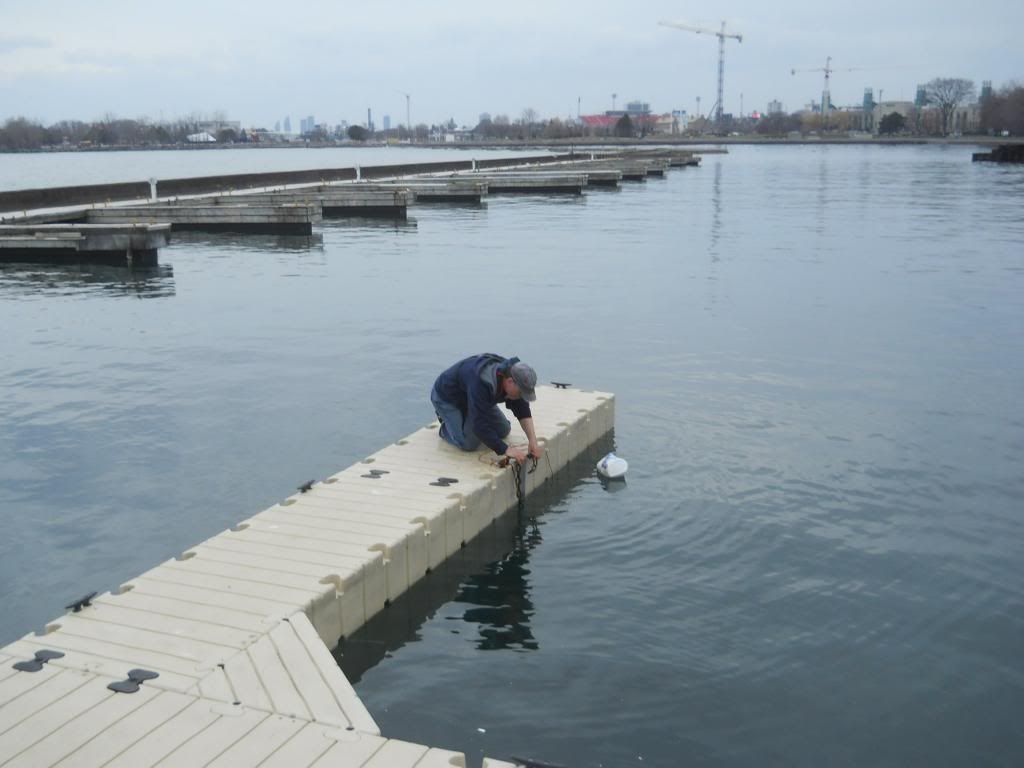
This is Malcolm. Sticking his hands in 3C water doesn't seem to bother him.
A Canadian boat club, with some rare exceptions, must defend its physical assets from the several months of winter we endure enjoy each year. This means hauling out those parts of the dock that would otherwise suffer from winds, waves and the never-gentle actions of ice.
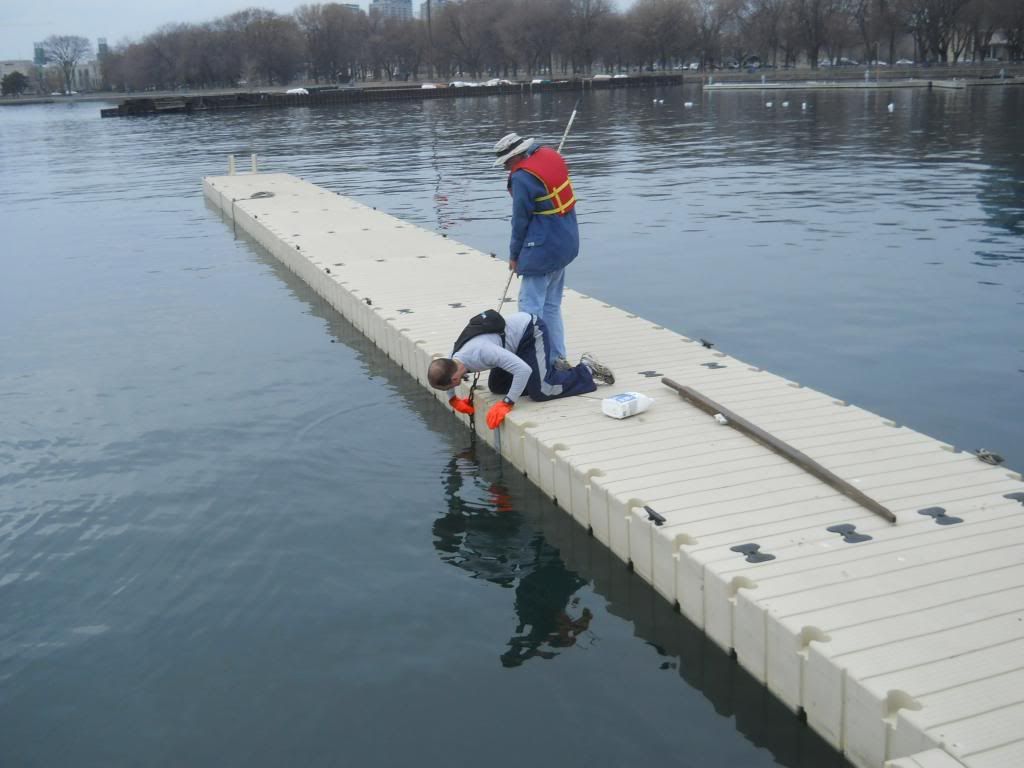
These plastic, Lego-like dock blocks only work when secured by chains left in over the winter.
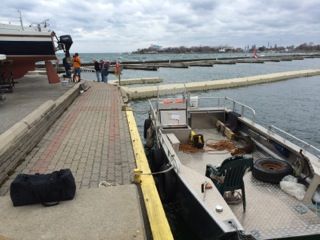
So while the main wooden and steel cylinder and beam docks are handled by contractors, the dinghy docks and the moorings in the mooring field (as seen behind that breakwall "island" in the photo above) are maintained by the Mooring Committee. It's manly stuff, I tell you.

And like many manly things, one man works while three or four give helpful advice. Photo (c) C. Lahmer.

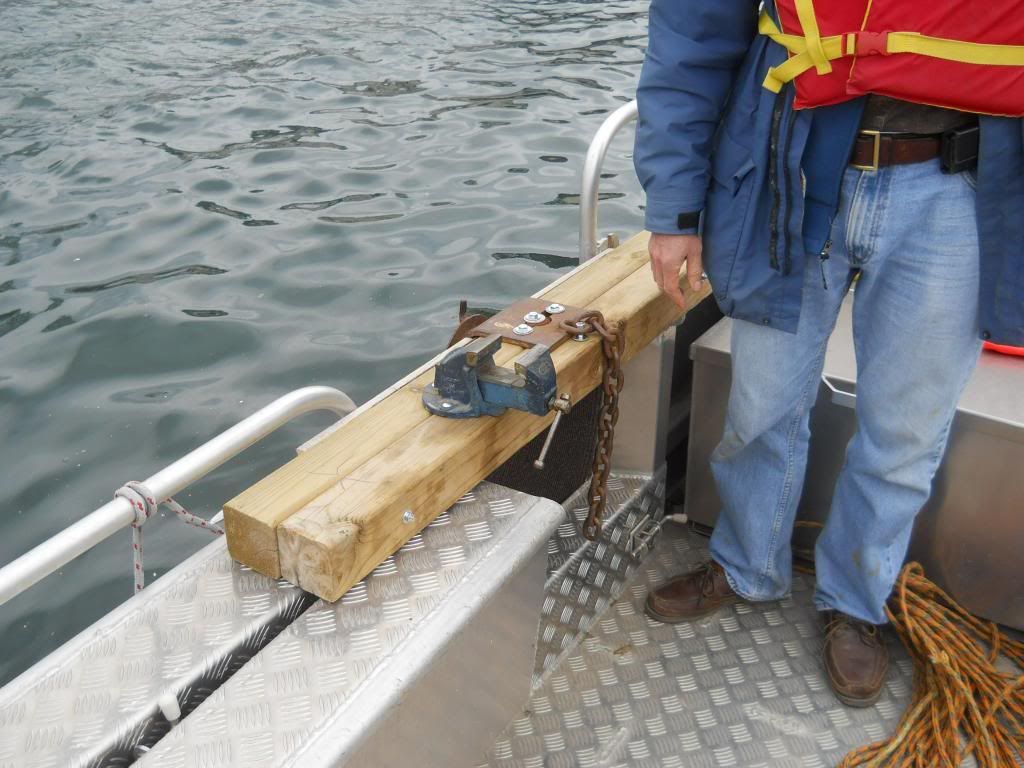
Because members of the Mooring Committee value thrift, we tend to opt for the rough-hewn fix over the buffed manufactured product. This is a removable vise and "tire hook" that can be mounted on the door of the work boat, Storm King. It makes it easier to secure a length of mooring chain to replace or mouse or tag a shackle, and keeps the actual "hands in freezing water" time a touch more manageable.
Keeping hands out of the water is key to keeping volunteers on the Mooring Committee, studies have concluded.

It's all in a day's work, as was yesterday's 2014 Club Boat Launch. Always a mixture of excitement (the sailing season is starting!) and dread (will it float? Will it start? Will it plummet off the slings and end up on YouTube?), a boat club's launch and haulout weekends can run the gamut of emotions, lapsed safety procedures and very marginal weather.

Last year's "Horrible Haulout" argued for a relocation of the "sling marks". Yr humble skipper did that prior to the Big Lift.

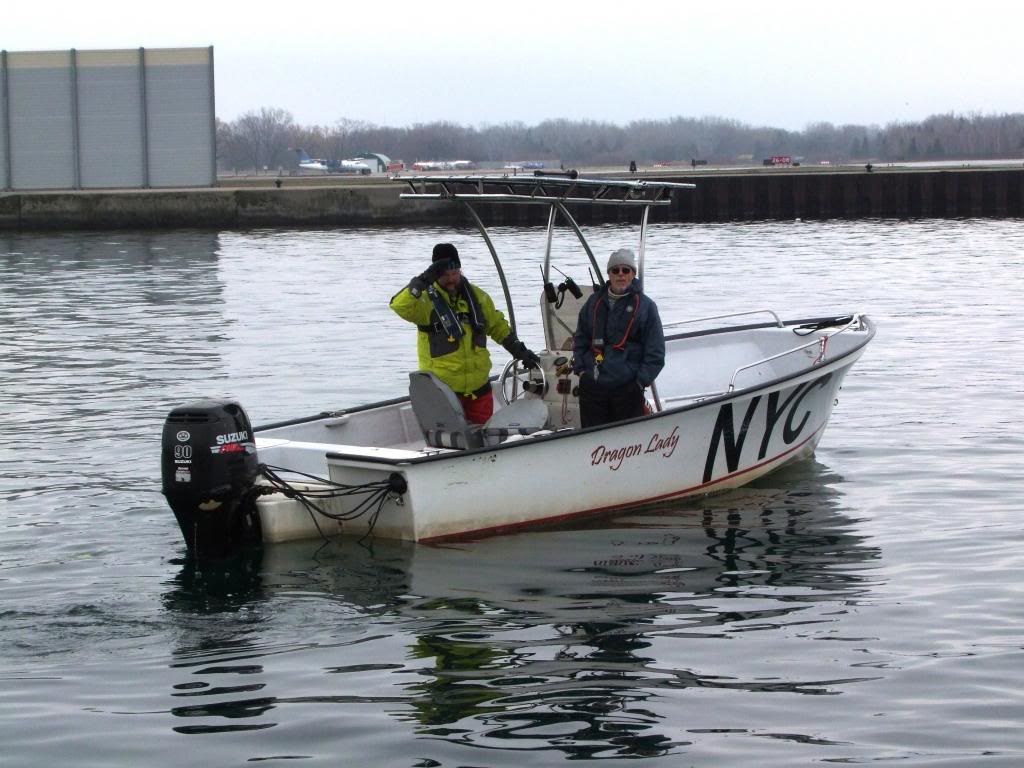
Well, it was mercifully merely chilly, and only fractionally rainy and windy, and my driving of a safety boat for the half of the club that gets launched onto the south side (as dictated by the reach of the cranes) went off relatively smoothly, being only spottily damp and hardly breezy, although our low profile may have helped us here.
Your correspondent and the redoubtable Malcolm, allegedly on duty to pull your clumsy corpse dues-paying body from the murky waters. Photo (c) Don Williams
After a brief not-lunch, Mrs. Alchemy (who had been daubing last-minute anti-fouling on the hull and herself) found ourselves rather suddently at the front of the launch line.

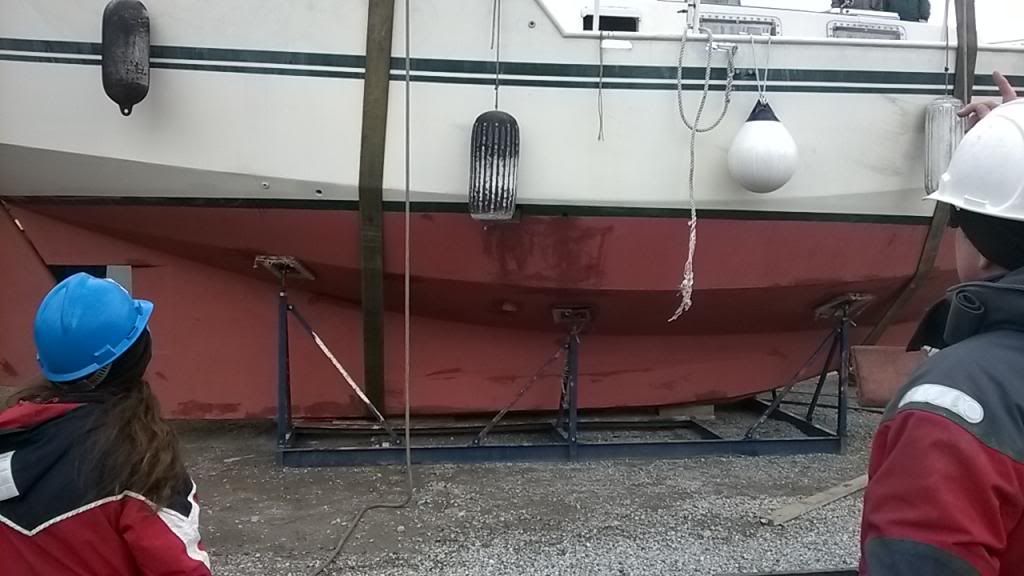
Somewhere down here, there is just enough of a gap to push a sling through.

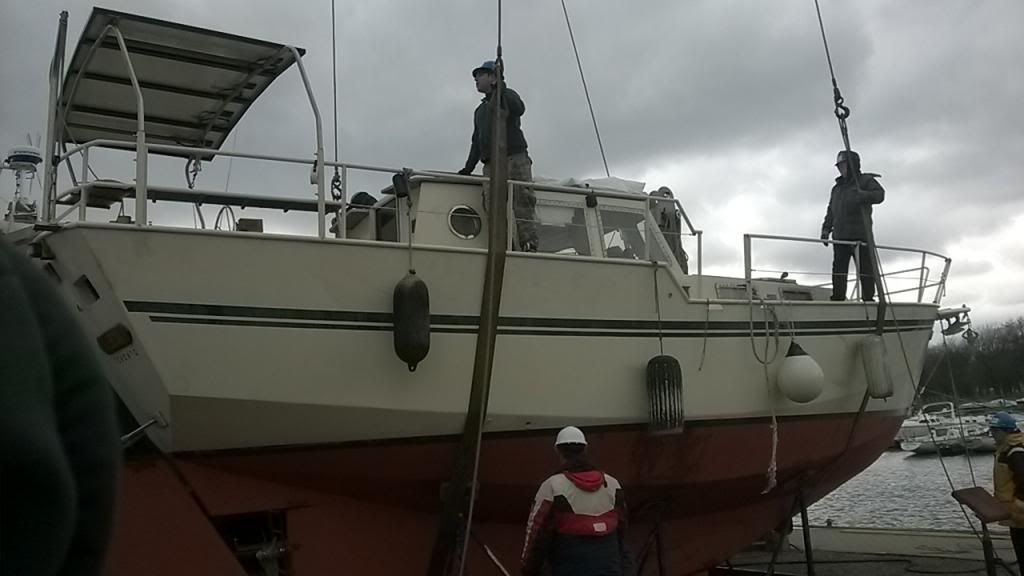
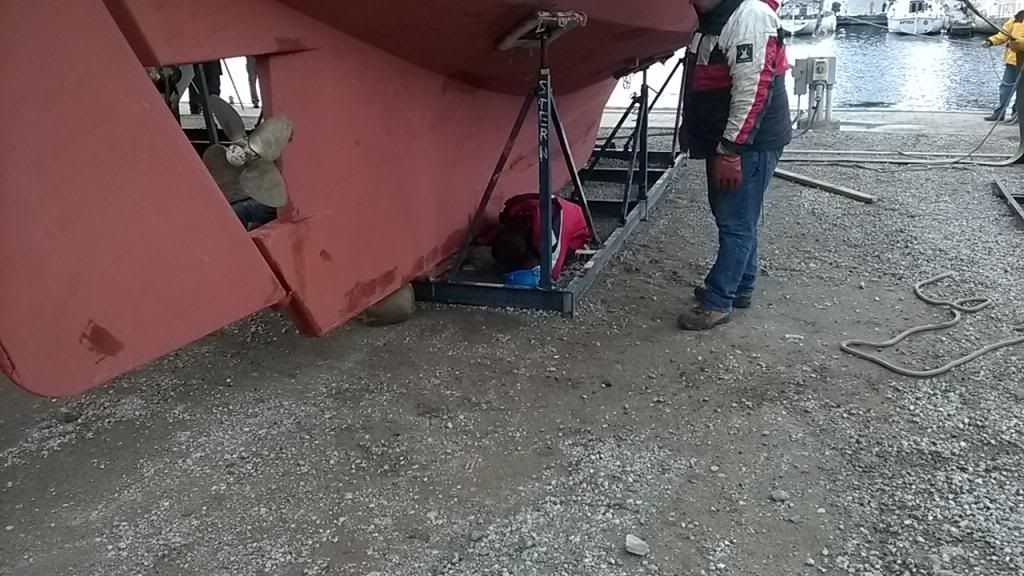
Due to the inexplicable absence of "sling notes" from the previous episode of steel boat suspension, there was a minor amount of futzing about to locate the right space through which to pass the aft sling. Mrs. Alchemy, being younger and considerably more compact than your correspondent, was a good fit for the dirty work.

Like threading a needle with thread that can support 25 tonnes.
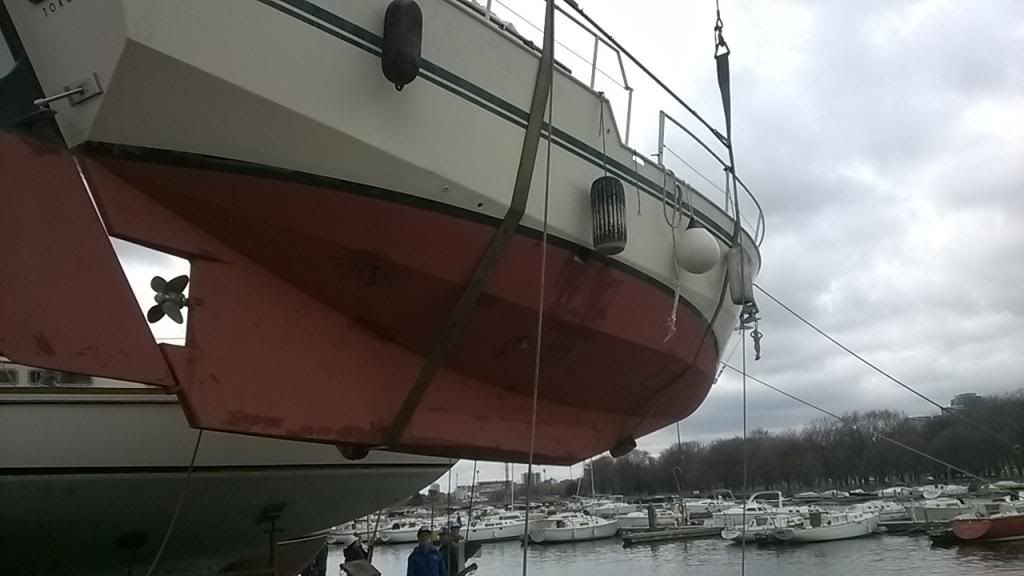
We've reflected before on how relatively small shifts in onboard equipment or stores can change the sling points fairly significantly. Both slings are about 30 cm. forward from before the new engine went in.

The old fenders didn't look so grubby until I got the God Balls.
It's also occasionally necessary, as the roster of volunteers in charge of slinging changes from year-to-year, that it's prudent on full keel hulls to rig "cinch belts" to keep the slings from shifting.

If this happens at sea, reduce sail. Note the cinch belt just above the staboard rail.
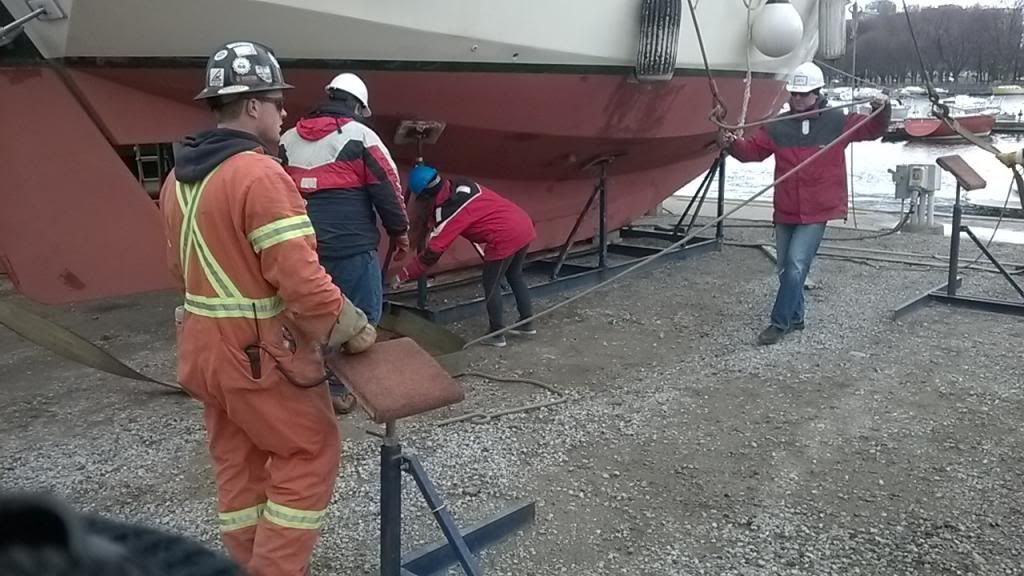
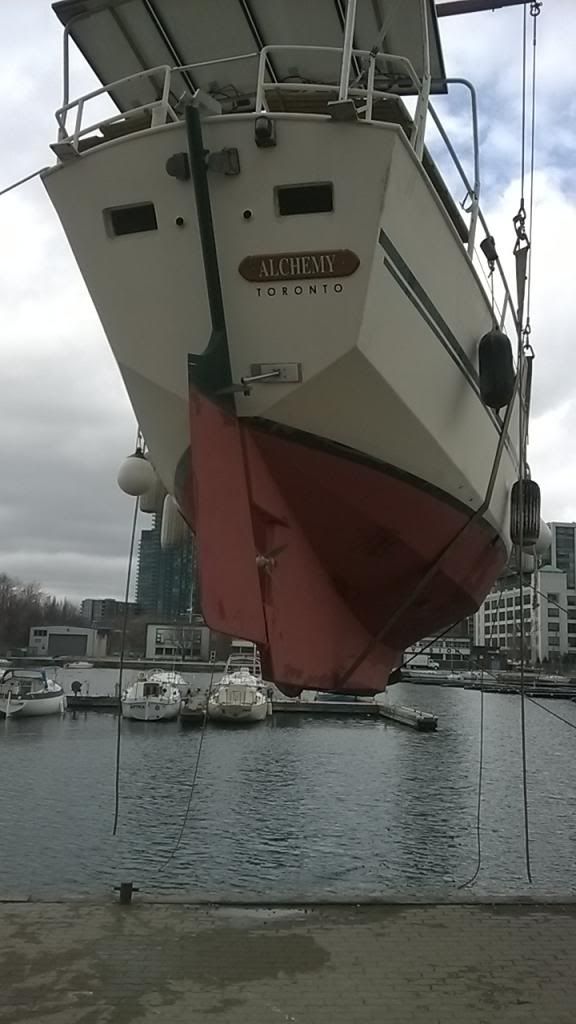
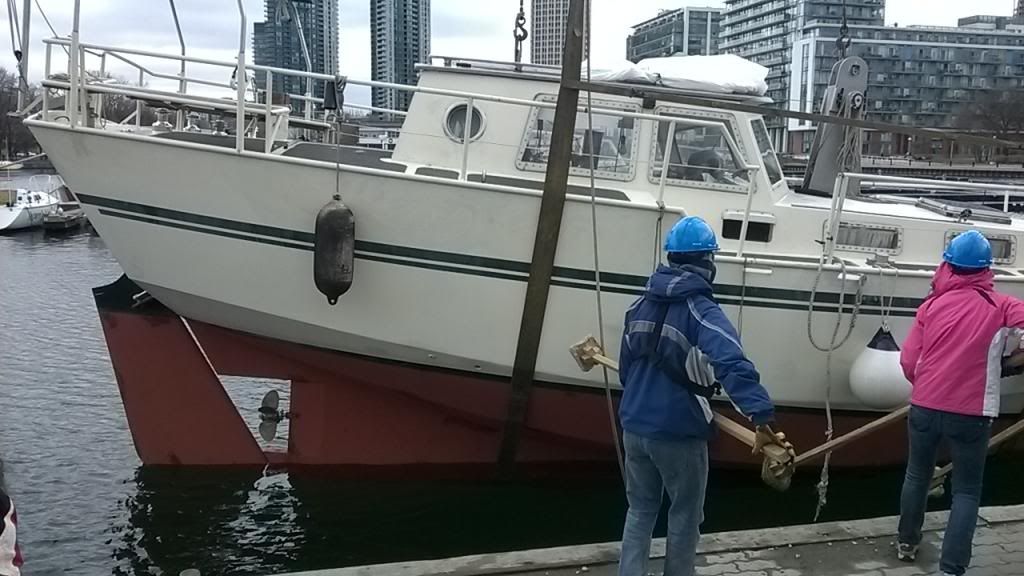
Several people not entirely in shot make this crane posture possible. The lines off bow and stern are used to rotate and move incrementally the boat while airborne, and there's half a dozen "pushers" at the sea wall with three-metre lengths of lumber fitted with carpet-covered pads at one end to keep the boat from scraping against the wall.

Like many a fine lady, some might say her stern is her best side.
Given the number of fenders I deploy, this isn't likely, but the crane operator can't always see how closely the boat is to the edge as the boat is slowly lowered, although if the drop is too close, there's usually a lot of incoherent yelling and gesticulation.

Oh, there are some pushers. I always look for unexpected bubbles at this stage. None observed.
And...we splash. It's arguable (and was pointed out by a helpful bystander) that a couple of shackles to lengthen the aft sling would allow a more level hoist. Something to remember for Haulout.

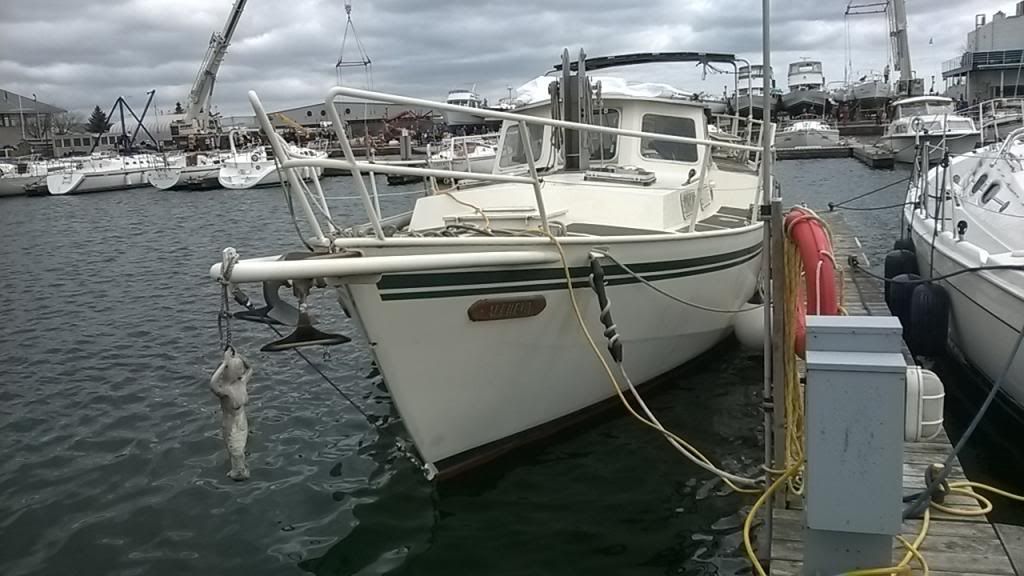
Nothing says "WORKING VESSEL" like a green plastic deck chair, I think. Photo (c) C. Lahmer.
The still shiny club workboat, Storm King, was then hailed for a tow, as I did not finish the engine revival in a timely fashion. It was this noble and still-on-warranty vessel that hauled us last fall, and the new driver was a touch nervous as Alchemy was the most massive of his tow jobs to that point. We took it slowly and made a nice touchdown on our customary slip, thanks to the kindly "line catchers". I think any transit of Alchemy possesses a sort of morbid fascination to people, because I am conscious of being observed when underway in a way that just doesn't happen when I'm noodling about in the far lower-to-the-water 33 footer.

Is it time to retire the very grubby "lucky mermaid"? Maybe to the interior of the boat, perhaps.
And so to bed, or dock. Reconstruction resumes shortly, and, if I can get a weather window, one remaining launch!

2014-04-24

Oil and painting

As with Valiente, much of the waterline and topside cleaning will be done post launch

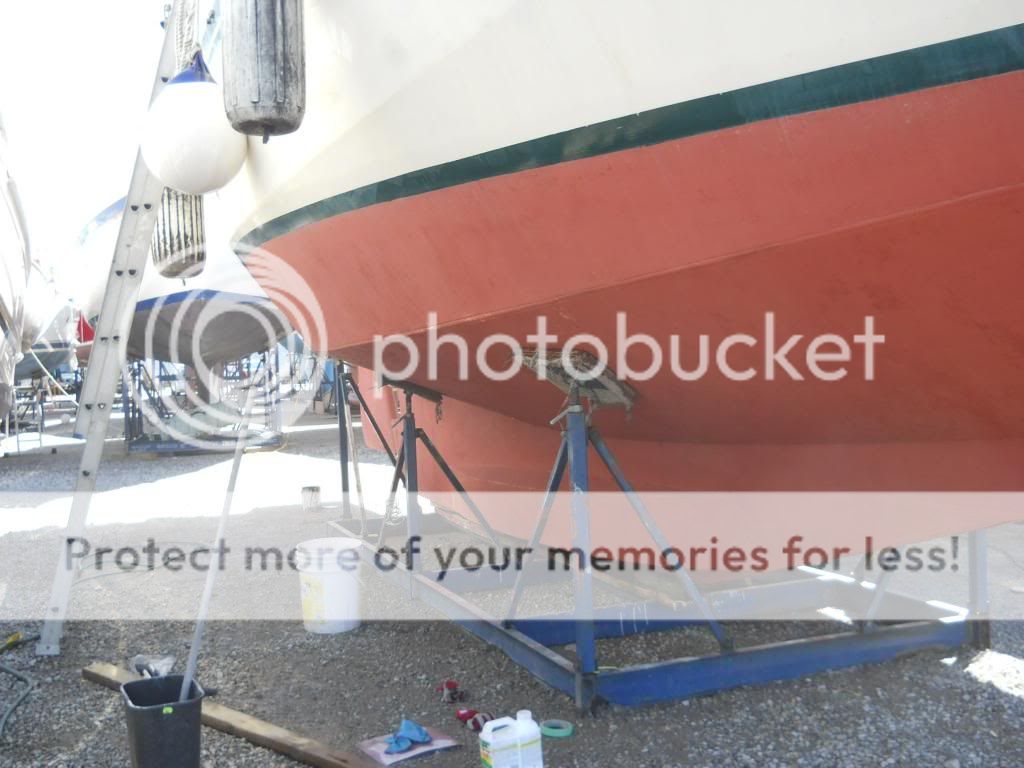
Today was a good day to paint, being both clement, if cool, and a day during which my long-suffering missus wasn't off repairing some wayward creature. The wear and tear from last year's "didn't move" time at dock meant only spot anti-fouling, zinc daubing and barrier coating was necessary, with only a bit to finish tomorrow if I can get paying work done tonight.

Mrs. Alchemy does the happy dance to appease the gods of two-part epoxy.
Meanwhile, I deployed our usual mooring lines and coiled down the "sling lines" so that the good ship Alchemy, once slung and aloft this Saturday, can be more or less (depending on the wind) maneuvered by line pullers on the ground. It's alarming and fascinating and often raining.
I'm getting a sense of remoteness here.


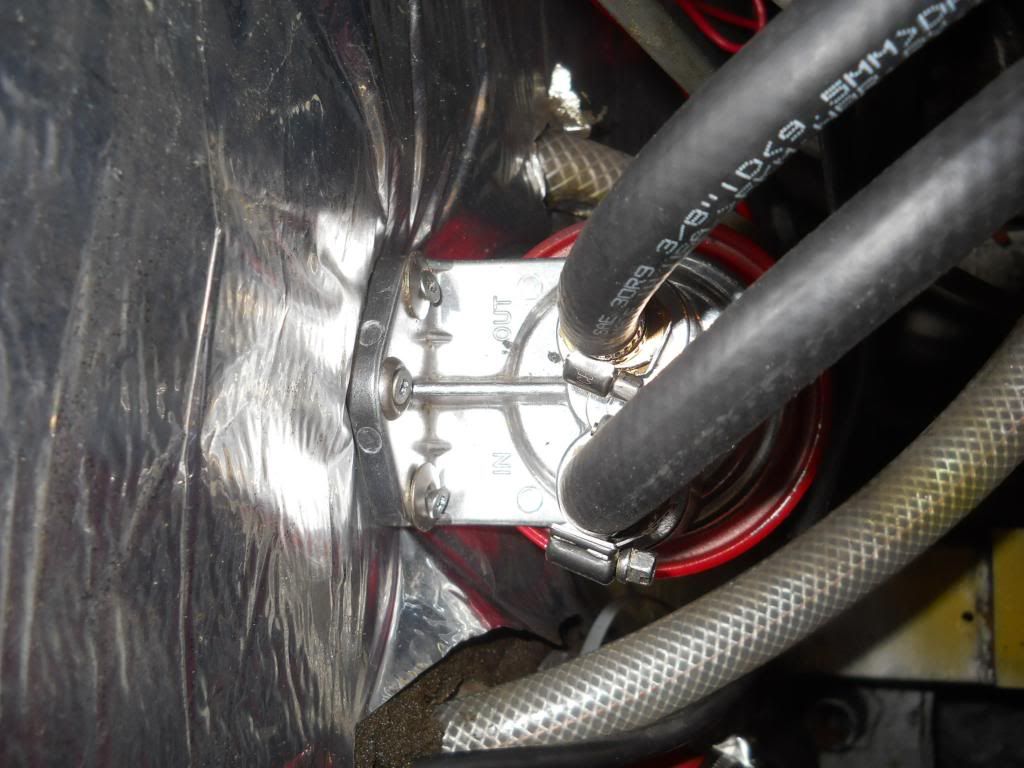
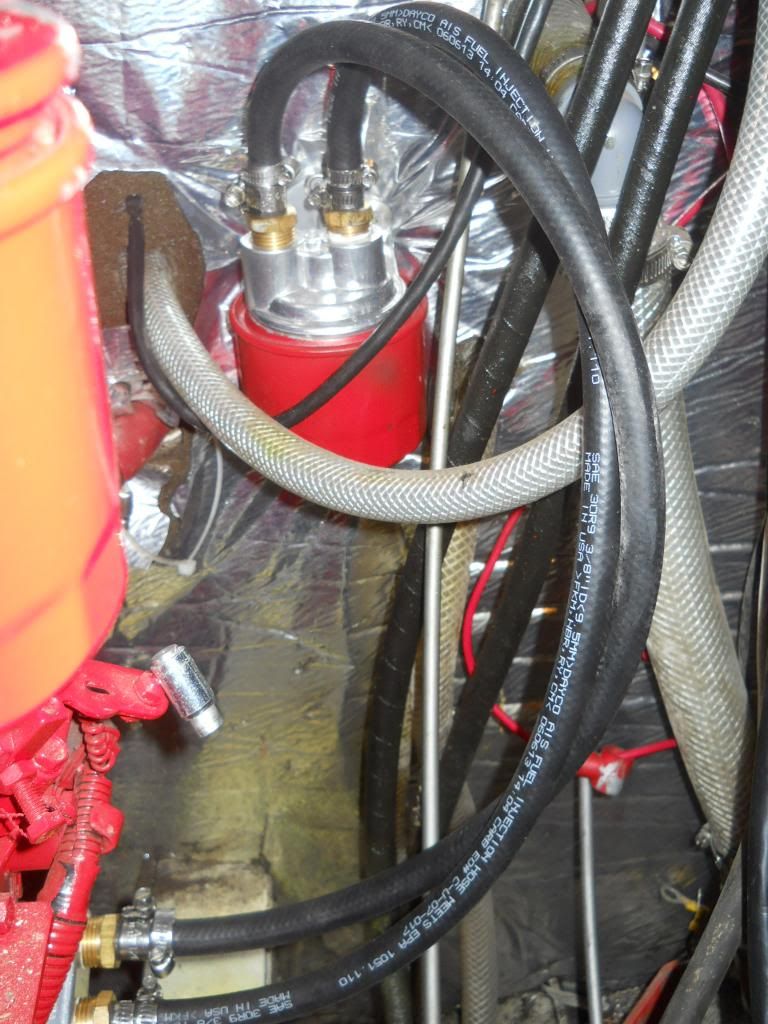
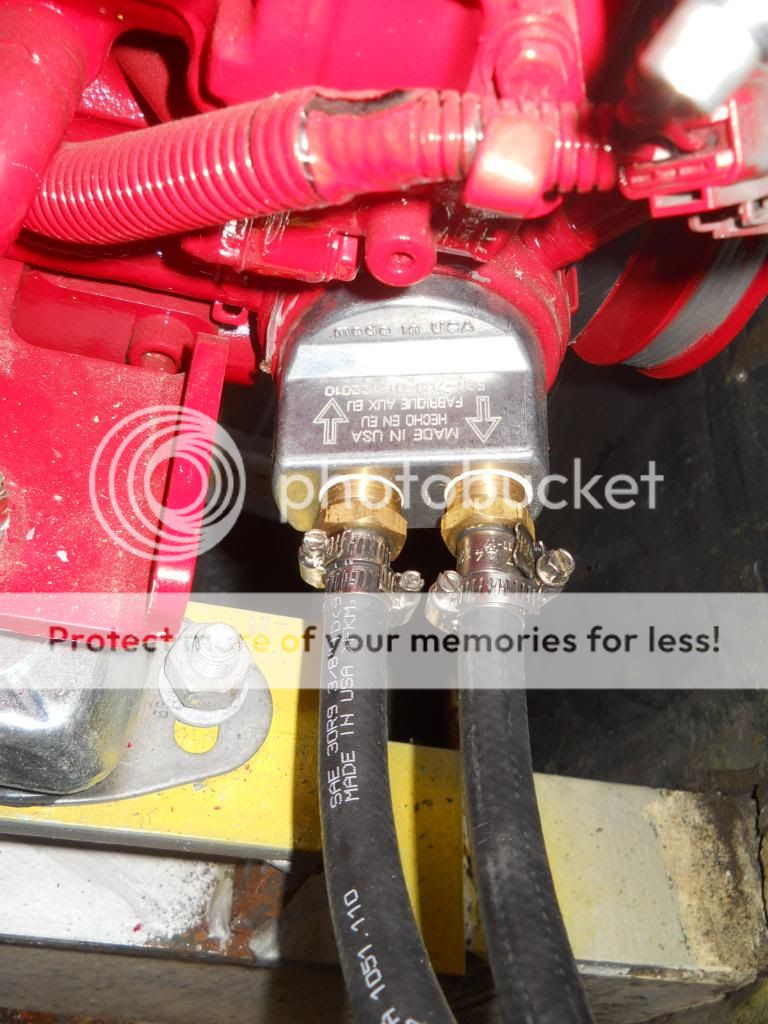
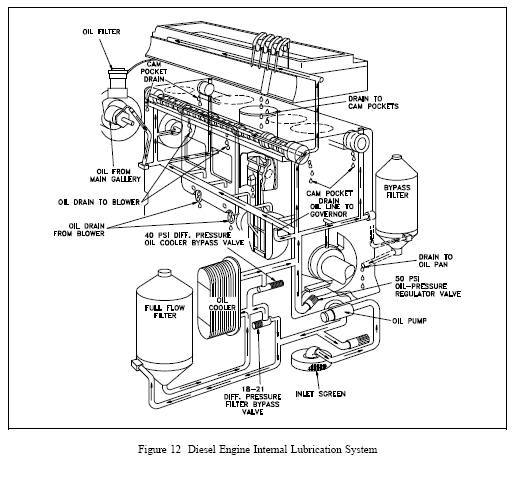
This is the latest fix in the Drive to Drive, '14. Before you is the freshly installed Remote Oil Filter Kit (engine end). For some reason unknown to the unmechanical such as myself, oil filters are usually spun on to threaded barbs which are bolted sideways into engine oil sumps (basically the pan in the bottom from where the oil is pumped, circulated and does its lubing and cooling thing).

Yes, like that. Thing is, if you spin off a filter in order to change it, about half the oil IN the filter will reliably pour OUT of the filter and into your bilges. Surprisingly, this doesn't service the pumps as well as one might think, although even a cup of oil can leave a kilometre-long slick in the water.

The length of the screws required meant I had to angle in the outboard ones. I try to have explanations for what appear to be mistakes.


The solution is to remove the filter from the engine and its problematic horizontal orientation, and to  make it "remote" by mounting it vertically on the nearby bulkhead. Those wires and hoses will be tidied up a little later.

If I need to change a filter, I can do so without emptying the engine or spilling oil.
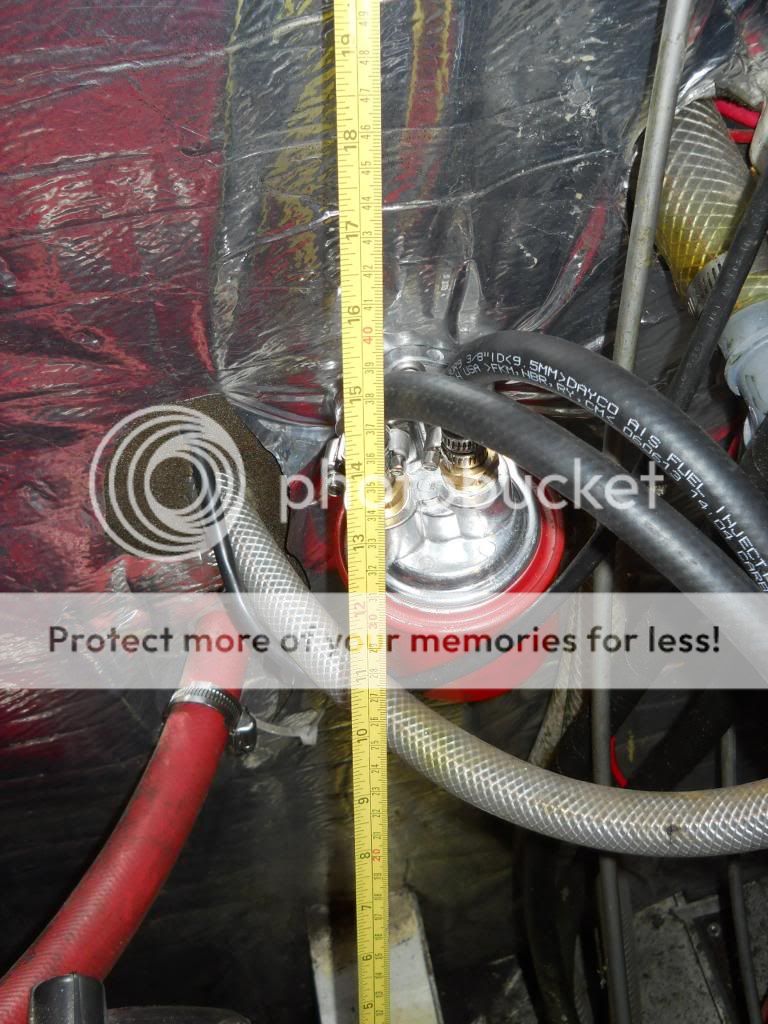
The total hose runs are about 28 inches, and the total "lift" required is about 12-13 inches. At the typical 50-75 psi diesel oil circuit pressure, this shouldn't be an issue, and yet the "top" of the oil circuit is still below the top of the engine itself.

If there is any spillage, it will tend to fall just to the right of that engine stringer, an area easily swabbed.
Onto other stuff tomorrow. The T-fitting for the dual exhaust hose setup is ordered.

2014-04-22

Christmas in April


Now with glow-in-the-dark properties!

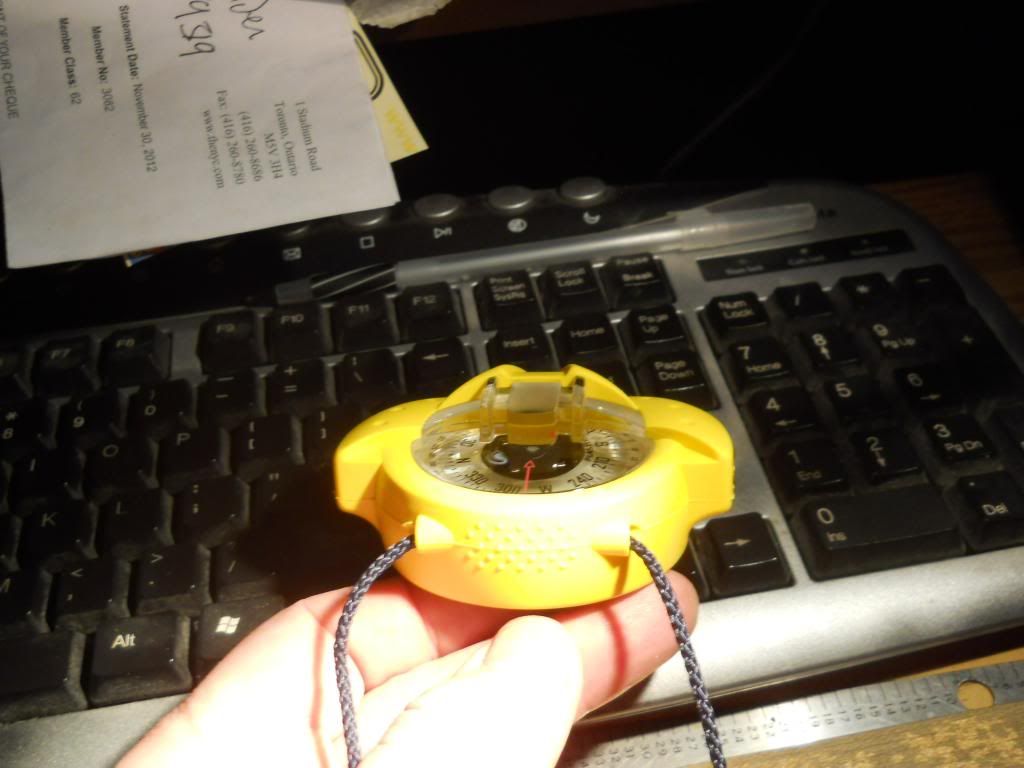
Due to the vagaries of international trade and, presumably, becayse I desire only the finest and least often ordered in boating gear, the Plastimo handheld compass I asked for as a Christmas present was picked up today. It's called an Iris 50, I was impressed with it in use during last November's RYA course in Brittany. I didn't think it was roughly as hard to obtain as a no-fault divorce.
When told to "get lost", I like a challenge

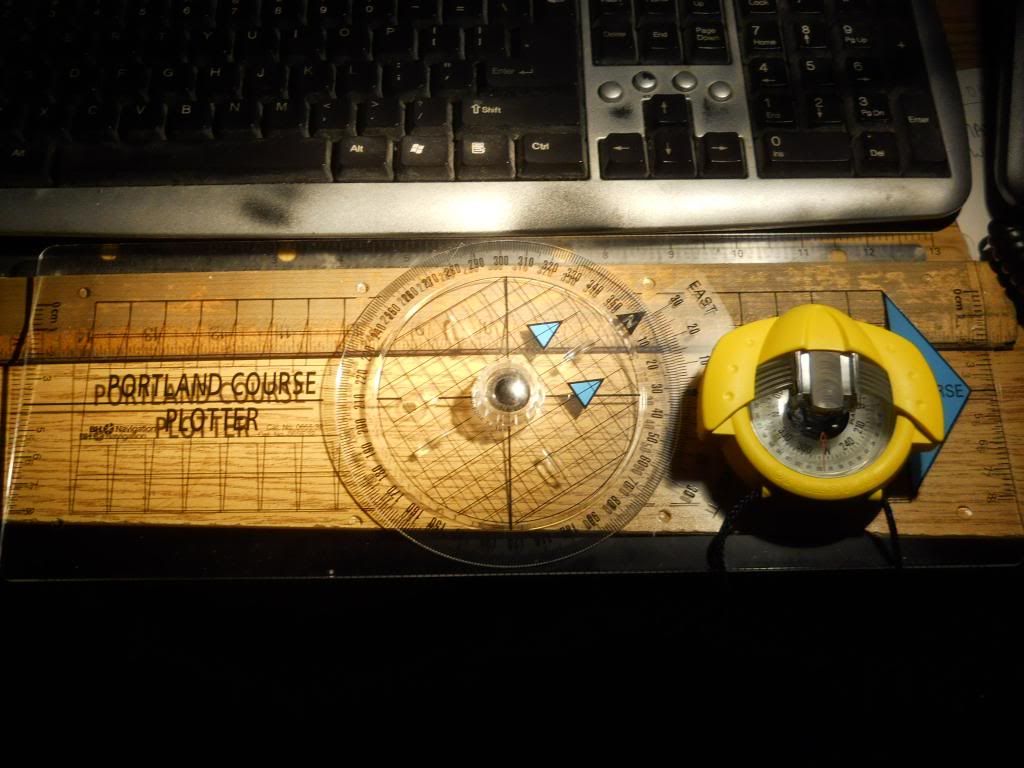
The other thing I asked for as a prezzie was the equally RYA-centric Portland Course Plotter (I already have a lovely pair of brass dividers). So chartwork can proceed apace this season, even if chartwork seems to some like nodding off in a scriptorium.

Freshly anti-fouled. Much needed topside cleaning to come when I fix the gaskets on the powerwasher.

Oh, well. I cling as did the whale's lunch Job to his faith in a capricious and possibly psychotic Yahweh to my continuing honing of my traditional navigation skills, and there's fingernail marks in the chart table to prove it. Sailing may be going digital, but there's something very analog about bending on a main on a cradled boat in 25 knot breezes. Alchemy launches on Saturday, and Valiente early next week.


2014-04-21

When is a skipper a captain?

"Arr, matey, I be parallel parking this scurvy scow!"
Clearly, despite the eclipsing in most senses of the Age of Sail, the allure of the rank of Captain remains culturally intact, if at times nautically dubious. Now, as a title, it's never gone out of style as a military rank in various armed forces, nor is the usage of Captain a thing of the past for the commander of commercial, merchant vessels. But those uses are essentially professional in nature.

Slicker, peaked cap, spoked wheel and manly facial hair: Most male cruising sailors are using "old salt" as a style guide.
Is the skipper of a private yacht in any sense a captain? I've been called that, usually by someone trying to sell me something boat-related, but also occasionally by marine police or Coast Guard officials by way of inquiry. But despite a plethora of nautically themed headgear that imply a sort of braid-accessorized naval authority, I am unsure whether anyone in a sailboat (or powerboat, for that matter) is, unless such an individual is an actual current or former professional mariner or ex-Navy member, a "captain".

So, Captain Douchebagge, we meet again.
Certainly, as has been seen with the sad and disappointing cases of the captain of the cruise ship Costa Concordia and the recent sinking of the South Korean ferry, expectations are quite high and seem to include that "the captain stays with the ship" ...or at least isn't on the first boat off. Whether they are legally obliged to linger until they themselves are in danger of drowning is another question. Being captain is a job, not a holy office, despite what centuries of naval literature have suggested. Nonetheless, it's a rare job that has some real power when actually at sea. Not to mention a nice hat.

So the bumboat boys know who to pester
I've encountered holders of Royal Yachting Association (RYA) Yachtmaster qualifications who don't object if you call them "Captain"...but that's not quite the case, is it? "Yachtmaster" sounds a bit kinky when shouted across the deck, and yet that's most accurate. Harder to fit on a hat, though.

I see the YM course as a qualification, but not as a licence like a "ticket" from a marine school or institute. Some sailors obtain either through youthful employment or via military service or working on tall ships or coastal boats, certifications like a "60-tonne Master Limited". But generally, this pro or semi-pro level of mariner education is not pursued by those who wish to just sail their own boats, or, at best, run a rather limited sort of charter operation, 

But the lure of the title remains: The "ticket", leading to the stepwise attainment of the rank of Captain, is a sort of guild distinction. In the British Merchant Navy it's like being in a trade (see http://en.wikipedia.org/wiki/Merchant_Navy_%28United_Kingdom%29); you have to take both shoreside courses and "work study" aboard vessels if you want to get to second mate.
A Captain able to find rum before it's gone and all the occult treasure and seamonster one could wish. Docking, not so much.
Similarly, I don't think the licences the MCA issues are equivalant to RYA certifications in the sense that the person successfully completing the course is a licensed mariner. None of my research on RYA courses, despite a lot of informational crossover, lead me to consider them STCW qualifications.

I think the equivalency might be "private Cessna jockey" versus "commercial airline pilot", or private car driver versus the tractor-trailer driver of road freight. If I fly a Cessna for fun, it doesn't qualify me to fly a DC-3 for money, although if the DC-3 pilot has a heart attack, the Cessna pilot is probably the best option for experiencing a flame-deficient landing. The YM Offshore, which a good sailing friend of mine has recently achieved and is happily using on his sailing adventures, isn't a commercial or a professional certification, whereas a Captain is a sort of trade description, as well as a title or rank. Interestingly, until the mid-18th century, a naval Captain could be any titled lubber, Court hanger-on or Army guy, and was the person who made "naval" decisions based on the advice of the ship's master, the non-dilettante career sailor actually responsible for the sailing-not-sinking part. It took a series of reforms to professionalize the Royal Navy and to get the "place-men" reduced, although advancement still favoured the well-connected and the aristocratic.


If this is your charter captain, switch to a walking tour.
Anyway, while it's harmless to call yourself "Captain", I find it imprecise and allusive to professional attainments in an area other than pleasure craft operation. I would allow that the owner and skipper of any given vessel is its Master, but one doesn't need the RYA or the CPS to tell one that. Any warm body with a PCOC is an "operator" in front of the water cops, and a "master" in Admiralty law. I can claim salvage as a master of a sailing vessel, should I wander across something not under command or 'clearly adrift', although this is a very nuanced topic in law, and there are many who would suggest that the line between righteous salvage and vile theft is permeable. Skippers or captain, beware.

I have seen a document
on official RYA stationary in which the "am I now a Captain" question was answered with "we take no stance" is an attempt to say "call yourself Captain, because it doesn't matter".  If people think they are captains, or even armchair admirals, it's going to have some sort of persuasive effect on RYA course-taking, even though that is *never stated* in the literature; it's sold as "the opportunity to improve one's seamanship skills" (which it is, of course), or the opportunity to evaluate one's existing skills (which it also is, as in the case of professional mariners who can "challenge" the higher YM exams and basically get passed into them for the purposes of post-career mucking about in boats.  

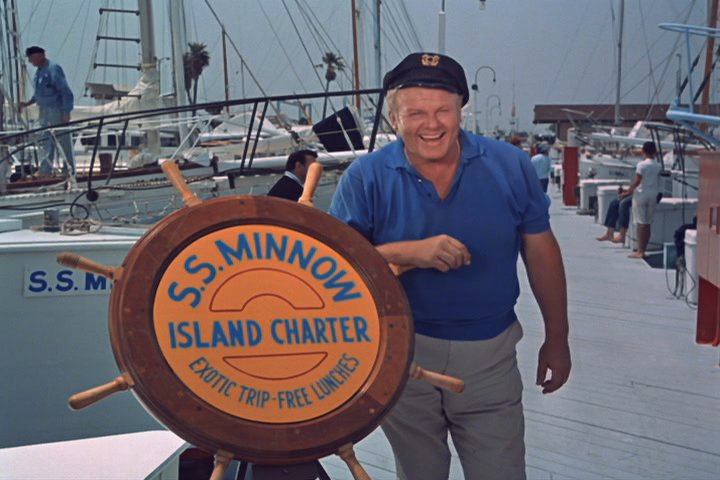
Another fictional old salt, only this one is just "Skipper". Note the cardboard signage on "S.S Minnow". Good grief.


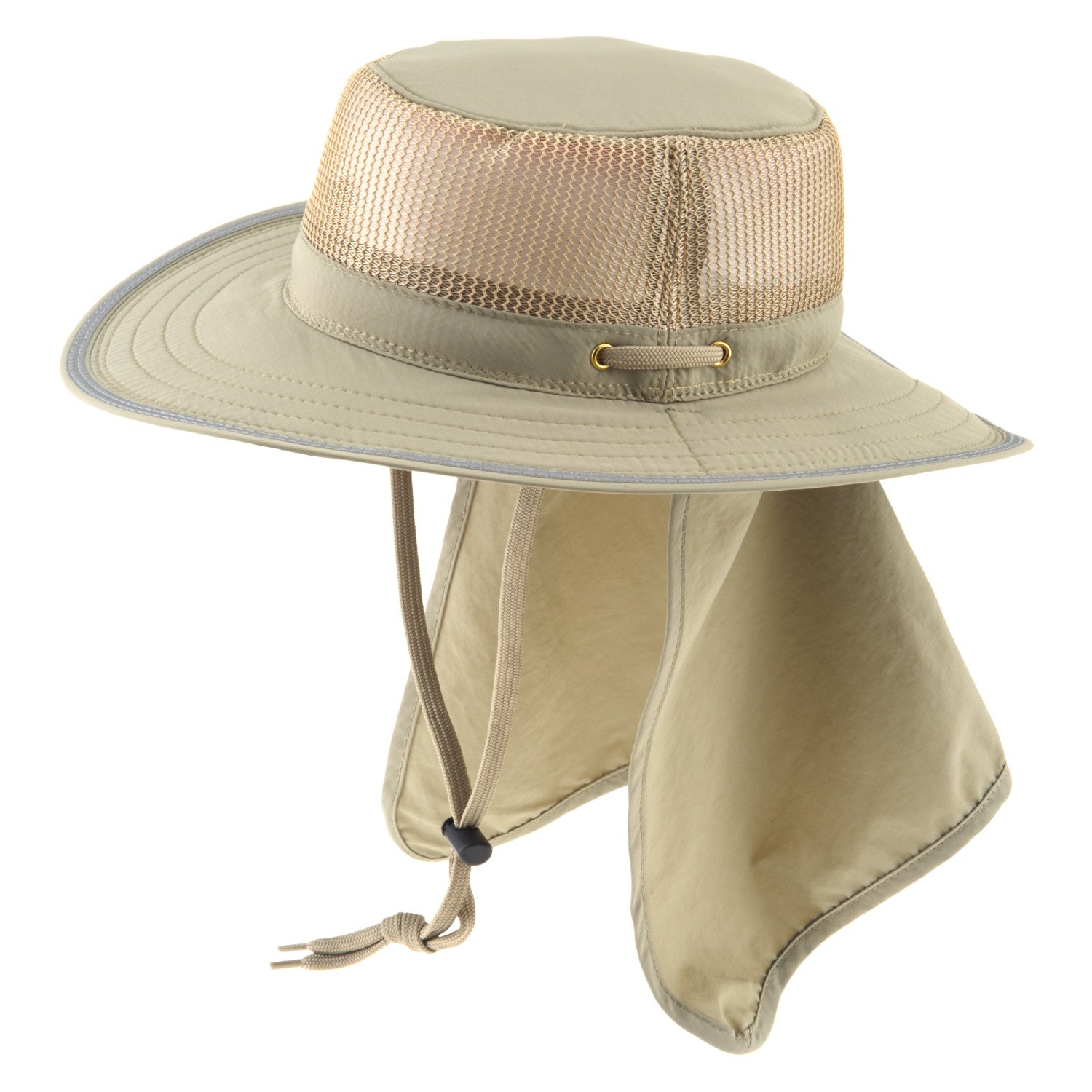
So while I'm happy with "Skipper", I'll leave "Captain" to the pros. The simple fact is that there are different expectations that are bundled up with "Captain", and if you screw up, as one does, it seems worse surrounded by braid than when one is just "Skipper". And as for the hat, I'll bow to my pasty Celtic ancestry and just go with something that keeps the melanoma at bay.
Also good for garden work, I would imagine. Gold braid and anchor badge optional.