Copyright (c) Marc Dacey/Dark Star Media 2006-2026. Above photo (c) Marc Dacey. Powered by Blogger.

2009-08-14

Throttling up....and out


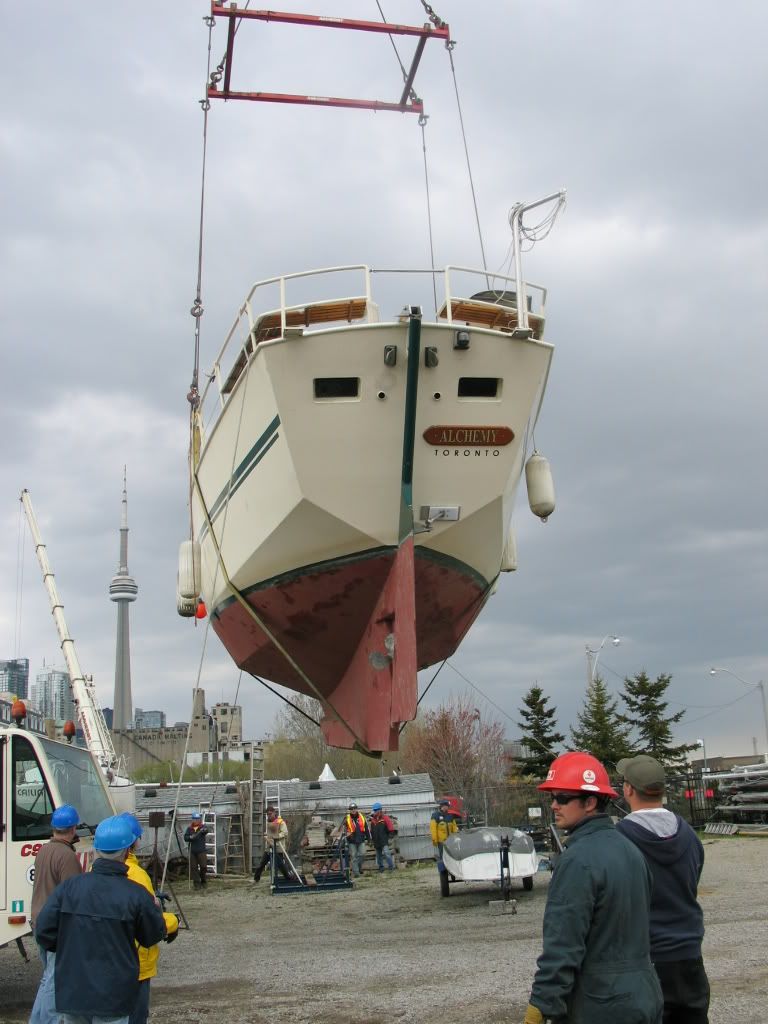
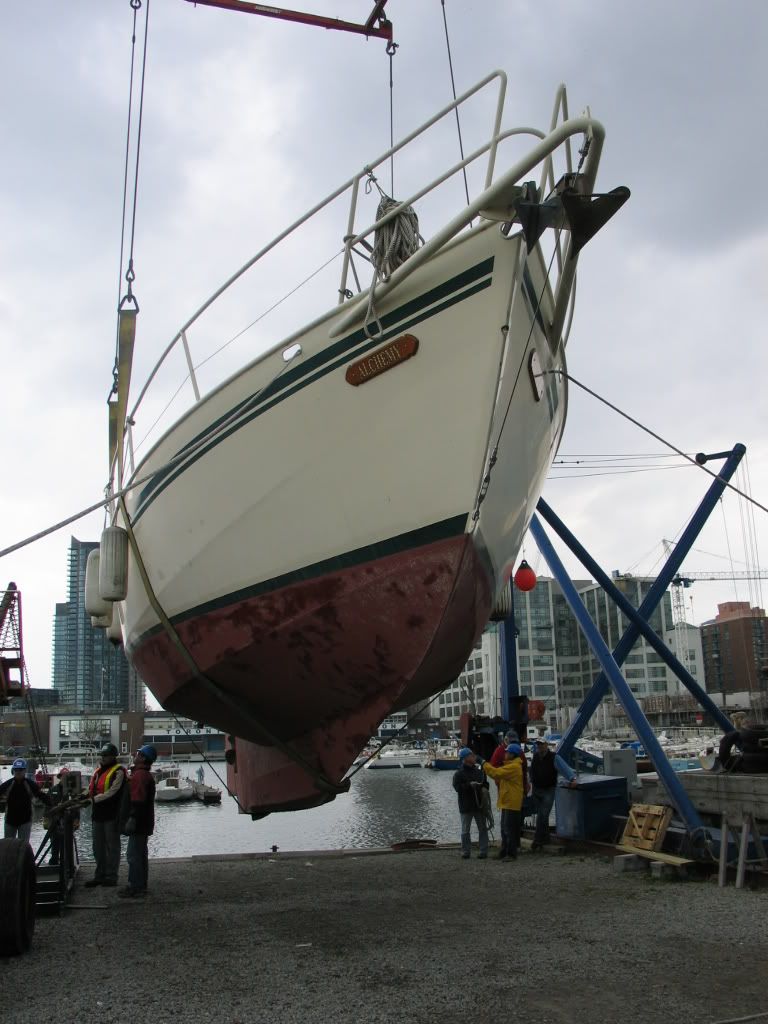
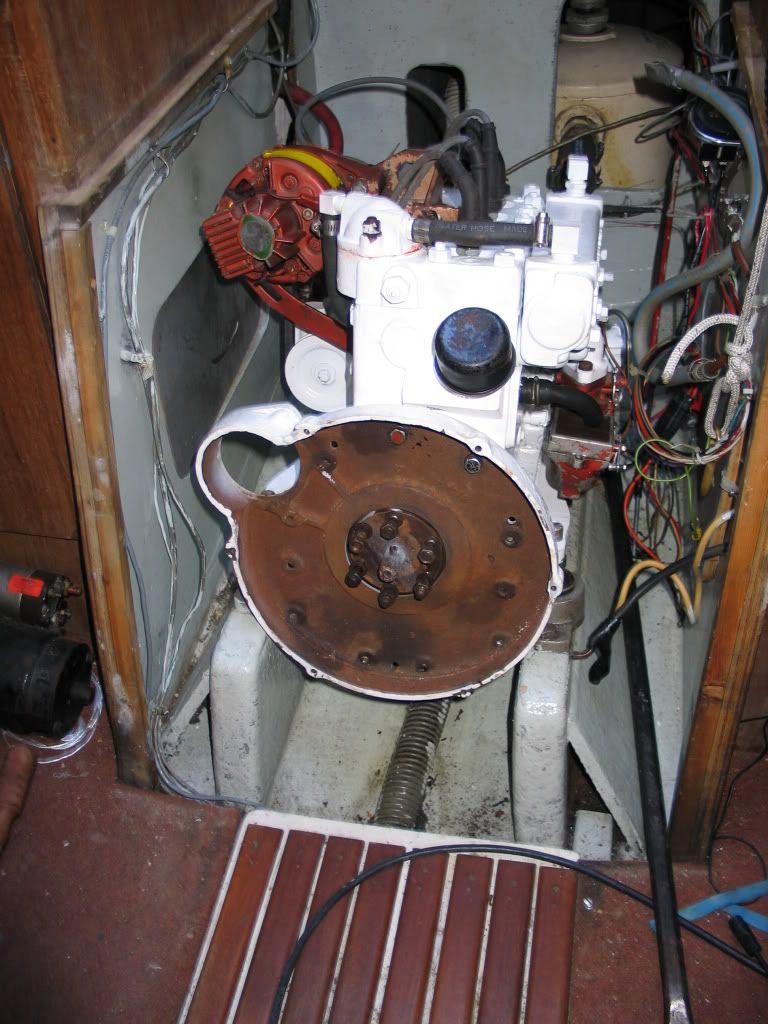
Ye olde Westerbeke W-52, a.k.a. the Perkins 4-135, a.k.a. the Mazda R2 block found powering a range of B2200s and Ford Rangers in the '80s, travelled farther yesterday than it has in some time, going as it did for a ride on the end of a truck crane's hook. Much sweat and swearing went into releasing the engine from a corroded engine mount bolt, and I learned that it's best that it goes back at as close to its eventual "resting angle" as is possible.

I finally got the pilothouse roof freed, after many hours of fruitless sabre-sawing through steel-aluminum galling and excessive amounts of "5200" glue, which Galactus uses to keep his helmet on, as far as I can tell. I did this not only to prime and paint the pilothouse's inward turning flange (and to naturally insert some sort of gasket between the steel and the aluminum), but to get a straight drop into the engine bay in order to get the engine out for the "prophylactic rebuild" I mentioned in a previous post.

The engine is getting picked up in a week by a recommended mechanic on a trailer. In order for this to happen, it has to be within range of a stationary boat crane at my club, so it's sitting on a shipping flat swaddled in a plastic tarp. What a lovely couple. Needs some TLC, however.


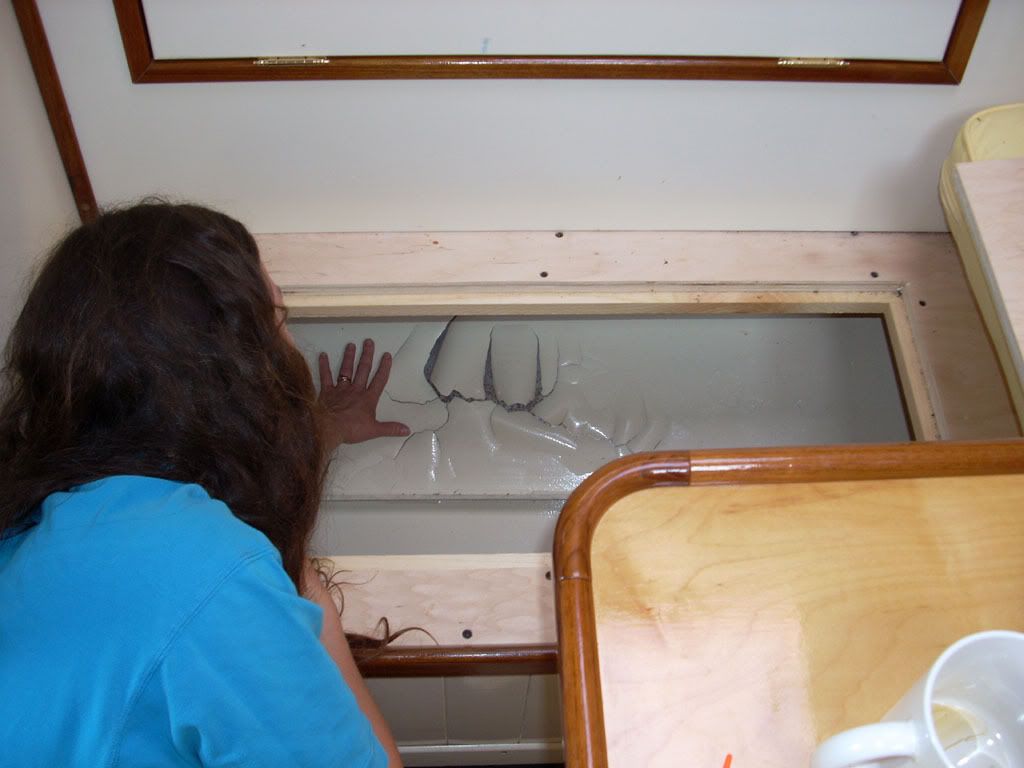
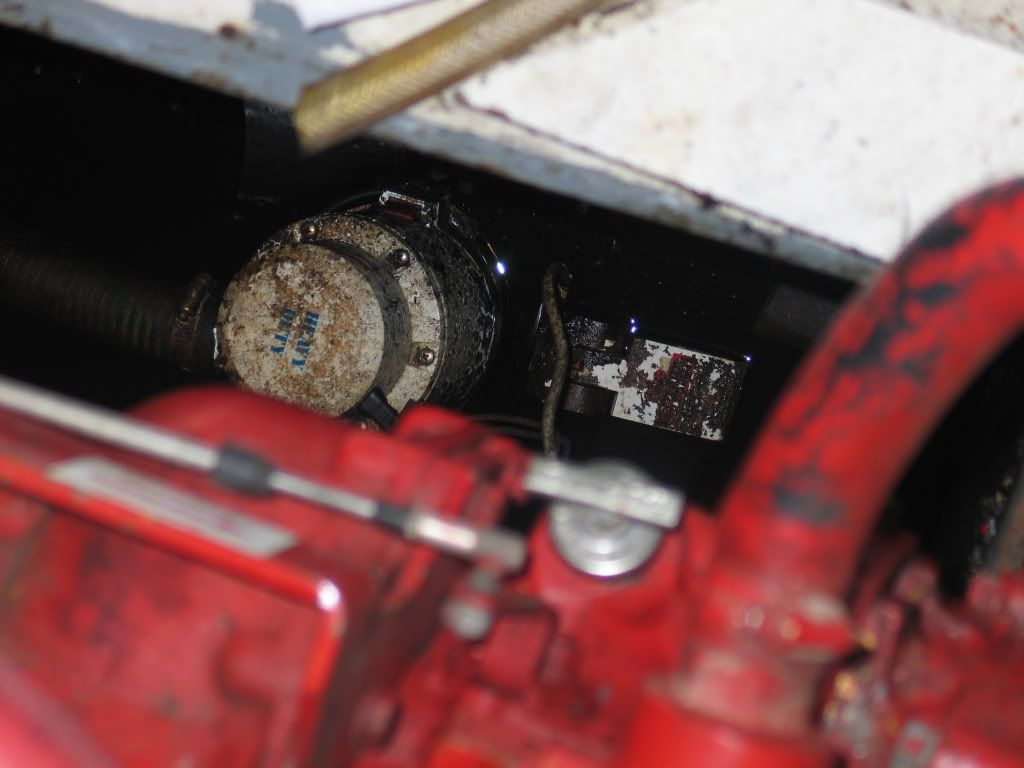
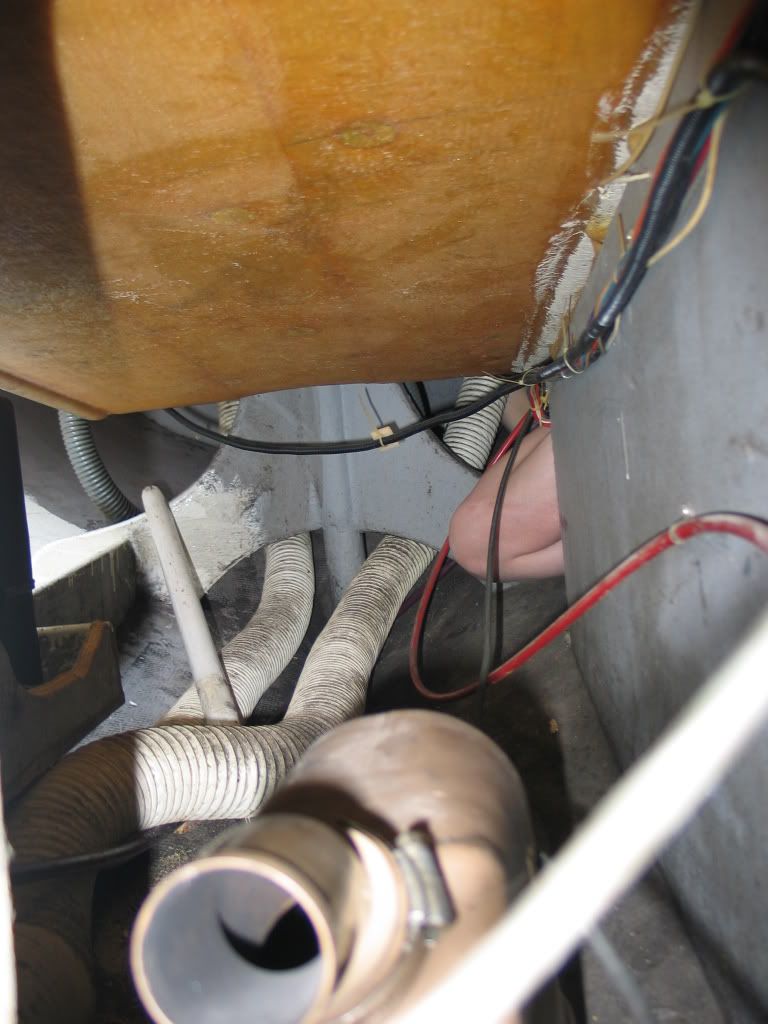
Alchemy's "engine room" seems strangely empty and predictably filthy, as plenty of sump oil chose the airborne moment to escape.

That tank dimly visible was a stainless steel holding tank. It is (I hope) empty save for a thorough swab-out and drying, because I am going to convert it to a diesel day tank. This will increase my fuel capacity from 100 to 140 gallons, and will allow me to "polish" the keel tanks' contents via my soon to be installed Filter BOSS Racor filter set-up so that I can with confidence always have 40 gallons of relatively pristine fuel for my refreshed diesel.


What that pipe is I have yet to learn.


The bilge will get attention, namely a big cleanout and a white paint-job, not to mention the removal of that "stock pot" water muffler in favour of a Vetus-type waterlock muffler.


After that, out comes the busbars, the batteries and lastly, the massive water tanks. Then, all gets painted with sound-deadening paint, and then I have fabbed up four 50 gallon tanks and a load of piping. The idea is to get the water tanks low, just off the hull and between the frames, for better weight distribution and because I want two "city water" tanks, a rainwater tank and a watermaker tank, with circumstances and a bypass manifold determining what water is used at what tap.

Well, it's a start...


My son, who is seven, has begun White Sail 1 classes in Optimists and 420 dinghies.

This pleases me.

I'll try to get pictures of him actually handling his own boat next week. He's the little fella in the yellow cap.

2009-08-12

Two wheels good: To bring or borrow a boat bike


?
The question of shore-side transport on passagemakers comes up surprisingly frequently on various sailing forums.

Getting to the shore is something we've already addressed: We have two tenders: a motor-ready, rowable, folding Portabote, and a motor-ready, sail-capable, rowable and "nesting" fibreglass dinghy. A light, air-cooled Honda 2 outboard motor is shared as needed, and four knots, no problem is the result.

What to do when you reach land is another question. Humping supplies at the end of stretched arms or inside backpacks is an option, but this leaves the ship's provisioners at the mercy of local taxi services (when existing) or simply the willingness to walk on often indifferent local roads in usually constant tropical heat.

Some folk, of course, get their International Driver's Licences and rent vehicles. This is not always possible, particularly in smaller places where private cars may be non-existent or in constant use by the locals. Public transit may also be spotty.

Many cruisers, therefore, choose to bring bicycles aboard. A popular choice is a small-wheeled folding bike, for compactness and ease of transport to and from shore.

A problem, of course, is corrosion. Keeping the ferrous bits of a bike rust-free without getting oil on the deck is a challenge, as it keeping them out of the sea itself if stowed, as is typical, on the rail and not down below. As long as the bike is made entirely of aluminum, it's good. This is rare, however, and can be very expensive, as welds in this metal are tricky.

The folding aspect is one thing (particularly on a small boat...that bike could lash to the mast easily). But the main objection remains corrosion. Our current, if subject to revision, opinion on shoreside bikes is NOT to bring them with us, despite having the space and even the inclination to do so.

Instead, we will bring bike tools, bike racks and a waterproof pannier "system" that can double as "cargo bags" in the tenders:
Waterproof and therefore appropriate for the bottom of the tenders.


Ortliebs come recommended. They are pricy, but evidently superior.


Our working assumption is that crappy bikes are available everywhere, and the words for "bicycle" aren't so different around the world that finding one would be a challenge. So our plan is to hit the shore and buy a "beater" for $20, put on our racks and our good locks, and use them as shoreside transport. When we are leaving a given area, we remove the racks and the panniers and the locks and sell the bikes for $10, probably with bonus bike grease and tuned up. Cost to us: ten bucks and no bikes to store. If we are cruising inshore around an entire country or between islands, we can opt to carry the bikes aboard on a temporary basis.

Many years and kilos ago, I used to be a bike courier and can fix all but the most modern of bikes (like Hayes hydraulic brakes...I don't want to know...) But we are unlikely to be acquiring anything above some Chinese steel mountain bike with caliper brakes (and I can bring better pads easily), and this will save space and the monumental hassle of having a bike that stays folded in the hold or lashed under Sunbrella to the rail 95% of the time, never mind the trouble of bringing a bike from boat to shore in one piece.

I'd be willing to be persuaded that my "no bike left aboard" idea is silly.

An esteemed reader of this proposal on a sailing forum asked "but how much time do you have to spend fixing the bikes before they're usable? Personally I love the idea of the fold-up one. I think I might be persuaded to actually take them somewhere and actually ride it if it's that easy to transport. Beats breaking out with the big ass bike rack and hooking it up to the trailer hitch."

Well, I agree. If you are coastal cruising or cruising from the same club or even doing a "there-and-back" trip of under a month's duration, yes, I would get a bike to keep and figure out a stowage solution.

But I am discussing this from a passagemaker's point of view: We will go from place to place and probably anchor for a few weeks at a time. It is easier to spend one hour altering and adjusting a cheapo "land" bike in a given month, say, than to make space and spend money on a personal bike with amazing folding capacities that would inevitably (unless made entirely from aluminum with a rubber belt drive instead of a steel chain) corrode on deck, even if wrapped up, and get in the way below (and corrode not quite so fast!).

The assumption here as well is that bringing a fancy folder made from space-age materials immediately marks you and your bike when locked as "rich foreigner with expensive bike I can fence". You might as well wear a "ROB ME" sign. While our size, complexions and language will underline our foreignness in most places, I wish to keep the "flashiness" of our relative wealth to a minimum. We want to be seen, if at all, as travellers, not tourists waving Western affluence, such as that is these days, in the local faces. Some space bike would probably do that. A four-times recycled 1992 mountain bike with cracked tires? Not so much..

If we get the local equivalent of a rustbucket CCM 15-speed (think "Schwinn", Americans, or "Raleigh", Brits), clean it up, lube the moving parts and put on the racks and panniers, the result is that your bike looks like a local bike when you take off the panniers to go shopping. It attracts little or no interest from the locals, or the local "bad element".

This is why, among other reasons, we will rust-proof our steel boat, but won't bother with waxing it or otherwise making it visibly "pristine from a distance": This is protective colouration. Why make yourself a target? I learned this the hard way years ago when I was a bike courier with a new, fancy bike. It got stolen, rather embarrassingly quickly. I bought a non-descript beater and swapped in some decent parts like very good brakes and shifters. I then applied "courier grime", which consisted of affixing various counter-culture or rock band logo stickers on the bike, and daubing grease on selected parts of the frame, followed by powdered brown chalk and Vaseline paste artistically applied. It made the bike look like a complete rolling piece of garbage, even though functionally, it was kept in top gear, so to speak.

I follow this today: My $1,300 mountain bike is equipped with narrow, high pressure slicks, Presta valves, Hayes disc brakes, 27 gears and carbon fibre this and that. But it is coloured a dour slate grey and is a very boring object at which to look. The mind of a thief is the mind of a magpie: shiny attracts attention. My bike runs like a dream, but sucks the life (visually speaking) out of its immediate surroundings. And what's that obscuring the maker's decals?

"Courier grime".

2009-08-03

Fiat lux, baby

From this entirely speculative, not to mention crude bit of Photoshoppery,
The start of something bright?

...to this highly functional and strong solar panel arch. Only took 14 months of planning!
This is me in the distant future captioning that I've clearly missed a salient point.

It's funny for those of us not architects or builders or carpenters to actually see a product of the mind come to material fruition... to actualize, as it were. While I've been an on-and-off professional writer for many years now (a paid one, at that), seeing my deathless prose-for-hire has rarely given me the satisfaction I felt today.

And the damn thing's not even done yet.

The "thing" is an arch, a welded set of tubes carefully bent by a clever welder (the hereby heartily endorsed Greg Misko) with a very good eye and a very good understanding of what I wanted.
Nice weather for it.

The arch holds the four solar panels I mentioned lo, those many months ago. The idea was to use the solar panels not just as a means to make power, but as a large shade-casting object in its own right.

As the idea developed, I indicated to Greg that I wanted each panel slightly cambered or tilted to compensate for the fact that boats are frequently heeled. In addition, a panel slightly angled off dead flat will get more photons in the early morning and the later afternoon in some boat positions, and will shed water more easily. The wiring will see Panels 1 and 2 wired together into a device known as an MPPT (which alters the voltage and current to the optimal preset point for charging batteries), and Panels 3 and 4 likewise generating juice on a separate circuit.


High noon, of course, will see them at maximum output. Fire up the water heater, Skipper needs a bath.

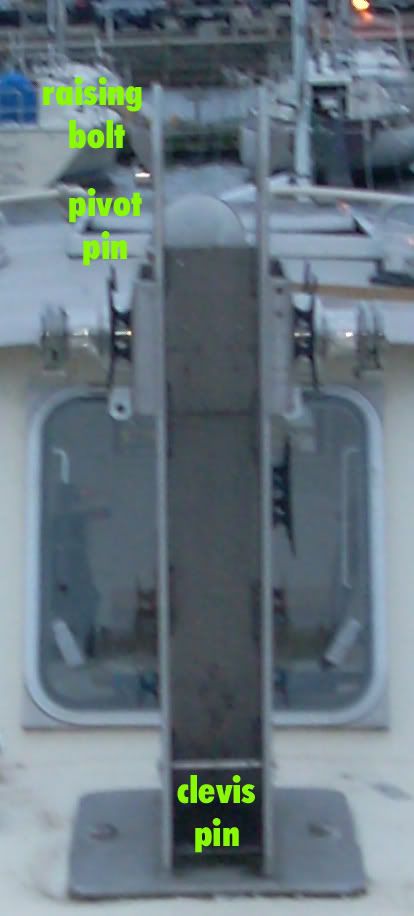
The clever bit, to which I must credit Greg the Welder, was to weld larger galvanized pipes to the rails of the aft deck, and them to slip the precisely bent stainless steel arch assembly into those supports, which feature three Allen key-style bolts to fix them strongly. This means that I can actually take the thing off (if not down, as such) if needed, without sawing or torching it to bits.


Once the arch "legs" were in (and they went in smoothly thanks to Greg's construction of a tack-welded jig),


we used a sort of insert-thingie that was like a threaded rivet, if that makes any sense. Drill a hole in the frame, pop-rivet this fastener and you can bolt it onto the arch support plates without trying to hold onto a nut in a tight spot. These things could be very handy on a mast or mounting eyestraps, say.
Since found to be called "nutserts" or "plusnuts". Write your own joke here.

When it was up, it proved as strong as expected, but the question arose "where do we run the wires?" It was decided that once I tear apart the aft cabin to determine where best to put my power cable runs and my SSB coax cable runs, we will drill two holes in the deck and weld a truncated "H" in galvanized pipe (see drawing on picture of crew enjoying the aft deck shade).
Yes, he was too young to helm here, and let's face it, we were in a parking lot.


Then we will put two angled pieces of SS in there, welded at the top. This will increase the support aspect of the whole assembly, will give me a mounting bar for any helm instruments I care to install, will conduit the panel wiring straight into the boat and out of the weather, will give us a place to snap on tethers for safety, and will not get in the way of the main.

Wow. Long sentence. Long day. Good job.

2009-07-13

Sometimes you just have to go out for a sail

Yesterday, I took out the neighbour, Todd, for his birthday at the suggestion of his wife, Elizabeth (in the last picture with the Toronto skyline behind her). Elizabeth had casually enquired of me a couple of weeks ago whether I knew of a cheap boat charter as she wanted to surprise her husband with a day of sailing around the Toronto waterfront. I suggested that "the good old plastic boat" would provide good, if Spartan (it's stripped out for racing and doesn't even have working footpumps...) service.

Both Todd and Elizabeth had sailed before, and so were quite helpful aboard and good at reminding their sons to climb up the high side (and we were heeled a fair bit yesterday as it was breezy in places), and to keep one hand for the boat, etc. They were perfect guests: Elizabeth provided sandwiches and snacks to placate both the helmsman and the midget "crew".

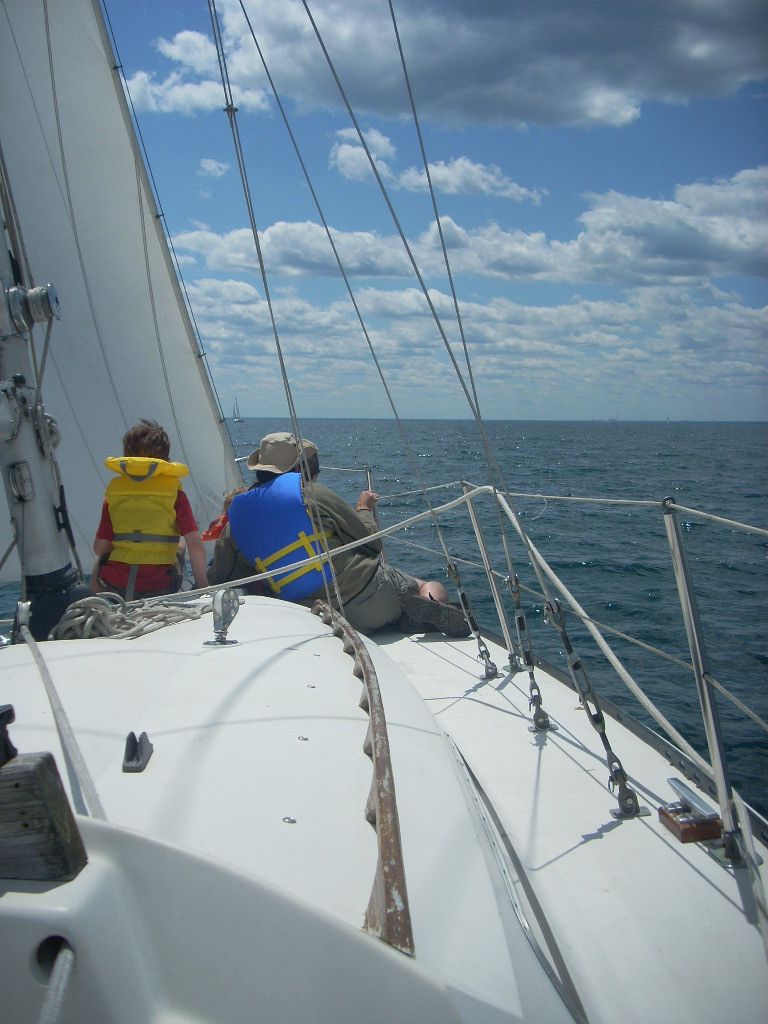
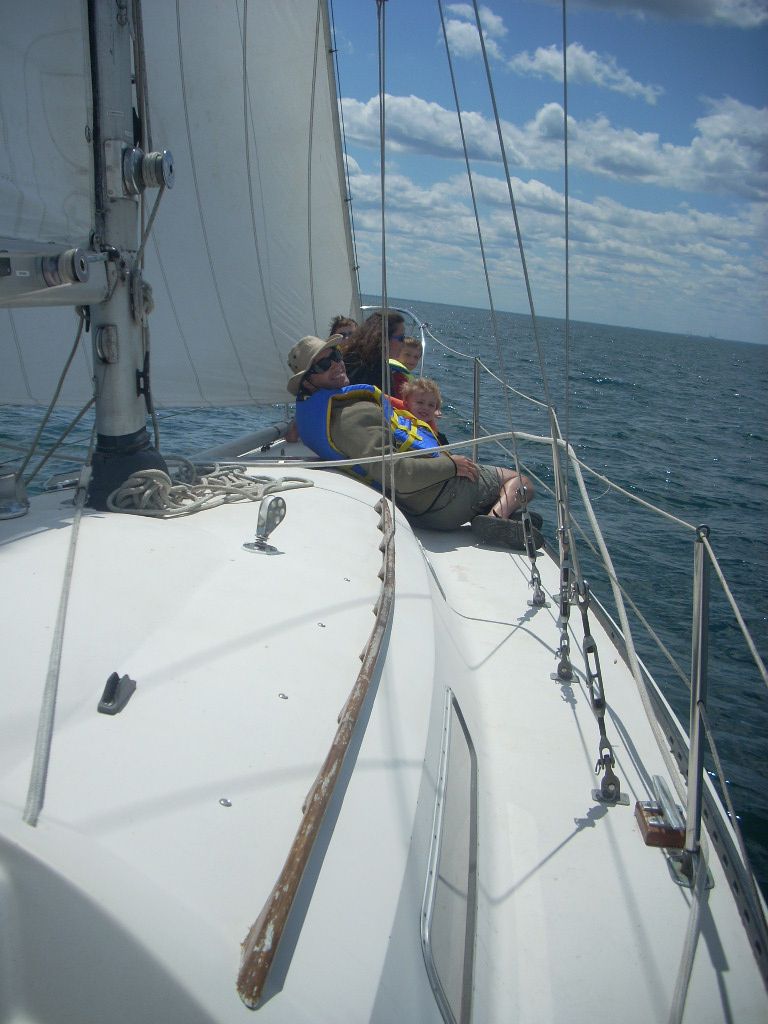
So with their two sons, ages 5 and 3, along my son, who is seven, that made four adults (including my wife) and three little boys on a day with occasional 25-knot gusts...I'm glad I set the No. 3 jib...

HEY, LOOK HERE!


NO, BACK HERE!


Yes, those are my boys!


We had a great four-hour sail and got back to find that the boat in the slip next to us had been blown into our slip trying to dock! Anyway, after a quick 180 to kill some time while that got sorted out, everything went smoothly (we were blown on our dock, after all), and the reason I'm posting these pictures is that the two smaller, blonder boys are having their first sail EVER in these pictures, and the five-year-old described getting sprayed on the bow by the occasional wave as "AWESOME!".

I find it odd that my son is the oldest boy at seven and that he is casually using terms like "go aft, and go down below, and get my Star Wars toy from the port settee berth" quite casually. He also hops around the deck like a monkey and took a crack at helming yesterday. He can almost see over the cabin, and is starting Optimist junior sailing for the first time in three weeks.

2009-07-09

The realities of self-rescue on a sailboat

The little float coat is sort of cute, until one contemplates its intended use.


My wife recently returned from a delivery (see previous entry below) and stood a few midnight deck watches. I was insistent that she bring a tether and harness from the currently beached Alchemy as I really feel it's important to stay with the boat. And yet various technologies aimed at the recreational boater seem, in my view, to foster a false sense of security by implying that transmitting a GPS co-ordinate or a homing signal from your person to a boat or a satellite is going to keep you alive.

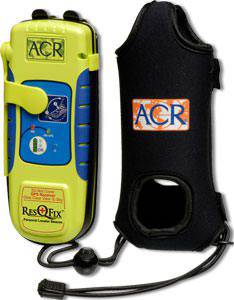
While I would certainly place these location devices in the "better than nothing or a waving penlight" category, and while I bought an ACR ResQFix personal locator beacon (PLB) in 2007 for myself and my wife once we started to crew for others in salt water, I try to avoid subscribing to the illusion that the danger of falling off a moving sailboat away from land is somehow now less dire a prospect than Captain Ahab going for a whale surf.

PLBs are meant to assist SAR personnel to find you. EPIRBs are meant to assist SAR personnel to find your boat or your liferaft. The increasingly popular SPOT Messenger Service seems a weaker version of either, but can be used to track movements.

The "self-rescue" systems I find quite specialized are exemplified by the Sea Marshall brand whereby you have a short-range locator beacon on which a shipboard direction finder can zero in.

http://www.seamarshall.com/

I can see divers, oil rig workers, trawler deck crew and the military really going for these devices. A cruising couple, not so much. The trouble, as I see it, is that these stand-alone systems are really expensive, and the situations in which a sailboat can effectively self-rescue a crew are typically few. Picture a cruising couple on a downwind run in a gale. A preventer line parts, the boom crash gybes, and the PFD-wearing...but untethered...husband is knocked in the head and right over the lifelines. The beacon is activated hydrostatically, and the husband's PFD also inflates.

Now you've got a guy in 20-foot waves with a head laceration, perhaps a cracked skull, very dazed or totally unconscious, in the water. He isn't sinking, but he isn't swimming, either, nor can he more than reflexively keep his head out of the water and the breaking spray, so he might drown in his PFD anyway. Knowing exactly where he is makes him no safer at this stage. Far better he had stayed on the boat in the first place. This may seem self-evident, but like the old saying about "don't get into the life raft until you have to step up to it from the boat"...implying that a half-sunken boat is intrinsically a safer place to be than a fully functioning life raft...a lot of people seem to think that gadgets will save them, instead of just marking the location of their corpses.

Back to the scenario: The wife is hypothetically a great sailor in her own right, but she has to bring the boat about in a gale and sail or, more likely, motor directly into the wind in very challenging conditions. She is alone, distraught and fighting to keep a course. Nobody falls off in calm weather at noon within shouting distance, do they?

Then what? Motoring in heavy seas next to an unconscious floater is a good way to kill him off entirely through blunt force trauma from the hull or by beheading him with the prop. I haven't even got to the idea of dislocating his arm on a fast-moving "rescue line" or taking out his eye with a boat hook...assuming you ever get that close...and has he regained consciousness yet? This is assuming you can even keep him in sight...I hope that PFD has a strobe! Or that it isn't blackest night...

My point is that finding someone, even someone uninjured and conscious, is no guarantee of getting them aboard a sailboat in heavy weather. Few autopilots are going to work predictably in such conditions, and the boat itself can become very dangerous going to weather.

If the water temperature allows it and one is sailing coastal, the odds are better to let SAR handle it, in my opinion, but I believe the best option is to tether on religiously in any situation in which you are unlikely to have another crew save you. That means "much of the time on passage", unless motoring through a calm.

Airbags didn't replace seatbelts, nor do they permit terrible driving. If you work from the baseline that falling off a moving boat is a potential death sentence in every instance, you may invest less in "spot the corpse" technologies and more in behaviour modification on deck.

2009-06-23

Tackling anchor opinions


Here is a reasonably clear photo of Alchemy's anchors and the bowsprit rollers from which they are deployed and on which they are stowed. Basically, I'm on land this year (see previous posts), so they aren't deployed for any reason other than I don't want them on deck and I am clearing out the forepeak "workshop" for painting and modifications. They are currently a 33 lbs. CQR and a 45 lbs. CQR, appropriate for Lake Ontario and the ground conditions here. I carry some 200 feet of 3/8" chain and 300 feet of 1 inch nylon rode at the moment, but will go "all chain" before we leave, and after I install our Lofrans Tigre manual/electrical windlass.

Anchoring as a technique and anchors as devices are among the most divisive topics in cruising. Advocacy of one anchor type over another is quasi-religious, and the manufacturers of new styles of anchors, such as the Rocna, the Manson Supreme, the XYZ, the Raya, the Bulwagga and so on, make fairly aggressive claims, probably in an effort to overcome the generally conservative mindset of sailors for whom the Bruce anchor was a goddamn newfangled devil's hook back in the 1970s. Given that the 1930s-era CQR and Danforth anchors are still in the majority of cruisers (or so it seems), change comes hard to the world of recreational boating.

Those of us who see the current "star" anchors, the Rocna and the Manson Supreme, as functionally equivalent are learning a lot about the "special conditions", such as mud bottoms, that may be a factor in deciding to buy it. Now, we may never anchor in in the Chesapeake, but I can certainly see anchoring up river deltas, and this information is good to have. Also, there is a lot of auxiliary information about rode twist, the use of swivels and snubbers and bridles and kellets and floats, etc. that is great and essential information. I recommend, if I haven't already, Earl Hinz's The Complete Book of Anchoring and Mooring (http://www.amazon.com/Complete-Book-Anchoring-Mooring/dp/0870335391) as a great reference. Next to going out in heavy weather and seeing what holds you, mind.


To my mind, a coastal cruiser, unless mainly on the hook as a matter of course, is liable to have one main anchor and one "lunch hook", like a 20 lb. Danforth, say, on a 35 foot sailboat, unless local bottom condtions or powerful tides and currents dictate going "big" all the time. Such sailors must decide for themselves if the newer generation of anchors is appropriate, or worth the pretty steep cost or the sometimes onerous task of stowage (the newer anchors all seem quite large and awkward, if frequently less heavy than their older equivalents).

For me, readying for a circ, the situation is more ambiguous. I will carry perhaps five anchors in total, with two on the bowsprit and one at the stern "deployable" at any given time, and two in reserve for unusual conditions, like rocks or weeds, and as spares. Obviously, I will tend to have a "main" and it will tend to be larger, as the boat is going to be 34,000 lbs or so fully loaded, and I will tend to favour "one size up". So I am very much in the category of wanting both superior holding power and quick resetting. One way or another, I am likely to buy a largish, and quite likely a newer design. I will also use a bridle, snubbers and adequate, all-chain rode. Because I will have the capacity to carry it, I will have the tendency to deploy any and all means to aid whatever anchor I use to the best of my ability to accomplish the task of keeping the boat where I want it to be.

But I sure as hell won't be chucking my CQR or my Bruce. I know they work, and I can see in a protected or a calm situation just chucking them over with a rope rode because it will halve the time I spend retrieving and stowing them later. It's called a "main" anchor (formerly "best bower", I suppose!), but that doesn't necessarily mean it's the ground tackle most commonly deployed, at least aboard a passagemaker.

Anchor tests, of which I have read quite a few to this point, are a different beast. The "modern" anchors always seem to shine here, because they dig in so well that they don't break free until some truly awesome force (as measured by dynamometer) is applied.

I suppose if you are anchored in a wind tunnel, this is a meaningful test. But straight line pull tests are as limited as "gas mileage" tests...they never replicate the real, dynamic world!

Is the "best" anchor the one that holds fast in a situation that never occurs, such as a straight line reversal?

Or is an anchor that perhaps breaks free sooner in a straight line, but holds (and resets) quickly in a dynamic situation better?

Most anchoring most of the time is of the casual type. When an anchor fails this test, it's news. The sort of anchoring that is critical, such as during a prolonged squall with a wind shift, is less common, and one would hope that the anchor choice, if not the absolute best available, is picked at a weight, scope and known ability to reset after undergoing a jerking, shearing load such as a squall or a gusting wind shift combined with a confused sea state can produce.

All anchors can hold under the right conditions, and all anchors can fail under severe conditions. Certain anchors on certain bottoms are known to skip or otherwise fail to reset if broken free. This is why I don't know why I see really large Danforths, because I associate them closely with the "calm water/lunch hook" concept, but presumably in some bottoms they hold well enough and the folding aspect is attractive.

But there are still no shortcuts and no magic bullets.

I think that some of the newer designs have great promise and are continuing to build reputation based on real life use, not marketing and frankly not nearly useless tests of high artificiality. The suitability of the newer designs, however, does not render the older, proven models (Bruce, CQR, etc.) useless, ineffectual junk. There are cases for carrying them, I still think, and I am as yet unpersuaded that there is "one" do it all anchor. There may be one "do most of better, most of the time, in most of the bottom conditions, when sized up and bridled"... and we have two years to make that determination.

Speaking of anchors, I read a fascinating pictorial set in Antarctica in which the inventor of the Rocna anchor went for a pretty impressive cruise: http://www.petersmith.net.nz/photos/antarctica-1.php

His boat's about 10 feet bigger than ours and is aluminum. It looks pretty bloody capable and I'm going to steal some ideas!

Adventures in the Gulf Stream and the Repair Bay

The Ontario 32 Veleda IV at anchor. Photo (c) http://www.veledaiv.ca

You know, I've read that while hundreds of thousands of people cruise coastal waters and live aboard at dock or mooring, the number of people actively on passage (or preparing to do so) from a given area at any one time is quite low.

The Millards on Veleda IV ran into Ken and Lynn on Silverheels III (friends of ours who went a-Bahama-ing last September) as they were preparing to head to Chesapeake for the hurricane season. Ken and Lynn forwarded the Millards' call for crew to myself and Mrs. Alchemy, knowing we were looking for "real" sea hours for both the experience and to qualify for stuff like the RYA. As I've followed the Millard's blog on and off for years, and as Judy was once my dentist (more small worldliness), they were a semi-known quantity. They were also quite involved in the local Power Squadron, and Aubrey's ex-Navy, so they can be reasonably assumed to have a high degree of seamanship skills. It turns out that Judy damaged her knee falling off a Caribbean scooter, and while she got back to Toronto and a summer of healing all right, her husband needed crew to get their boat back to Canadian waters.

So it was a good fit. I would've gone myself had I not been working and had the delivery been a week later. But I understand that "a week later" at the beginning of hurricane season is a throw of the dice, and so my wife left May 31 in the dark for a somewhat haphazard series of increasingly "island time" flights to Eleuthera, Bahamas.

I think what can be learned from this for anyone seeking to be delivery crew is that crewing opportunities can arise quite quickly (particularly the juicy downwind ones with the Gulf Stream adding a few knots in the right direction!). One has to be flexible and should have a bag packed and one's papers/travel documents/inocculations must be in order. When the call came, my wife was unemployed at everything but being a mother and renovating the house for tenants (not minor in terms of work, mind you!), and I work from home, so we had the option with only minor adjustments to seize at these opportunities.

Others would have to schedule crewing during holidays or unpaid leave...this is less attractive, naturally. For us, it means the floors won't be redone until July...but that was well worth a thousand sea miles of experience in the Atlantic.

Well, it didn't quite turn out to be a due-north dash in the Gulf Stream for New York City, but such, it appears, are the ways of the sea.

After (eventually) getting to the boat in one piece, my wife awoke the next day to the beauty of the Bahamas, a place she's never been (nor have I):

What is it? Dunno, but it's a nice shade of blue.

Now, S/V Veleda had been out for 11 years, and some of her bits and pieces are original (over 30 years). This becomes important later on. Just before the boat was going to jump off into the Atlantic, the boom broke due to corrosion at the boom bail. Undaunted, the skipper set course for Florida (and a new boom) under an assy spinnaker and a poled-out genny.

Crap to windward, but acceptable aft of it.

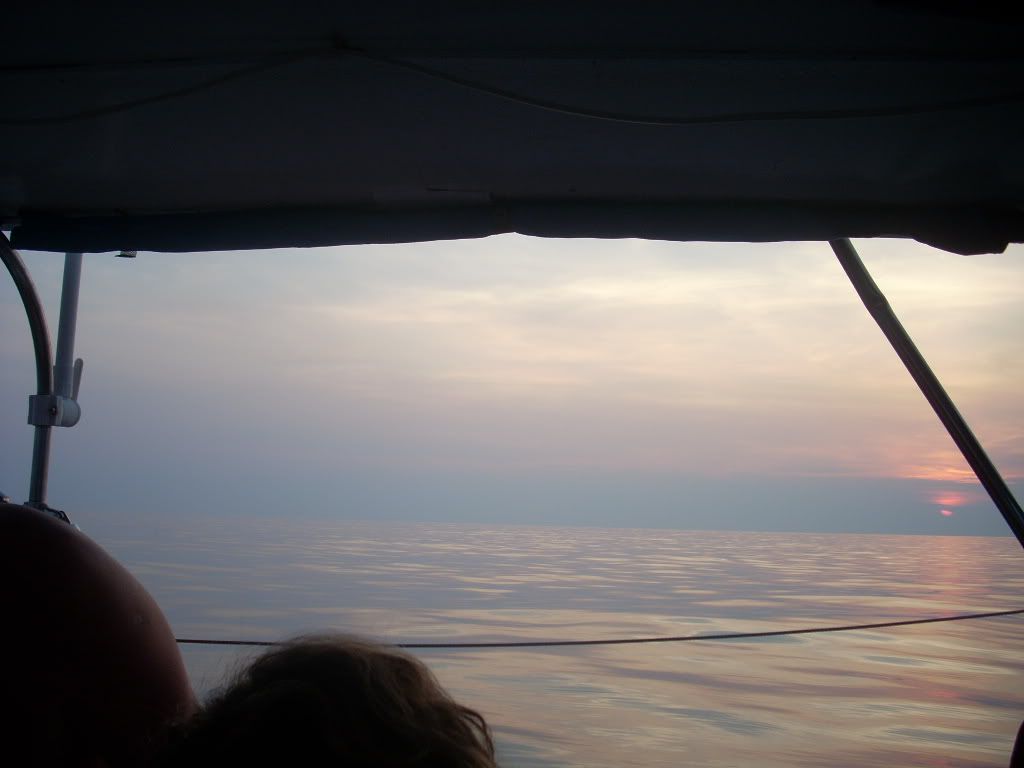
The three-day passage gave Becky (aka Mrs. Alchemy) plenty of watch-standing experience and the chance to see some of the typical Floridian summertime weather.

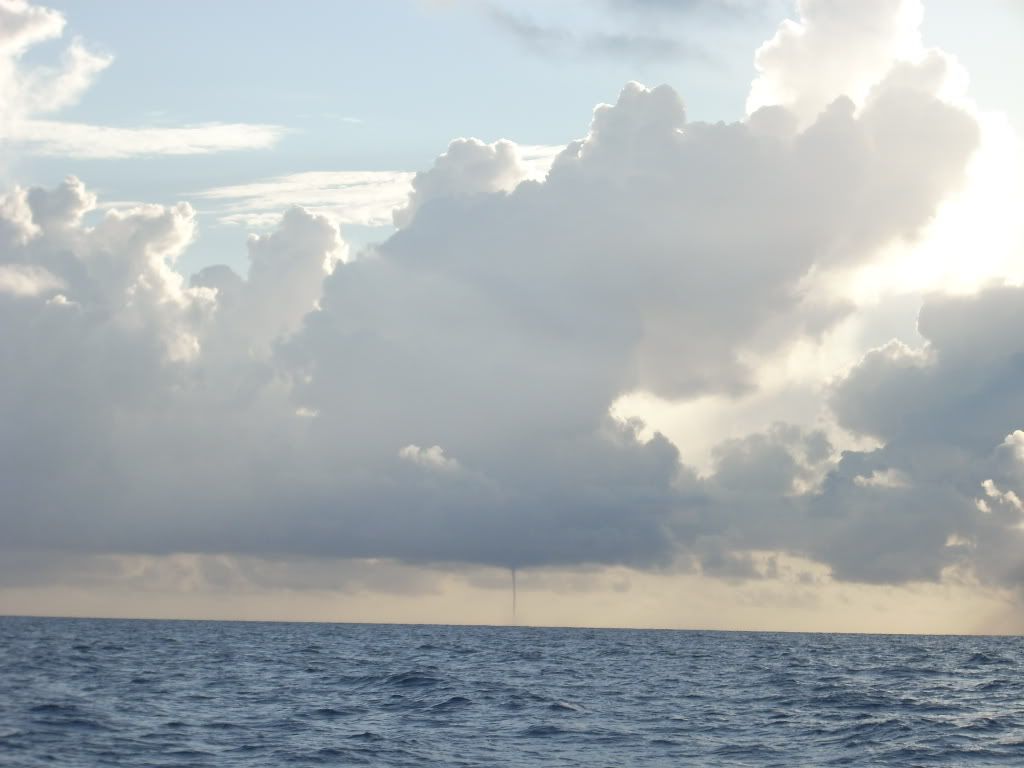
I've seen a single waterspiut. Apparently, they are a near-daily thing in this part of the sea.
After time spent in Florida waiting for the repair gods to smile upon their enterprise, they had the new boom "professionally" installed by a rigger who, finding their gooseneck slightly narrow, broke the casting.

So down went the uninstalled boom, lashed on deck, and up went the two headsails again for a trip north.

After that, the one-year-old fridge quit, and the bilge pump failed (turned out it was just clogged). Then the propshaft (a mere six years old) broke, killing all forward propulsion.
Chart capture (c) Wally Moran

Then the freighter came when they were engineless and becalmed...in the rather difficult approach to Charleston Harbour.

We're renaming this vessel "Bob".

But everyone (after a pricey "Sea-Tow") eventually made it into Charleston safe and sound. There Veleda sits, on the hard and awaiting some further repairs before heading for NYC and the Erie Canal in about a month's time.

I think the skipper needs some R and R from his "retirement"! He's back in Toronto now, but will get the boat back in the South Carolina waters shortly.
Becky learned a lot despite (or because of) some of the equipment mishaps, and found the whole experience of great benefit looking forward to our own trip. She also had few problems with crew rotation or standing watches (the lightning at night helped to keep her awake) and having seen some fairly swampy parts of Florida, the flashy montages of CSI: Miami are no longer persuasive.

So I encourage prospective world cruisers to crew, because your education will come in many forms, all of which will likely bear fruit in your own adventures.

2009-05-25

We who are about to shop...


The nice people at Integrated Power Systems (http://www.ipwr.net/cms/) in British Columbia seem to be on the ball when it comes to helping me make purchasing decisions, so I am forgoing "cheapest" for "seems to have experience and knowledge I lack". Because I am making decisions that have to stand for the duration, one hopes, of a multi-year cruise (ditto), I remain, while not averse to price points, not entirely focused on them, either.

Now, all this unaccustomed fiscal splashing about is happening because I appear to have a welder who wants to weld (yes, incredible but true), and who has already been aboard and has already had a constructive idea or two about how best to bang together Alchemy's Arch of Sunny Amperage. But, he said, and I understand why, that in order to get the curves right, he needs an example of one of the solar panels (http://www.renewableenergyworld.com/rea/partner/products/view?id=22399&cid=1786) in question (see picture above).

Well, shipping is expensive. Why not get a bunch of stuff now and assemble as we go?

After some 1-800 discussion, the fellows at IPS are recommending four of the above panels, a MPPT controller called an Outback FM-60 (http://www.outbackpower.com/products/charge_controllers/flexmax/#) and a multi-function monitor for the battery banks (yet to be purchased) called a Bogart Pentametric (http://www.bogartengineering.com/pentametric.htm).

Throw in various cables, clamps, connectors and shunts and a lot of installation and we're well on the road to energy independence.

I won't even get into the money I'm spending, but anyone who owns a boat will have gotten used to the "rapid transfusion" aspect.

2009-05-05

Short take-off and landing


Because the pace of work this winter was slow due to my occupation and some prolonged and poorly timed (from my point of view) winter weather, we are staying "on the hard" for a year.
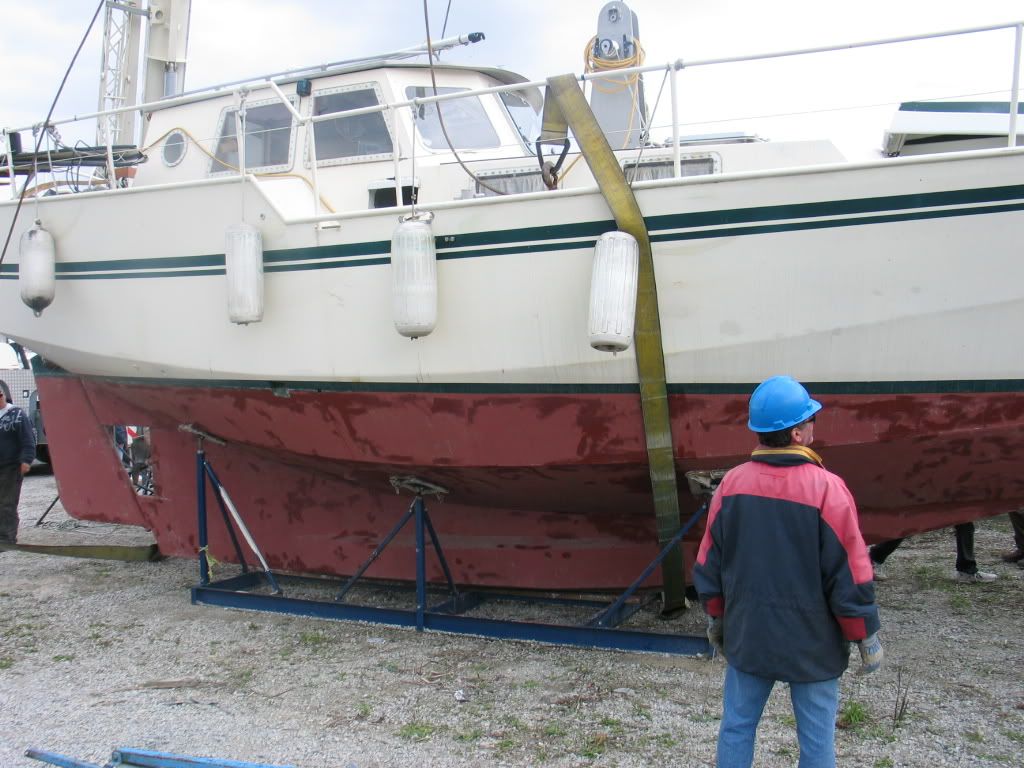
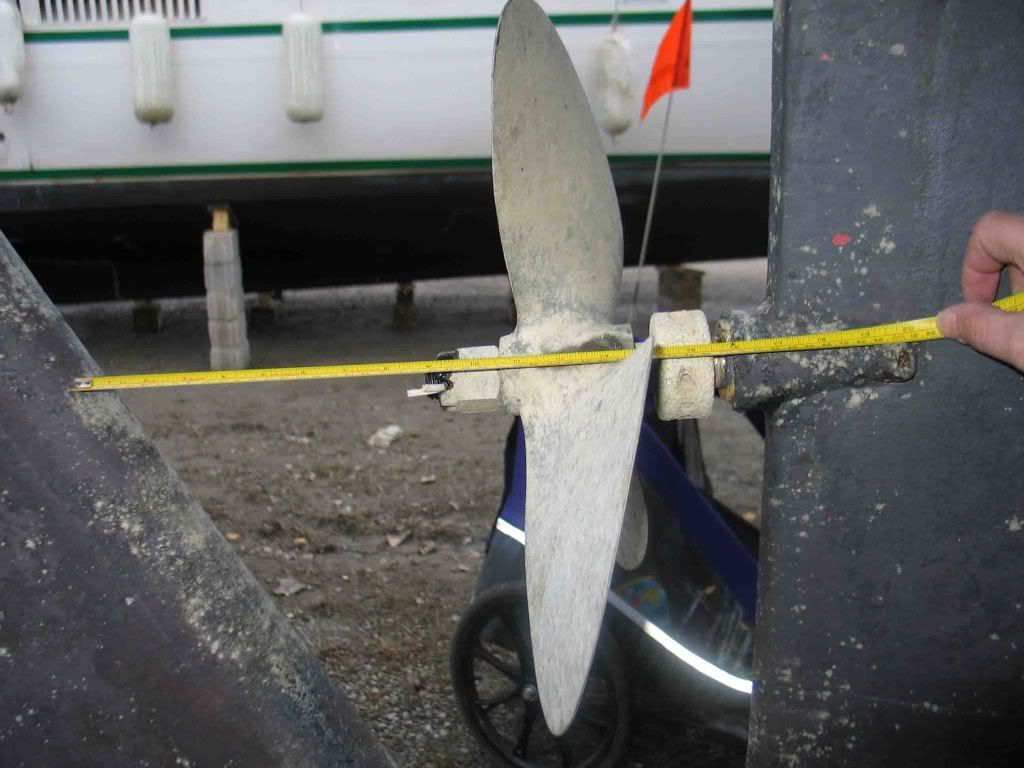
The decision to leave the boat on land is in order to do things like pull out the tanks, pull the prop, get lots of welding done and to rebuilt the aft cabin.

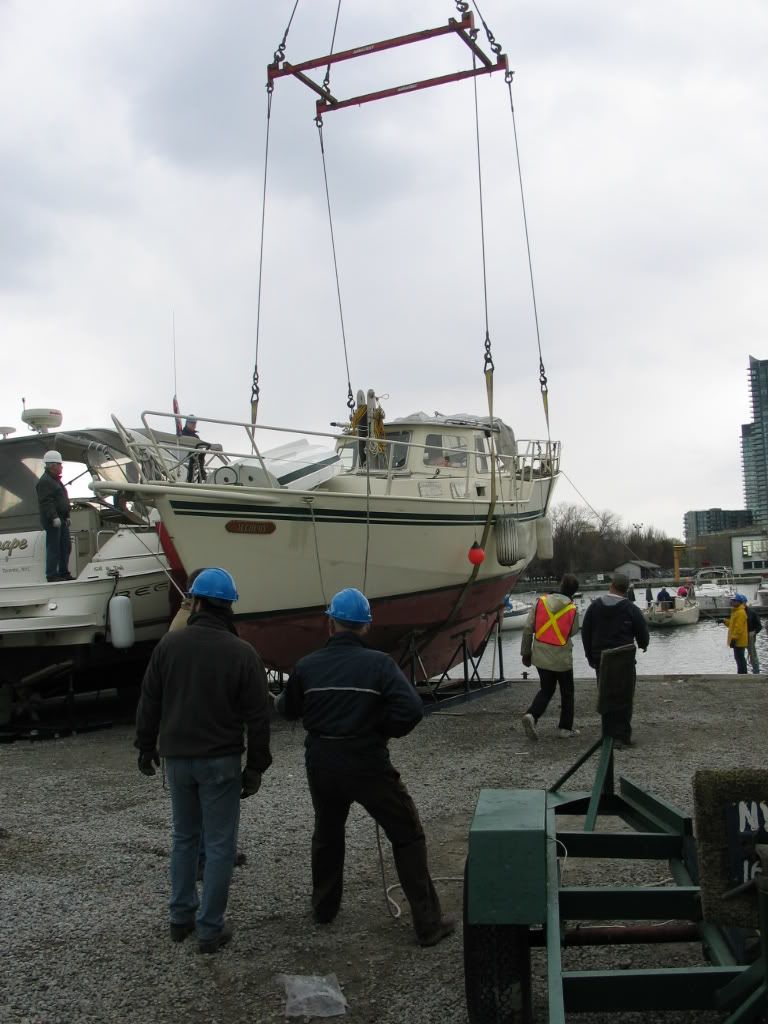
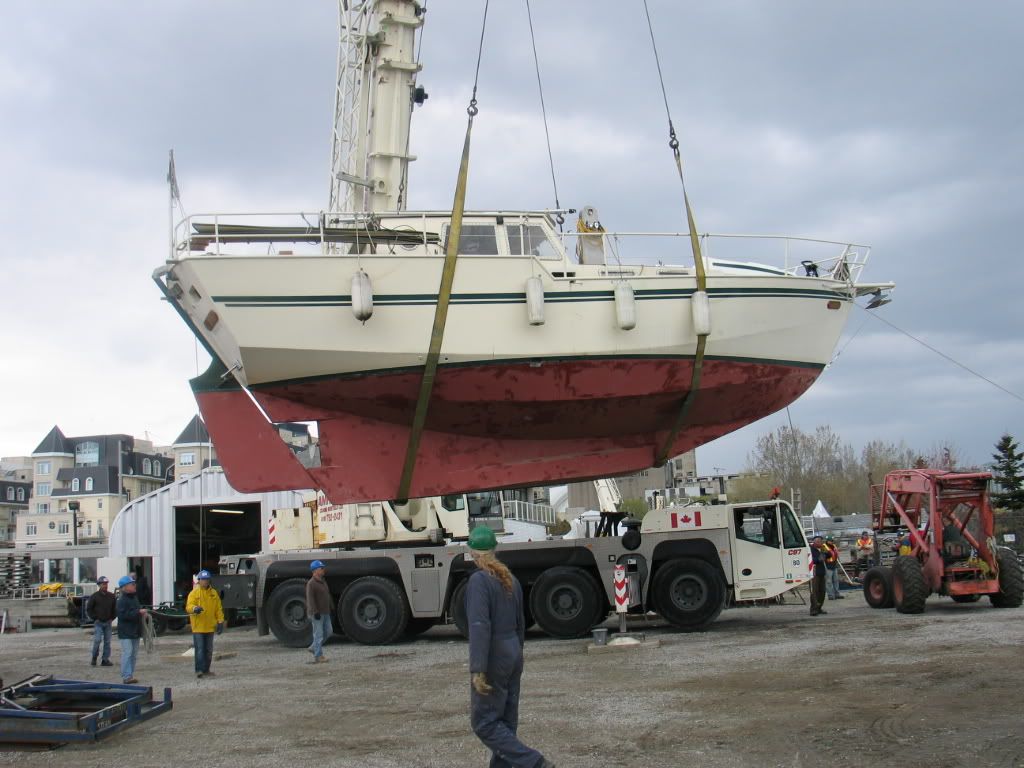
So on Saturday, May 2, instead of getting launched with the other 200-plus yachts in my club, I drove a powerboat on "safety patrol", in case someone fell off the seawall into the short channel that links Toronto Harbour with Lake Ontario, and then I got called to help move my boat. Did I help? I pushed the cradle a bit, but the 100-foot tall crane did all the work!

It took a little fine-tuning, but we put her down easily, and my stern has plenty of space in which to remove the rudder, pull the shaft and other manly tasks. You can find me in the yard...just follow the swearing that has an echo.

I'm very privileged to have access to a second boat for those days when it's just too nice to rustproof steel or figure out polarity...so I will get out sailing this summer. There's also a 10 foot nesting dinghy that requires multiple falling-out-ofs ... once the water is warmer.

Now I have to figure out how to get enough electricity aboard to keep the fridge running. I'm a simple man, not a barbarian.

2009-04-05

Does a skipper need to be a handyman?

Most sailors do their own maintenance and repair. This is usually because it is quicker and certainly cheaper to do boat jobs oneself, and the quality of hired help can be variable, to say the least. Another reason is that the sailing life, even that lived only after work or on weekends, favours the self-reliant person who fancies him or herself a jack of all trades. It's part of the independent-minded ethos of sailing, even though there are plenty of perfectly skilled sailors with more cash than me who happily delegate most maintenance jobs to a cadre of boat-fixing retainers.


If you are planning long-term cruising, however, having Joe Boat Mechanic on speed dial isn't feasible unless you're bringing him and 400 kilos of tools and spares along. If you don't know how to do basic maintenance, you're going to have a very expensive, and a possibly shortened and even a dangerous cruise.


I didn't grow up around boats, as my father stopped being a professional sailor (12 years in the British Merchant Navy) seven years before I was born, and we didn't own a boat. I went from utterly inexperienced boat crew to 33 footer owner between the end of May and the end of August, 1999. I promptly wrecked my Atomic 4 gas inboard engine by forgetting to open the seacock for cooling water, and so had to replace the engine. That involved a rebuild. A busted waterlift muffler convinced me I had a cracked block, so I rebuilt a SECOND Atomic 4 and put it in, as well as replacing the entire fuel and exhaust systems. While a rebuild shop handled the actual crankset replacement, I did most of the reassemblies, and had some help getting the second engine back in. I did all the fuel, exhaust, seacocks, batteries, electrical panel, instruments and plumbing stuff myself, as well as extensive glasswork (retabbing, core replacement, chip and crack repair), the installation of custom-cut backing plates, portlight replacement, and the usual sail and rigging work.


I can't fix instruments, so they've been sent out for repair (they are vintage Electromarine analog instruments, and I like them). This spring, I'll be grinding and filling a crack in the hull-keel join on my old f/g boat: I've never done this job, but I've done enough glass work to feel confident that I can do it.


All this would've been easier had I ever taken shop class or owned a motor more complex than a moped or a chainsaw, but theatre class was where the girls were, and at 14 that seemed a better idea. I have found that going from essentially total ignorance to semi-competent in my 40s, while hard at times, has been rewarding, and that going to a more complex diesel-powered motor sailer hasn't been quite the overwhelming challenge I had thought.


I have also discovered that other people have had the same nemeses as myself in the areas of exhaust venting, cooling and drinking water, and some electrical issues. I have also been surprised to find myself giving semi-valuable advice, because after a number of costly or embarrassing errors, you either improve or take up lawn bowling. I am sure from direct observation that my awareness of my own deficits in not having a long sailing history have made me more safety conscious on the water, and I believe I am more strict about the various rules and good habits that a lot of the "veterans" of my acquaintance. Having a young boy aboard also helps to keep habits like "PFD on deck" going, as well.

The next step that will more or less complete my maintenance ambitions is to learn basic (stick) welding to do minor repairs, and to formalize my diesel and electrical maintenance skills via courses, and to learn to dive, as I think a diving certificate and a willingness to get dirty cleaning hulls and unfouling props would not only help me keep our boat clean and functional, but might be a way to make some money for the older or less-capable cruisers who might be great cruisers, but lack the equipment or the strength to clean hulls while in anchorages.

A codicil to this paean to self-reliance is knowing what jobs to avoid, or which jobs one should parcel out to service people or installers because it would be easy to screw up. The welding together of my solar panel arch and bimini, for instance, or the welding of my new battery compartment frames, or the welding of my thrust bearing, or the construction of my new HDPE water tanks, I will leave to others. I will also have the hull blasted down to bare metal and professionally recoated with zinc, then a barrier coat, then an industrial marine paint, plus a hard tropical anti-foul. I can do those things, and do them on my Lake Ontario boat (where it doesn't matter much), but for offshore, I want the best possible job, and I can't do the best possible job...nor do I particularly want to learn. But I will spec out my preferred products, and obviously, with a steel boat, I am quite familiar with scraping, chipping, priming and topcoating little areas of concern.


It's been an interesting ten years. Certainly, it occured to me last winter as I was servicing the circulating pump on my home's hot water radiatior system furnace that it was pulling apart a series of Oberdorfer, Sherwood and Flojet pumps and various head plumbing pieces that gave me the confidence to do a job I would've paid someone else to do when we bought the house in 1998.

So the painful part of learning previously non-existent skills has been positive, and I still possess an even number of fingers, even if I now sport some minor scarring. We get to sail.


2009-03-25

Wood I? Yes, Probably


Something different this time.

I stumbled upon this via an innocent search for a "dutch door companionway" in Google. I was trying to explain to a guy online why I thought washboards weren't the way forward for us on the ocean.


I hit this:


https://www.yachtworld.com/core/listing/boatFullDetails.jsp?boat_id=1983580&checked_boats=1983580&ybw=&units=Feet¤cy=USD&access=Public&listing_id=74772&url=


It's like my boat as a double-ender in wood crossed with a ketch. It's freaking gorgeous and suspiciously cheap. There must be a fatal flaw (like sailing like a drunken pig?), because it looks like a museum piece, not a 14 year old ketch.

I like it very much. So must the owner or the broker, who have provided 97 photos in the ad. I hope she finds a good berth and a fine skipper.

Don't get me wrong. We love our steel cutter, and I love seeing other people owning wood boats (and never sailing them because the varnish is never dry enough), but there's room enough in my heart to appreciate a beautiful work of craft and art, and that's a lovely vessel.

2009-03-24

The future of sailing is staying tied to the dock


A wise fellow on a very good sailing forum I frequent mused upon the future of recreational sailing thusly "And so as I thought about this discussion, and the state of the world economy, I began to wonder if sailing is doomed to continue to decline as living standard expectations add so much to the cost of a boat that it prices more and more of the population out of the marketplace? Or will the next generation of young family sailors be willing to keep it simple, and take advantage of technology improvements that allows better boats than we ever had 50-60 years ago to be produced at comparatively affordable prices?"

I think perhaps not.

The context of the question was a gathering in which various production boat designers were floating the idea of a Folkboat for the 21 century. The Folkboat, for the unfamiliar, was a small (25 foot), Swedish boat of World War II vintage motivated by the same ethos that built the Volkswagen in Germany: make it cheap enough and simple enough...but fun enough and safe enough...to get people into sailing. While they are still being built today in wood and plastic (there's a nice one across from me at my club, in fact), they are pretty Spartan, two-bunk affairs that have all the amenities of a 1950s assault on Everest, which is to say a bucket for sanitation and a gimballed butane burner for stew.

So if you built a smallish, simple boat today that incorporated modern rigging and hull forms, sailed fast but was conservative in terms of seakindliness and could take heavy weather...a sort of Super Shark...would people line up for it if it cost fifty grand?

Probably not. People love their gear, and you can't fit the means to create gear's electricity needs on a sub-30 footer easily. You also can't fit an inboard engine so well, and an outboard in a well is going to seem somehow declasse to the prospective boat buyer, who will want to turn a key and start moving.

Cynical sounding? Consider camping. Camping used to mean hauling about 30 pounds of gear low on your back and hiking 20-30 miles out from the nearest road using a compass, woodcraft and a canvas pup tent. You would cut the poles at the site.

Now it involves putting up a "dining tent" next to an SUV and trying to get the Honda genset far enough away not to hear it while it powers your Koolatron and the kids' videogames or DVD player.

Back with sailing, I believe that the desire to replicate shore life aboard a production cruiser, with the emphasis on electrical appliances and conveniences, has to do with the increasingly meagre skill set of the modern urban dweller. It's not a matter of being unable to splice, hand and helm...a lot of people today break into hives going beyond cell phone range.

I took OUT a lot of the aged plumbing on Valiente, my '73 boat, because a barbeque with a 1 lb gas bottle on the rail and a campstove in the cockpit trumped a funky alcohol stove in the galley...and weighed less. The head works, but you wash your hands in a sink filled from a bucket, and you drink from a container or a square bag. Big deal. We daysail that boat, and if we cruise, we can pull in to a dock anytime I think I've got too much money on my person.

I'm keeping it simple on Alchemy, our bigger, newer boat as well. We'll have refrigeration, but just about everything else save a couple of big bilge pumps will be muscle-driven, including a big backup bilge pump. We'll have LED lighting, RADAR and pretty sophisticated chartplotting and systems monitoring, but also oil lamps for drying out the boat and (as we know from sailing in Toronto) taking the chill out of the air. Also, the systems being monitored will be deliberately simple and will rely more on math and "dipstick backup" than sassy glowing displays. Again, not so much a Luddite impulse as the certain knowledge that stuff breaks at sea, and the less time I have to spend scraping and soldering when I have a manual or common-sense option, the happier I will be. I will inevitably be doing this stuff anyway, but I don't need the helm to look like the deck of a spaceship in order to know we are sailing.

I think my attitude stems from this belief: The key to replicating one's shore life aboard is to live a simple life on land. Then the transition to "the cruising lifestyle" isn't as jarring, and the opportunity to learn other skills (I'm still a crappy splicer, but they stay put!) is enhanced. In our urban house, we just don't own a lot of appliances, A/C, "entertainment centres", and so on. Part of that is because I don't choose to spend money on annoying, poorly made crap, but the other part is that we had better be a bookish, handy and skilled family at sea, because "movie night" aboard is going to be a treat, not a nightly occurrence. So I spend time checking out the latest digital radars and manual coffee grinders from Lehman's (http://www.lehmans.com/), the place the Amish get their kitchen gadgets and a wide range of stuff that doesn't need batteries.

I don't see a lot of people willing to disconnect from their gadget-crammed modern life (which I can understand has its attractions) to reconnect with something like the sound of a five-degrees heeled boat in 11 knots of wind chuckling its way through the water. A lot of young people today are confused and bored by the natural world, having never grown to appreciate it.

Go to Niagara Falls, or the Grand Canyon, or some other "beauty spot". What do you see? Hordes of people staring at the "attraction" through the two-inch viewscreen of a digital camera or a camphone.

People want mediated experience. Sailing is very direct. Once underway, you can't easily switch it off and go play with your XBox. I am not sure today's youth has the attention span for it....

...which is precisely why I am taking my son to sea for five years. Come hell or high water, after standing a few hundred watches, he'll have the concentration of a Zen monk, which should stand him in good stead as he comes to manhood in a world full of scatterbrained stimulus junkies. I don't think that a Luddite impulse so much as a critical assessment that certain trends in our society are not entirely positive, and that an alternative upbringing, one which exposes a child to different, more self-reliant ways of living have merit and are worth the work my wife and I are making.

I nearly wrote "worth the sacrifice", but who am I kidding? What will we miss? The opportunity not to get raises for the next 10 years?

2009-03-18

Cutting-edge sailing

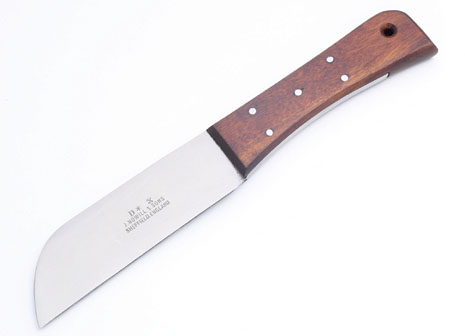
The traditional "sheepsfoot" fixed blade

These are frequently on sale and make nice sailorly stocking stuffers
Proper rigger's knife with small marlinspike (or "marlinespike").
Some people wear a belt while sailing not primarily to hold up their pants but as a place to support the various gear sailors favour, such as a flashlight in a cloth holster, maybe a submersible VHF, or frequently a cellphone or CrackBerry-style device (for those skippers who have to give the impression they are at the office). The most common accessory for the wind-pushed crowd is a knife of some sort.

The risible thought is that we sailors are all so hopped up on grog and old hemp cables that we are prone to gang-style shiv fights, but the type of knives usually carried by sailors on deck aren't even pointed (look up "sheepsfoot", a Scrabble-winning word, as are most nautical terms). They are usually sharp enough to rapidly part a tensioned line, however, and the best are either straight or are folders able to be deployed one-handed. This is important in the context of, for instance, freeing oneself from a line that is dragging one underwater...you might need the other hand to attract attention or to maintain some kind of proximity to the surface. Sailors' knives will often feature a regular ground edge and a serrated edge for a rapid sawing movement; some full-blown "riggers' knives" have marlinspikes for splicing and little tools for dealing with turnbuckles, split rings or pins and other fiddly objects aboard.

I didn't always carry a knife while sailing, but now I always do. I carry cheap knives because I lose them, but I keep them fully sharp and completely functional while they are in my customarily brief care. I will probably buy one of those fabulous, hundred-dollar riggers' knives before we leave, but I'll want a Dyneema lanyard to keep it attached to me.

As to why I now always have a knife: About the second year I had my first boat, I was single-handing in fairly brisk wind off the land, so there was only "nervous" seas, but plenty of air. The boat was sailing nicely and I had the tiller pilot on.

I stupidly (the adverb that precedes "experiencedly") went down on the lee side to retrieve dunked fenders as the boat started to cross an open estuary, and the wind was funnelled there to much higher speeds (I suspect 40 knots as it was already 25-28 knots). I had on neither tether nor PFD nor handheld radio, and we were welll knocked down, with the cold October water of Lake Ontario up to my hips. By arm strength alone, I crawled up to the coach house traveller and managed to release the mainsheet, which flew out with such speed that it took part of the flesh on my fingers with it (Yes, now I wear gloves, as well!). The boom went out and the boat found her feet, and I spilled air until I could tie up my hand and continue. The autopilot had simply been overwhelmed at that point.

Had I a knife on me , I might have had the option of cutting the mainsheet instead of releasing it from an awkward "too close for comfort" position. I had plenty of line on board to rereeve the blocks and to get back to sailing.

A couple of seasons later, after I started to carry a knife, we rounded a sheltered point with an old No.1 genoa up and again, the wind went from 8 knots to 22 knots very quickly. The leech line of this sail hooked on a spreader end, making it difficult if not impossible to douse (hank-on sail with no downhaul). Going off the wind didn't help...the leech line was somehow hooked deeply into the spreader end (yes, I now tape off the spreader ends.)

Once the sail began to rip, I got out the knife, told my seven-months-pregnant wife to "feather the main close to head to wind" and stood on my toes to cut the leech line. I was then able to drag the mess down and we sailed into our basin under main only.

I have also cut off a piece of trailing line that threatened to foul a moving prop, but that was on another boat.

As can be seen, inexperience or lack of anticipation led in part to bad situations, but there's a place for a small, sharp knife on board any boat, I think, and now it's habit for me to carry an inexpensive sailor's knife (serrated edge) on my belt, plus an inexpensive multi-tool. I use the multi-tool far more often as I am forever tightening bolts or screws or other fasteners both above and below deck. I go "inexpensive" because it's not tragic if a ten-dollar knife or multi-tool is sacrificed to Neptune.

I am aware that slicing a loaded line brings its own issues, but I still believe that lines are cheaper than limbs, and sometimes you have a need to cut away a line to save limbs, life or more important parts of the boat. The idea of disposable "lashings", small stuff you can slash with impunity to free it from a secure state, depends on having a very sharp knife and being able to deploy in in a dynamic environment without hurting yourself.

I find the cheaper sort of divers' knife can be mounted on nav station or companionway frame for retrieval in passing, should you have no pants on. Seriously.


If you have a steel boat, it's easy to have them magnetically stuck to things a sufficient distance from the compasses. I have one by the companionway and even a hand axe under a locker lid. I also carry pretty beefy chain cutters in case I have to neuter a whale.

A friend who dives and also owns a steel boat has a pretty serious dive knife mounted next to his companionway steps so that he can grab it and unsheath it with his trailing hand as he hauls himself into the cockpit, so it's not so uncommon a practice.
The inherited knife is very much like this.

My favourite knife is a pretty utilitarian Solingen blade with a leather grip. There is nothing at all remarkable about it except that it belonged to my late father who wore it as a merchant seaman for a number of years in the 1940s and 1950s. This knife was used to cut out a tooth from a sperm whale (yes, they were different times...), which I also have, along with an excellent example of Carl Zeiss 7 x 50 binoculars my dad picked up in post-war Hamburg for a pittance, apparently advertised as "U-Boot Kapitan Glasses". And thus concludes today's pointed remarks.